Moderate
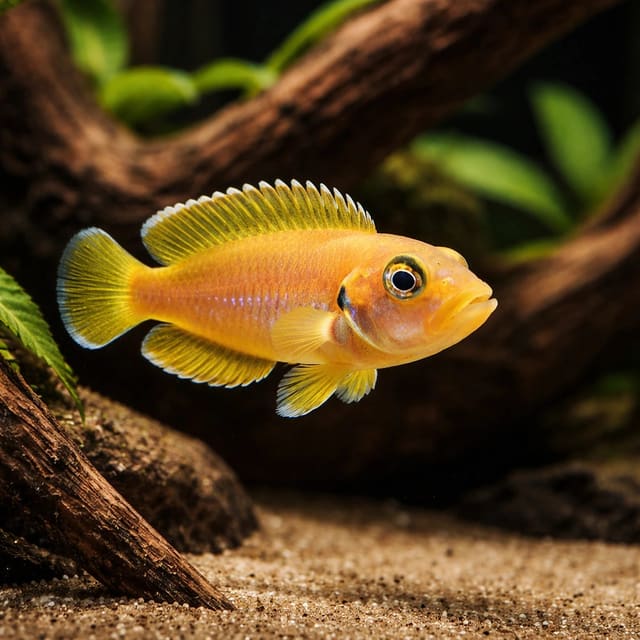
Gold Ocellatus Shell-Dweller (Neolamprologus ocellatus)
23–25°C · pH 8–9
£16.59

The Black Pearl Calvus (Altolamprologus calvus) is a Lake Tanganyika cichlid endemic to the lake’s south-western region that reaches 13.5 cm. It suits established rocky aquariums kept at the 24–25°C, pH 8.0–8.6 and 12–18 dGH overlap of FishBase, Seriously Fish and OATA’s African lake cichlid group guidance. Sold individually at 3–4 cm.
Adult size is the maximum length this species reaches at full maturity (scientific sources). The livestock you receive will be younger and smaller. Product-photo provenance and any image-specific limitations are stated on the listing.
Altolamprologus calvus
Save when buying multiple fish. Each quantity is one fish; sex and pair formation are not guaranteed unless the selected variant explicitly states them.
The Black Pearl Calvus (Altolamprologus calvus) is a Lake Tanganyika cichlid endemic to the lake’s south-western region that reaches 13.5 cm. It suits established rocky aquariums kept at the 24–25°C, pH 8.0–8.6 and 12–18 dGH overlap of FishBase, Seriously Fish and OATA’s African lake cichlid group guidance. Sold individually at 3–4 cm.
Adult size is the maximum length this species reaches at full maturity (scientific sources). The livestock you receive will be younger and smaller. Product-photo provenance and any image-specific limitations are stated on the listing.
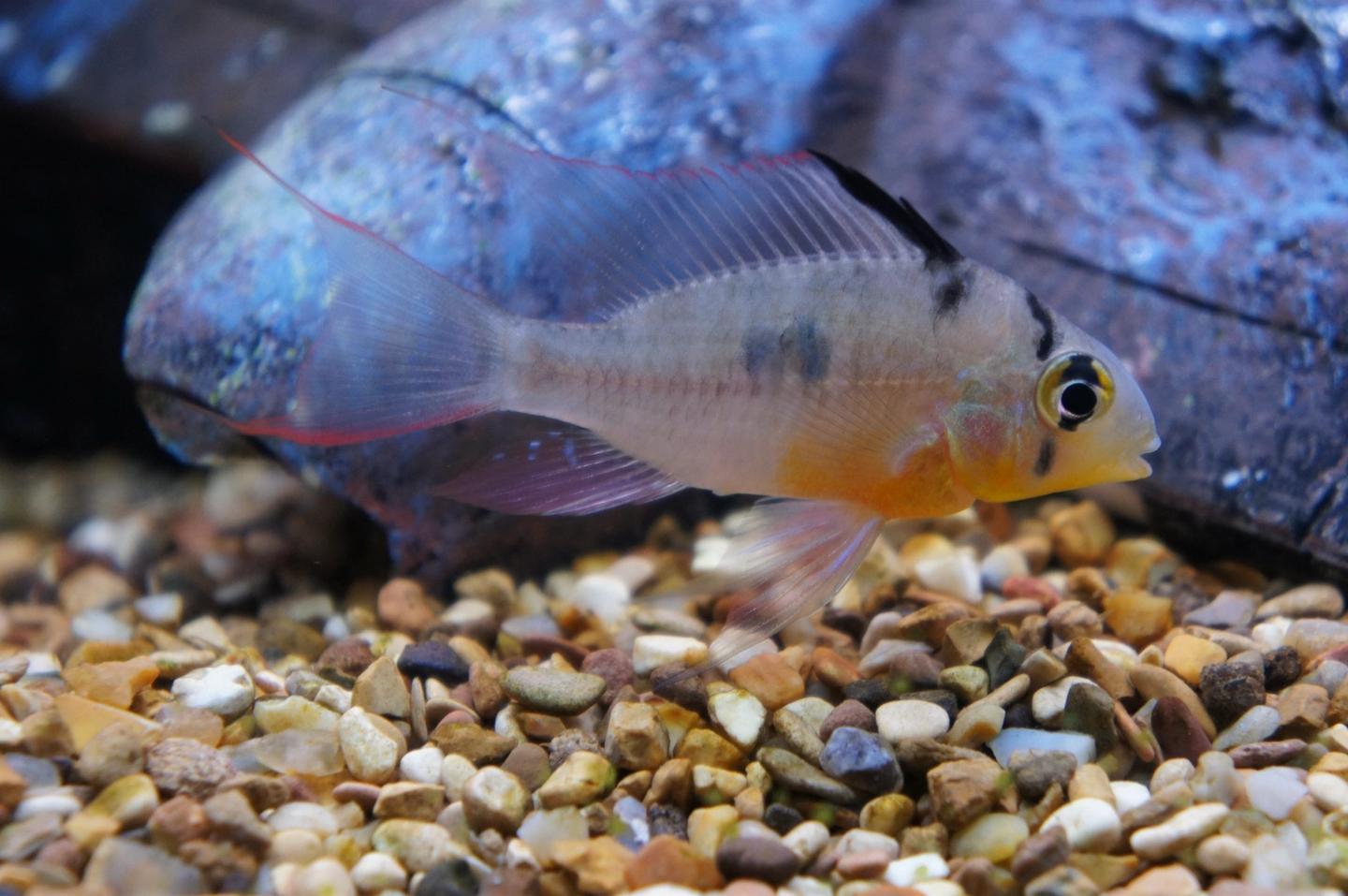
Cichlids are a family of roughly 1,800 accepted species, not one care type. Before buying, identify the exact species and source, then compare adult measurement, usable tank dimensions, social system, territory, tested water, diet and an exit plan. No family-wide minimum tank, water range or tank-mate list is safe.
Maintain these water conditions for optimal health and vibrant colors
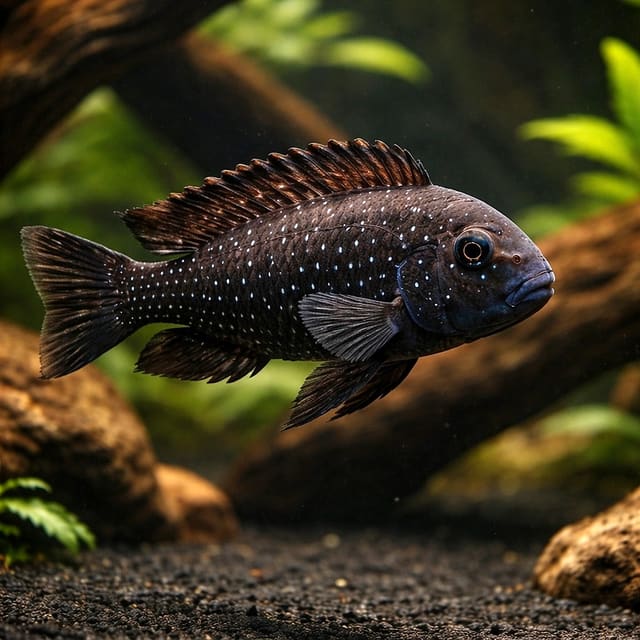
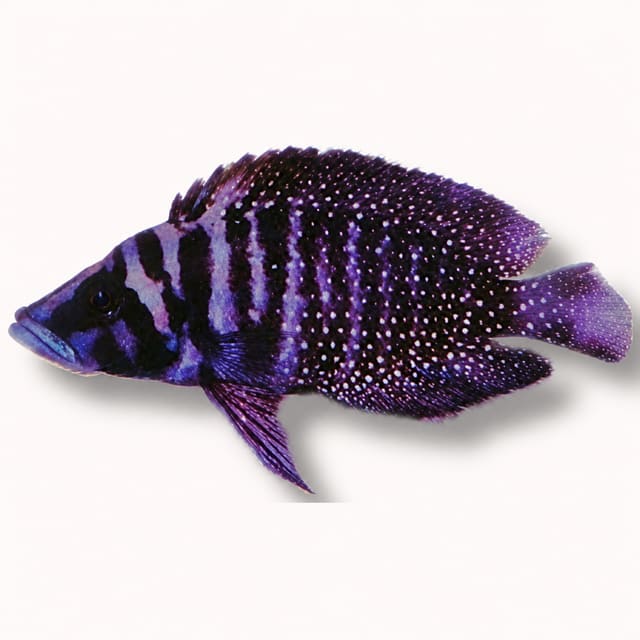
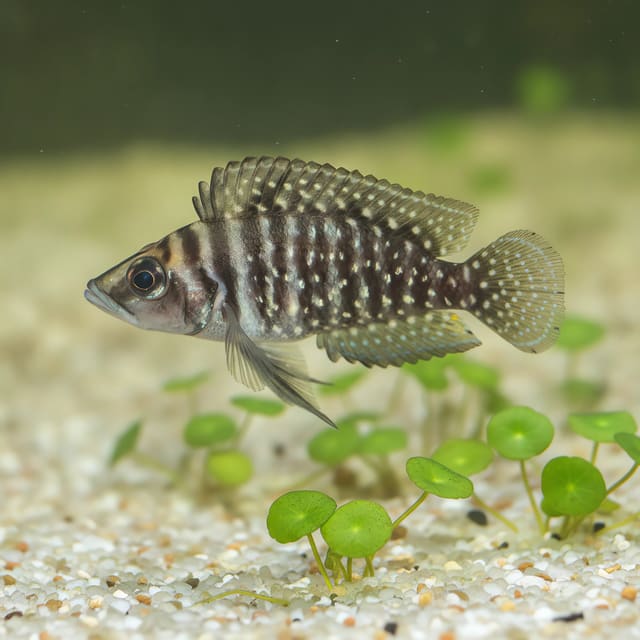
Black Pearl Calvus is a dark aquarium form of Altolamprologus calvus, a freshwater cichlid endemic to the south-western part of Lake Tanganyika. Its deep, laterally compressed body allows it to enter narrow cracks and shallow caves. The steep forehead, tall dorsal profile, dark vertical bars and pale pearling give this form its distinctive appearance. It suits keepers who can maintain stable hard alkaline water, extensive rocky cover and carefully screened Tanganyika companions.
FishBase records a maximum of 13.5 cm total length for a male or unsexed fish. It also describes the wild fish cruising through rocky habitat while maintaining a distance of 30–100 cm from the substrate. Shrimps and other crustaceans make up its main natural diet, so its deliberate hovering and short stalking movements are purposeful rather than inactivity.
This body shape determines the aquarium plan. Provide rock faces, shaded retreats and gaps that the fish can explore without becoming trapped. Leave open routes between structures so it can move around its territory and withdraw from companions. A bare aquarium removes the cover around which its natural behaviour is organised.
The black form is one of several recognised aquarium colour forms. Treat Black Pearl as a colour-form name rather than a collection-locality guarantee. Build the care plan around Altolamprologus calvus, its adult size and its rocky Lake Tanganyika habitat.
One purchase supplies one Black Pearl Calvus. The fish is supplied at 3–4 cm; this is its dispatch size rather than its adult size. Choose the purchase quantity by the number of animals required, while allowing separately for the social and territorial needs of every fish in the final plan.
Complete the adult aquarium, filtration and rock layout before introduction rather than treating the smaller dispatch size as suitable for temporary cramped housing.
Sex is guaranteed only when the selected option explicitly states male or female. This Black Pearl Calvus listing has no sex-guaranteed option.
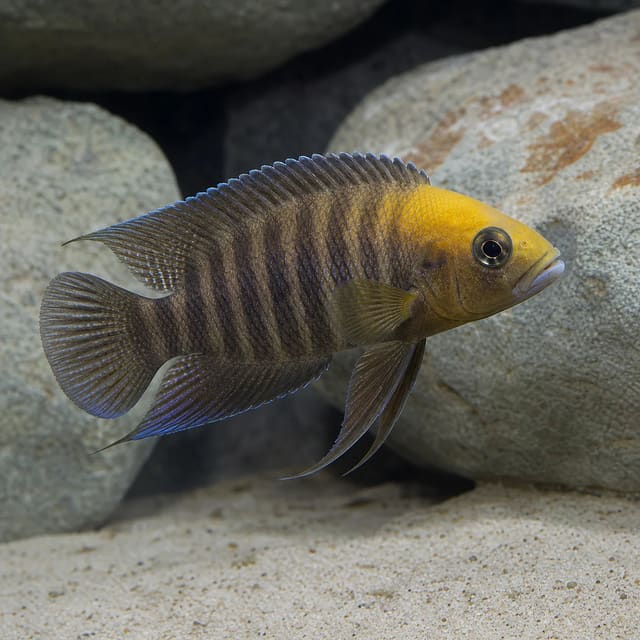
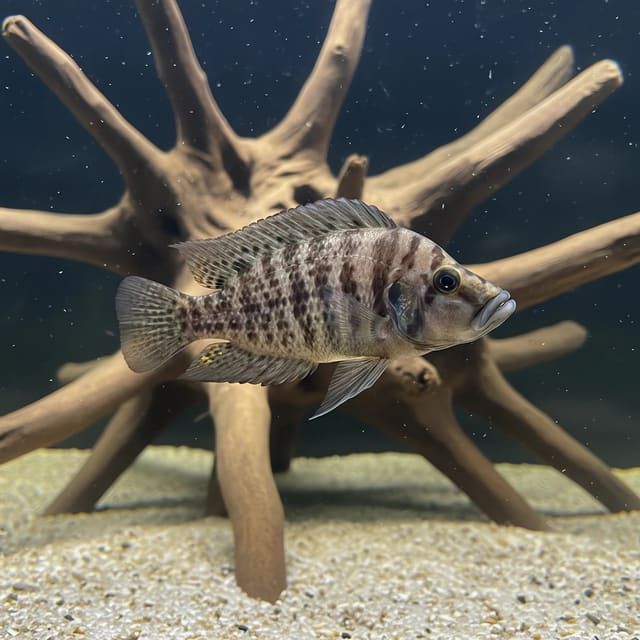
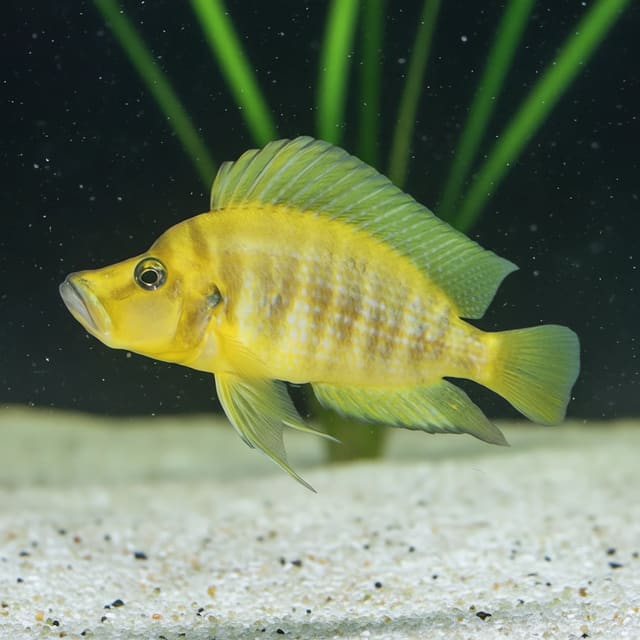
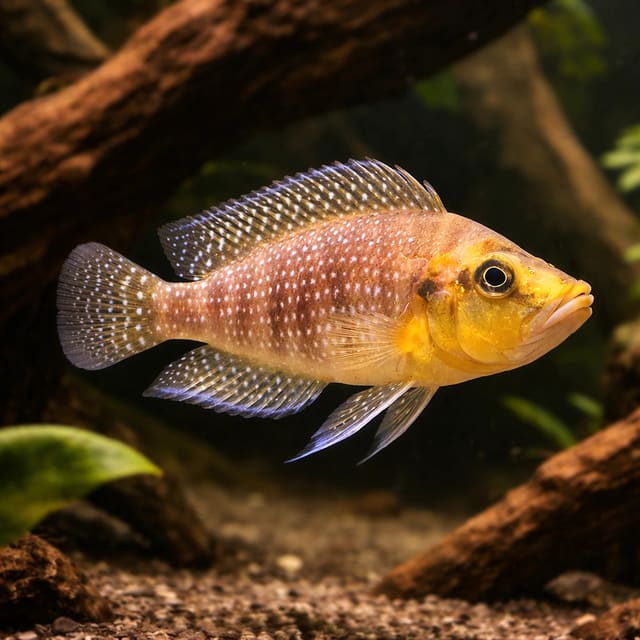
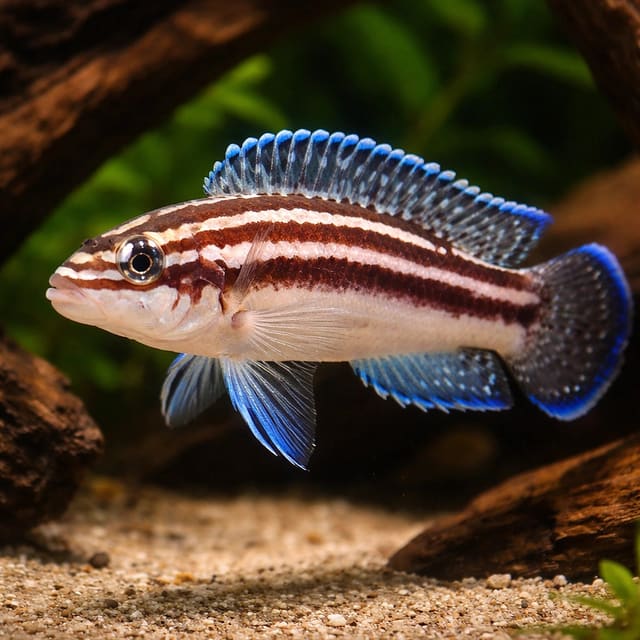
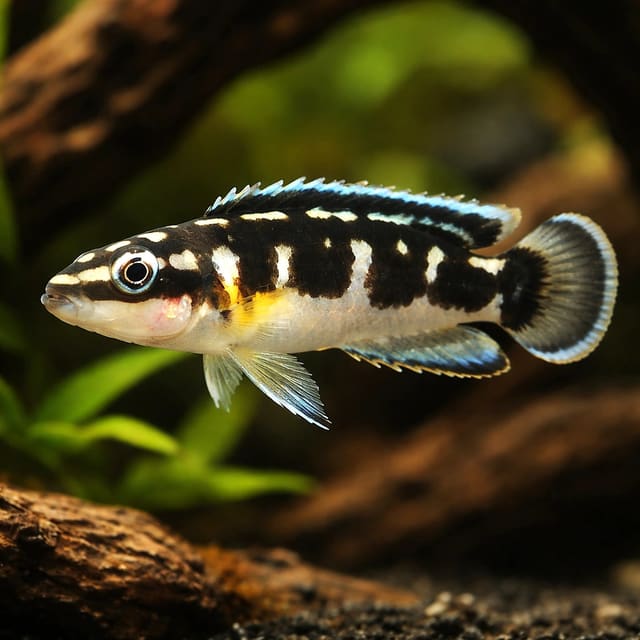
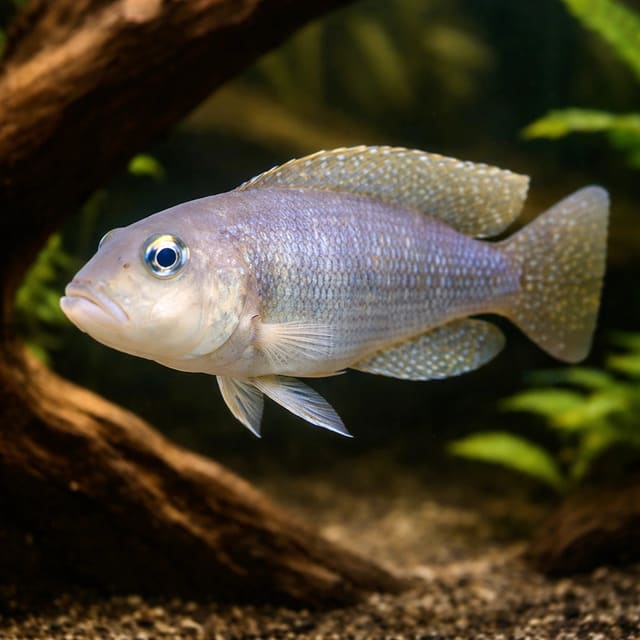
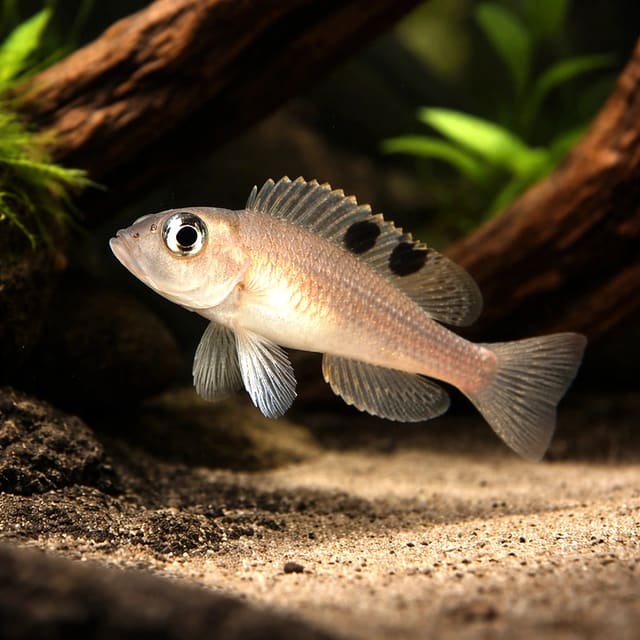
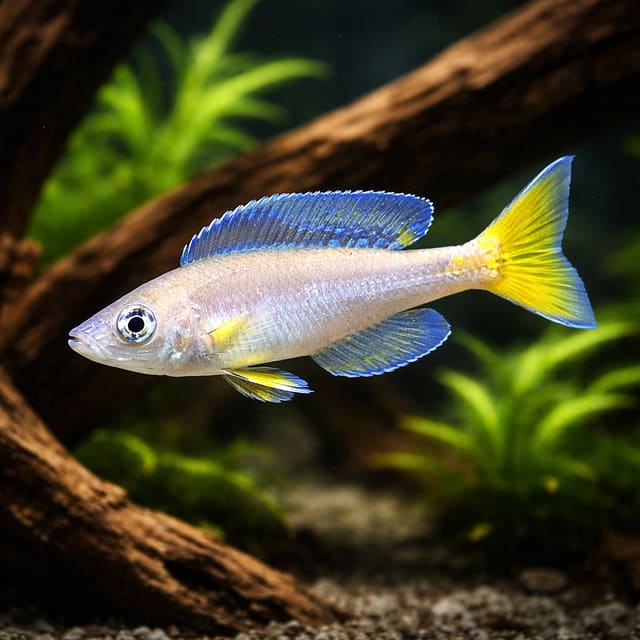
The gallery images are representative of this type of animal rather than photographs of the exact animal supplied, so colours can look slightly different from the live animal.
Darkness, visible bars and pearling can vary with the individual, lighting and surroundings. Use the gallery to recognise the intended dark, spotted form, but use the scientific name when making practical decisions.
This cichlid suits an established Lake Tanganyika-style aquarium with hard alkaline water, extensive rocky cover and companions chosen for calm behaviour. It is territorial but is described as generally peaceful towards fish it cannot fit into its mouth. Its shy, deliberate feeding style makes protection from aggressive or very vigorous competitors particularly important.
The Seriously Fish species account recommends a Lake Tanganyika biotope with piles of rocks forming caves. It describes pair or colony keeping in a suitably sized aquarium, making territory layout and a separation plan more useful than relying on a nominal fish count.
| Suits | Not suited to |
|---|---|
| Established aquariums kept at 24–25°C, pH 8.0–8.6 and 12–18 dGH | Water that cannot be maintained within the routine hard alkaline range |
| Rock piles with several caves, shaded gaps and open patrol routes | Bare layouts without narrow retreats or usable rocky territory |
| Calm Tanganyika companions too large to swallow | Aggressive or very vigorous tank mates such as mbuna |
| Pair or colony plans with suitable space and separation capacity | Plans that assume any two fish will form a compatible pair |
| Keepers able to confirm that this deliberate feeder receives food | Communities where faster fish monopolise every meal |
Measure the aquarium’s water and assess its usable rocky territory before adding the fish. If the chemistry needs repeated abrupt correction, the rockwork leaves no escape route or existing fish monopolise food, resolve that problem first.
Arrange piles of rocks to form caves across much of the aquarium. The aim is not simply to add decoration: the structures create the narrow gaps, shaded resting places and broken sight lines around which this fish feeds and establishes territory.
Use more than one cave entrance and divide the rockwork into separate zones. A fish should be able to leave one retreat and reach another without crossing an entirely exposed aquarium. Open routes between the structures also let you observe swimming, feeding and body condition.
Keep each accessible space free from sharp obstructions. Arrange heavy pieces firmly before routine maintenance begins, then check them after any disturbance. Solid placement matters because waste removal and territory rearrangement should not create a collapse risk.
Look through the aquarium from both ends before the fish arrives. If one rock pile blocks every route or one cave is the only shaded refuge, divide the structure and create another usable choice. Check that the fish could withdraw behind cover without entering a dead end and that you can still reach areas where uneaten food may settle.
Recheck the same routes after maintenance. A moved stone can close an entrance, expose a retreat or direct one fish into another territory. Restoring the intended layout immediately is safer than waiting for exclusion or chasing to reveal the problem.
Dim lighting encourages this naturally shy fish to show itself more often. A dark substrate can also display the black form effectively. Provide shadow beneath overhangs while retaining enough light and open frontage to examine the eyes, fins, scales, breathing and feeding response.
| If you see | Change the layout |
|---|---|
| Constant exposure with no settled resting place | Add a shaded cave or break the direct line of sight |
| One fish controlling every entrance | Separate rock piles and create another route around them |
| Food collecting in inaccessible cracks | Open a maintenance route without removing all cover |
| A fish repeatedly cornered | Separate the fish and redesign the territory before another attempt |
Plants are not needed to reproduce the essential habitat. Prioritise functional caves and rock faces rather than letting planting block entrances or trap food. Leave room around the structures for circulation and routine waste removal.
Keep this fish at 24–25°C, pH 8.0–8.6 and 12–18 dGH. FishBase records 23–25°C, pH 8.0–9.0 and 9–19 dH for the wild environment, while Seriously Fish gives aquarium ranges of 24–27°C, pH 7.5–9.0 and 8–20 dGH. OATA’s African lake cichlid sheet gives 23–27°C, pH 8.0–8.6 and 12–18 dGH as group guidance. The routine values are the overlap of all three.
| Value | Routine target |
|---|---|
| Temperature | 24–25°C |
| pH | 8.0–8.6 |
| General hardness | 12–18 dGH |
| Carbonate hardness | 10–15 dKH |
| Ammonia | 0 mg/L |
| Nitrite | 0 mg/L |
| Nitrate | Up to 20 mg/L above the normal tap-water level |
Test the aquarium and replacement water rather than adjusting by appearance. Our water chemistry guide explains the role of pH, GH, KH, ammonia, nitrite and nitrate. The water matcher then helps compare measured values with this routine range.
For example, aquarium water at 24°C, pH 8.3 and 15 dGH sits within the working range. Prepare replacement water close to those values so a normal water change maintains stability instead of creating a sudden swing.
Write down the readings before and after routine maintenance. If pH, hardness and temperature remain close from one week to the next, the preparation method is repeatable. If the same value repeatedly moves towards the edge of the range, examine replacement-water preparation, maintenance timing and waste accumulation before making another adjustment.
A single acceptable reading does not replace regular testing. The useful pattern is stable hard alkaline water, ammonia and nitrite held at 0 mg/L, and nitrate controlled through maintenance. Test again after a significant stocking or feeding change because the biological load has changed even when the water still looks clear.
Any detectable ammonia or nitrite needs immediate attention to filtration, stocking, feeding and maintenance. A rising nitrate trend calls for timely partial water changes and removal of trapped waste. Avoid repeated abrupt pH correction; prepare water consistently and confirm each adjustment with a test.
RSPCA aquarium welfare guidance explains that fish release toxic ammonia and that a working biological filter supports bacteria which convert it to nitrite and then nitrate. Run a mature, maintained filter continuously and establish it before the fish arrives.
OATA recommends an oversized filter for crowded African lake cichlid communities and vigorous aeration to maintain dissolved oxygen. Position the outlet or an air source to keep the surface moving, while leaving calmer areas beside caves where the fish is not pushed continuously by the current.
Cleaning every filter component at once can remove too much of the established bacterial population. Preserve biological media while clearing enough mechanical debris to keep water moving. If flow has weakened, check intakes, trapped waste and blocked media rather than assuming the filter is still operating at full capacity.
| Observation | First check |
|---|---|
| Reduced outlet flow | Inspect the intake and media for blockages |
| Waste collecting behind rocks | Remove it during the partial water change |
| Ammonia or nitrite detected | Review filtration, feeding and recent livestock additions |
| Faster breathing than usual | Test water and check surface movement and filter flow |
Clear water alone is not a measure of biological performance. Use test results, steady flow and the fish’s breathing and feeding behaviour together. This separates a filter that merely moves water from one that is supporting the aquarium’s waste load.
Follow our first tropical aquarium guide to prepare and mature the system. Readiness means the filter is running reliably, ammonia and nitrite remain at 0 mg/L, temperature and mineral values are stable, and all rockwork is complete.
Increase livestock gradually. Every added fish and extra feed increases the load on the filter bacteria. A slow stocking sequence gives the biological filter time to respond and makes it easier to identify which change preceded a water-quality problem.
In Lake Tanganyika, Altolamprologus calvus feeds mainly on shrimps and other crustaceans. Its compressed body lets it approach prey around cracks and rock faces. Build the aquarium diet around appropriately sized meaty live and frozen foods rather than expecting it to compete for plant-based food or scavenge leftovers.
Seriously Fish reports that meaty live and frozen foods are readily accepted and that dried varieties are not usually taken. OATA includes frozen brine shrimp, prawns and cockles among suitable foods for predatory African lake cichlids. Introduce one suitable food at a time and watch the fish swallow it before adding more.
Feed twice a day, offering only what the fish can eat within a few minutes. Begin with a small amount close to its rocky territory. If every piece is consumed promptly and the fish remains engaged, add another small portion. Stop when interest falls rather than allowing food to settle into caves.
| Observation | Feeding response |
|---|---|
| Food is taken promptly | Continue the measured portion and stop within a few minutes |
| Faster fish take every piece | Feed them at the opposite side, then place food near the Calvus territory |
| Food remains in rock gaps | Remove it and reduce the next portion |
| The fish approaches but rejects dried food | Use appropriately sized meaty live or frozen food instead |
| Appetite drops suddenly | Test water and assess breathing, behaviour and social pressure |
In a community, watch the Black Pearl Calvus rather than the food alone. A meal can disappear within minutes while a shy fish receives nothing. Occupy faster companions away from the rocks, then place a measured portion near the Calvus territory and confirm that it eats.
Use the same observation point for several meals. A steady response makes a later change easier to recognise, while repeated food refusal points to a need to check food type, water quality and social pressure. Remove food lodged in caves before it breaks down.
Overfeeding creates uneaten material that breaks down and adds toxic waste to the water. Do not add a large compensatory meal after one quiet feed. Record what was offered and eaten so a genuine change in appetite is clear.
Complete the aquarium before delivery day. Confirm 24–25°C, pH 8.0–8.6, ammonia at 0 mg/L and nitrite at 0 mg/L. Check filter flow, secure the cave layout and leave an unoccupied retreat that the fish can reach immediately.
Arrange for someone to receive the parcel because live fish must not be left unattended. Read the current delivery and Live Arrival Guarantee policy before the delivery window so the arrival and claim steps are understood in advance.
Seriously Fish advises dim lighting for this shy species. Keep observation calm while it settles and avoid chasing it back into view.
A rock-associated fish may remain close to a cave or vertical surface after transfer. Observe breathing, posture and balance without repeatedly disturbing its retreat. Hiding by itself is less concerning than hiding combined with rapid breathing, damaged fins, erratic swimming or an inability to hold position.
A calm first day gives the fish time to orient around the cave system. Repeatedly moving décor, increasing the lighting or trying to force it into open water removes that opportunity. Make only the change needed to correct an immediate water, equipment or aggression problem.
Keep feeding restrained during the settling period. When food is offered, place a small amount near cover and confirm whether it is eaten. Remove leftovers promptly, because a newly introduced fish and an increased feeding load both affect water quality.
Look for trends rather than judging health from colour alone. African lake cichlids vary naturally in appearance and behaviour, but changes in swimming, breathing, appetite, condition or temperament can reveal a developing problem.
Compare body condition from week to week. A fish that repeatedly approaches food but never eats may dislike the food, be intimidated by another fish or be affected by water conditions. A fish that stays pinned at the surface, behind equipment or in one exposed corner needs prompt assessment of aggression and territory access.
Record weekly pH, nitrate and maintenance alongside feeding and behaviour. This makes a gradual water trend or social change easier to recognise. Continue the 25% partial water change at least once a week, condition tap water and clean blocked media only in removed aquarium water.
Make the same checks before changing the aquarium: water readings, filter flow, breathing, appetite, body condition and access to cover. A consistent sequence helps distinguish a one-off startle response from a trend that needs action. Note recent livestock additions or feeding changes beside the results because either can alter filtration demand and social pressure.
If the fish feeds but loses access to its retreat, treat the territory problem separately from diet. If it hides securely but stops eating and breathes rapidly, test the water and check aeration before changing the rockwork. Matching the response to the observed change avoids several disruptive adjustments at once.
| If the change persists | Act first |
|---|---|
| Reduced feeding | Test water and check whether companions block food access |
| Rapid breathing | Test ammonia and nitrite, then check aeration and filter flow |
| Repeated chasing | Separate the targeted fish and redesign territories |
| White spots, growths or ulcers | Check water and contact us for health guidance |
| Fading or darkening alone | Assess it alongside posture, breathing, feeding and social pressure |
Seriously Fish describes this species as suitable for maintenance as a pair or colony in a suitably sized aquarium. That does not make any two individuals a compatible pair or turn a purchase quantity into a social recommendation. Build several territories and retain a practical way to separate fish if behaviour changes.
Males grow larger and develop longer fins than females, but those adult differences should not be used to assign sex to the animal supplied. Do not infer sex from colour, size or the gallery when a sex-specific plan matters.
Territorial failure is often visible through exclusion. One fish may control the only secure cave, intercept food or force another fish to remain near the surface. Persistent loss of access to food and cover requires separation even before torn fins appear.
Several geographic colour forms occur in the aquarium trade. Seriously Fish advises that these forms should not be allowed to hybridise and should not be kept together. Maintain Black Pearl Calvus separately from other A. calvus forms where reproduction could occur.
Breeding behaviour can intensify defence of a cave. Flowerpots or shells may form breeding cavities, but adding another cavity does not guarantee that incompatible fish will coexist. Territory, adult size, feeding access and a prompt separation option remain the practical safeguards.
This fish is territorial but generally peaceful towards fish it cannot fit into its mouth. That makes adult size the first compatibility screen. Small fish, fry and ornamental crustaceans are exposed to predation because A. calvus naturally eats shrimps and other crustaceans and enters crevices to prey on eggs, fry and small fish.
Temperament and feeding pace form the second screen. Seriously Fish specifically says to avoid aggressive or very vigorous tank mates such as mbuna because this species tends to be shy. A companion that consumes every meal or repeatedly drives the Calvus away from rock cover is unsuitable even when it is too large to swallow.
| Candidate | Decision |
|---|---|
| Calm Lake Tanganyika fish too large to swallow | Consider only after matching water, feeding pace and territory |
| Aggressive or very vigorous mbuna | Avoid |
| Malawi and Tanganyika cichlid mix | Avoid |
| Small fish, fry or tiny shell dwellers | Avoid where they could fit into its mouth |
| Shrimp and other ornamental crustaceans | Avoid because crustaceans are natural prey |
| Another Calvus colour form | Avoid where hybridisation could occur |
| A proposed pair or colony | Use divided rock territories and a separation plan |
OATA recommends keeping African lake species with fish from the same location and does not generally recommend mixing Malawi and Tanganyika cichlids because their temperament and behaviour differ. Shared hard alkaline water alone is not enough.
Compare the proposed companion at adult size, not dispatch size. Then ask whether it can use the same 24–25°C, pH 8.0–8.6 and 12–18 dGH routine range, whether it feeds at a compatible pace and whether the rock layout leaves each fish a usable territory.
Reject the combination if one animal is likely to be swallowed or if the companion is an aggressive, very vigorous competitor. Where the basic screen is passed, keep separation capacity ready and watch access to food and caves after introduction. A pairing that works at first can still change as territories develop.
Compatibility remains individual and conditional. Screen the final stocking list by adult size, water needs, aggression, feeding speed and territory, then contact us for a stocking and compatibility assessment if the combination is uncertain.
Begin with a restrained Lake Tanganyika plan rather than treating every African cichlid as interchangeable. The African cichlid collection is useful for browsing identities, but a shared collection does not make two fish compatible.
OATA recommends adding more peaceful African lake species first and more aggressive species later. Increase the population slowly so the biological filter can respond to each rise in waste and feeding. Rearranging décor before an introduction may reduce established territorial ownership, but every rock must remain stable and the resident Calvus must retain secure cover.
After an addition, watch both meals each day. Check whether every fish leaves cover voluntarily, reaches food and withdraws without sustained pursuit. Separate a fish that is continually cornered, pinned near the surface or losing condition.
Do not judge the combination only during the first minutes. Check the next feeds, resting places and movement between caves. A resident that initially retreats may settle, but repeated exclusion from food or cover shows that the introduction is not working.
Test ammonia and nitrite after the stocking change and keep the normal maintenance schedule. Adding fish increases both social pressure and biological load, so a change in breathing or appetite needs a water-quality check as well as a behaviour check. Make the next addition only after the aquarium has returned to a stable routine.
Named genera sometimes kept in Tanganyika communities still require this full screen. Adult size, individual behaviour and the exact layout determine the result; a familiar common name is never a universal compatibility guarantee.
FishBase records a maximum of 13.5 cm total length for Black Pearl Calvus. Plan the aquarium around that adult size rather than its 3–4 cm dispatch size.
Use a suitably sized mature aquarium that can hold extensive rock piles, several caves, open routes and separate territories for every fish. Seriously Fish bases the setup on a Lake Tanganyika biotope and describes pair or colony keeping only in suitably sized accommodation.
Seriously Fish describes pair or colony keeping in a suitably sized aquarium. Any pair or colony needs divided rocky territories and a practical separation plan because individual fish are not automatically compatible.
It suits a keeper who can maintain 24–25°C, pH 8.0–8.6 and 12–18 dGH, run a mature biological filter and monitor a shy territorial predator at every feed.
Feed appropriately sized meaty live and frozen foods twice daily, offering only what it can eat within a few minutes. FishBase records shrimps and other crustaceans as its main natural diet, while Seriously Fish reports that dried foods are not usually accepted.
Keep it at 24–25°C, pH 8.0–8.6 and 12–18 dGH, the overlap of FishBase, Seriously Fish and OATA’s African lake cichlid group guidance. Maintain ammonia and nitrite at 0 mg/L.
It is territorial but generally peaceful towards fish it cannot swallow. The practical risks are predation on small animals and exclusion from food or caves, so separate any fish that is repeatedly chased, cornered or prevented from feeding.
Consider calm Tanganyika fish too large to swallow and able to share its water, feeding pace and rocky territory. Seriously Fish names Julidochromis, Neolamprologus, Cyprichromis and Tanganyikan Synodontis as possible choices; avoid mbuna, small fish, ornamental crustaceans and other Calvus colour forms where hybridisation could occur.
Tropical Fish Co hand-packs live fish in oxygen inside an insulated box, using a heat pack when the weather calls for it. Someone must be present to receive the parcel. Start filming every delivery before opening the sealed parcel, continue as it is opened and show the fish still inside the sealed bag; then float the bag for 20–30 minutes and never pour the bag water into the aquarium.
No reviews for this item yet. Bought one? Honest reviews only, good or bad.
What customers say about ordering from us
I have a small group of long finned mountain minnows. So was delighted to be able to order ten of this variety to increase the genetics in my tank . The ones I recieved are healthy but it’s to early to give a verdict on wether they are of a long finned type since they are small currently.
Gordon Walker · 23 Sept 2026
100% success travel and "installation". Pleased with quality of purchase. The Siamese fighter a bit "shy" so have not yet seen him at his best yet but looking good. Happy customer. GG
George E Garratt · 21 Sept 2026
Reviews of our shop, collected by Judge.me, an independent third-party review collector. Newest first.