Moderate
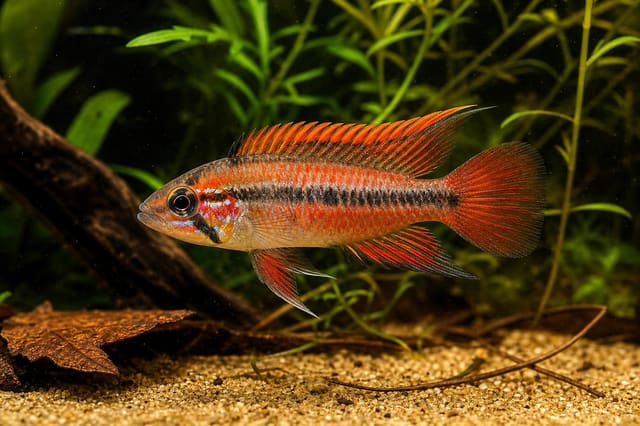
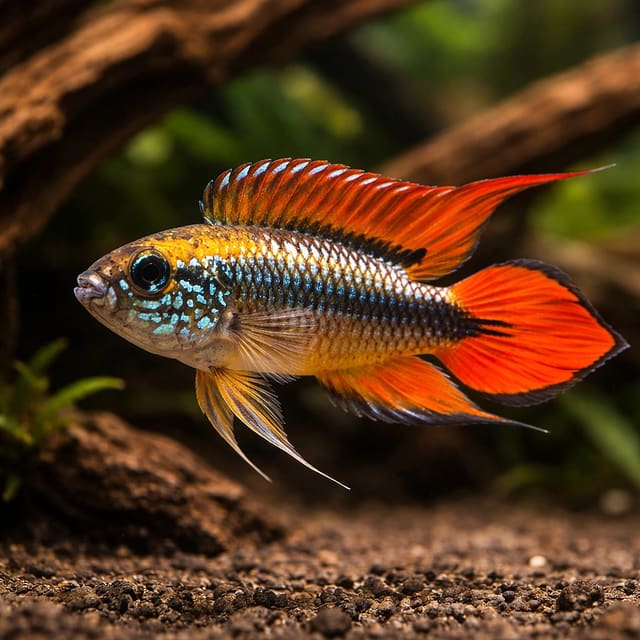
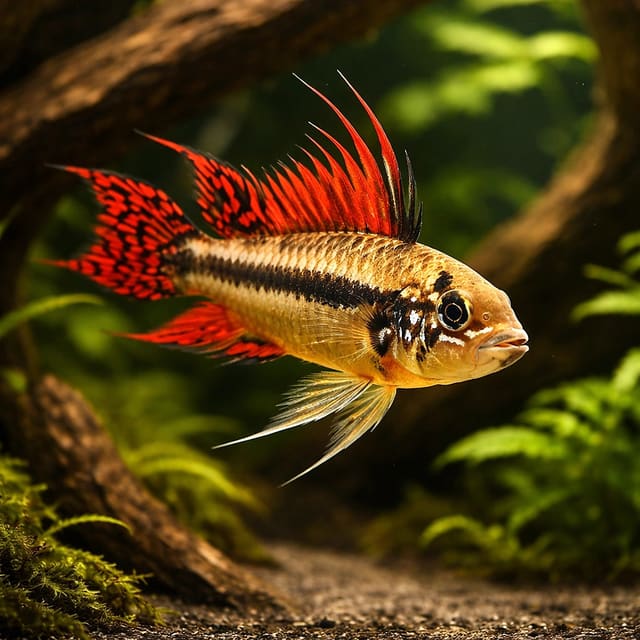
Cockatoo Dwarf Cichlid (Apistogramma cacatuoides)
22–29°C · pH 5–6 · 54L
£10.99

Guianacara dacrya is a South American cichlid from clear, softwater rivers of the Essequibo and Branco drainages in Guyana, described in 2011. It reaches about 12 cm standard length and needs a roomy tank with sand, rocks and caves at 24–28 °C. Sold as one fish per unit at 3 cm or 4–5 cm, sex not guaranteed.
Adult size is the maximum length this species reaches at full maturity (scientific sources). The livestock you receive will be younger and smaller — pick a size above for the actual shipping size. Product-photo provenance and any image-specific limitations are stated on the listing.
Guianacara dacrya
Each quantity is one pair containing 2 fish. Discounts count pairs.
Guianacara dacrya is a South American cichlid from clear, softwater rivers of the Essequibo and Branco drainages in Guyana, described in 2011. It reaches about 12 cm standard length and needs a roomy tank with sand, rocks and caves at 24–28 °C. Sold as one fish per unit at 3 cm or 4–5 cm, sex not guaranteed.
Adult size is the maximum length this species reaches at full maturity (scientific sources). The livestock you receive will be younger and smaller — pick a size above for the actual shipping size. Product-photo provenance and any image-specific limitations are stated on the listing.

Cichlids are a family of roughly 1,800 accepted species, not one care type. Before buying, identify the exact species and source, then compare adult measurement, usable tank dimensions, social system, territory, tested water, diet and an exit plan. No family-wide minimum tank, water range or tank-mate list is safe.
Maintain these water conditions for optimal health and vibrant colors
This page is for Guianacara dacrya, a mid-sized cichlid from the rivers of Guyana. You choose between two size options, 3 cm and 4 to 5 cm, and each unit you order is one fish of the size you select. As the listing already states, these are individual fish, not guaranteed pairs and not sexed specimens. Ordering two does not mean you will receive a male and a female; with this species that would be hard to promise in any case, for reasons explained further down.
The sizes are the length of the fish when it leaves us, not the size it will reach. FishBase records a maximum of 12.0 cm standard length, which is measured from the snout to the base of the tail fin, so a fully grown fish looks larger in the tank than that figure suggests. A 3 cm fish is a small juvenile with a lot of growing ahead of it. Plan the aquarium around the adult, not around the little fish in the bag.
| Quick facts | Guianacara dacrya |
|---|---|
| Family | Cichlidae (subfamily Geophaginae) |
| Wild range | Essequibo and Branco river drainages, Guyana |
| Adult size | 12.0 cm standard length (FishBase) |
| Temperature | 24–28 °C (24.8–28.5 °C measured in the wild) |
| Water | Soft, clean and well oxygenated |
| Natural diet | Mainly small invertebrates |
| Sexes | No apparent external difference described |
| What you receive | One fish per unit, 3 cm or 4–5 cm, sex not guaranteed |
Who is it for? Guianacara dacrya suits a keeper who wants a South American cichlid with real character but without the size and destructive habits of the big species. It is for someone who will set up a tank with sand, rocks and caves, keep the water clean and well oxygenated, and choose companions with some thought. It is not a fish for a tank of neon tetras and cherry shrimp, and it is not for someone who wants a guaranteed breeding pair straight out of the box.
It is also a fish of particular interest to collectors. The species was only formally described in 2011, it has no established English common name, and it is one of just seven species in its genus. It is a quietly handsome fish rather than a gaudy one, with a pattern of bars and stripes that makes more sense the longer you watch it.
Everything factual in this guide comes from published references we read for this listing: the FishBase species summary, the taxonomic treatment of the original 2011 description by Arbour and López-Fernández (published in Neotropical Ichthyology and reproduced on Zenodo), Wikipedia's article on the genus, and FishBase's accounts of two close relatives. Where a detail is known only for related species, we say so. Where nothing has been published that we could find, we give you our practical advice and label it as such rather than dressing it up as fact.
Guianacara is a small genus of South American cichlids named by Kullander and Nijssen in 1989. Wikipedia lists seven species: G. cuyunii, G. dacrya, G. geayi, G. oelemariensis, G. owroewefi, G. sphenozona and G. stergiosi. All of them are endemic to freshwater in the Guiana Shield of north-eastern South America. FishBase places the genus in the family Cichlidae, subfamily Geophaginae, the same broad group that holds the eartheaters of the genus Geophagus.
Guianacara dacrya was described by Jessica Arbour and Hernán López-Fernández in 2011, in a paper titled Guianacara dacrya, a new species from the rio Branco and Essequibo River drainages of the Guiana Shield. It sits in the subgenus Guianacara. Books and articles from before 2011 will not mention it by this name.
FishBase explains both parts of the name. The genus name joins Guyana with acara, a Tupí and Guaraní word for fish. The species name dacrya comes from the Greek dakryo, to shed tears or weep. It refers to the stripe running down from the eye, which the authors describe as giving the fish a tear-streaked look. Once you have seen it, the name is hard to forget.
FishBase lists no English common name for this species, and we are not going to invent one. In the hobby it is sold under its scientific name, which is also the safest way to make sure you are buying, and later identifying, the right fish. If you see Guianacara listed elsewhere under a vague trade name with no species attached, it may not be the same animal.
The IUCN assesses Guianacara dacrya as Least Concern; FishBase dates that assessment to 18 November 2020. The original description also reports it as abundant in several tributaries of the Essequibo.
The original description gives a clear set of features for telling this species apart from its relatives, and they are worth learning because several Guianacara species look broadly alike. Wikipedia notes that all members of the genus share a dark line through the eye, of varying strength, and that adults differ mainly in the dark bar or spot on the middle of the body.
The description also lists an internal feature, an expansion of the lower pharyngeal tooth plate, which is useful to scientists but not something you will see in the aquarium.
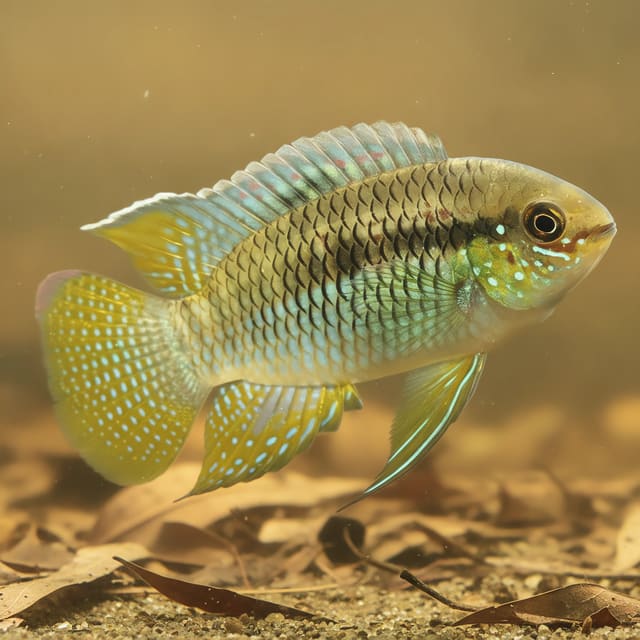
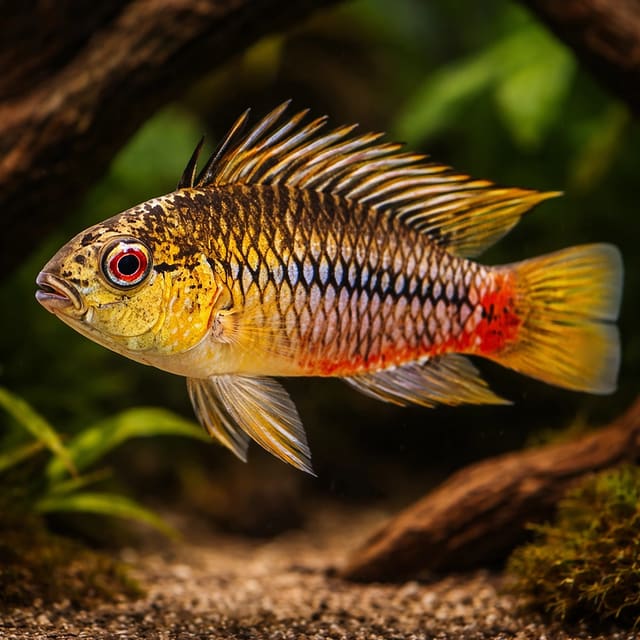
The photograph on this page shows a fish with a pale, peach-toned body and yellowish fins, a dark vertical bar on the middle of the flank that runs up into the dorsal fin, a dark stripe through the eye continuing down towards the throat, and small bright blue marks below the eye. The spiny part of the dorsal fin is tipped with dark rays. That fits the general Guianacara pattern described above.
Here is the important point for buyers: the fading cheek stripe is described for fish over 45 mm standard length. A 3 cm fish has not reached that stage, and a 4 to 5 cm fish is at most on the threshold of it. Young fish will show the general markings of the genus, and the distinctive adult pattern develops as they grow. Do not expect a juvenile to look exactly like an adult in a reference photograph.
The original description states that there is no apparent sexual dimorphism. In other words, the scientists who examined the type material could not see a reliable external difference between the sexes. FishBase notes that in the related G. owroewefi females are smaller than males, but no such dependable sign has been described for G. dacrya. That is exactly why this listing does not promise a sex, and why two fish are not sold as a pair.
Guianacara dacrya lives in south-western and central Guyana. The original description records it as abundant in the Essequibo basin, including the Rupununi, Siparuni and Kuyuwini tributaries, and in the Takutu and Ireng drainages, which belong to the Branco River basin. The authors suggest it may also occur in northern Brazil, in the rio Uraricoera. FishBase summarises the range as Guyana, in the rio Branco and Essequibo River drainages.
FishBase and the original description agree on the habitat: clear-water streams with moderate current, and also seasonally flooded lagoons. The bottom is typically sandy with large rocks. Juveniles were found in abundance where pebbles and small rocks mixed with leaf litter. Wikipedia describes the genus as a whole in the same terms, as fish of moderately flowing clear- or blackwater rivers and streams that also turn up in seasonally flooded lagoons, usually over sandy patches mixed with large rocks.
Two things stand out in that picture. First, this is not a still-water fish. It lives where water moves, which keeps oxygen high. Second, the habitat is structured: open sand for foraging, with large rocks breaking it up into territories and hiding places. Both points shape the aquarium.
The collecting data published with the species are unusually useful for a fishkeeper:
| Measurement | Recorded where collected | What it tells you |
|---|---|---|
| Temperature | 24.8–28.5 °C | A warm tropical fish; 24 to 28 °C in the aquarium covers it. |
| Conductivity | 27.1–34.5 µS | Very low: the water carries very few dissolved minerals, so it is extremely soft. |
| Dissolved oxygen | 5.3–6.56 mg/L | Well-oxygenated water, in keeping with flowing streams. |
For comparison, most UK tap water reads many times higher in conductivity than that. You do not have to copy wild water exactly to keep this fish well, but it tells you which direction to lean: soft, clean, warm and well oxygenated.
FishBase also notes a curious detail about the genus as a whole: G. owroewefi lives in river zones with cascades in shallow, sunny water, while G. geayi is recorded from calm inland creeks. The genus spans a range of river habitats. What your fish needs most from you is clean water and the right structure, not a perfect copy of a Guyanese stream.
We suggest a tank of at least 150 litres for a single adult or a pair, with more space if you plan a mixed community or want to keep several young fish while pairs sort themselves out. That figure is our planning advice for a 12 cm cichlid that holds territory near the bottom, not a published minimum. What matters most is floor area. A long, reasonably deep tank gives the fish room to claim a patch without controlling the whole aquarium, and gives every other fish space to keep out of the way.
Copy the wild habitat: a bed of fine sand with large, smooth rocks set into it. Bed the rocks onto the tank floor or onto the glass before adding sand, so nothing can be undermined if the fish move sand around. Add a few areas of pebbles and small stones, with a scattering of dried leaves; the original description records juveniles in exactly that kind of pebble and leaf-litter mix, so it is a natural place for small fish to feel secure.
FishBase's accounts of two relatives describe breeding in hidden places and rock crevices, so build caves and crevices into the rockwork from the start. Several caves are better than one, because a cichlid that owns the only shelter in the tank can make life miserable for everyone else. Use rocks and wood to break up the line of sight across the tank. A fish that cannot see its rival all the time is far less likely to keep chasing it.
Plants are optional rather than essential, since the wild habitat is rock and sand. If you want them, choose tough species that can be attached to rock or wood, such as Java fern and Anubias, or robust rooted plants in protected corners. Fine stem plants in open sand are likely to be disturbed.
This is a fish of moving water, and the wild oxygen figures are high. Use a filter rated comfortably for the tank volume, with outlets arranged to create a moderate current along the length of the tank and plenty of surface movement. Leave calmer areas behind rocks where fish can rest out of the flow. An external canister filter, or a large internal filter with an air stone, does the job well.
The tank must be fully cycled, with ammonia and nitrite both at zero, before you order. Put all rockwork in place, check it is stable, and run the tank for long enough that the temperature and water quality are steady. Rearranging heavy rocks after cichlids have settled in is stressful for them and risks injury.
Temperature is the easy part. Our care figures give 24 to 28 °C, and that range sits almost exactly on the 24.8 to 28.5 °C measured where the species was collected. Set the heater for around 26 °C, check it with a separate thermometer, and you are in the middle of the fish's natural range.
The wild water is extremely soft, with conductivity of only 27.1 to 34.5 µS in the collecting data. None of the sources we read publishes a pH or hardness range for this species, so our care figures use a general planning range of pH 5.5 to 7.5 and 2 to 15 dGH, as on our existing listing. Given how soft the wild water is, we would aim for the softer half of that range, with a pH a little below neutral.
In practice:
This is the part that keeps the fish healthy. This fish comes from clear, flowing, well-oxygenated streams, and that is the standard to keep to; cichlids fed rich foods produce plenty of waste. Change 25 to 30 per cent of the water every week, using water prepared to the same temperature and chemistry, and siphon the sand as you go to lift out uneaten food. Ammonia and nitrite must always be zero, and nitrate should be kept low by those regular changes rather than allowed to build.
Keep oxygen high, especially in summer when warm water holds less of it. Strong surface movement and good flow do most of the work; an air stone is a cheap extra safety margin. Gasping at the surface or fast gill movement are signs to test the water and check the filter straight away.
Test your water a few days before the delivery date and again on the day. Have the temperature set and steady, and if any reading is off, put it right before the parcel arrives rather than after.
Wikipedia's article on the genus states that Guianacara mainly feed on small invertebrates. That is the basis for the diet. In the aquarium, the aim is to provide small, protein-rich foods that reach the lower part of the tank, where the fish spends much of its time foraging over sand and among rocks.
A sensible routine:
Our existing care figures include some vegetable matter in the diet. No source we read describes plant food for this species, so treat it as an optional extra in the form of a pellet that includes plant ingredients, not as a staple.
Feed juveniles small amounts two or three times a day; growing fish do better on little and often. Adults can be fed once or twice a day. In each case, give only what is eaten within a couple of minutes, and siphon out leftovers. Rich frozen foods that lie in the sand rot quickly and undo the clean water this fish needs.
In a mixed tank, fast mid-water fish can take most of the food before it reaches the bottom. Feed sinking foods, drop some at each end of the tank at once, and watch for the first few weeks that the cichlid is actually eating. A healthy fish has a gently rounded belly; a pinched belly means it needs more food or less competition.
After delivery, a new fish may not eat for a day or so while it settles. That is normal. Offer a small amount of frozen food on the first day or two, remove what is not eaten, and introduce pellets once the fish is feeding confidently.
No source we read describes the behaviour of G. dacrya in aquariums in detail, so this section combines what is known about the genus with the practical experience that applies to any territorial cichlid of this size. FishBase records that in G. owroewefi males defend breeding sites, and that in G. geayi males maintain harems and keep a cave or lair. Expect your fish to behave like a cichlid: reasonably calm most of the time, and assertive about its own patch, especially when it is in breeding condition.
Because the sex is not guaranteed and the sexes are hard to tell apart, think about how many fish you want before you order:
Good companions share the same warm, soft water, are not small enough to be eaten, and are not so aggressive that they bully the cichlid. Our existing care notes suggest medium-sized tetras, Corydoras and plecos; these work in principle, but check each species' own temperature and space needs against this fish before adding it. Leave enough room on the bottom that a catfish and the cichlid are not competing for the same cave.
Avoid:
Signs that a fish is being bullied include torn fins, a fish pinned in a corner or at the surface, a fish that has stopped coming out to feed, and darkened or faded colour that does not recover. Add more rockwork and sight breaks first; if that does not help, separate the fish. Do not wait for it to sort itself out once one fish has been singled out.
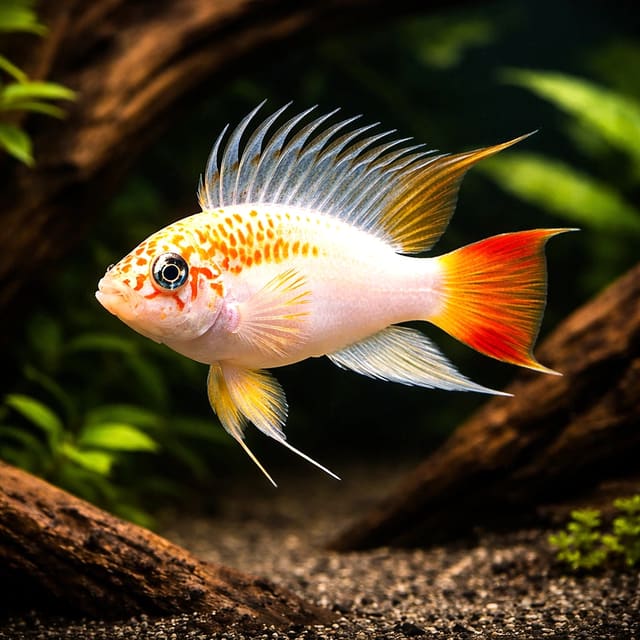
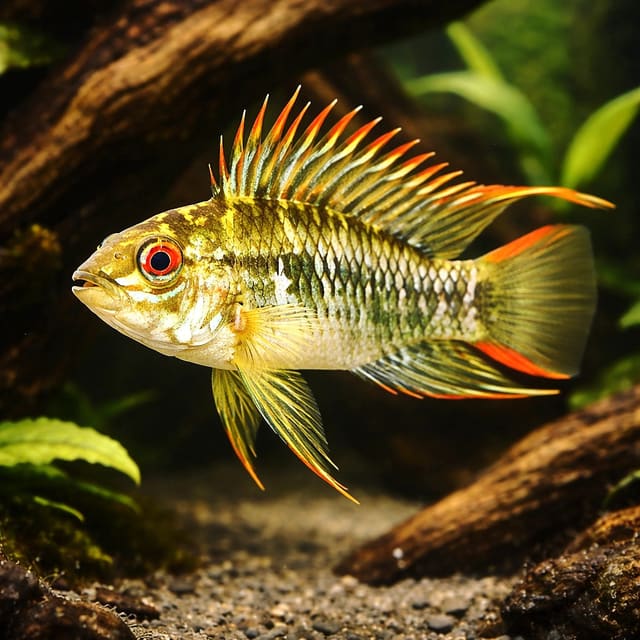
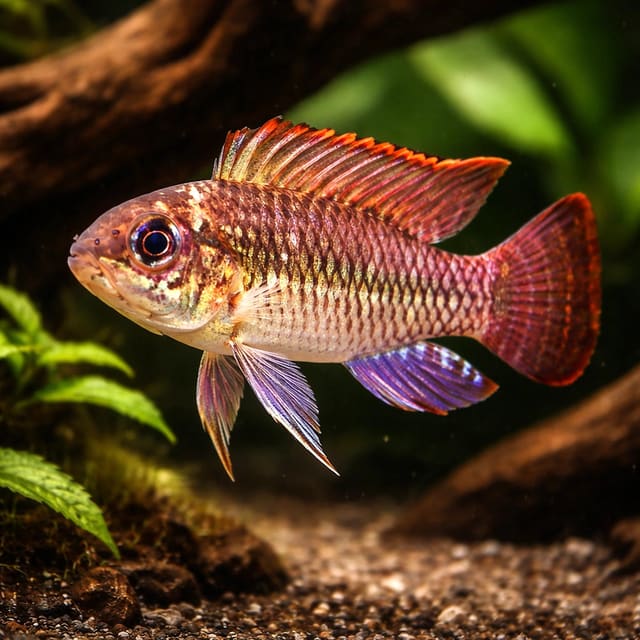
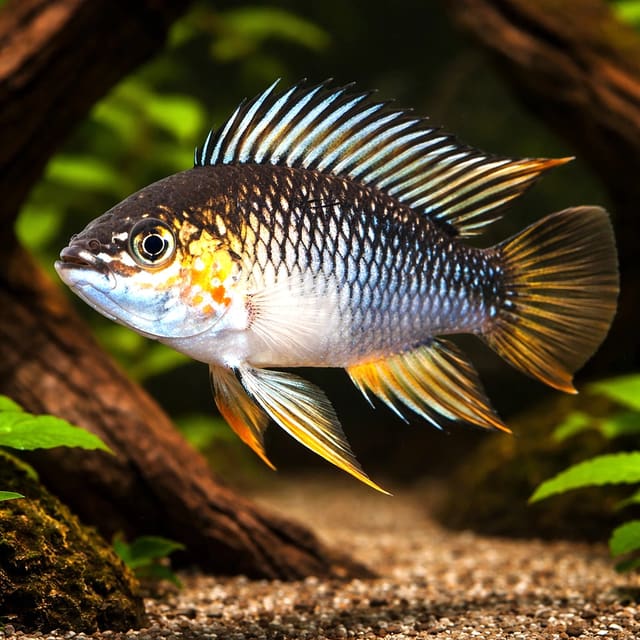
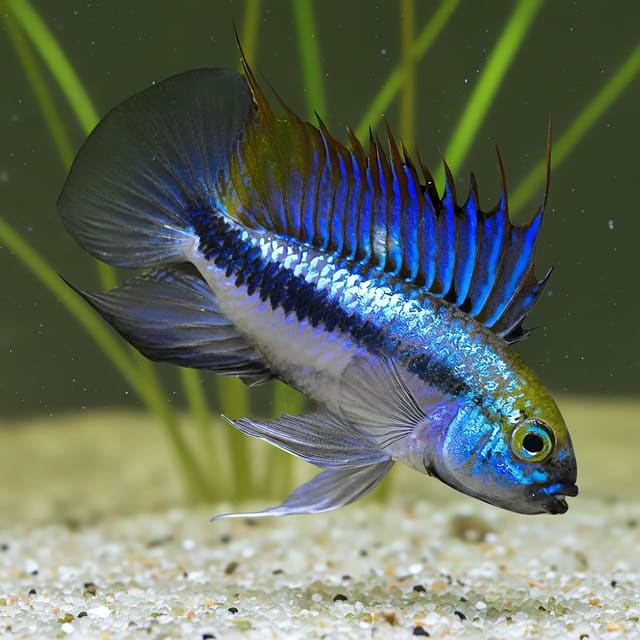
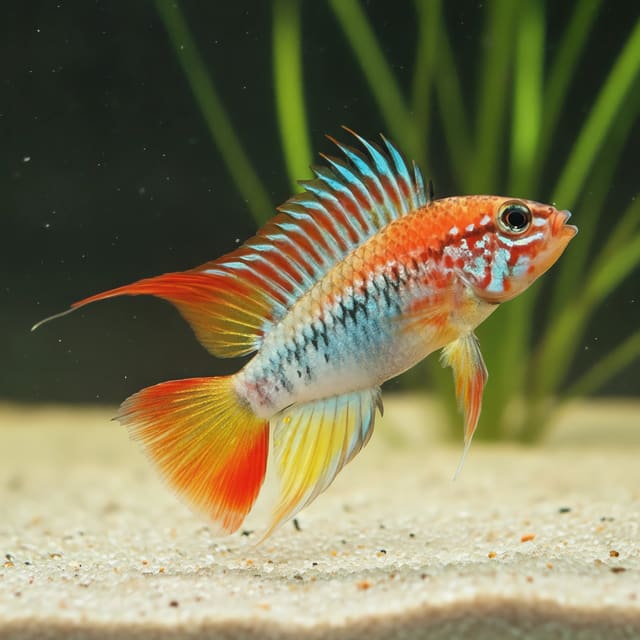
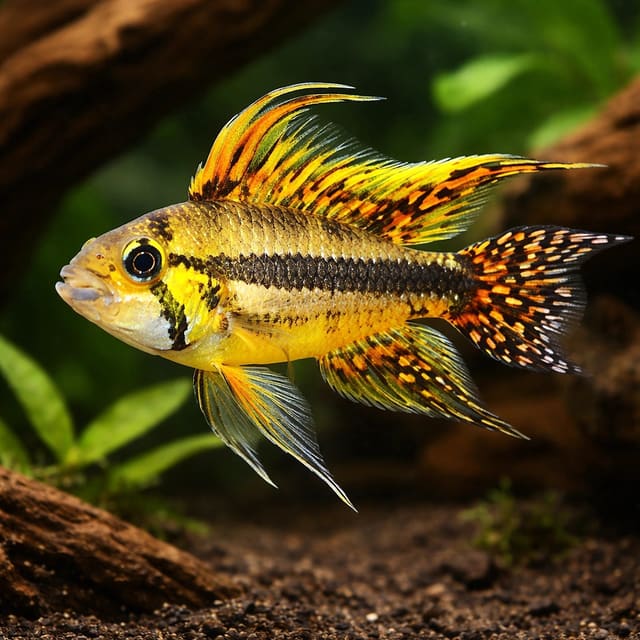
If you are looking for something smaller for a different South American tank, we also list dwarf cichlids such as the Cockatoo Dwarf Cichlid (Apistogramma cacatuoides) and the Super Red Agassiz's Dwarf Cichlid. They are very different fish with their own needs, so read each listing rather than assuming they belong in the same tank as this one.
We could not find a published account of breeding Guianacara dacrya itself in the sources we read, so we will not describe it as if we had. What FishBase does record is how two of its closest relatives breed, which gives a reasonable idea of what to prepare for.
If a pair forms in your tank, the setup described above already gives them what the genus uses: caves and crevices among rocks over a sandy floor. A few practical points:
Because the sexes are hard to tell apart, the main obstacle to breeding is usually getting a pair in the first place. Buying a single fish or two fish is not a breeding plan; growing on a small group in a large tank gives you the best chance. If a pair does form and spawn, keep notes on what you see: we could not find a published breeding account for this species, so first-hand observations are genuinely useful.
Please read our delivery and live-arrival information before you order. The aquarium must be ready before the parcel arrives: filter running, water tested, and temperature matched to the 24 to 28 °C this fish needs. Someone must be at the delivery address to receive live animals.
Your fish travels in an oxygen-filled bag inside insulated packaging, with heat packs when conditions call for them, via a tracked courier licensed to carry live animals. We email the confirmed delivery date and tracking so you can plan to be at home.
Start recording a continuous video while the parcel is still sealed. Open it in the same take and show the fish in its still-sealed bag. If a fish arrives dead, dying or clearly compromised, email hello@tropicalfishco.co.uk on the day of delivery with your order number and that video. Photos alone do not meet the policy. The resolution is a replacement with your next order or a refund for the affected fish, subject to the guarantee terms.
Keep the lights low for the first day and let the fish find its way among the rocks. A new cichlid often hides at first, which is normal. Over the following week, watch:
If you already have an established community, the safest approach is to keep a new fish in a separate cycled quarantine tank for a few weeks before adding it to the main display. That lets you watch it closely, make sure it is feeding, and avoid bringing problems into a tank full of fish you value.
If anything looks wrong, test the water first, since most early problems start there, then look at tank mates and feeding. Keep feeding light, keep changing water, and avoid moving rocks or adding new fish while it settles in.
These are the references we used. The original description is especially worth reading if you want to understand how this species differs from its relatives.
No reviews for this item yet. Bought one? Honest reviews only, good or bad.
What customers say about ordering from us
I have a small group of long finned mountain minnows. So was delighted to be able to order ten of this variety to increase the genetics in my tank . The ones I recieved are healthy but it’s to early to give a verdict on wether they are of a long finned type since they are small currently.
Gordon Walker · 23 Sept 2026
100% success travel and "installation". Pleased with quality of purchase. The Siamese fighter a bit "shy" so have not yet seen him at his best yet but looking good. Happy customer. GG
George E Garratt · 21 Sept 2026
Reviews of our shop, collected by Judge.me, an independent third-party review collector. Newest first.