Moderate
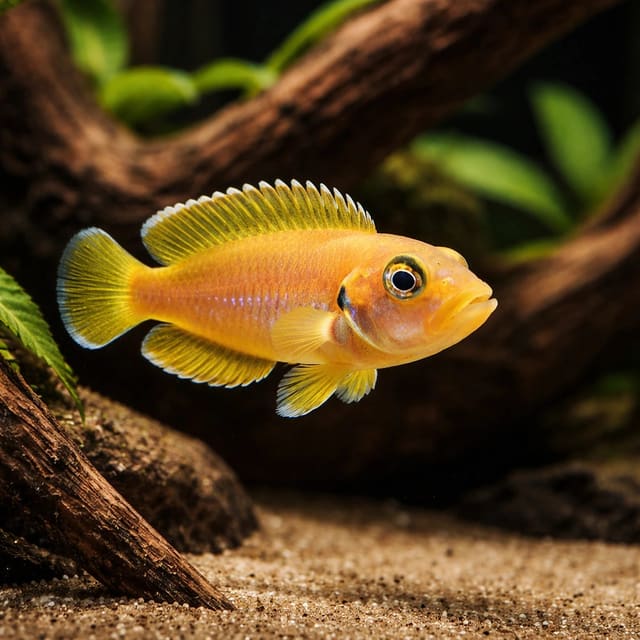
Gold Ocellatus Shell-Dweller (Neolamprologus ocellatus)
23–25°C · pH 8–9
£16.59

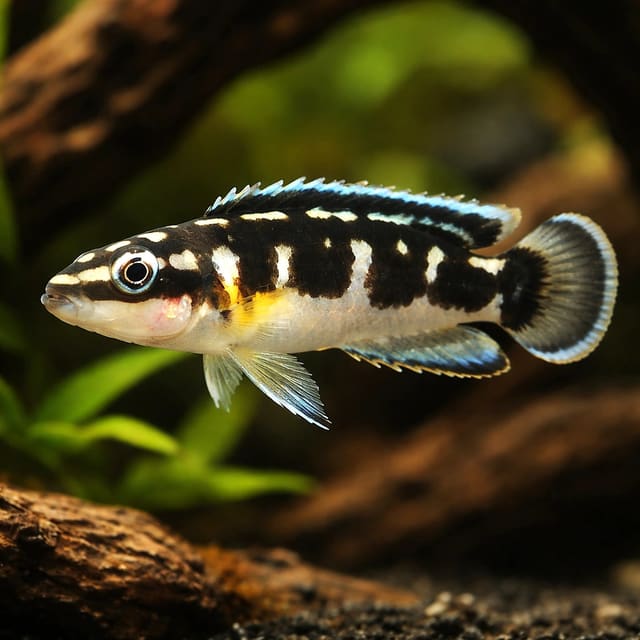
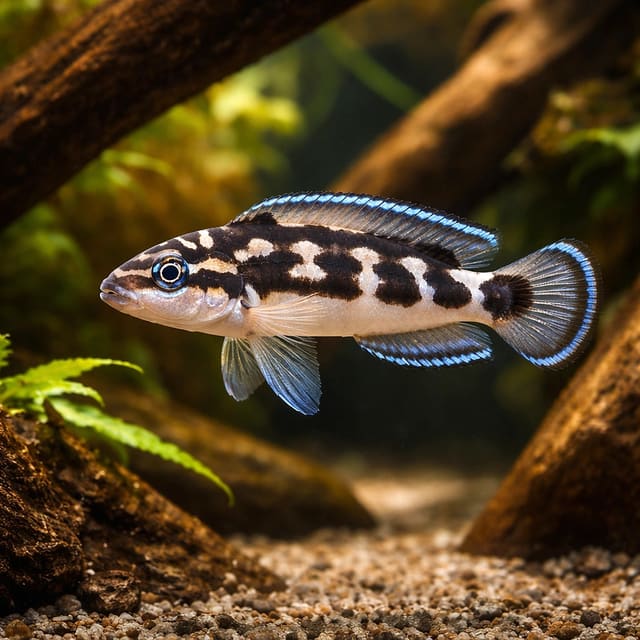
Marlier's Julie (Julidochromis marlieri) is a rock cichlid endemic to north-western Lake Tanganyika that reaches 13 cm. It suits keepers who can provide a compatible pair with at least 110 litres and a 120 × 30 cm base, plus the FishBase, Seriously Fish and OATA overlap of 23–25°C, pH 8.0–8.6 and 12 dGH. Sold individually in dispatch sizes from 3–4 cm to over 8 cm.
Adult size is the maximum length this species reaches at full maturity (scientific sources). The livestock you receive will be younger and smaller — pick a size above for the actual shipping size. Product-photo provenance and any image-specific limitations are stated on the listing.
Julidochromis marlieri
Save when buying multiple fish. Each quantity is one fish; sex and pair formation are not guaranteed unless the selected variant explicitly states them.
Marlier's Julie (Julidochromis marlieri) is a rock cichlid endemic to north-western Lake Tanganyika that reaches 13 cm. It suits keepers who can provide a compatible pair with at least 110 litres and a 120 × 30 cm base, plus the FishBase, Seriously Fish and OATA overlap of 23–25°C, pH 8.0–8.6 and 12 dGH. Sold individually in dispatch sizes from 3–4 cm to over 8 cm.
Adult size is the maximum length this species reaches at full maturity (scientific sources). The livestock you receive will be younger and smaller — pick a size above for the actual shipping size. Product-photo provenance and any image-specific limitations are stated on the listing.
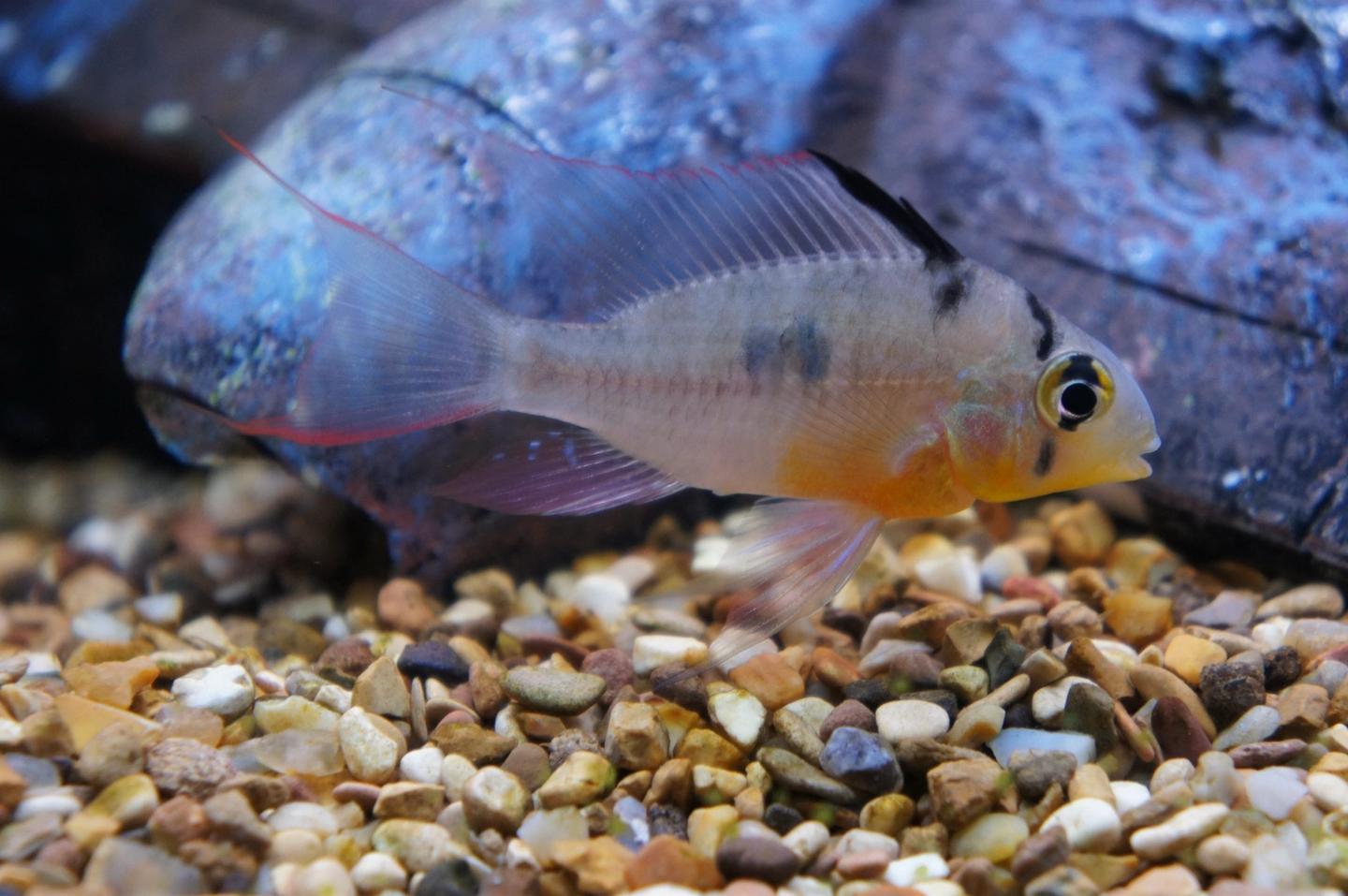
Cichlids are a family of roughly 1,800 accepted species, not one care type. Before buying, identify the exact species and source, then compare adult measurement, usable tank dimensions, social system, territory, tested water, diet and an exit plan. No family-wide minimum tank, water range or tank-mate list is safe.
Maintain these water conditions for optimal health and vibrant colors
Marlier's Julie (Julidochromis marlieri) is a freshwater cichlid in the family Cichlidae, endemic to the north-western part of Lake Tanganyika. FishBase records a maximum of 13 cm total length. It suits keepers who can provide a compatible pair with at least 110 litres and a 120 × 30 cm base, as recommended by Seriously Fish, together with secure caves and distinct rock territories. Keep it at 23–25°C, pH 8.0–8.6 and 12 dGH; these values are the overlap of FishBase, Seriously Fish and OATA's African lake cichlid group guidance.
Julidochromis are commonly called Julies in the aquarium hobby, and this patterned species is also known as the Chequered Julie. FishBase describes the wild fish as demersal. It lives close to rocks, ventures into open water without moving far from cover and uses crevices and caves for breeding. In nature it does not normally occupy midwater or rise to the surface to feed. FishBase also lists the species as Least Concern.
This is a microfeeder rather than a carnivorous hunter. Its tendency to inspect rock surfaces explains why an open aquarium with only one decorative cave is a poor match. Build a substantial network of accessible crevices and distinct rock areas, then leave enough room around the structure for the fish to move between feeding and shelter. Expect it to orient closely to rock faces, including angled surfaces, rather than spending all day in exposed open water.
| Suits | Not suited to |
|---|---|
| Keepers able to provide at least 110 litres and a 120 × 30 cm base for a compatible pair | A smaller permanent aquarium planned around the dispatch size |
| A hard, alkaline Lake Tanganyika-style aquarium with extensive caves | An open setup with little rock cover |
| A carefully screened Tanganyika community with distinct territories | A mixed Malawi and Tanganyika cichlid community |
| A compatible pair or a much larger adult-group plan | An adult group in the pair-sized aquarium |
FishBase describes it as peaceful towards other species, while aquarium guidance identifies strong territorial behaviour between adults of its own kind. That combination makes it a fish for a deliberately planned Tanganyika aquarium rather than an unstructured mixed community. Browse our African cichlid collection to compare body size and aquarium style, but assess every proposed combination by lake origin, adult size and territorial use.
One purchase supplies one animal of the selected size. The offer uses the labels 3 - 4 cm, 4 - 5 cm, 6-7 cm and > 8 cm; use the live size selector to make your choice. The size you select is the size supplied, not the adult size. Treat that dispatch measurement as the fish's starting point in your aquarium, not as a reason to choose a smaller permanent home.
Sex is guaranteed only when the selected option explicitly states male or female. This Marlier's Julie listing has no sex-guaranteed option.
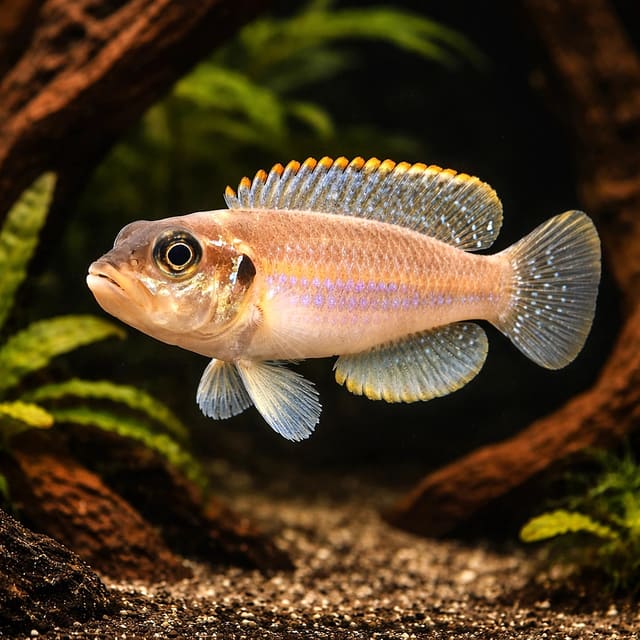
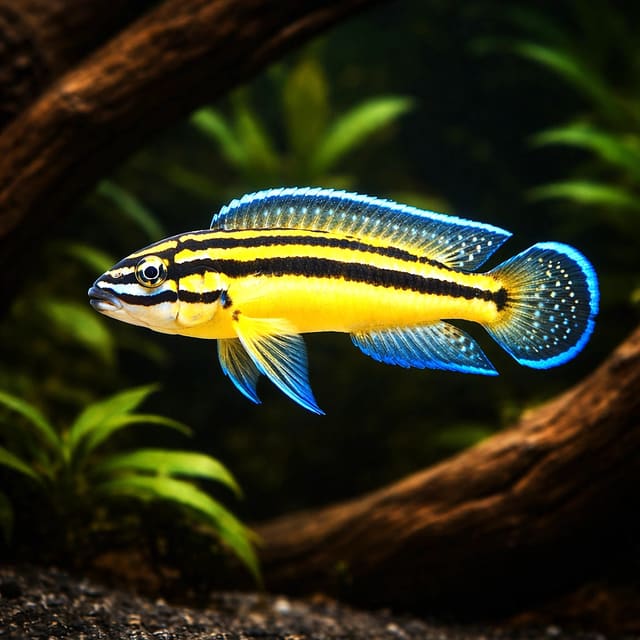
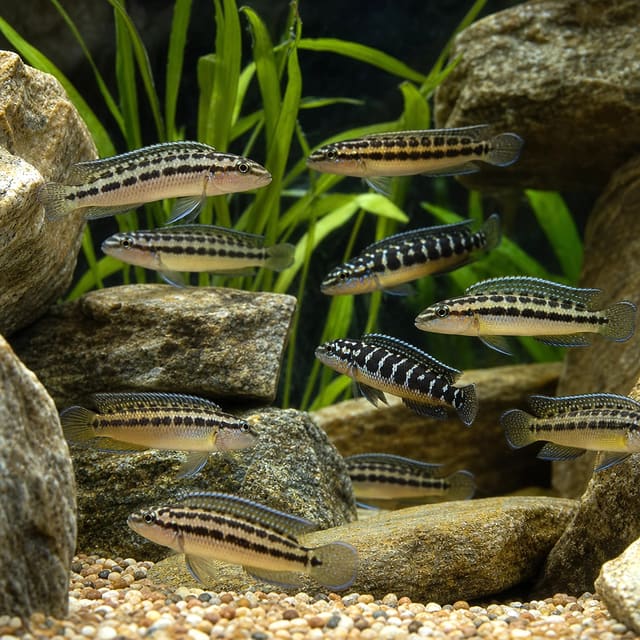
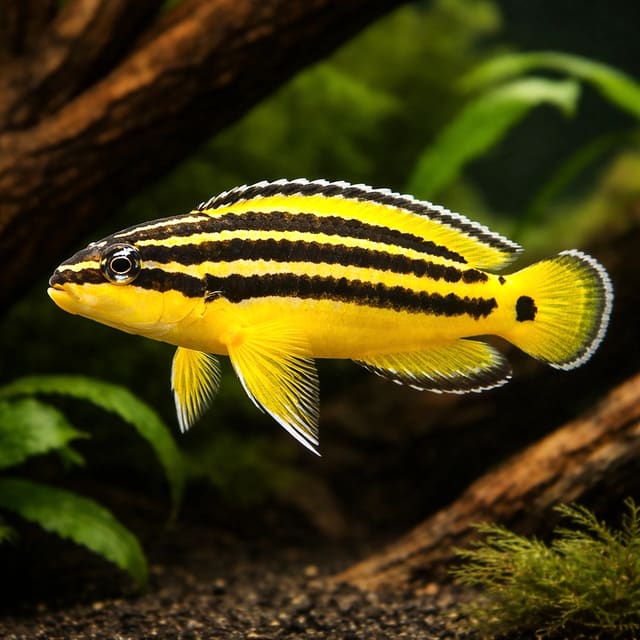
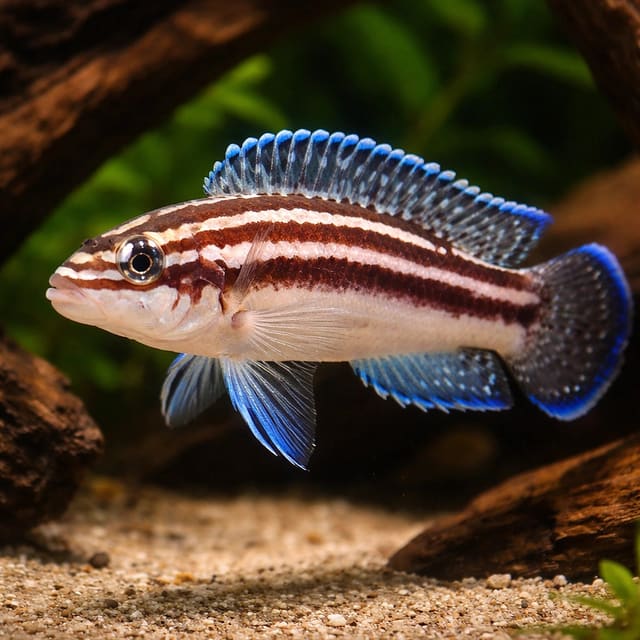
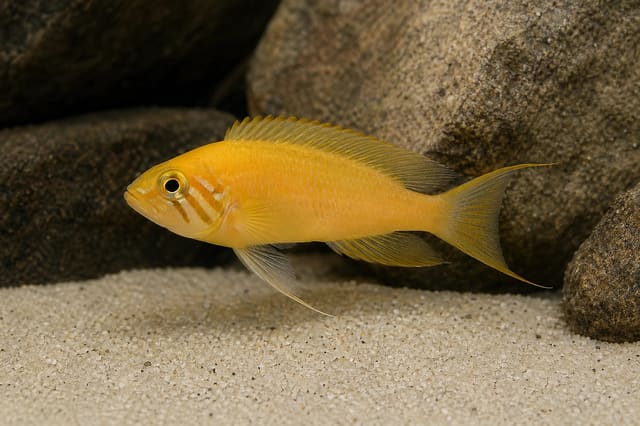
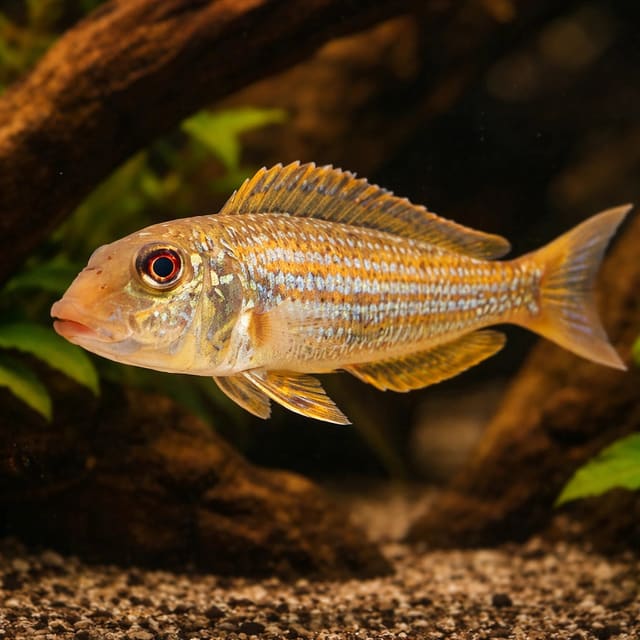
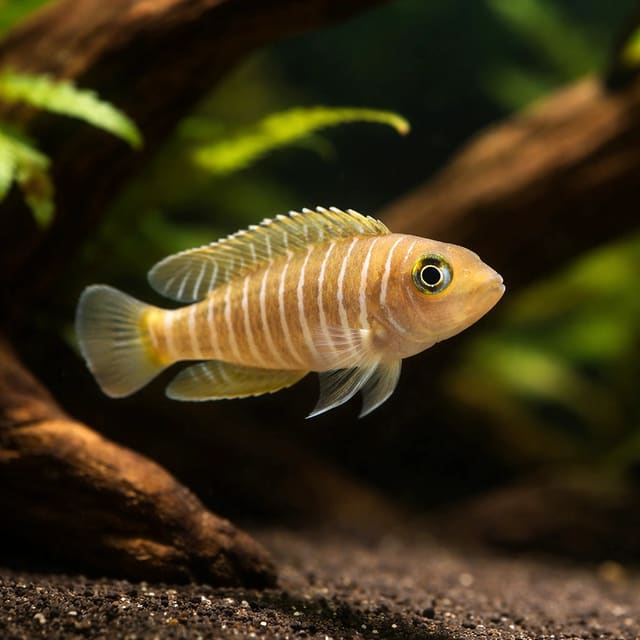
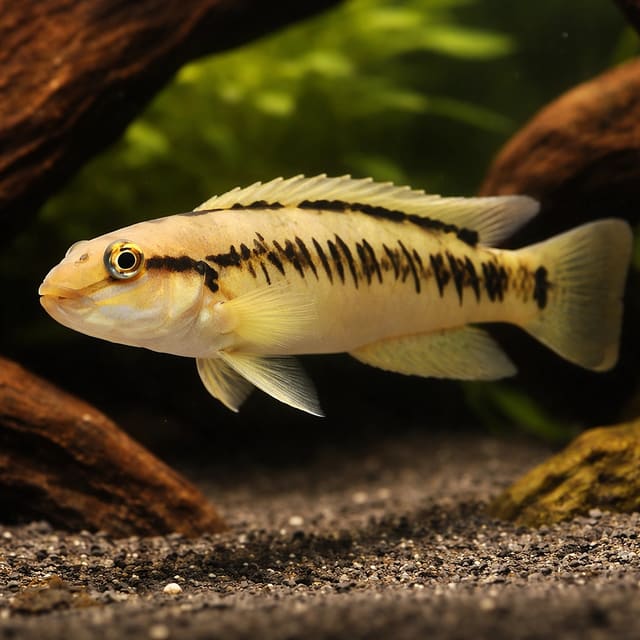
The gallery images are representative, based on reference photographs of this species, so colours can look slightly different from the live animal.
Seriously Fish uses 15 cm standard length as its planning reference and recommends an aquarium measuring 120 × 30 × 30 cm, about 110 litres, for a single pair. FishBase records a different maximum figure of 13 cm total length. These are planning limits rather than a promise that every individual will reach one precise measurement.
| Planning point | Decision |
|---|---|
| Dispatch size | Choose the labelled size through the live selector. |
| Recorded maximum | Allow for FishBase's 13 cm total-length figure. |
| Husbandry reference | Also account for the 15 cm standard-length planning figure. |
| Pair aquarium | Use at least 110 litres with a 120 × 30 cm base. |
| Adult group | Provide much larger quarters than the pair setup. |
The footprint matters as much as the litre figure because caves and defended boundaries occupy floor and rock-face space. Before selecting a dispatch size, decide where the permanent 120 cm aquarium will stand, how the rock piles will be arranged and how a compatible pair would divide the structure. If your plan involves a group of adults, start with the larger aquarium rather than relying on a later upgrade after territories have formed.
Make rockwork the functional centre of the aquarium. Seriously Fish recommends a Lake Tanganyika-style setup with piles of rocks forming caves through much of the tank, a sandy substrate and strong oxygenation. Every pile must be stable enough to remain secure during routine maintenance and territorial activity. Create several entrances and separate rock areas instead of one exposed arch that every fish must contest.
When more than one rock-dwelling species is planned, give each species a distinct rock pile. This spreads territorial pressure and lets each fish retreat without crossing every other cave entrance. Do not treat two caves touching the same central mound as separate territories when both belong to the same contested structure.
| If the layout has… | Change it by… |
|---|---|
| One dominant cave | Adding several separate crevices and entrances. |
| One central rock mound | Dividing it into distinct territorial areas. |
| Several species sharing one mound | Giving each species a distinct rock area. |
| Little water movement | Improving filtration and vigorous aeration. |
Finish the complete structure before introducing the fish. A rock-hugging cichlid needs immediate access to cover, while a territorial adult needs boundaries that are already clear. If aggression later develops, rearranging décor can help reset territories, but the initial design should reduce the need for repeated disturbance.
Use 23–25°C, pH 8.0–8.6 and 12 dGH as the routine aquarium target. FishBase records a wild environmental temperature of 22–25°C, pH 7.5–9.0 and a hardness entry reaching 12 dH. Seriously Fish gives 23–27°C, pH 7.5–9.5 and 10–25 dGH for aquarium care. OATA's African lake cichlid guide gives 23–27°C, pH 8.0–8.6 and 12–18 dGH as group guidance. The routine targets use the shared part of those ranges rather than widening any species boundary.
| Value | Routine target |
|---|---|
| Temperature | 23–25°C |
| pH | 8.0–8.6 |
| General hardness | 12 dGH |
| Carbonate hardness | 10–15 dKH |
| Ammonia | 0 mg/l |
| Nitrite | 0 mg/l |
| Nitrate | Not to exceed 20 mg/l above the normal tap-water level |
The general-hardness target is deliberately precise: 12 dGH is the common point between FishBase's upper value, the 10–25 dGH aquarium range and OATA's 12–18 dGH group range. Carbonate hardness of 10–15 dKH comes from the African lake cichlid guidance and supports the hard, alkaline setup. Test the actual aquarium rather than judging hardness from appearance or assuming that clear water has suitable chemistry.
Use our water chemistry guide to understand pH, GH, KH and nitrogen-waste tests. Record the aquarium values and compare them with the targets using the water matcher. A worked check is simple: water at 24°C, pH 8.3 and 12 dGH sits inside the routine target; water at pH 7.2 does not, even if its temperature is correct.
Prioritise consistency once the aquarium is within range. Regular testing reveals gradual drift before behaviour or appetite changes. It also separates a chemistry problem from a territorial problem: if hiding or rapid breathing appears, test ammonia, nitrite, nitrate, pH and temperature before changing the rock layout.
A working biological filter is essential. The RSPCA explains the aquarium nitrogen cycle: fish release toxic ammonia, beneficial filter bacteria convert it to nitrite, and another stage converts nitrite to the safer nitrate. The aquarium must therefore be matured and tested before livestock is added, not merely filled and brought to the right temperature.
Follow our first tropical aquarium guide while preparing the system. OATA recommends an oversized filter for African lake cichlid communities and vigorous aeration to maintain dissolved oxygen. Those measures suit this well-oxygenated Tanganyika setup, but extra filter capacity does not replace water testing or routine maintenance.
Add fish slowly because every increase in livestock and feeding increases the waste handled by the bacterial population. Stocking too quickly can cause new tank syndrome when the filter bacteria cannot process the increased ammonia and nitrite. Test after each planned addition rather than assuming that a previously mature filter can absorb every increase immediately.
Once occupied, check the filter for reduced flow or blockages. A quiet filter or clear-looking aquarium is not enough to judge biological performance. The decisive readings remain ammonia and nitrite at zero, supported by controlled nitrate and normal behaviour, breathing and appetite.
FishBase describes the wild animal as a microfeeder and specifically says it is not carnivorous. Build the aquarium diet around variety rather than using a meat-heavy predator ration. Seriously Fish recommends that live and frozen foods form a decent proportion of the diet alongside a quality dried product. Add algae-based food and vegetable matter such as spirulina or blanched spinach.
| Food role | Suitable approach |
|---|---|
| Live and frozen foods | Keep these as a meaningful part of the varied diet. |
| Quality dried food | Use alongside, not instead of, the full range. |
| Algae-based food | Include it as a regular plant component. |
| Vegetable matter | Offer spirulina or blanched spinach. |
Feed twice a day and give only what the fish can finish within a few minutes. That OATA schedule supplies a clear portion test without relying on a fixed number of pieces. Watch the entire feeding period: food remaining after the fish have stopped eating means the portion was too large, while uneaten food breaks down and adds waste to the water.
Its wild habit of staying close to rock cover matters during feeding. Place attention on whether the fish leaves or moves along cover to feed, rather than expecting it to rise to the surface like an open-water species. Make sure food reaches its feeding area without increasing the portion simply because some pieces drift elsewhere.
Use appetite as a daily checkpoint. A reduced intake or complete loss of interest can accompany water-quality or health problems. Test ammonia, nitrite, nitrate, pH and temperature when feeding behaviour changes, then compare the result with the fish's normal breathing, colour, condition and use of caves. Do not compensate for poor appetite by repeatedly adding more food, because the resulting waste can make water quality worse.
Prepare the aquarium and keep someone at home for the delivery window so live fish are not left unattended. Follow the current delivery and Live Arrival Guarantee policy. Have the filter, aeration, temperature and water tests ready before the parcel arrives.
OATA advises watching a newly introduced fish for changes in swimming, breathing, colour, condition and feeding. Rock-oriented behaviour has a natural context for this species. Staying close to caves or moving along rock faces can match its normal way of using cover, so judge that behaviour alongside posture, breathing, colour and feeding rather than treating hiding alone as a diagnosis.
| Checkpoint | What to assess |
|---|---|
| Water | Ammonia and nitrite remain at 0 mg/l; temperature stays at 23–25°C. |
| Breathing | Gill-cover movement has not become unusually fast or slow. |
| Appearance | Eyes are clear; fins, scales and body remain intact. |
| Behaviour | The fish can use cover without continuous pursuit. |
| Feeding | Interest in the controlled twice-daily meals is developing or maintained. |
Changes in colour, erratic swimming, hanging at the surface, persistent bottom sitting, damaged fins, white spots, fluffy growths or reduced food intake all deserve attention. Test water quality first because even small amounts of ammonia can stress African lake cichlids. Record the result and the behaviour together; that makes it easier to distinguish a water problem from territorial pressure or a health change.
Carry out a 25% partial water change at least once every week. Use a siphon to remove solid waste, treat replacement tap water with conditioner to remove chlorine or chloramine, and keep the replacement water consistent with the established hard, alkaline target. Test ammonia and nitrite at least weekly even when the fish appear normal.
| Maintenance job | Reason |
|---|---|
| 25% water change at least once a week | Controls accumulated waste without relying on occasional major changes. |
| Siphon accessible substrate | Removes solid waste before it breaks down. |
| Treat replacement water | Prevents chlorine or chloramine entering the aquarium. |
| Check filter flow | Reveals blockages that reduce circulation and oxygenation. |
| Rinse media in removed tank water | Reduces loss of beneficial bacteria. |
| Record test results | Shows gradual drift before it becomes a crisis. |
Never rinse biological filter media under the tap. Chlorine or chloramine may damage the bacterial population that processes ammonia and nitrite. Lightly rinse dirty media in aquarium water removed during the partial change, and avoid cleaning every part of the filter simply because one section needs attention.
Seriously Fish advises avoiding large water changes with established Marlier's Julie pairs because disruption may cause partners to turn on one another. The regular 25% routine provides a predictable baseline. Combine each change with a quick territory check rather than repeatedly dismantling the caves: confirm that entrances remain open, rocks remain secure and neither fish is trapped away from cover.
During the first month, compare each weekly set of readings with breathing, appetite, colour and aggression. A sudden change in those observations should trigger immediate water tests rather than waiting for the next routine day. If concerning health changes continue after the readings and husbandry have been checked, contact us with the results and a clear description of what changed.
Plan around a compatible pair unless the aquarium is much larger than the 110-litre pair setup. FishBase reports that monogamous pairs are most common in the wild, while Seriously Fish says adults are very belligerent towards one another and recommends pair keeping unless the tank is huge. A pair still needs extensive caves, distinct rock areas and the full 120 × 30 cm base.
Two fish are not automatically a bonded pair. Seriously Fish warns that simply combining an adult male and female does not guarantee compatibility and may lead to severe harassment. Sexing characteristics described for adults should not be used as a promise about a selected fish or as a substitute for watching the actual relationship.
Seriously Fish describes beginning with a group of young fish and allowing a pair to form naturally. Pair formation may take a year or more. Once a pair forms, the remaining fish should be removed because the established pair may direct strong aggression towards them. This method therefore requires spare capacity and a clear plan for every surplus fish; it is not a way to keep an adult group permanently in the pair-sized aquarium.
| Keeping plan | Requirement |
|---|---|
| Single fish | Monitor behaviour carefully because African lake cichlids commonly benefit from social planning appropriate to their species. |
| Compatible pair | Use at least 110 litres, a 120 × 30 cm base and extensive caves. |
| Young pairing group | Provide removal space before pair formation begins. |
| Adult group | Use much larger quarters and watch territorial boundaries closely. |
Do not infer life stage from a size label. Choose the dispatch measurement through the selector, then judge group planning from the known aquarium footprint, the number of secure territories and the behaviour seen after introduction. If the aim is a pair, success is defined by stable coexistence and shared territorial behaviour, not merely by placing two animals together.
Start with Lake Tanganyika origin, similar adult size and a different use of territory. OATA advises keeping African lake species with fish from the same location and generally avoiding mixtures of Malawi and Tanganyika cichlids because their behaviour and temperament differ. Seriously Fish says this species can be maintained with similarly sized Tanganyikan cichlids, including Altolamprologus and Cyprichromis species, when the aquarium is planned correctly.
Those examples are candidates for assessment, not universal companions. Each rock-dwelling species needs a distinct pile of rocks so territories do not collapse onto the same caves. Compare adult size rather than dispatch size, and consider whether every fish can reach food and shelter without crossing the pair's defended core.
| Candidate | Screening decision |
|---|---|
| Similarly sized Tanganyika cichlid | Consider only with enough space and separate territory. |
| Altolamprologus species | Possible after checking adult size and rock use. |
| Cyprichromis species | Possible after checking footprint, numbers and feeding access. |
| Lake Malawi cichlid | Avoid mixing Malawi and Tanganyika communities. |
| Another Julidochromis species or morph | Avoid because Julidochromis may hybridise. |
Do not combine different Julidochromis species or geographical morphs in the same aquarium because they may hybridise. Also avoid treating all African cichlids as one interchangeable community: a shared continent does not replace matching by lake, behaviour, water conditions and territorial needs.
Individual responses can still differ after every initial check has passed. The compatibility test continues after introduction: watch whether each fish can occupy cover, feed and rest without persistent pursuit. A combination that repeatedly excludes one fish from caves or meals has failed the territorial screen even when both species share the same lake.
Prepare for territorial pressure before adding another fish. Identify which caves belong to the established pair, build a genuinely separate rock pile for the newcomer and confirm that the aquarium has enough base area for both zones. Adding more livestock cannot create territory that the footprint and rockwork do not contain.
| If you see… | Do this… |
|---|---|
| Brief display near a cave | Observe whether both fish can disengage and return to separate cover. |
| Continuous pursuit | Rearrange décor to create new territories. |
| One fish excluded from every cave | Move the pressured fish apart from the aggressor rather than waiting for injury. |
| Damaged fins, lost scales or poor feeding | Separate the fish and test water quality promptly. |
| A pair forming within a young group | Remove the remaining Julidochromis as planned. |
OATA recommends adding more peaceful African lake species before more aggressive ones and notes that rearranging aquarium décor can reduce aggression by making fish establish new territories. Use that sequence only after checking biological capacity: livestock must still be added slowly enough for the filter bacteria to adjust to the extra waste and feeding.
Do not respond to aggression by overfeeding. Extra uneaten food increases toxic waste without changing the amount of defendable space. Instead, review the physical causes: too little base area, too few independent caves or too much competition for one rock pile. Correct the layout, then continue observing access to food and shelter.
A stable pair may react badly to major disturbance, so avoid repeatedly stripping down the whole aquarium. Make the smallest effective territorial change, preserve secure caves where possible and continue the normal 25% water-change routine at least once a week. If one fish remains under sustained attack, physical separation takes priority over preserving the intended community plan.
FishBase records Marlier's Julie at up to 13 cm total length. Plan its permanent aquarium around that adult figure rather than the dispatch size.
Seriously Fish recommends at least 110 litres with a 120 × 30 cm base for a compatible pair. Use extensive secure rock piles, caves, sand and strong oxygenation; a group of adults needs much larger quarters.
Plan around a compatible pair unless the aquarium is much larger than the 110-litre pair setup. A young pairing group requires spare accommodation because the remaining fish should be removed when a pair forms.
Marlier's Julie suits a keeper prepared to maintain hard, alkaline water, secure extensive rockwork and manage territorial pair behaviour. OATA describes African lake cichlids as specialised fish requiring particular water parameters.
Feed varied live and frozen foods, quality dried food, algae-based food and vegetable matter such as spirulina or blanched spinach. Offer only what it can eat within a few minutes, twice a day.
Keep Marlier's Julie at 23–25°C, pH 8.0–8.6 and 12 dGH. These routine values are the overlap of FishBase, Seriously Fish and OATA's African lake cichlid group guidance.
It is territorial, and Seriously Fish describes adults as very belligerent towards one another. Use a compatible pair, extensive caves and enough space, and separate fish if continuous pursuit, injury or exclusion from shelter develops.
Carefully consider similarly sized Tanganyika cichlids such as Altolamprologus or Cyprichromis species when each has suitable space and territory. Avoid mixing Malawi and Tanganyika cichlids, and avoid other Julidochromis species or morphs because they may hybridise.
The Tropical Fish Co policy requires someone to receive the parcel in person. Film every delivery continuously from the sealed parcel as it is opened, showing the fish still in the sealed bag; then float the bag for 20–30 minutes and never pour the bag water into the aquarium.
No reviews for this item yet. Bought one? Honest reviews only, good or bad.
What customers say about ordering from us
I have a small group of long finned mountain minnows. So was delighted to be able to order ten of this variety to increase the genetics in my tank . The ones I recieved are healthy but it’s to early to give a verdict on wether they are of a long finned type since they are small currently.
Gordon Walker · 23 Sept 2026
100% success travel and "installation". Pleased with quality of purchase. The Siamese fighter a bit "shy" so have not yet seen him at his best yet but looking good. Happy customer. GG
George E Garratt · 21 Sept 2026
Reviews of our shop, collected by Judge.me, an independent third-party review collector. Newest first.