Moderate
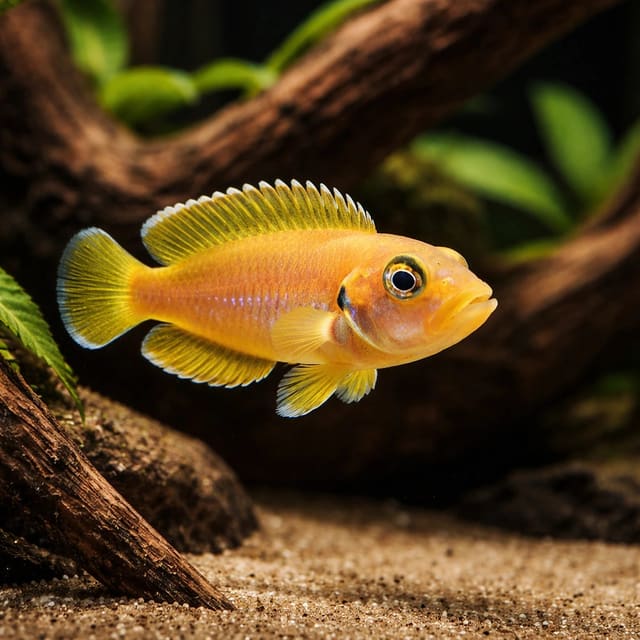
Gold Ocellatus Shell-Dweller (Neolamprologus ocellatus)
23–25°C · pH 8–9
£16.59

Golden Julie (Julidochromis ornatus) is a territorial, rock-dwelling Lake Tanganyika cichlid that reaches a recorded maximum of 8.5 cm total length. Plan a compatible pair in at least 70 litres with a 75 × 30 cm base, abundant caves, 23–27°C water and careful Tanganyikan tank-mate screening; one purchase supplies one fish of the selected size.
Adult size is the maximum length this species reaches at full maturity (scientific sources). The livestock you receive will be younger and smaller — pick a size above for the actual shipping size. Product-photo provenance and any image-specific limitations are stated on the listing.
Julidochromis ornatus
Save when buying multiple fish. Each quantity is one fish; sex and pair formation are not guaranteed unless the selected variant explicitly states them.
Golden Julie (Julidochromis ornatus) is a territorial, rock-dwelling Lake Tanganyika cichlid that reaches a recorded maximum of 8.5 cm total length. Plan a compatible pair in at least 70 litres with a 75 × 30 cm base, abundant caves, 23–27°C water and careful Tanganyikan tank-mate screening; one purchase supplies one fish of the selected size.
Adult size is the maximum length this species reaches at full maturity (scientific sources). The livestock you receive will be younger and smaller — pick a size above for the actual shipping size. Product-photo provenance and any image-specific limitations are stated on the listing.
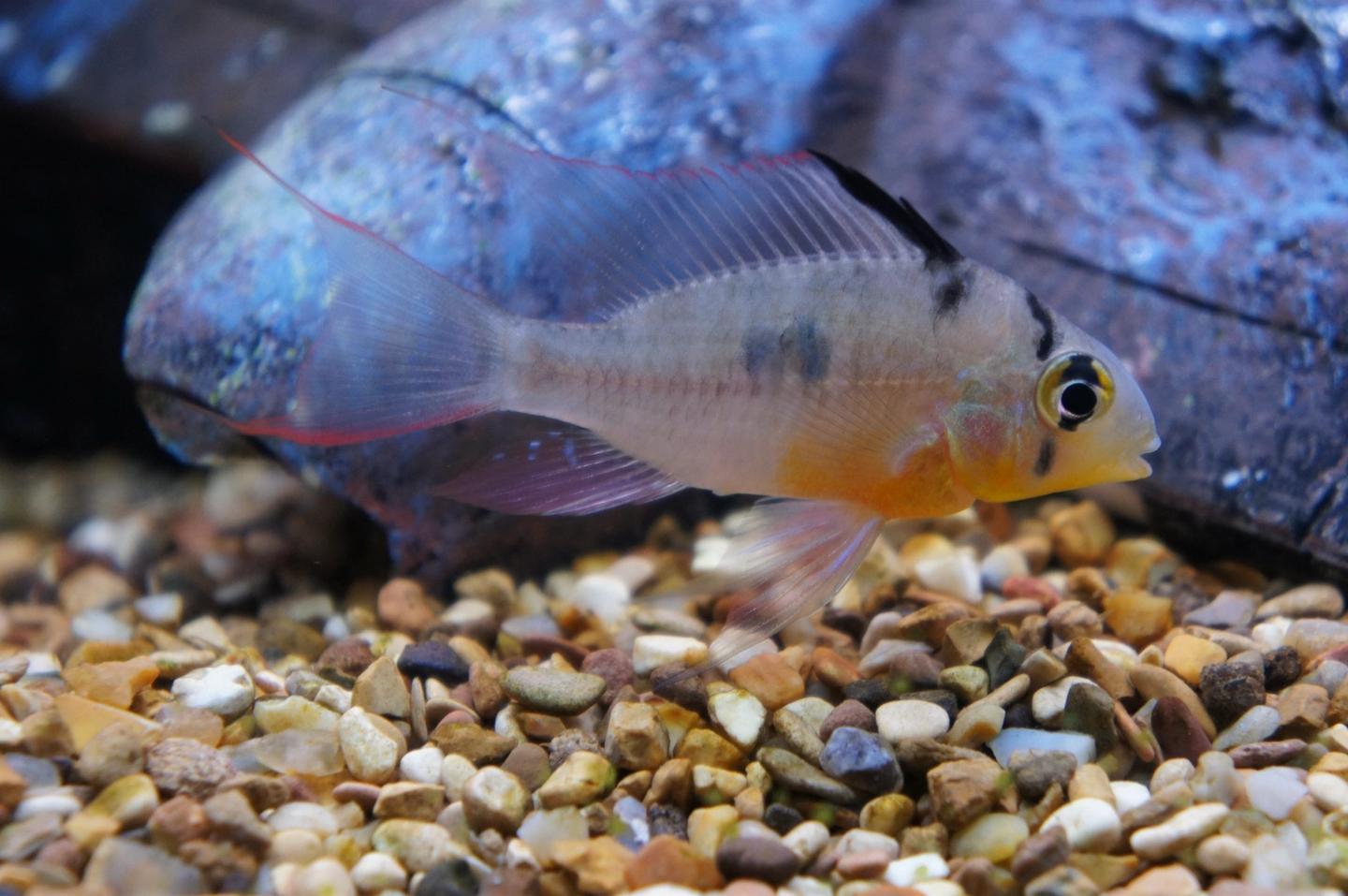
Cichlids are a family of roughly 1,800 accepted species, not one care type. Before buying, identify the exact species and source, then compare adult measurement, usable tank dimensions, social system, territory, tested water, diet and an exit plan. No family-wide minimum tank, water range or tank-mate list is safe.
Maintain these water conditions for optimal health and vibrant colors
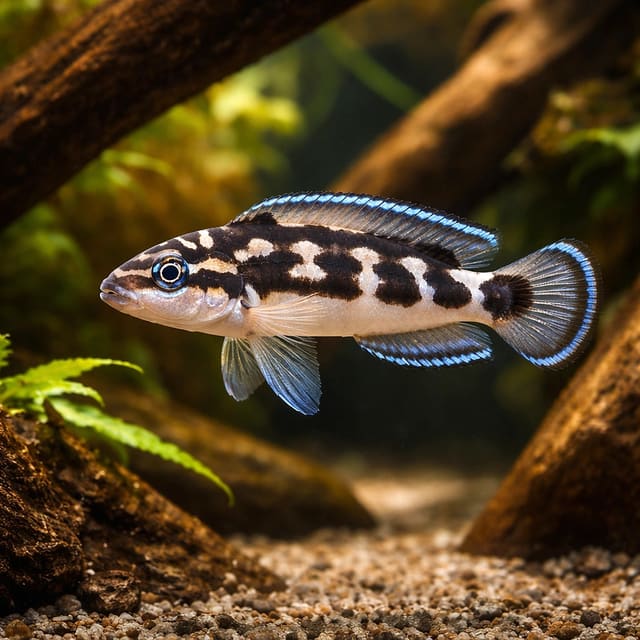
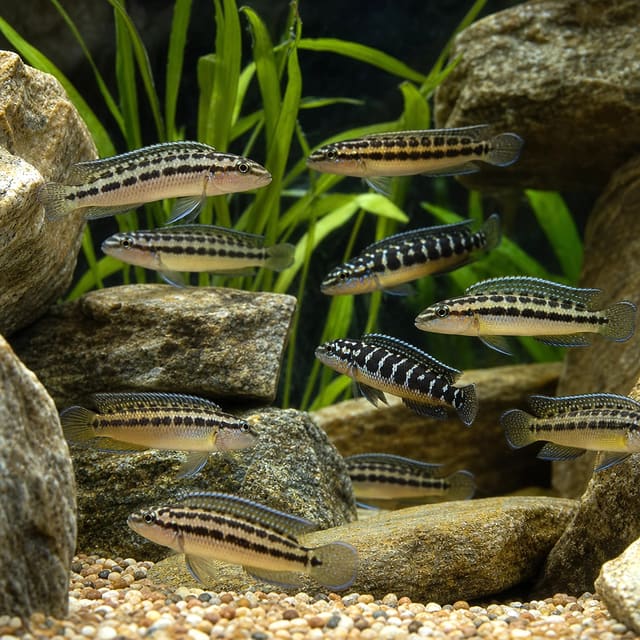
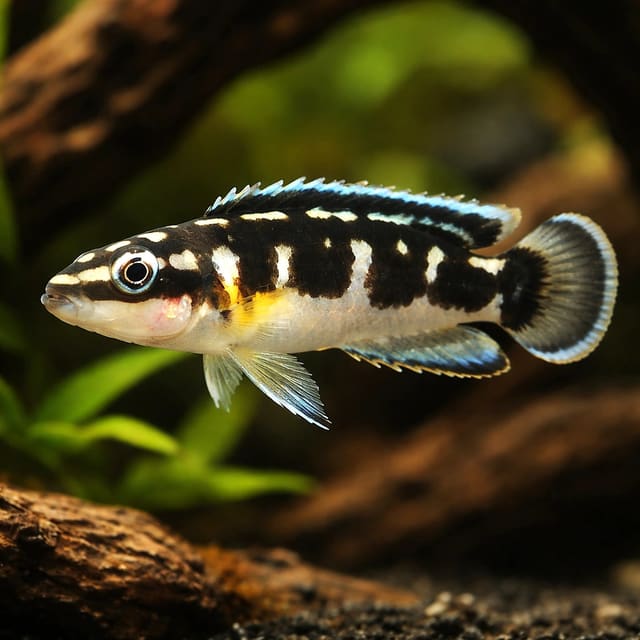
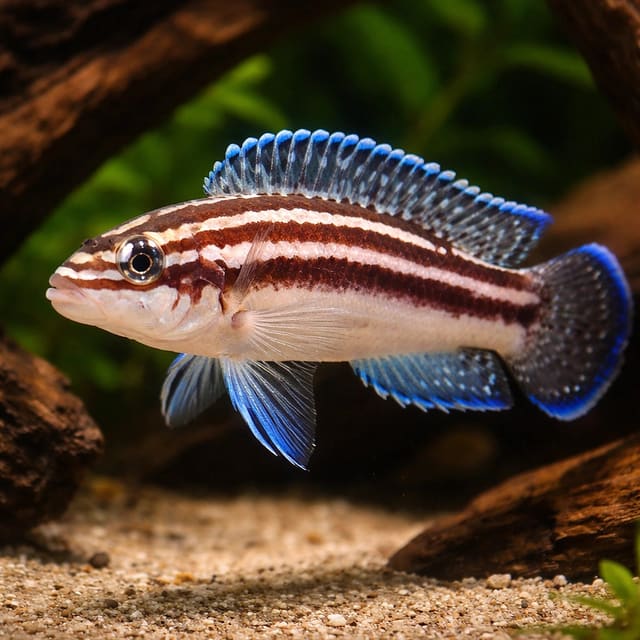
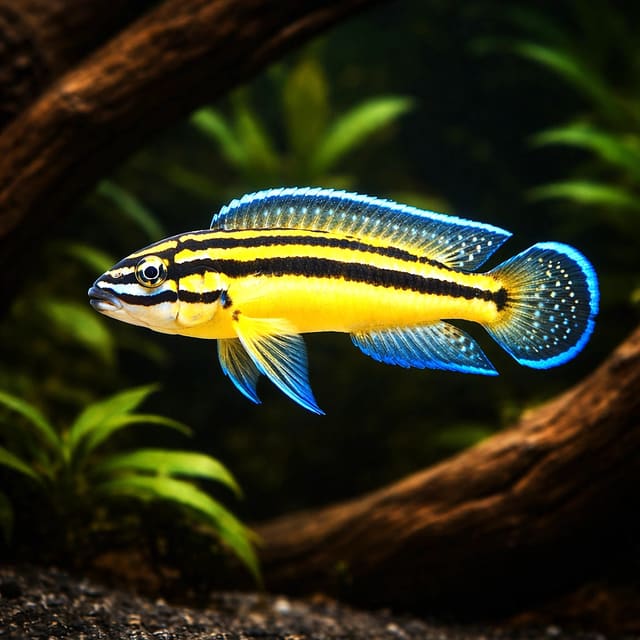
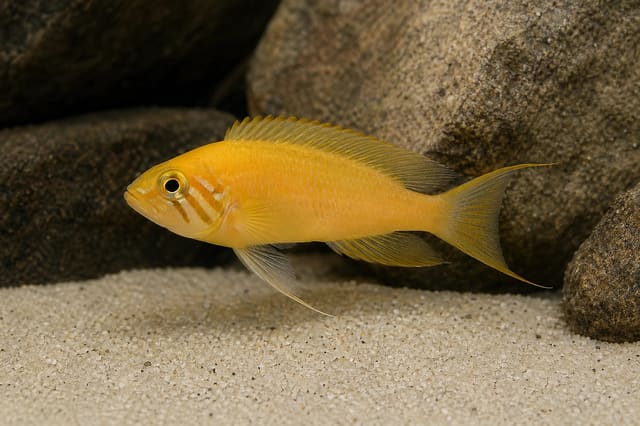
Golden Julie is the established aquarium name for Julidochromis ornatus, a freshwater cichlid from Lake Tanganyika. Its elongated shape, yellow ground colour and dark horizontal markings make it distinctive, but its behaviour should drive the buying decision: this is a rock-dwelling, territorial fish that uses caves, crevices and nearby surfaces rather than an open-water community fish.
FishBase records a maximum of 8.5 cm total length and describes wild fish as usually solitary and territorial. It feeds on microorganisms in its natural habitat and is endemic to Lake Tanganyika, principally in the northern part of the lake, with a southern variety near Mpulungu. FishBase assesses the species as Near Threatened in the wild; that conservation category describes the wild species rather than the origin of an individual aquarium fish.
The modest adult length can make this Julie look like a candidate for any small community, but territory design matters more than centimetres alone. A suitable aquarium gives a compatible pair a defined rocky area and several retreats. Open floor space without caves does not meet the fish’s rock-oriented behaviour, while one dominant cave can leave a subordinate fish with nowhere to withdraw.
| Suits | Not suited to |
|---|---|
| A keeper planning one compatible pair | An arbitrary group in a 70-litre aquarium |
| A hard, alkaline Tanganyikan setup | A general mixed tropical community |
| Rockwork with many caves and crevices | An open aquarium without rocky cover |
| Carefully screened Tanganyikan tank mates | A Malawi and Tanganyika cichlid mix |
This is a better choice for a keeper prepared to manage hard, alkaline water and observe territorial behaviour than for someone seeking an undemanding mixed tropical community. The routine involves measured water chemistry, a mature biological filter, controlled feeding and weekly maintenance. Browse our African cichlid collection when comparing it with other lake cichlids, but assess each species by adult size, territory and social structure rather than appearance alone.
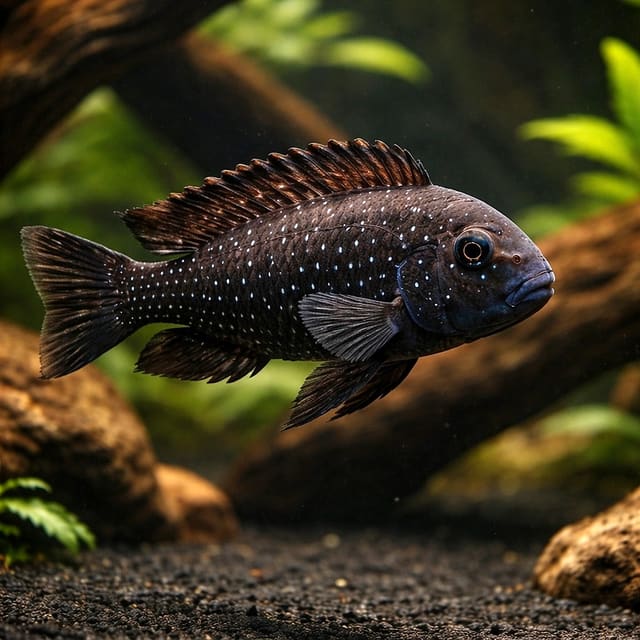
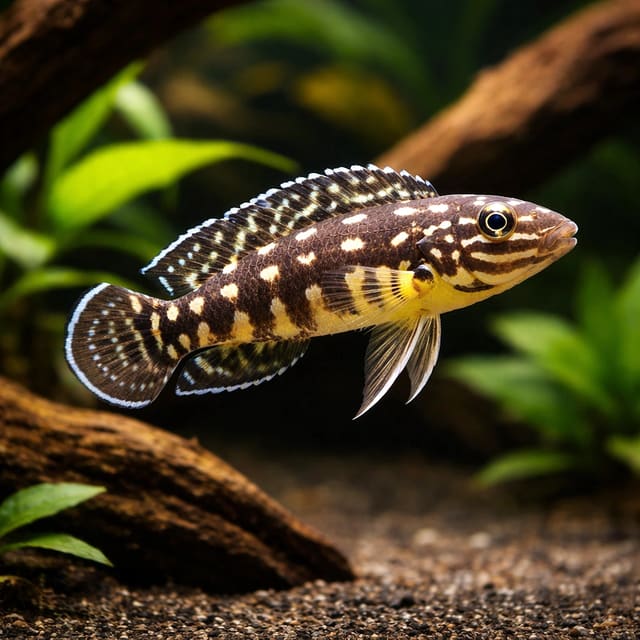
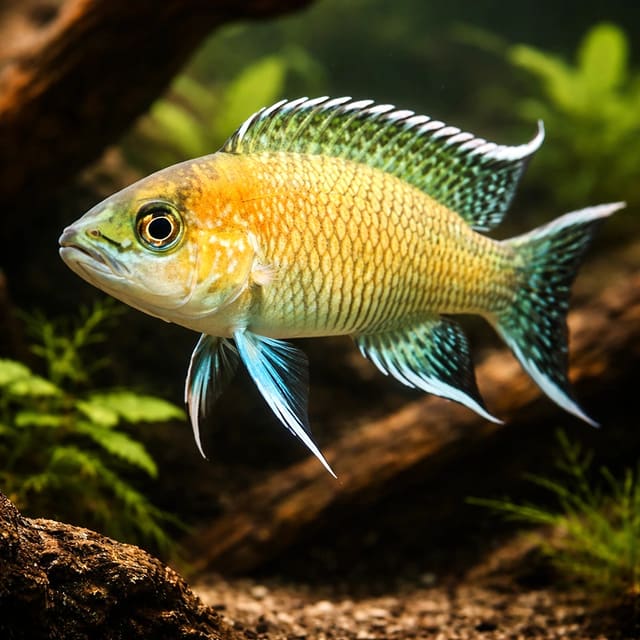
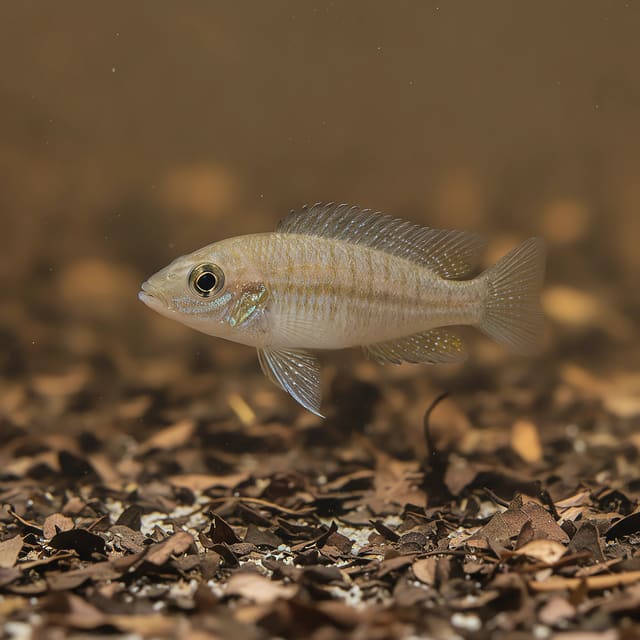
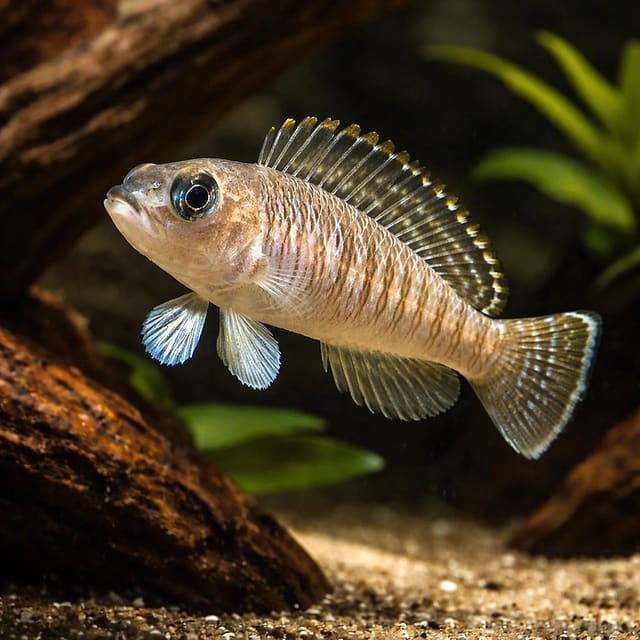
The gallery images are representative, based on reference photographs of this species, so colours can look slightly different from the live animal.
One purchase supplies one Golden Julie of the option selected on the live size selector. The labels are S, 3,5 - 4 cm, 4,5 - 5,5 cm and > 6 cm; use the selector itself when choosing the dispatch grade. The size you select is the size supplied, not the adult size.
A smaller dispatch fish still needs an aquarium planned around the recorded adult maximum of 8.5 cm total length. Do not scale down the permanent aquarium, cave network or filtration because the selected fish is currently shorter. The benefit of planning for the adult at the outset is continuity: the fish can learn one territory while the filter, rockwork and maintenance routine remain stable.
Sex is guaranteed only when the selected option explicitly states male or female. This Golden Julie listing has no sex-guaranteed option.
The Seriously Fish species profile gives 23–27°C, pH 7.5–9.0 and hardness of 10–25 dGH. It recommends a 75 × 30 × 30 cm aquarium, about 70 litres, for a single pair. Treat both the volume and the 75 × 30 cm base as planning requirements: litres support water stability, while the footprint provides room to arrange separate caves and usable rocky areas.
| Planning point | Working figure |
|---|---|
| Recorded maximum | 8.5 cm total length |
| Single-pair aquarium | At least 70 litres |
| Suggested base | 75 × 30 cm |
| Temperature | 23–27°C |
| pH | 7.5–9.0 |
| General hardness | 10–25 dGH |
These figures define the starting assessment, not permission to fill every suitable-looking space. Extra Julies or additional species increase the number of territories and the biological load. A community therefore needs more usable floor and rock surface than a pair-only aquarium, along with separate zones for fish that occupy shells or open water.
Review dispatch arrangements and claim conditions on our delivery and Live Arrival Guarantee page. Prepare the aquarium before selecting a dispatch date so temperature, water chemistry and biological filtration are already stable when the fish arrives.
Start with a sandy substrate and arrange substantial rockwork across much of the aquarium. Golden Julies are associated with rocks, so caves and narrow crevices are functional living areas rather than decoration. Create several choices at different points in the structure instead of one central cave that every fish must approach.
Use the 75 × 30 cm base as a practical map. One workable approach is to form rocky zones towards the ends and retain a serviceable strip of sand. This does not assign permanent ownership, but it gives the fish several retreats and makes behaviour easier to read.
Do not rely on litres alone. A tall 70-litre aquarium with a short base may hold the same volume as a longer design but offers less horizontal separation. Conversely, a suitable footprint loses value if a single solid wall creates no usable crevices. Judge the completed arrangement by the number of secure retreats and their distribution across the base.
Once fish have established territories, avoid unnecessary large-scale rearrangement. Seriously Fish notes that rearranging established Julie aquariums through large water changes can disturb pair stability. Make routine interventions measured and purposeful, while reserving a controlled décor change for situations where aggression requires territories to be reset.
Use 23–27°C, pH 7.5–9.0 and 10–25 dGH as the aquarium range for Julidochromis ornatus. Choose a stable point within each range that your source water and aquarium can maintain, then avoid abrupt swings. A reading inside the range is useful only when ammonia and nitrite are controlled and the value remains consistent between maintenance days.
OATA’s African lake cichlid guidance gives group-level operating targets of zero mg/l ammonia, zero mg/l nitrite and nitrate no more than 20 mg/l above the normal tap-water level. It also gives 23–27°C, pH 8.0–8.6 and hard water of 12–18 dGH for the wider group. Use the wider J. ornatus range for identity-specific planning and the nitrogen limits as day-to-day safety signals.
| Test result | Decision |
|---|---|
| Ammonia above 0 mg/l | Treat it as a filtration or stocking warning and stop adding fish. |
| Nitrite above 0 mg/l | Reduce further load and restore safe biological filtration. |
| Nitrate rising rapidly | Review feeding, waste removal and the weekly water-change routine. |
| pH drifting | Compare tap and aquarium readings before changing the routine. |
| Temperature fluctuating | Check heater operation and measure at consistent times. |
Read our water chemistry guide for the role of each measurement, then enter actual readings into the water matcher. Record the result rather than relying on a description such as “hard water”, because the measured pH and dGH decide whether this Tanganyikan setup is appropriate.
Test both aquarium and replacement water when diagnosing a change. If the aquarium pH differs sharply from the tap, identify whether accumulated waste, substrate or buffering materials are affecting it before making an adjustment. Replace water at a similar temperature and treat tap water for chlorine or chloramine before it enters the aquarium.
Stability does not mean ignoring the upper and lower limits. A plan near an edge of the range leaves less room for ordinary measurement variation. Select a repeatable target, log weekly readings and respond to a trend before fish behaviour or condition changes.
Run a well-established biological filter before introducing a Golden Julie. The RSPCA explains that fish release toxic ammonia; filter bacteria convert it to nitrite and then to safer nitrate. A powered filter is therefore not enough by itself—the bacterial population must be established and capable of processing the waste produced by the intended livestock.
Use our first tropical aquarium guide to prepare and mature the system before the arrival date. Confirm zero mg/l ammonia and zero mg/l nitrite with tests rather than judging maturity from clear-looking water. Clear water can still contain dissolved nitrogen waste.
OATA recommends an oversized filter and vigorous aeration for crowded African lake cichlid communities. For a pair-only setup, select filtration by the aquarium’s actual load and monitor results; for a community, allow additional capacity because more feeding and more fish produce more waste. Direct the flow so oxygenated water circulates around the rockwork without leaving quiet pockets full of debris.
Before any introduction, recheck water on the day the fish enters the aquarium. Increase livestock slowly because the established bacterial population must grow as fish numbers and feeding increase. Adding several fish at once can exceed the filter’s present capacity even when the aquarium was mature for its previous inhabitants.
Do not add this fish as an experiment to correct an existing stocking problem. If ammonia or nitrite is detectable, postpone further introductions and restore the filter’s performance first. If established tank mates are already disputing territories, settle the layout and compatibility plan before adding another territorial cichlid.
After introduction, observe breathing, swimming, hiding and feeding while continuing to test. A fish using a cave is behaving consistently with its biology; a fish trapped in one corner, persistently chased or breathing unusually needs a prompt check of both water quality and social pressure.
In nature, Golden Julies feed on microorganisms around their rocky habitat. In the aquarium, Seriously Fish recommends making live and frozen foods a large part of the diet, using dried foods less often and including vegetable matter such as spirulina or blanched spinach. Build variety around those categories rather than relying on one dry food at every meal.
| Food category | Role in the routine |
|---|---|
| Live and frozen foods | Use for a large proportion of the diet. |
| Quality dried food | Offer less often than live and frozen foods. |
| Algae-based food | Include as the vegetable component. |
| Blanched spinach | Use as another supported vegetable option. |
OATA’s feeding schedule for African lake cichlids is twice daily, with only as much food as the fish can consume within a few minutes. Start with a deliberately small portion, watch until it is eaten and stop before fragments collect between rocks. The goal is a complete meal without a residue that will decay and increase the load on the biological filter.
Rockwork makes uneaten food harder to see. Feed where you can observe the fish and inspect nearby crevices after the meal. If food repeatedly disappears behind a structure without being eaten, change the feeding point or reduce the portion rather than adding more. Remove accessible remains during maintenance.
A newly introduced fish may remain close to cover. Present a small amount near a secure feeding area without forcing it into open water or scattering food throughout the aquarium. In a community, confirm that the Julie eats rather than assuming food reaching the aquarium reaches every fish. Tank mates occupying open water may take food first, while a territorial fish can also exclude a subordinate individual from a preferred spot.
Reduced appetite is a health or husbandry signal, not a reason to leave extra food in the aquarium. Check ammonia, nitrite, temperature and recent social interactions. Compare the response with the fish’s normal pattern and remove uneaten material before it breaks down.
Keep changes controlled. Introduce one new food type in a modest amount and observe acceptance. A varied routine based on the supported food categories is preferable to frequent random changes, and measured portions protect both body condition and water quality.
Carry out a partial water change of 25% at least once each week. OATA recommends this schedule for African lake cichlids, together with weekly testing and removal of solid waste. For a 70-litre aquarium, 25% is 17.5 litres; calculate the amount from the aquarium’s actual water volume and mark a container so the routine is repeatable.
Avoid turning a routine change into a complete reset. Seriously Fish warns against large water changes for established Julidochromis pairs because disruption can cause partners to turn on one another. The weekly 25% routine removes waste while preserving continuity in water conditions and territory. Emergency water-quality problems still require action proportionate to the readings, but ordinary maintenance should be steady.
Check the filter for blocked intakes or reduced output. When media needs cleaning, rinse it lightly in aquarium water removed during the water change; do not run it under the tap. Chlorine or chloramine can damage the beneficial bacteria responsible for processing ammonia and nitrite.
Reduced flow around dense rockwork can allow waste to settle, so inspect sheltered areas rather than cleaning only the open front of the aquarium.
Record the readings, water-change volume and any filter work. A simple log separates a one-off result from a trend. For example, nitrate rising faster over several weeks can point to larger portions, missed waste or increased livestock load; pH drifting between changes can point to a mismatch between replacement water and the aquarium.
Finish by checking every visible fish. Maintenance is complete only when equipment is operating, rockwork remains secure and breathing and swimming have returned to the normal pattern.
Learn the fish’s ordinary pattern during calm periods. A Golden Julie may spend substantial time close to rock surfaces and retreats, so hiding by itself is not automatically a problem. The important signal is a change: more hiding than usual, repeated exclusion from caves, abnormal swimming, altered breathing, loss of appetite or a marked shift in colour or condition.
| What you see | What to do first |
|---|---|
| Fast or slow gill movement | Test ammonia, nitrite and temperature; check aeration and filter flow. |
| Hanging at the surface | Check oxygenation, water quality and whether circulation is obstructed. |
| Sitting unusually still | Compare temperature, water readings and recent aggression. |
| Erratic swimming | Test water immediately and inspect the aquarium for pursuit or injury. |
| Reduced feeding | Remove leftovers, test water and observe access to the feeding area. |
| Fin or scale damage | Identify the aggressor and make sure the injured fish can withdraw. |
Water and social conditions should be checked together. A fish hiding because it is being chased will not be helped by extra food, while fish affected by ammonia will not be protected by adding another cave. Observe who approaches whom, whether pursuit stops and whether each fish can reach shelter and food.
During the first week, make short observations at consistent times and test more readily if anything changes. During the first month, compare those observations with the weekly maintenance log. This creates a useful baseline without repeatedly disturbing the aquarium.
If abnormal behaviour, breathing, appetite or appearance persists, test the water and contact us for further guidance. Record the temperature, pH, ammonia, nitrite and nitrate results, along with the timing of the change and any recent addition, filter work or territory dispute. Concrete readings make the next decision clearer than a general description of the water.
Do not medicate solely because a fish hides or changes feeding position. Correct measurable husbandry problems first and separate the effects of water quality from aggression. Continue observing all livestock, because a change affecting several fish at once points to a different decision from one individual being repeatedly displaced.
Keep Julidochromis ornatus as a compatible pair. “Pair” describes a social relationship, not simply two fish placed together. Seriously Fish reports aggression towards conspecifics and warns that purchasing an adult male and female does not guarantee compatibility. Plan a way to separate fish if persistent aggression develops.
Short displays or a fish returning to its preferred cave may be territorial behaviour. Persistent pursuit is different. Intervene when one fish cannot leave cover, cannot feed, is repeatedly driven into an exposed corner or develops fin and scale damage. Adding more caves can help only when both fish are able to reach and use them; it does not make an incompatible pairing safe.
Several Golden Julies require a suitably larger aquarium. More volume alone does not define suitability: the layout must contain enough distinct rocky areas, and the keeper must be able to remove additional fish if a pair excludes them. Do not use the 70-litre pair figure as a group allowance.
When a fish arrives at a dispatch size below the adult maximum, continue judging behaviour rather than assuming smaller individuals will remain tolerant as they grow. Review the territory map whenever pursuit becomes more frequent, but avoid constant rearrangement that prevents fish from settling.
If both fish feed, maintain condition and can withdraw after an interaction, continue close observation. If one fish loses access to food or shelter, separate first and reassess the arrangement. If injury appears, treat separation as the immediate welfare decision rather than waiting to see whether the hierarchy settles.
This behavioural approach also explains why the sex disclosure matters. Sex and compatibility are different questions: even a known male and female would not automatically form a safe pair. The aquarium must be arranged and monitored for the relationship actually shown by the fish.
Start with a Lake Tanganyika community rather than mixing cichlids from different African lakes. OATA generally advises against combining Malawi and Tanganyikan cichlids because their temperament and behaviour differ. Shared preference for hard, alkaline water is not enough to establish compatibility.
Seriously Fish reports that Golden Julies can be maintained with small to medium Tanganyikan cichlids occupying different parts of the aquarium, including Neolamprologus shell-dwellers and Cyprichromis. These are conditional examples, not universal tank-mate guarantees. The aquarium still needs adequate dimensions, distinct habitat zones and enough filtration for the combined load.
| Screen | Question to answer |
|---|---|
| Lake | Is the proposed fish suited to a Tanganyikan community? |
| Zone | Will it use shells or open water rather than competing for the same rock crevices? |
| Territory | Can the aquarium provide enough distinct habitat areas at adult size? |
A shell-dweller may use a different resource from a rock-dwelling Julie, while an open-water Cyprichromis uses another part of the aquarium. That separation is helpful only when the aquarium is large enough to express it. Placing shells directly beneath a Julie’s only cave, for example, concentrates two territories rather than separating them.
Account for stocking order as well. OATA advises adding more peaceful fish before more aggressive fish and notes that rearranging décor can reset territories when aggression occurs. Use that tool deliberately: preserve stable rockwork when the community is calm, but consider a controlled rearrangement before an introduction when an established fish controls every usable area.
Outside the named examples, compatibility depends on adult size, habitat use, temperament, group needs and the exact aquarium layout. Send the aquarium dimensions, current stock and a simple territory plan to our team for a stocking assessment before combining fish that fall outside these cases.
Avoid keeping different Julidochromis species or geographical morphs together. Seriously Fish warns that they may hybridise, and closely related rock-dwellers also compete for similar cave space. One aquarium should therefore have a clear Julie identity rather than a mixture assembled because the fish share a common name.
This species is aggressive towards its own kind and is recommended as a pair. Extra individuals need a suitably large aquarium with multiple rocky areas, plus a practical removal plan. A dense pile of rocks in a small footprint is not equivalent to several territories if every usable area remains controlled by one fish.
Do not add a tank mate to spread aggression. OATA notes that some African lake cichlid systems use carefully planned stocking density, but that is a species- and aquarium-dependent strategy requiring greater filtration and close management. It is not a substitute for suitable dimensions, secure retreats and compatible social groups.
Observe whether every fish can use its intended zone. Shell users should be able to approach shells, open-water fish should have unobstructed swimming room and the Julie pair should not control every route between them. Confirm each fish feeds and that pursuit is not persistent.
If one individual is persistently excluded, separate it before injury occurs. A décor change can redistribute territory, but it cannot correct a fundamental overlap in habitat or social requirements. Reassess adult dimensions and group needs before trying another arrangement.
The safest compatibility decision is the one supported by the exact footprint and territory map, not the number of litres alone. A larger aquarium improves options and stability, but every proposed resident must still have a distinct place to live.
It is a territorial, rock-dwelling Lake Tanganyika cichlid with a recorded maximum length of 8.5 cm.
One purchase supplies one animal of the option selected on the live size selector.
The selector labels are S, 3,5 - 4 cm, 4,5 - 5,5 cm and > 6 cm; these are dispatch sizes.
Plan at least 70 litres with a 75 × 30 cm base, sandy substrate, stable rockwork and several caves.
Plan a compatible pair and monitor behaviour; additional individuals require a suitably larger aquarium and a removal plan.
Keep it at 23–27°C, pH 7.5–9.0 and 10–25 dGH, with ammonia and nitrite at zero mg/l.
Use live and frozen foods for a large proportion of the diet, with dried food less often and some spirulina or blanched spinach.
Before adding it, confirm stable temperature and chemistry, zero mg/l ammonia and nitrite, secure rockwork and mature filtration.
Screen small to medium Tanganyikan cichlids that use different zones; avoid other Julidochromis and mixing Malawi with Tanganyika cichlids.
No reviews for this item yet. Bought one? Honest reviews only, good or bad.
What customers say about ordering from us
I have a small group of long finned mountain minnows. So was delighted to be able to order ten of this variety to increase the genetics in my tank . The ones I recieved are healthy but it’s to early to give a verdict on wether they are of a long finned type since they are small currently.
Gordon Walker · 23 Sept 2026
100% success travel and "installation". Pleased with quality of purchase. The Siamese fighter a bit "shy" so have not yet seen him at his best yet but looking good. Happy customer. GG
George E Garratt · 21 Sept 2026
Reviews of our shop, collected by Judge.me, an independent third-party review collector. Newest first.