Moderate
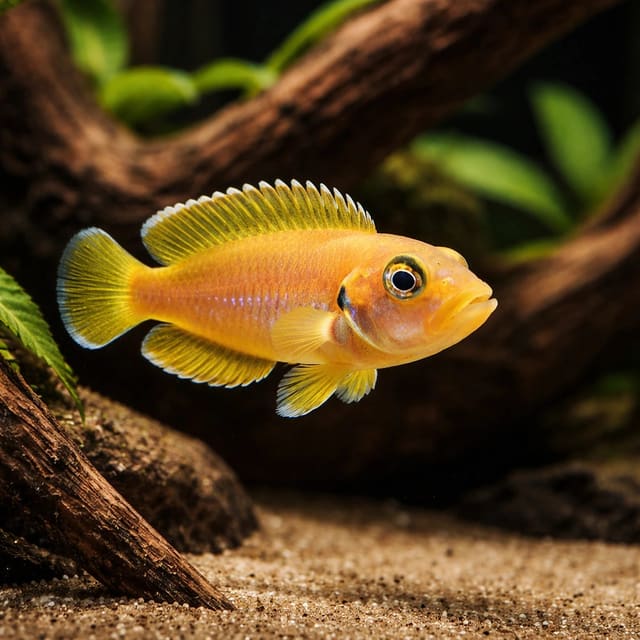
Gold Ocellatus Shell-Dweller (Neolamprologus ocellatus)
23–25°C · pH 8–9
£16.59

Dickfeld's Julie (Julidochromis dickfeldi) is a territorial Lake Tanganyika cichlid best suited to an established hard, alkaline aquarium with extensive rockwork. One purchase supplies one unsexed fish in the chosen size; plan around an eventual pair rather than an informal group.
Adult size is the maximum length this species reaches at full maturity (scientific sources). The livestock you receive will be younger and smaller — pick a size above for the actual shipping size. Product-photo provenance and any image-specific limitations are stated on the listing.
Julidochromis dickfeldi
Save when buying multiple fish. Each quantity is one fish; sex and pair formation are not guaranteed unless the selected variant explicitly states them.
Dickfeld's Julie (Julidochromis dickfeldi) is a territorial Lake Tanganyika cichlid best suited to an established hard, alkaline aquarium with extensive rockwork. One purchase supplies one unsexed fish in the chosen size; plan around an eventual pair rather than an informal group.
Adult size is the maximum length this species reaches at full maturity (scientific sources). The livestock you receive will be younger and smaller — pick a size above for the actual shipping size. Product-photo provenance and any image-specific limitations are stated on the listing.
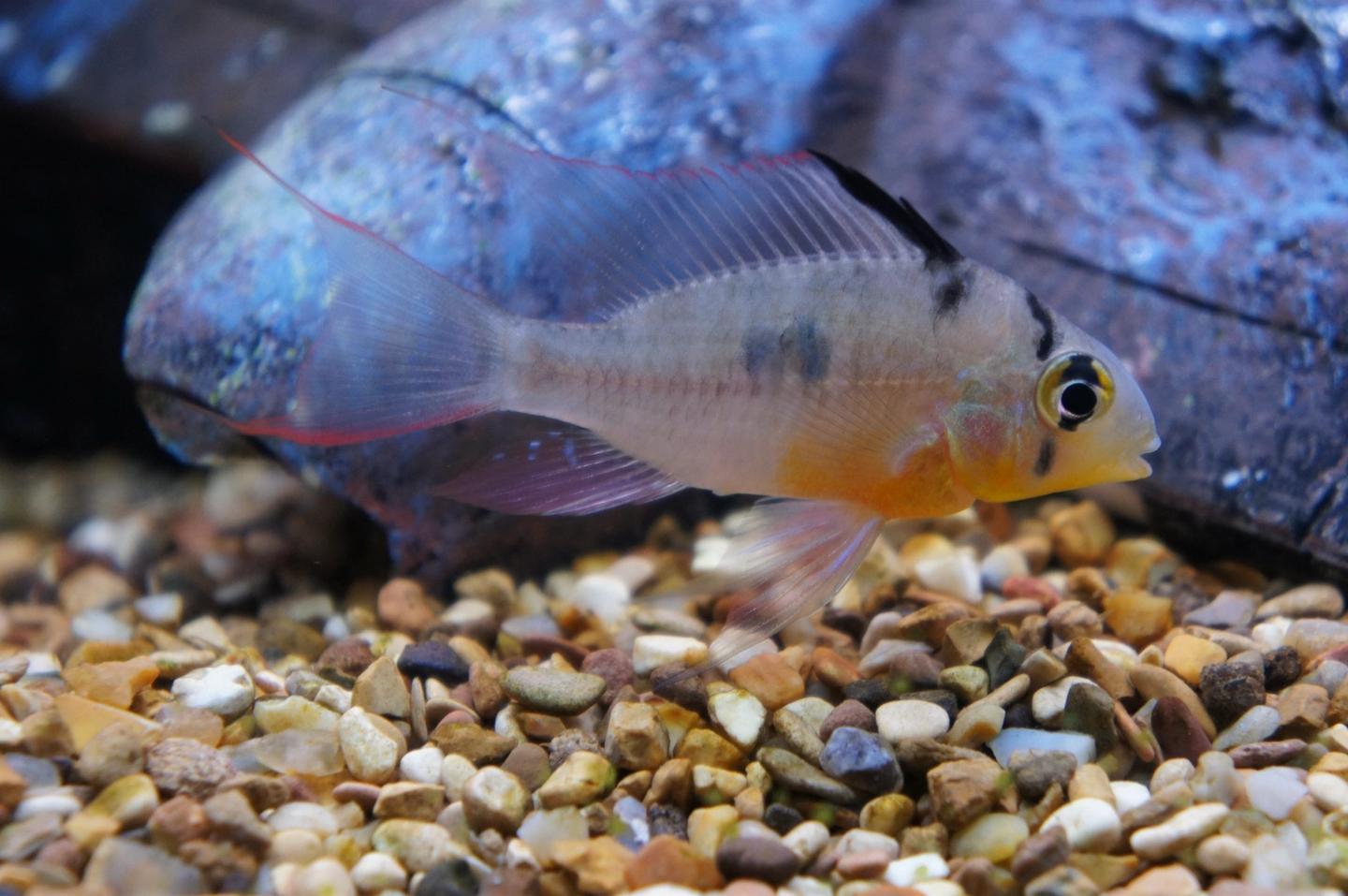
Cichlids are a family of roughly 1,800 accepted species, not one care type. Before buying, identify the exact species and source, then compare adult measurement, usable tank dimensions, social system, territory, tested water, diet and an exit plan. No family-wide minimum tank, water range or tank-mate list is safe.
Maintain these water conditions for optimal health and vibrant colors
Dickfeld's Julie (Julidochromis dickfeldi) is a slim, rock-associated cichlid from the south-western part of Lake Tanganyika. It spends much of its life close to cracks, caves and rubble, holding a compact territory rather than roaming through open water. That behaviour is the key to understanding this fish: it can be deeply rewarding in a carefully arranged Tanganyikan aquarium, but it is not a casual addition to a general community.
One purchase supplies one live fish in the size chosen. The size you select is the size supplied, not the adult size. The listing carries 4–5 cm, 5–7 cm and XL sizes; these are dispatch labels, while FishBase records a maximum of 11 cm total length for the species. Sex is guaranteed only when the selected option explicitly states male or female. This Dickfeld's Julie listing has no sex-guaranteed option. Young fish and adults are difficult to sex reliably, so size and colour do not identify the sex supplied.
| Suits | Keepers who can provide stable hard, alkaline water, a mature filter and rockwork with several secure caves |
|---|---|
| Adult planning size | Up to 11 cm total length in the FishBase record |
| Routine aquarium range | 23–27 °C, pH 8.0–9.2 and 10–25 dGH in the species profile |
| Space | A 75 × 30 cm base, about 68 litres, is described for one established mated pair; more territory is needed for additional cichlids |
| Social plan | Best managed as one compatible pair, with a plan for separating surplus young fish |
| Food | A varied menu led by live or frozen invertebrate foods, with dried food used less often and some vegetable matter |
In its native lake, J. dickfeldi is usually associated with rocks and rubble. A fissure or crack forms the centre of a territory, and the fish picks small crustaceans from the rock surface. Aquarium design should therefore begin at the bottom and back of the tank: stable rock piles, narrow retreats and usable surfaces matter more than a large empty swimming area. A sandy substrate fits the species profile and leaves the rockwork visually clear.
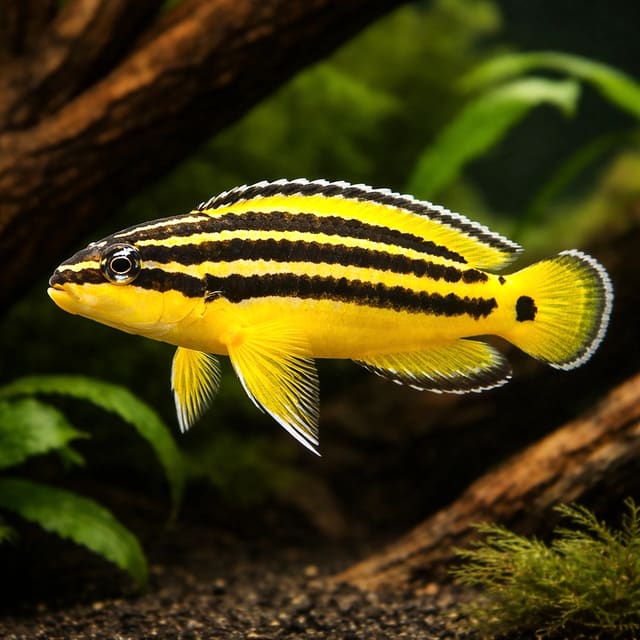
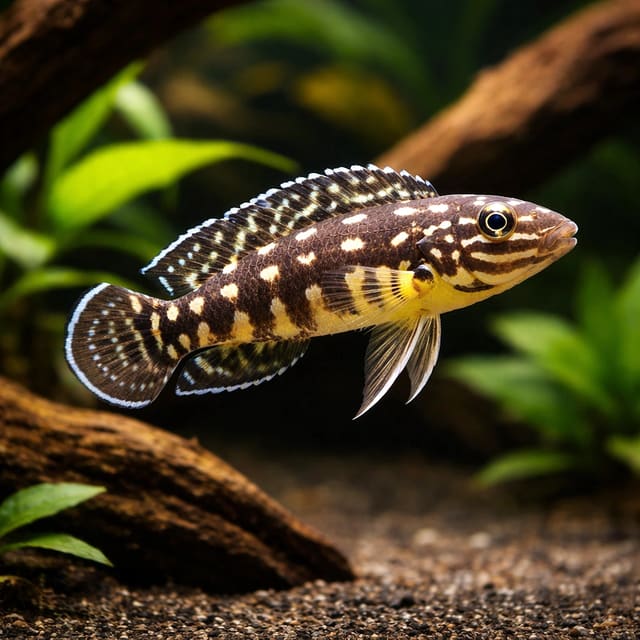
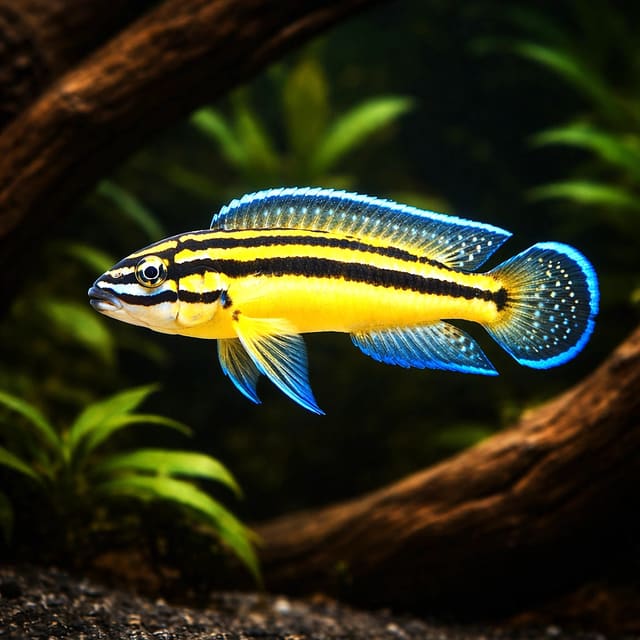
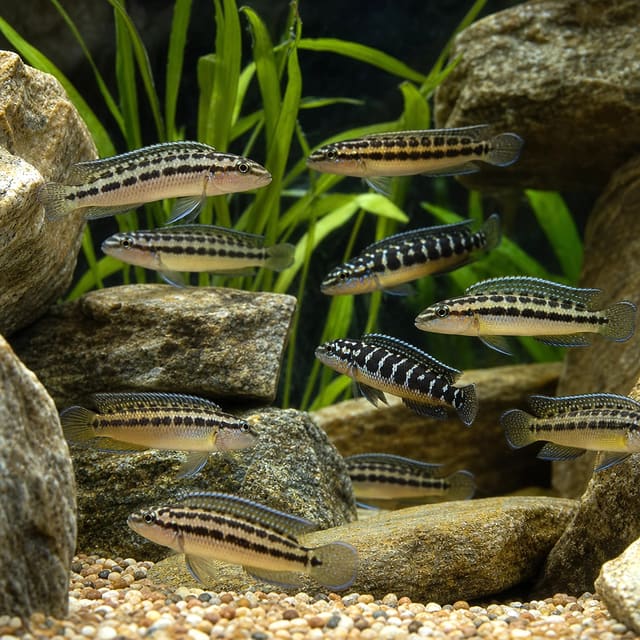
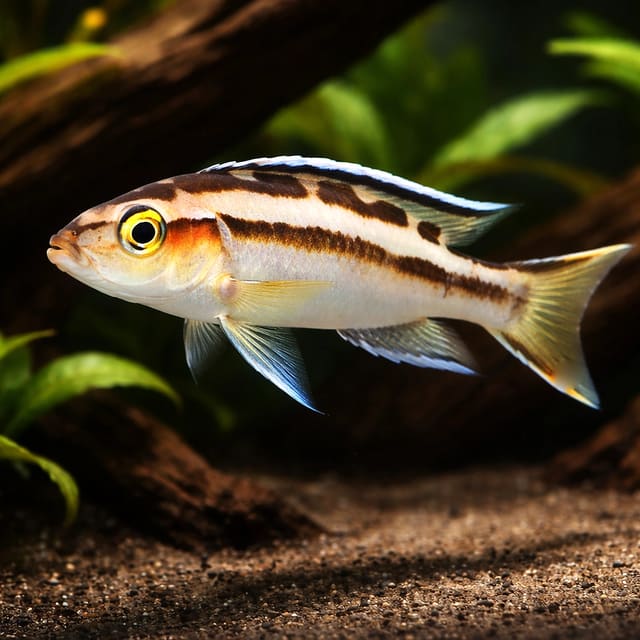
The name “Julie” is used widely for members of Julidochromis. Dickfeld's Julie differs in shape and pattern from several better-known relatives, with a pointed snout, dark horizontal markings and blue edging reported on the dorsal and anal fins. Colour intensity and pattern can vary with age, condition and lighting, so choose the fish for its husbandry needs as well as its appearance.
This is a good match when the aquarium is already cycled, the tap water or prepared water can be kept within a hard alkaline range, and the layout can be dedicated to territory. It is a poor match for a soft-water community, a newly filled aquarium, or a tank in which every cave is already occupied. A keeper should also be comfortable watching for pair formation and moving incompatible fish if aggression develops.
For broader browsing, the African cichlid collection shows other fish with very different social and space requirements. Sharing a regional label does not make every cichlid a suitable companion, so choose the aquarium plan first and compare species afterwards.
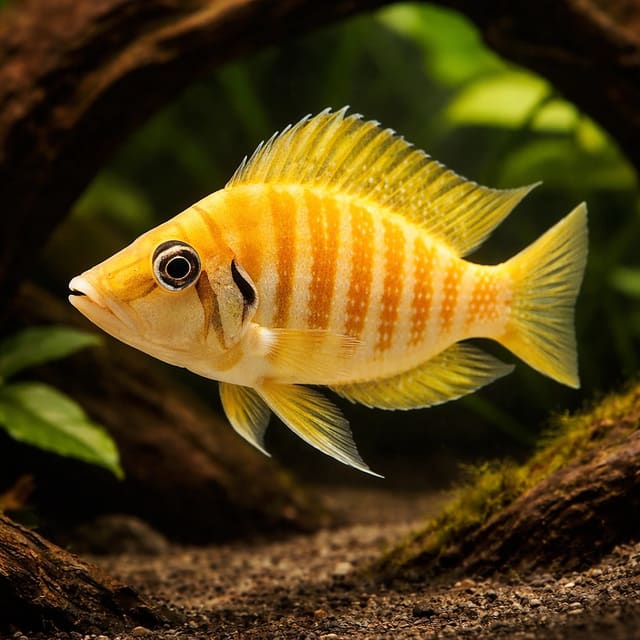
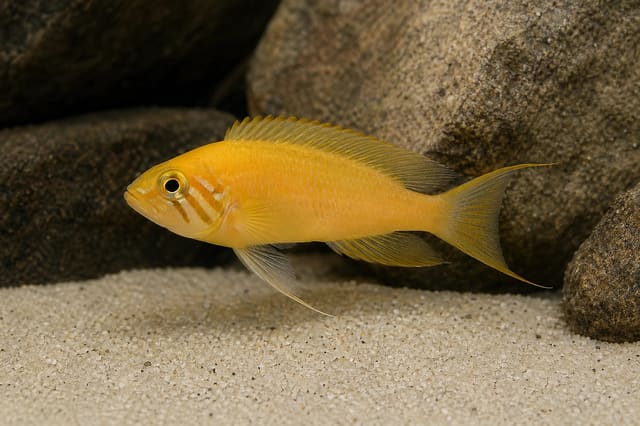
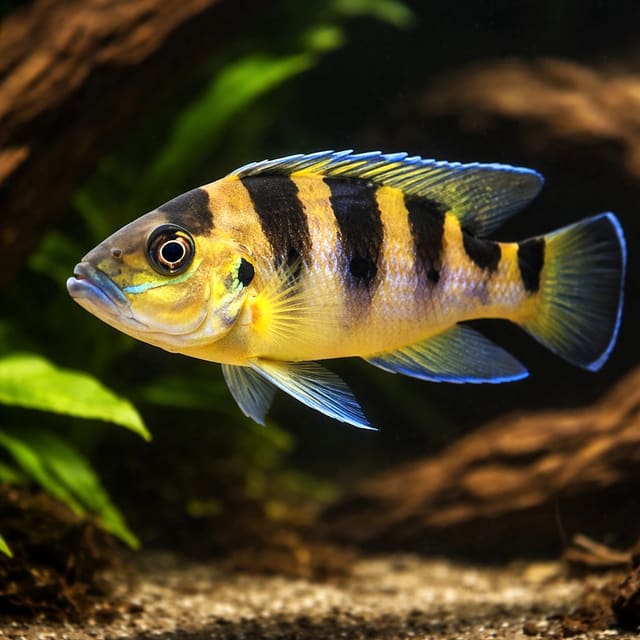
Gallery images have been digitally enhanced to improve image quality. Natural colour, pattern, size and maturity can vary between live animals.
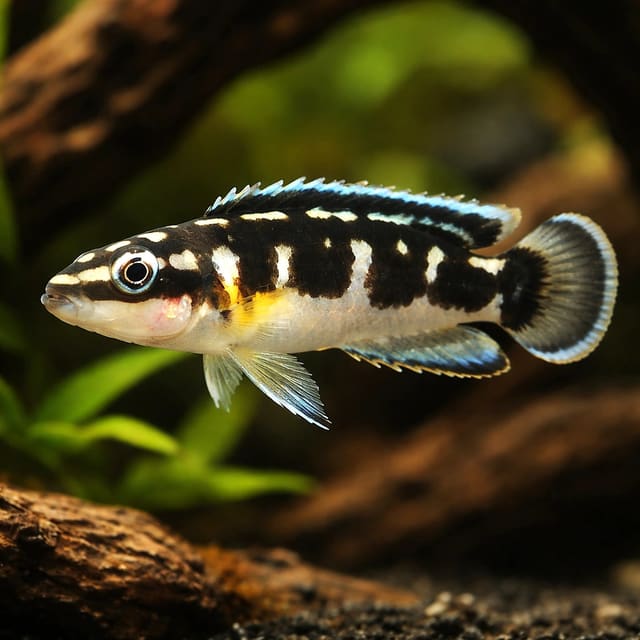
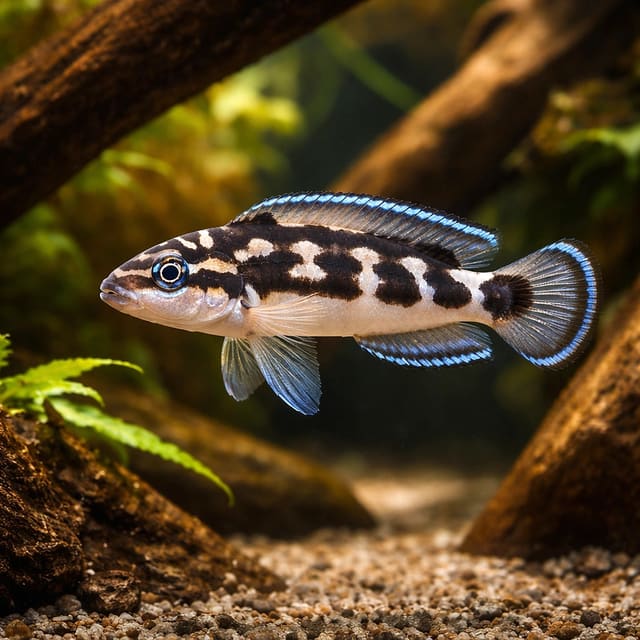
The images help show the fish's general form and markings; they do not select a sex or promise the exact pattern of the individual supplied. Judge suitability from the care needs, adult planning size and social behaviour, then use the live size choice for the dispatch size.
A useful starting footprint for one established mated pair is 75 × 30 cm, which the species profile describes as roughly 68 litres in a 75 × 30 × 30 cm aquarium. Footprint matters because this fish claims caves and rock faces. Height alone does not create extra territory. If the plan includes other cichlids, or more than a formed pair of Dickfeld's Julies, move beyond that minimum and provide clearly separated rock zones.
Arrange rocks securely before the fish arrives. Build several caves, fissures and overhangs rather than one prized centrepiece. The fish should be able to enter a retreat without being followed immediately by another territorial cichlid. Use aquarium-safe material and make sure the structure cannot shift if sand is moved around its base. A sandy substrate is preferred in the species profile and works naturally with a Tanganyika-style rock layout.
Open water still has value for circulation and observation, but a bare aquarium gives this stationary rock dweller little security. Place filter outlets so oxygenated water reaches the rockwork without turning every refuge into a high-speed jet. Seriously Fish recommends good oxygenation; its worked example for a roughly 68-litre aquarium uses turnover of about four to five times the tank volume per hour. Treat that as a planning illustration, then account for the real filter, media, head height and rock obstruction in your own system.
The species-level aquarium profile gives 23–27 °C, pH 8.0–9.2 and 10–25 dGH. FishBase records wild environmental values of 22–25 °C, pH 8.5–9.2 and 8–14 dH. For routine home care, use the aquarium profile's 23–27 °C range and aim for stability within it rather than chasing the edges of either record. The overlap between the sources reinforces the need for warm, alkaline and mineral-rich water.
Measure the water you actually have before choosing the fish. The water chemistry guide explains the main readings, while the water matcher can help compare measured values with the stated care range. A stable result that suits Tanganyikan cichlids is more useful than repeated rapid adjustments. If the tap supply is naturally soft or acidic, establish a repeatable preparation method before purchase.
Temperature, pH and hardness describe different properties. A heater can hold temperature but does not create mineral hardness or alkalinity. Likewise, a high pH reading on one day does not prove that the aquarium is buffered against change. Test consistently, note trends and prepare replacement water so that a routine water change does not expose a territorial pair to a sudden swing.
A working biological filter is essential. Fish release ammonia, which is toxic; beneficial bacteria convert it first to nitrite, also toxic, and then to nitrate. Before livestock is introduced, ammonia and nitrite should both read zero. The RSPCA's aquarium environment advice explains why filtration and a mature biological colony are central to fish welfare.
If this is the first aquarium, use the first tropical tank guide to prepare and mature it before the delivery date. Add livestock at a pace the filter can support and check water after any increase in feeding or fish load. Cloudy water, rapid breathing, hanging near the surface or an unexpected loss of appetite should prompt an immediate water test rather than an automatic treatment.
OATA's African lake cichlid care sheet gives group-level goals of zero ammonia, zero nitrite and nitrate no more than 20 mg/l above the normal tap-water level. Those figures are broad guidance for African lake cichlids, not a replacement for the species-specific temperature, pH and hardness values above. They are useful as practical checks on filtration and maintenance.
OATA strongly recommends a partial water change of 25% at least once a week for African lake cichlids, alongside regular testing. Match the replacement water for temperature and prepare it with an appropriate conditioner where chlorine or chloramine is present. Siphon accumulated waste from accessible areas, particularly where debris collects around rock bases, while leaving the aquarium's secure cave structure intact.
Check the filter for reduced flow and blockages. When media needs cleaning, never run it under tap water; rinse it lightly in water removed from the aquarium instead, the aim is to protect the beneficial bacteria supporting the nitrogen cycle. Maintain vigorous gas exchange and watch whether the densely arranged rocks create still pockets where waste settles.
For a formed Julie pair, make changes calmly. The species account notes that large water changes can cause mated pairs to turn on one another. That makes consistent weekly care especially valuable: a modest, repeatable routine is preferable to allowing waste to accumulate and then making an emergency-scale change. Observe both fish after maintenance and make sure each can reach a retreat without sustained pursuit.
Wild Dickfeld's Julies mainly pick crustaceans from rocks and take drifting matter only occasionally. Seriously Fish advises that live and frozen foods should form a large part of the aquarium diet, with dried foods offered less often and some vegetable matter, such as spirulina or blanched spinach, included. Suitable portions should be small enough to be eaten promptly so food does not lodge unseen among rocks.
Vary the menu rather than relying on one rich food. Small frozen invertebrate items can reflect the species' natural feeding mode; a quality dried food provides a convenient part of the rotation; and an algae-based food or appropriate vegetable matter adds variety. Watch the fish feed. A territorial individual may control the most convenient feeding point, so distribute small portions where both members of a pair can reach them without abandoning their refuge for long.
OATA's group sheet suggests feeding African lake cichlids only what they consume within a few minutes, twice a day. That is broad group guidance rather than proof of a species-specific schedule. Use it as an upper practical framework, adjust portions to the fish and the aquarium, and remove uneaten food where possible. Persistent refusal, weight loss or a swollen appearance deserves a water-quality check and informed diagnosis rather than simply offering more food.
Plan to be at the delivery address. Before disturbing the parcel, inspect its exterior and make a continuous unboxing video showing the parcel sealed, the outer box, the opening and the fish still inside the sealed bag. This is the evidence required if a Live Arrival Guarantee claim is needed. Open and inspect the animal on the day it arrives, and contact Tropical Fish Co that day with the order number and video if anything is wrong.
The current delivery and Live Arrival Guarantee policy contains the full packing, receiving and claim conditions. It explains that fish are hand-bagged in oxygen, packed in an insulated box with a heat pack when weather calls for it, and carried by a licensed live-animal courier. Tracking and the confirmed delivery date are sent by email.
Learn the normal behaviour of the individual. A healthy Julie should be alert around its territory, interested in food and able to use cover without continuous distress. Changes worth investigating include unusually rapid or slow gill movement, hanging at the surface, remaining on the bottom, erratic swimming, loss of colour, damaged fins, white spots, fluffy growths, weight change or a sudden increase in hiding or aggression.
Begin with water tests because ammonia, nitrite, temperature or pH problems can affect several fish at once. Review recent maintenance, feeding and stocking changes. If concern remains, seek appropriate aquatic veterinary or experienced retailer guidance with the test results and a clear description of the signs. Avoid guessing at a treatment when the underlying issue may be unstable water or social pressure.
Julidochromis dickfeldi is territorial and aggressive towards its own kind. The species profile recommends keeping it as a pair. That simple phrase needs careful interpretation: an arbitrary adult male and female are not guaranteed to accept one another, and sex itself is difficult to determine. A genuinely compatible pair is a social relationship, not merely two fish sharing a label.
One established pair can centre its life on a cave system and stay close to that territory. Several Julies need a much larger aquarium because each territorial unit requires usable rockwork. In cramped quarters, a subordinate fish may be denied food and refuge even when the aquarium's total volume seems adequate. Plan a spare mature aquarium or another safe separation route before attempting to form a pair from young fish.
Seriously Fish suggests starting with a group of young fish and allowing a pair to form naturally. It may take a year or more. Once a pair forms, the other fish should be removed because the pair may attack them. This approach therefore needs more room, close observation and a realistic destination for every surplus fish; it should not be attempted in the minimum pair aquarium.
Buying fish believed to be one male and one female does not assure compatibility. Adult females are generally larger, but sexing remains difficult, and size or colour is not a dependable retail sex guarantee. The safest customer expectation for this listing is one unsexed fish per purchase, followed by deliberate social planning rather than assumptions about the individual supplied.
The species profile says Dickfeld's Julie can be kept with small to medium Tanganyikan cichlids that occupy different parts of the aquarium. It names Neolamprologus shell dwellers and Cyprichromis species as examples. These are conditional examples, not universal recommendations: tank footprint, rock placement, shell beds, open-water space, individual temperament and the number of fish all determine whether the combination is workable.
Give each ecological zone a clear purpose. The Julie needs rock cracks and caves. A shell dweller needs an appropriate shell area that is not placed inside the Julie's core territory. An open-water species needs enough unobstructed swimming room above the rocks. If all three needs are squeezed into a small footprint, the different labels do not prevent conflict.
OATA advises that African lake cichlids are generally best combined with fish from the same lake and that Malawi and Tanganyika cichlids should not usually be mixed because their behaviour and social patterns differ. Use that regional rule as a first screen, then apply the more specific behaviour and space needs of each proposed species.
Short displays and boundary defence are different from relentless pursuit. Watch whether every fish can feed, rest and move away. Repeated pinning into a corner, torn fins, rapid breathing, loss of colour or refusal to leave cover indicates that the layout or stocking plan is failing. Adding another cave is not always enough after a dominant pair has claimed the aquarium; separation may be the responsible response.
Rearranging décor can reduce established territorial cues when fish are introduced, as OATA notes for African lake cichlids, but the rebuilt structure must remain secure. Make changes before adding the newcomer, not during a serious attack. Continue observing after lights-on, feeding and maintenance, because those moments can reveal competition that is easy to miss during a brief daytime glance.
Dickfeld's Julie is a biparental cave spawner. The pair lays eggs secretly on a cave wall or roof, and the first obvious sign may be fry rather than a visible spawn. Parents can become more active around the chosen cave for weeks beforehand. That intensifies the need for clear territory and a plan for other fish that approach the brood area.
A breeding project should use an aquarium at least 36 inches long according to the species account, with the rock and water conditions already described. The account suggests pH about 8.2–9.0 and 25–26.5 °C for breeding. Those figures are specialised breeding guidance, not a reason to change a stable general-care aquarium without a considered plan.
Because this product does not guarantee sex or a formed pair, buying an individual is no shortcut to breeding. The attraction is the fish's distinctive rock-centred behaviour. A compatible pair and spawning are possible outcomes of skilled long-term care, not features supplied with an individual animal.
FishBase records Julidochromis dickfeldi at up to 11 cm total length. The 4–5 cm, 5–7 cm and XL labels describe dispatch sizes, not adult size, so plan the aquarium around the adult record.
Seriously Fish describes a 75 × 30 cm base, about 68 litres, for one established mated pair. Use a larger footprint when housing additional Tanganyikan cichlids or when starting with several young Julies to form a pair.
A compatible pair is the usual long-term arrangement. This species is aggressive towards its own kind; surplus young fish should be removed after a pair forms, and simply buying two unsexed fish does not guarantee that they will pair.
It suits a prepared keeper rather than a first unplanned community. Success depends on a mature filter, stable hard alkaline water, secure caves, careful pairing and the ability to separate fish if territorial aggression develops.
Offer a varied diet in which small live or frozen foods form a substantial part, with quality dried food less often and some spirulina or suitable vegetable matter. Give portions the fish consume promptly so waste does not collect among the rocks.
The species aquarium profile gives 23–27 °C and pH 8.0–9.2, with hardness of 10–25 dGH. Keep the water stable, well oxygenated and free from measurable ammonia and nitrite.
It is territorial, especially towards its own kind and around caves. The main warning is sustained territorial pursuit rather than routine community fin-nipping; every fish must be able to leave the territory, feed and use a safe refuge.
In a suitably large Tanganyika aquarium, the species profile names small to medium Tanganyikan cichlids using different zones, including Neolamprologus shell dwellers and Cyprichromis species. Space and territory still need checking for the exact combination.
Tropical Fish Co hand-bags fish in oxygen, uses an insulated box and a heat pack when weather calls for it, and sends them with a licensed live-animal courier. Be present to receive the parcel, record the continuous unboxing from the sealed box with the fish still bagged, inspect it that day, then float the sealed bag for 20–30 minutes and transfer the fish without adding transport water to the aquarium.
Test the aquarium over several days rather than relying on one reading. Confirm that temperature stays within 23–27 °C, that pH remains alkaline and that hardness is within the 10–25 dGH species range. Record ammonia and nitrite as zero and compare nitrate with the normal tap-water baseline. Check those results after feeding and after routine maintenance so the plan reflects the system under real use.
Walk through the physical layout from the fish's point of view. There should be more than one narrow retreat, stable rock contact with the aquarium base, and enough access for cleaning around the structure. A keeper should be able to inspect the fish without dismantling its main territory. Leave room for water to circulate past the caves and confirm that the filter still produces useful surface movement once the rockwork is in place.
After introduction, note where the fish settles, whether it emerges for food, how quickly its breathing returns to normal and whether another resident blocks access to shelter. A newly arrived fish may use cover heavily, so judge progress from several quiet observations instead of forcing it into the open. Test water promptly if breathing, balance, appetite or colour changes.
Feed modest portions and watch where food travels. Rockwork can trap uneaten items out of sight, making a seemingly tidy aquarium dirtier than expected. Adjust the amount before increasing frequency. During the next weekly maintenance, inspect debris paths, filter flow and the security of the structure, then keep the routine predictable.
As the fish grows, reassess territory rather than looking only at body length. An 11 cm planning maximum does not describe the space occupied by a defensive pair. Check whether other fish can still reach food and shelter, whether disputes are brief, and whether both members of a pair retain good condition. Growth, maturity and spawning behaviour can change a combination that appeared calm when every fish was young.
Keep written water results and observations. Trends are easier to act on than isolated impressions: slowly falling hardness, gradually reduced flow or increasing pursuit can be addressed before they become emergencies. The goal is a stable Tanganyika-style system whose chemistry, oxygenation and physical territory all continue to work together.
Map the shell bed and rock zone as separate territories before adding a Julie. A shell-dwelling Neolamprologus can be an example of a fish using a different area, but the combination still needs enough floor space that neither fish must cross the other's home to feed. Watch the boundary after any décor change and be ready to separate fish if one species is displaced.
Cyprichromis species are named in the species profile because they use a different part of the aquarium. Their open-water needs must remain intact above the rockwork. Do not fill the whole swimming area with stone merely to create more Julie caves; compatibility depends on meeting both species' spatial requirements at the same time.
Treat persistent exclusion as a stocking problem, not a spectacle. Check that the other fish can feed, then move threatened surplus Julies or incompatible residents to a prepared aquarium. Secretive spawning means fry may appear before a keeper has seen eggs, so a sudden tightening of the territory can have a biological cause even when no nest is visible.
FishBase: Julidochromis dickfeldi supports the accepted species name, family, Lake Tanganyika distribution, rock-and-rubble habitat, wild environmental record, feeding observations, territorial behaviour and maximum recorded total length.
Seriously Fish: Julidochromis dickfeldi provides the aquarium footprint, routine water range, rockwork and substrate advice, diet, pair management, named companion examples, sexual dimorphism and cave-spawning notes used in this guide.
OATA's African lake cichlid care sheet supplies UK group-level guidance for filtration, water quality, maintenance, feeding and regional compatibility. The RSPCA aquarium environment page explains biological filtration and toxic nitrogen waste. Tropical Fish Co's delivery page supplies the packing, receiving, unboxing-video, temperature-equalisation, transfer and Live Arrival Guarantee steps. Species-specific values above take priority over broad group ranges where their scope differs.
No reviews for this item yet. Bought one? Honest reviews only, good or bad.
What customers say about ordering from us
I have a small group of long finned mountain minnows. So was delighted to be able to order ten of this variety to increase the genetics in my tank . The ones I recieved are healthy but it’s to early to give a verdict on wether they are of a long finned type since they are small currently.
Gordon Walker · 23 Sept 2026
100% success travel and "installation". Pleased with quality of purchase. The Siamese fighter a bit "shy" so have not yet seen him at his best yet but looking good. Happy customer. GG
George E Garratt · 21 Sept 2026
Reviews of our shop, collected by Judge.me, an independent third-party review collector. Newest first.