−13%
Signatus Shell Dweller (Neolamprologus signatus)
23–27°C · pH 7.5–9 · 40L
£16.52£18.99

Striped Lamprologus (Neolamprologus buescheri) is a small but very territorial southern Lake Tanganyika cichlid for an experienced keeper and a carefully structured aquarium. One unsexed fish is supplied per purchase in either the 3.5–5 cm or over 5.5 cm dispatch size. Plan around stable rockwork, numerous caves and a separation option.
Adult size is the maximum length this species reaches at full maturity (scientific sources). The livestock you receive will be younger and smaller — pick a size above for the actual shipping size. Product-photo provenance and any image-specific limitations are stated on the listing.
Neolamprologus buescheri
Save when buying multiple fish. Each quantity is one fish; sex and pair formation are not guaranteed unless the selected variant explicitly states them.
Striped Lamprologus (Neolamprologus buescheri) is a small but very territorial southern Lake Tanganyika cichlid for an experienced keeper and a carefully structured aquarium. One unsexed fish is supplied per purchase in either the 3.5–5 cm or over 5.5 cm dispatch size. Plan around stable rockwork, numerous caves and a separation option.
Adult size is the maximum length this species reaches at full maturity (scientific sources). The livestock you receive will be younger and smaller — pick a size above for the actual shipping size. Product-photo provenance and any image-specific limitations are stated on the listing.

Cichlids are a family of roughly 1,800 accepted species, not one care type. Before buying, identify the exact species and source, then compare adult measurement, usable tank dimensions, social system, territory, tested water, diet and an exit plan. No family-wide minimum tank, water range or tank-mate list is safe.
Maintain these water conditions for optimal health and vibrant colors
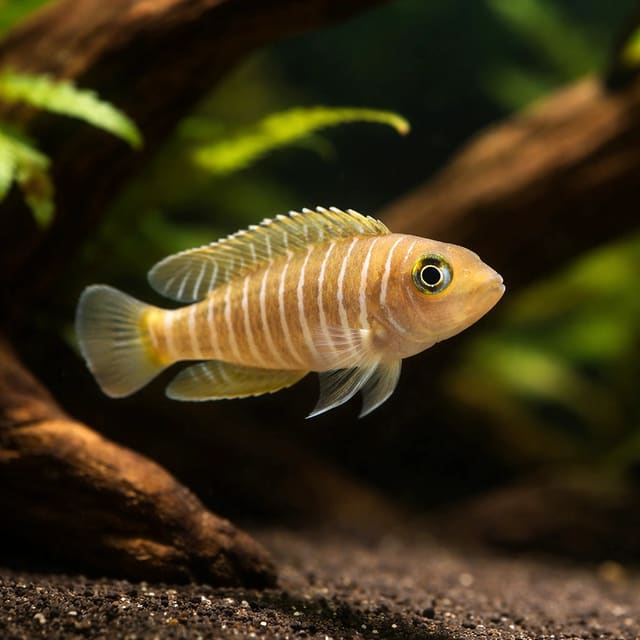
Striped Lamprologus (Neolamprologus buescheri) is a compact, cave-associated cichlid from southern Lake Tanganyika. Its dark horizontal striping and close relationship with rock make it visually suited to a carefully built Tanganyika display, but its modest length should not be mistaken for an easy temperament. This species is strongly territorial, defends caves and can be aggressive towards its own kind. It is a fish for a keeper willing to plan territories, observe individuals and separate them if the social arrangement fails.
The accepted name is Neolamprologus buescheri. The species was originally described as Lamprologus buescheri, and older aquarium references may still use that combination. The trade spelling “Lamprologus buscheri”, without the second “e”, is linked to this species by the matching common name and dispatch grades; that link is an inference, and “buscheri” is not an accepted scientific spelling. The title therefore uses the current valid name rather than repeating the misspelling.
One purchase supplies one live fish. The two recorded dispatch sizes are 3.5–5 cm and over 5.5 cm. The size you select is the size supplied, not the adult size. FishBase records a maximum of 8 cm total length, while the specialist aquarium profile reports 70 mm standard length. Total length includes the tail and standard length does not, so these figures describe different measurements and should remain separate rather than being averaged.
Sex is guaranteed only when the selected option explicitly states male or female. This Striped Lamprologus listing has no sex-guaranteed option.
| Suits | Choose another fish if the plan depends on |
|---|---|
| An established hard-water aquarium with stable chemistry | A new or biologically immature aquarium |
| A base of at least 90 × 38 cm for the documented one-male, several-female example | A small tank chosen only because the fish remains short |
| Stable rockwork, numerous caves and visual barriers | One open cave that every fish must contest |
| A species-focused layout or a much larger zoned Tanganyika aquarium | A general mixed-cichlid community |
| Capacity to separate an attacked or incompatible individual | Assuming aggression will settle without intervention |
| Live and frozen foods as the dietary basis | Expecting every fish to accept dry food readily |
The species-profile aquarium example is 90 × 38 × 30 cm, about 103 litres gross, for one male with several females. Gross volume is the outside dimensional calculation before substrate, rocks and the air gap reduce usable water. Treat the 90 × 38 cm base as the important starting point and 103 litres as the associated gross example, not as permission to squeeze arbitrary combinations into any tank carrying that number. Rock volume, territories, adult social composition and the ability of a subordinate fish to retreat all matter.
This is not a fish to add simply because a gap remains among the rocks. The successful aquarium begins with a territory map: several caves, broken lines of sight, routes around the structure and a practical way to remove one fish without collapsing the entire rock pile. A keeper who enjoys close observation can see purposeful cave use, territorial signalling and deliberate feeding behaviour. A keeper seeking a forgiving community fish should choose a less confrontational species.
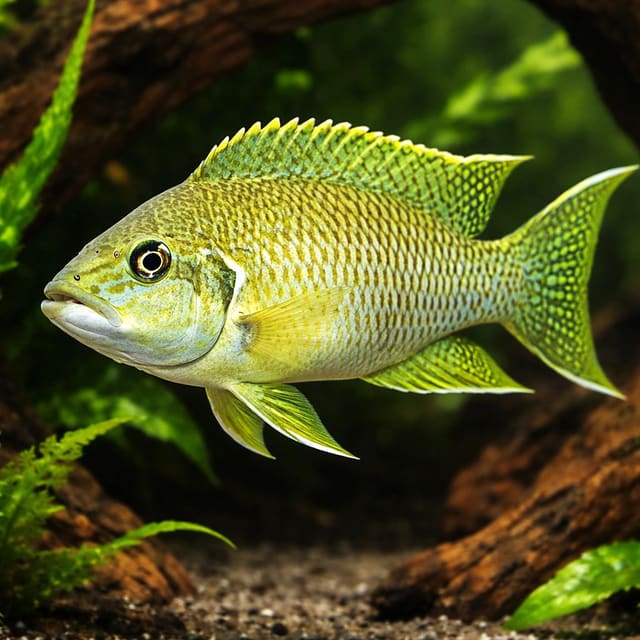
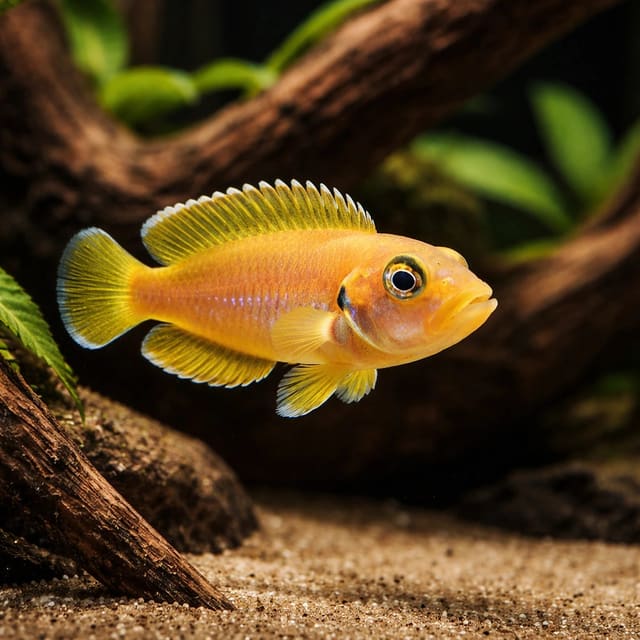
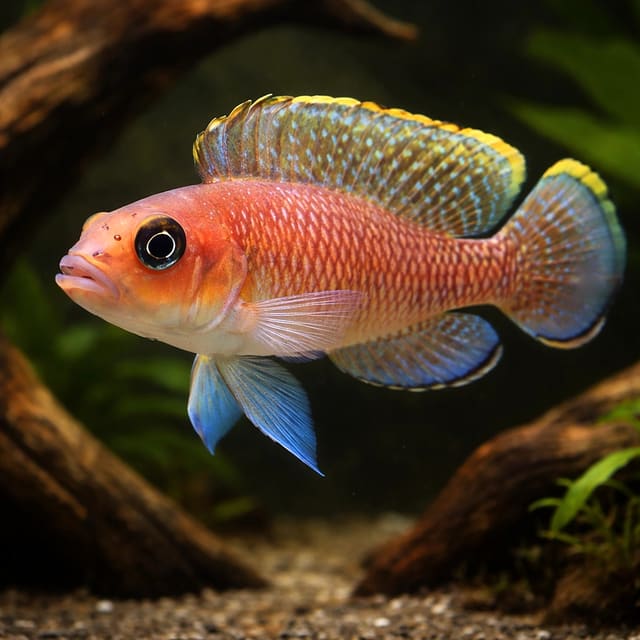
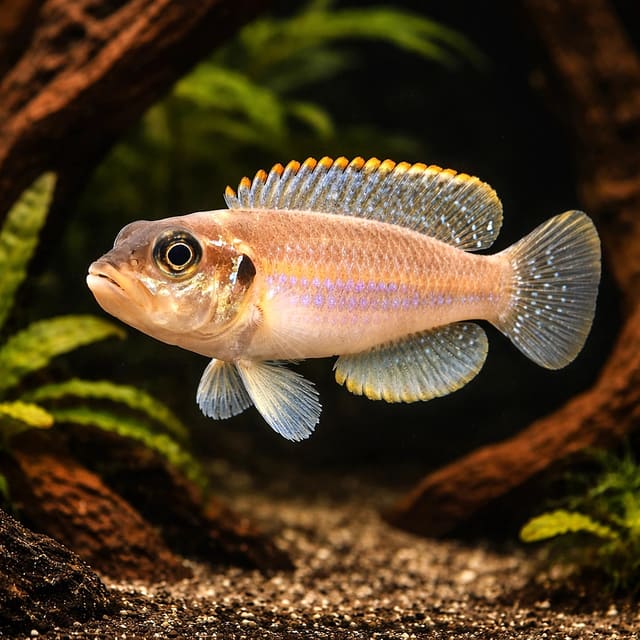
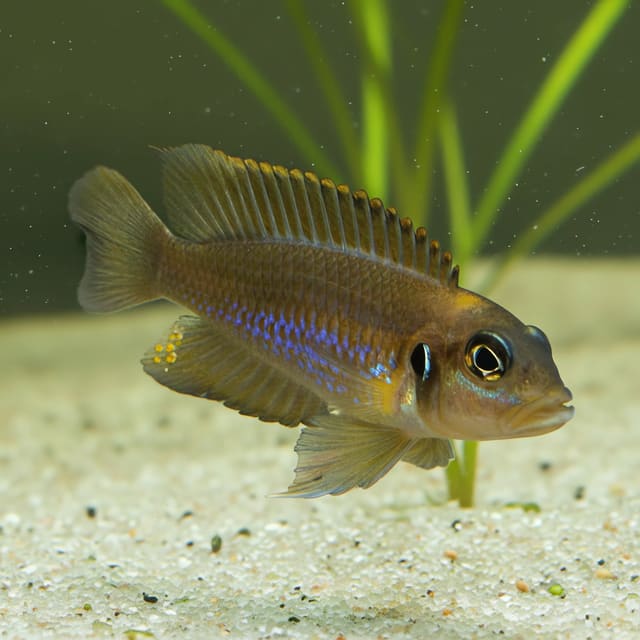
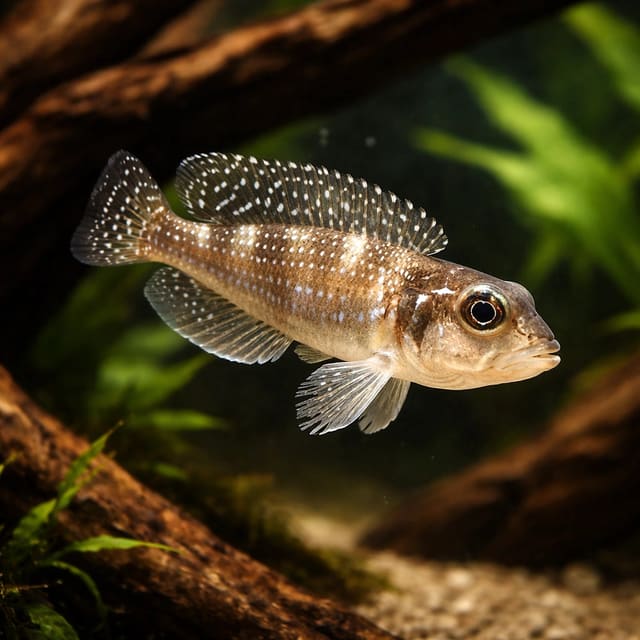
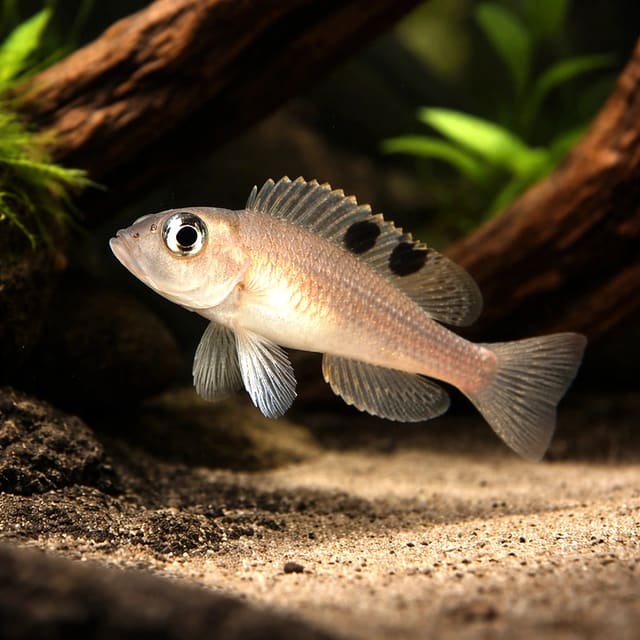
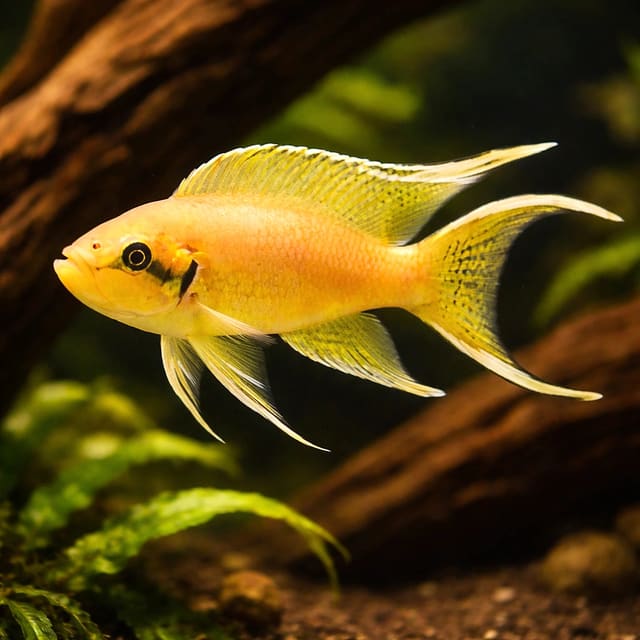
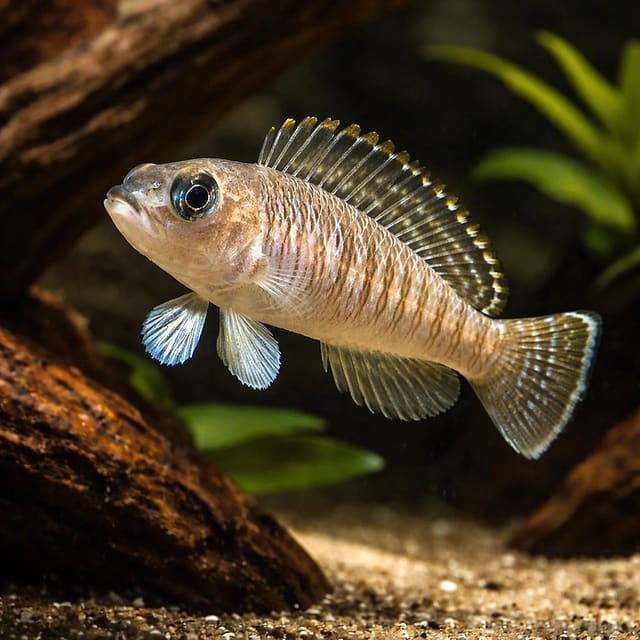
Colour and pattern vary with maturity, condition, lighting and the individual. The held gallery should be treated as representative rather than as a promise that the delivered fish will match one photograph. Gallery images have been digitally enhanced to improve image quality. Natural colour, pattern, size and maturity can vary between live animals.
Neolamprologus buescheri is associated with rocky habitat and caves in the wild, and the aquarium profile calls for substantial rockwork with numerous caves. Build on a stable base rather than balancing heavy stone on loose sand. If a fish excavates beneath a rock that lacks a stable base, the structure can shift; if the whole display must be dismantled to catch a bullied fish, intervention may come too late. Place major rocks securely first, then add sand around them and test every piece for movement.
Create more retreats than the number of fish expected to claim them. Cave entrances should face different directions and be separated by visual barriers so that the dominant resident cannot monitor every shelter from one position. Narrow gaps can be useful only when the intended fish can enter and leave safely. Avoid blind traps where a subordinate fish can be cornered. View the finished structure from the front, both ends and above: each angle should reveal routes that are hidden from another territory.
A 90 × 38 cm base is the documented species-level starting point for the one-male, several-female arrangement. The matching 90 × 38 × 30 cm example is about 103 litres gross, but rocks and sand displace water and reduce usable volume. A tall tank with a narrow base does not provide the same territory. Larger mixed-species plans need more footprint, more separated zones and more filtration; the stated example is not a universal community minimum.
Sand completes the habitat and allows ordinary excavation without sharp gravel around a cave mouth. Keep the foreground accessible for waste removal. Wood and dense planting are not substitutes for rocky territories. Plants can be used if they tolerate hard, alkaline water, but attach them where they will not hide an unstable joint or prevent the keeper from checking a refuge. The main design test is whether each fish can retreat out of sight while the keeper can still observe and intervene.
The specialist aquarium profile gives 24–28 °C, pH 7.5–9.0 and 8–25 dGH. These are the species-level managed aquarium values used for this listing. FishBase separately records pH 8–9 and 9–19 dH from the species record. The overlap confirms a hard, alkaline direction, but it does not justify rapid chemical adjustment. Stable conditions within the aquarium range are safer than repeatedly chasing a particular midpoint.
Test the source water before buying the fish. The aquarium water-chemistry guide explains the purpose of common readings, and the water matcher can help compare measured values with the care range. If source water is soft or acidic, decide on a repeatable preparation method for every replacement batch. A one-off dose that creates a high reading today is not a stable husbandry system.
OATA's broad African lake cichlid guidance gives 23–27 °C, pH 8.0–8.6, 12–18 dGH and 10–15 dKH, while warning that its figures are general to the group. Those numbers are useful background but do not replace the wider species-profile range above. The same guidance says ammonia and nitrite should be zero and nitrate should not exceed 20 mg/l above the normal tap-water level. Measure the tap value as well as the aquarium value so that the nitrate comparison has meaning.
Use a reliable thermometer and check heater operation rather than assuming the setting equals the water temperature. Record pH and hardness at consistent times, especially while learning how the system behaves between water changes. A written trend makes slow acidification, rising nitrate or an unstable preparation routine visible before the fish must signal distress. Sudden breathing changes, surface gathering or loss of appetite warrant immediate temperature, ammonia and nitrite checks.
These fish belong in a fully established aquarium. The RSPCA explains that a functioning biological filter houses bacteria that convert toxic ammonia to nitrite and then to the safer nitrate. That process takes time to establish and can be disrupted by over-cleaning, medication, power failure or adding too much biological load at once. A clear tank is not automatically a mature one; confirm the cycle with tests.
If this is your first system, use the first tropical aquarium guide before arranging livestock. Complete the cycle, prove that ammonia and nitrite remain at zero, and learn the tank's ordinary temperature and pH pattern. Introducing an aggressive specialist while filtration is still uncertain combines two problems that are much easier to manage separately.
Choose filtration that can process the adult load and capture debris without blasting a narrow cave continuously. Aim for surface movement and circulation around the rockwork, then look for places where food and waste settle. Intakes need guards and routine inspection. A reduced flow rate is a maintenance signal; find the blocked sponge, hose or impeller rather than compensating by creating one harsh jet elsewhere.
Preserve biological media during maintenance. Rinse reusable media lightly in removed aquarium water when needed; do not run it under the tap. Never replace every mature biological component at once. Clean mechanical stages often enough to keep water moving, but stagger deeper work so that the aquarium retains a stable bacterial population. After any major disruption, test ammonia and nitrite more frequently.
OATA's general African lake guidance recommends a 25% partial water change at least once every week. Treat that as a broad maintenance starting point, then adjust the routine using measured nitrate, feeding, stocking and the aquarium's real water volume. “At least once every week” does not mean that every aquarium should have more than 25% changed automatically; it means the interval should not drift while waste accumulates.
Prepare replacement water consistently. Use conditioner where the supply requires it, match temperature sensibly, and reproduce the established mineral method. Add water without undermining rockwork or sending sand into an occupied cave. Siphon visible waste from accessible areas and check the hidden zones where current slows. The goal is regular waste removal with small, predictable chemical movement.
Test before and after maintenance while establishing the routine. If pH shifts sharply, investigate the source-water preparation, carbonate hardness and interval rather than adding corrective products impulsively. If nitrate rises faster each week, reduce waste at source by reviewing feeding and stocking, then increase appropriate maintenance. Water changes cannot turn an overcrowded territorial layout into a sound social plan.
FishBase records chironomid insect larvae and other invertebrates in the natural diet. The specialist aquarium profile recommends live and frozen food as the basis and notes that dried foods are rarely accepted. Offer suitably sized items such as frozen or live bloodworm, brine shrimp, daphnia or comparable small invertebrate foods from reputable sources. Rotate foods rather than depending on one item.
Thaw frozen food appropriately and portion it so pieces reach more than one territory. A dominant fish stationed near the first feeding point can consume the whole ration while a subordinate remains hidden. Deliver small amounts to separated areas and watch each fish swallow. Adding a larger cloud of food is not a solution if one resident still controls access; uneaten material will decay among the rocks.
Dry foods can be offered carefully, but the care plan must not assume acceptance. If a fish ignores pellets or flakes, do not wait for it to become thin before returning to known suitable food. New arrivals may take time to feed confidently. Observe body condition, belly profile and participation at each meal, and remove leftovers that lodge in caves.
Feed enough to maintain condition without driving water-quality problems. Small portions allow the keeper to see appetite and hierarchy. A fish that approaches but is repeatedly displaced needs a social remedy, not just additional food. A fish that suddenly refuses a previously accepted live or frozen item deserves a water-quality and behaviour review before treatment is considered.
The species profile describes a workable arrangement of one male with several females and advises keeping only one male unless the aquarium is very large. Several females may distribute harassment, but there is no fixed count that guarantees compatibility. This listing is unsexed, and external appearance does not reliably distinguish male from female. Do not buy a precise number on the assumption that juvenile photographs reveal sex.
Start with the territory and separation capacity, then consider the social plan. More fish require more caves, more broken sightlines and more biological capacity. If two males mature in a tank that is not very large, serious conflict is a foreseeable risk. If one female receives persistent attention, a nominally correct group description does not make the result acceptable. Behaviour in the actual aquarium decides whether separation is needed.
Watch for repeated pursuit, exclusion from caves, confinement to a corner, torn fins, rapid breathing or failure to feed. Very territorial behaviour can escalate before obvious injury. Observe at quiet times as well as immediately after food, because a subordinate may appear only when the dominant fish is distracted. A phone video from several minutes away can reveal patterns that stop when a person stands at the glass.
Prepare a cycled alternative enclosure, secure divider or other safe separation method before conflict occurs. A bucket is not long-term housing, and dismantling unstable rockwork during an emergency creates further risk. Know which rocks can be removed first and keep a suitable net or container accessible. Separation is a normal contingency for this species, not proof that the keeper has failed.
Arrange for someone to receive the parcel. Live fish must not be left unattended, and the aquarium should already be mature, heated and within range. Before opening anything, start one continuous unboxing video. Show the parcel still sealed, the visible outer box, the opening in one take and the fish still inside the sealed bag before anything is disturbed. If a Live Arrival Guarantee claim is needed, send that recording with the order number.
Read the current delivery and Live Arrival Guarantee guidance before the parcel arrives. The order of actions matters for claim evidence: record the sealed parcel and fish in the sealed bag before opening or acclimating. After transfer, watch respiration, posture and territory access. Do not confuse normal caution with safety; a fish that remains pinned or attacked needs immediate protection.
Keep a brief daily record of temperature, appetite, position and interactions. A new fish may choose one refuge at first, but it should not be permanently prevented from feeding or leaving. Check ammonia and nitrite after adding livestock and whenever filtration has been disturbed. Make small corrections based on measurements rather than simultaneously changing food, rockwork and chemistry.
Rearranging selected boundaries can sometimes interrupt a dominant fish's territorial map, but it is not a substitute for enough space or removal. Make structural changes safely, with every rock supported. If conflict resumes immediately, separate the aggressor or victim according to the safest prepared plan. Repeatedly returning an injured fish to the same unchanged territory is not a fair test.
Over time, judge success by more than survival. Each fish should maintain body condition, feed, use shelter and move without constant pursuit. Stable water, appropriate food and predictable maintenance support health, while a workable territory plan reduces chronic stress. The species is rewarding precisely because its behaviour is so defined, but that behaviour must be managed rather than romanticised.
The specialist profile prefers a species-focused aquarium for Neolamprologus buescheri. That is the clearest starting point because even conspecific relationships can be aggressive. A dedicated tank lets the keeper design every cave, feeding point and sightline around this one species, and makes it easier to see which individual is eating or being excluded.
“Species-focused” does not mean that several Striped Lamprologus will automatically live peacefully. Normally keep one male unless the aquarium is very large, and provide several females with multiple refuges only when sex and space are genuinely known. Since this offer is unsexed and appearance is unreliable, maintain a plan for an unexpected second male or an incompatible individual.
In a larger, carefully structured Lake Tanganyika aquarium, Cyprichromis may use a separate open-water zone. That separation of ecological space is useful, but it is not a universal compatibility promise. The full Cyprichromis group, swimming room, feeding access and water requirements must fit without reducing the rock territory or trapping subordinate fish.
Julidochromis or Altolamprologus can be considered only when the aquarium provides enough room and fully separated territories. They are cichlids with their own territorial behaviour, not peaceful decorations. Map adult territories, cave entrances and feeding routes before purchase, and be prepared to remove a fish if boundaries fail.
Avoid shell-dwelling cichlids. Avoid mbuna, boisterous fish and predators. The shell-dweller exclusion is why the supplied shell-dweller product candidates are not presented as related alternatives. Small size or a shared African origin does not overcome incompatible territorial use, feeding pressure or predation risk.
Do not use a tank mate to “distract” aggression in an undersized aquarium. Adding more animals increases biological load and can create new territorial conflicts. If a Striped Lamprologus repeatedly attacks another fish, the solution is space, boundaries or separation—not asking a third fish to absorb the attention.
Brief display is not the same as safe long-term coexistence. Look at outcome: can every fish eat, rest, leave a cave and cross the aquarium without sustained pursuit? Torn fins, hiding above the heater, rapid breathing, weight loss or permanent confinement show that the arrangement is failing. Act before injury becomes severe.
Sex cannot be reliably assigned from external appearance, and this listing carries no sex guarantee. A plan built around a supposed male or female can change as fish mature. Reassess territories when colour, confidence or pair behaviour changes, and do not keep an extra male in a standard-sized setup simply because the first weeks appeared quiet.
For general browsing, the African cichlid collection shows other available cichlids. It is a collection link, not a compatibility list. Research each species independently; fish from different African lakes, habitats and social systems should never be combined solely because a retailer groups them under one navigation heading.
Striped Lamprologus (Neolamprologus buescheri) reaches a recorded maximum of 8 cm total length in FishBase. The specialist aquarium profile separately reports 70 mm standard length, which excludes the tail. Plan for the adult fish and its defended territory, not the smaller 3.5–5 cm or over 5.5 cm dispatch size.
The species profile gives a 90 × 38 cm base. Its 90 × 38 × 30 cm example is about 103 litres gross for one male with several females; rock, sand and the air gap reduce usable water. Larger communities need more footprint and fully separated territories.
Normally keep one male unless the aquarium is very large. Several females may distribute harassment, but no exact ratio guarantees peace and this offer is unsexed. Provide numerous caves and keep a safe separation plan ready for any individual that is attacked or incompatible.
No. Neolamprologus buescheri is better for an advanced keeper who can maintain hard alkaline water, build stable multi-cave rockwork, supply live and frozen food, recognise territorial pressure and separate fish promptly. Its short adult length does not make its social care simple.
Striped Lamprologus feeds on insect larvae and other invertebrates in nature. Use suitably sized live and frozen foods as the basis, offered across more than one territory. Dry foods are rarely accepted, so do not make pellets or flakes the only feeding plan.
Use the species-profile aquarium range of 24–28 °C, pH 7.5–9.0 and 8–25 dGH. Keep values stable, with zero ammonia and nitrite in a mature filtered aquarium. Test source and replacement water before trying to adjust a hard-water system.
Striped Lamprologus is very territorial and aggressive, including towards its own kind. Repeated pursuit, blocked feeding, confinement or torn fins requires a change of territory or separation. Numerous caves help, but they cannot guarantee that particular individuals will coexist.
Species-focused housing is preferred. In a larger, carefully zoned Tanganyika aquarium, Cyprichromis may use open water; Julidochromis or Altolamprologus require enough room and separate territories. Avoid shell dwellers, mbuna, boisterous fish and predators.
Tropical Fish Co uses its live-fish delivery process. Be present to receive the parcel and, before opening, record one continuous video from the sealed parcel to the fish in the sealed bag. Send it with the order number if a claim is needed. Inspect the fish the same day, float the closed bag for 20–30 minutes, and do not add transport water to the aquarium.
FishBase: Neolamprologus buescheri supports the accepted name, Cichlidae family, southern Lake Tanganyika distribution, 8 cm maximum total length, hard alkaline environmental record, rocky cave association, invertebrate diet, cave breeding and territorial defence. Wild depth observations describe habitat and are not aquarium-depth instructions.
Seriously Fish: Neolamprologus buescheri supports the 70 mm standard-length figure, 90 × 38 cm base, approximately 103-litre gross example, 24–28 °C, pH 7.5–9.0, 8–25 dGH, rock-and-cave layout, live and frozen diet, high territorial aggression, one-male guidance, conditional companions and explicit avoids.
Eschmeyer's Catalog of Fishes record supports the original combination Lamprologus buescheri Staeck, 1983 and the current valid name Neolamprologus buescheri (Staeck, 1983). The supplier spelling “buscheri” is recorded only as a misspelt trade-name bridge.
OATA's African lake cichlid care sheet supplies broad group-level maintenance context, while the RSPCA aquarium-environment guidance explains biological filtration. Neither replaces the species-level care profile. Tropical Fish Co supplies one unsexed live fish per purchase in the chosen dispatch size, and its linked delivery page governs arrival and claim steps.
No reviews for this item yet. Bought one? Honest reviews only, good or bad.
What customers say about ordering from us
I have a small group of long finned mountain minnows. So was delighted to be able to order ten of this variety to increase the genetics in my tank . The ones I recieved are healthy but it’s to early to give a verdict on wether they are of a long finned type since they are small currently.
Gordon Walker · 23 Sept 2026
100% success travel and "installation". Pleased with quality of purchase. The Siamese fighter a bit "shy" so have not yet seen him at his best yet but looking good. Happy customer. GG
George E Garratt · 21 Sept 2026
Reviews of our shop, collected by Judge.me, an independent third-party review collector. Newest first.