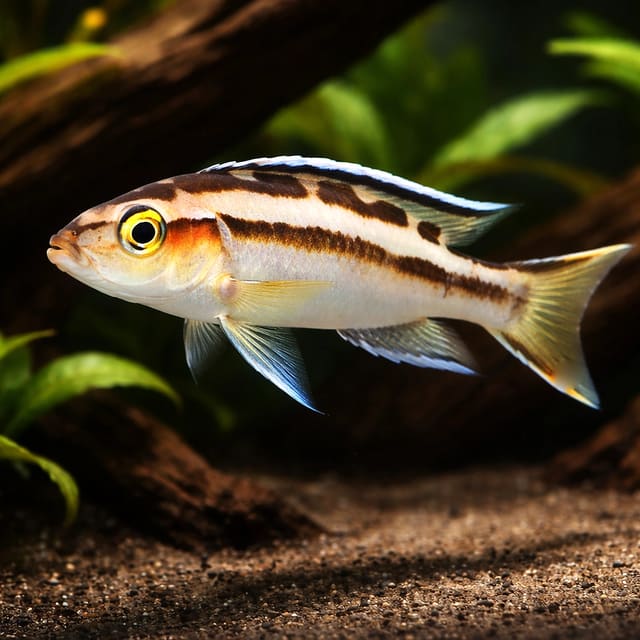
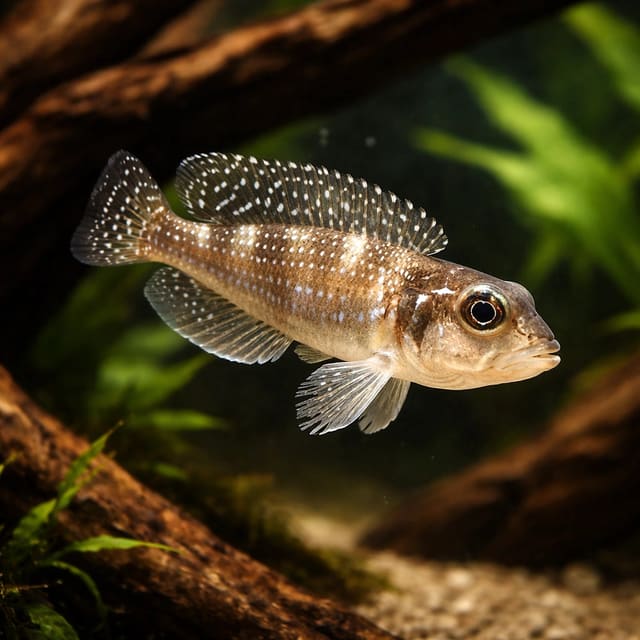
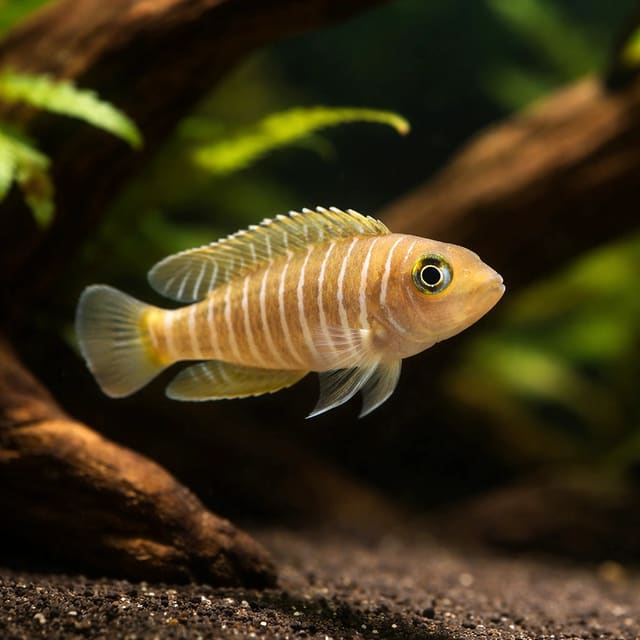
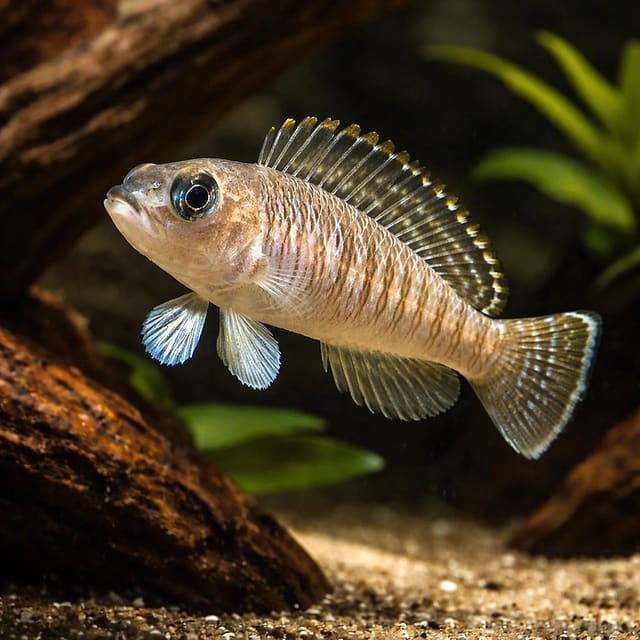
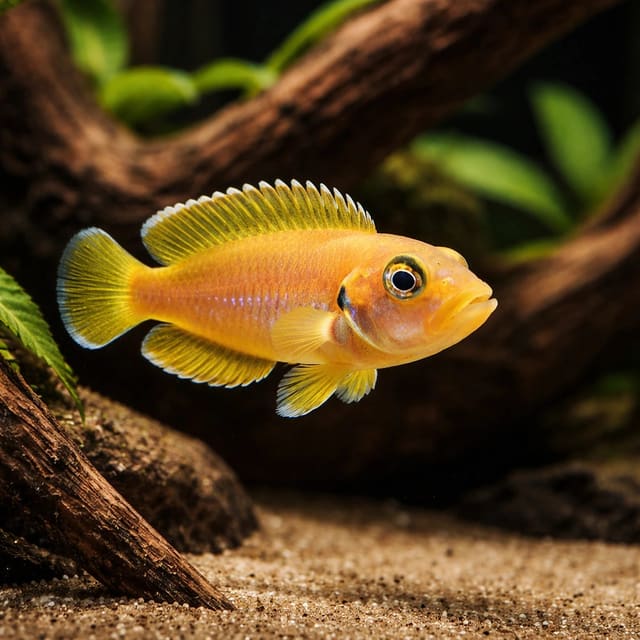
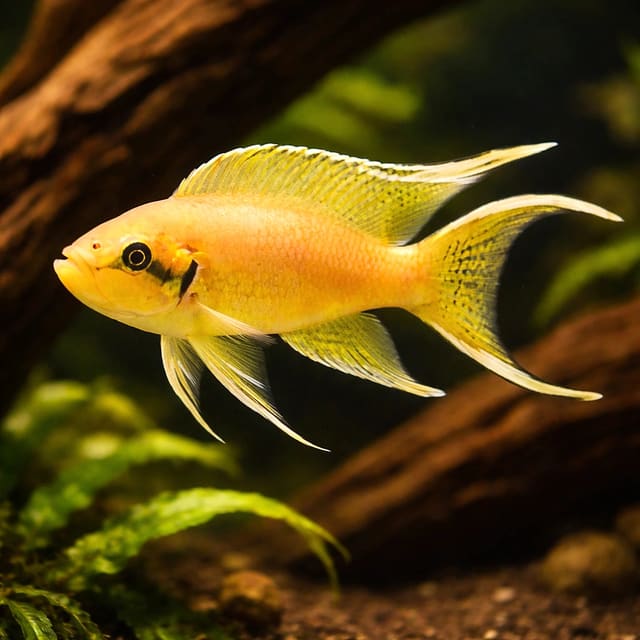
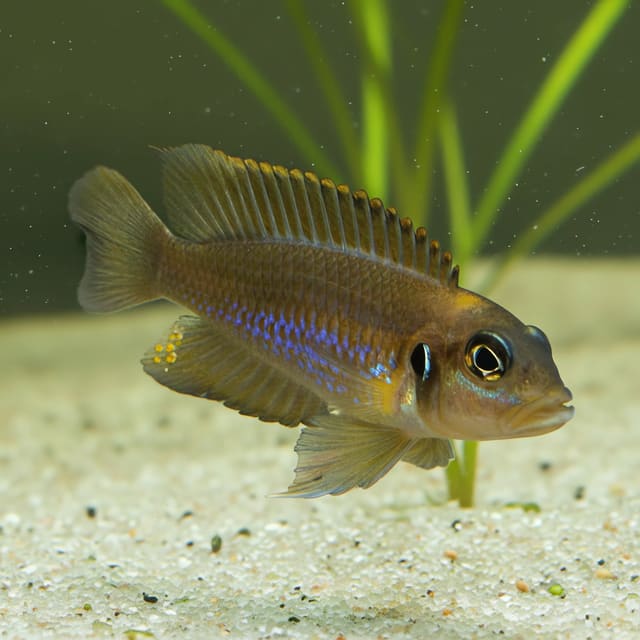
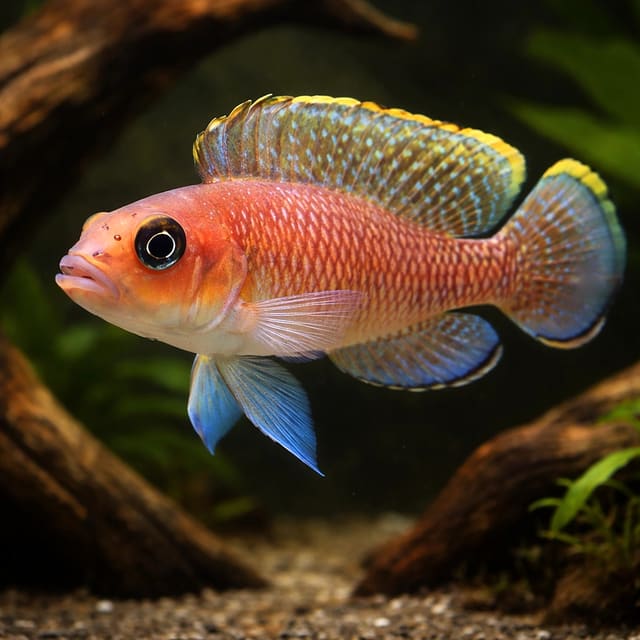
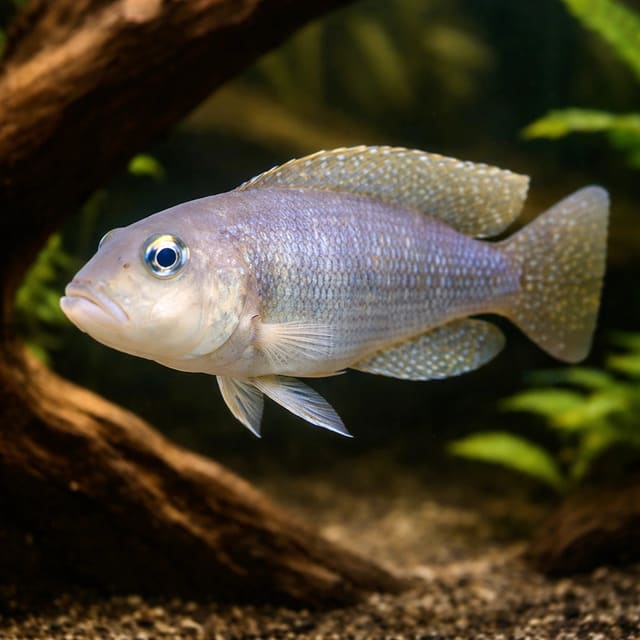
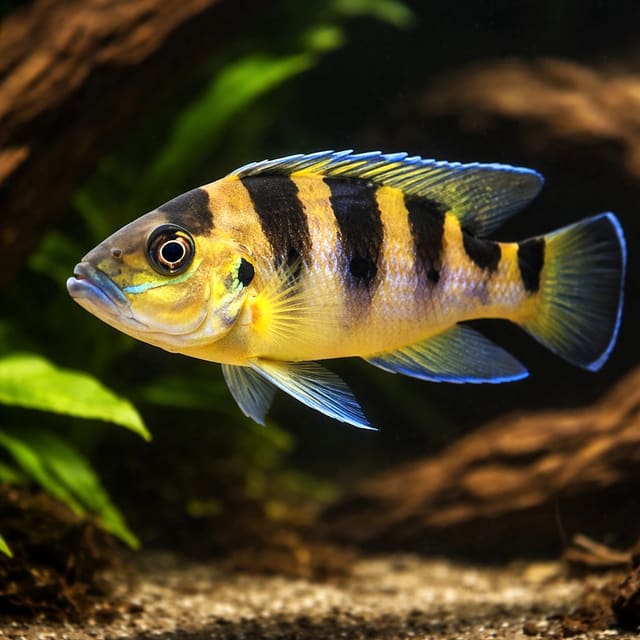
Pearl-Lined Lamprologus (Neolamprologus tetracanthus) — Gold
23–25°C · pH 7.5–8
£17.99
A rare Lake Tanganyika cichlid associated with muddy burrows and optional shell retreats. Best kept as a compatible pair in stable, hard alkaline water.
Adult size is the maximum length this species reaches at full maturity (scientific sources). The livestock you receive will be younger and smaller — pick a size above for the actual shipping size. Product-photo provenance and any image-specific limitations are stated on the listing.
Neolamprologus kungweensis
Save when buying multiple fish. Each quantity is one fish; sex and pair formation are not guaranteed unless the selected variant explicitly states them.
A rare Lake Tanganyika cichlid associated with muddy burrows and optional shell retreats. Best kept as a compatible pair in stable, hard alkaline water.
Adult size is the maximum length this species reaches at full maturity (scientific sources). The livestock you receive will be younger and smaller — pick a size above for the actual shipping size. Product-photo provenance and any image-specific limitations are stated on the listing.

Cichlids are a family of roughly 1,800 accepted species, not one care type. Before buying, identify the exact species and source, then compare adult measurement, usable tank dimensions, social system, territory, tested water, diet and an exit plan. No family-wide minimum tank, water range or tank-mate list is safe.
Maintain these water conditions for optimal health and vibrant colors
The Ocellated Shell-Dweller is a small, highly observant Lake Tanganyika cichlid whose natural history is more unusual than its trade name suggests. The currently accepted scientific name is Neolamprologus kungweensis. Many aquarium references, older books and supplier lists still use Lamprologus kungweensis, so both names are explained on this page. It is often grouped with shell dwellers because it uses small cavities and may associate with shells, but field records describe fish living mainly over flat muddy bottoms, excavating narrow burrows where shells can be sparse. That distinction matters when designing an aquarium: a pile of empty shells alone does not recreate the full habitat.
This is a specialist Tanganyikan cichlid for an established, stable aquarium. Its compact shape should not be mistaken for community-fish simplicity. It needs hard, alkaline water, a fine substrate it can manipulate, secure cavities, measured feeding and enough floor area for a compatible pair to settle without constant conflict. When those needs are met, the reward is close-up behaviour: digging, hovering at a burrow entrance, rearranging the substrate, inspecting every change and coordinating territory defence with a partner.
Important identity note
Accepted name: Neolamprologus kungweensis. Older name still used in aquarium references: Lamprologus kungweensis. This species is not the same fish as Lamprologus ocellatus, despite the shared “ocellated” wording found in the aquarium trade.
| Accepted scientific name | Neolamprologus kungweensis |
|---|---|
| Older name still in use | Lamprologus kungweensis |
| Family | Cichlidae |
| Natural range | Lake Tanganyika, East Africa; endemic to the lake |
| Published maximum size | Up to about 8 cm total length; do not plan around the old 4.5 cm claim |
| Practical temperature | 24-26°C, stable |
| Practical pH | 7.5-8.5, stable and well buffered |
| Practical hardness | 10-20 dGH |
| Social plan | A compatible pair; groups require substantially more floor area and an exit plan |
| Diet | Small zooplankton and invertebrate-style foods, supported by a quality micro pellet |
| Care level | Moderate; best for keepers comfortable with mineral-rich water and cichlid territories |
The ranges above are practical aquarium targets rather than an invitation to move the water between extremes. Stability is more important than chasing a precise number each day. Test the source water before choosing the fish; our water matcher can help compare a measured pH and hardness profile with the species' requirements. If the aquarium dimensions are uncertain, calculate the real filled volume with the tank-volume tool rather than relying only on the manufacturer's nominal size.
Neolamprologus kungweensis is the accepted combination in Eschmeyer's Catalog of Fishes. The species was described by Poll in 1956 and has long circulated as Lamprologus kungweensis. FishBase and a number of respected aquarium references continue to display the older combination, while more recent taxonomic resources place it in Neolamprologus. This is a normal result of scientific classification changing as relationships are reviewed; it does not mean that two different fish are being offered.
The common name needs similar care. “Ocellated Shell-Dweller” is an established trade label, but it can be confused with the better-known Ocellated Shell-Dweller Lamprologus ocellatus. The species on this page is N. kungweensis. Check the scientific name whenever comparing fish, care sheets or photographs. The word “ocellated” also has a historical taxonomic connection: an earlier replacement name associated with this species cannot safely be treated as the current identity of L. ocellatus.
| Name encountered | How to interpret it |
|---|---|
| Neolamprologus kungweensis | Current accepted name used for the product identity and care record. |
| Lamprologus kungweensis | Older combination still useful when searching established aquarium and scientific references. |
| Ocellated Shell-Dweller | Trade common name; always confirm the accompanying scientific name. |
| Lamprologus ocellatus | A different Tanganyika cichlid and not a synonym to substitute casually on this listing. |
This species is endemic to Lake Tanganyika. FishBase records it from the Kungwe Bay area north towards Bujumbura and south towards Kalemie. Lake Tanganyika is ancient, mineral-rich and biologically distinctive, but a general description of the lake is not enough to design this fish's home. N. kungweensis is associated with shallow, flat muddy bottoms rather than a conventional wall of rocks or a dense carpet of large snail shells.
Field observations summarised by FishBase describe low shell density and numerous narrow holes in the bottom, around one centimetre across and extending roughly twelve centimetres into the substrate. The fish were reported to dig and use these holes. That behaviour explains the compact body, low hovering position and intense attention to small entrances. It also explains why a generic shell-bed layout may fail to give the fish the structure it expects.
An aquarium cannot and should not reproduce deep, oxygen-poor lake mud literally. A thick bed of compact organic soil can develop anaerobic pockets and is difficult to keep clean. The useful lesson from the habitat is functional: provide fine, movable substrate and several secure, narrow retreats at substrate level. Smooth inert sand, partly buried shells, short aquarium-safe ceramic tubes and carefully positioned small caves can create choice without introducing unstable mud. Every heavy object must rest securely so digging cannot undermine it.
The most accurate answer is “a cavity-oriented fish with strong natural burrowing behaviour”. A comparative scientific study of Tanganyika cichlid brood care did not classify L. kungweensis as an obligatory shell breeder. Shells can still be useful retreats and may be selected in captivity, particularly where an opening suits the fish, but they should be offered as part of a varied cavity system rather than presented as the only correct home. Observe the fish instead of forcing it into a shell-only interpretation.
| Habitat element | Aquarium translation | Avoid |
|---|---|---|
| Flat muddy bottom | Open areas of fine inert sand that can be excavated. | Deep compact garden soil or dirty organic substrate. |
| Narrow burrows | Stable small caves or partially buried aquarium-safe tubes. | Sharp pipes, unstable stone stacks or entrances that trap fish. |
| Sparse shells | Several clean empty shells of usable sizes, spread among other retreats. | Treating shells as proof that every individual must spawn inside one. |
| Quiet bottom territory | A broad footprint with visual boundaries and low competition. | Busy bottom fish constantly crossing the pair's chosen entrance. |
Published records give a maximum of about 8 cm total length. Individual aquarium fish may remain below the published maximum, and sale-size juveniles are naturally smaller, but responsible tank planning should allow for the adult rather than assuming the purchase size is permanent.
The fish has a compact, elongated cichlid profile with a relatively large head and eyes suited to close inspection of the substrate. Colour can appear understated in a shop photograph: tan, brown and grey tones may be overlaid with darker patterning, iridescent detail and ocellated markings that become clearer when the fish is settled. Stress, lighting, social position, background and breeding condition can all alter how strongly the pattern shows. A newly arrived juvenile should not be judged against a fully settled adult photographed under studio lighting.
Sexing young fish by colour alone is unreliable. Mature males may become larger, but size overlap and social suppression can make a small dominant/subordinate group difficult to interpret. The safest route to a pair is careful observation over time, with spare accommodation available if two fish prove incompatible. Do not buy a fixed number on the assumption that every combination will form a peaceful colony.
Footprint matters more than height because nearly all meaningful activity occurs close to the bottom. A practical permanent plan for a compatible pair begins around 60 litres with a broad base, while a 75 cm or longer footprint gives better room to separate a principal retreat from feeding and maintenance zones. A nominal 40-litre aquarium can be used only as a very compact, species-focused arrangement by an experienced keeper who can monitor aggression closely; it should not be promoted as a generous default for an 8 cm territorial cichlid.
Groups need substantially more room. The old instruction that a “small colony” would automatically suit 60-90 litres was too confident. This species is reported as monogamous in comparative breeding research, and adding extra fish can leave an unpaired individual without a defensible retreat. If starting with a group to allow pair formation, use a much larger footprint with physically separated territories and keep a cycled second aquarium ready. Once a pair forms, remove fish that are repeatedly excluded rather than waiting for visible injury.
| Situation | Practical planning | Main risk |
|---|---|---|
| Established compatible pair | About 60 L or more, prioritising a broad 60-75 cm footprint and multiple retreats. | Too few escape routes if the bond changes. |
| Unsexed juveniles for pair formation | A larger zoned aquarium plus a ready second tank; monitor daily as they mature. | One fish becoming trapped outside the dominant territory. |
| Tanganyika community | Substantially larger aquarium with distinct bottom, rock and open-water zones. | Competing bottom fish repeatedly crossing the burrow zone. |
| Compact 40 L tank | Experienced species-only management, established pair, careful feeding and backup accommodation. | Rapid water-quality change and no distance from aggression. |
Use the stocking calculator only as an initial volume check. No calculator can predict whether two cichlids will form a compatible pair or whether the bottom layout provides adequate separation. Behaviour must override a numerical stocking result.
Use smooth inert sand fine enough for digging but easy to siphon at the surface. A moderate layer is safer than an exaggerated deep bed. Create several potential retreats before the fish arrives: clean empty snail shells, short ceramic spawning tubes, and compact caves with rounded edges. Partly bury some entrances and leave others exposed. This allows the fish to show a preference while keeping every retreat inspectable.
Place rocks directly on a stable base or support them so excavation cannot cause a collapse. Never balance a heavy stone on loose sand. Keep at least one retreat outside the main visual territory so a displaced fish can hide temporarily while you intervene. A removable divider is useful during pair formation.
Choose mature biological filtration sized for the real water volume. A sponge filter, protected internal filter or appropriately sized external filter can work. Flow should keep oxygen and waste moving without blasting sand into the entrances. Cover intakes if fry may be present. Because food is small and often sinks, inspect the quiet zones behind shells and tubes during maintenance; they can collect waste even when the open sand looks clean.
Plants are optional. Species attached to stone or wood, such as Java fern and Anubias, avoid root disturbance, while Vallisneria can be confined behind rock barriers if the mineral-rich water suits it. Do not let planting consume the open bottom area. Moderate lighting is enough, and shaded entrances help fish feel secure. A dark back panel and broken lines of sight usually contribute more to confidence than very bright decorative lighting.
The cycle tracker provides a useful record of ammonia, nitrite and nitrate readings. It does not shorten the biological cycle, but it makes it easier to see whether the aquarium is genuinely stable before live fish are added.
FishBase gives a published temperature range of 24-26°C, while the supplier data supports pH 7.5-8.5 and 10-20 dGH. These are sensible practical targets for this stock. The most important word is stable. A fish held at pH 8.0 every day is better served than one moved repeatedly between 7.5 and 8.5 because the keeper is chasing a theoretical ideal.
Test tap water after it has stood and aerated, because pH can change as dissolved gases equilibrate. If remineralisation is needed, prepare replacement water outside the aquarium and match it before a water change. Do not add random buffers directly to the fish tank. Alkalinity or carbonate hardness helps resist a pH crash, while general hardness describes dissolved calcium and magnesium; they are related but not interchangeable measurements.
| Check | Working target | Response to a poor result |
|---|---|---|
| Temperature | 24-26°C with minimal daily swing | Check heater placement and verify with a second thermometer. |
| pH | 7.5-8.5 and stable | Test source water and buffering capacity before changing chemistry. |
| General hardness | 10-20 dGH | Remineralise replacement water consistently if the source is too soft. |
| Ammonia / nitrite | 0 mg/L | Stop feeding, test again, protect oxygen and perform matched water changes. |
| Nitrate and debris | Controlled by regular maintenance | Increase appropriately sized changes and siphon exposed waste gently. |
A weekly partial water change is a useful starting rhythm, adjusted to measured nitrate, feeding and stocking. Match temperature and chemistry closely. Siphon around the edges of the territory without repeatedly dismantling the chosen burrow. Rinse filter media in removed aquarium water when flow falls; do not replace all biological media at once.
FishBase reports zooplankton and small invertebrates encountered while digging as natural foods. That points to a protein-oriented menu of suitably small particles, not bulky sticks or a generic “omnivore” mix dominated by large vegetable flakes. A high-quality micro pellet can provide nutritional consistency, supported by frozen cyclops, daphnia, baby brine shrimp and similar clean foods.
Feed where the pair can see the food without forcing it to abandon the bottom territory. Slow-sinking particles are often easier to intercept than food floating at the surface. In a mixed aquarium, deliver a little food towards the burrow zone after faster open-water fish have been occupied elsewhere. Watch both members of the pair eat; a fish that always remains hidden may be stressed, ill or excluded.
| Food type | Role | Use carefully |
|---|---|---|
| Quality micro pellet | Measured staple with consistent vitamins and minerals. | Choose a particle the smallest fish can swallow whole. |
| Frozen cyclops or daphnia | Small prey shape and varied movement through the water. | Thaw and portion; do not pour excessive thaw water into a small tank. |
| Baby brine shrimp | Useful variety and conditioning food; freshly hatched nauplii suit fry. | Rinse where appropriate and feed only what is consumed. |
| Large cichlid sticks or mammal meat | No useful role in the routine diet. | Avoid; particles are unsuitable and excess rich food increases waste. |
One or two small meals daily usually suit adults. Juveniles can be offered smaller portions more often when filtration and maintenance support it. The useful portion is what all fish finish promptly, not a fixed pinch. Check behind partly buried structures after feeding. Uneaten micro food can disappear from view while still decomposing.
This fish is best described as locally territorial. It may spend long periods calmly hovering, digging and watching, then react sharply when another fish approaches the chosen entrance. The aggression is meaningful rather than random: access to the burrow, feeding position and partner are valuable resources. The aquarium must allow an intruder to leave the defended area immediately.
Comparative research records a monogamous mating system for the species. In practice, that makes a compatible pair the most defensible social plan. “Pair” does not mean any two fish will get along. Watch for reciprocal tolerance: both fish feeding, both using cover, no individual permanently pale or pinned to the surface, and no repeated high-speed attack after the subordinate has retreated. Torn fins are a late sign; intervene before physical damage.
Digging is expected. A fish may deepen an entrance, move sand away from a shell or block a cavity that the keeper thought was ideal. Let safe rearrangement happen. Repeatedly restoring the display for visual symmetry removes information the fish has created and can restart disputes. Maintenance should preserve the basic territorial map unless there is a safety reason to change it.
The simplest and often most rewarding arrangement is species-focused. In a community, every companion must tolerate the same hard, alkaline water and avoid continual competition for the lower zone. Small Tanganyika open-water fish may be considered in a much larger aquarium, while rock-associated species need a separate rock structure with clear distance from the burrow field. A general soft-water community of tetras, rasboras or Corydoras is not appropriate simply because the temperatures overlap.
Large or boisterous Malawi cichlids are poor partners. They can overwhelm the quieter bottom territory and have different social-management requirements. Predatory fish, fin-nippers and aggressive bottom dwellers should also be excluded. Small shrimp may be viewed as food, and a territorial pair can harass snails or other animals that enter the cavity zone. Even a theoretically compatible species can fail in an aquarium without enough floor area.
| Companion plan | Assessment | Conditions |
|---|---|---|
| Compatible pair only | Preferred | Multiple retreats, visual cover and backup accommodation. |
| Small Tanganyika open-water species | Possible in a much larger specialist setup | Separate zones, compatible chemistry and no competition at entrances. |
| Other shell or burrow cichlids | High risk | Only in very large, carefully partitioned habitats with expert observation. |
| General community fish | Avoid | Chemistry, behaviour and habitat use usually conflict. |
| Malawi cichlids or large predators | Avoid | The smaller fish can be stressed, displaced or injured. |
| Shrimp | Avoid | Small invertebrates fit the natural feeding profile. |
Use the tank-mates tool to compare basic water and temperament requirements, then apply the species-specific territorial guidance above. The tool cannot see the actual footprint or burrow map, so the final decision remains with the keeper.
Breeding is possible in a settled pair, but it should not be described as a guaranteed shell-spawning routine. Research does not classify the species as an obligatory shell breeder, and its natural burrows deserve equal attention. Provide several secure cavities and let the pair choose. Courtship may include increased digging, close inspection of an entrance, stronger territorial responses and one fish spending more time near or inside the selected retreat.
Do not lift a shell or dismantle a tunnel to search for eggs. A sudden change can cause abandonment or expose eggs and fry. Keep temperature and chemistry stable, continue small measured feeds, and perform gentle maintenance away from the entrance. If one partner is excluded during breeding, be prepared to divide or remove it; pair behaviour can change as parental defence intensifies.
Once fry are free-swimming, offer appropriately tiny foods such as freshly hatched baby brine shrimp, microworms from a clean culture or a proven powdered fry food. Feed very small portions several times a day only if water quality can be maintained. Protect filter intakes and siphon with care. Growth should be judged by steady feeding and body condition, not by pushing rich food into a small volume.
| Stage | What to watch | Keeper response |
|---|---|---|
| Pair settling | Reciprocal tolerance, digging and shared use of a zone. | Maintain several cavities and avoid unnecessary rescapes. |
| Possible spawning | Focused cavity attendance and stronger local defence. | Do not inspect inside or make sudden chemistry changes. |
| Free-swimming fry | Tiny fish near the entrance and active feeding responses. | Offer tiny live/fry foods and protect the filter intake. |
| Juvenile growth | Increasing territorial pressure and uneven access to food. | Grade or move juveniles before crowding damages the group. |
Most preventable problems begin with unstable chemistry, incomplete cycling, accumulated food or social stress. A healthy fish is alert, maintains body weight, breathes evenly, investigates the substrate and responds to food. Hiding by itself is not automatically illness in a cavity fish, but a sudden change from normal behaviour needs investigation.
Warning signs include rapid gill movement, clamped fins, a hollow belly, refusal of several normal meals, persistent surface hovering, repeated scratching, white spots, damaged fins or a fish driven away from every retreat. Test ammonia, nitrite, nitrate, pH and temperature before reaching for medication. Correcting water or separating an aggressor is often the first essential action. Medication cannot compensate for a continuing pH crash or territorial attack.
Quarantine new fish in matched hard, alkaline water. Provide at least one secure cavity so natural hiding is not confused with sickness. Observe appetite, waste, breathing and skin condition. Equipment used in quarantine should not return wet to the main aquarium without appropriate disinfection. The care planner can help organise recurring tests and maintenance, but direct observation remains the most valuable check.
| Observation | Possible cause | First checks |
|---|---|---|
| Fish remains above the bottom | Excluded from territory, poor oxygen or water irritation | Aggression, ammonia, nitrite, temperature and aeration. |
| Rapid breathing | Water-quality problem, overheating, gill irritation or disease | Full water panel, oxygenation and close gill/skin observation. |
| Hollow belly or missed meals | Competition, unsuitable food, internal disease or transport stress | Watch individual feeding and isolate for diagnosis if needed. |
| Split fins | Territorial injury or abrasive decor | Separate aggression, inspect entrances and keep water clean. |
Prepare the aquarium before dispatch day: lights dimmed, cavities in place, filter mature and water tests completed. Avoid major maintenance immediately before arrival. When the fish reaches you, inspect the sealed bag and follow the supplied instructions. Temperature equalisation and controlled transfer should be completed without exposing the fish to prolonged ammonia after the bag is opened.
Our acclimation timer helps keep the process organised. The correct method depends on the shipment and the chemistry difference, so use the delivery instructions rather than applying an automatic long drip to every bag. Do not add transport water to the aquarium. After release, keep lighting low and give the fish time to locate a retreat. It is normal for a newly moved cavity fish to remain hidden, but breathing should settle and posture should improve.
Offer a very small familiar food only after the fish has had time to settle, and remove anything ignored. Check the tank quietly over the first evening. If more than one fish arrives, confirm that both can reach shelter. The full packing and claim process is on our live-fish delivery page, including the Live Arrival Guarantee requirements.
Similar trade names do not make species interchangeable. The Ocellated Shell-Dweller on this page is selected for its mud-burrow association, compact territory and uncommon identity. A keeper who specifically wants a classic shell-bed colony may prefer a different species, while someone who wants a pair-focused, behaviour-led aquarium may find N. kungweensis especially compelling.
| Fish | Useful distinction | Best reason to compare |
|---|---|---|
| Neolamprologus kungweensis | Mud-bottom burrow specialist with facultative shell association; pair-centred plan. | For keepers drawn to uncommon natural behaviour and subtle detail. |
| Multi Shell-Dweller | A different species commonly chosen for conspicuous shell-bed social behaviour. | Compare social structure and required shell-field design before choosing. |
| Signatus Shelldweller | Another small Tanganyika cavity-associated cichlid with its own behaviour and appearance. | Compare adult size, sex differences and pairing plan. |
| Brevis Shell-Dweller | A separate pair-oriented shell-dwelling species. | Compare shell use and territory before mixing or substituting. |
Browse the Lake Tanganyika cichlid collection to compare current stock. Product availability and sizes change, so use each species page rather than assuming that all Tanganyikans share the same diet or social plan.
This is a strong choice for a keeper who enjoys watching behaviour at close range and is willing to build around one species' needs. It suits a mature hard-water aquarium, a broad footprint, restrained feeding and patient observation. It is less suitable for someone seeking a plug-and-play nano community, a soft-water planted display, or a colourful fish that spends all day in open water.
The available size describes the fish at dispatch, not its final adult length. Smaller juveniles can be easier to introduce together, but their sex and eventual pair relationship may be unclear. Larger fish may show more developed pattern and behaviour, yet two mature individuals are not automatically compatible. Choose by the aquarium's readiness and your ability to manage pairing, rather than selecting only the largest or smallest option.
Before checkout, compare the listed variant with the dimensions of every entrance already in the aquarium. A retreat must be large enough for the fish to enter and turn safely, while still giving the close fit that makes a cavity useful. Provide more than one size because growth and individual preference can change which retreat is occupied. Never trap a fish by narrowing a tube with loose stones, and remove any shell with a damaged sharp lip.
Success is not measured only by spawning. A healthy long-term result is a fish that maintains weight, feeds promptly, uses the lower territory confidently and recovers calmly after routine maintenance. Keep a simple monthly record of water tests, body condition and social changes. Photographs taken from the same angle can reveal slow weight loss or fin damage that is easy to miss day to day.
Review the layout as the fish grows. An entrance that suited a juvenile may become tight, and a pair that shared one zone may begin to defend a wider area at maturity. Add alternatives at a normal maintenance point, not during a conflict, and preserve the established retreat whenever it remains safe. If one fish repeatedly loses access to food or cover, act on the behaviour immediately rather than waiting for the next scheduled review.
Before ordering, confirm the selected size, current availability and aquarium readiness. WELCOME5 may provide 5% off an eligible first order; the checkout confirms whether the offer applies. Live fish are covered by our Live Arrival Guarantee when the published delivery and evidence requirements are followed.
Neolamprologus kungweensis is the accepted current name in Eschmeyer's Catalog of Fishes. Lamprologus kungweensis is the older combination still used by FishBase and aquarium references. They refer to the same species on this page.
No. The common wording can be confusing, but N. kungweensis and L. ocellatus are different species. Use the scientific name, not “ocellated shell dweller” alone, when comparing stock or care information.
No. Shells are useful options, but natural records emphasise muddy bottoms and excavated burrows, and comparative research did not classify the species as an obligatory shell breeder. Offer shells alongside stable narrow caves or tubes and let the fish choose.
FishBase reports a maximum of about 8 cm total length. Plan the permanent aquarium for that published size even though juveniles are sold smaller and some adults may remain below the maximum.
Use stable mineral-rich water around 24-26°C, pH 7.5-8.5 and 10-20 dGH for this stock. Ammonia and nitrite must remain at zero. Avoid sudden pH correction or adding buffer directly to an occupied aquarium.
It is not a general community fish. A species-focused pair setup is safest. A carefully planned Tanganyika community is possible only in a larger aquarium with compatible chemistry and distinct territories that prevent other bottom fish from crossing the burrow zone continually.
A compatible pair is the clearest long-term plan. The species is reported as monogamous, and extra fish can be excluded. A group used for pair formation needs much more floor area, close observation and a cycled second tank so displaced fish can be moved promptly.
Offer small zooplankton and invertebrate-style foods: a quality micro pellet plus varied frozen cyclops, daphnia and baby brine shrimp. Feed small measured portions and confirm that every fish eats without leaving food to decay behind the retreats.
Care recommendations combine the cited species evidence with conservative aquarium practice for the stock offered here. Aquarium volume and compatibility recommendations are practical planning guidance, not measurements reported from the wild. Always respond to the behaviour and water tests in the individual aquarium.
No reviews for this item yet. Bought one? Honest reviews only, good or bad.
What customers say about ordering from us
Easy website plenty of info on fish your buying great to pick a time slot
TRACEY DURRANT · 7 Oct 2026
Got some lovely fish thank you
Kevin Mackie · 7 Oct 2026
Reviews of our shop, collected by Judge.me, an independent third-party review collector. Newest first.