Moderate
Gold Ocellatus Shell-Dweller (Neolamprologus ocellatus)
23–25°C · pH 8–9
£16.59
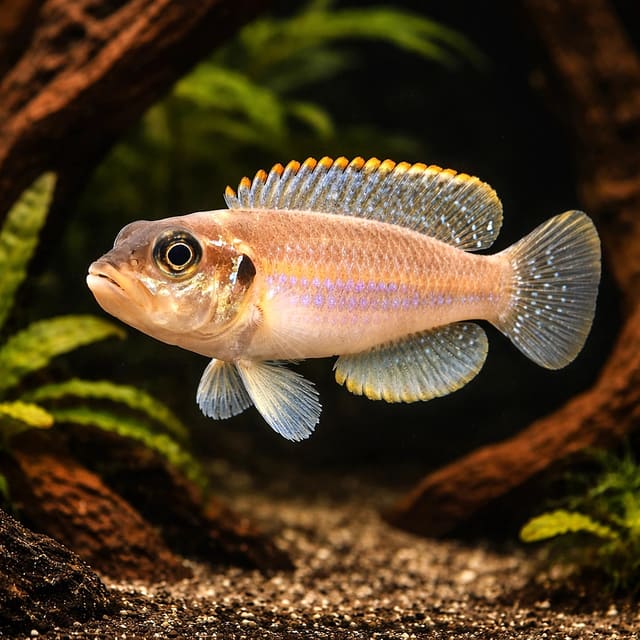
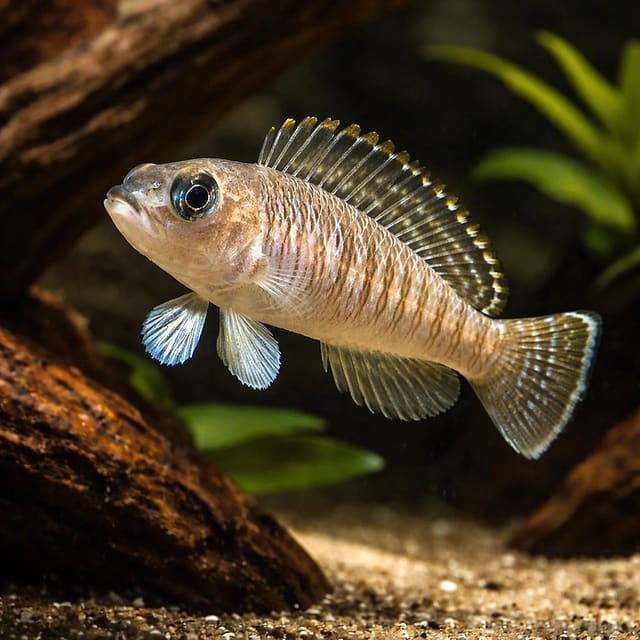
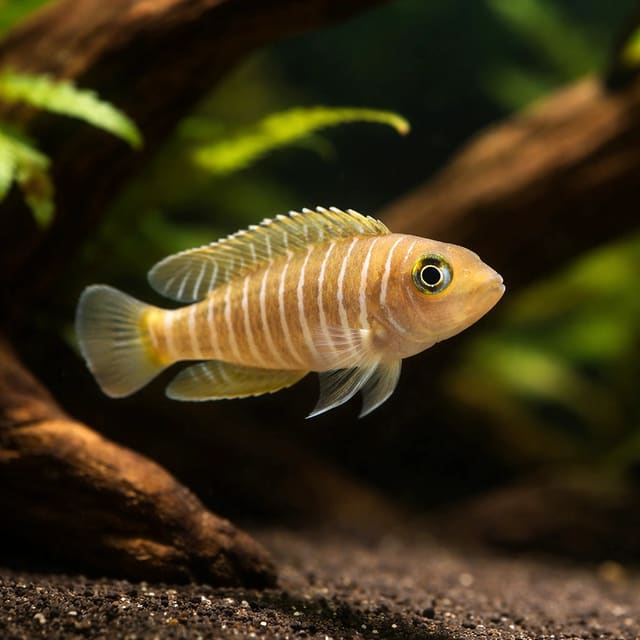
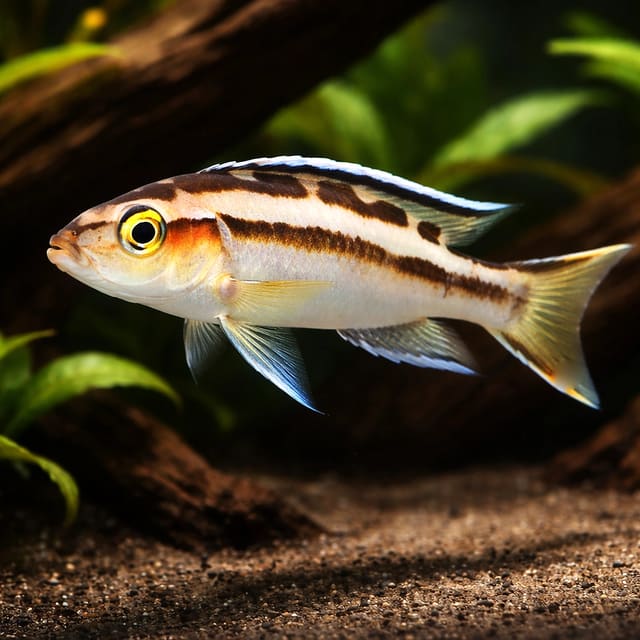
The Meleagris Shell-Dweller (Neolamprologus stappersi) is a shell-brooding cichlid from Lake Tanganyika near Bwassa, Democratic Republic of the Congo, that reaches 7 cm total length. It suits keepers who can provide shells and hard, alkaline water at the FishBase/OATA temperature overlap of 24–27°C; OATA’s group guidance gives pH 8.0–8.6 and 12–18°dH, while the number kept depends on the species. Sold individually in “2,5-3 cm” and “3 - 4 cm” dispatch sizes.
Adult size is the maximum length this species reaches at full maturity (scientific sources). The livestock you receive will be younger and smaller — pick a size above for the actual shipping size. Product-photo provenance and any image-specific limitations are stated on the listing.
Neolamprologus stappersi
Already 12% off. New customers can take 5% more with WELCOME5.
Save when buying multiple fish. Each quantity is one fish; sex and pair formation are not guaranteed unless the selected variant explicitly states them.
The Meleagris Shell-Dweller (Neolamprologus stappersi) is a shell-brooding cichlid from Lake Tanganyika near Bwassa, Democratic Republic of the Congo, that reaches 7 cm total length. It suits keepers who can provide shells and hard, alkaline water at the FishBase/OATA temperature overlap of 24–27°C; OATA’s group guidance gives pH 8.0–8.6 and 12–18°dH, while the number kept depends on the species. Sold individually in “2,5-3 cm” and “3 - 4 cm” dispatch sizes.
Adult size is the maximum length this species reaches at full maturity (scientific sources). The livestock you receive will be younger and smaller — pick a size above for the actual shipping size. Product-photo provenance and any image-specific limitations are stated on the listing.
Cichlids are a family of roughly 1,800 accepted species, not one care type. Before buying, identify the exact species and source, then compare adult measurement, usable tank dimensions, social system, territory, tested water, diet and an exit plan. No family-wide minimum tank, water range or tank-mate list is safe.
Maintain these water conditions for optimal health and vibrant colors
The Meleagris Shell-Dweller is a small cichlid associated with the bottom of Lake Tanganyika. FishBase records it as Lamprologus meleagris, a freshwater, benthopelagic member of the Cichlidae family found near Bwassa in the Democratic Republic of the Congo. It reaches a recorded maximum of 7 cm total length. It suits keepers who can provide hard, alkaline water, a mature filtered aquarium and a functional shell area while monitoring access to shelter and food.
FishBase describes the wild fish as a shell-brooder from areas where shells occur at low density. It mainly feeds on insect larvae and uses empty snail shells as breeding caves. A male may be too large to enter the shell, so fertilisation takes place from its entrance. These details make the shell field a functional part of the aquarium rather than decoration.
The Neolamprologus genus summary places the genus among the cichlids endemic to eastern Africa, with its members occurring in Lake Tanganyika. This fish is presented as Neolamprologus stappersi; FishBase now lists it as Lamprologus meleagris.
| Planning fact | What it means |
|---|---|
| Adult length | Plan around a recorded maximum of 7 cm total length. |
| Natural zone | Reserve usable bottom area around shells. |
| Natural food | Choose food suited to an insect-larva feeder. |
| Breeding site | Keep empty snail shells accessible and stable. |
The live size selector shows the dispatch choices “2,5-3 cm” and “3 - 4 cm”. One purchase quantity supplies one animal of the selected option. Use the selector to choose the dispatch size that suits the established aquarium and its other occupants rather than treating the smaller choice as a different care type.
The size you select is the size supplied, not the adult size. Both choices therefore need an aquarium planned around the recorded maximum of 7 cm total length. Check that filter intakes, gaps in décor and feeding access are suitable for the selected dispatch size while retaining enough floor area for the adult fish.
Length must not be used to infer sex, pair formation or social status. Sex is guaranteed only when the selected option explicitly states male or female. This Meleagris Shell-Dweller listing has no sex-guaranteed option.
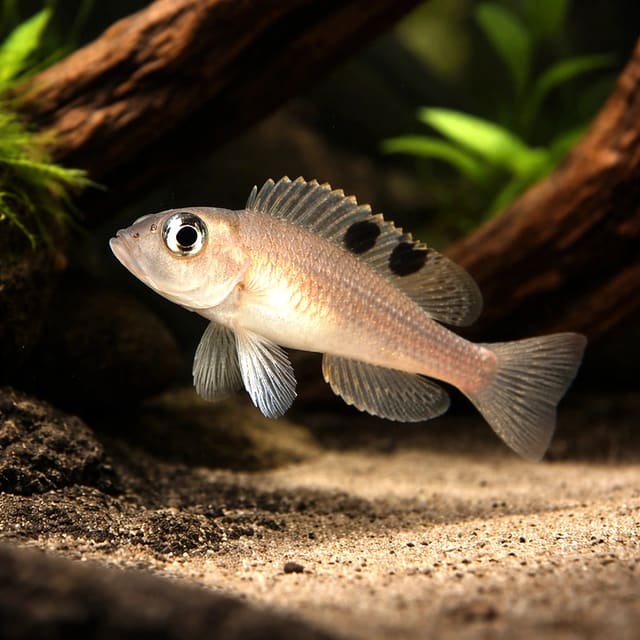
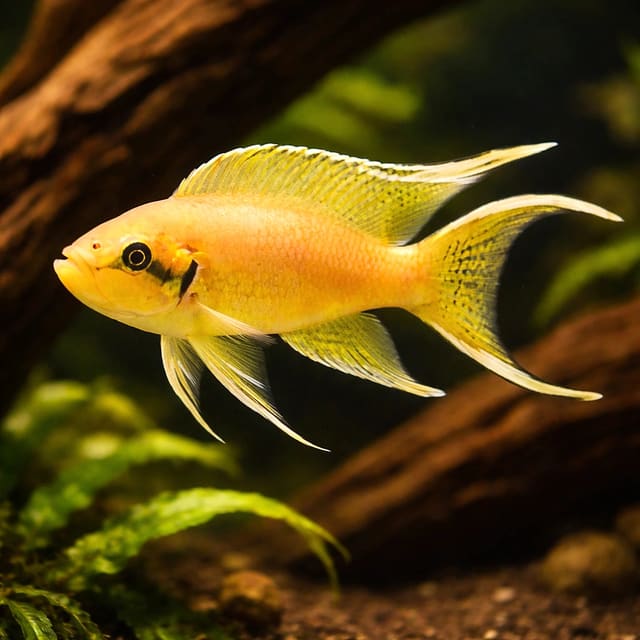
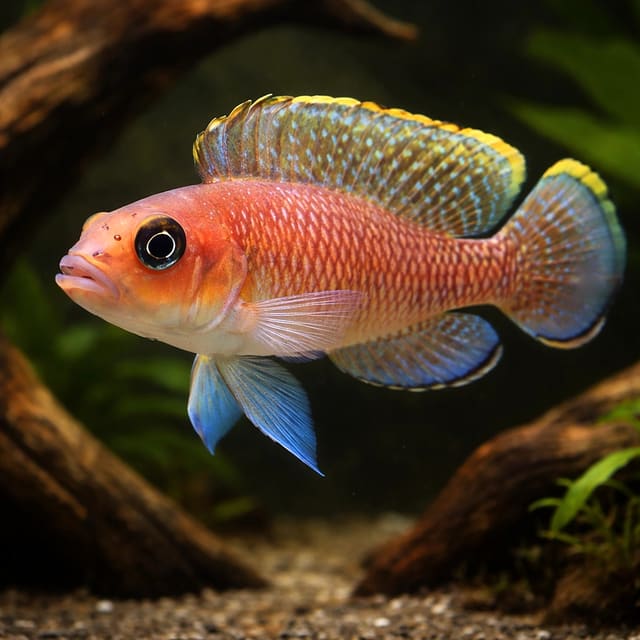
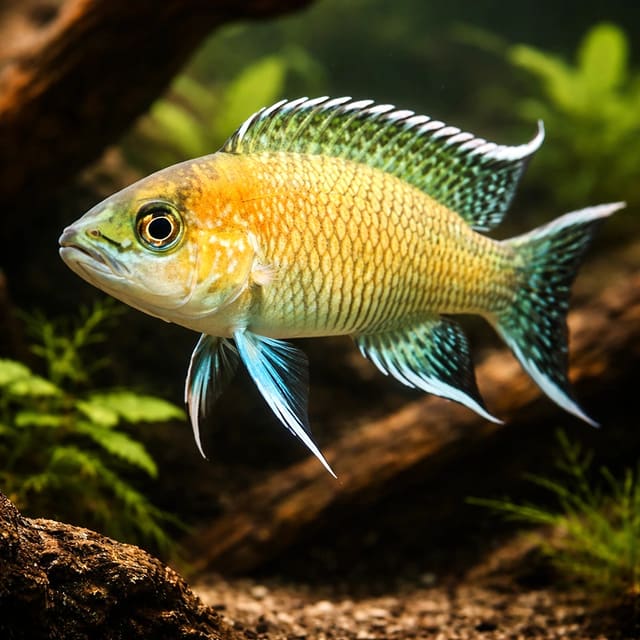
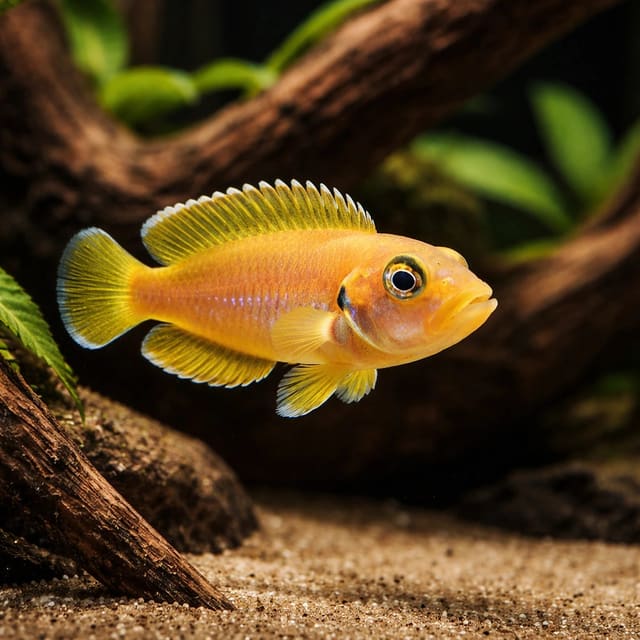
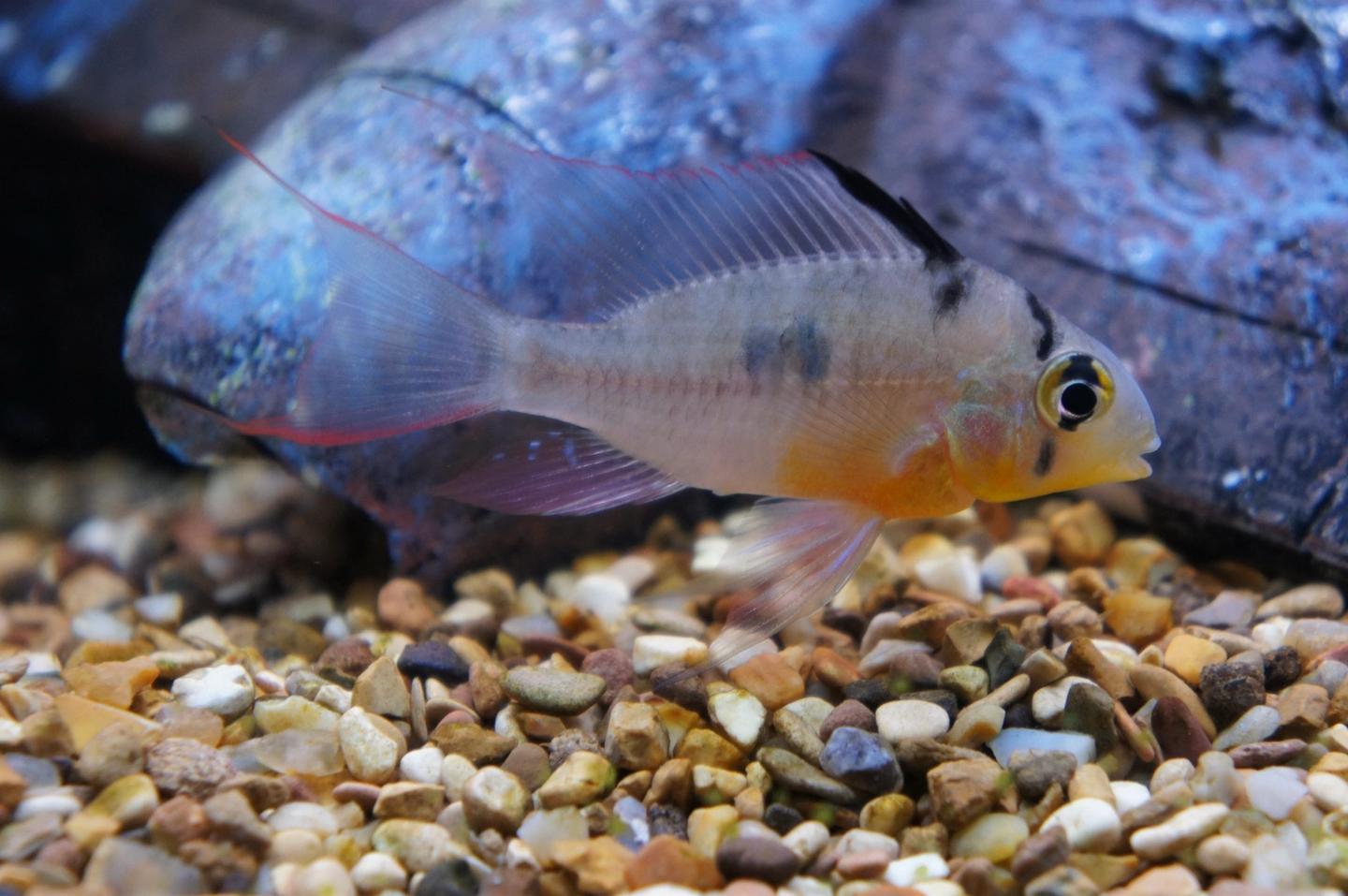
The gallery images are representative, based on reference photographs of this species, so colours can look slightly different from the live animal.
A larger dispatch fish is still one animal and does not create a guaranteed pair. If the aquarium already contains fish, compare physical size and likely access to food before choosing; do not rely on centimetres alone to resolve compatibility.
This is a specialised hard-water cichlid rather than a general soft-water community fish. OATA’s African lake cichlid guidance gives 23–27°C, pH 8.0–8.6, general hardness of 12–18°dH and carbonate hardness of 10–15°dKH for the group. FishBase records 24–28°C for this fish’s environment, so use the shared 24–27°C interval for routine aquarium planning.
OATA uses an aquarium at least 45 cm long as its example for a pair of the smallest shell dwellers. Treat that as a starting benchmark for the care group, then judge the actual aquarium by adult size, usable bottom area, shell placement and the number and temperament of fish. A narrow base can remain unsuitable even when its water volume sounds generous.
| Value | Routine target |
|---|---|
| Temperature | 24–27°C |
| pH | 8.0–8.6 |
| General hardness | 12–18°dH |
| Carbonate hardness | 10–15°dKH |
| Ammonia and nitrite | 0 mg/l |
| Nitrate | Up to 20 mg/l above the normal tap-water level |
| Suits | Not suited to |
|---|---|
| Keepers able to maintain hard, alkaline water and an essential biological filter | Soft-water community plans that cannot meet the stated water values |
| Lake Tanganyika-focused stocking assessed by adult size, temperament and territory | General Malawi and Tanganyika mixed-cichlid communities |
| Aquariums with usable bottom area and accessible snail shells | Aquariums without filtration or practical shell-oriented floor space |
Choose this fish when you can establish those values, provide an essential filter, maintain strong oxygenation and leave a practical shell-oriented floor area. It suits a keeper willing to measure water, observe territory use and change the stocking plan if one fish loses access to shelter or food.
Start with fine coral sand or a similar substrate that supports the hard-water aquarium described by OATA. Add empty snail shells because FishBase identifies them as the fish’s natural breeding caves. Keep each shell stable, visible enough for observation and reachable without forcing the fish through a narrow trap between equipment and décor.
The wild biology refers to low-density shell areas. Recreate that function by leaving open space between shell positions rather than covering every part of the base. The aim is to create more than one usable point of shelter while preserving clear movement around the bottom. Do not assume that a decorative heap automatically gives separate territories.
Stable décor can break long sight lines, but it must not consume the shell field or create unstable overhangs. Watch how the fish uses the base before making changes. A brief inspection of several shells fits its biology; persistent exclusion from the entire bottom area calls for a social or layout response.
| What you see | What to do |
|---|---|
| One shell is used repeatedly | Leave it stable and keep its approach clear. |
| An entrance fills with sand | Adjust disruptive flow rather than repeatedly moving the fish. |
| One fish blocks the whole base | Add visual separation or use a prepared separate aquarium. |
| Waste gathers between shells | Create an accessible cleaning lane during the next maintenance session. |
Before adding another fish, view the aquarium from the front and both ends. Confirm that the fixed equipment does not funnel every route through one shell position and that open sand remains reachable for cleaning. After introduction, compare where each fish rests, feeds and retreats. If those three activities all depend on one contested point, adjust the layout or separate the fish rather than waiting for repeated pursuit to resolve itself.
Maintain 24–27°C, pH 8.0–8.6, general hardness of 12–18°dH and carbonate hardness of 10–15°dKH. Stability matters because African lake cichlids are specialised for particular water conditions. Measure the aquarium rather than judging suitability from whether the water looks clear.
Use the water chemistry guide to understand each test, then compare measured values with the targets using the water matcher. Test the source water as well as the aquarium so each replacement-water batch can be prepared consistently.
| Test result | Decision |
|---|---|
| Temperature below 24°C | Correct the heating plan gradually and check the heater’s operation. |
| Temperature above 27°C | Increase safe aeration and address the heat source without sudden chilling. |
| pH outside 8.0–8.6 | Check source water, hardness and preparation before making a measured correction. |
| Ammonia or nitrite detected | Reduce feeding pressure, test again and restore safe biological filtration. |
| Nitrate rising quickly | Review feeding, stocking pace and the weekly water-change routine. |
Keep ammonia and nitrite at 0 mg/l. Nitrate should not rise by more than 20 mg/l above the normal level in the tap water. Test the incoming water so the aquarium result can be interpreted correctly.
Treat replacement tap water with conditioner before it enters the aquarium to remove chlorine or chloramine. Match its temperature and water chemistry closely enough to avoid an abrupt swing. A repeatable measured routine is safer than changing several values at once and then trying to identify which adjustment caused a problem.
Use a written baseline for comparison: record the aquarium temperature, pH, general hardness, carbonate hardness, ammonia, nitrite and nitrate after the system is stable. At each routine test, compare the new result with that baseline as well as the target range. A value moving steadily towards a limit deserves action before it crosses the limit. Change one controllable part of the routine at a time, then retest, so the result can be linked to the adjustment.
A working biological filter is essential. The RSPCA explains that fish release toxic ammonia; filter bacteria convert it first to nitrite, which is also toxic, and then to safer nitrate. Clear water is therefore not a substitute for a mature, tested filter.
Prepare and mature the aquarium before the fish arrives. Our first tropical tank guide explains the setup sequence. Readiness is demonstrated by stable water tests and working equipment, not simply by how many days the aquarium has contained water.
OATA recommends an oversized filter for crowded African lake cichlid communities. Do not turn that recommendation into a reason to overstock: the shell field must still give each fish practical access to shelter and food. Direct strong flow across the surface rather than straight into a shell entrance.
When reusable filter media needs cleaning, rinse it lightly in aquarium water removed during a partial water change. Do not wash it under the tap, because chlorine or chloramine may damage the beneficial bacterial population. Avoid cleaning every piece of biological media at the same time.
Check filter performance by outcome rather than sound alone. Confirm that the outlet still moves the surface, the intake is unobstructed and ammonia and nitrite remain at 0 mg/l. If flow falls after maintenance, inspect the media placement and pipework before increasing feeding or adding fish. When stocking rises, test more frequently until the aquarium again holds stable results under its normal feeding routine.
FishBase describes this shell-dweller as a keen feeder that eats mainly insect larvae in nature. Build the aquarium diet around an appropriate animal-protein cichlid food and suitable insect-larva foods. OATA also identifies animal-rich pellets and frozen animal foods as choices for carnivorous African lake cichlids.
Feed twice a day and give only what the fish can finish within a few minutes. That timing is the practical limit: uneaten food breaks down, increases waste and places extra pressure on the biological filter. Remove leftovers rather than leaving them to disappear among the shells.
A busy feeding response does not justify a larger portion. Use appetite, body condition and the amount left behind to set the next meal. If one fish rushes forward while another stays behind equipment or a shell, investigate territorial exclusion before adding more food to the water.
| Feeding observation | Response |
|---|---|
| All food is eaten promptly | Keep the measured portion and continue observing body condition. |
| Food remains on the substrate | Remove it and reduce the next portion. |
| One fish takes every item | Separate feeding points and reassess territory access. |
| Interest in food falls | Test water and inspect breathing, colour, fins and social pressure. |
For the first several feeds after introduction, use the same small measured portion and note where it lands. Watch whether the fish leaves shelter, takes food and returns without being intercepted. If food consistently misses the shell area, alter the placement rather than increasing the total. When more than one fish is present, judge success by the slowest feeder; a clear feeding response from the dominant individual does not show that every animal has eaten.
Complete the shell layout, filtration, heating and water tests before delivery. Arrange for someone to receive the parcel because live fish must not be left unattended. The current delivery and Live Arrival Guarantee policy gives the receiving steps and any claim requirements that apply to the order.
Complete all aquarium preparations before the parcel arrives, then follow the 20–30 minute bag-float instruction and release the fish without adding the bag water to the aquarium.
Keep feeding modest after introduction while the biological filter responds to the added waste. Check ammonia and nitrite after a meaningful stocking increase, especially if several fish are introduced over a short period. Additions should be gradual because the established bacterial population must grow as feeding and waste increase.
| First observation | Immediate check |
|---|---|
| Fish enters a shell | Leave the shelter undisturbed and monitor from outside. |
| Fish remains at the surface | Check oxygenation, water values and aggression. |
| Rapid gill movement | Test water and confirm strong surface movement. |
| Another fish blocks every retreat | Separate before repeated pursuit causes injury. |
During the first day, keep observation purposeful and brief. Confirm that the fish remains balanced, breathes steadily and can reach shelter without continuous pursuit. Recheck the filter outlet after release because a moved fitting or disturbed substrate can alter flow around the shell field. Record the introduction time and the first feeding response so later changes can be compared with a clear starting point.
Change 25% of the water at least once every week. Treat the replacement water with tap-water conditioner before adding it, and keep its temperature and chemistry close to the aquarium values. Use the change to remove solid waste from accessible substrate without dismantling occupied shell positions.
Test ammonia, nitrite and nitrate at least weekly. Record temperature, pH and hardness often enough to catch a drift before it becomes a sudden correction. Test immediately when appetite, breathing, colour or swimming behaviour changes rather than waiting for the regular maintenance day.
Do not use the water change as a full redesign. Shell-brooding behaviour depends on access to familiar shelter, while territorial boundaries can change when décor is moved. Rearrangement has a place when managing aggression, but routine cleaning should preserve a layout that is working.
| Weekly finding | Next decision |
|---|---|
| Ammonia or nitrite above 0 mg/l | Respond at once and review filter function, feeding and stocking pace. |
| Nitrate approaches the stated ceiling | Increase waste control and reassess the maintenance interval. |
| Filter flow has fallen | Check for blockage and clean appropriate media safely. |
| Shell area remains clean | Leave stable shelters in place and clean the open lanes. |
Compare the result after maintenance with the reading taken before it. The comparison shows whether the change restored the intended conditions and whether the interval is controlling waste. If nitrate repeatedly rises quickly, review the amount fed, the pace of additions and accessible waste before relying on a larger one-off clean. Consistent smaller decisions protect the filter and preserve the shell arrangement better than waiting for several problems to appear together.
Learn the individual fish’s normal behaviour so changes stand out. OATA highlights surface hanging, prolonged bottom sitting, erratic swimming, a darker or paler colour, increased hiding, altered aggression, faster or slower gill movement, white spots, fluffy growths, fin or scale loss, body-condition change and reduced feeding as warning signs.
Begin with measurable causes. Test ammonia, nitrite, nitrate, temperature and pH, then check filter flow and aeration. Inspect whether the fish can reach a shell, food and open water without constant pursuit. Water quality and territorial pressure can occur together, so checking only one may miss the immediate problem.
| Change | First response |
|---|---|
| Surface hanging or rapid breathing | Test water immediately and increase safe oxygenation. |
| Sudden hiding away from shells | Check for pursuit and blocked retreat routes. |
| Torn fins or missing scales | Separate ongoing aggression and inspect water quality. |
| Reduced food intake | Check water, body condition and whether another fish controls the feeding area. |
| White spots or fluffy growth | Isolate risk where practical and obtain diagnosis before choosing treatment. |
Do not add a random treatment solely from one outward sign. Similar changes can accompany poor water, injury, social stress or illness, and an unsuitable treatment can add pressure to the fish or biological filter. Preserve stable heat and oxygen while the cause is assessed.
If a change persists after the immediate water and aggression checks, contact us with the test results, recent maintenance, feeding response and a clear description of what changed. Those details allow the next step to focus on the fish’s actual condition rather than its appearance alone.
Record when the change began and whether it followed feeding, maintenance, a new addition or a shift in territory use. Compare more than one observation: appetite together with breathing, position and fin condition gives a clearer picture than colour alone. Keep the affected fish under close observation after the first response and repeat the relevant water tests. Improvement should be visible in behaviour as well as in the numbers.
OATA advises that very few African lake cichlids do well when kept singly, while also making clear that the right number depends on the species. For the Meleagris Shell-Dweller, plan social stocking around shell access, adult size, temperament and usable bottom area instead of assuming that a fixed pair, harem or colony will form.
Each purchase supplies one animal, so choose the order quantity separately from the dispatch-size choice. Adding several fish increases both social uncertainty and the load on the filter. Make additions slowly and keep a mature separation aquarium or secure divider ready before territorial behaviour develops.
| Outcome | Decision |
|---|---|
| Every fish feeds and reaches shelter | Continue observing without forcing a layout change. |
| One fish controls all shells | Change separation or move a fish before damage develops. |
| One fish stays at the surface | Treat it as displacement and check water and aggression immediately. |
| Repeated chasing crosses the whole base | Use the prepared separation plan. |
| A brief chase ends at a boundary | Confirm both fish retain safe areas and keep monitoring. |
Sex cannot be selected from body length, and the two dispatch sizes do not promise a social role. Do not build the whole aquarium around an assumed male or female. Build several retreat routes, observe where each fish settles and be prepared to revise the group rather than adding more animals to distract an aggressor.
For a stocking and compatibility assessment, contact us with the aquarium’s length, usable base, water values, established inhabitants and intended quantity. The assessment must consider the adult fish and its territory, not just whether every candidate tolerates alkaline water.
Review the group at feeding time and again when food is absent. A fish that eats only during a brief distraction may still lack secure access to the aquarium. Check whether every animal can occupy shelter, cross the base and rest without being pursued continuously. If the same individual loses access on repeated checks, use the prepared separation plan before adding another fish or changing the order of introduction.
As a general rule, keep African lake cichlids with species from the same location. OATA does not generally recommend mixing Lake Malawi and Lake Tanganyika cichlids because their temperament and behaviour differ. For this fish, Lake Tanganyika origin is only the first screen; matching origin does not make two species automatic companions.
| Candidate plan | Screening result |
|---|---|
| General Malawi and Tanganyika mix | Avoid this combination because location, temperament and behaviour do not align. |
| Another bottom or shell user | Use caution because direct territory competition may develop. |
| Lake Tanganyika fish using another zone | Assess adult size, temperament, water needs and aquarium dimensions individually. |
| Several additions at once | Slow the stocking pace so the filter and social structure can adjust. |
When additions are suitable after assessment, introduce more peaceful fish before more aggressive fish. Rearranging décor may reduce established territorial advantage, but only if every inhabitant still receives a usable refuge. Observe continuously during the settling period and separate any fish that loses access to shelter or food.
Browse the African cichlid collection for comparison, then apply the location and territory screen to each animal. A shared collection or similar adult length is not a compatibility decision.
Work through all five checks before purchase rather than stopping after the first match. For example, a candidate may share the 24–27°C range yet still depend on the same bottom area, or it may use another zone but require an adult stocking plan that leaves too little filtration capacity. Treat any failed check as a reason to revise the combination. After introduction, repeat the screen using observed access to food, shelter and open water.
The Meleagris Shell-Dweller reaches a recorded maximum of 7 cm total length, so plan its aquarium around that adult size rather than its dispatch length.
OATA’s group guidance uses an aquarium at least 45 cm long as its example for a pair of the smallest shell dwellers; judge the final aquarium by the Meleagris Shell-Dweller’s 7 cm adult size, usable bottom area, shells, number and temperament.
OATA advises that very few African lake cichlids do well singly, but the right number depends on the species; assess shell access, temperament and floor area, and keep separation ready.
OATA describes African lake cichlids as usually easy to keep, but the Meleagris Shell-Dweller needs a mature filtered aquarium, shells, hard alkaline water at 24–27°C and regular testing.
FishBase records mainly insect larvae in its wild diet; use an appropriate animal-protein cichlid food and suitable insect-larva foods twice daily, giving only what it can eat within a few minutes.
Keep it at the FishBase/OATA temperature overlap of 24–27°C; OATA’s African lake cichlid guidance gives pH 8.0–8.6 and general hardness of 12–18°dH.
African lake cichlids vary in temperament, so watch for repeated chasing, torn fins, exclusion from shells or loss of feeding access and separate fish when pursuit does not stop at a boundary.
Screen Lake Tanganyika candidates individually by adult size, temperament, water needs, aquarium dimensions and territory; avoid mixing this fish with Lake Malawi cichlids.
Film every delivery continuously from the sealed parcel as you open it, keeping the fish inside the sealed bag visible; have someone present to receive it, float the bag for 20–30 minutes and never pour the bag water into the aquarium.
No reviews for this item yet. Bought one? Honest reviews only, good or bad.
What customers say about ordering from us
Easy website plenty of info on fish your buying great to pick a time slot
TRACEY DURRANT · 7 Oct 2026
Got some lovely fish thank you
Kevin Mackie · 7 Oct 2026
Reviews of our shop, collected by Judge.me, an independent third-party review collector. Newest first.