Moderate
Gold Ocellatus Shell-Dweller (Neolamprologus ocellatus)
23–25°C · pH 8–9
£16.59

Pearl-Lined Lamprologus gold (Neolamprologus tetracanthus) is a gold-coloured Lake Tanganyika cichlid that grows up to 20 cm, sold as one live fish per purchase in sizes from 4–5 cm to XL. It needs a large aquarium with open sand, hard alkaline water and tank mates too big to be eaten.
Adult size is the maximum length this species reaches at full maturity (scientific sources). The livestock you receive will be younger and smaller — pick a size above for the actual shipping size. Product-photo provenance and any image-specific limitations are stated on the listing.
Neolamprologus tetracanthus
Save when buying multiple fish. Each quantity is one fish; sex and pair formation are not guaranteed unless the selected variant explicitly states them.
Pearl-Lined Lamprologus gold (Neolamprologus tetracanthus) is a gold-coloured Lake Tanganyika cichlid that grows up to 20 cm, sold as one live fish per purchase in sizes from 4–5 cm to XL. It needs a large aquarium with open sand, hard alkaline water and tank mates too big to be eaten.
Adult size is the maximum length this species reaches at full maturity (scientific sources). The livestock you receive will be younger and smaller — pick a size above for the actual shipping size. Product-photo provenance and any image-specific limitations are stated on the listing.

Cichlids are a family of roughly 1,800 accepted species, not one care type. Before buying, identify the exact species and source, then compare adult measurement, usable tank dimensions, social system, territory, tested water, diet and an exit plan. No family-wide minimum tank, water range or tank-mate list is safe.
Maintain these water conditions for optimal health and vibrant colors
Pearl-Lined Lamprologus gold is the trade name for a gold-coloured Neolamprologus tetracanthus, a cichlid found only in Lake Tanganyika. Each purchase is one live fish in the size you choose, and the smallest size is a young fish of 4–5 cm. That young fish has a lot of growing ahead of it: FishBase and Wikipedia both record the species at up to 20 cm total length.
Three facts decide whether this cichlid suits your aquarium. It grows into a large fish; it comes from hard, alkaline lake water; and in the wild it eats molluscs, insect larvae and other fish. If you can plan for all three, it makes a bold centrepiece for a Lake Tanganyika aquarium built around open sand.
| Suits | A large, matured Lake Tanganyika aquarium with open fine sand and robust tank mates too big to be eaten |
|---|---|
| Supplied | One fish per purchase, in the size you choose |
| Sizes | 4–5 cm, 5.5–7 cm or XL |
| Maximum recorded length | 20 cm total length |
| Natural water | 23–25 °C, pH 7.5–8.0, 12–15 dH |
| Natural diet | Molluscs, insect larvae and fish |
| Not for | Tanks with snails, small fish, or soft and acidic water |
There are three sizes to choose from: 4–5 cm, 5.5–7 cm and XL. The size you select is the size supplied, not the adult size. Whichever size you pick, plan the aquarium and its tank mates for a 20 cm adult. Availability can differ from one size to another, so check the size menu when you order.
A smaller fish costs less space at the start but grows into the same large cichlid, and a larger size gives you a fish that is further along that path. Neither changes what the adult will need.
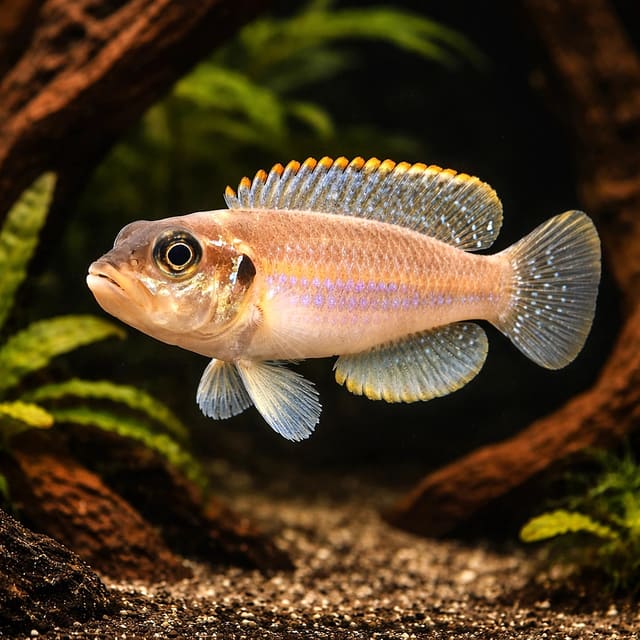
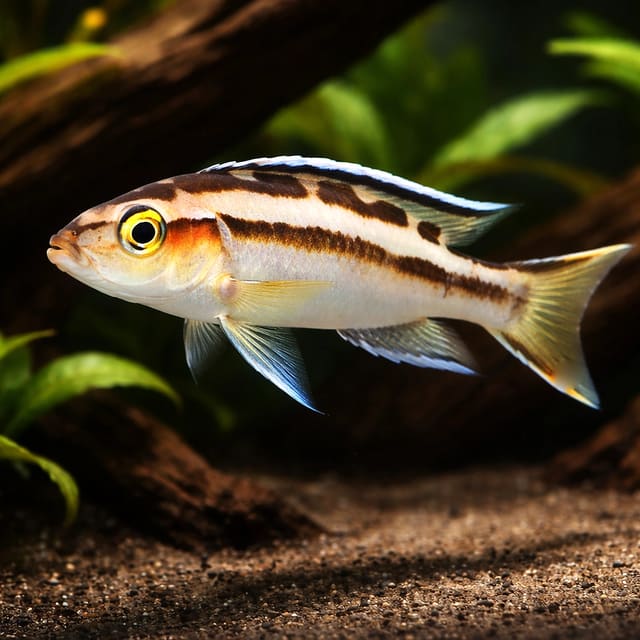
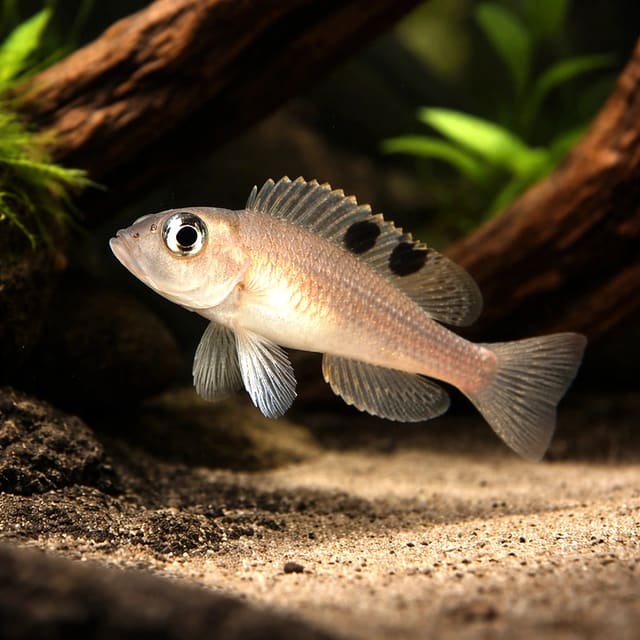
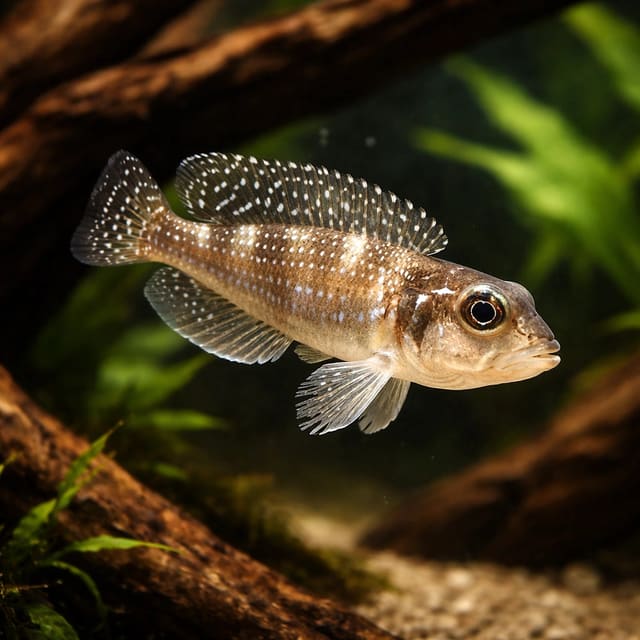
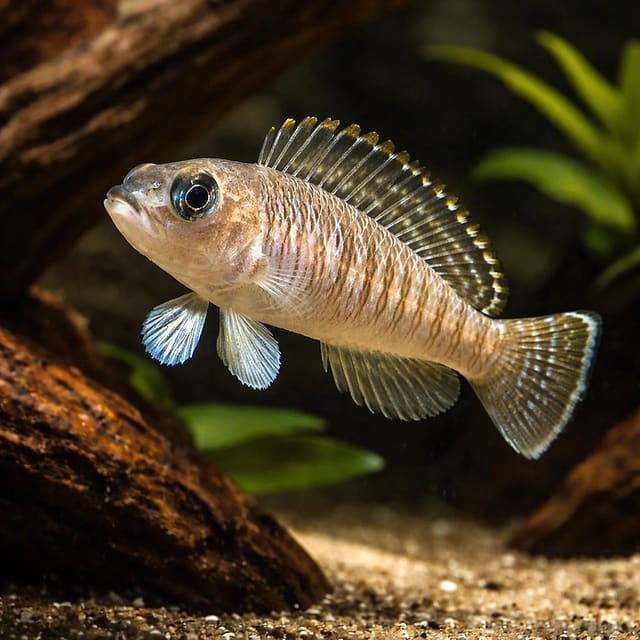
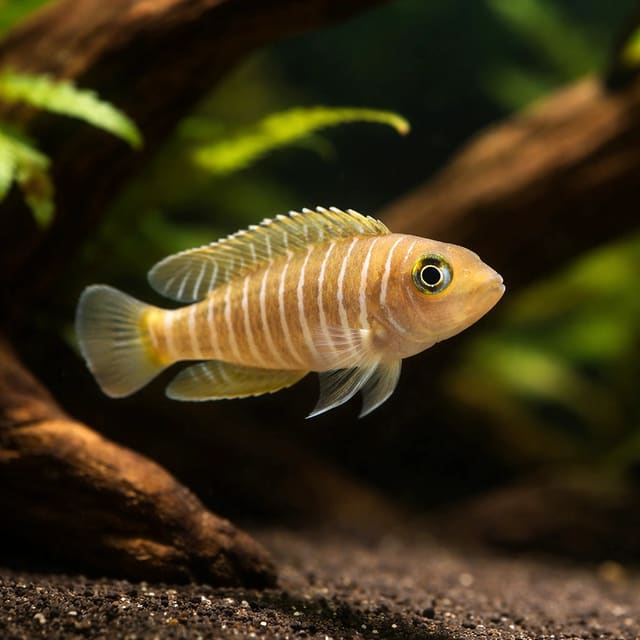
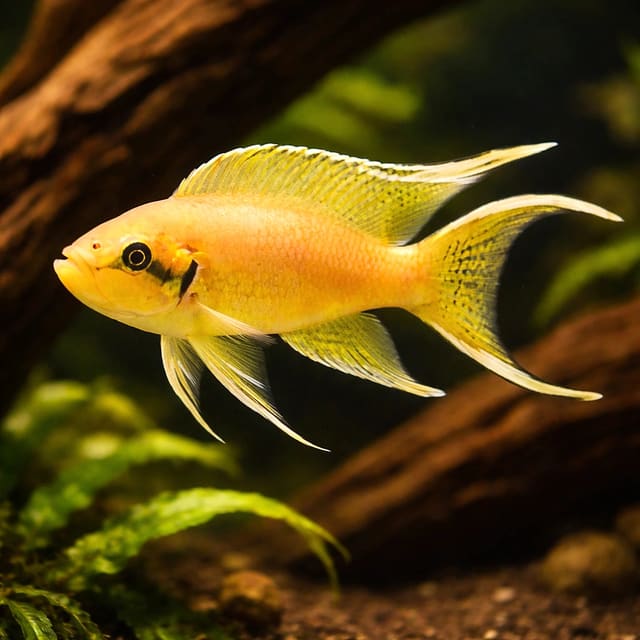
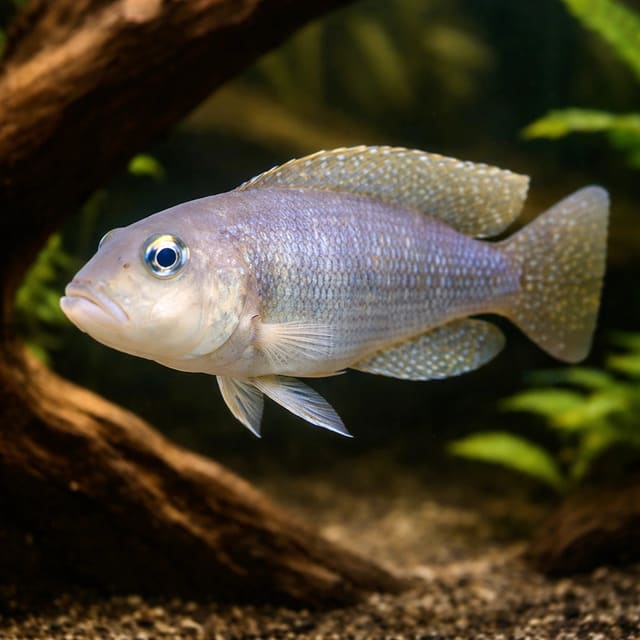
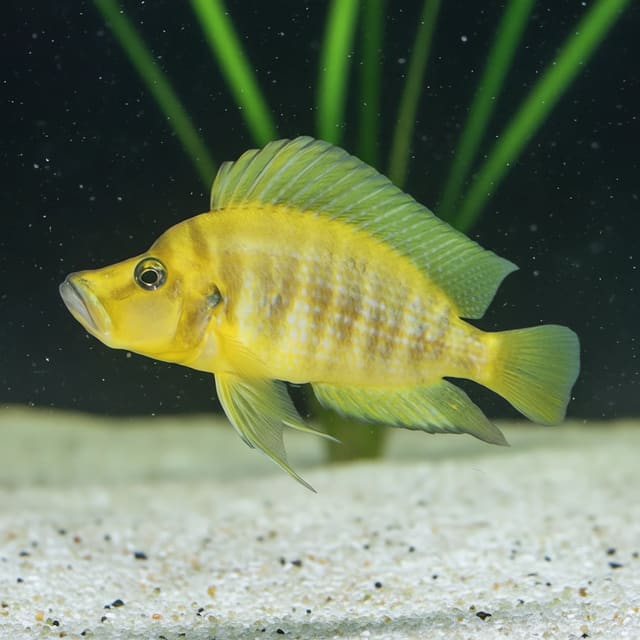
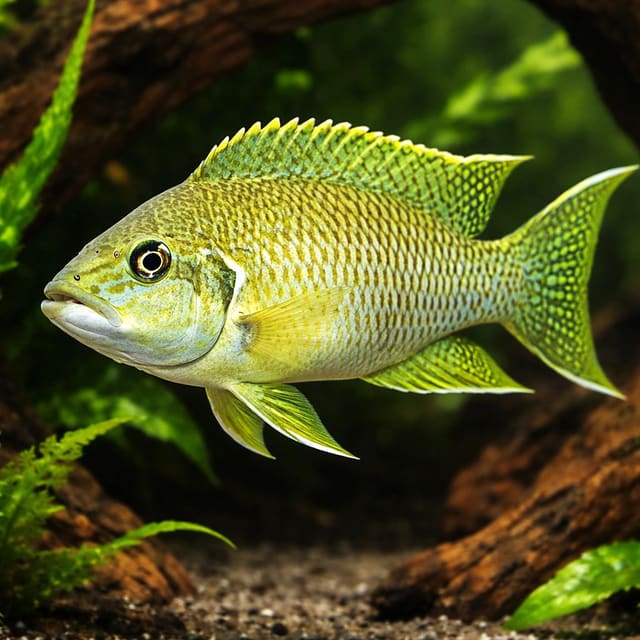
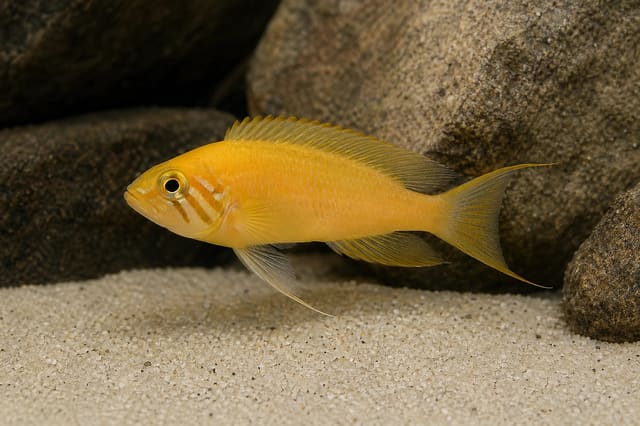
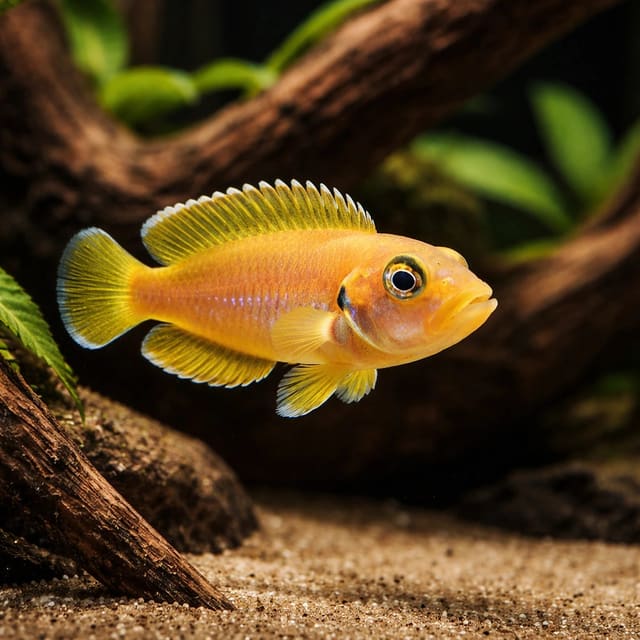
The gallery shows yellow-gold fish covered in rows of small white spots, with spotted, white-edged dorsal and tail fins. The gold in the trade name describes that colouring. Gallery images have been digitally enhanced to improve image quality. Natural colour, pattern, size and maturity can vary between live animals.
Sex is guaranteed only when the selected option explicitly states male or female. This Pearl-Lined Lamprologus gold listing has no sex-guaranteed option. If you order more than one fish, they are not selected as a pair.
| A good fit if | You are building, or already keep, a large Lake Tanganyika aquarium with open sand, your tap water tests hard and alkaline, and every fish in the tank will be too big to eat |
|---|---|
| Think again if | Your aquarium is small or holds snails or small community fish, your water is soft or acidic, or you want a fish that stays small |
Buying this fish is really a decision about its future aquarium. If that aquarium is ready, or will be ready long before the fish outgrows its first home, it is a rewarding cichlid to plan around. To compare it with other species from the African lakes before you decide, browse our African cichlid collection.
FishBase lists this fish as Neolamprologus tetracanthus, the fourspine cichlid, in the family Cichlidae. FishBase treats Lamprologus tetracanthus as a synonym, and you may still see that name used in the aquarium trade.
Three names can describe the same animal:
| Pearl-Lined Lamprologus gold | The trade name for this fish; gold describes its colouring |
|---|---|
| Fourspine cichlid | The common name FishBase and Wikipedia use for the species |
| Neolamprologus tetracanthus | The accepted scientific name, with Lamprologus tetracanthus as a synonym |
When you look up care advice or check a tank mate, search under both scientific names and the common name, because information about this species may be filed under any of them. The gold label is a trade description of colour; the care in this guide applies to the species as a whole.
The rows of pale spots visible in the photographs fit the pearl-lined part of the trade name, and the fourspine name used by FishBase and Wikipedia is the one you will meet in scientific and reference sources.
Neolamprologus tetracanthus is endemic to Lake Tanganyika, meaning it occurs naturally nowhere else, and FishBase describes it as widely distributed within the lake. Wikipedia places it in areas with sandy substrates, and FishBase calls it a sand-dweller, usually found at depths of 6–12 m. FishBase also classes it as benthopelagic, a fish that lives close to the bottom but also uses the water above it.
Its feeding habits are the most unusual thing about it. In the wild it eats molluscs, insect larvae and fish. FishBase notes that it is not a typical crusher of mollusc shells; instead, it is able to suck the mollusc out of its shell, and Wikipedia describes the species as specialised for exactly that.
The IUCN assesses the species as Least Concern, and Wikipedia notes that it is also found in the aquarium trade. Like any aquarium fish, it should never be released into ponds or waterways.
It is easy to plan for the fish in the bag rather than the fish it will become. A 4–5 cm juvenile and a 20 cm adult need very different aquariums, so use the adult length for every decision: tank size, tank mates, filtration and feeding.
OATA, the UK trade body for the ornamental fish industry, gives a simple general rule: within reason, buy an aquarium as large as possible, because the larger the aquarium, the more stable the temperature and water quality will be. For a fish that reaches 20 cm and lives over open sand, give length and floor area priority over height, because this is a sand-dweller.
If you are unsure whether your aquarium is big enough, contact us with its dimensions and the fish already in it before you order.
Whatever the size, a filter is always essential, and a fish that grows this large adds a steadily rising amount of waste. Pair it with a heater and thermometer that can hold the aquarium within the 23–25 °C band recorded for the species, and check the thermometer daily until you trust the set-up.
The three sizes on this listing are all well short of the 20 cm the species can reach. A 4–5 cm fish is about a quarter of that recorded length, and a 5.5–7 cm fish about a third. XL is the largest size offered here, but it is still a size at dispatch rather than a guarantee of adult length.
| Decision | Plan for the adult |
|---|---|
| Aquarium | Large and long, with a wide sand floor, before the fish needs it |
| Filtration | Capacity for a large, meat-eating fish, with bacteria that keep pace as feeding increases |
| Food | Portions and food size that rise with the fish |
| Tank mates | Only fish that will still be too large to eat when it is fully grown |
A young fish can settle into the final aquarium from the start, which avoids a later move. If you do begin in a smaller tank, have the larger one set up and matured well before the fish needs it, so that the move is to a stable aquarium rather than a new one still building its filter bacteria.
FishBase records Neolamprologus tetracanthus in water of 23–25 °C, pH 7.5–8.0 and a hardness of 12–15 dH. These are natural conditions in Lake Tanganyika rather than figures from aquarium trials, but they are narrow, specific ranges for this species, and they make the right planning targets for its aquarium.
| Value | Plan for |
|---|---|
| Temperature | 23–25 °C |
| pH | 7.5–8.0 |
| General hardness | 12–15 dH |
| Ammonia and nitrite | Zero |
A two-degree band leaves little room for drift. In a warm room in summer the water can creep above 25 °C even with the heater idle, and in winter a heater that is too small for the aquarium may struggle to hold 23 °C. Read the thermometer at the same time each day, note the figure alongside your weekly tests, and adjust the thermostat in small steps.
Test your conditioned replacement water as well as the aquarium. If the new water is softer or less alkaline than the tank, each weekly change pulls the aquarium away from 7.5–8.0 and 12–15 dH, so it is worth knowing before the fish arrives how your supply compares.
Our guide to aquarium water chemistry explains what pH, general hardness and the other common tests measure, and the water parameter matcher lets you compare your own readings with the values above. If your tap water sits well away from them, a species suited to your supply will be easier to keep well than this cichlid.
The RSPCA puts it plainly: no fish should be kept in a tank without a well set up and maintained filter. Fish release ammonia, which is toxic. A working biological filter grows beneficial bacteria that turn ammonia into nitrite, which is also toxic, and then into nitrate, which is safer.
OATA explains that those bacteria must increase every time more fish are added and feeding increases. Overstocking or stocking too quickly can cause new tank syndrome, when there are not enough nitrifying bacteria to cope, and the resulting ammonia and nitrite can make fish ill or kill them. A growing cichlid on a meaty diet raises the load gradually, so the filter needs to be matured before the fish arrives and kept healthy afterwards. Our guide to setting up a first tropical tank covers maturing a new aquarium step by step.
Siphon sand gently, holding the tube just above the surface, so you lift waste without emptying the sand bed into the bucket.
Any reading above zero means the filter bacteria are not keeping up. Make a partial water change with conditioned water, check that the filter is running and unblocked, and feed less until the readings are back at zero. Then look for the cause, such as a recent new fish, heavier feeding or filter media rinsed under the tap, all of which OATA links to the bacterial population falling behind.
No aquarium menu copies the lake exactly, but the natural diet gives a clear direction. Neolamprologus tetracanthus eats molluscs, insect larvae and fish in the wild, and it is specialised to suck molluscs out of their shells.
Match the food to the fish. Small frozen larvae suit a 4–5 cm juvenile, and larger meaty foods become practical as it grows towards adult size. Whatever the size, keep the diet animal-based, as the natural diet is.
Take care not to overfeed. Uneaten food breaks down and releases toxic waste into the water, and meaty foods foul water quickly if they are left to rot in the sand. Feed small portions, watch them go, and remove anything left over.
Mealtimes are also your best daily health check. OATA lists reduced intake or lack of interest in food among the changes to watch for, so a fish that stops feeding deserves a water test and a closer look.
Run through these points before you place the order. If any is not yet in place, it is better to wait than to ask a young cichlid to cope with an aquarium that is still settling.
Every order is hand-packed by our team: the fish is bagged in pure oxygen inside an insulated poly box, with a heat pack when the weather calls for it. A licensed live-animal courier carries the parcel, and we email the tracking number and your confirmed delivery date so you know when to be in. The full terms are on our delivery and Live Arrival Guarantee page.
Test ammonia and nitrite, confirm the thermometer reads within 23–25 °C, and leave the filter and heater running as normal. Clear a space next to the aquarium for the parcel so that nothing delays floating the bag once it has been filmed and opened.
A Live Arrival Guarantee claim relies on those steps: someone present to receive the parcel, same-day opening and inspection, and a continuous unboxing video that begins with the parcel sealed. If anything has gone wrong, contact us the same day with your order number and the video; WhatsApp is fastest, and we will arrange a replacement or refund.
Add the new cichlid to a matured aquarium with zero ammonia and nitrite, and increase stocking slowly afterwards. For the first week, test more often than usual and watch how the fish swims, breathes and feeds, so that any change stands out early.
OATA describes healthy fish as having clear, bright eyes, undamaged fins, intact scales and no ulcers or bumps. It also notes that every fish varies slightly in behaviour and appearance, so the aim is to learn what is normal for yours and spot changes early.
| Watch | Change to notice |
|---|---|
| Swimming | Hanging at the surface, sitting on the bottom or swimming erratically |
| Colour | Turning darker or paler than normal |
| Temperament | More aggression or more hiding than usual |
| Breathing | Gill covers moving faster or slower than normal |
| Appearance | White spots, fluffy growths, or lost fins or scales |
| Condition | Gaining or losing body weight |
| Feeding | Eating less or losing interest in food |
When you notice a change, OATA’s advice is to test your water quality and then ask your retailer for further guidance. A photograph of the fish makes that conversation far more useful.
A notebook or phone note turns weekly checks into a record you can compare. For each entry, write down the date, temperature, pH, general hardness, ammonia and nitrite readings, the size of any water change, and anything you noticed about feeding or behaviour. Slow drifts, such as pH creeping down between water changes or a fish eating a little less each week, are much easier to see on paper than from memory.
Choosing companions for this cichlid starts with its diet. FishBase lists fish among the foods it takes in the wild, alongside molluscs and insect larvae, and adults are recorded at up to 20 cm. Any fish small enough to be eaten is at risk.
Suppose you buy a 4–5 cm fish and add a 3 cm companion. At first they are similar in size, but a cichlid that grows towards 20 cm will in time be many times larger than that companion, and a fish that was safe at the start becomes potential prey. Pick every tank mate for the day your cichlid is fully grown.
If the answer to any of these is uncertain, leave that species out until you can answer it.
Because Neolamprologus tetracanthus is endemic to Lake Tanganyika, other fish from the same lake live in the same kind of water, which makes them the natural place to start your search. That is a starting point only: check each candidate’s adult size, diet and needs against the rules above, and leave out anything small enough to become a meal.
OATA advises increasing the number of fish slowly, because the filter bacteria must grow each time fish are added. Add one species at a time, test ammonia and nitrite afterwards, and wait for zero readings before the next addition. Each pause also shows you how the fish already in the tank react to the newcomer.
If you are adding a juvenile to an aquarium that already has fish in it, apply the same test to the residents. A community that is safe beside a 4–5 cm cichlid now may not be safe once it has grown, so every fish already in the tank needs to be too large to eat by then, and the aquarium must hold the hard, alkaline water this species needs.
OATA’s list of changes to watch for includes aggression and hiding, and those are the signs to look for after every addition. If one fish is being chased or pinned in a corner, act early by rearranging the décor or rehoming the fish concerned rather than waiting for injuries.
FishBase and Wikipedia both record the species at up to 20 cm total length, which makes it a large cichlid. Plan the aquarium and every tank mate around a fish of that size.
Plan around the adult. Neolamprologus tetracanthus reaches up to 20 cm and lives over open sand, so choose a large, long aquarium with a wide area of fine sand. OATA’s general rule is to buy an aquarium as large as you reasonably can, because a larger volume keeps temperature and water quality more stable.
It suits a keeper who can give a large fish stable, hard, alkaline water and a matured filter, and who is planning a Lake Tanganyika aquarium around it. Someone looking for a small fish for a mixed community tank would be better served by another species.
In the wild it feeds on molluscs, insect larvae and fish, and it sucks molluscs out of their shells rather than crushing them. In the aquarium, build the diet on meaty foods such as frozen insect larvae, and feed small portions so that nothing is left to decay.
FishBase records Neolamprologus tetracanthus in Lake Tanganyika water of 23–25 °C, pH 7.5–8.0 and 12–15 dH. Keep the aquarium steady within those values, with ammonia and nitrite at zero.
It can. Fish are part of its natural diet alongside molluscs and insect larvae, and adults reach up to 20 cm. Keep it only with fish too large to be eaten, and remember that a young fish will grow.
Not if you want to keep the snails. Molluscs are part of its natural diet, and the species is specialised to suck them out of their shells, so snails in its aquarium are likely to be eaten.
Choose robust fish that are too large to be eaten and that thrive in the same hard, alkaline Lake Tanganyika conditions. Leave out snails and other molluscs, which are natural prey, and any fish that needs soft or acidic water.
Our team hand-bags it in pure oxygen and packs it in an insulated poly box, adding a heat pack when the weather calls for it, and a licensed live-animal courier delivers it with tracking. Be at home to receive it, film the sealed parcel being opened in one continuous take, float the sealed bag for 20–30 minutes and then release the fish without adding any bag water to the tank.
No reviews for this item yet. Bought one? Honest reviews only, good or bad.
What customers say about ordering from us
I have a small group of long finned mountain minnows. So was delighted to be able to order ten of this variety to increase the genetics in my tank . The ones I recieved are healthy but it’s to early to give a verdict on wether they are of a long finned type since they are small currently.
Gordon Walker · 23 Sept 2026
100% success travel and "installation". Pleased with quality of purchase. The Siamese fighter a bit "shy" so have not yet seen him at his best yet but looking good. Happy customer. GG
George E Garratt · 21 Sept 2026
Reviews of our shop, collected by Judge.me, an independent third-party review collector. Newest first.