Advanced
Utinta Black-Chinned Xenotilapia (Enantiopus melanogenys)
24–27°C · pH 7.5–9 · 137L
£34.99

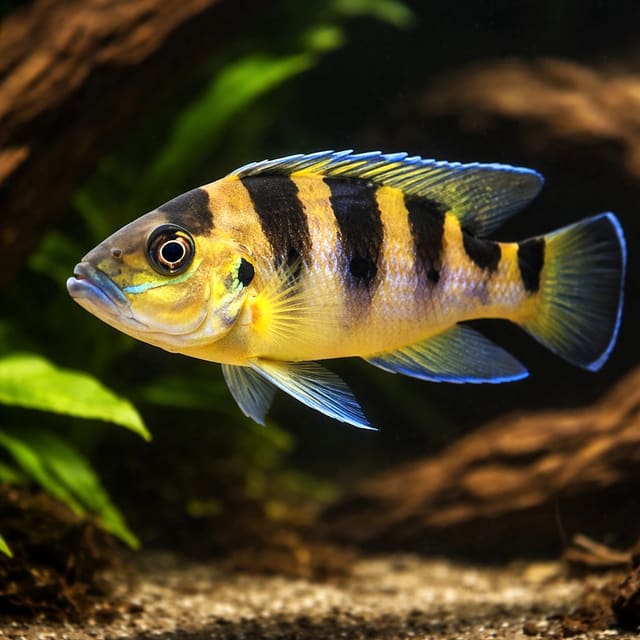
The Five Bar Cichlid (Lamprologus tretocephalus) is a territorial Lake Tanganyika cichlid from the lake’s northern half that reaches 15 cm. It suits intermediate cichlid keepers planning one mated pair in at least 108 litres, using the 24–26°C, pH 8.0 and 12 dGH overlap of FishBase, Seriously Fish and OATA guidance. Sold individually in dispatch sizes from 3–4 cm to over 9 cm.
Adult size is the maximum length this species reaches at full maturity (scientific sources). The livestock you receive will be younger and smaller — pick a size above for the actual shipping size. Product-photo provenance and any image-specific limitations are stated on the listing.
Lamprologus tretocephalus
Save when buying multiple fish. Each quantity is one fish; sex and pair formation are not guaranteed unless the selected variant explicitly states them.
The Five Bar Cichlid (Lamprologus tretocephalus) is a territorial Lake Tanganyika cichlid from the lake’s northern half that reaches 15 cm. It suits intermediate cichlid keepers planning one mated pair in at least 108 litres, using the 24–26°C, pH 8.0 and 12 dGH overlap of FishBase, Seriously Fish and OATA guidance. Sold individually in dispatch sizes from 3–4 cm to over 9 cm.
Adult size is the maximum length this species reaches at full maturity (scientific sources). The livestock you receive will be younger and smaller — pick a size above for the actual shipping size. Product-photo provenance and any image-specific limitations are stated on the listing.

Cichlids are a family of roughly 1,800 accepted species, not one care type. Before buying, identify the exact species and source, then compare adult measurement, usable tank dimensions, social system, territory, tested water, diet and an exit plan. No family-wide minimum tank, water range or tank-mate list is safe.
Maintain these water conditions for optimal health and vibrant colors
The Five Bar Cichlid (Lamprologus tretocephalus) is a freshwater member of the cichlid family from the northern half of Lake Tanganyika. It is a rock-dwelling, territorial fish that reaches 15 cm and suits an intermediate keeper prepared to manage hard alkaline water, substantial cave structure and aggression between fish. FishBase records its Lake Tanganyika distribution, Cichlidae family and 15 cm maximum length. FishBase now lists it as Neolamprologus tretocephalus.
In nature, it occupies intermediate habitat where rock, pebbles and sand meet. It feeds mainly from sandy areas, taking insect larvae, crustaceans, snails and other invertebrates living in the substrate. Strong lower pharyngeal teeth help it crush snails. These details explain three central aquarium decisions: include open sand beside the rocks, feed an animal-based diet, and treat each cave system as potential territory rather than decoration alone.
This is not a general community fish. Its appeal lies in purposeful behaviour around caves and boundaries, but the same behaviour makes careless stocking risky. It is aggressive towards its own kind, can become especially difficult around reproduction, and needs tank mates chosen for compatible water, adult size, temperament and use of space.
| Suits | Not suited to |
|---|---|
| Intermediate cichlid keepers | A general peaceful community |
| Hard, alkaline aquariums | Soft-water aquarium plans |
| One established mated pair | Several adults sharing one territory |
| Rock caves with open sand and water | A layout without defensible areas |
Plan for an adult length of 15 cm, regardless of the dispatch size selected. The fish uses the lower and rock-facing parts of the aquarium, so usable base area matters more than height alone. A tall aquarium with a small footprint cannot provide the same cave spacing, open sand and visual separation as a longer layout of similar volume.
Seriously Fish gives a base of 120 × 30 cm and about 108 litres for a single mated pair. Treat both the footprint and the volume as minimum planning figures for that pair. If other cichlids are contemplated, increase the space and create additional territories rather than trying to divide the pair’s minimum layout among more fish.
We class this as an intermediate fish because successful care combines precise water planning with territorial management. A keeper who already tests water, maintains a mature biological filter and can separate incompatible cichlids is better placed to respond when boundaries or pair relationships change.
One purchase supplies one Five Bar Cichlid. Use the live size selector to choose 3–4 cm, 4–5 cm, 5–7 cm, 7–9 cm or > 9 cm. The size you select is the size supplied, not the adult size. Every choice therefore needs the same long-term plan for a fish reaching 15 cm; a smaller dispatch fish is not a smaller adult form.
Dispatch size also says nothing about sex, life stage or origin. Sex is guaranteed only when the selected option explicitly states male or female. This Five Bar Cichlid listing has no sex-guaranteed option. Seriously Fish describes sexing as difficult, although adult males tend to grow larger than females, so visual guesses should not replace the wording of the selected offer.
If the aim is a mated pair, remember that buying two unsexed fish does not create one. Seriously Fish describes adult male-and-female purchases as unreliable for pair formation and warns that the female may be harassed. Its pairing approach starts with young fish, allows a pair to form naturally and then removes the other fish. That plan requires enough temporary space and a definite route for separating every fish the pair rejects.
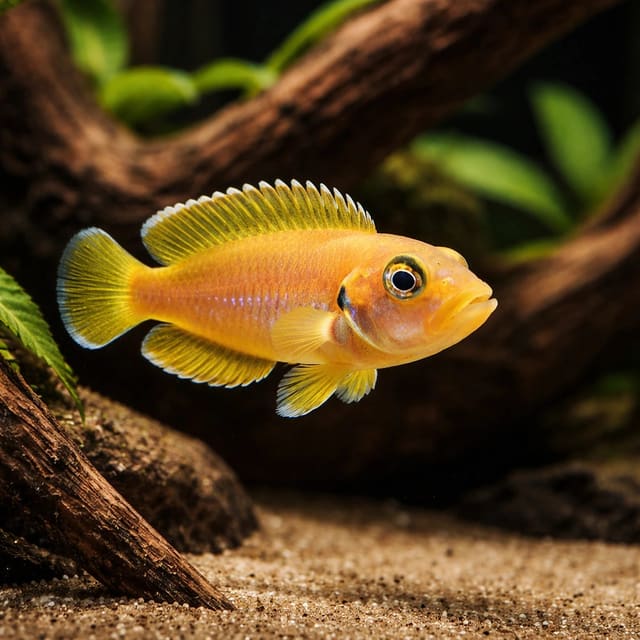
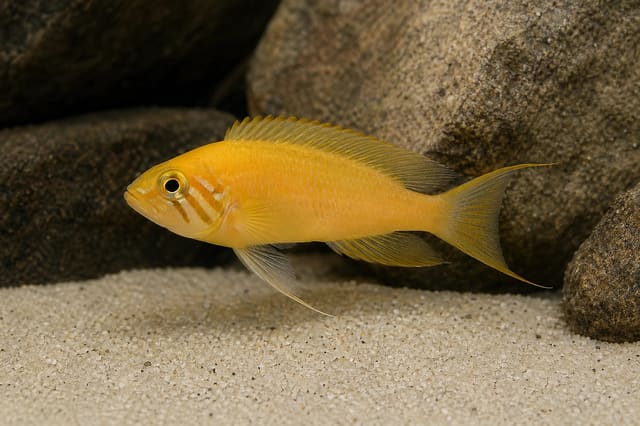
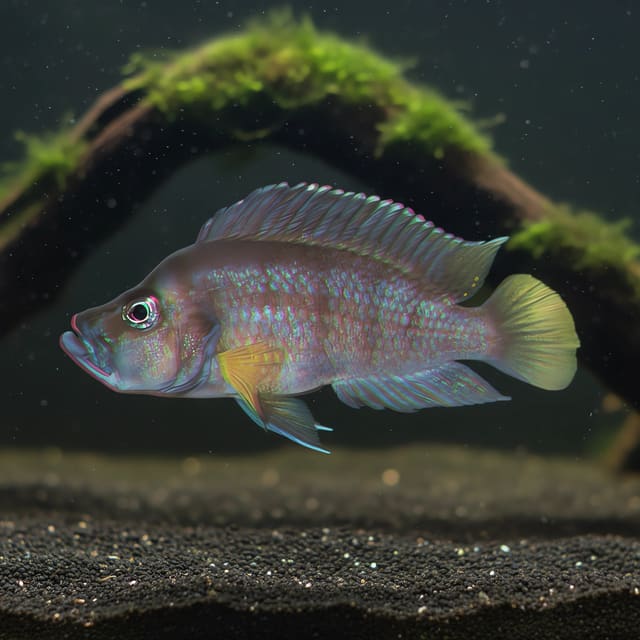
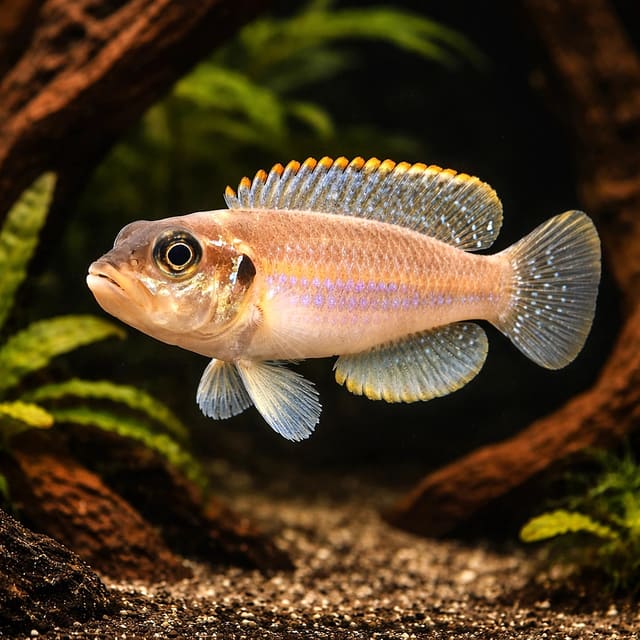
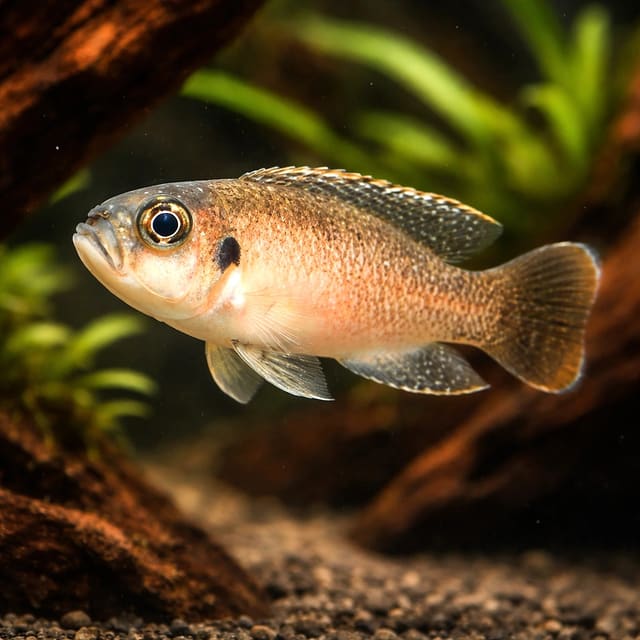
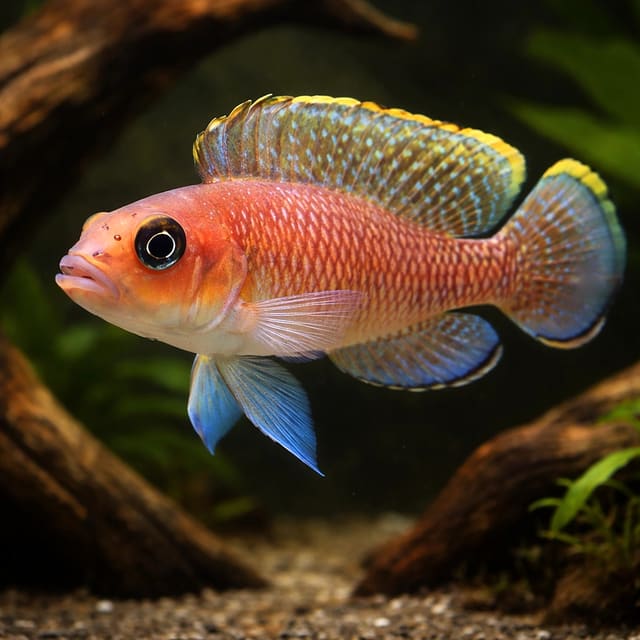
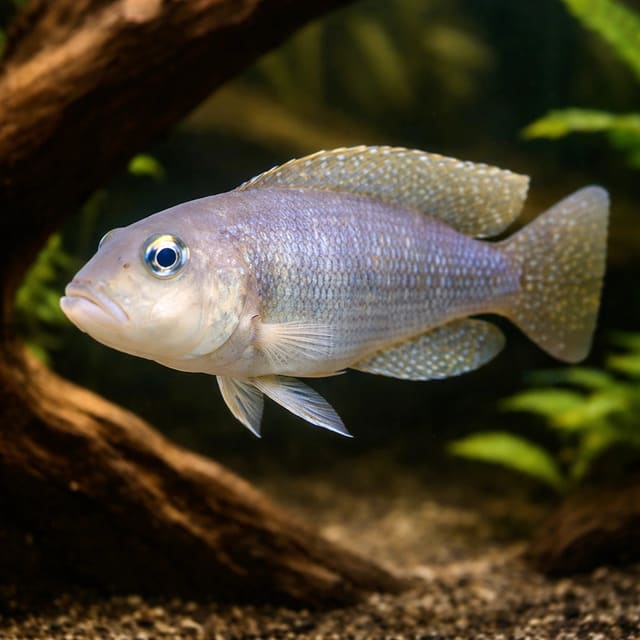
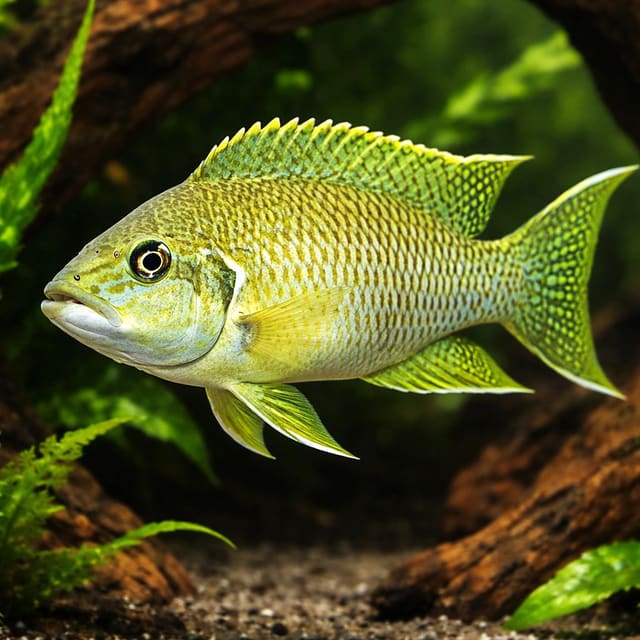
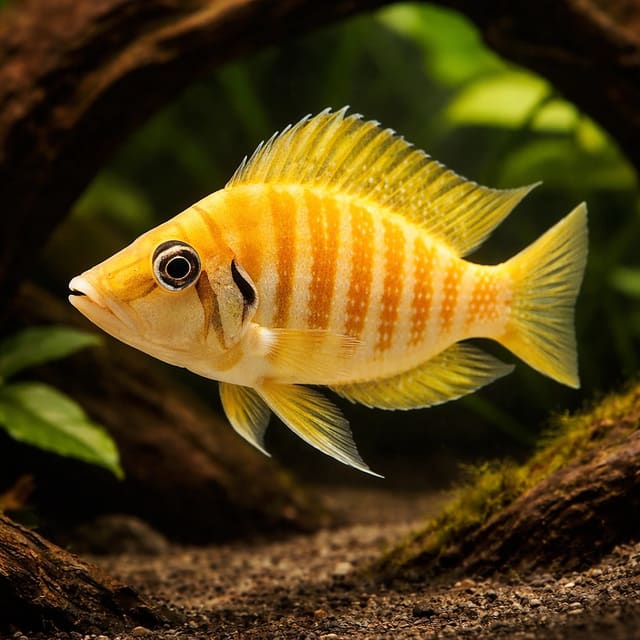
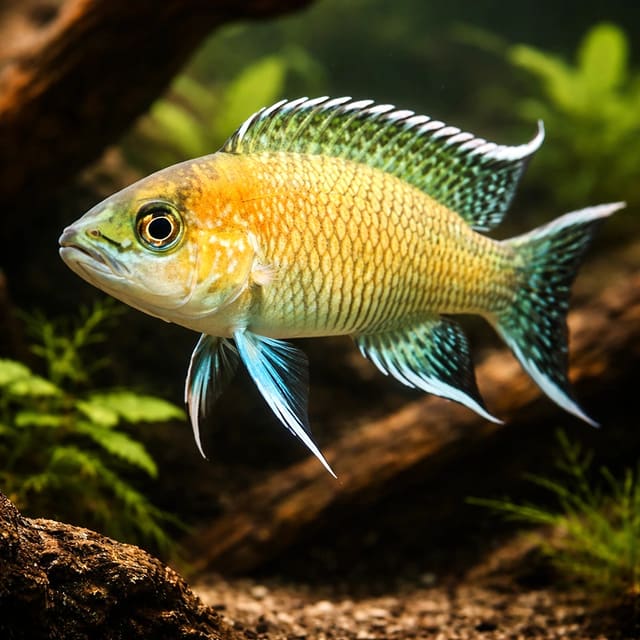
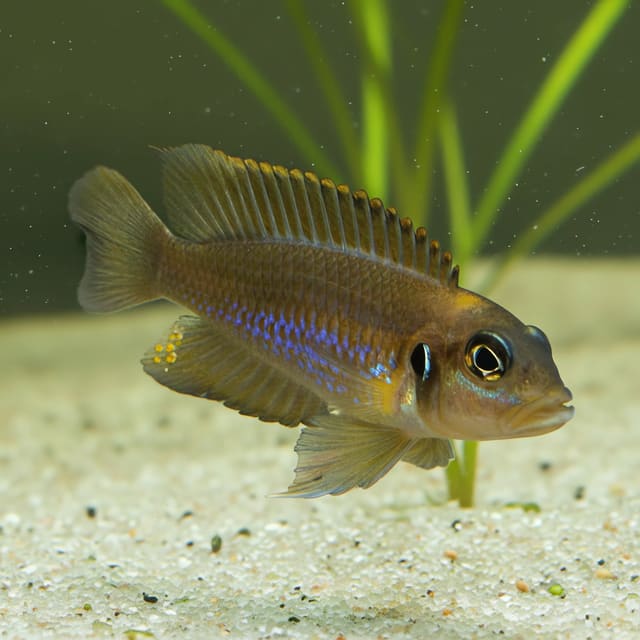
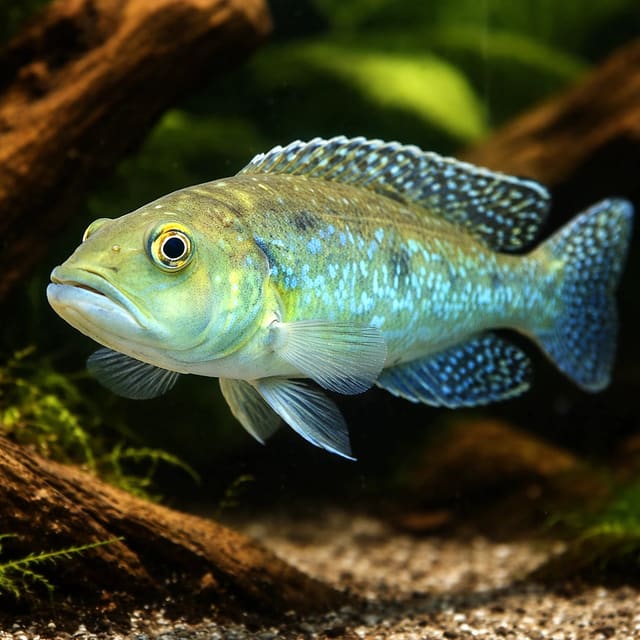
Some gallery images have been digitally enhanced to improve image quality. They show the listed type of animal rather than guaranteeing the exact markings of the individual supplied, so natural colour and pattern can vary. Use the images to understand the characteristic barred form and the written care plan to decide whether the fish fits your aquarium.
Keep the aquarium at 24–26°C, target pH 8.0 and target general hardness of 12 dGH. This target is the overlap between FishBase’s recorded environment of 24–26°C, pH 7.6–8.0 and 8–12 dGH; the Seriously Fish aquarium range of 23–27°C, pH 7.5–9.0 and 8–25 dGH; and OATA’s African lake cichlid group guidance of 23–27°C, pH 8.0–8.6 and 12–18 dGH. The overlap gives one practical routine that remains within all three ranges.
Test the aquarium and replacement water rather than relying on the heater setting or a description of local tap water. Use our water chemistry guide to identify the measurements that matter, then compare your readings with this plan using the aquarium water matcher.
| Reading | Decision |
|---|---|
| Temperature | Maintain 24–26°C without abrupt changes |
| pH | Target 8.0 |
| General hardness | Target 12 dGH |
| Ammonia | Keep at 0 mg/l |
| Nitrite | Keep at 0 mg/l |
| Nitrate | Keep no more than 20 mg/l above normal tap-water level |
OATA gives the ammonia, nitrite and nitrate limits for African lake cichlids. If ammonia or nitrite rises above zero, pause further livestock additions and deal with the waste-processing problem. Do not try to correct several readings rapidly at once; identify what changed, test the replacement water and make controlled adjustments that preserve stability.
Start with a base of at least 120 × 30 cm and about 108 litres for one mated pair. Arrange much of the aquarium as rock piles that form caves, while leaving open water between structures and open sand where the fish can forage. Seriously Fish recommends a sandy substrate and this rock-and-open-water arrangement for the species.
The minimum is specifically for a mated pair. More fish require more territory; they do not make the minimum footprint more efficient. If a companion would occupy the same caves or rock face, adding volume without creating a separate usable zone may still leave both fish competing for one place.
Prepare and mature the aquarium before livestock arrives. Our first tropical aquarium guide covers the sequence for establishing the system. The decisive readiness checks for this fish are a functioning biological filter, ammonia and nitrite at zero, stable temperature, and water already measuring at the intended pH and hardness.
Review the layout from the fish’s level. A cave should not merely be visible from the front; it should create shelter and a boundary. Open sand must remain usable after rocks, filter fittings and other equipment occupy the footprint.
Use efficient biological filtration and keep it running continuously. Seriously Fish treats strong filtration as essential because this cichlid’s carnivorous diet produces substantial waste. For a 108-litre aquarium, it gives a turnover of four to five times the aquarium volume each hour, corresponding to a filter rating of about 430–540 litres per hour.
The RSPCA explains why a well-established aquarium filter is vital: fish release toxic ammonia, beneficial bacteria convert it to nitrite, and another bacterial stage converts nitrite to safer nitrate. A filter rating is therefore only the starting point. Media must be established, flow must remain unobstructed, and test results must show that the biological process is coping with feeding and livestock.
OATA also recommends vigorous aeration for African lake cichlid aquariums. Check surface movement and circulation around the rock structures, because solid caves can create areas with less flow. The goal is adequate oxygen and waste transport without sacrificing the sheltered spaces the fish uses.
Increase feeding or livestock slowly. OATA warns that filter bacteria must increase as waste rises; adding too many fish or too much food at once can lead to new tank syndrome. Let water tests, not visual clarity alone, show whether the aquarium is processing waste properly.
Use good-quality cichlid pellets with animal content alongside varied meaty live and frozen foods. FishBase records a wild diet of sand-dwelling invertebrates, including insect larvae, crustaceans and snails, while Seriously Fish recommends meaty live and frozen foods plus good-quality cichlid pellets. The staple should therefore suit an invertebrate-feeding cichlid.
| Food role | Suitable approach |
|---|---|
| Regular dried food | Good-quality cichlid pellets suited to a carnivorous diet |
| Frozen variety | Animal-based feeds such as brine shrimp, prawn or cockle |
| Live variety | Meaty live food appropriate for aquarium fish |
| Natural feeding context | Present food where the fish can search around open sand and rock edges |
Feed twice a day, giving only what the fish can consume within a few minutes. That frequency and portion rule comes from OATA’s African lake cichlid guidance. Watch the fish take the food, then remove or reduce anything that repeatedly remains. Uneaten food breaks down, increases the load on the filter and can push ammonia, nitrite or nitrate away from the intended limits.
Use body condition and feeding response together. A fish that rushes forward is not automatically underfed, while a fish losing condition despite eating needs closer observation. If food is ignored, test the water and compare the fish’s breathing, colour, swimming and territorial behaviour with its normal pattern before offering extra meals.
Variation means rotating suitable animal-based formats, not making every meal larger. Keep the pellet portion modest on days when frozen or live foods are included. This gives dietary variety while preserving the water quality required by an aggressive fish living around enclosed rockwork.
Arrange for someone to receive the parcel so live fish are not left unattended. Tropical Fish Co hand-bags the fish in pure oxygen, uses an insulated poly box and adds a heat pack when the weather calls for one. The parcel travels with a courier licensed to carry live animals, with tracking and the confirmed arrival date sent by email.
Before release, the aquarium should already be mature, heated and filtered, with ammonia and nitrite at zero. OATA advises increasing fish numbers slowly because the filter’s bacterial population must adjust whenever livestock and feeding increase. This matters particularly in a rock-filled aquarium where a new territorial fish may be difficult to remove quickly.
Observe where the fish shelters, whether it enters open sand to feed, how quickly it accepts food and whether its breathing remains steady. Record the water readings rather than relying on memory. A fish may spend time close to caves as it settles, but a sudden change after an established pattern deserves attention.
If another cichlid is already present, watch the interaction from the first release. Persistent exclusion from shelter or food is a practical reason to separate fish; waiting for visible injury gives an aggressive interaction too much time to escalate.
Plan for one mated pair, not simply two fish. Seriously Fish describes this species as very aggressive towards its own kind and advises keeping only a single pair. Sexing is difficult; adult males tend to become larger than females, but purchasing an adult male and female does not guarantee compatibility.
The documented route is to begin with a group of young fish, allow them to pair naturally and remove every remaining fish once a pair forms. Pair formation may take a year or more. This is only responsible when separate mature accommodation or another definite placement has been arranged for the rejected fish.
Do not leave the group together after a pair claims a cave. Seriously Fish warns that the other fish will not be tolerated. Even a formed pair needs several hiding places because the bond can be weak and may last only through spawning and brood care. Between spawning periods, the male may become intolerant of the female.
| What you observe | What to do |
|---|---|
| Two fish share and defend a cave | Prepare to remove all other Five Bar Cichlids |
| One fish is repeatedly driven from shelter | Separate it before condition or feeding declines |
| The male excludes the female between spawns | Use the prepared separation plan |
| A pair excavates beneath a cave | Protect filtration flow and leave the chosen site undisturbed |
Reproduction is possible but described as infrequent in aquaria. The fish is a biparental cave spawner, and the pair may excavate its chosen site before eggs are laid on the cave floor. The same behaviour that makes spawning interesting also raises territorial pressure, so breeding should never be treated as proof that the pair will remain permanently peaceful.
Learn the fish’s normal swimming, colour, breathing, appetite and use of shelter, then respond when that pattern changes. OATA highlights hanging at the surface, sitting on the bottom, erratic swimming, faster or slower gill movement, unusual hiding, changed aggression, reduced feeding, weight change, white spots, fluffy growths, damaged fins, missing scales, ulcers or bumps as signs requiring attention.
If a fish is being attacked, separation is an immediate husbandry decision rather than a water-treatment question. If several fish change behaviour together, give water testing and equipment checks particular priority. Reduced appetite should lead to investigation, not a larger portion that adds further waste.
For health changes, test the water and contact us with the readings, recent maintenance, feeding pattern and observed signs. Those details make the change easier to assess than colour or a single photograph alone. Avoid choosing a treatment before the water and aggression checks have been completed.
Keep a simple weekly record of water values, water changes, filter checks and appetite. A sequence of measurements can reveal gradual drift before it becomes obvious in the fish. It also separates a recurring husbandry issue from a single unusual observation.
Keep no more than one mated pair of Five Bar Cichlids in the planned territory. Seriously Fish describes severe aggression towards conspecifics and advises removing the remaining fish once a pair has formed. A larger group may be used temporarily for natural pair formation, but it is not the final social arrangement.
Treat two fish as a pair only when their behaviour shows that they accept one another. An adult male and female may fail to pair, and harassment can be fatal. The aquarium therefore needs enough caves for choice and an immediate separation route if one fish is repeatedly displaced, prevented from eating or pursued whenever it leaves shelter.
| Observation | Compatibility decision |
|---|---|
| Brief display followed by separation | Continue close observation |
| Both fish use shelter and eat | Monitor whether the pattern remains stable |
| One fish cannot enter a cave | Separate before its condition declines |
| A formed pair attacks other conspecifics | Remove the additional fish |
| The male turns on the female | Use the planned alternative accommodation |
Do not solve aggression by adding more members of the species. OATA notes that group numbers vary among African lake cichlids, while the species profile gives a specific single-pair arrangement here. The pair’s territory, cave access and changing breeding behaviour are the controlling factors.
A stable period does not make the relationship permanent. The pair bond may weaken outside spawning and brood care. Continue checking access to food and shelter after the fish appear settled, particularly when cave ownership or reproductive behaviour changes.
Choose companions only after matching water requirements, adult size, aggression and use of the aquarium. Seriously Fish names medium-sized Tanganyikan cichlids occupying different areas, such as Cyprichromis species, as possible companions. Larger Julidochromis or Altolamprologus may also be considered when the aquarium is large enough and provides sufficient territories.
Do not assume that similar water chemistry makes two fish compatible. Two rock dwellers may require the same cave, while an open-water fish may reduce direct territorial contact. Conversely, occupying another level does not cancel mismatched aggression, adult size or group requirements.
Outside the named possibilities, compatibility depends on the exact species and the usable territory in the aquarium. Review the proposed companion’s adult needs and observe how the layout divides space before making the stocking decision. Browse the African cichlid collection to compare identities, then contact us with the aquarium dimensions, water readings, current livestock and proposed species for a stocking assessment.
After introduction, watch access to food, caves and open swimming areas. Rearranging décor can help fish establish new territories, as OATA advises, but separation remains necessary when one fish is persistently excluded or attacked.
It reaches 15 cm. FishBase records 15 cm as the maximum length, so plan the aquarium around that adult figure rather than the selected dispatch size.
Use at least a 120 × 30 cm base and about 108 litres for one mated pair. Seriously Fish gives these figures for the species, with rock caves, open water and sand.
Keep one mated pair and remove additional fish after the pair forms. Two unsexed fish are not automatically a pair, and a male and female may still be incompatible.
We class it as intermediate because it needs a mature filtered aquarium, active management of territorial aggression and the 24–26°C, pH 8.0 and 12 dGH overlap of FishBase’s recorded environment, Seriously Fish aquarium guidance and OATA’s African lake cichlid guidance.
Feed animal-based cichlid pellets with varied meaty live and frozen foods twice daily, offering only what it consumes within a few minutes. Its recorded wild prey includes insect larvae, crustaceans and snails.
Keep it at 24–26°C, target pH 8.0 and target 12 dGH. These values overlap FishBase’s recorded environment, Seriously Fish aquarium guidance and OATA’s African lake cichlid guidance.
Treat it as aggressive and territorial, especially towards its own kind. Judge compatibility through access to food, caves and swimming space rather than relying on fin nipping as the only warning sign.
Possible companions include medium-sized Tanganyikan cichlids using different areas, such as Cyprichromis, or larger Julidochromis and Altolamprologus when the aquarium provides enough space and separate territories.
Start filming every delivery while the parcel is still sealed and before opening it, making one continuous unboxing video that shows the sealed parcel, the parcel being opened and the fish still inside the sealed bag. It is hand-bagged in pure oxygen, placed in an insulated poly box with a heat pack when weather calls for one, and carried by a licensed live-animal courier. Someone must receive it; float the bag for 20–30 minutes before release and do not pour bag water into the aquarium.
No reviews for this item yet. Bought one? Honest reviews only, good or bad.
What customers say about ordering from us
I have a small group of long finned mountain minnows. So was delighted to be able to order ten of this variety to increase the genetics in my tank . The ones I recieved are healthy but it’s to early to give a verdict on wether they are of a long finned type since they are small currently.
Gordon Walker · 23 Sept 2026
100% success travel and "installation". Pleased with quality of purchase. The Siamese fighter a bit "shy" so have not yet seen him at his best yet but looking good. Happy customer. GG
George E Garratt · 21 Sept 2026
Reviews of our shop, collected by Judge.me, an independent third-party review collector. Newest first.