−13%
Moderate
Ocellated Shell-Dweller (Lamprologus ocellatus)
23–27°C · pH 7.5–9 · 40L
£16.52£18.99
Territorial Lake Tanganyika shell-dweller for mature hard-water aquariums with fine sand and usable shells. Blue is a trade-form label; exact colour and sex are not guaranteed.
Lamprologus ocellatus
Already 14% off. New customers can take 5% more with WELCOME5.
Save when buying multiple fish. Each quantity is one fish; sex and pair formation are not guaranteed unless the selected variant explicitly states them.
Territorial Lake Tanganyika shell-dweller for mature hard-water aquariums with fine sand and usable shells. Blue is a trade-form label; exact colour and sex are not guaranteed.
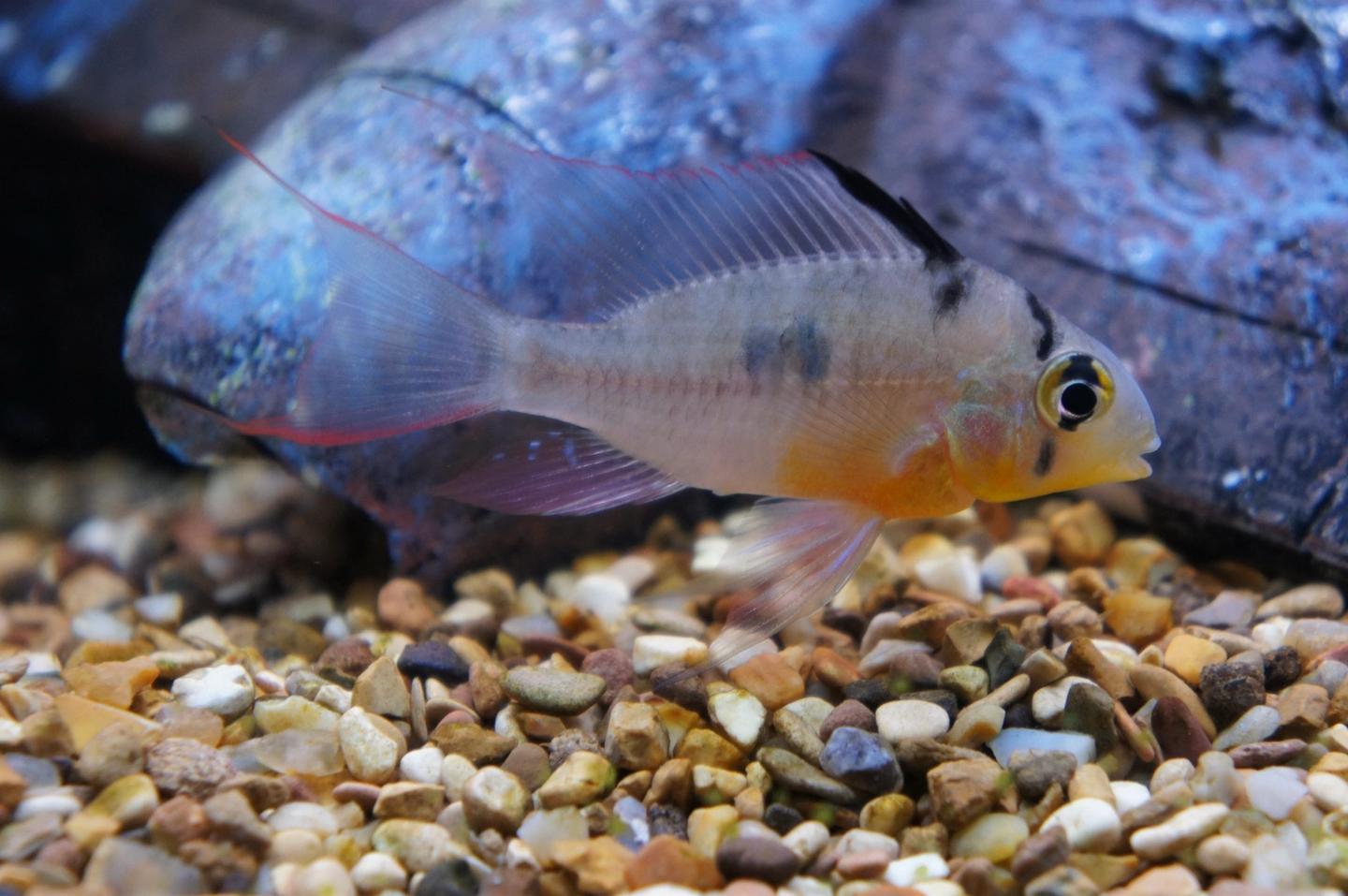
Cichlids are a family of roughly 1,800 accepted species, not one care type. Before buying, identify the exact species and source, then compare adult measurement, usable tank dimensions, social system, territory, tested water, diet and an exit plan. No family-wide minimum tank, water range or tank-mate list is safe.
Maintain these water conditions for optimal health and vibrant colors
Blue Ocellated Shell-Dweller is a supplier trade form of Lamprologus ocellatus, a tiny but highly territorial Lake Tanganyika cichlid that lives and breeds around empty snail shells. Its adult size is small, but its aquarium needs are specialised: hard alkaline water, fine sand, several usable shells, a mature filter and enough floor space for each fish to establish a territory.
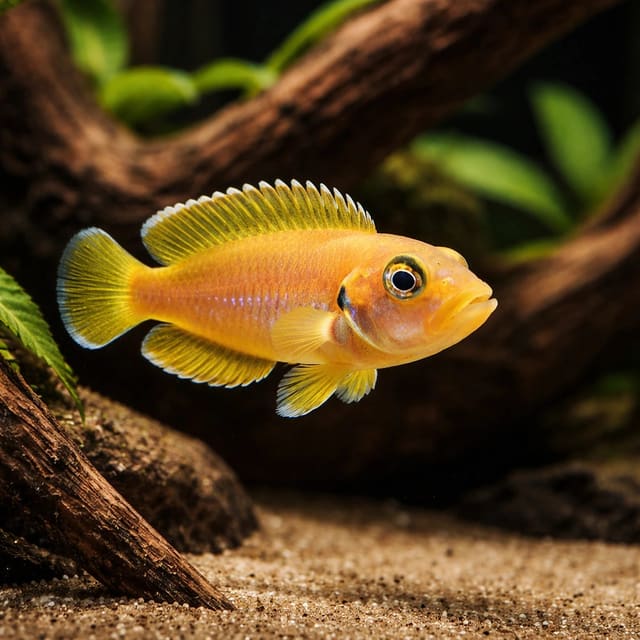
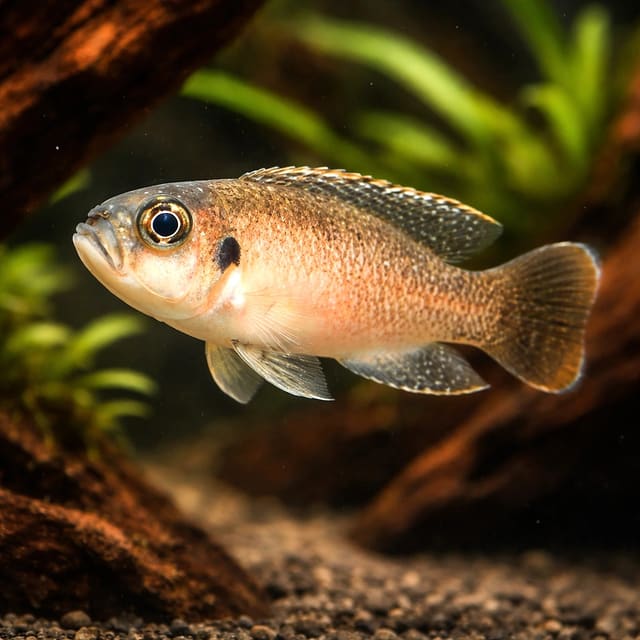
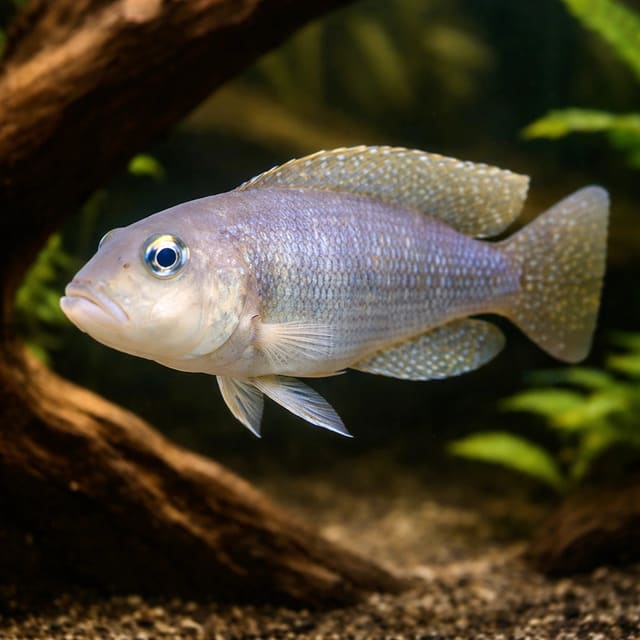
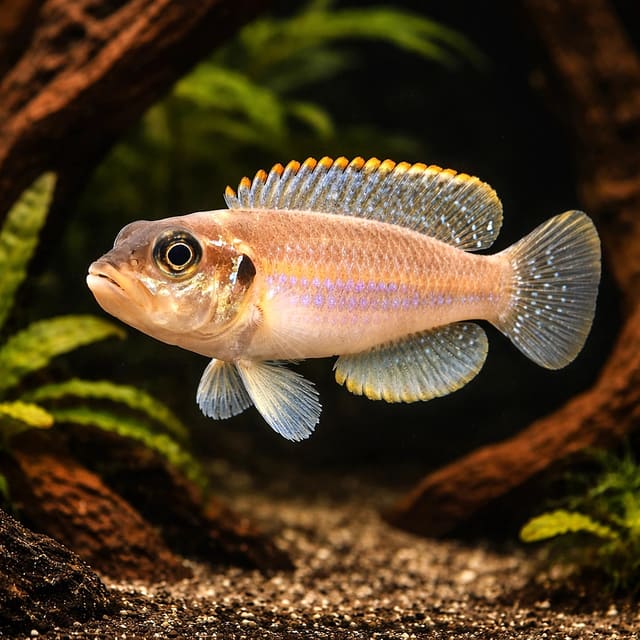
Colour and representative image: “Blue” is the supplier trade-form label, not a promise of uniform electric-blue colour. The current image shows a compact brown/gold fish with blue flank flecks and an eye-like dark mark near the gill cover. It does not independently establish the exact size, sex or appearance of the fish selected for your order.
The valid scientific name is Lamprologus ocellatus. Neolamprologus ocellatus is widespread in shops and search results, but the June 2026 Catalog of Fishes and FishBase retain Lamprologus ocellatus as the valid combination. The familiar alternative name is explained here so the same species can be recognised in aquarium references.
| Trade name | Blue Ocellated Shell-Dweller |
|---|---|
| Valid scientific name | Lamprologus ocellatus (Steindachner, 1909) |
| Common alternative online | Neolamprologus ocellatus; not used here as the valid combination |
| Family | Cichlidae |
| Origin | Endemic to Lake Tanganyika, Africa |
| Care level | Moderate because shell territories and Tanganyika water must be managed |
| Temperament | Territorial and semi-aggressive, especially near shells |
| Published maximum | 5.8cm total length; males are generally larger than females |
| Recommended aquarium | 75L+ and at least 60cm long for one or a proven pair; 100L+/90cm for a small planned group |
| Temperature | 23-25C as a stable routine range |
| pH | Approximately 8.0-9.0 |
| General hardness | Approximately 9-19 dGH |
| Diet | Micro-predator; small crustaceans and insect-based or complete micro foods |
| Breeding | Substrate spawner inside a shell with female brood care |
| Selection | Size option only; sex and exact blue colour are not guaranteed |
Select one live fish from the available 2-3cm or 3-4cm size option. Those measurements describe dispatch size, not guaranteed sex or final size. Both size options belong to the same product, and their prices and inventory are managed separately. No option promises a pair, trio or colony.
Juveniles are difficult to sex reliably. Adult males are usually larger and more robust, while females remain smaller and spend more time close to breeding shells, but size overlap and individual variation make a retail guarantee unsafe. If a breeding project is the aim, the aquarium must be able to house the whole unsexed starting group and separate incompatible individuals.
Actual fish may show grey, cream, gold and blue reflective tones depending on trade form, age, mood, lighting and background. A stressed arrival can be pale. The word Blue does not promise uniform electric-blue colour or an exact match to the representative image.
Eschmeyer's Catalog of Fishes lists this species as valid in Lamprologus. FishBase follows the same name and records it as a Lake Tanganyika endemic. The alternative combination Neolamprologus ocellatus remains very common in aquarium articles and product titles, which explains why the original supplier name used it.
Using the accepted combination improves clarity for scientific references and reduces the chance of copying care from a different Neolamprologus species. It does not mean the popular alternative should be hidden: it helps readers connect familiar aquarium wording with the scientific references.
The “ocellated” name refers to eye-like markings and visual patterning associated with the species. “Blue” is not part of the scientific name. It is a trade colour label supplied for this stock and does not establish locality or a formally defined strain.
The current representative view shows a compact fish with brown/gold base colour, blue flank flecks and an eye-like dark mark near the gill cover. A single image without a trustworthy size scale is not a measurement or independent proof of the current stock. Use the selected dispatch-size option and the written species guide to plan the aquarium.
| Image feature | What the asset shows | Correct customer interpretation |
|---|---|---|
| Body | Compact fish in a side view | Not diagnostic for L. ocellatus |
| Colour | Brown/gold base with blue flank flecks | Exact blue intensity is not guaranteed |
| Habitat | Aquarium substrate and plants | The real fish requires fine sand and usable shells |
| Scale | No trustworthy size reference | Use the published 5.8cm maximum and selected dispatch size |
| Selection | One illustrative fish | Not independent proof of selected stock, sex or exact colour |
Use the written selection and care details rather than an exact image match. Contact us before ordering if current colour or appearance is essential.
Lamprologus ocellatus is endemic to Lake Tanganyika. FishBase records it from benthopelagic shell-associated habitat, commonly around 6-12m depth. Empty snail shells are not decorative extras: they provide refuge, breeding chambers and the centre of defended territories.
The lake's water is mineral-rich, alkaline and exceptionally stable compared with many small aquariums. The bottom habitat combines open sand with shell accumulations. This is why the species should not be placed in a generic soft-water planted community simply because it is physically small.
Recent behavioural research uses L. ocellatus to study shell-nest construction. Fish select shells suited to their size, move sand and orient or bury shells. The behaviour has an innate sequence but improves with experience. A keeper should provide the materials and space for that behaviour rather than fixing every shell permanently for visual neatness.
FishBase records a maximum of 5.8cm total length. Adult males are generally larger than females, which may remain around 3.5-4.5cm depending on population and conditions. Small body size does not equal low territorial demand.
Each fish uses a three-dimensional zone around one or more shells. A dominant male can patrol several female shell sites, and two fish may reject each other even when a theoretical sex ratio appears correct. Floor length and shell separation matter more than a tall unused water column.
Do not overfeed to force growth. Steady development with varied small food, stable water and low chronic stress is preferable. The 2-3cm option can still show strong territorial behaviour soon after arrival.
We recommend at least 75 litres with a 60cm footprint for one fish or a proven compatible pair. A small planned group should have at least 100 litres and around 90cm length, with more space where sexes are unknown. They provide a margin for territory, shell separation and water stability.
| Stocking aim | Recommended starting space | Conditions |
|---|---|---|
| One display fish | 75L+ / 60cm length | Several shells, mature filter and no competing bottom fish |
| Proven compatible pair | 75L+ / 60cm length | Separated shell zones and a backup divider or tank |
| Unsexed trio or small group | 100L+ / 90cm length | Many shells, wide spacing and removal plan |
| Tanganyika community | 150L+ and longer | Separate rock and shell territories; species-level planning |
A footprint can be unsuitable even when nominal litres look adequate. Avoid narrow portrait aquariums. Keep the full shell field visible enough to observe feeding and aggression, while providing visual breaks and escape routes.
Provide at least two or three suitable shells per fish as a practical starting point, distributed across more sites than there are fish. A bare minimum of one shell each offers no choice when sizes or orientations are rejected. Extra shells help a subordinate fish move without entering the only territory controlled by another.
Use clean, unpainted shells with smooth openings large enough for the fish to enter and turn but not so huge that they lose a secure chamber. Escargot shells are commonly used where legal and appropriately cleaned. Large native snail shells or decorative sea shells can alter risk through sharp edges, contamination or unsuitable openings.
Place shells on fine sand with openings visible. Allow the fish to move or partly bury them. Do not glue them into fixed ornaments. Inspect for trapped debris during maintenance without repeatedly destroying established territories.
Use a fine, smooth sand bed deep enough for digging and shell positioning. Coarse sharp gravel interferes with natural excavation and can trap food. The current gallery's coarse substrate is not the recommended model.
Create distinct shell zones. In a larger Tanganyika aquarium, put rockwork at the opposite end for rock-dwelling companions and leave a clear neutral boundary. Secure rocks directly on a protected base so digging cannot cause a collapse.
Plants are optional and not part of the core shell-bed habitat. Hardy alkaline-tolerant plants may be used away from the shell field, but roots and pots must not block digging. The fish's behavioural needs take priority over a decorative planted layout.
| Parameter | Routine range | Reason |
|---|---|---|
| Temperature | 23-25C | Matches the published range and preserves oxygen margin |
| pH | 8.0-9.0 | Reflects stable alkaline Tanganyika conditions |
| GH | Approximately 9-19 dGH | Supports mineral-rich hard-water husbandry |
| KH | Maintain useful carbonate buffering | Reduces sudden pH fall |
| Ammonia | 0 mg/L | Toxic at any detectable level |
| Nitrite | 0 mg/L | Toxic and evidence of inadequate cycling |
| Nitrate | Keep low and stable | Controlled by feeding, stocking and water changes |
Do not chase pH with unmeasured powders. Test source water, GH and KH, then prepare replacement water consistently if remineralisation is genuinely needed. Rapid increases can be as harmful as unsuitable long-term values.
Use a mature filter with enough biological capacity for the full stocking plan. Flow should move waste toward the intake and maintain surface gas exchange without blasting sand from the shell field. Protect intakes from fry.
A sponge pre-filter or air-driven sponge can add biological area and fry safety. It does not remove the need for water changes. Keep the aquarium covered because small cichlids can jump when chased or startled.
Never add these fish to an uncycled aquarium. Their hard-water requirement does not protect them from ammonia or nitrite, and high pH can make ammonia more dangerous.
FishBase describes L. ocellatus as a microfeeder on invertebrates. In aquariums, use small complete carnivore or cichlid micro-pellets, frozen Cyclops, daphnia, baby brine shrimp, finely chopped mysis and other appropriately sized foods in rotation.
| Food | Role | How to offer it |
|---|---|---|
| Complete micro-pellet or granule | Balanced staple | Choose a size that is swallowed without repeated spitting |
| Frozen Cyclops or daphnia | Small invertebrate variety | Thaw and distribute modest portions |
| Baby brine shrimp | Useful live or frozen movement and nutrition | Part of a rotation, especially for juveniles |
| Finely chopped mysis | Occasional larger prey item | Cut to mouth size and avoid excess |
| Large pellets, feeder fish or fatty meat | Unsuitable | Do not use |
Feed small portions once or twice daily and ensure food reaches each shell territory. Remove leftovers before they decay in shells. A dominant fish may intercept food, so spread it over the whole floor rather than dropping one pile.
Watch each individual from above and the side. A healthy fish should not develop a pinched belly, hollow head profile or persistent bloating. Shell residents can hide declining condition, which makes regular observation important.
Refusal of one meal after transport can be normal. Ongoing refusal, rapid breathing, white faeces or swelling needs water testing and diagnosis. Do not assume every digestive sign has the same cause.
This species is bold and territorial. A fish may bite a hand or tool near its shell, flare at a much larger tank mate and move surprising amounts of sand. That behaviour is normal until another fish loses access to food, shelter or open water.
Persistent chasing across the whole aquarium, torn fins, a fish trapped at the surface or inability to leave a corner means the layout or stocking has failed. Add space or separate fish rather than hoping they will form a pair.
Ocellatus are not schooling fish. A group occupies neighbouring territories and may appear colonial, but each shell site is defended. A fixed “one male with two or three females” group is not guaranteed by unsexed retail options.
Adult males are usually larger and broader. Females are smaller and more closely associated with a breeding shell. Juveniles cannot be reliably selected by those differences, and colour alone is not a safe sex test.
A proven compatible pair is different from two random fish. Starting with several juveniles may improve the chance of both sexes, but the aquarium must house every fish until compatibility is known. Have a divider, spare cycled aquarium or rehoming plan ready.
The simplest arrangement is species-focused. In a larger aquarium, selected open-water Tanganyika fish can occupy a different zone, but shell territory and food competition must be considered. Avoid mixing different shell dwellers in a small tank because they compete for the same resource.
A Marlier's Julie is not a small-tank companion; in a large zoned aquarium, rockwork must be completely separate and adult aggression monitored. Cyprichromis require a much larger group aquarium than this shell dweller alone.
Avoid Malawi mbuna, Tropheus, large predatory cichlids, boisterous catfish, small shrimp and soft-water community fish. Similar water chemistry does not automatically create behavioural compatibility.
| Listing | Social pattern | Main planning difference |
|---|---|---|
| Standard Ocellated Shell-Dweller | Territorial pair or small group | Same species without the Blue supplier label |
| Gold Ocellated Shell-Dweller | Territorial shell user | Gold trade form; keep forms separate for breeding |
| Multi Shell-Dweller | Colony-forming | Different social expansion and shell-field planning |
| Brevis Shell-Dweller | Often pair-focused | Different shell sharing and temperament |
| Similis Shell-Dweller | Colony-forming | Different species identity and group behaviour |
Do not choose only by colour. Compare adult behaviour, shell use, colony growth, water needs and the space required for compatible adults. Keep named forms separate if breeding or distributing fry.
The female lays eggs inside a selected shell and remains closely involved with the brood. The male fertilises from outside or near the opening, depending on shell and fish size. Fry remain protected in and around the shell before becoming visible over the sand.
Provide multiple correctly sized shells and stable water. Do not lift or inspect an occupied shell repeatedly. A female may abandon or consume a brood when disturbed. Protect filter intakes and feed fry suitably small foods such as newly hatched brine shrimp and powdered complete fry food.
Recent research on brood-care timing and nest construction makes this species scientifically interesting as well as attractive. The fish's shell choice and sand-moving behaviour are part of its biology, not mess to be corrected every day.
Prepare the mature shell aquarium before dispatch day. Read the current Tropical Fish Co acclimation instructions, match temperature and avoid leaving opened shipping water unattended for a long drip. Shipping chemistry can change when air enters the bag.
Place the fish near several available shells with lights reduced. Do not force it into a shell. It may hide immediately or remain cautious while choosing a territory. Feed lightly after it settles.
Keep packaging and take clear evidence within the published live-arrival window if there is a concern. Report severe breathing distress, loss of balance or visible injury promptly.
Quarantine in a fully cycled hard-water tank with sand, shells, heat and a secure cover. A bare uncycled container is not suitable. Use separate nets and siphons and never pour shipping water into the display.
Observe breathing, skin, fins, appetite and faeces. Diagnose before medicating. Many treatments affect biological filtration or require extra oxygen, and an incorrect broad cocktail can worsen stress.
| Period | Priority | What to observe |
|---|---|---|
| Arrival day | Controlled acclimation and shell access | Breathing, balance, injury and first refuge |
| Days 2-7 | Confirm feeding and zero ammonia/nitrite | Food reaching the territory, waste and aggression |
| Weeks 2-4 | Assess shell choice and compatibility | Digging, rejected shells, chasing and body condition |
| Months 2-3 | Set long-term maintenance | Growth, sex differences, nitrate trend and territory stability |
Test water before treating. Ammonia, nitrite, oxygen shortage and aggression can imitate disease. Seek experienced aquatic-veterinary guidance for severe or persistent signs.
| Frequency | Task | Purpose |
|---|---|---|
| Daily | Observe each territory, feeding and equipment | Find exclusion or illness early |
| Weekly | Test as needed and change matched water | Control waste without chemistry shock |
| As required | Clean mechanical media and exposed debris | Maintain flow while preserving biological filtration |
| Monthly | Check shell condition and rock stability | Prevent sharp edges, traps and collapses |
| After stocking change | Reassess territories and food access | Every addition can change the hierarchy |
Lamprologus ocellatus appears in the aquarium trade under standard, gold, blue and locality-associated labels. Those names can describe selected appearance or supplier convention without representing separate species.
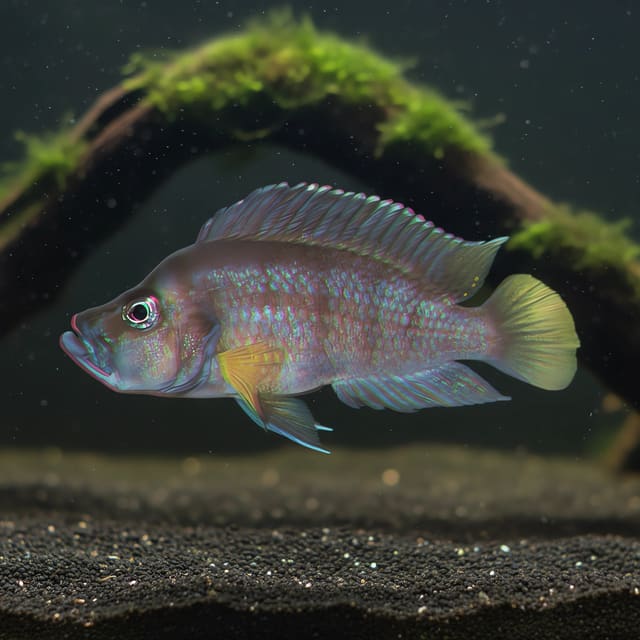
Blue reflection can vary with the angle of light, substrate colour, stress, breeding condition and camera processing. A fish may show blue along the face, scales or fin edges without becoming uniformly electric blue. Juveniles can be much plainer. The Blue trade-form label is not an exact appearance guarantee.
Keep Blue, Gold and standard lines separate if breeding. Colour-form names lose meaning when adults of uncertain history are crossed and the fry are resold under whichever label is most attractive. Record source, date, size and any reliable locality information when fish arrive. The separate Gold Ocellated Shell-Dweller listing is not a colour option within this product.
Shell choice affects security and reproduction. The opening must admit the fish without scraping its flanks, while the inner chamber must offer enough depth to retreat. An oversized open shell can feel exposed; an undersized shell can trap a growing fish. Recent experimental work shows that juveniles change shell-size preference as they grow, supporting the practical value of offering a range rather than one permanent shell.
Before use, select intact shells without sharp chips, internal debris, paint, varnish or fragrance. Clean them with aquarium-safe methods and rinse thoroughly. Do not use shells collected from polluted water or protected habitats. If boiling is appropriate for the material, allow them to cool completely and inspect again before placing them in the aquarium.
Arrange shells in loose groups separated by open sand. Point some openings in different directions so fish can choose. Avoid a perfectly straight decorative row, which offers little visual separation. A dominant fish should not be able to sit centrally and see every entrance.
Shells can trap uneaten food. During water changes, siphon loose debris from nearby sand without turning over every occupied shell. If a foul pocket develops, test water and clean the area carefully. Never lift a shell that may contain a brooding female or fry unless there is an immediate welfare reason.
Start with the actual source-water report or test results. Measure pH, GH and KH after the water has stood and aerated, because freshly drawn water can change as dissolved gases equilibrate. If the source is already hard and buffered, repeated additions of Rift Lake salts may overshoot the target.
Where remineralisation is needed, prepare replacement water in a separate clean container using a consistent measured recipe. Bring it close to aquarium temperature and confirm that no undissolved salts remain. Record the amount used so later water changes do not depend on memory. Never add concentrated powder directly onto fish or occupied shells.
Evaporation leaves minerals behind. Top up evaporated water with suitable low-mineral water rather than adding the full mineral recipe again, then replace minerals through measured water changes. Otherwise GH and conductivity can climb unnoticed even while pH appears acceptable.
Stability is the goal, not the highest number on the range. A fish maintained at pH 8.2 with consistent hardness is safer than one moved repeatedly between 8.0 and 9.0 by corrections. Test after major decor, substrate or source-water changes.
| Observation | Likely meaning | Response |
|---|---|---|
| Short display and retreat near one shell | Normal boundary communication | Observe; confirm both fish retain food and refuge |
| One fish crosses the whole tank to attack | Territory is too large or the match is failing | Increase separation or remove the aggressor |
| Subordinate remains at the surface | No safe floor territory | Separate immediately; adding one shell is unlikely to solve it |
| Fish repeatedly buries a shell opening | Nest construction or unsuitable orientation | Allow normal work unless the fish becomes trapped |
| Pair was calm and suddenly becomes hostile | Breeding, maturity or compatibility change | Use the prepared divider or second cycled tank |
| New tank mate never enters the shell field | Existing fish controls all usable sites | Rehome or redesign in a larger aquarium |
Do not respond to every chase by filling the aquarium with more fish. “Overstocking to spread aggression” is not a responsible default for this species and can increase waste, oxygen demand and disease transmission. Territory must be solved with footprint, zoning, compatible stocking and removal options.
Fry emerge very small and stay close to shells. Feed tiny portions several times where possible without allowing food to decay. Newly hatched brine shrimp, microworms from a safe culture and a complete powdered fry food can be rotated. Observe that the smallest fry actually eat.
Population can increase when several females breed. Before encouraging spawning, decide how juveniles will be grown, sexed and rehomed. A 75L pair aquarium cannot indefinitely hold multiple generations of territorial adults. Separate grow-out space must have the same water quality and filtration standards.
Do not move fry into a brand-new tank because it is empty. Seeded media, stable heat and protected intakes are required. Sudden differences in pH and hardness can be especially damaging to small juveniles. Record parent form and avoid labelling offspring as Blue when parent colour or provenance is uncertain.
This page does not promise a fixed five-year lifespan because individual longevity depends on genetics, conditions and evidence quality. The keeper should nevertheless plan for a multi-year commitment. Shell territories, filter maintenance and hard-water preparation remain necessary after the novelty of digging behaviour has passed.
Older or subordinate fish may need targeted feeding. Watch for gradual weight loss, clouded eyes, mouth injury and reduced ability to defend a shell. Do not assume decline is inevitable age without checking water, diet and social pressure.
Never release fish, fry, aquarium plants or water into natural waterways. Rehome through responsible aquarium channels and disclose uncertain colour-form history. Clean and dry equipment before it moves between unrelated systems.
Use this guide to plan realistic shell territories, adult floor space and stable Tanganyika water. A small body does not make this fish an easy general-community species; have a separation option ready for incompatible fish.
Check the current delivery areas, dispatch options, live-arrival terms and acclimation instructions before ordering. Prepare the mature shell aquarium and selected size option before committing to a new fish.
Browse the Lake Tanganyika cichlid collection to compare shell, rock and open-water specialists before planning the aquarium.
The June 2026 Catalog of Fishes and FishBase use Lamprologus ocellatus as the valid name. Neolamprologus ocellatus remains a common aquarium alternative.
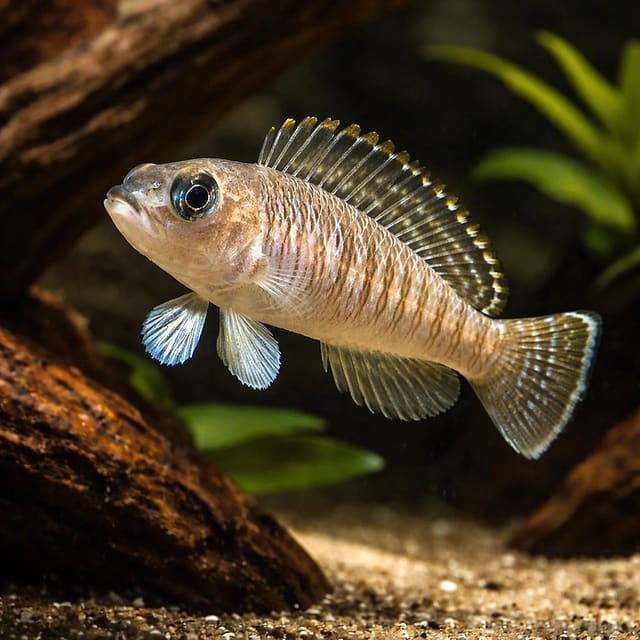
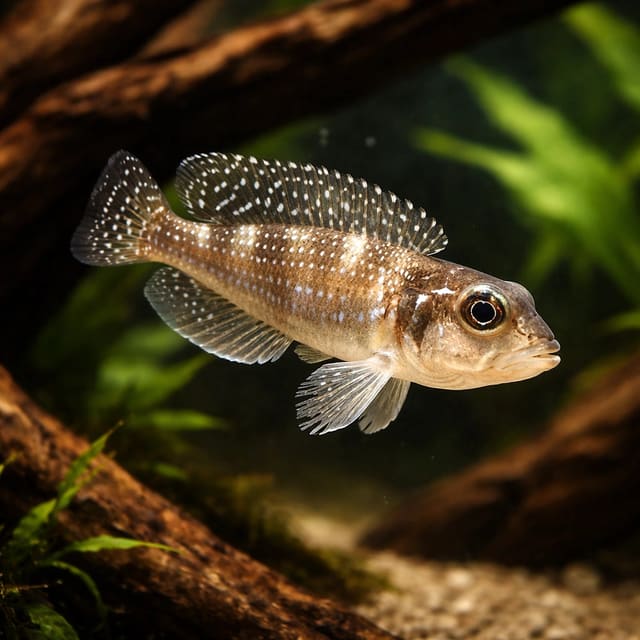
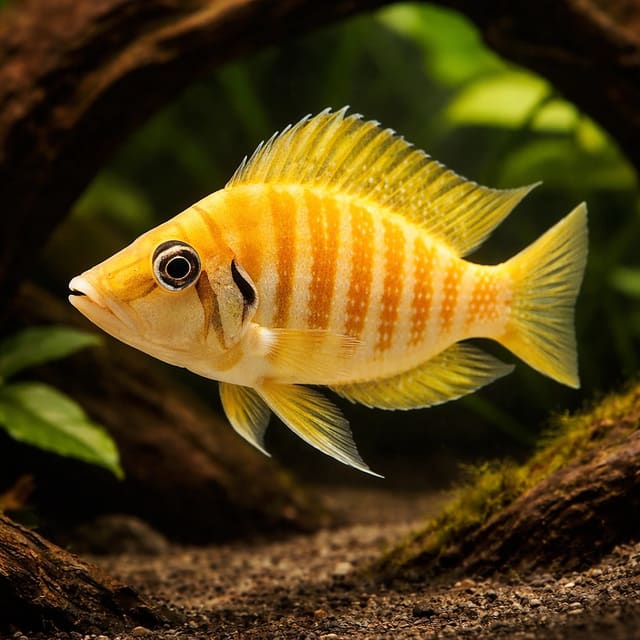
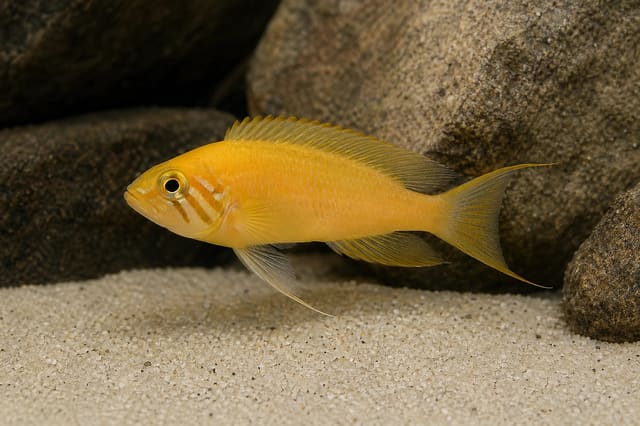
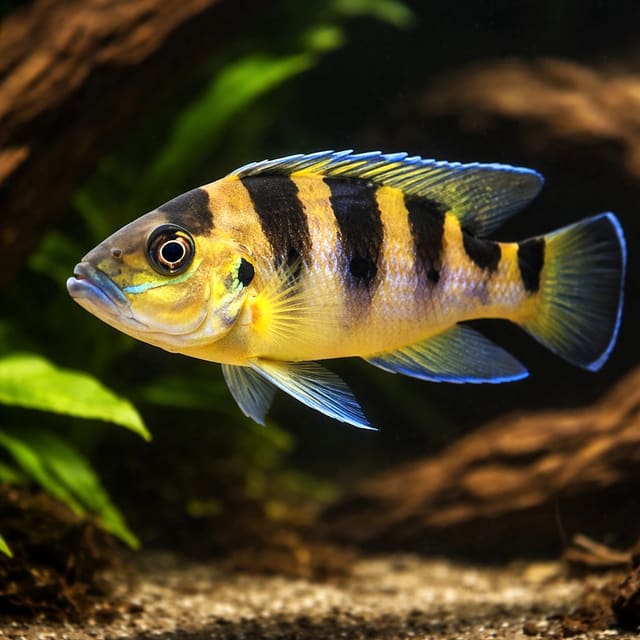
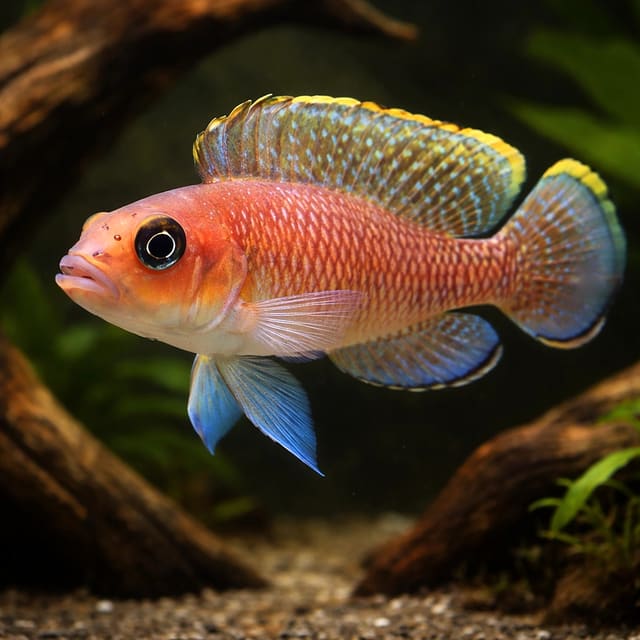
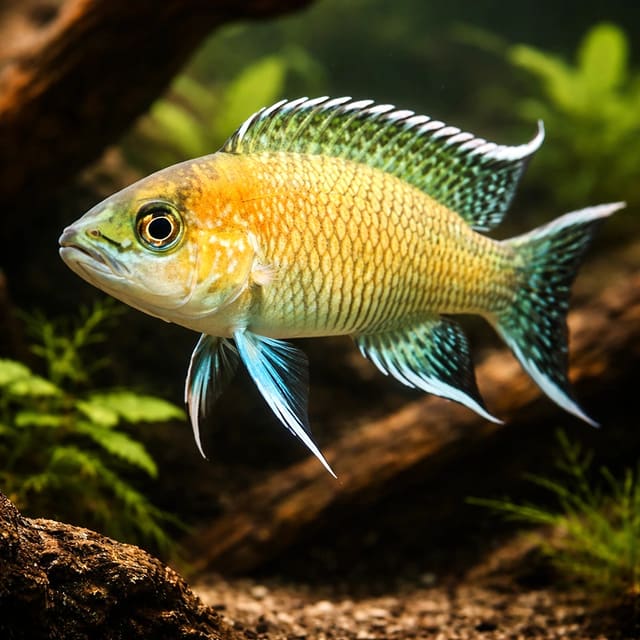
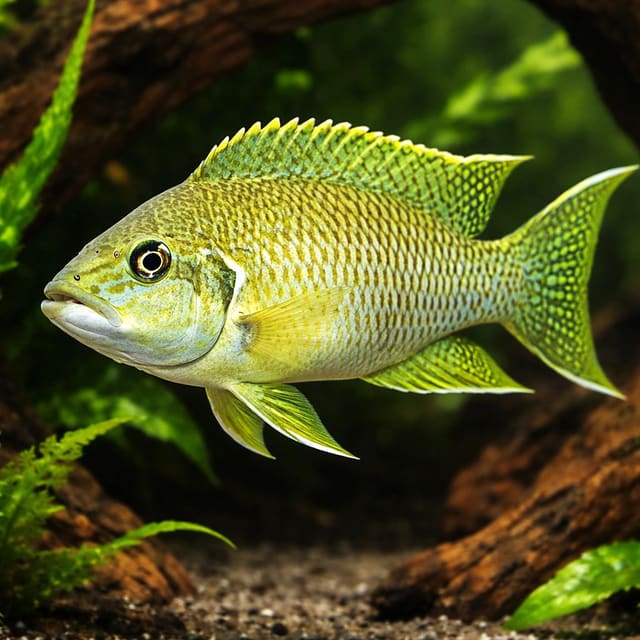
No exact image match is guaranteed. The current image is representative and does not independently establish selected stock size or sex. Colour and blue reflection can vary with age, condition and lighting.
FishBase records a maximum of 5.8cm total length. Males are usually larger than females.
We do not recommend 40L. Use at least 75L and a 60cm footprint for one or a proven pair to provide shells, territory and water stability.
Provide at least two or three suitable shells per fish as a practical starting point, with more sites than fish and enough distance between territories.
Two unsexed fish are not a proven pair and may fight. Use sufficient space and keep a separation plan.
Maintain a stable 23-25C, with pH 8.0-9.0 and approximately 9-19 dGH.
They are micro-predators. Use small complete carnivore foods plus frozen Cyclops, daphnia, baby brine shrimp and finely chopped mysis in rotation.
They are territorial and bold around shells. Their small body does not make them peaceful community fish.
Not in a small aquarium. Different species compete for the same shells and floor territory. Large zoned setups require species-level planning.
The female lays eggs inside a shell and cares for the brood. Fry emerge around the shell and need tiny food and a protected filter intake.
Read the current Tropical Fish Co live-arrival terms before ordering, including delivery, evidence and acclimation requirements. Eligibility and reporting windows are determined by the published terms.
Live fish vary naturally. The Blue label is a supplier trade-form name, not a promise of an exact match to the representative image. Observe the actual fish, test the water and adjust husbandry gradually within a stable Tanganyika system.
No reviews for this item yet. Bought one? Honest reviews only, good or bad.
What customers say about ordering from us
Easy website plenty of info on fish your buying great to pick a time slot
TRACEY DURRANT · 7 Oct 2026
Got some lovely fish thank you
Kevin Mackie · 7 Oct 2026
Reviews of our shop, collected by Judge.me, an independent third-party review collector. Newest first.