Moderate
Gold Ocellatus Shell-Dweller (Neolamprologus ocellatus)
23–25°C · pH 8–9
£16.59
The Tanganyikan Lamprologus Cichlid (Lamprologus heliantus) is a member of the Cichlidae family from Lake Tanganyika, East Africa, that reaches 8 cm. It suits keepers prepared for territorial cichlid care; keep it at 23–27°C, pH 8.0–8.5 and 12–18°dGH, and plan social numbers around the aquarium footprint and territories. Sold individually at approximately 3.5–4 cm.
Adult size is the maximum length this species reaches at full maturity (scientific sources). The livestock you receive will be younger and smaller. Product-photo provenance and any image-specific limitations are stated on the listing.
Lamprologus heliantus
Save when buying multiple fish. Each quantity is one fish; sex and pair formation are not guaranteed unless the selected variant explicitly states them.
The Tanganyikan Lamprologus Cichlid (Lamprologus heliantus) is a member of the Cichlidae family from Lake Tanganyika, East Africa, that reaches 8 cm. It suits keepers prepared for territorial cichlid care; keep it at 23–27°C, pH 8.0–8.5 and 12–18°dGH, and plan social numbers around the aquarium footprint and territories. Sold individually at approximately 3.5–4 cm.
Adult size is the maximum length this species reaches at full maturity (scientific sources). The livestock you receive will be younger and smaller. Product-photo provenance and any image-specific limitations are stated on the listing.

Cichlids are a family of roughly 1,800 accepted species, not one care type. Before buying, identify the exact species and source, then compare adult measurement, usable tank dimensions, social system, territory, tested water, diet and an exit plan. No family-wide minimum tank, water range or tank-mate list is safe.
Maintain these water conditions for optimal health and vibrant colors
The Tanganyikan Lamprologus Cichlid (Lamprologus heliantus) is a compact member of the Cichlidae family from Lake Tanganyika in East Africa. It reaches 8 cm as an adult and suits a keeper who can maintain hard, alkaline water, stable biological filtration and a carefully structured territory. Treat it as a specialist cichlid rather than a general peaceful-community fish.
Keep the aquarium at 23–27°C, pH 8.0–8.5 and 12–18°dGH. Keep ammonia and nitrite at zero and nitrate at no more than 20 mg per litre above the normal tap-water level. These targets make water testing, filtration and regular maintenance central to the decision.
Territorial behaviour shapes the rest of the setup. Provide rockwork, caves or shell clusters, break up lines of sight and leave more than one usable refuge when keeping multiple fish. The aquarium should offer physical boundaries rather than one exposed floor where a dominant fish can watch every route.
| Suits | Not suited to |
|---|---|
| Hard, alkaline water at 23–27°C | Soft, acidic community conditions |
| A mature, filtered aquarium | An uncycled aquarium |
| A keeper prepared to manage territories | An open layout without refuges |
| A screened Lake Tanganyikan community | A mixed Malawi and Tanganyika collection |
| A species-focused aquarium | Delicate or slow-moving community fish |
If these conditions match the aquarium you are planning, explore the African cichlid collection in the context of water chemistry and territory requirements rather than appearance alone.
Plan the aquarium around an adult length of 8 cm. Compact size does not remove the need for usable territory: a short territorial fish can still control a cave, rock face, shell cluster or route through the aquarium. Floor area, boundaries and refuge placement therefore matter alongside water volume.
Use at least 120 litres for a pair and plan a larger aquarium for a group. Treat that volume as the starting point, not permission to fill every part of the aquarium with fish. Rockwork and caves occupy space, filters need clear flow paths, and each fish needs a route away from another individual. A larger body of water also changes temperature and water chemistry more slowly, giving the filter and keeper more time to respond to a problem.
Territorial behaviour may become more obvious as fish settle or mature. Watch which entrances, rock faces and routes are being defended. Repeated chasing, hiding or exclusion from food calls for a prompt review of the layout and stocking plan rather than waiting for physical damage.
An adult-size plan should also include the space occupied by companions. A nominal aquarium volume cannot show whether two fish will compete for the same cave or whether one animal can avoid another. Map the proposed territories on the actual footprint before livestock is introduced.
One purchase supplies one live Lamprologus heliantus. The fish is supplied at approximately 3.5–4 cm; this is its dispatch size, not its adult size. Plan the finished aquarium for the 8 cm adult and for the territories occupied by any other fish.
Sex is guaranteed only when the selected option explicitly states male or female. This Lamprologus heliantus listing has no sex-guaranteed option.
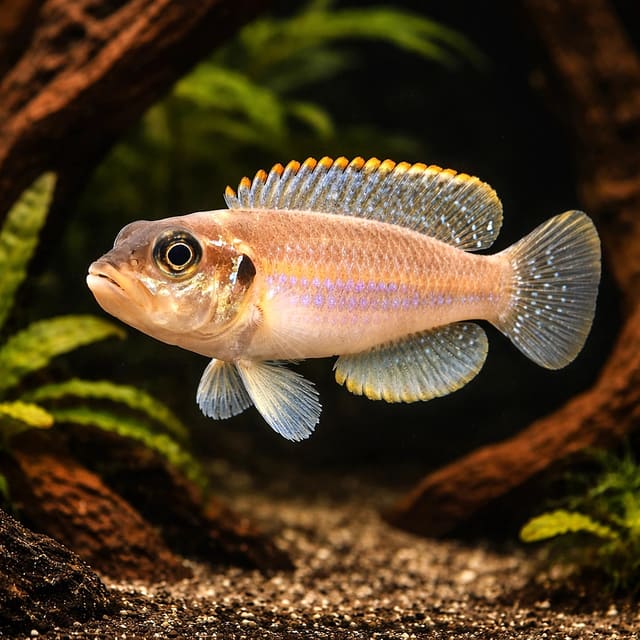
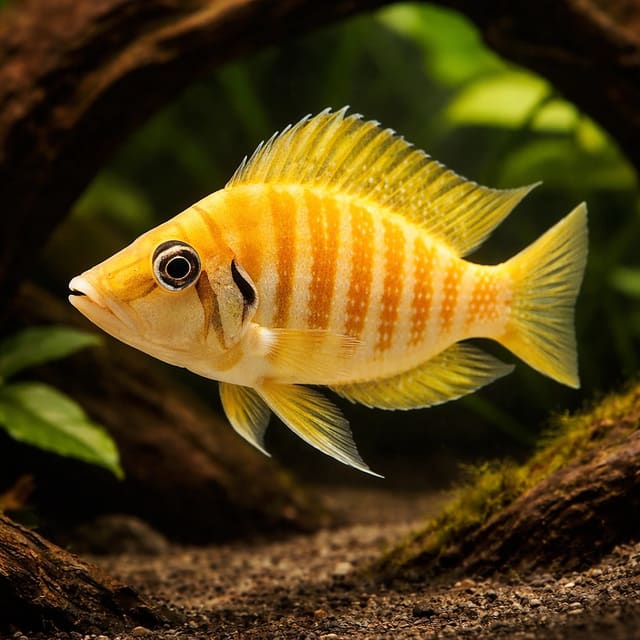
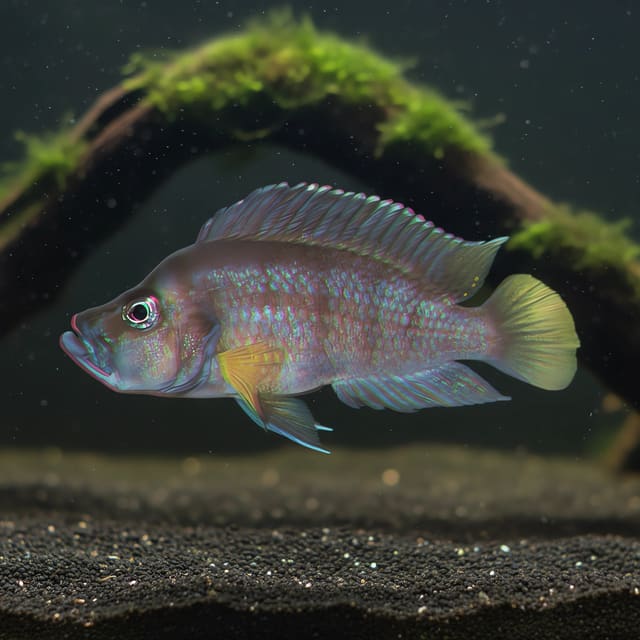
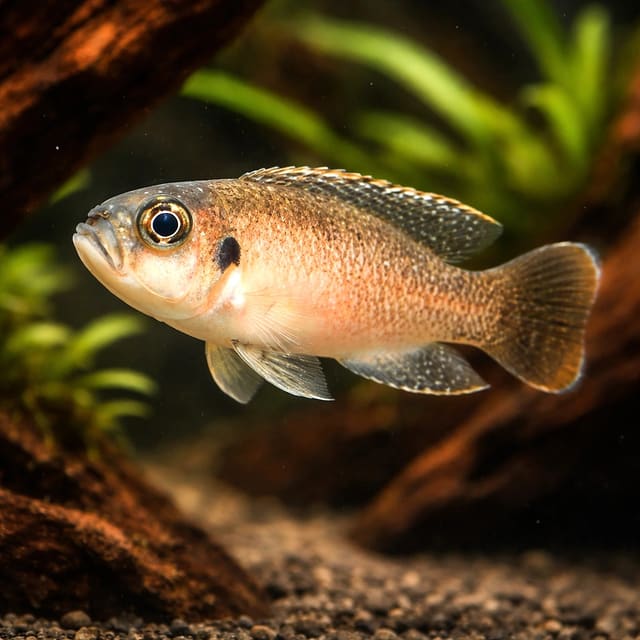
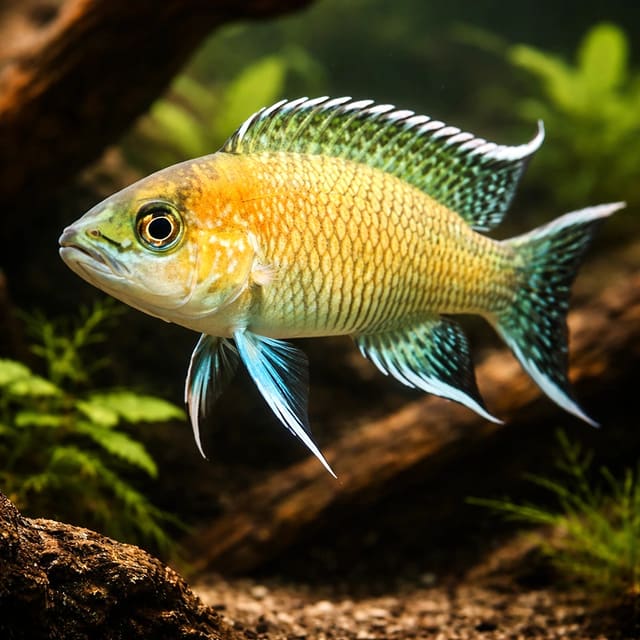
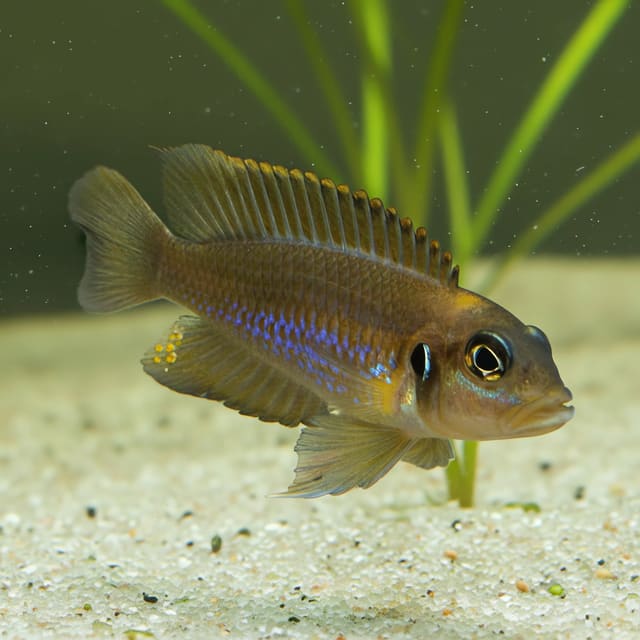
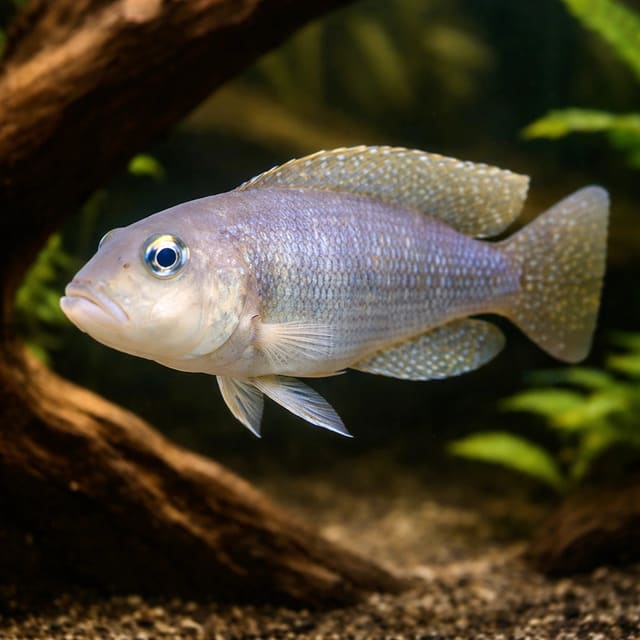
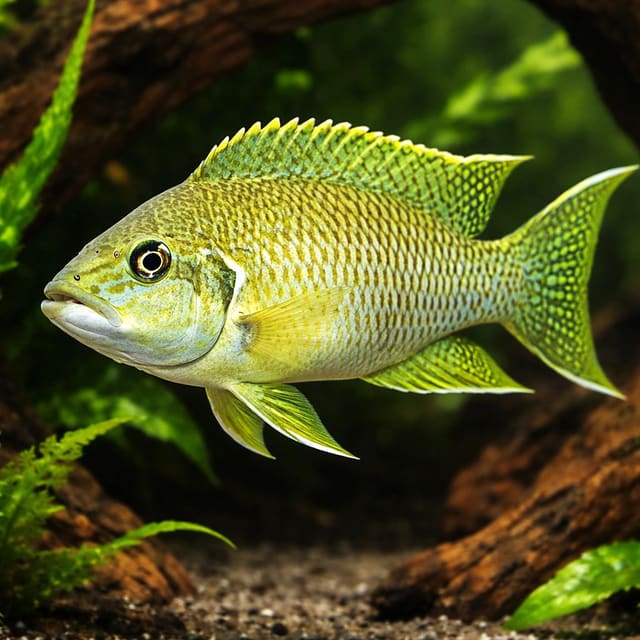
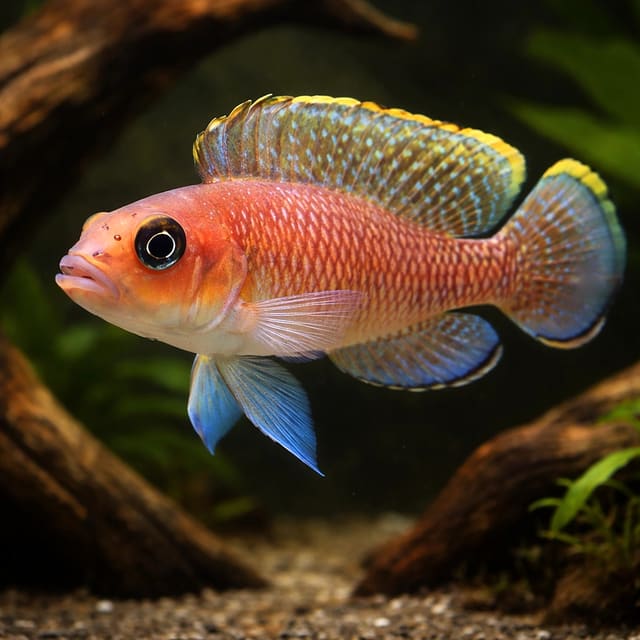
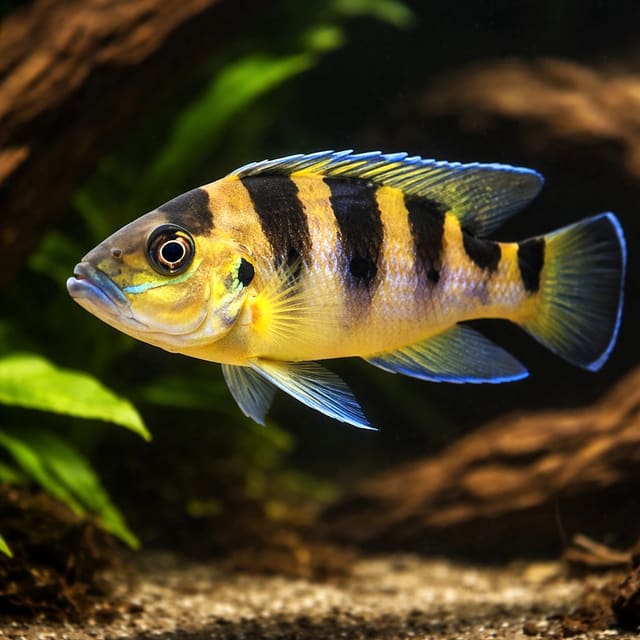
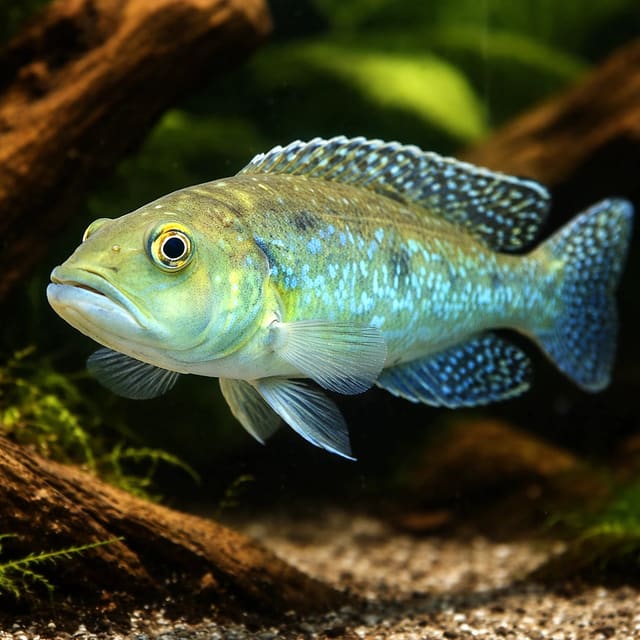
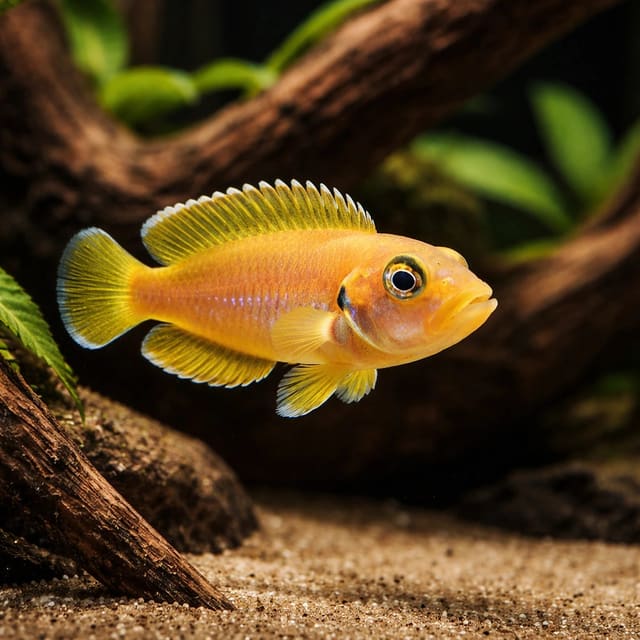
The gallery images are representative, based on reference photographs of this species, so colours can look slightly different from the live animal.
Do not use the dispatch measurement to reduce the intended aquarium, filter capacity or territorial layout. The fish needs a mature destination that is already operating at the required water values. Buying a small fish first and planning its adult accommodation later risks forcing a rushed move or leaving too little room for boundaries.
Appearance in an illustration also cannot identify the sex of the fish supplied. Make social and compatibility decisions without assuming that body colour, fin shape or the appearance of a gallery animal reveals the sex of the animal received.
Keep the aquarium at 23–27°C, pH 8.0–8.5 and 12–18°dGH. OATA’s broad group guidance for African lake cichlids covers this working range. It also gives carbonate hardness of 10–15°dKH, ammonia at zero, nitrite at zero and nitrate no more than 20 mg per litre above the normal tap-water level. Measure these values before the fish arrives and continue checking them after introduction.
Temperature alone is not enough. This fish needs the combination of warm, hard and alkaline conditions, so a reading of 25°C does not make an otherwise soft, acidic aquarium suitable. Use the aquarium water chemistry guide to understand what each test measures, then compare the actual readings with the target range using the water matcher.
| Measurement | Working target |
|---|---|
| Temperature | 23–27°C |
| pH | 8.0–8.5 |
| General hardness | 12–18°dGH |
| Carbonate hardness | 10–15°dKH |
| Ammonia | Zero mg/l |
| Nitrite | Zero mg/l |
| Nitrate | Up to 20 mg/l above tap-water level |
Test the source water as well as the aquarium. The nitrate limit is measured relative to the normal tap-water level, so knowing both readings makes the result meaningful. If tap water contains 10 mg/l nitrate, the aquarium should not exceed 30 mg/l under that guidance.
Respond to ammonia or nitrite immediately by stopping further livestock additions, checking the filter and carrying out an appropriate conditioned water change. Do not treat a low but detectable reading as acceptable: the target for both is zero. Recheck after action and continue monitoring until the readings remain stable.
Consistency matters because sudden changes add stress even when the final number falls within the target range. Match replacement water carefully, treat it before adding it, and avoid making several large changes to chemistry at the same time.
Use a mature aquarium with an established biological filter. The RSPCA explains that biological filtration supports beneficial bacteria that convert toxic ammonia to nitrite and then to the safer nitrate. A newly filled aquarium does not gain that capacity simply because its temperature and pH are correct.
Prepare and mature the system before livestock arrives. The first tropical aquarium guide covers the sequence for establishing a filtered setup. Confirm zero ammonia and zero nitrite through testing rather than judging maturity by clear-looking water.
Add fish slowly. Every added animal and every increase in food creates more waste, while the beneficial bacterial population needs time to grow. Adding too many fish too quickly can produce new tank syndrome, with ammonia and nitrite rising faster than the filter can process them.
Clear water is not proof of safe water. Ammonia and nitrite are invisible, so regular tests are the decision tool. If either appears after a livestock addition, pause further additions, check the filter for interruption or blockage and restore safe conditions before changing the stocking level again.
A larger aquarium helps environmental stability, but volume never replaces filtration. The planned 120-litre minimum for a pair still needs an established filter, oxygenation and a sustainable maintenance routine. Build the system so the filter can operate continuously and so routine work can be completed without dismantling the territorial layout.
Create a rock- or shell-associated layout before introducing the fish. Use sand or fine gravel, stable rockwork, caves, crevices and suitable shell clusters to create separate areas. The purpose is not decoration alone: each structure changes what a fish can see, defend and escape from.
Place rocks securely on the tank base, not on loose substrate, to prevent collapse. Avoid sharp edges and test every pile by applying gentle pressure from several directions before filling the aquarium fully.
Multiple shelters are particularly important when more than one fish is present. A shelter count alone is not enough: two caves placed side by side may function as one defended area. Spread usable refuges across the footprint and make their entrances face different directions.
Observe the layout from fish level by looking along the front and side panes. If every cave can be seen from one central point, add a visual barrier. If a retreating fish has only one exit, rotate the structure or open another path. These simple checks turn a decorative rock pile into a workable territorial plan.
Waste management remains part of the design. Fine food and solid waste can settle behind rocks, so leave narrow maintenance routes where a siphon can reach. Do not make the territory so intricate that dead material accumulates beyond sight and raises the load on the filter.
Once a stable layout is working, change it for a reason rather than repeatedly disturbing it. Rearranging décor can help when aggression centres on established territories, but the replacement layout must remain secure, accessible and well circulated.
Feed a varied carnivorous diet built around quality cichlid pellets or granules intended for carnivorous fish. Add suitable frozen or live foods such as daphnia, brine shrimp, mysis or chopped earthworm for variety. Choose pieces the fish can take readily without leaving fragments throughout the rockwork.
Offer only what the fish can eat within a few minutes, twice a day. OATA applies that portion and frequency to African lake cichlids generally. Remove or siphon uneaten food because it breaks down and adds toxic waste to the water.
Keep prepared food as the dependable part of the routine because its portion can be measured. Frozen and live foods add variety, but they should not turn each meal into an uncontrolled release of food that settles behind rocks. Avoid fatty foods and store every food as directed so it remains in sound condition.
Do not compensate for a missed meal by doubling the next one. A large portion places more immediate demand on the filter and may leave food to decay. Resume the normal twice-daily pattern and judge each meal by what is eaten within a few minutes.
Feeding is also a useful daily observation point. Note whether the fish approaches food, stays hidden, has difficulty taking pieces or is excluded by another individual. A change in appetite can accompany water-quality trouble, stress or a developing health problem, so connect the feeding observation to a water test rather than automatically changing diets.
Carry out a partial water change of 25% at least once every week. Test ammonia and nitrite at least weekly, monitor nitrate against the tap-water baseline and check the filter for blockages. This routine removes dissolved waste, allows substrate cleaning and provides an early warning when biological filtration is under pressure.
For a 120-litre aquarium, 25% equals 30 litres. Measure the replacement volume rather than estimating it by eye. Treat replacement tap water with conditioner to remove harmful chlorine or chloramine before it enters the aquarium, and match the working temperature and chemistry carefully.
Change 25% of the aquarium water at least once every week. Additional action may be needed if a test shows ammonia, nitrite or excessive nitrate, but routine maintenance should not wait for visible dirt or unusual behaviour.
A filter check is not the same as replacing all media. The established bacterial population is part of the aquarium’s waste-processing capacity. Clean only as needed to restore flow, use removed tank water and avoid changing every piece of media together.
Review trends rather than isolated readings. A gradual rise in nitrate, a recurring trace of nitrite or repeatedly reduced filter flow points to a mismatch between stocking, feeding, equipment and maintenance. Correct the cause instead of relying on a single large clean followed by the same routine.
Before the parcel is due, confirm that the aquarium is mature, filtered and within the working water range. OATA’s aquarium checks place ammonia and nitrite at zero before fish are introduced. Do not use the arrival itself as the deadline for completing rockwork, adjusting chemistry or starting the filter.
Follow the Tropical Fish Co delivery and Live Arrival Guarantee policy:
Film every delivery from the sealed parcel onward. Keep the fish inside the sealed bag during the initial condition view.
If a Live Arrival Guarantee claim is needed, contact us the same day with the order number and continuous unboxing video. The video should show the sealed parcel, its opening and the fish inside the sealed bag.
After release, judge the introduction through breathing, swimming, colour, hiding and interest in food. Some shelter use is expected in a structured cichlid aquarium, but a marked change or worsening condition should trigger a water test and closer assessment rather than an immediate alteration to several care factors.
Check the fish every day for changes in swimming, colour, breathing, body condition, feeding and use of shelter. A single observation becomes more useful when compared with the fish’s usual pattern and the aquarium’s test results.
| What you see | What to do first |
|---|---|
| Hanging at the surface | Test water and check aeration and filter flow |
| Sitting on the bottom unusually | Test ammonia, nitrite and temperature |
| Erratic swimming | Check water values and inspect for injury or conflict |
| Darker or paler colour | Review water quality, hiding and territorial pressure |
| Faster or slower gill movement | Check oxygenation, temperature and water tests |
| More aggression or hiding | Assess territory access and stocking |
| White spots or fluffy growths | Test water and seek prompt health guidance |
| Lost fins or scales | Inspect décor and watch interactions |
| Reduced appetite | Test water before changing food or increasing portions |
Healthy fish should have clear, bright eyes, undamaged fins, intact scales and no ulcers or bumps. They should maintain suitable body condition and show a consistent response to feeding. Use these observations as a baseline rather than expecting every individual to behave identically.
Water testing is the first response because ammonia, nitrite, excessive nitrate, unsuitable temperature or unstable chemistry may affect several behaviours at once. Record the result before making changes so the action is tied to a measured problem.
Territorial injury requires both health attention and an environmental review. Separating two fish temporarily without addressing the defended cave, blocked escape route or unsuitable companion can recreate the same conflict after reintroduction.
If you are concerned about a health change, test the water and contact us for guidance. Give the measured values, the observed signs, when they began and whether feeding or stocking changed recently.
Build compatibility around a Lake Tanganyikan aquarium. OATA advises stocking African lake species with fish from the same location and specifically advises against mixing Malawi and Tanganyikan cichlids because their temperament and behaviour differ.
Screen potential companions against 23–27°C, pH 8.0–8.5 and 12–18°dGH. They must also fit the aquarium’s territory map. A fish can share the chemistry yet still compete for the same cave, shell area or bottom route.
Avoid mixing this fish with Lake Malawi cichlids, soft-water species, small peaceful community fish, slow-moving or long-finned fish, overly aggressive large cichlids, and tiny shrimp or delicate invertebrates. A species aquarium remains the clearest way to control the water, feeding and territorial layout.
Other Tanganyikan cichlids of similar size and temperament may be considered when the aquarium is large enough and structured appropriately. This is a screening category, not a universal approval. Compare the exact species, mature size, behaviour and territory before combining them.
Ask us for a stocking and compatibility assessment before adding a companion. Include the aquarium dimensions, water readings, existing inhabitants, adult sizes and a description of the rock or shell layout. Those details allow the decision to focus on actual territory and water conditions rather than the tank’s nominal volume alone.
Introduce fish gradually so the biological filter and territorial layout can adjust. OATA advises adding more peaceful African lake cichlids first and more aggressive species later. Adding some fish as an appropriate group may reduce the chance of one individual receiving all the aggression, but the correct number depends on the species.
OATA says very few, if any, African lake cichlids do well when kept singly and are likely to become stressed. Decide the number through the exact species combination, aquarium footprint and available territories. Do not treat an arbitrary mixed selection as a substitute for a suitable social arrangement.
Rearranging décor can reduce aggression by forcing fish to establish new territories. Make that change deliberately: preserve rock stability, circulation, filter access and multiple escape routes. Moving one ornament while leaving the dominant cave and every sight line intact is unlikely to change the territorial balance.
Do not solve aggression by adding fish rapidly. Every addition raises the biological load and can create new tank syndrome if filter bacteria cannot process the increased waste. Change one part of the plan at a time, test the water and observe the result.
Successful compatibility means more than the absence of immediate injury. Each fish should be able to feed, maintain condition, use shelter and move without continuous pursuit. Review those outcomes during the first week and again as individuals settle into established territories.
It reaches 8 cm as an adult. Plan the aquarium and territorial layout around that adult measurement rather than the approximately 3.5–4 cm dispatch size.
Use at least 120 litres for a pair and plan a larger aquarium for a group. Floor area, separate refuges, visual barriers and escape routes matter alongside volume.
OATA says very few, if any, African lake cichlids do well when kept singly and are likely to become stressed. Base the decision on the aquarium footprint, territory layout and exact companions.
It suits a keeper who can maintain hard, alkaline water, mature biological filtration and a structured territorial aquarium. Test water regularly and screen every companion before introduction.
Feed quality carnivorous cichlid pellets or granules with suitable frozen or live foods such as daphnia, brine shrimp, mysis or chopped earthworm. Offer only what it eats within a few minutes, twice a day.
Keep it at 23–27°C, pH 8.0–8.5 and 12–18°dGH. Keep ammonia and nitrite at zero.
Treat it as semi-aggressive and territorial rather than as a peaceful community fish. Avoid slow-moving or long-finned companions and provide separate refuges and broken lines of sight.
Consider screened Lake Tanganyikan cichlids of similar size and temperament that suit the same hard, alkaline water. Avoid mixing Lake Malawi and Lake Tanganyika cichlids.
Start filming with the parcel still sealed before opening it or floating the bag. Tropical Fish Co hand-bags the fish in pure oxygen and uses an insulated box, with a heat pack when weather calls for it. A licensed live-animal courier carries the parcel; someone must receive it, and the bag should be floated for 20–30 minutes before release.
No reviews for this item yet. Bought one? Honest reviews only, good or bad.
What customers say about ordering from us
Easy website plenty of info on fish your buying great to pick a time slot
TRACEY DURRANT · 7 Oct 2026
Got some lovely fish thank you
Kevin Mackie · 7 Oct 2026
Reviews of our shop, collected by Judge.me, an independent third-party review collector. Newest first.