Moderate
Gold Ocellatus Shell-Dweller (Neolamprologus ocellatus)
23–25°C · pH 8–9
£16.59

Lamprologus falcicula (Neolamprologus falcicula) is a Lake Tanganyika cichlid that reaches up to 8.1 cm total length. One purchase supplies one fish in the selected 3.5–4 cm or XL size, while routine care calls for 23–27°C, hard alkaline water and carefully screened Tanganyikan companions.
Adult size is the maximum length this species reaches at full maturity (scientific sources). The livestock you receive will be younger and smaller — pick a size above for the actual shipping size. Product-photo provenance and any image-specific limitations are stated on the listing.
Neolamprologus falcicula
Save when buying multiple fish. Each quantity is one fish; sex and pair formation are not guaranteed unless the selected variant explicitly states them.
Lamprologus falcicula (Neolamprologus falcicula) is a Lake Tanganyika cichlid that reaches up to 8.1 cm total length. One purchase supplies one fish in the selected 3.5–4 cm or XL size, while routine care calls for 23–27°C, hard alkaline water and carefully screened Tanganyikan companions.
Adult size is the maximum length this species reaches at full maturity (scientific sources). The livestock you receive will be younger and smaller — pick a size above for the actual shipping size. Product-photo provenance and any image-specific limitations are stated on the listing.
Cichlids are a family of roughly 1,800 accepted species, not one care type. Before buying, identify the exact species and source, then compare adult measurement, usable tank dimensions, social system, territory, tested water, diet and an exit plan. No family-wide minimum tank, water range or tank-mate list is safe.
Maintain these water conditions for optimal health and vibrant colors
Lamprologus falcicula is a freshwater cichlid endemic to Lake Tanganyika. FishBase now lists it as Neolamprologus falcicula in the family Cichlidae and describes the wild fish as benthopelagic. This means its identity and aquarium planning belong firmly within a Lake Tanganyika context rather than a general mixed-fish setup.
The species summary on Wikipedia places its known range in the waters off Burundi and gives the Magara coast as the type locality, at a depth of 10 metres. These are natural-history details rather than aquarium targets, but they help define the animal precisely and distinguish it from similarly named African cichlids.
FishBase records a maximum length of 8.1 cm total length for male or unsexed fish. Treat that figure as the adult planning reference. It is a maximum recorded total length, including the tail, rather than a promise that every individual will attain exactly 8.1 cm.
| Suits | Not suited to |
|---|---|
| A keeper prepared to maintain hard, alkaline freshwater | An aquarium whose residents need different water conditions |
| A mature aquarium with working biological filtration | An unfiltered or biologically immature aquarium |
| A carefully screened Lake Tanganyika community | Routine mixing of Lake Malawi and Lake Tanganyika cichlids |
| A keeper able to test water and complete weekly maintenance | A setup without regular water testing and partial water changes |
This fish suits a keeper prepared to measure water chemistry, maintain biological filtration and make stocking decisions around cichlid behaviour. Browse our African cichlid collection to compare identities and size profiles, but assess every prospective companion separately rather than treating a shared category as automatic compatibility.
The live size selector uses the labels 3.5–4 cm and XL. One purchase quantity supplies one animal of the selected option. The size you select is the size supplied, not the adult size.
The 3.5–4 cm label gives a bounded dispatch measurement. XL is a grade name, so treat it as that selector label rather than converting it into an assumed centimetre measurement. In either case, build the aquarium and choose companions around the maximum recorded adult length of 8.1 cm, the intended number of cichlids and their likely need for separate space.
Sex is guaranteed only when the selected option explicitly states male or female. This Lamprologus falcicula listing has no sex-guaranteed option.
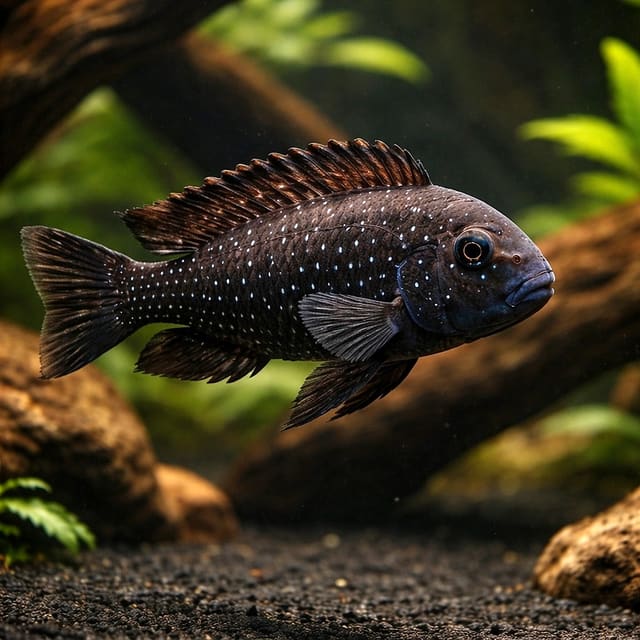
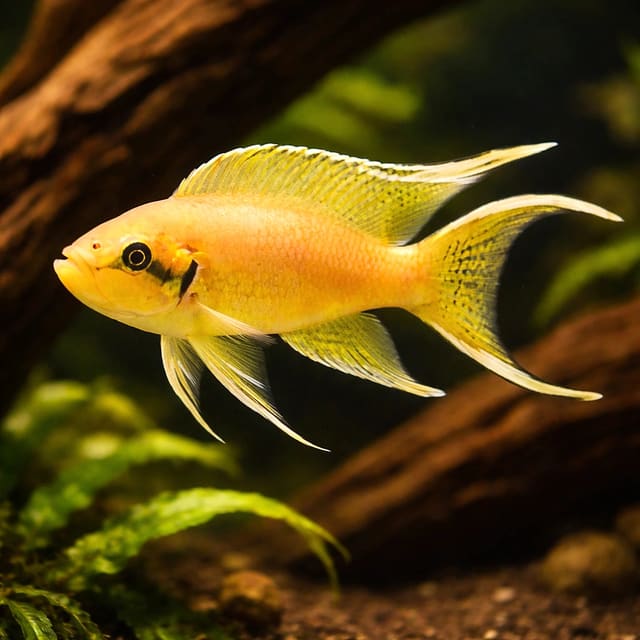
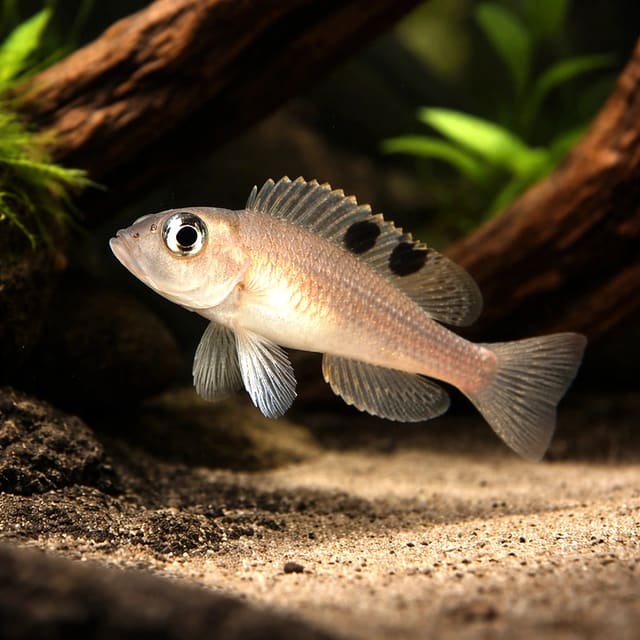
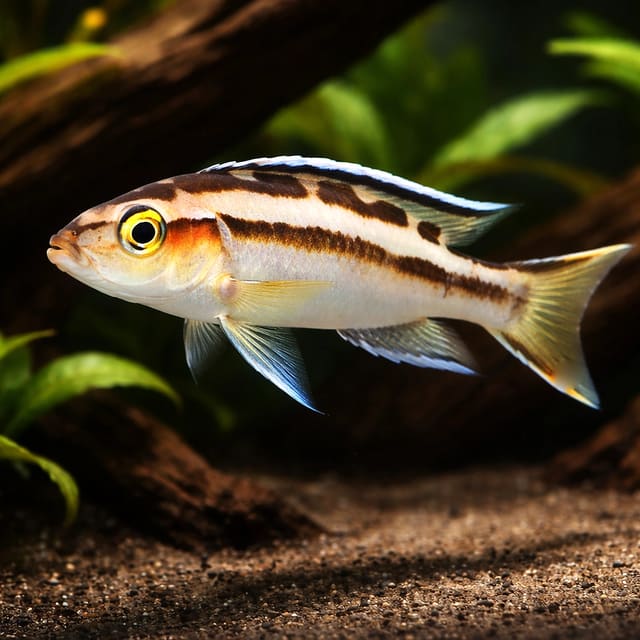
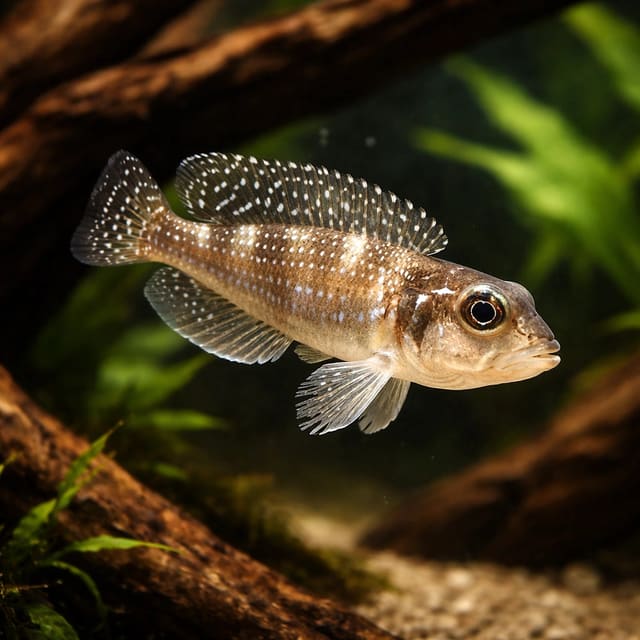
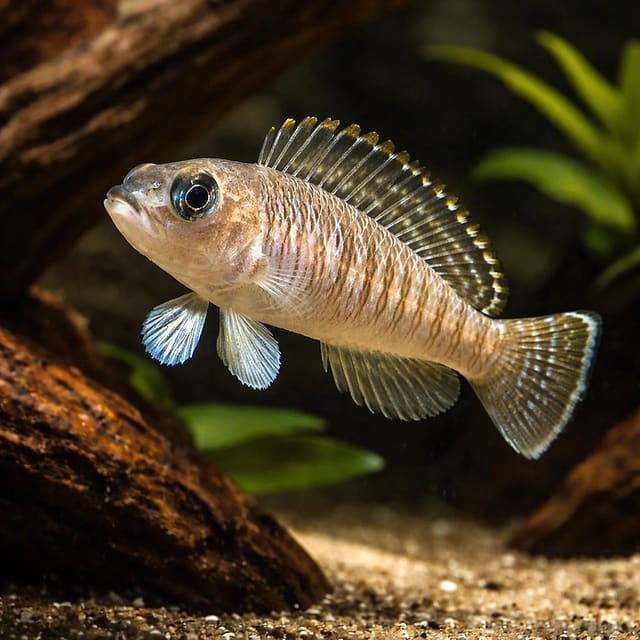
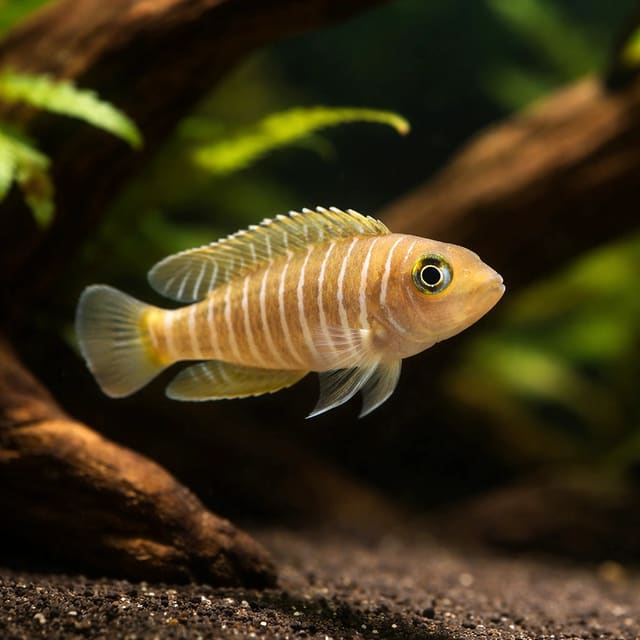
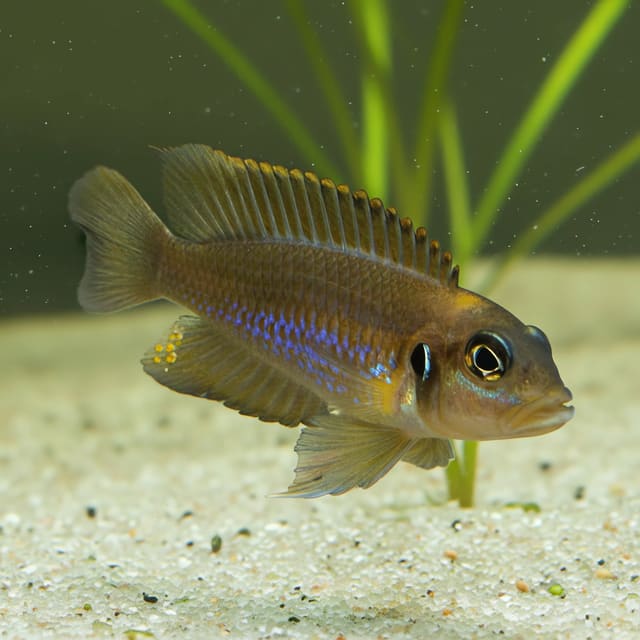
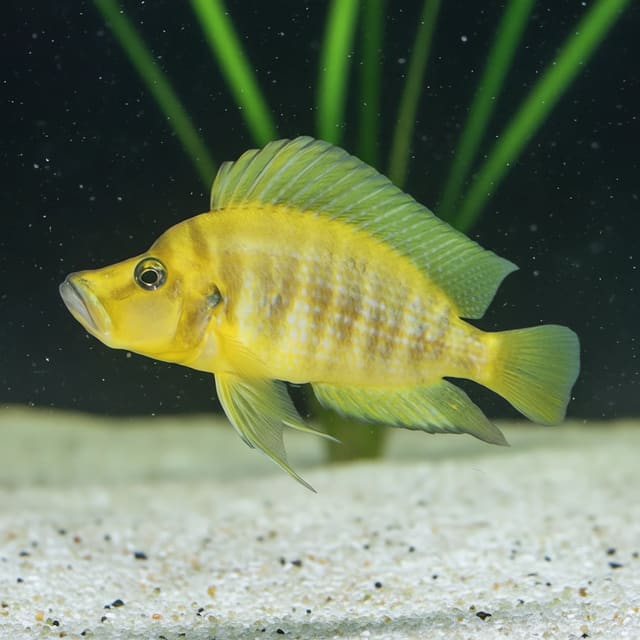
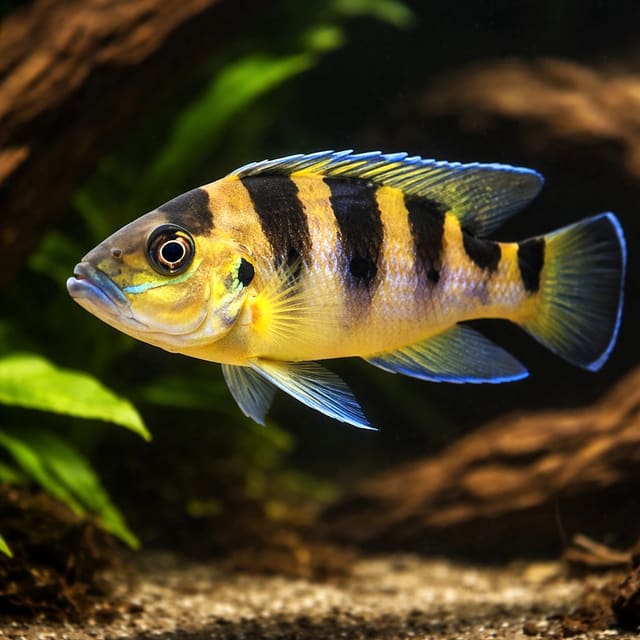
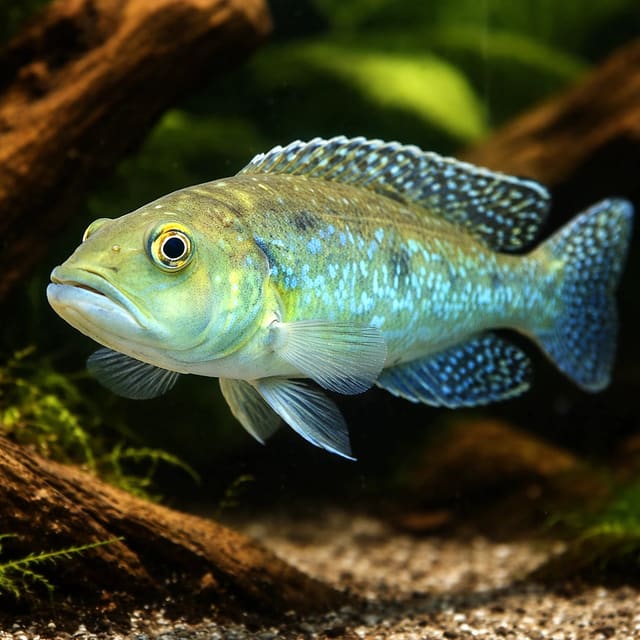
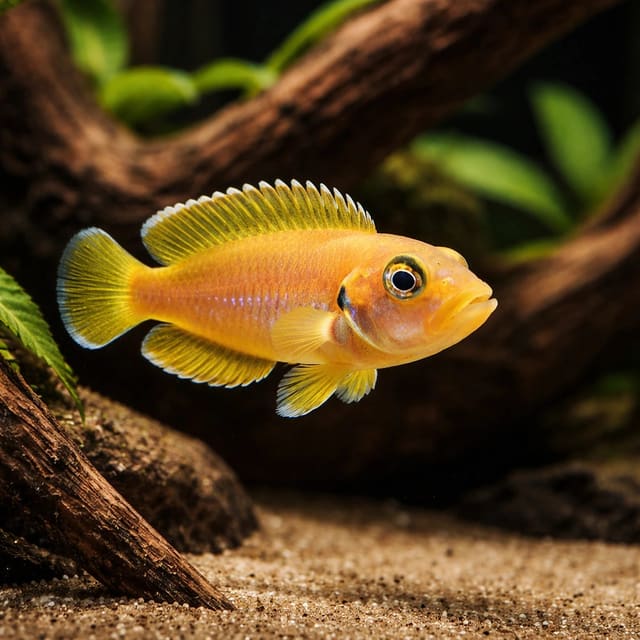
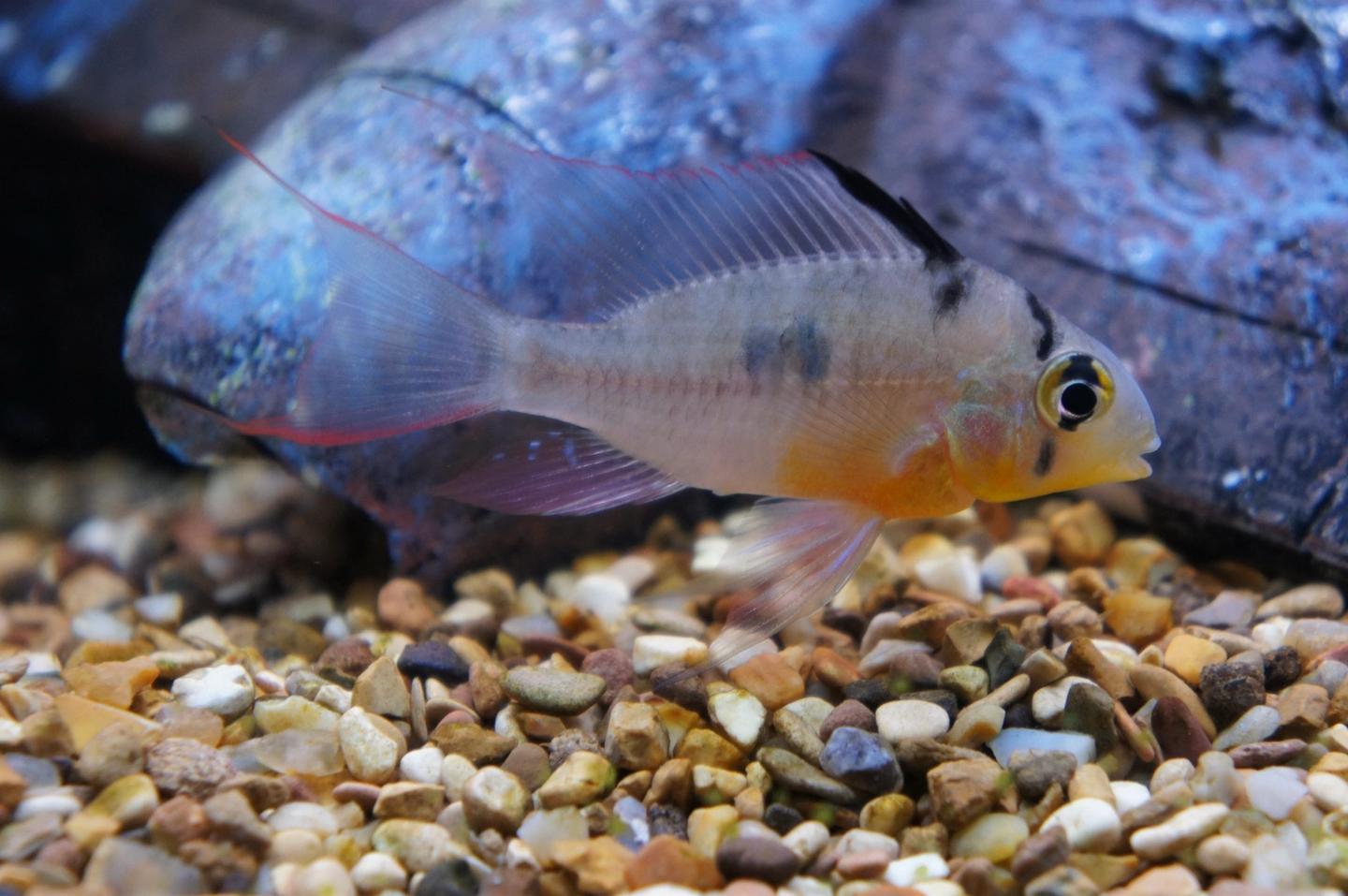
The gallery images are representative, based on reference photographs of this species, so colours can look slightly different from the live animal.
Neither dispatch grade nor gallery appearance should be used to infer sex, life stage or origin. Base the purchase decision on the selected size label and the care plan. If more than one fish is intended, increase the purchase quantity deliberately and complete the group and compatibility assessment before ordering.
Begin with the values that determine whether the aquarium is suitable. FishBase records the wild environmental range as 23–27°C, pH 7.5–9.0 and 10–25°dH. For routine aquarium care, OATA’s African lake cichlid guidance narrows that to 23–27°C, pH 8.0–8.6 and 12–18°dGH. Use those narrower values while keeping temperature and chemistry stable.
| Decision | Working figure |
|---|---|
| Adult planning length | Up to 8.1 cm total length |
| Temperature | 23–27°C |
| pH | 8.0–8.6 |
| General hardness | 12–18°dGH |
| Ammonia and nitrite | 0 mg/l |
| Nitrate | Up to 20 mg/l above the tap-water level |
Choose an aquarium as large as practical and assess its footprint, filtration and planned population together. A litre figure alone cannot describe usable space or the pressure created by cichlid territories. The most useful plan includes the aquarium’s length and width, the adult dimensions of every intended fish, visual boundaries and a route for each animal to move away from conflict.
African lake cichlids generally require social planning: OATA notes that very few, if any, do well when kept singly, while the correct number depends on the species. Do not assume that one fish, a pair or a larger group is automatically right for this animal. Set the intended number through a stocking assessment that considers the full aquarium.
This is a suitable choice when you can hold hard alkaline water, mature a filter before introduction, test weekly and screen companions as Lake Tanganyika fish. If those conditions require major changes to an established soft-water community, prepare a separate aquarium instead of compromising between incompatible requirements.
Set the aquarium to 23–27°C, pH 8.0–8.6 and 12–18°dGH. These routine values sit within FishBase’s wider environmental figures for the species. Stability matters alongside the reading itself, so establish the intended chemistry before introducing the fish and use the same method when preparing replacement water.
| Result | Action |
|---|---|
| Temperature below 23°C or above 27°C | Correct the cause and confirm a stable reading before introduction |
| pH outside 8.0–8.6 | Prepare the aquarium consistently rather than making abrupt changes around fish |
| GH outside 12–18°dGH | Review the mineral content and test the prepared replacement water |
| Ammonia or nitrite above 0 mg/l | Do not add fish; restore biological filtration and water quality first |
| Nitrate rising too quickly | Review feeding, population and the weekly maintenance routine |
The nitrate ceiling is relative to source water. For example, if conditioned tap water tests at 10 mg/l nitrate, keep the aquarium at no more than 30 mg/l. If the tap-water reading is 25 mg/l, the corresponding ceiling is 45 mg/l. Record both values so that “20 mg/l above tap” remains a measurable limit rather than a vague description.
Use our water chemistry guide to understand pH, GH, KH, ammonia, nitrite and nitrate. Once you have measured the aquarium, the water matcher can help compare those readings with the working range above.
Test the water at least weekly and whenever behaviour, breathing or feeding changes. Measure after setup changes as well as during normal maintenance. A single suitable reading on one day is less useful than a sequence showing that the aquarium remains within range between water changes.
A working biological filter is essential. The RSPCA explains that fish release toxic ammonia, which filter bacteria convert first to nitrite and then to the safer nitrate. Ammonia and nitrite must both read 0 mg/l before this cichlid is introduced.
Install and mature the filter before livestock enters the aquarium. Our first tropical aquarium guide sets out the preparation sequence. Test rather than judging readiness from clear-looking water: an aquarium can look clean while lacking enough beneficial bacteria to process fish waste.
Avoid washing biological media under the tap. Chlorine or chloramine may kill part of the bacterial population that makes the filter effective. When cleaning is needed, rinse the media lightly in aquarium water removed during a partial water change. This clears loose debris while reducing bacterial loss.
Filtration capacity is not permission to add fish rapidly. Every added animal and every increase in feeding raises the waste load. New tank syndrome occurs when the bacterial population cannot process that increase, allowing ammonia or nitrite to rise. Prevent it by testing after each stocking change and pausing further additions until the readings remain at zero.
Plan from the adult length of up to 8.1 cm, but do not use length alone to choose the aquarium. African lake cichlids vary in temperament and may establish territories, so usable footprint, visual separation, filtration and the total population all affect whether the setup works.
Choose an aquarium as large as practical. Larger water volume generally makes temperature and water quality more stable, while a broader footprint gives more options for arranging boundaries. Measure the internal length and width after allowing for equipment and décor, then map where each intended fish can feed, move and withdraw.
| Write down | Why it matters |
|---|---|
| Aquarium length and width | Shows the usable footprint rather than litres alone |
| Filter type and maturity | Defines the present biological capacity |
| Measured water values | Rules out fish needing a different chemistry |
| Every intended species and number | Reveals territory and group conflicts before purchase |
| Adult dimensions | Prevents a plan that works only at dispatch size |
Contact us with those details for a stocking and compatibility assessment before choosing the number of L. falcicula. OATA advises that very few African lake cichlids do well alone, while the correct number depends on the particular species. That makes a complete aquarium assessment more responsible than declaring a universal pair or group size.
For the base, OATA recommends fine coral sand or a similar substrate for African lake cichlids because it can help buffer the water. Test pH, GH and KH rather than assuming that substrate alone will hold the right chemistry. Arrange secure décor to create visual boundaries, leave access for cleaning and make sure no item can shift onto a fish.
Complete this plan before selecting 3.5–4 cm or XL. Dispatch size changes the animal’s starting dimensions, but it does not reduce the need to accommodate adult growth, social pressure and every established tank resident.
African lake cichlids have varied dietary requirements: some require algae-rich formulations, while more predatory species need foods with greater animal content. Choose an African lake cichlid food formulated for this fish’s dietary category rather than assigning a herbivorous or carnivorous diet from appearance, dispatch size or family name.
Feed twice a day, offering only what the fish can consume within a few minutes. This schedule comes from OATA’s African lake cichlid guidance and gives a clear portion limit even when food form and particle size differ. The goal is prompt feeding without material remaining to decay.
Uneaten food breaks down and releases waste, increasing pressure on the filter and water quality. A portion is therefore judged by consumption, not by spoon size or the number of fish alone. The correct quantity may change as the fish grows or when the aquarium population changes, so reassess it through direct observation.
If appetite falls, test temperature, ammonia, nitrite and the other routine water values before trying to solve the problem by adding more food. Also watch whether another cichlid is controlling access to the feeding area. Reduced intake is an observation cue, while excess feeding can conceal the original issue and worsen water quality.
Keep the formulation consistent enough to observe normal intake. When changing food, compare particle size and how readily it is eaten within the same short window. Do not use breeding goals, colour enhancement claims or the XL label as reasons to exceed the twice-daily measured schedule.
Change 25% of the aquarium water at least once every week. Use a siphon to remove settled solid waste, including debris caught around décor. Treat replacement tap water with a suitable conditioner before it enters the aquarium so chlorine or chloramine cannot harm the fish or filter bacteria.
Prepare replacement water consistently and avoid turning routine maintenance into a sudden shift in temperature or chemistry. Check that the new water supports the established 23–27°C, pH 8.0–8.6 and 12–18°dGH plan. The purpose of the weekly change is to maintain predictable conditions, not repeatedly rebuild them.
Do not clean biological filter media under running tap water. Chlorine or chloramine may damage the beneficial bacteria responsible for processing ammonia and nitrite.
| Checkpoint | Required result |
|---|---|
| Ammonia | 0 mg/l |
| Nitrite | 0 mg/l |
| Nitrate | No more than 20 mg/l above tap water |
| Filter flow | Unobstructed and operating normally |
| Replacement water | Conditioned before addition |
If nitrate climbs rapidly between changes, review the amount fed, the number of fish and trapped waste before simply increasing maintenance effort. Those three factors determine how quickly the system asks the filter and water-change routine to process additional waste.
Before the delivery window, make sure someone can receive the parcel and confirm that the aquarium is ready. Temperature must be within 23–27°C, ammonia and nitrite must be 0 mg/l, filtration must be running, and the intended companions must already have passed the compatibility screen.
Follow our delivery and Live Arrival Guarantee policy when the fish arrives. Float the closed bag for 20–30 minutes before releasing the fish, and do not pour the transport water into the aquarium. Keep the animal attended throughout the process rather than leaving the parcel or floating bag unattended.
| Stage | Decision |
|---|---|
| Before opening the parcel | Confirm the aquarium, equipment and receiving person are ready |
| During the 20–30 minute float | Keep the bag secure and observe the fish without repeated handling |
| At release | Transfer the fish without adding transport water to the aquarium |
| After release | Watch balance, breathing, swimming and the response of existing fish |
| During the first week | Test water and check feeding access and aggression each day |
Add African lake cichlids slowly rather than making several untested additions at once. Beneficial bacteria need time to increase as fish waste and feeding rise. Test ammonia and nitrite after a stocking change and wait for stable zero readings before considering another addition.
Introduction also changes social pressure. Watch whether the new fish can move away from chasing and reach food. OATA advises that some African lake cichlids may settle better when introduced in suitable groups, but the correct number depends on the species and aquarium. Use the stocking plan rather than adding extra fish as an improvised response to aggression.
Record the first week’s observations: breathing rate, swimming position, appetite, colour and any chasing. A short daily record makes a developing change easier to recognise than relying on a single snapshot.
Learn the fish’s normal swimming, colour, breathing, appetite and use of the aquarium. Individual behaviour varies, but a change from that established pattern is a practical warning. Check the animal and the aquarium together rather than treating one visible sign as a diagnosis.
| Change to watch | First response |
|---|---|
| Hanging at the surface, sitting on the bottom or erratic swimming | Test temperature, ammonia, nitrite and the remaining routine values |
| Faster or slower gill movement | Check water quality, aeration and filter operation |
| Darker or paler colour than normal | Review recent water and social changes |
| More aggression or hiding | Check whether stocking or territory pressure has changed |
| White spots, fluffy growths, damaged fins or lost scales | Observe closely and seek guidance before choosing a response |
| Reduced food intake or changing body condition | Test water and confirm feeding access |
Start with measured facts: temperature, pH, GH, ammonia, nitrite and nitrate. Confirm that the filter is operating and that aeration has not been obstructed. If ammonia or nitrite is detectable, stop further livestock additions and restore safe water quality.
Next, review what changed. A recent introduction, increased feeding, blocked filter, altered décor or rising population may explain why the aquarium’s biological or social balance shifted. Correct the underlying condition rather than masking it by feeding more or repeatedly moving fish without a plan.
Contact us if the health change continues or if you see spots, growths, damaged tissue, abnormal balance or persistent breathing difficulty. Share the test results, aquarium dimensions, population, recent additions and a clear description of the change. Those details support useful guidance without guessing at a disease from one symptom.
Continue the weekly 25% water-change and testing routine as prevention. Consistent observation is equally important: appetite, breathing and behaviour often reveal a change before a periodic maintenance task would otherwise bring it to attention.
Build compatibility around location, water requirements, temperament, behaviour and space. OATA’s general rule is to stock African lake species with fish from the same location, such as a Lake Tanganyika community. A shared lake is a starting screen rather than a universal tank-mate guarantee.
Avoid routinely mixing Lake Malawi and Lake Tanganyika cichlids. The groups may differ in temperament and behaviour even when both prefer mineral-rich alkaline water. Do not use similar water chemistry as the only reason to combine them.
Do not declare a particular cichlid or catfish universally suitable with L. falcicula. Compatibility depends on the aquarium and the individuals involved. The honest working rule is to consider only carefully screened Tanganyikan fish whose water, adult size, temperament and spatial needs fit the complete plan.
Some African lake cichlid communities use higher population levels to spread aggression, but that is a species-dependent technique requiring sufficient aquarium capacity and filtration. Do not increase numbers automatically when conflict appears. First check whether the aquarium is too small, whether similar territories overlap and whether a weaker fish lacks a route away from pressure.
When uncertainty remains, use the stocking brief: aquarium length and width, mature filter, measured chemistry, every resident’s identity and intended numbers. A compatibility decision made from those details is more useful than a list of names detached from the actual aquarium.
Introduce a planned community gradually. OATA recommends adding more peaceful African lake cichlids before more aggressive ones and notes that some species may be best added in groups. Apply either approach only after deciding the appropriate number for each identified fish and confirming that the filter can absorb the added waste load.
| Situation | Decision |
|---|---|
| An established Tanganyika aquarium with matching water | Continue only after checking adult size, temperament, territory and remaining footprint |
| A Lake Malawi cichlid aquarium | Avoid the routine mix because behaviour and temperament may differ |
| A general community aquarium | Assess every resident against the hard alkaline range and cichlid behaviour before proceeding |
| A newly matured aquarium | Add fish slowly and test ammonia and nitrite after each population increase |
Arrange décor so the aquarium has visual boundaries rather than one uninterrupted field of view. OATA notes that rearranging décor may reduce aggression by making fish establish new territories. Use that option deliberately and observe the whole population afterwards; changing the arrangement can alter every existing boundary, not just the area around one fish.
During the first week after an introduction, check three things daily: whether the newcomer can feed, whether it can move away from chasing, and whether established fish have changed their behaviour. Also continue testing ammonia and nitrite because social compatibility and biological capacity can fail independently.
If one fish receives persistent aggression, do not solve the problem by adding random companions. Recheck the location screen, intended group structure, available footprint and introduction order. Simplifying the population may be more appropriate than trying to distribute aggression across an aquarium that lacks enough space.
The useful compatibility conclusion is conditional: a carefully screened Lake Tanganyika community may fit, while no named companion is guaranteed across every aquarium. Keep the decision tied to measured water, adult planning sizes, observed behaviour and a mature filter.
It is a freshwater cichlid endemic to Lake Tanganyika, known from waters off Burundi, and recorded at up to 8.1 cm total length.
One purchase quantity supplies one animal of the selected option; sex is not guaranteed because neither selector label explicitly states male or female.
The live selector uses 3.5–4 cm and XL; these are dispatch-size labels, while the maximum recorded adult length is 8.1 cm total length.
Use the largest practical aquarium with a mature biological filter, vigorous aeration, fine coral sand or a similar buffering substrate, and space planned for the complete cichlid population.
Very few African lake cichlids do well singly, but the correct number depends on the species, aquarium footprint, filtration and companions, so complete a stocking assessment first.
Keep it at 23–27°C, pH 8.0–8.6 and 12–18°dGH, with ammonia and nitrite at 0 mg/l and nitrate no more than 20 mg/l above tap water.
Use an African lake cichlid food formulated for its dietary category and feed only what it consumes within a few minutes, twice a day.
Start filming before opening the sealed parcel, continue in one take through opening and showing the fish inside the sealed bag, then float the bag for 20–30 minutes before release and do not pour transport water into the aquarium.
Consider carefully screened Lake Tanganyika species with matching water, adult size, temperament and space; avoid routinely mixing Malawi and Tanganyika cichlids.
No reviews for this item yet. Bought one? Honest reviews only, good or bad.
What customers say about ordering from us
I have a small group of long finned mountain minnows. So was delighted to be able to order ten of this variety to increase the genetics in my tank . The ones I recieved are healthy but it’s to early to give a verdict on wether they are of a long finned type since they are small currently.
Gordon Walker · 23 Sept 2026
100% success travel and "installation". Pleased with quality of purchase. The Siamese fighter a bit "shy" so have not yet seen him at his best yet but looking good. Happy customer. GG
George E Garratt · 21 Sept 2026
Reviews of our shop, collected by Judge.me, an independent third-party review collector. Newest first.