Advanced
Jumbo Yellow Sardine Cichlid (Cyprichromis sp.)
24–27°C · pH 7.8–9
£39.99

Utinta Black-Chinned Xenotilapia is a peaceful but specialist Lake Tanganyika sand cichlid. Give a social group a broad fine-sand floor, calm companions and stable hard alkaline water. One purchase supplies one fish in the selected size choice.
Enantiopus melanogenys
Save when buying multiple fish. Each quantity is one fish; sex and pair formation are not guaranteed unless the selected variant explicitly states them.
Utinta Black-Chinned Xenotilapia is a peaceful but specialist Lake Tanganyika sand cichlid. Give a social group a broad fine-sand floor, calm companions and stable hard alkaline water. One purchase supplies one fish in the selected size choice.
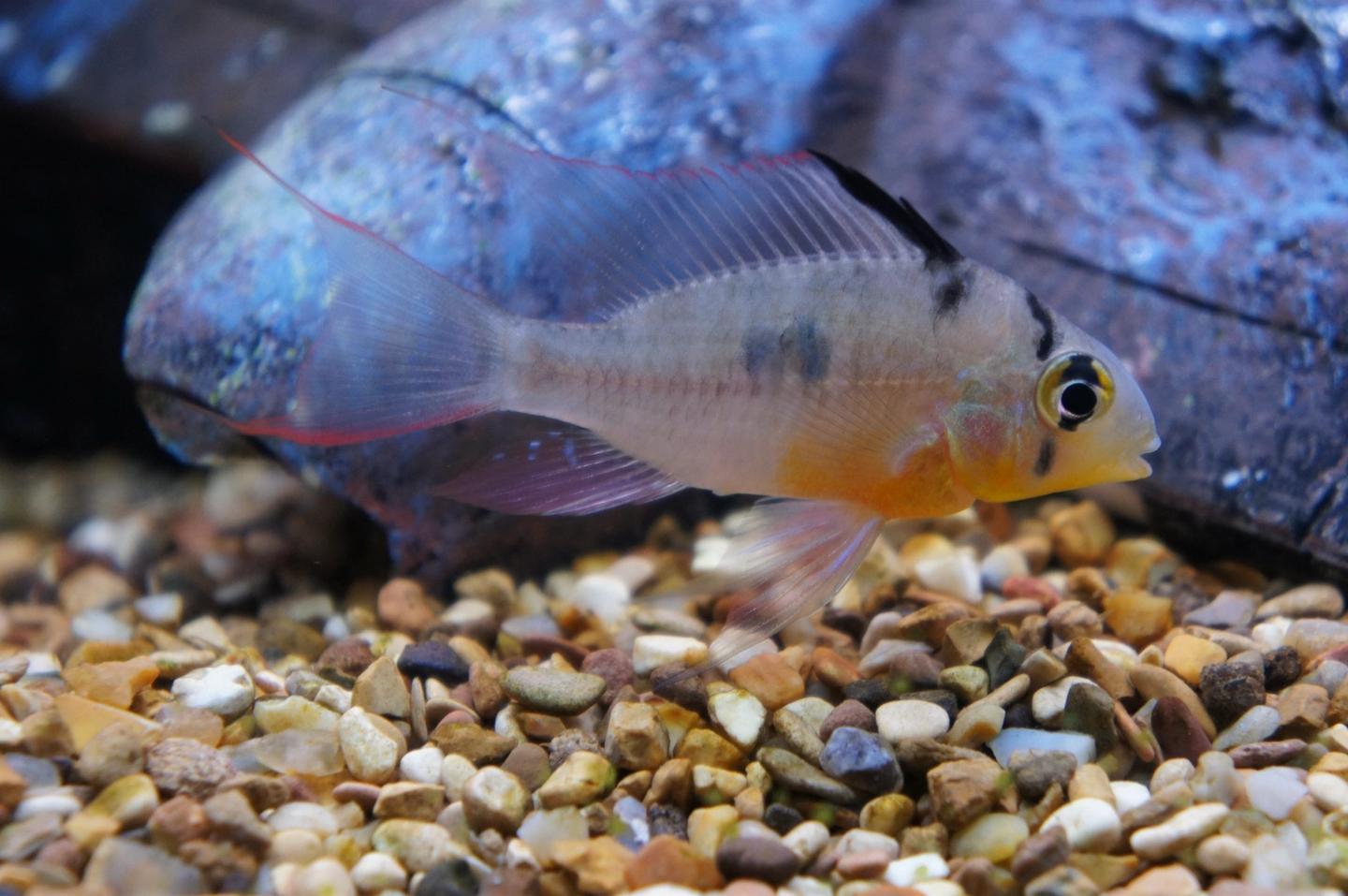
Cichlids are a family of roughly 1,800 accepted species, not one care type. Before buying, identify the exact species and source, then compare adult measurement, usable tank dimensions, social system, territory, tested water, diet and an exit plan. No family-wide minimum tank, water range or tank-mate list is safe.
Maintain these water conditions for optimal health and vibrant colors
Utinta Black-Chinned Xenotilapia is a Lake Tanganyika sand cichlid sold under the name Enantiopus melanogenys. FishBase currently treats that name as a synonym of Xenotilapia melanogenys. Both names refer to the same species here. Utinta is its locality or trade name. Aquarium literature uses both genera, so keeping the names together helps a keeper connect the fish with the right care information.
In the lake, FishBase describes the species as a common sand dweller that forages in large schools over the substrate, reaching depths of 40 metres and moving shallower during breeding. Copepods, ostracods and shrimps have been found in stomach contents. That natural-history picture explains the core aquarium decisions: fine sand is essential, food has to reach the bottom, the fish needs social context, and boisterous companions must not dominate the feeding zone.
One purchase supplies one live fish in the size choice selected on the product page. There are three recurring size choices: 4–5 cm, 5–6 cm and XL. XL is the shop's larger choice, without a stated centimetre range. The size you select is the size supplied, not the adult size. Current availability belongs to the live size choices rather than permanent copy. Sex is guaranteed only when the selected option explicitly states male or female. This Utinta Black-Chinned Xenotilapia listing has no sex-guaranteed option.
| Sold unit | One live fish per purchase |
|---|---|
| Adult records | 15.0 cm TL and 160 mm SL, measured in different ways |
| Minimum base | 120 × 38 cm in the species profile |
| Water | 24–27°C, pH 7.5–9.0, 10–25°dGH |
| Temperament | Peaceful and skittish; spawning males become territorial |
Before ordering, measure the usable base after rockwork, decide how displaced fish would be separated, and confirm that every planned resident can feed without crowding the sand.
The adult records use different measurement systems and must stay separate. FishBase gives 15.0 cm total length for a male or unsexed fish, which includes the tail. Seriously Fish gives 160 mm standard length, which excludes the tail. Treat them as separately measured adult records, and do not confuse dispatch sizes with adult maxima. Plan for a substantial adult sand cichlid rather than for the juvenile size that arrives.
This is peaceful for a cichlid but not effortless. It is skittish, depends on the substrate for feeding, and needs enough floor area for more than one male to display without controlling the entire aquarium. A calm, established Tanganyika project is a much better fit than a busy mixed-lake tank. The African cichlid collection is useful for comparing other offers, but each possible companion still needs its own compatibility check.
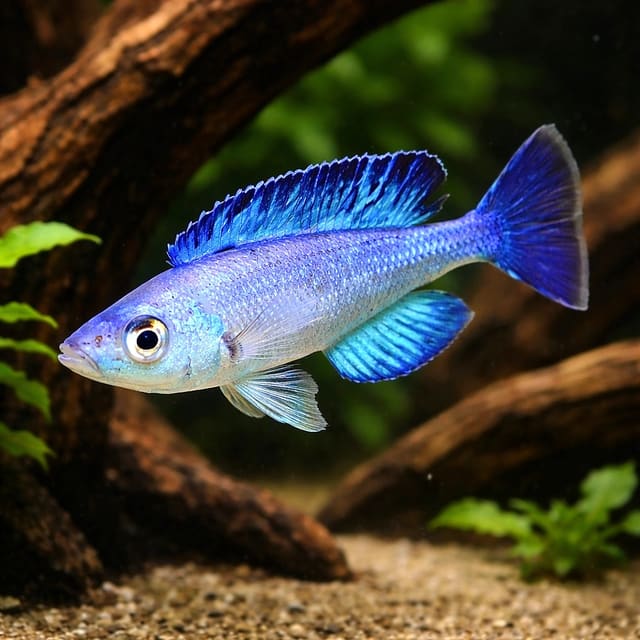
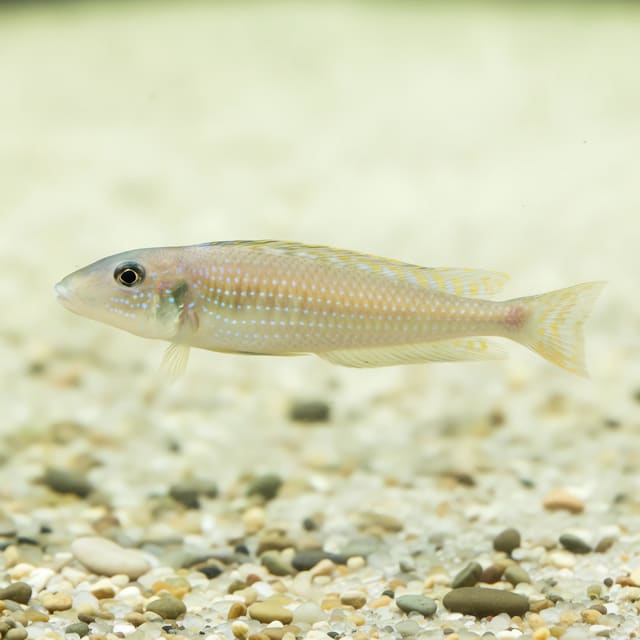
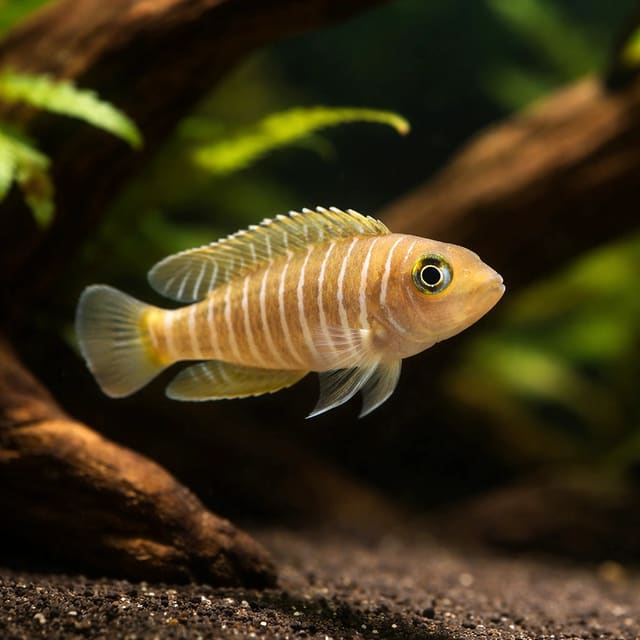
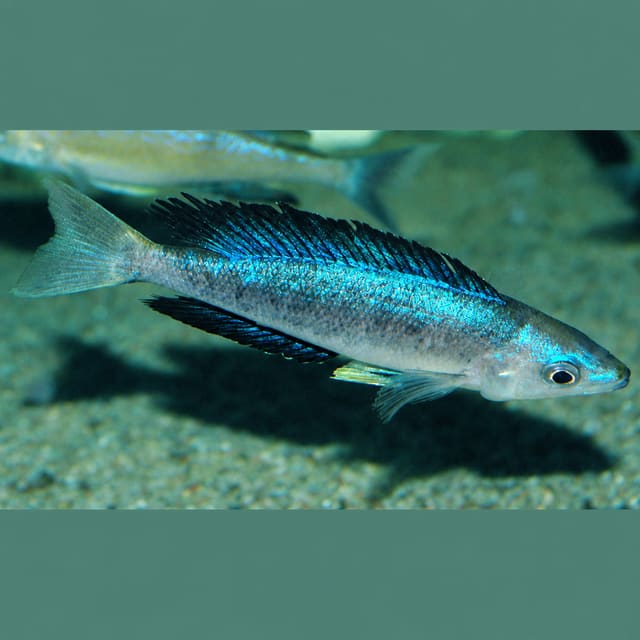
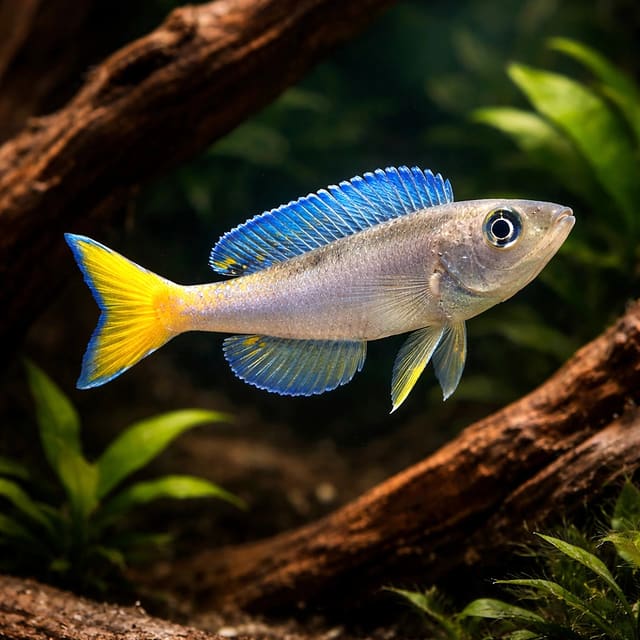
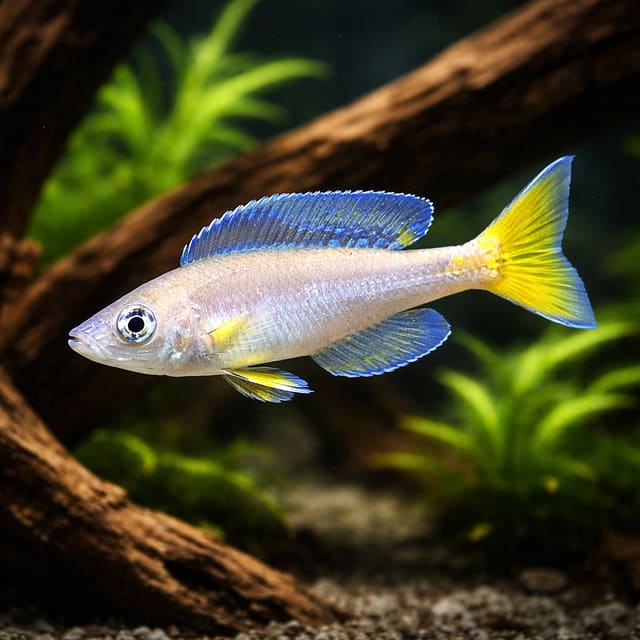
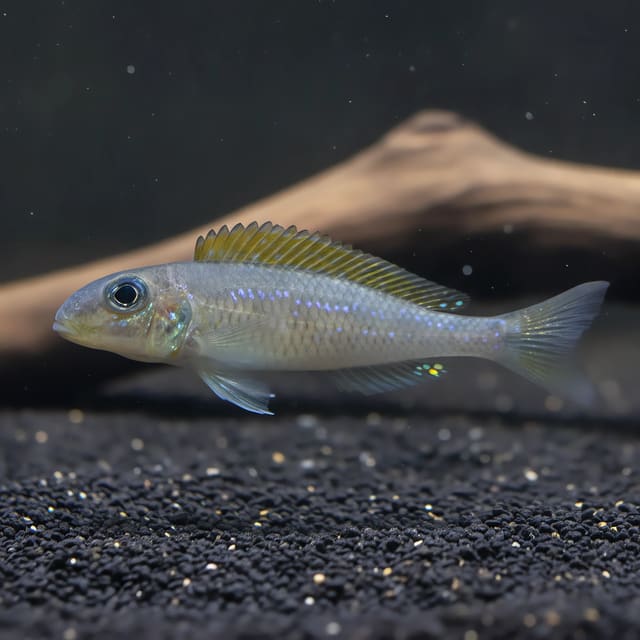
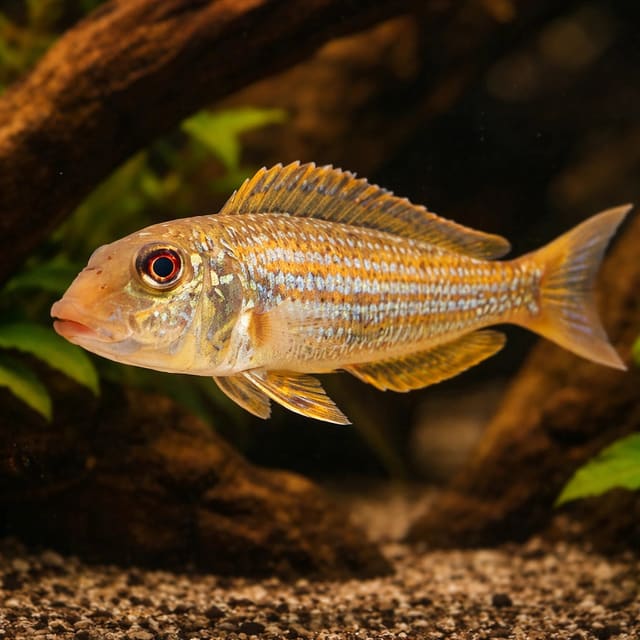
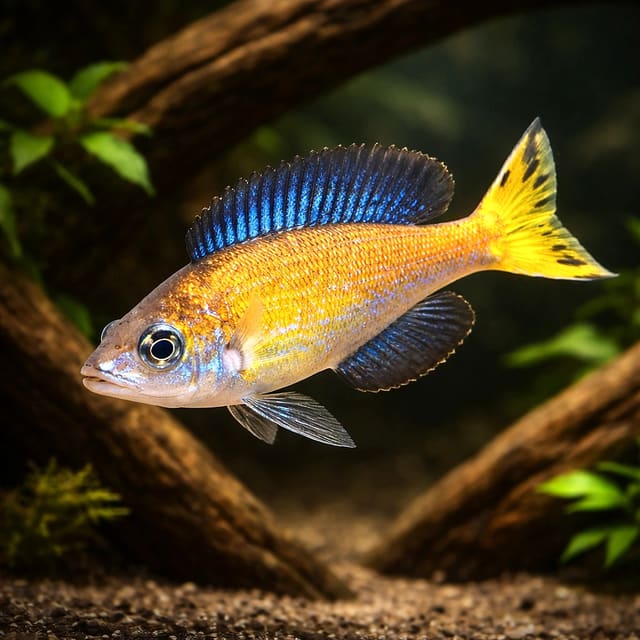
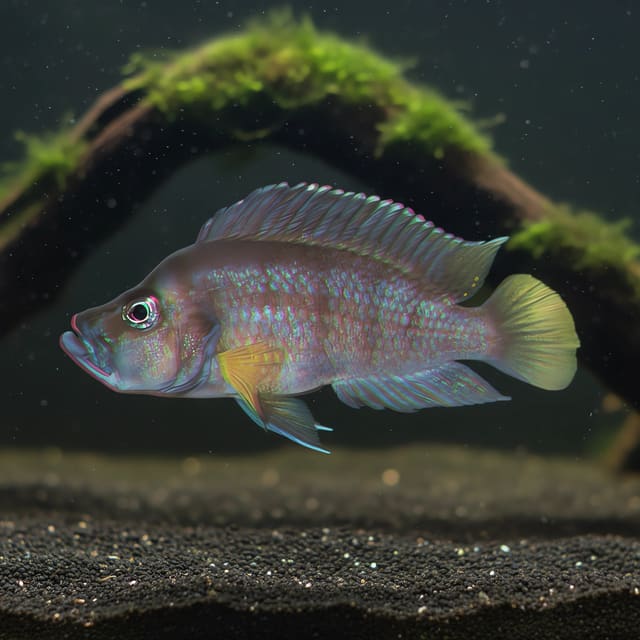
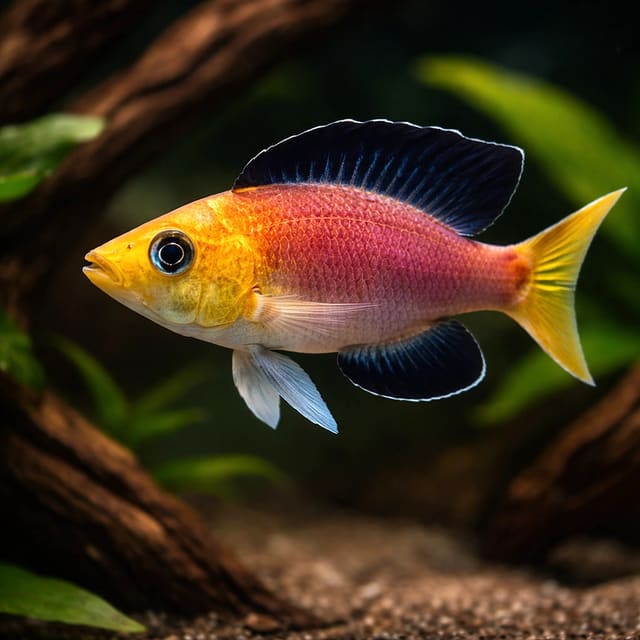
Gallery images have been digitally enhanced to improve image quality. Natural colour, pattern, size and maturity can vary between live animals. The pictures do not guarantee sex, locality purity, adult colour or the exact specimen that arrives. Use them for general presentation and make the buying decision from the offer, adult planning, care needs and compatibility.
Seriously Fish gives a minimum base of 120 × 38 cm and illustrates it as roughly 137 litres at a 30 cm height. Treat the base dimensions as the more useful planning figure because this species feeds, socialises and breeds around the sand. A tall aquarium may hold more litres while offering no extra room for foraging lanes or male territories. Where space allows, choose a longer and wider aquarium rather than relying on height.
The cited minimum is a starting point, not an invitation to crowd the footprint. The same profile recommends at least two males and several females per male where sex can be established. That group needs open sand, feeding access and separated areas for display. Extra floor area gives more freedom to arrange those zones and is especially valuable when the purchased juveniles cannot yet be reliably sexed.
Start with a mature biological filter. The RSPCA explains that fish waste releases toxic ammonia, which a working filter's bacteria convert to nitrite and then nitrate. A new aquarium should be cycled before fish arrive; the first tropical tank guide sets out that preparation. Add livestock gradually so the filter community can respond to the growing waste load.
Keep the aquarium away from loud vibration, sudden traffic, direct sun and temperature swings. OATA notes that African lake cichlids can be disturbed by noise, movement and unstable conditions, while the species profile describes this fish as nervous around rapid movement outside the glass. A quiet position and predictable routine are practical care equipment, not cosmetic extras.
A sandy substrate is essential. FishBase describes this species foraging over sand, and Seriously Fish says it feeds in a Geophagus-like way by sifting sand through the gills to extract small food items. Choose fine, smooth aquarium sand that can pass safely through that feeding action. Avoid sharp gravel, coarse crushed material or a carpet of rock that prevents normal substrate use.
Keep a broad area of sand open. Seriously Fish recommends rock piles arranged into caves with large open-water spaces between them. For this species, the rocks should frame the habitat rather than dominate the whole floor. Place them on a stable base, leave clear passages around them and use separate clusters to break up male territories without creating a continuous wall.
During breeding, a male may excavate a depression in his territory. If more than one male is present, divide the sand into visual zones with rockwork so each display area has a boundary. Do not force territories into tiny squares simply because the fish are still young. Watch where they actually feed and display, then adjust only when a fish is repeatedly excluded or trapped.
Bright lighting may be appreciated according to the species profile, but the fish is also skittish. Use a predictable day-night cycle and avoid sudden switching from darkness to full intensity. Planting can soften the scene, but the core welfare features are usable sand, stable rocks, open water and low social pressure. Never let decorative roots, dense plants or ornaments block the feeding floor.
Seriously Fish gives species-level aquarium guidance of 24–27°C, pH 7.5–9.0 and hardness 10–25°dGH. Those are the working values for this profile. FishBase separately records environmental values of pH 7.5–8.5, hardness up to 20°dH and 25°C. Use the aquarium range for routine care and keep the FishBase figures as natural-history context rather than creating a second target.
Test the actual source water before buying. The water-chemistry guide explains what the readings mean, and the water-parameter matcher can compare measured values with the stated plan. If the source water needs adjustment, practise producing repeatable replacement water before the fish arrives. Stability matters more than repeatedly chasing a single midpoint.
Ammonia and nitrite should remain at zero. OATA's broad African-lake guidance keeps nitrate no more than 20 mg/l above the normal tap-water level and gives 12–18°dH general hardness plus 10–15°dKH carbonate hardness for the wider group. The species-specific range above takes priority for routine temperature, pH and general hardness; the group sheet remains useful for nitrogen waste, buffering context and testing practice.
Seriously Fish's 137-litre example uses four to five filter turnovers an hour, approximately 550–685 l/h. That is a flow calculation for the cited example rather than a universal model recommendation. Select a filter that can deliver effective biological filtration and circulation after media and pipe losses, while leaving calm zones and keeping food on the sand long enough for all fish to feed.
Seriously Fish describes the species as generally peaceful towards its own kind, with males becoming territorial when spawning. It recommends at least two males for full colour development and several females per male where possible. A later breeding note suggests at least two females per male. Those points support social group planning, but they do not turn an unsexed retail choice into a guaranteed ratio.
Buy with a contingency. Juveniles may not reveal sex reliably, and this listing does not guarantee male or female. If the maturing group develops too many males or one fish becomes persistently excluded, the keeper needs enough temporary space and a responsible rehoming route. Do not buy an exact number on the assumption that every fish will mature into the desired role.
Provide more than one feeding patch and more than one path across the sand. A group can look calm until food arrives, when a faster or bolder fish begins controlling the bottom. Scatter suitable food across several areas and watch each individual take it. A fish that repeatedly hovers off the substrate, retreats from every approach or loses condition may be socially displaced even without dramatic fighting.
Rapid movements outside the tank can trigger nervous reactions. Approach predictably, keep maintenance tools ready before opening the lid and avoid chasing the whole group to inspect one individual. A secure lid is prudent for startled fish. Give new arrivals subdued light and time to map the aquarium before expecting confident display behaviour.
Seriously Fish says Xenotilapia melanogenys accepts most foods but that live and frozen varieties should form the bulk of the diet. It feeds almost entirely from the substrate, so the keeper must ensure food reaches the bottom. FishBase's wild record of copepods, ostracods and shrimps in stomach contents supports the picture of an animal searching the sand for small invertebrate prey.
Offer small, appropriately sized foods that sink or can be directed to the substrate. Live or frozen foods can provide the bulk as the profile advises, while a suitable fine prepared food can add consistency and variety if the fish accepts it. Avoid large floating items that are gone before the group reaches them, and do not bury excessive food where it can decay unseen.
OATA's broad African-lake routine is to feed only what fish can consume within a few minutes, twice daily. Use that as portion discipline rather than a promise that every individual needs the same amount. Spread food over the usable sand and watch the slower fish. If one area becomes dominated, change distribution before increasing the overall ration.
Remove leftovers and track body condition. A sand sifter can appear busy while finding little usable food, so activity alone is not proof of intake. Conversely, repeated heavy feeding can load the filter and raise nitrate. Read appetite, belly profile, growth, waste and water tests together, and seek expert advice when a fish stops feeding or loses condition.
OATA strongly recommends at least one partial water change of 25% each week for African lake cichlids. Condition replacement water for chlorine or chloramine and match it closely for temperature and chemistry. Use test results and the actual waste load to decide whether the routine needs strengthening rather than waiting for cloudy water or distressed fish.
Test ammonia, nitrite, nitrate, pH and hardness at least weekly, and record temperature as well. Test more often after adding fish, changing filtration or increasing food. If ammonia or nitrite appears, respond as a filtration or loading problem and seek experienced help. Do not mask the reading with an unplanned chemical treatment while continuing the cause.
Siphon visible waste while preserving enough fine sand for natural feeding. Work section by section and avoid deep, wholesale disruption of the entire substrate in one session. Check beneath overhangs and around rock bases where waste can settle. A thin clean feeding surface is more valuable than a decorative deep bed that traps uneaten food.
Inspect filter flow and aeration. If the filter needs cleaning, do not run it under the tap because chlorine or chloramine may kill beneficial bacteria. Rinse media lightly in aquarium water removed during the water change. Check intakes for sand, confirm rocks remain stable and make sure current has not excavated the feeding zone or piled sand against equipment.
Know the group's normal swimming, colour, breathing and feeding pattern. OATA lists hanging at the surface, sitting on the bottom, erratic swimming, colour becoming darker or paler, unusual hiding, aggression changes, altered gill movement, white spots, fluffy growths, damaged fins or scales, weight change and reduced feeding as warning signs. These observations point to a problem but do not diagnose one.
Test water first, then consider oxygenation, temperature, recent maintenance, new livestock and social pressure. For a substrate feeder, confirm that the fish can actually reach food. For a skittish fish, look for repeated disturbance outside the aquarium. Write down when the behaviour started and whether it affects one fish or the group.
Contact the retailer or an aquatic vet with those observations and the test results before choosing a treatment. Avoid medicating a whole established Tanganyika aquarium on a guess. If a bullied fish must be separated, use a mature, heated and appropriately buffered setup; an uncycled container can replace one danger with another.
Healthy arrivals still increase waste and change social spacing. Add fish gradually and monitor closely through the first week. A new animal that hides briefly may simply be settling, but persistent exclusion from sand and food, rapid breathing or worsening condition needs action. Adjust disturbance, layout and group pressure deliberately rather than repeatedly netting the fish.
The current Tropical Fish Co policy says each fish is individually bagged with pure oxygen, packed in an insulated box and carried by a tracked courier licensed for live animals. Someone must be at the delivery address because live animals cannot be left at the door, with a neighbour or in a safe place. Review the current delivery and Live Arrival Guarantee policy before ordering.
Have the mature aquarium stable before the parcel arrives. Open and inspect it on the same day. The policy advises floating the sealed bag for 20–30 minutes before release. Avoid bright sudden light while temperatures equalise, limit sudden movement around this skittish species and do not pour transport water into the aquarium. Once released, let the fish find the sand and cover without repeated capture.
For a Live Arrival Guarantee claim, contact the team the same day with the order number and a continuous unboxing video. It should begin with the parcel still sealed and outer box visible, show the opening in one take and show the fish still inside the sealed bag. That video is evidence for the claim, not a biological care requirement.
After a normal arrival, offer a small portion only when the fish is settled enough to feed and remove leftovers. Watch whether established fish allow access to the substrate. Recheck water after the new addition and keep outside movement calm and predictable during the first week.
Seriously Fish describes this species as peaceful and skittish and specifically advises against boisterous fish such as mbuna. It names Cyprichromis, Cyathopharynx, Julidochromis, Neolamprologus and Altolamprologus as possible companion genera. These are candidates for a researched Tanganyika plan, not automatic universal tank mates.
The best companion leaves the open sand usable, does not rush every feeding and accepts compatible hard alkaline water. Check adult size, territory, diet, breeding behaviour and group count for each species. A calm fish that occupies rock or open water may still conflict if it crosses male display zones or consumes all sinking food before it reaches the bottom.
Do not mix this fish with Malawi mbuna. OATA also advises that African lake communities should generally use species from the same location and that Malawi and Tanganyika cichlids should not routinely be mixed because temperament and behaviour differ. Similar water chemistry alone does not make the social match safe.
The two Cyprichromis alternatives are useful comparison destinations, not promises of compatibility for every aquarium. Compare the Tanganyika offers, then assess the exact adult group, footprint and feeding plan. Related does not mean guaranteed tank mate.
Males become territorial when spawning. FishBase calls the species a colonial lek breeder, and Seriously Fish describes a male excavating a depression in his sand territory. The display is part of normal behaviour, but one male should not be able to control every feeding patch and escape route. Separate sand zones with stable rock clusters and preserve open movement between them.
Watch for repeated chasing, torn fins, a fish pinned above the substrate or an individual that cannot feed. Brief display and retreat can be normal; constant exclusion is not. If tension rises, check the group composition, sand area and sight lines before adding more fish. A bigger number in the same cramped footprint can make the problem worse.
Seriously Fish recommends at least two males and several females per male where possible, but this listing does not guarantee sex. A maturing unsexed group may need adjustment. Keep a rehoming plan and do not force an adult ratio the aquarium cannot support. Where sex cannot be established confidently, behaviour and welfare take priority over pursuing display colour.
Changes should be measured. Moving rockwork can redraw boundaries, but repeated full rescapes keep the group unsettled. Alter the problem area, maintain secure caves and observe from a distance. If a fish remains targeted or injured, separate it into suitable established conditions and seek experienced advice.
FishBase describes this species as a polygamous maternal mouthbrooder that breeds in colonies. Seriously Fish gives more aquarium context: the male prepares a sand depression, displays within a territory and the female carries the brood. This is useful behaviour context, but the product is not a sexed breeding group and no breeding outcome is promised.
A breeding-focused group needs enough sand to separate male display areas and enough calm space for females to leave them. The species profile recommends at least two females per male for breeding and at least two males for display, where sex can be established. Because the offer is unsexed, that ratio may require later responsible adjustment rather than being achievable from a fixed purchase count.
Do not turn mouthbrooding into a reason to handle a female repeatedly. Observe feeding, breathing and harassment, maintain stable water and provide retreats. A fish refusing food may be brooding, stressed or unwell; check the whole context rather than assuming. Anyone planning to rear young should research fry care, extra capacity and rehoming before spawning occurs.
FishBase records 15.0 cm total length for a male or unsexed fish, while Seriously Fish records 160 mm standard length. Total length includes the tail and standard length excludes it, so keep the two labelled records separate.
For Utinta Black-Chinned Xenotilapia, Seriously Fish gives a minimum base of 120 × 38 cm, illustrated as roughly 137 litres at 30 cm high. Choose more floor area where possible for group feeding and male territories.
Seriously Fish advises at least two males and several females per male where sex can be established. This offer does not guarantee sex, so plan extra space and a responsible way to adjust the adult group.
This store rates the fish as advanced because it needs specialist fine-sand habitat, a social plan, calm feeding access, hard alkaline water and careful management of skittish behaviour and male territories.
Live and frozen foods should form the bulk of the diet according to Seriously Fish. Use small foods that reach the substrate, distribute them across the sand and check that every fish feeds.
Use the species-profile aquarium guidance of 24–27°C, pH 7.5–9.0 and 10–25°dGH. Test regularly and keep changes gradual and repeatable.
It is generally peaceful and skittish, but males become territorial when spawning. Provide separate sand territories, calm companions and several feeding areas; avoid boisterous mbuna.
Possible companion genera include Cyprichromis, Cyathopharynx, Julidochromis, Neolamprologus and Altolamprologus. Check the exact species, adult group, footprint, diet and territory before combining them.
Tropical Fish Co bags each fish with oxygen, uses insulated packaging and a tracked licensed live-animal courier. For a Live Arrival Guarantee claim, contact the team the same day with your order number and a continuous video from the sealed parcel to the fish still in its sealed bag.
Identity and natural history: FishBase: Enantiopus melanogenys resolves to Xenotilapia melanogenys and supports the Cichlidae family, Lake Tanganyika distribution, wild sand-schooling behaviour, diet findings, 15.0 cm TL maximum and maternal mouthbrooding.
Species-level aquarium care: Seriously Fish: Xenotilapia melanogenys supports the 160 mm SL record, 120 × 38 cm base, 24–27°C, pH 7.5–9.0, 10–25°dGH, sand layout, substrate feeding, peaceful/skittish behaviour, companion genera and group/breeding guidance. The TL and SL records remain separately labelled.
UK welfare context: the OATA African lake cichlid sheet supports broad maintenance, testing, acclimation and lake-community guidance. The RSPCA fish-environment guidance explains mature biological filtration. Lifespan, disease treatment and guaranteed breeding are not stated as customer promises.
No reviews for this item yet. Bought one? Honest reviews only, good or bad.
What customers say about ordering from us
I have a small group of long finned mountain minnows. So was delighted to be able to order ten of this variety to increase the genetics in my tank . The ones I recieved are healthy but it’s to early to give a verdict on wether they are of a long finned type since they are small currently.
Gordon Walker · 23 Sept 2026
100% success travel and "installation". Pleased with quality of purchase. The Siamese fighter a bit "shy" so have not yet seen him at his best yet but looking good. Happy customer. GG
George E Garratt · 21 Sept 2026
Reviews of our shop, collected by Judge.me, an independent third-party review collector. Newest first.