−13%
Moderate
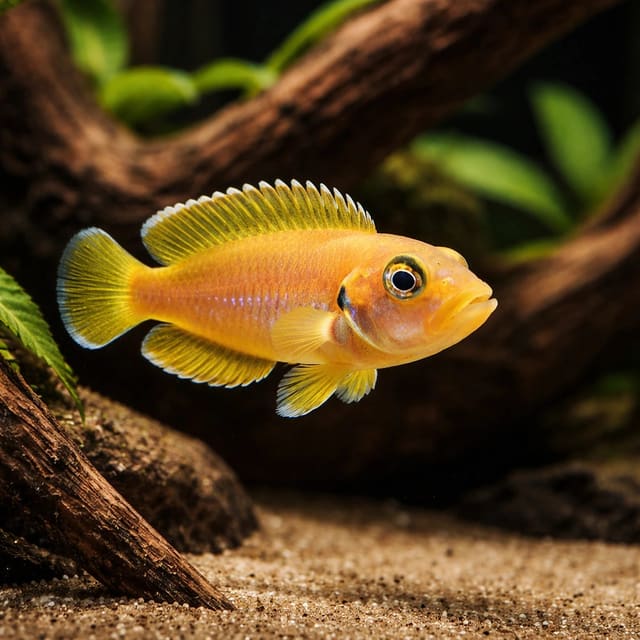
Gold Ocellatus Shell-Dweller (Neolamprologus ocellatus)
23–25°C · pH 8–9
£17.39£19.99

The Titcha Mandarin Compressiceps (Altolamprologus compressiceps) is a cichlid from Lake Tanganyika that reaches 12.3 cm. It suits keepers who can provide a 120 × 45 cm base, about 243 litres and the Seriously Fish and OATA overlap of 24–27°C, pH 8.0–8.6 and 12–18 dGH. Sold individually in sizes from 3.5–4 cm to 7–8 cm.
Adult size is the maximum length this species reaches at full maturity (scientific sources). The livestock you receive will be younger and smaller — pick a size variant above for the actual shipping size. Product-photo provenance and any image-specific limitations are stated on the listing.
Altolamprologus compressiceps
Save when buying multiple fish. Each quantity is one fish; sex and pair formation are not guaranteed unless the selected variant explicitly states them.
Confirm your email, then we’ll send an availability message for this exact item if it returns within 180 days.
This request is only for this product—no newsletter or other promotions. A mail-provider retry may very rarely duplicate the same availability message. Unconfirmed addresses are removed after 48 hours. See our privacy policy.
The Titcha Mandarin Compressiceps (Altolamprologus compressiceps) is a cichlid from Lake Tanganyika that reaches 12.3 cm. It suits keepers who can provide a 120 × 45 cm base, about 243 litres and the Seriously Fish and OATA overlap of 24–27°C, pH 8.0–8.6 and 12–18 dGH. Sold individually in sizes from 3.5–4 cm to 7–8 cm.
Adult size is the maximum length this species reaches at full maturity (scientific sources). The livestock you receive will be younger and smaller — pick a size variant above for the actual shipping size. Product-photo provenance and any image-specific limitations are stated on the listing.
23–25°C · pH 8–9
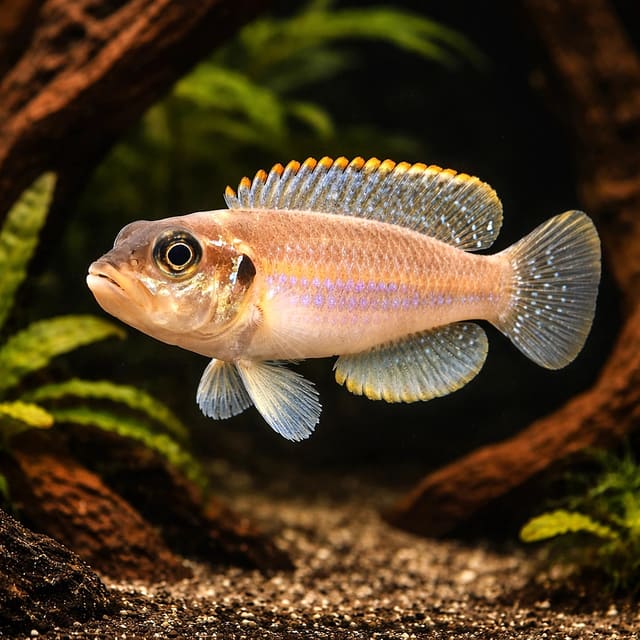
23–27°C · pH 7.5–9 · 40L

23–27°C · pH 8–8.6

24–28°C · pH 8–9 · 243L
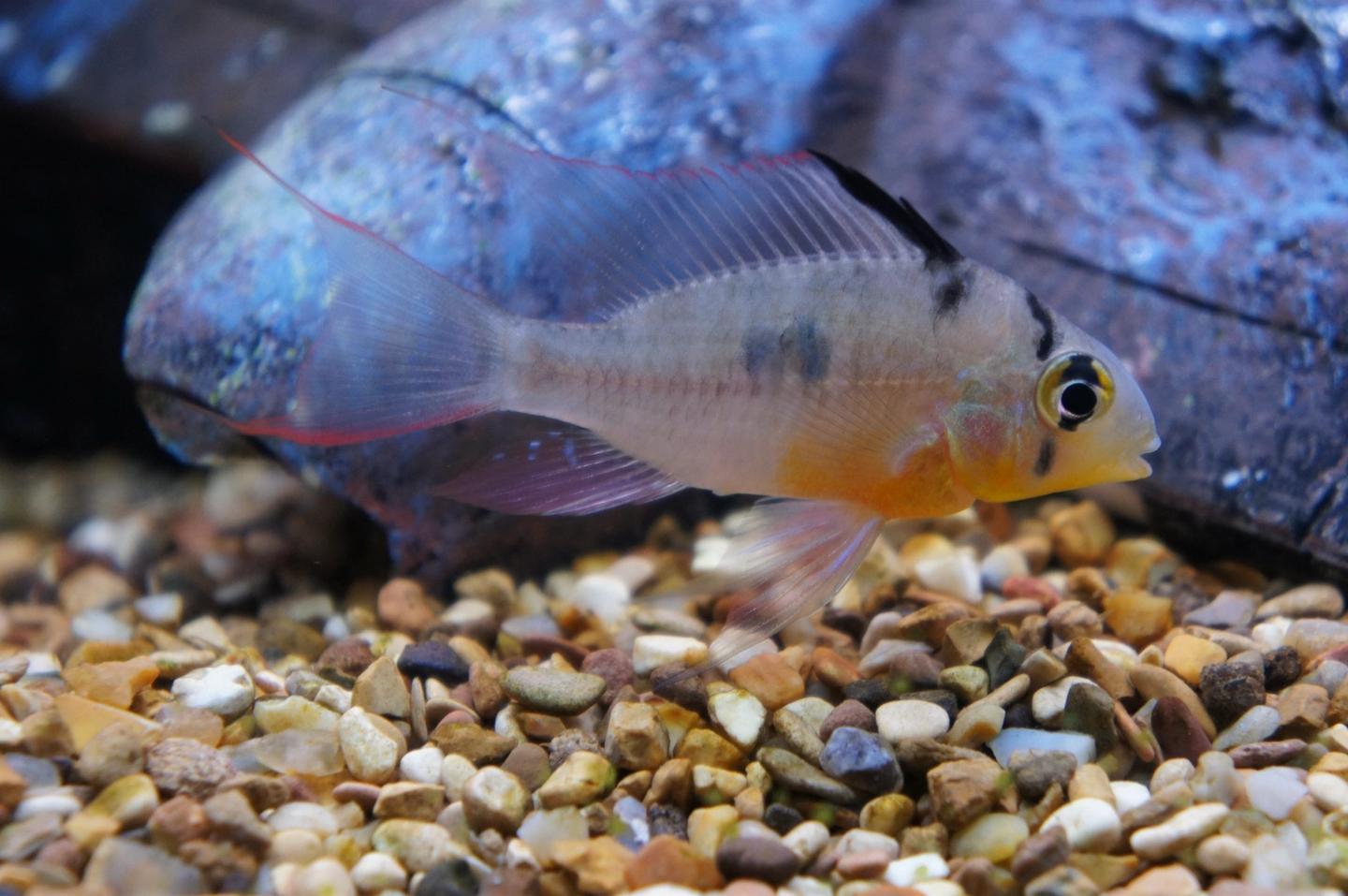
Cichlids are a family of roughly 1,800 accepted species, not one care type. Before buying, identify the exact species and source, then compare adult measurement, usable tank dimensions, social system, territory, tested water, diet and an exit plan. No family-wide minimum tank, water range or tank-mate list is safe.
Maintain these water conditions for optimal health and vibrant colors
Titcha Mandarin Compressiceps is the shopping name for Altolamprologus compressiceps, a freshwater cichlid with a deep, laterally compressed body and an elongated mouth adapted to search cracks between rocks. FishBase identifies the species as endemic to and widely distributed in Lake Tanganyika. Seriously Fish describes it as a specialised carnivore that takes invertebrates, crustaceans and smaller fish in nature, with shrimp making up more than 80% of stomach contents in one study of wild fish.
Those characteristics shape every useful aquarium decision. Build around rock faces and crevices rather than an empty open floor, offer animal-based foods that can reach a deliberate feeder, and screen companions by adult mouth size as well as temperament. This is not a general mixed-community choice for tiny fish or ornamental shrimp. It suits a keeper prepared to maintain hard, alkaline water, high water quality and a carefully planned Tanganyikan community.
The live selector uses the labels “3,5 - 4 cm”, “4-5 cm”, “5-6 cm” and “7 - 8 cm”. One purchase supplies one animal of the selected option. The size you select is the size supplied, not the adult size. Choose by the aquarium and its existing occupants: a smaller animal needs reliable access to correctly sized food, while every selection still requires space for the full adult body and territory.
Sex is guaranteed only when the selected option explicitly states male or female. This Titcha Mandarin Compressiceps listing has no sex-guaranteed option.
The pictured fish shows a deep yellow body, pale mottling, pointed snout and tall dorsal profile. The gallery images are representative of this type of animal rather than photographs of the exact animal supplied, so colours can look slightly different from the live animal.
| Suits | Not suited to |
|---|---|
| Keepers who can dedicate a long aquarium base to secure rockwork and sandy open lanes. | Aquariums containing animals small enough to be treated as food. |
| Keepers who test hard, alkaline water and maintain a mature biological filter. | Communities whose fish require soft water or a low-protein diet. |
| Setups where individual feeding can be observed and social conflict can be managed. | Layouts where every crevice is controlled by another rock-associated cichlid. |
FishBase records a maximum of 12.3 cm total length for male or unsexed Altolamprologus compressiceps. Seriously Fish separately records 125 mm standard length. Plan around the FishBase maximum of 12.3 cm used throughout this listing rather than scaling the aquarium to the dispatch selection.
Seriously Fish recommends minimum base dimensions of 120 × 45 cm or equivalent, paired with an aquarium volume of about 243 litres. Both parts matter. A tall aquarium with a narrow floor may hold the same nominal volume but offer fewer separate rock faces, feeding lanes and withdrawal routes. Rockwork also displaces water, so compare the stated volume with the actual usable footprint and filtered water volume.
Seriously Fish gives aquarium values of 24–28°C, pH 8.0–9.0 and 7–25 dGH. OATA’s African lake cichlid guide gives 23–27°C, pH 8.0–8.6 and 12–18 dGH for the group; use their shared routine range of 24–27°C, pH 8.0–8.6 and 12–18 dGH. FishBase records wild environmental values of 23–25°C, pH 6.5–7.5 and 8–12 dH, while the dedicated aquarium profile supports the hard, alkaline Tanganyikan conditions used here.
| Planning measure | Decision |
|---|---|
| Adult scale | Allow for 12.3 cm total length and the deeper body shape, not only nose-to-tail length. |
| Aquarium base | Use at least 120 × 45 cm or an equivalent base that preserves territory and escape routes. |
| Approximate volume | Plan around 243 litres before displacement by rocks and substrate. |
| Routine temperature | Hold a stable point within 24–27°C. |
| Routine chemistry | Keep pH within 8.0–8.6 and general hardness within 12–18 dGH. |
| Social plan | Seriously Fish favours a single pair; groups require larger aquaria. |
Before committing, sketch the base as a 120 × 45 cm rectangle and mark the footprint of every major rock structure. If all crevices cluster in one pile, one fish may control the entire useful shelter zone. Several broken structures create more boundaries without changing the litre figure.
A sandy substrate with complex piles of rock closely matches the aquarium layout recommended for this species. Put the main rocks directly on the aquarium base before adding substrate around them. This prevents digging from removing support beneath a heavy structure. Each piece should remain stable when neighbouring sand shifts, and no upper rock should depend on a small, loose contact point.
Use the rockwork to create function rather than one solid wall. Crevices let the fish use its compressed body and elongated mouth, while broken sight lines allow another cichlid to leave view. Keep some clear sand in front of the structures as a feeding and observation lane. You should be able to see whether food is eaten and reach debris without dismantling the whole aquarium.
At about 243 litres, Seriously Fish illustrates a turnover of four to five times the aquarium volume each hour. That works out at roughly 970–1,215 litres per hour. Treat this as the rated starting point, then arrange outlets so they circulate water around the structures and maintain surface movement without blasting the fish’s preferred crevices.
The same profile estimates about 125–175 W across two heaters for a 243-litre aquarium in a room near 20°C. Using two heaters spreads the heating load, but their combined rating still needs to match the aquarium and room. Place them where circulated water carries warmth away from the elements rather than leaving a poorly mixed warm pocket behind rockwork.
| Layout feature | Reason |
|---|---|
| Sand around a rock-supported base | Digging cannot remove the foundation of the structure. |
| Several separated crevices | More than one fish can withdraw without sharing a single entrance. |
| Open feeding lane | You can confirm that portions reach this deliberate feeder. |
| Reachable waste traps | Protein-rich leftovers and solid waste can be removed during maintenance. |
Choose a stable operating point within 24–27°C, pH 8.0–8.6 and 12–18 dGH, then make sure every proposed companion fits the same range. OATA also gives 10–15 dKH for African lake cichlids. Carbonate hardness supports the alkaline conditions expected by this group, but measure the aquarium rather than relying on the label attached to a substrate or rock.
Use the water chemistry guide to identify the values to measure and the water matcher to compare those readings with the routine range. Record results on the same day each week. A sequence shows whether pH, hardness or nitrogen waste is changing; an isolated result gives no trend.
Ammonia and nitrite should remain at zero milligrams per litre. OATA says nitrate should not exceed 20 mg/l above the normal tap-water level. That wording matters: test the replacement water as well as the aquarium. If the tap water reads 10 mg/l nitrate, the corresponding upper aquarium limit is 30 mg/l. If the tap reading changes, recalculate from the new baseline rather than preserving an old ceiling.
| Reading | Action |
|---|---|
| Temperature outside 24–27°C | Check heater operation, room conditions and circulation before the deviation continues. |
| pH outside 8.0–8.6 | Compare aquarium and replacement water, then inspect the recent trend and maintenance history. |
| General hardness outside 12–18 dGH | Measure the tap water and aquarium separately before altering the routine. |
| Detectable ammonia or nitrite | Test again promptly, reduce further stocking pressure and carry out the appropriate water-quality response. |
| Nitrate more than 20 mg/l above tap water | Review water-change volume, feeding and debris trapped around rocks. |
Water testing should happen before the fish is selected, not after it enters an unsuitable system. Confirm that the aquarium can hold the intended temperature and chemistry through ordinary weekly maintenance. If another species needs values outside this range, reject that combination rather than forcing one fish to live at the edge of its needs.
A mature biological filter is essential because fish release toxic ammonia. The RSPCA explains that filter bacteria convert ammonia to nitrite and then to the safer nitrate. That process only works reliably when the filter is established, maintained and matched to the waste produced by the aquarium.
If this is a new setup, complete the first tropical aquarium preparation and maturation steps before choosing livestock. Additions increase both feeding and waste, so introduce fish gradually enough for the bacterial population to respond. OATA warns that stocking too quickly can cause new tank syndrome when nitrifying bacteria cannot process the increased ammonia and nitrite.
For an aquarium holding about 243 litres before displacement, 25% is roughly 61 litres and 50% is roughly 122 litres. Actual water volume will be lower after rocks, substrate and equipment displace water, so calculate the practical change using the filled system. The important decision is to establish a repeatable weekly routine that keeps nitrogen readings and visible debris within control.
Compare weekly tests with feeding and maintenance notes. Rising nitrate alongside food trapped behind rocks points towards portion control and more thorough siphoning. Reduced outlet flow points towards a blockage check. Detectable ammonia or nitrite requires immediate attention to water quality and stocking load; do not wait for visible illness before responding.
Altolamprologus compressiceps searches cracks for animal prey. Seriously Fish describes a natural diet of invertebrates, crustaceans and smaller fish, with shrimp accounting for more than 80% of stomach contents in one wild study. In the aquarium, use suitable animal-based foods while maintaining variety and controlling the amount that disappears into inaccessible gaps.
Most captive fish may accept dried food, but the species profile favours live or frozen bloodworm, Tubifex, Artemia, chopped prawns, small earthworms and similar choices. A quality dried food, freeze-dried bloodworm or freeze-dried Artemia can also form part of the rotation. Offer pieces the selected animal can take easily rather than dropping large chunks beside a smaller mouth.
OATA advises feeding African lake cichlids twice a day and giving only what they can eat within a few minutes. For this deliberate rock-associated feeder, “eaten” means seeing the individual take food. It does not mean watching faster fish clear the open water while portions intended for the Compressiceps vanish behind stones.
Seriously Fish says feeder livebearers or small goldfish bring a risk of parasite or disease introduction and tend to have poor nutritional value unless properly conditioned. They add no benefit to the feeding plan described above. Use the named prepared, frozen, freeze-dried or appropriate live invertebrate foods instead.
| What you observe | What to change |
|---|---|
| The fish takes food and the lane remains clean | Keep the portion and delivery point consistent. |
| Faster fish take every piece | Change the feeding position and reassess the companion mix. |
| Food remains after a few minutes | Remove it and reduce the next portion. |
| Food repeatedly disappears behind rocks | Use smaller observed portions and improve maintenance access. |
Finish the rockwork, establish the filter and confirm the water readings before the fish travels. The aquarium should already hold 24–27°C, pH 8.0–8.6 and 12–18 dGH, with ammonia and nitrite at zero. Make sure the intended shelter remains usable after equipment, substrate and other territories are in place.
Check the attendance requirements on the current delivery and Live Arrival Guarantee policy. Live fish must not be left unattended, so someone must be present to receive the parcel.
OATA advises checking that ammonia and nitrite are zero before adding fish and increasing livestock numbers slowly so the biological filter can adjust to the extra waste and feeding. After release, watch swimming, breathing, feeding and interactions with established fish.
Confirm that the fish can remain upright, breathe without continuing distress and enter a shelter without being driven out. A new arrival may use cover, so judge the situation by access and physical condition rather than demanding immediate open swimming. Do not identify sex or infer a size-related life stage from colour after transport.
Healthy fish should have clear, bright eyes, intact scales and undamaged fins, without ulcers or bumps. OATA recommends watching each fish’s normal swimming, colour, temperament, breathing, appearance, body condition and feeding. A change from that individual’s usual pattern is more useful than comparing it with a fish that behaves differently.
| If you see this | Do this next |
|---|---|
| Hanging at the surface, sitting on the bottom or erratic swimming | Test temperature, ammonia and nitrite promptly and inspect social pressure. |
| Gill covers moving markedly faster or slower | Check water quality, circulation and aeration without delay. |
| Sudden darker or paler colour | Compare behaviour, breathing and access to shelter with the fish’s normal pattern. |
| More hiding or a change in aggression | Watch which fish controls the entrances, feeding lane and escape route. |
| White spots, fluffy growths, lost scales or damaged fins | Record the extent of the change and check whether it is spreading. |
| Reduced feeding or declining body condition | Observe an individual feed and confirm that food reaches the fish. |
Begin with measurable causes. Ammonia and nitrite should be zero, temperature should remain within 24–27°C, and the fish should be able to leave another animal’s space. Correcting a water-quality or access problem starts with identifying which reading or interaction changed.
Social exclusion can appear as repeated retreat rather than continuous attack. A fish may lose access to the preferred crevice or feeding lane without showing torn fins. Watch the whole sequence: where it waits, whether it approaches food, which animal interrupts it and where it is forced to move. That pattern tells you whether the immediate decision concerns water, feeding delivery or separation.
If changes continue after the water and social checks, contact us with the test results, aquarium dimensions, stocking details and a clear description of the signs. Those details make the health discussion specific to the animal and setup.
Seriously Fish recommends maintaining Altolamprologus compressiceps as a single pair, while groups can be kept in larger aquaria. That is a social-care recommendation, not a statement that two independently selected animals form a pair. Selecting two supplies two individual animals, and their relationship must be judged through behaviour over time.
Plan the long-term social arrangement before adding more than one. A group needs more aquarium space than the 120 × 45 cm base used for the species minimum, but no fixed larger group volume applies to every combination. The number and placement of rock structures, the other territories and the ability to separate incompatible animals all affect the decision.
The species is a substrate spawner that uses crevices or cavities among rocks. Seriously Fish describes a cavity narrow enough for the female to enter, with the male departing after fertilisation and the female guarding the brood during incubation for three to five days. Parental care ends when the fry become free-swimming. This behaviour explains why access to a particular crevice may become more important and why relationships can change around spawning.
Growth is described as slow, and sexual maturity may take a year or more. Do not use a dispatch selection, photograph, colour or fin shape as a shortcut to sex or maturity. Keep the purchase decision tied to the selected size and the social decision tied to observed interactions.
| Stocking plan | Required preparation |
|---|---|
| One selected animal | Plan how its longer-term social needs will fit the aquarium. |
| Two selected animals | Treat them as two individuals and retain a separation option. |
| A larger group | Use a larger aquarium with multiple territories and contingency space. |
Seriously Fish describes this cichlid as not particularly territorial and suitable for a well-chosen Tanganyikan community, but it should not live with anything small enough to be considered food. That distinction matters. A fish can be relatively restrained in territorial behaviour and still be an efficient predator with mouthparts adapted to extracting prey from crevices.
| Candidate | Decision |
|---|---|
| Tiny fish or fry | Avoid them because they may be treated as food. |
| Small ornamental shrimp | Avoid them because the natural diet is strongly crustacean-based and small animals can be extracted from cover. |
| Tropheus | Avoid this combination because Seriously Fish calls Compressiceps a poor companion for Tropheus. |
| Any species requiring a low-protein diet | Avoid combining it with this specialised carnivore because the feeding plans conflict. |
| Lake Malawi cichlids | Avoid mixing them with Tanganyikan cichlids because OATA does not generally recommend the combination due to differences in temperament and behaviour. |
| Different geographic populations of this species | Keep them apart to avoid hybridisation. |
A promising companion should overlap at 24–27°C, pH 8.0–8.6 and 12–18 dGH, remain too large to be food, and eat a compatible diet. It must also use the aquarium without taking every crevice or preventing observed feeding. Shared Lake Tanganyika origin is useful context, but it does not answer those individual questions.
Browse the African cichlid collection for comparison, then assess each animal by its own adult size, water range, social structure, diet and space use. A collection link is not a cohabitation recommendation.
Compatibility remains specific to the aquarium and individuals. Before combining unfamiliar cichlids, contact us with the aquarium dimensions, current occupants, measured water values and intended size selection for a stocking assessment.
Once a candidate passes the prey, water and diet screens, examine territory and introduction order. OATA recommends adding more peaceful African lake cichlids before more aggressive species. It also advises increasing the population slowly so the biological filter can respond to the extra waste and feeding.
Draw the 120 × 45 cm minimum base and mark the existing rock piles, caves and clear feeding lanes. Then identify which fish controls each area. A crevice shown on the drawing is not truly usable if the only route into it passes another cichlid’s defended entrance. The new animal needs both a refuge and a route away from pressure.
OATA notes that rearranging aquarium décor can reduce aggression as fish establish new territories. If established occupants control all useful boundaries, adjust the layout before the newcomer enters rather than placing it directly into a settled territorial map. Keep every rock stable on the base while changing the visible boundaries.
Watch whether the Compressiceps can hold a position, withdraw, and take food within a few minutes. Also watch the existing fish: a combination has failed if another animal loses its normal shelter or feeding route. Persistent hiding, altered aggression, rapid breathing or reduced feeding are reasons to intervene.
No fixed list can predict the temperament of every individual or the effect of every hardscape. Use the screening sequence for the initial decision, then let observed access to food, shelter and escape routes decide whether the arrangement continues.
FishBase records a maximum adult length of 12.3 cm for Titcha Mandarin Compressiceps; plan the aquarium around that adult size rather than its dispatch size.
Plan at least a 120 × 45 cm base or equivalent and about 243 litres, following the Seriously Fish species profile; place stable rock structures directly on the aquarium base before adding sand.
Seriously Fish recommends keeping Altolamprologus compressiceps as a single pair, while groups can be maintained in larger aquaria; two selected animals are not an established pair.
Titcha Mandarin Compressiceps suits a prepared keeper who can maintain hard, alkaline water, high water quality, secure rockwork and carefully screened companions; OATA describes African lake cichlids as usually undemanding and easy to keep.
Feed dried, live, frozen or freeze-dried animal-based foods twice daily, using choices such as bloodworm, Tubifex, Artemia, chopped prawns or small earthworms and offering only what it eats within a few minutes.
Keep Titcha Mandarin Compressiceps within the Seriously Fish and OATA overlap of 24–27°C, pH 8.0–8.6 and 12–18 dGH, with ammonia and nitrite at zero.
Seriously Fish describes Altolamprologus compressiceps as not particularly territorial, but it is predatory towards animals small enough to be food; monitor access to rock shelters and feeding lanes.
Choose a well-planned Lake Tanganyika community whose members match its water and diet needs and are too large to be food. Avoid prey-sized animals, Tropheus, species requiring a low-protein diet, Malawi cichlids and different geographic populations of this species.
Start filming the sealed parcel before opening it, then record the continuous opening with the fish still in its sealed bag. Someone must be present to receive the parcel; float the bag for 20–30 minutes before release and never pour the bag water into the aquarium.
Max adult size is the length this species reaches at full maturity (from scientific sources). The livestock you receive will be younger and smaller — pick a size variant on the buy box for the actual shipping size. Product-photo provenance and any image-specific limitations are stated on the listing.
Always research specific species before adding them to your tank. Consider:
No reviews for this item yet. Bought one? Honest reviews only, good or bad.
What customers say about ordering from us
I have a small group of long finned mountain minnows. So was delighted to be able to order ten of this variety to increase the genetics in my tank . The ones I recieved are healthy but it’s to early to give a verdict on wether they are of a long finned type since they are small currently.
Gordon Walker · 23 Sept 2026
100% success travel and "installation". Pleased with quality of purchase. The Siamese fighter a bit "shy" so have not yet seen him at his best yet but looking good. Happy customer. GG
George E Garratt · 21 Sept 2026
Reviews of our shop, collected by Judge.me, an independent third-party review collector. Newest first.
