Moderate
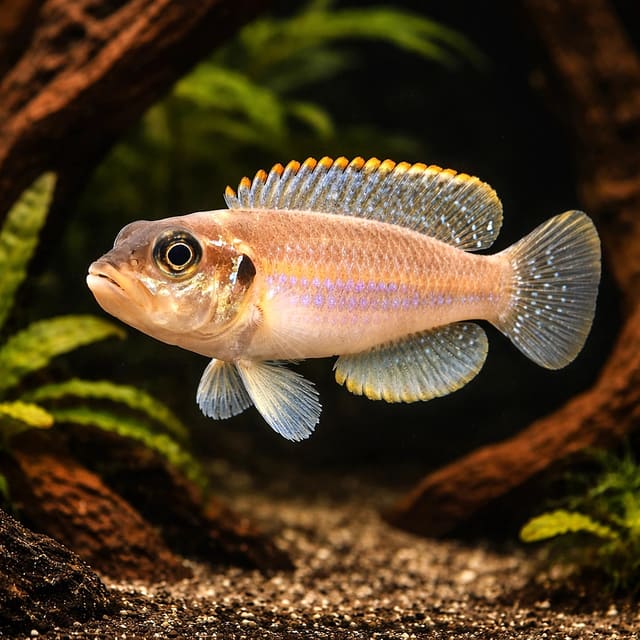
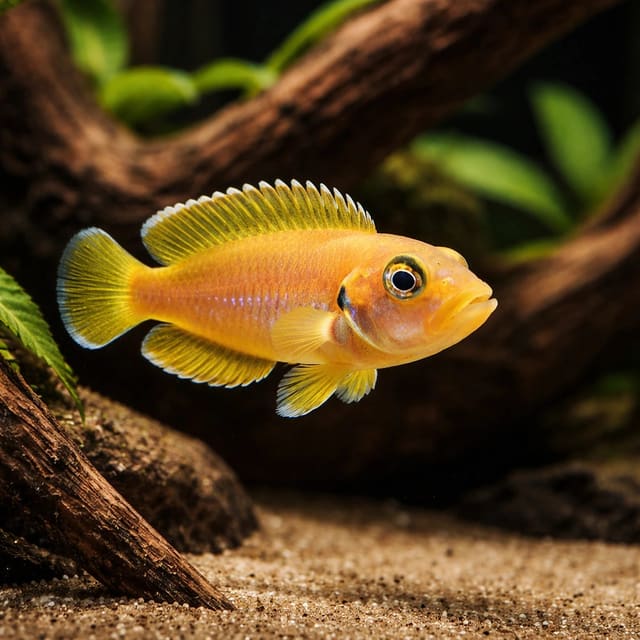
Gold Ocellatus Shell-Dweller (Neolamprologus ocellatus)
23–25°C · pH 8–9
£16.59
Julie mixed (Julidochromis sp.) is a genus-level Lake Tanganyika cichlid trade mix for experienced hard-water keepers. One purchase supplies one live fish around 3.5–4.5 cm; the species and sex are not guaranteed.
Julidochromis sp.
Save when buying multiple fish. Each quantity is one fish; sex and pair formation are not guaranteed unless the selected variant explicitly states them.
Julie mixed (Julidochromis sp.) is a genus-level Lake Tanganyika cichlid trade mix for experienced hard-water keepers. One purchase supplies one live fish around 3.5–4.5 cm; the species and sex are not guaranteed.

Cichlids are a family of roughly 1,800 accepted species, not one care type. Before buying, identify the exact species and source, then compare adult measurement, usable tank dimensions, social system, territory, tested water, diet and an exit plan. No family-wide minimum tank, water range or tank-mate list is safe.
Maintain these water conditions for optimal health and vibrant colors
Julie mixed (Julidochromis sp.) is a genus-level trade mix of cichlids commonly known as julies. The word “mixed” belongs to the offer name; it is not a species epithet. One purchase supplies one live fish at approximately 3.5–4.5 cm. The offer does not promise a particular Julidochromis species, sex, adult size, colour form or social pairing, so it should be chosen as a genuinely mixed identity rather than as a shortcut to a named species.
The Julidochromis genus summary places julies in the cichlid family and records the genus as endemic to Lake Tanganyika in eastern Africa. It also describes several formally recognised species, local variants whose status remains uncertain, and hybridisation that complicates relationships. That diversity is exactly why a photograph or a supplier word cannot safely be turned into a species name. The honest scientific parenthetical for this offer is Julidochromis sp.
The supplied 3.5–4.5 cm measurement is the dispatch grade, not an adult-size prediction. Different species within a genus can finish at different sizes and need different amounts of territory. Plan the aquarium around a confirmed identity and the individual’s development, not around the dimensions of the fish in the parcel. The same caution applies to food and social structure: a fixed “pair”, “group” or “carnivore” recipe would pretend the mix is more specific than it is.
| Offer | One live Julie cichlid per purchase |
|---|---|
| Scientific identity | Julidochromis sp.; genus level only |
| Dispatch size | Approximately 3.5–4.5 cm |
| Species | Not guaranteed within the trade mix |
| Sex | Not guaranteed |
| Native context | The genus is endemic to Lake Tanganyika |
| Keeper fit | Experienced keeper able to maintain stable hard, alkaline water and make conservative stocking decisions |
This offer best suits someone who values the genus and is comfortable leaving species-level decisions open until there is defensible identification. It is a poor match for a project that depends on receiving one named species, building a guaranteed breeding pair, following one fixed adult-size plan or completing a precise community before the animal arrives. If those details are essential, choose a correctly identified species listing instead.
Water preparation can still be responsible. OATA provides broad African lake cichlid values that give a safe shared framework for the hard-water system, while the final species plan remains separate. The aquarium should already be mature, filtered and stable. Do not use the arrival of a small juvenile to test an unfinished cycle, and do not buy several unidentified fish merely to discover later whether their adult space and social needs fit.
Use the African cichlid collection to compare this genus-level offer with named alternatives and decide whether certainty or variety matters more to your aquarium plan. The useful distinction is simple: this listing supplies one small Julie from a trade mix, while a named listing should supply the identity written in its title.
Gallery images have been digitally enhanced to improve image quality. Natural colour, pattern, size and maturity can vary between live animals.
Have the aquarium running and biologically mature before the fish is ordered. The RSPCA aquarium guidance explains the essential chain: fish release toxic ammonia, beneficial filter bacteria convert it to toxic nitrite and then to the safer nitrate. A dependable system therefore needs a working filter, oxygenated water and test results that show ammonia and nitrite remain at zero under the expected livestock load.
Maturity is demonstrated by performance rather than by waiting a fixed number of days. Test the aquarium, confirm the heater and filter can hold steady conditions, and make sure the return creates surface movement. Add livestock gradually because each addition increases waste and the bacterial population must respond. The first aquarium setup guide is a practical starting point for cycling, equipment and pre-arrival checks.
No litre figure is attached to this genus-level offer. The 3.5–4.5 cm dispatch grade cannot tell you the adult footprint because the trade mix does not identify the species. Select a tank only when it has enough permanent space for the eventual animal, its territories and any companions. If the current aquarium depends on a particular small adult size, this offer introduces the wrong kind of uncertainty.
Think in dimensions as well as litres. Length and width determine how many separate areas can exist; height cannot compensate for a short floor. Leave enough accessible space to observe the fish, feed it accurately and remove waste. Any hardscape must be stable before water and livestock are added. A juvenile can enter openings that later become restrictive, so inspect gaps as the fish develops and adjust the layout before a space becomes a trap.
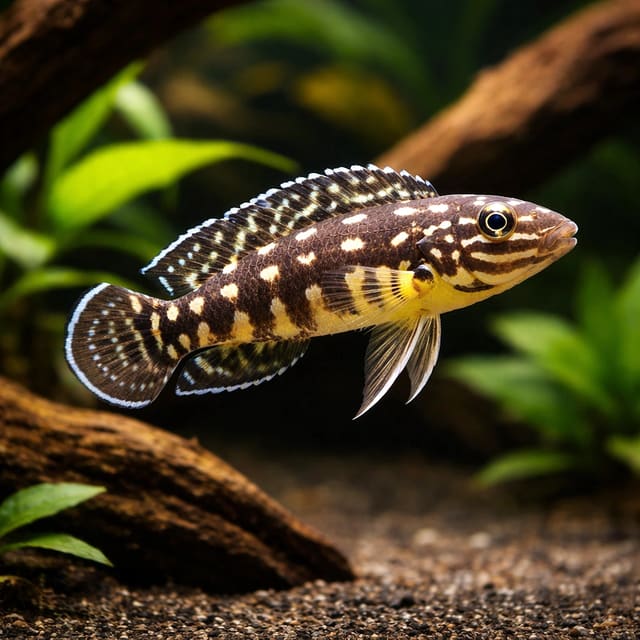
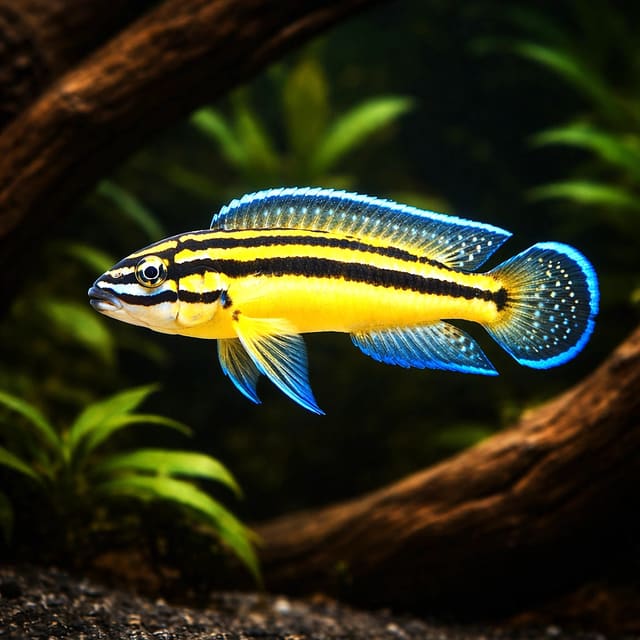
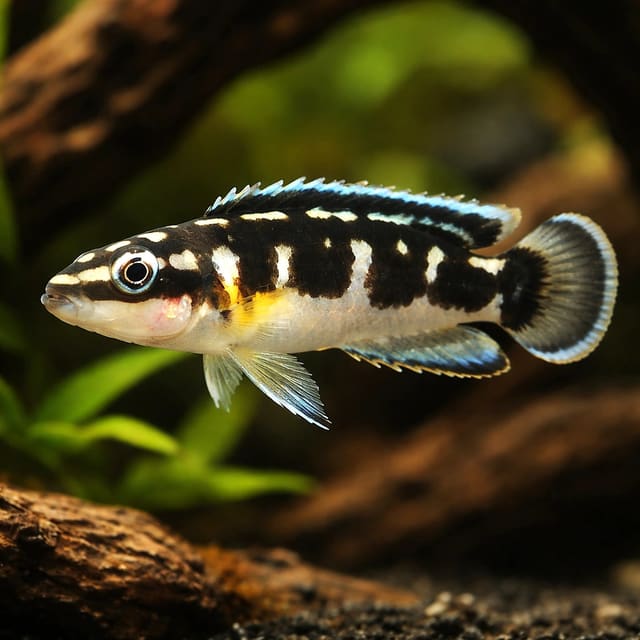
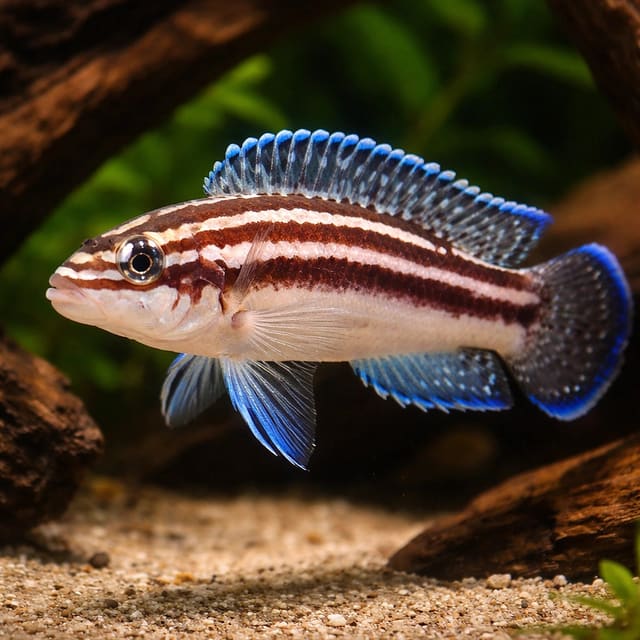
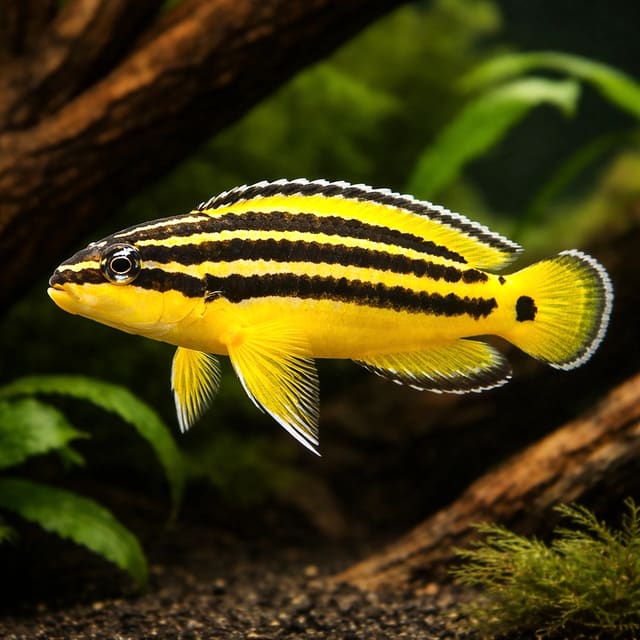
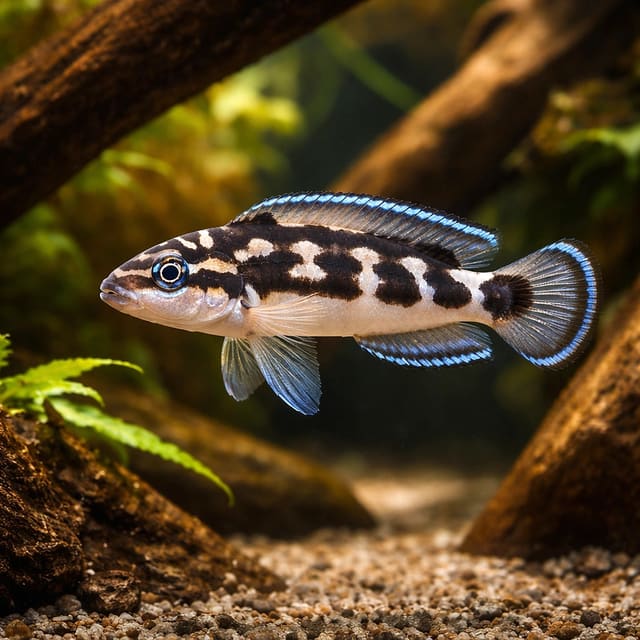
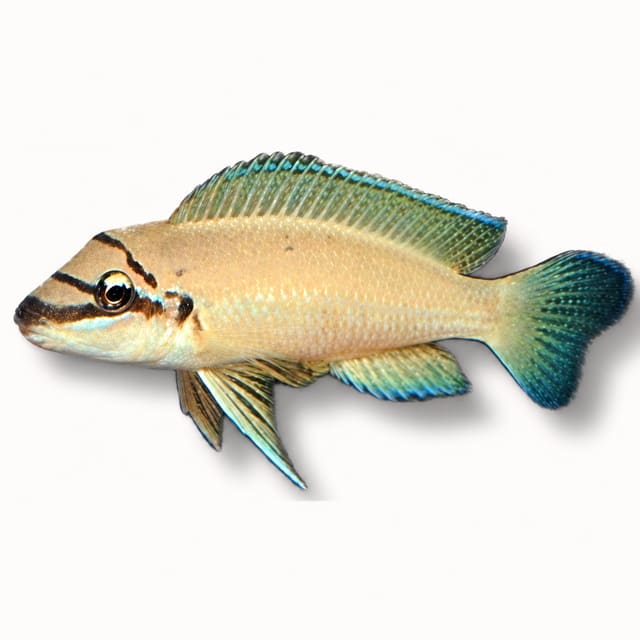
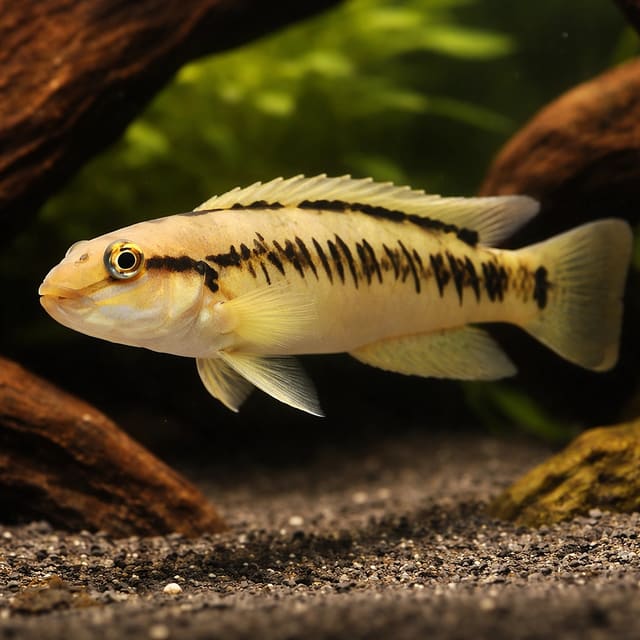
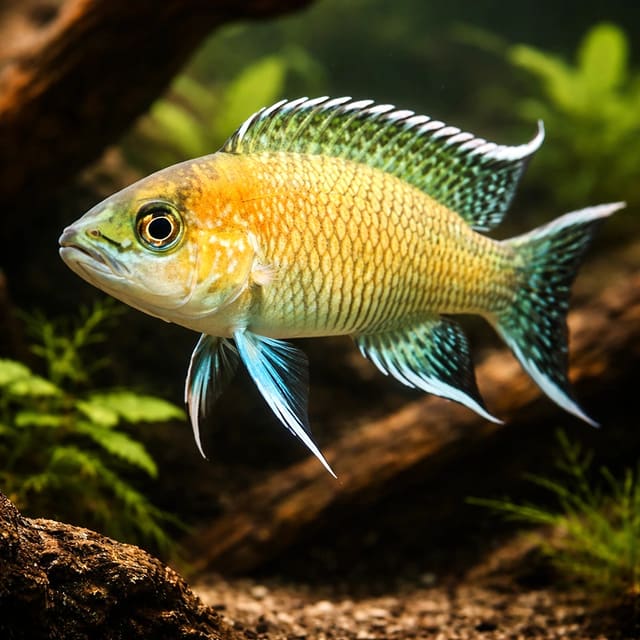
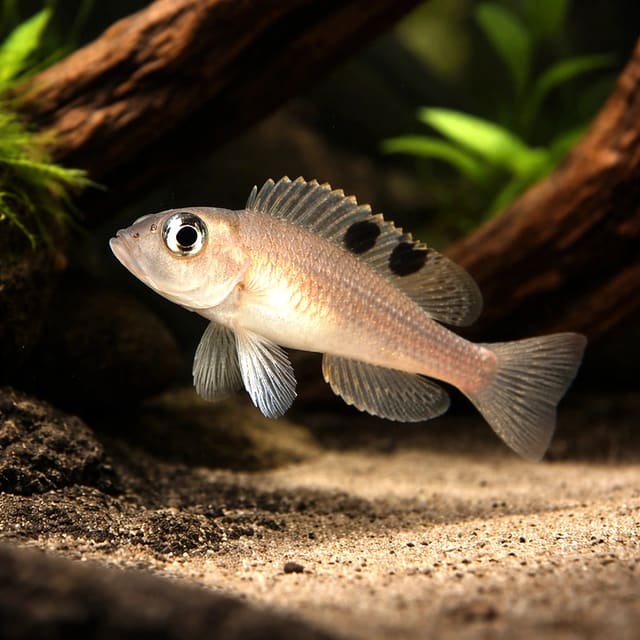
The gallery shows striped fish among rocks and plants, but an image is not a species diagnosis or a complete aquarium plan. Arrange the aquarium around safe movement, secure shelter, water circulation and cleaning access. Keep filter intakes visible, prevent décor from resting precariously on loose substrate, and ensure waste cannot collect in areas that are impossible to reach.
Use materials that do not create unpredictable chemistry. In an African lake aquarium, a mineral substrate may support hard, alkaline water, but it should never replace measurement. Test the source water and the finished tank so that you know what the materials actually do. Make changes outside the livestock aquarium where possible and confirm the result before exposing the fish to it.
Sex is guaranteed only when the selected option explicitly states male or female. This Julie mixed listing has no sex-guaranteed option. Treat that as a firm buying boundary: neither stripe pattern, colour nor the number of fish in the gallery establishes sex. The image also cannot turn a genus-level offer into a named species.
| Suits | An experienced keeper with a mature hard-water aquarium, flexible long-term space and a willingness to base later decisions on the actual animal. |
|---|---|
| Does not suit | A breeding project requiring a guaranteed pair, a community whose safety depends on one exact adult size, or a keeper who needs a fixed species diet and social number before purchase. |
The strongest reason to choose this fish is an informed interest in julies as a genus. The strongest reason to choose a different listing is that your aquarium design depends on species-level certainty. Both are valid decisions; the important point is to make the distinction before the fish arrives.
OATA’s African lake cichlid sheet gives a broad framework of 23–27 °C, pH 8.0–8.6, 12–18 dGH and 10–15 dKH. It also requires ammonia and nitrite at zero and recommends keeping nitrate no more than 20 mg/L above the normal tap-water level. These figures apply to the wider African lake cichlid group; they are useful for preparing a stable hard-water aquarium but do not prove the exact optimum of every possible species in this trade mix.
Choose a steady point within that framework that your source water and equipment can maintain. Stability matters more than repeatedly chasing one decimal place. Sudden alterations made with buffers, acids or salts can produce a worse welfare outcome than a measured system that stays consistent. Use the water chemistry guide to understand pH, general hardness, carbonate hardness and nitrogen waste, then use the water matcher to compare actual readings with the values used here.
OATA recommends a 25% partial water change at least once each week. Use a siphon to remove settled waste, condition replacement tap water for chlorine or chloramine before it enters the aquarium, and avoid a sudden temperature change. Test ammonia and nitrite at least weekly and after any event that changes the load, such as adding livestock, increasing food or a loss of filter flow.
Check the filter for blockage. When media needs cleaning, rinse it lightly in aquarium water removed during the change rather than under the tap; chlorine or chloramine can damage the bacteria that carry the biological cycle. Restore flow without stripping the filter. If flow falls again quickly, investigate excess food, trapped debris and stocking load instead of turning maintenance into a complete reset.
Nitrate should be read against the tap-water baseline. If tap water already contains nitrate, the aquarium figure alone does not show how much the livestock system has added. Record both periodically. A rising difference between tap and tank points to feeding, stocking or maintenance pressure. Hardness and pH records also reveal slow drift that a single test would miss.
Healthy assessment is a pattern, not one colour or pose. Check swimming, balance, breathing, appetite, body condition, fins and scales. A new habit of remaining at the surface, sitting unusually, hiding continuously, breathing faster or ignoring food should prompt immediate water tests and an equipment check. The response begins with temperature, oxygenation, ammonia, nitrite and filter flow before any assumption about disease.
Keep a compact log with the date, temperature, pH, hardness, ammonia, nitrite, nitrate, water-change amount and any behaviour change. The purpose is not bureaucracy; it is to make cause and effect visible. When the aquarium changes, compare recent results before adding chemicals or more fish.
African lake cichlids do not all eat alike. OATA distinguishes different feeding needs across the group, so this listing does not label every possible Julie in the mix as carnivorous, herbivorous or omnivorous. Match the long-term diet to a defensible identity rather than copying the old generic protein prescription. A food that is appropriate for one species may be poorly balanced as the sole diet for another.
For the immediate routine, use a correctly sized complete food chosen for the animal and observe how it is taken. OATA’s group advice is to offer only what fish consume within a few minutes, twice daily. That is a maximum feeding window, not a reason to keep adding food until the time expires. Begin with a small amount, confirm the fish swallows it cleanly, and stop before pieces disappear into décor or the filter.
Feed where the fish can reach food without being driven away. In a shared aquarium, watch the individual rather than assuming every portion is distributed fairly. A bold resident may intercept everything; a shy newcomer may remain hidden; sinking food may lodge between rocks. Separate feeding areas or a temporary holding arrangement may be needed if you cannot verify that the Julie has eaten.
Choose particle size for the supplied 3.5–4.5 cm fish, then adjust as its mouth and feeding response change. Do not assume the dispatch measurement defines a permanent food size. Remove uneaten food promptly because decomposition adds ammonia and pushes the filter harder. If waste rises after a menu change, reduce the amount and reassess the food rather than increasing water treatments to compensate.
A missed meal is information, not an instruction to offer several rich alternatives at once. Check water, temperature, social pressure and recent handling. Changing many variables together makes the cause harder to identify. Once the animal’s identity is reliable, refine the staple and variety to the needs of that species.
A mature filter, zero ammonia and nitrite, stable hard alkaline water, careful feeding portions and reliable observation can be prepared now. Permanent footprint, adult clearance, precise staple diet, social number and final companions depend on the actual animal. Keeping those two categories separate prevents a temporary juvenile setup from becoming an accidental long-term commitment.
| Decision | What must support it |
|---|---|
| Permanent aquarium dimensions | A reliable species identity and its mature spatial needs, never the dispatch grade alone |
| Social number | Species, available territory, sex where genuinely known and observed interactions |
| Long-term staple diet | Species-appropriate feeding information and the individual’s response |
| Companions | Comparable water, mature size, territory use, feeding access and behaviour |
| Breeding plan | Confirmed identity and sex plus an intentionally designed arrangement |
First commit to water quality and biological capacity. Next confirm that the fish can rest, move and feed without pressure. Only then consider permanent companions or additional Julie cichlids. This order keeps each decision reversible while information is limited. It also stops a second purchase from being used as a test of whether the first fish “wants company”.
If the intended aquarium has no room for change, a named species is the safer purchase. A fixed community may be balanced around exact adult dimensions and behaviour; inserting an unidentified fish can invalidate those calculations. Flexibility is therefore part of the care requirement, not merely a shopping preference.
Keep clear dated photographs and notes on growth, feeding, colour changes, hiding and interactions. These records are useful when comparing the animal with defensible identification material, but one photograph should not be treated as proof. Similar-looking forms and changing juvenile patterns are precisely why the scientific field remains Julidochromis sp. until a reliable identification is available.
When an identity becomes reliable, update the aquarium plan as one coherent set: adult space, food, social structure and companions. Do not change only the name while leaving generic assumptions in place. If certainty never improves, continue managing conservatively and avoid commitments that require a species-level prediction.
One purchase supplies one unsexed fish. Buying two does not create a bonded pair, and buying several does not guarantee a workable group. OATA notes that social numbers vary between African lake cichlid species. Because this trade mix leaves the species open, no responsible fixed number can be assigned to every fish sold under the name.
Decide only after considering the exact identity, mature space, sex where genuinely known, territory pattern and the behaviour already present in the aquarium. If several fish are being considered, the aquarium must also support separation if one individual is excluded or persistently chased. Do not rely on a young fish appearing calm during the first few days; social pressure can change as animals mature and claim space.
OATA advises against treating African lake cichlids as one interchangeable community and specifically separates Malawi and Tanganyika stocking. Julie cichlids belong to the Lake Tanganyika genus context. A fish sharing hard alkaline water is still not automatically compatible: adult size, territory, feeding speed and social organisation must also fit.
Avoid soft-water residents that need acidic conditions, because one aquarium cannot remain both hard alkaline and soft acidic. Avoid any combination that depends on one species being peaceful, tiny or pair-forming when this offer does not establish those traits. Consider other Tanganyika animals only after their water, space and social needs have been compared with the actual Julie in front of you.
Watch every introduction closely. Repeated chasing, blocked access to food, damaged fins, a fish pinned at the surface or continuous hiding are signs that the arrangement needs intervention. Increasing the number of fish is not a universal cure. First verify water and oxygen, then assess space, shelter, feeding access and the individual causing pressure.
Rearranging décor can disrupt established territories when a new cichlid is introduced, as OATA suggests, but it cannot make an undersized aquarium or incompatible species safe. Any change must leave hardscape secure. A separate backup aquarium or rehoming route should be available before experimenting with uncertain combinations.
The result is a conditional decision, not a universal tank-mate list. This is particularly important for a trade mix: the name gives a genus, but the safe community depends on the individual animal and the final identification.
The aquarium should already meet the chosen hard-water framework, with ammonia and nitrite at zero, stable temperature and a working filter. Have a clear route from the parcel to the aquarium and keep other livestock calm. Avoid major maintenance, hardscape rebuilding or a large chemistry adjustment on arrival day.
Tropical Fish Co’s current delivery and Live Arrival Guarantee policy explains packing, receipt and the claim process. Live fish are hand-bagged in oxygen, placed in an insulated box with a heat pack when conditions call for it, and carried by a licensed live-animal courier. Someone must be present to receive the parcel.
If a Live Arrival Guarantee claim may be needed, start one continuous unboxing video while the parcel is still sealed. Show the outer box, the opening and the fish still inside the sealed bag before anything is disturbed. Contact Tropical Fish Co on the same day with the order number and video. This sequence matters because opening first and trying to recreate the evidence afterwards does not show the original arrival condition.
After the arrival record is secured, follow the policy direction to float the sealed bag for 20–30 minutes before release. Do not pour bag water into the aquarium. Observe breathing, balance and swimming after transfer. Avoid an immediate heavy meal, and check the receiving fish cannot be cornered by established residents.
During the first day, confirm heater and filter operation and test ammonia and nitrite if anything looks unusual. In the first week, check that the fish emerges, breathes evenly and obtains food. Do not add more animals while you are still learning its normal behaviour. The arrival period is also the first opportunity to see whether the intended aquarium gives this unidentified Julie enough secure space and feeding access.
It means one fish from the Julidochromis genus is sold under a supplier trade-mix label. “Mixed” is not a species name, so the offer does not guarantee which Julie species, colour form, sex or adult size will be supplied.
One live fish around 3.5–4.5 cm is supplied per purchase. That is the dispatch grade only and must not be used as an adult-size forecast.
Use OATA’s broad African lake cichlid framework of 23–27 °C, pH 8.0–8.6 and 12–18 dGH, with ammonia and nitrite at zero. These are group values rather than a species-specific optimum, so keep them stable while refining the plan only after the fish is reliably identified.
There is no universal number for this trade mix. One purchase is one unsexed fish; two purchases do not guarantee a pair. Social numbers must follow the identified species, available territory, sex where genuinely known and observed behaviour.
This store rates the offer advanced. Stable hard alkaline water is achievable, but unresolved species, adult size, diet and social requirements make aquarium and companion decisions less forgiving than they are with a correctly identified fish.
Diet varies across African lake cichlids, so do not assume every fish in the mix needs the same protein-heavy menu. Use correctly sized complete food selected for the identified animal, and offer only what it consumes within a few minutes, up to twice daily under OATA’s general feeding guidance.
The trade label does not support one universal temperament. Watch access to food and shelter, repeated chasing, fin condition and hiding, and be prepared to separate fish if an individual cannot feed or rest normally.
Consider only carefully selected Lake Tanganyika species with compatible water, adult space, feeding and social needs. Do not combine it with Malawi cichlids as a generic mixed-lake community or with soft-water fish that require acidic conditions.
Tropical Fish Co hand-bags the fish in oxygen, uses an insulated box and adds a heat pack when conditions call for it, then sends it with a licensed live-animal courier. Someone must receive it. For a Live Arrival Guarantee claim, film continuously from the sealed parcel through opening to the fish still in the sealed bag, then contact the shop the same day.
No reviews for this item yet. Bought one? Honest reviews only, good or bad.
What customers say about ordering from us
Easy website plenty of info on fish your buying great to pick a time slot
TRACEY DURRANT · 7 Oct 2026
Got some lovely fish thank you
Kevin Mackie · 7 Oct 2026
Reviews of our shop, collected by Judge.me, an independent third-party review collector. Newest first.