Marlier's Julie (Julidochromis marlieri)
23–25°C · pH 8–8.6 · 110L
£8.99

Striped Julie Kipili is the Kipili endemic Julidochromis marksmithi, formerly traded as J. regani "Kipili". It needs a mature hard, alkaline aquarium with secure rockwork and careful pair planning.
Adult size is the maximum length this species reaches at full maturity (scientific sources). The livestock you receive will be younger and smaller — pick a size above for the actual shipping size. Product-photo provenance and any image-specific limitations are stated on the listing.
Julidochromis marksmithi
Save when buying multiple fish. Each quantity is one fish; sex and pair formation are not guaranteed unless the selected variant explicitly states them.
Striped Julie Kipili is the Kipili endemic Julidochromis marksmithi, formerly traded as J. regani "Kipili". It needs a mature hard, alkaline aquarium with secure rockwork and careful pair planning.
Adult size is the maximum length this species reaches at full maturity (scientific sources). The livestock you receive will be younger and smaller — pick a size above for the actual shipping size. Product-photo provenance and any image-specific limitations are stated on the listing.
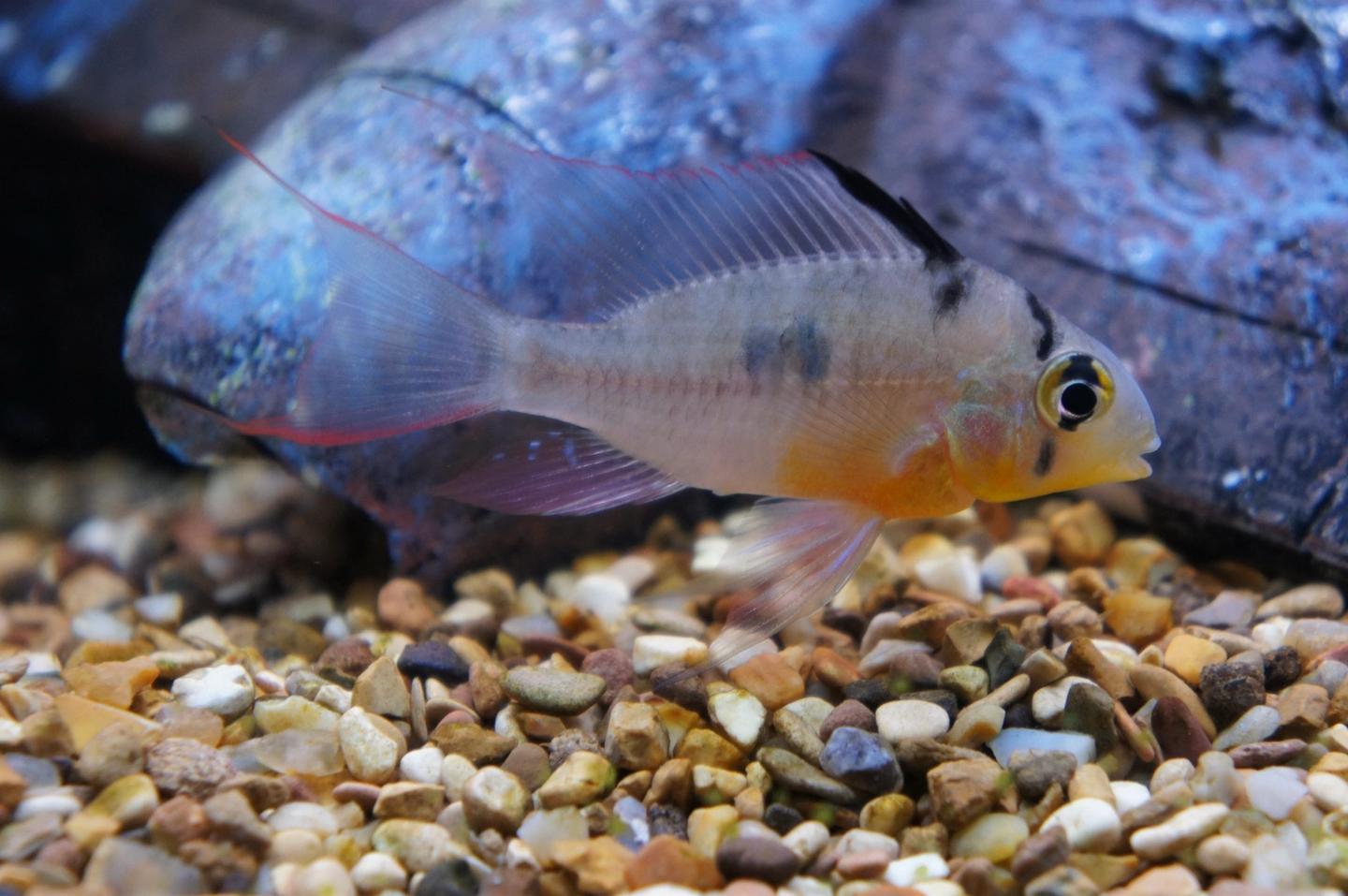
Cichlids are a family of roughly 1,800 accepted species, not one care type. Before buying, identify the exact species and source, then compare adult measurement, usable tank dimensions, social system, territory, tested water, diet and an exit plan. No family-wide minimum tank, water range or tank-mate list is safe.
Maintain these water conditions for optimal health and vibrant colors
Striped Julie Kipili is the established aquarium trade name for Julidochromis marksmithi, a slender rock-dwelling cichlid found around Kipili on the Tanzanian shore of Lake Tanganyika. Older stock lists and care guides often call this fish Julidochromis regani "Kipili", but the Kipili fish was formally described as J. marksmithi in 2014 and is treated as an accepted species by current taxonomic references.
One product quantity buys one unsexed fish in the approximate size band selected on this page. It does not buy a bonded pair, and sex, exact markings, breeding compatibility or an individual shown in the gallery are not guaranteed. The live size selector shows which options are currently available.
This is a territorial Lake Tanganyika cichlid for a mature, hard-water aquarium with secure rockwork, strong oxygenation and a plan for pair formation. It is not a general soft-water community fish. A compatible adult pair can make a fascinating display, but a juvenile group needs substantially more space and a practical way to remove extra fish once a pair forms.
| Detail | Practical guidance |
|---|---|
| Accepted name | Julidochromis marksmithi Burgess, 2014 |
| Legacy trade name | Julidochromis regani "Kipili" or Regani Kipili |
| Natural range | Endemic to the Kipili area of Lake Tanganyika, Tanzania |
| Sale unit | One unsexed fish in the selected approximate size band; not a bonded pair |
| Adult planning size | Allow for roughly 10-12 cm total length; FishBase records 6.3 cm standard length, which excludes the tail |
| Temperature | Keep stable around 23-25°C |
| Water | Hard and alkaline; approximately pH 8.0-9.0 and 15-25 dGH |
| Aquarium plan | At least 120 cm long and about 150 litres or more for one compatible pair; use a substantially larger, multi-zone aquarium for a community or growing juvenile group |
| Temperament | Territorial around rocks and caves, especially after pairing or during spawning |
| Diet | Varied omnivore: quality small pellets or flakes plus suitable frozen invertebrate foods |
| Breeding | Substrate or cave spawner that forms a pair and guards eggs and fry |
Older aquarium records use the label Julidochromis regani Kipili. That name remains useful as a trade-name bridge because experienced aquarists may know the fish by it, but it is no longer the accepted scientific identity. FishBase recognises Julidochromis marksmithi, records it from the Kipili area and cites Burgess's 2014 description. The exact Eschmeyer's Catalog of Fishes species record also lists the name as valid.
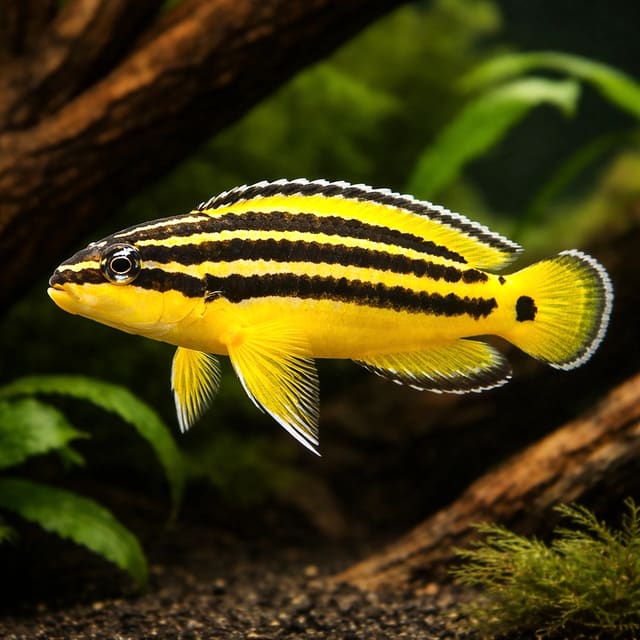
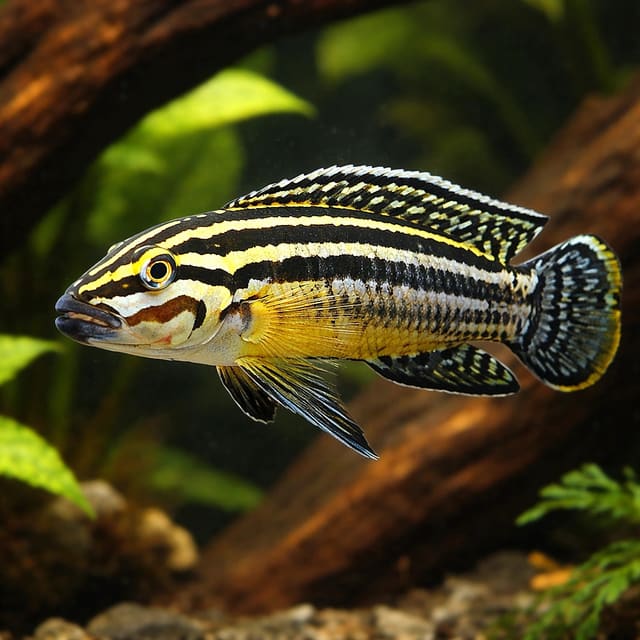
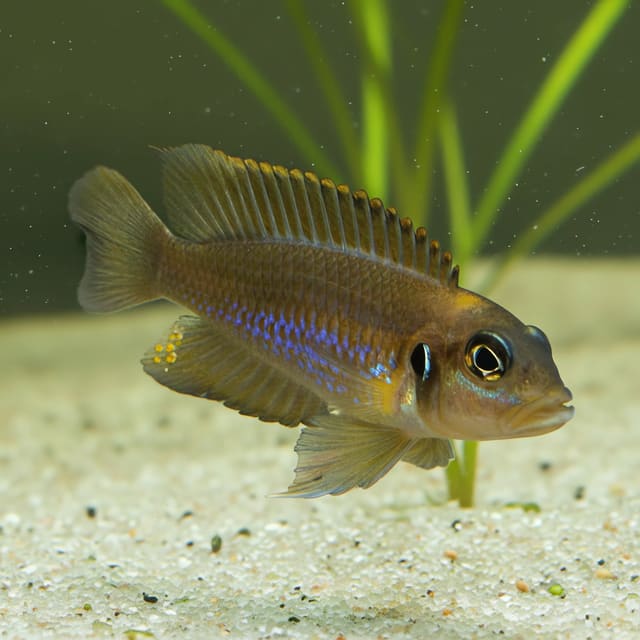
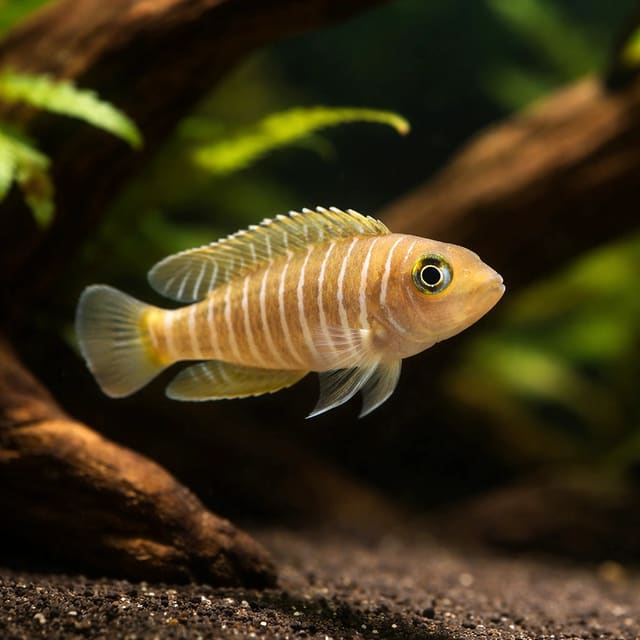
J. marksmithi is bright yellow with two main dark horizontal body bands, a shorter upper stripe and a cheek stripe. These characters help distinguish it from the larger true J. regani. The species is associated with rocky habitat where sandy areas occur nearby, so a mixed rock-and-sand shoreline layout is more appropriate than presenting it as a fish of bare open water.
FishBase gives a maximum of 6.3 cm standard length. Standard length stops at the base of the tail and should not be compared directly with an aquarium retailer's total-length measurement. UK aquarium references report up to about 12 cm total length. For husbandry, it is safer to plan space, caves and tank mates around a possible 10-12 cm adult than to assume every fish will remain 6 cm nose to tail.
Litres alone do not make a suitable Julie aquarium. Horizontal territory, cave distribution and uninterrupted escape routes matter just as much. For one established compatible pair, use an aquarium at least 120 cm long and about 150 litres or more. A Tanganyika community or a group of juveniles being allowed to choose partners needs a substantially larger, multi-zone aquarium with genuinely separate rocky territories; do not treat the pair minimum as a group allowance.
Set the main rocks directly and securely before adding sand so digging cannot undermine them. Build several caves, narrow gaps and visual barriers rather than one central pile with a single valuable crevice. Each fish should be able to leave another fish's line of sight without becoming trapped in a dead end. Smooth sand or fine gravel suits the mixed habitat and makes waste easier to see.
Plants are optional. Tough plants can be used outside the main territories if they tolerate hard alkaline water, but they do not replace caves. Leave some open substrate between rock groups so territorial boundaries are legible to the fish. A secure cover is sensible because a chased or startled cichlid can jump through surprisingly small gaps.
Browse the Julidochromis category to compare related species, or review the wider Lake Tanganyika cichlid range. Similar body shape does not mean different Julie species or locality forms should be mixed: territorial conflict and uncertain hybrid ancestry are both reasons to choose deliberately.
Striped Julie Kipili is better described as territorial than indiscriminately aggressive. A compatible pair may spend long periods moving calmly through its rock zone, then defend a cave forcefully when eggs or fry are present. The main danger is sustained pressure on a fish that cannot leave the dominant pair's territory.
Sex is difficult to guarantee from ordinary juvenile stock. One method is to start with several juveniles in a properly sized aquarium, allow a compatible pair to form and remove the extras promptly. That method is not permission to leave a rejected fish being pinned behind a filter or at the surface. Have a mature spare aquarium, dividers or a rehoming plan ready before the group begins to mature.
Buying two unsexed fish does not guarantee one male and one female, and even opposite-sex fish may not accept each other. Do not force unfamiliar adults into one small cave system. Watch for persistent hiding, torn fins, refusal to feed, rapid breathing and one fish being excluded from the rockwork. Rearranging territories can sometimes interrupt aggression, but separation is the correct response when a fish cannot recover.
Lake Tanganyika is mineral-rich and alkaline. Maintain this species around pH 8.0-9.0 and roughly 15-25 dGH, with a stable working temperature around 23-25°C. Consistency matters more than repeatedly adjusting the water to hit an exact decimal. Sudden pH, hardness or temperature changes can be more harmful than a stable value inside the suitable range.
| Priority | Action | Reason |
|---|---|---|
| Biological maturity | Introduce fish only after ammonia and nitrite control is proven | Hard alkaline water makes ammonia exposure particularly dangerous |
| Oxygenation | Maintain strong surface movement and dependable filter flow | Tanganyika cichlids are adapted to clear, oxygen-rich water |
| Stability | Match replacement water for temperature and mineral chemistry | Abrupt swings create avoidable physiological stress |
| Waste control | Use regular measured water changes and remove food trapped between rocks | Territorial fish still need clean water throughout every cave |
Naturally hard tap water, appropriate mineral media or a measured Tanganyika remineralisation method can all work. Test the method before the fish arrives. Avoid large unmeasured doses of buffer, and do not use an incoming fish to discover whether a newly arranged aquarium is cycled. The tank volume calculator can help check actual water volume after displacement by substantial rockwork.
In nature, Julidochromis marksmithi feeds around algae-covered rock surfaces on small crustaceans, insect larvae, molluscs and occasional drifting plankton. In the aquarium, use a varied omnivorous diet rather than treating it as either a strict algae eater or a fish that needs heavy high-protein feeding.
A quality small cichlid pellet or granule can form the staple. Rotate suitable frozen foods such as Cyclops, daphnia, brine shrimp or mysis, and include a balanced flake or food with plant material. Choose pieces the fish can take cleanly. Feed measured portions that are cleared promptly, checking that a subordinate fish can reach food without entering the dominant pair's cave.
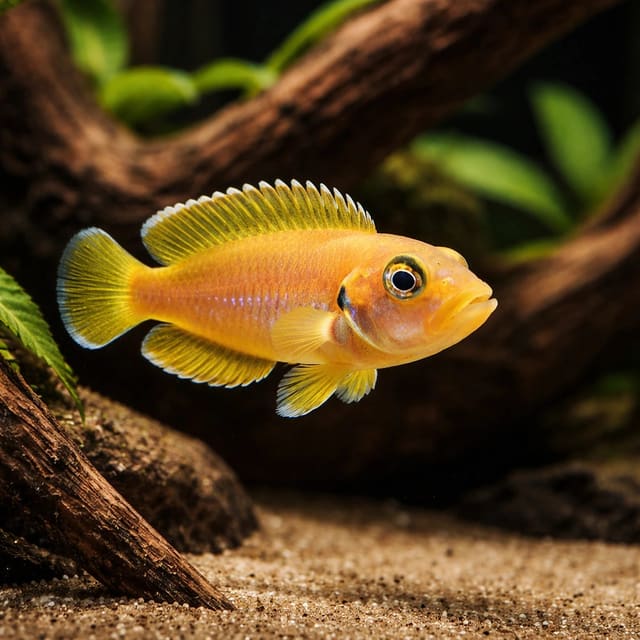
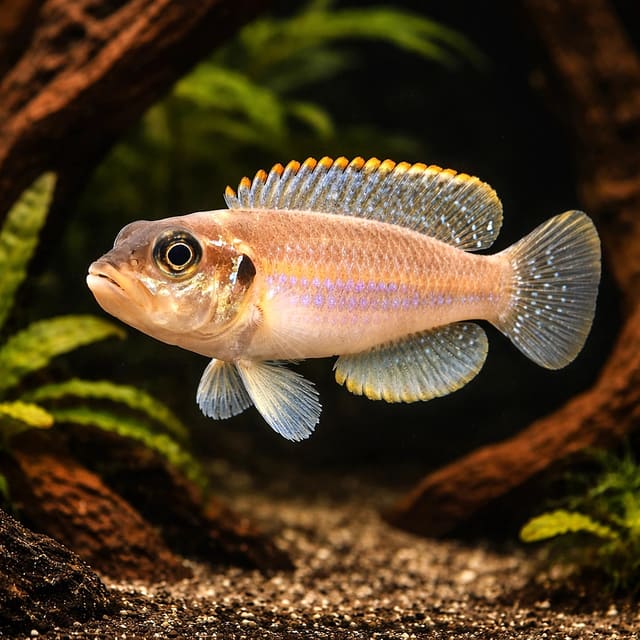
Avoid overfeeding rich foods to intensify colour. Excess food disappears between rocks, degrades water and can hide a social problem: a dominant fish growing quickly while a pressured fish becomes thin. Normal colour also varies with age, sex, lighting, social status and the individual; it should not be judged against the saturation of a generated gallery illustration.
Choose companions by adult size, water chemistry, feeding behaviour and territory zone. In a large, carefully structured aquarium, possible companions include appropriate shell dwellers using a separate floor area, open-water Cyprichromis, or other non-predatory Tanganyika cichlids whose territories do not overlap heavily. Every combination still needs observation and enough space for the most territorial adult stage.
Avoid soft-water tetras and rasboras, delicate nano fish, large piscivores, persistent fin nippers and highly aggressive Malawi mbuna. Avoid casually mixing other Julidochromis species or locality forms, especially where breeding may occur. Similar fish can compete for the same narrow caves, and offspring of uncertain parentage should not be represented as locality-pure stock.
For comparison rather than an automatic mixing recommendation, see Marlier's Julie, Dickfeld's Julie and Golden Julie. The general cichlid care guide explains cycling, observation and water-quality principles that apply across the group.
J. marksmithi is a cave or substrate spawner. A compatible pair selects a protected surface within the rockwork, lays and guards the eggs, and continues defending fry around the territory. Eggs may be hidden so well that the first obvious sign is a small group of fry close to a crevice.
Stable water, suitable caves and low social stress are more important than attempting to trigger spawning with sudden environmental changes. Protect filter intakes if fry are present and avoid dismantling a chosen territory without a welfare reason. Parents may tolerate multiple broods for a time, but the available territory eventually determines how many fish can remain safely.
This listing does not promise a particular sex, a breeding pair or successful spawning. If provenance matters, retain the accepted J.
The size options on this page are approximate supplier bands, not exact measurements for an individually photographed fish. Smaller juveniles can adapt well to a planned group, while larger fish may establish territories sooner and require closer compatibility monitoring. Select the size that fits the social plan already in place, not simply the largest available option.
Prepare a mature aquarium before ordering. Confirm temperature, pH, hardness, ammonia, nitrite and filter operation; secure the rockwork; and make sure every current inhabitant is suitable. Our new-fish acclimation guide covers the arrival process. Keep the lights subdued, minimise abrupt temperature and chemistry changes, and give the fish access to cover without prolonging its time in shipping water unnecessarily.
During the first fortnight, monitor breathing, appetite, fins and access to territory. A newly arrived Julie may stay close to cover while it maps the aquarium, but continuous panic hiding or exclusion is not something to wait out indefinitely. Test water and assess aggression before reaching for medication. Eligible livestock orders are covered only under the current Live Arrival Guarantee and delivery terms, so review those conditions before dispatch.
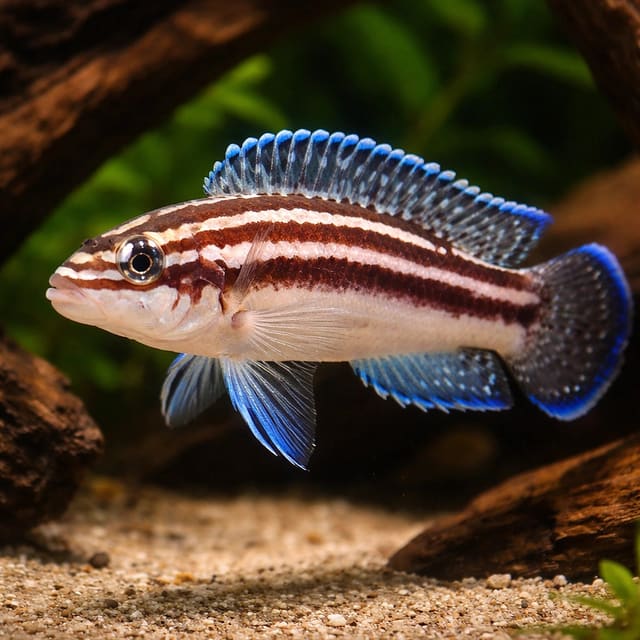
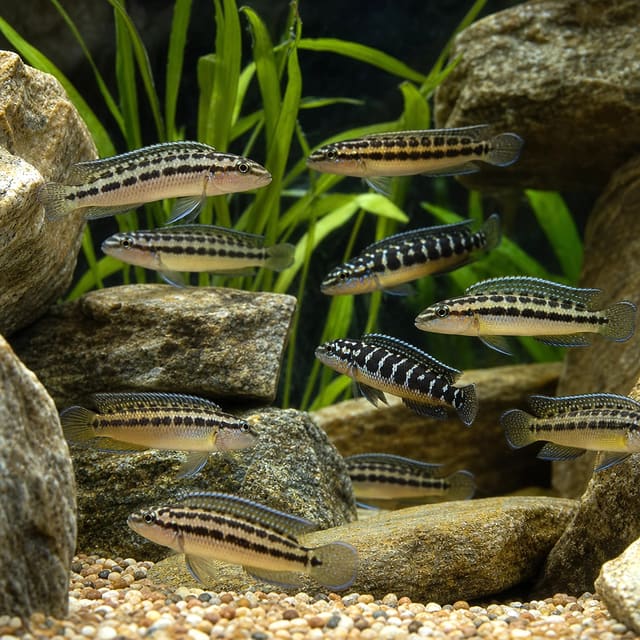
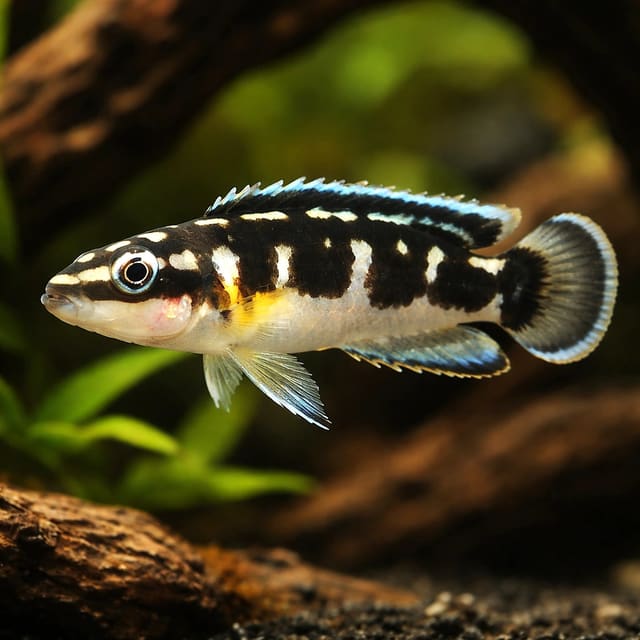
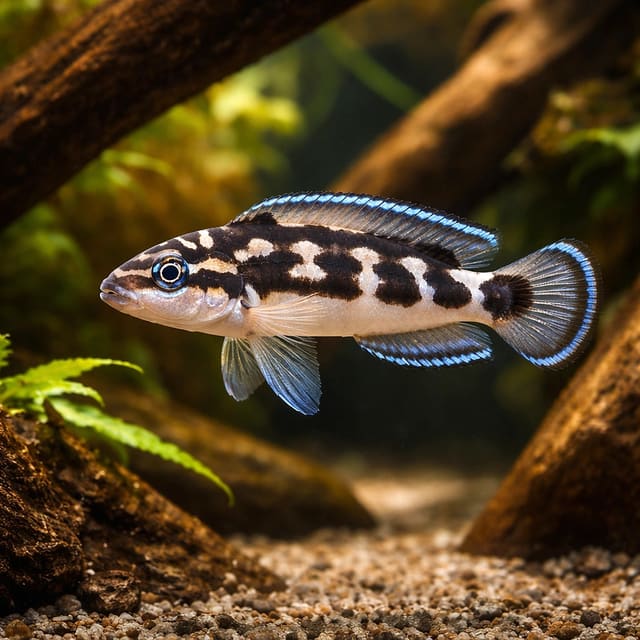
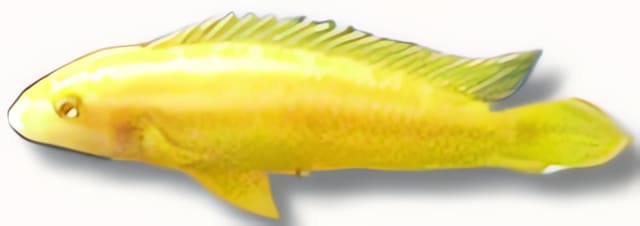
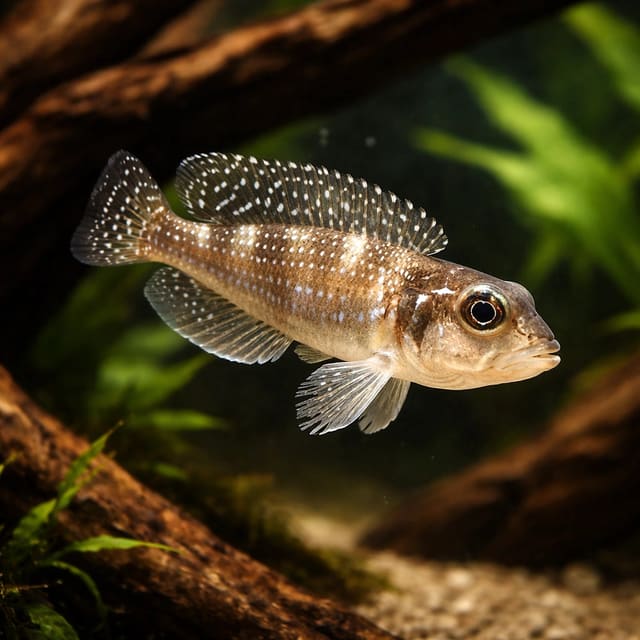
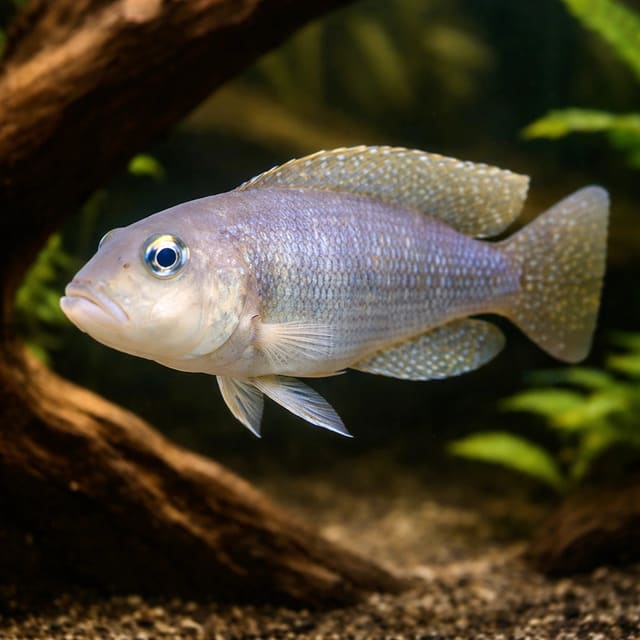
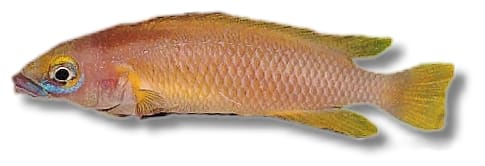
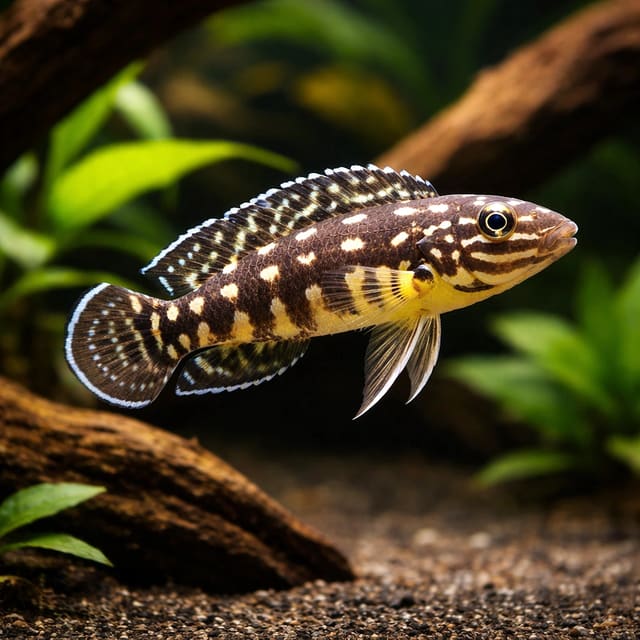
Gallery images 1-4 are representative illustrations. Image 5 is the reference photograph. They show the product's general appearance, but none is a photograph of the exact individual dispatched.
| Gallery positions | Media type | How to use it |
|---|---|---|
| 1-4 | representative illustrations | Use for a general impression of form and pattern; colour, sex, pairing and exact markings are not promised |
| 5 | reference photograph | Use as the closest source reference for the supplied stock form, while allowing for individual variation |
The image showing two fish does not mean the sale contains two fish or a bonded pair. The leaf beside one illustration is scenery, not a measuring scale. Compare the complete gallery, the selected approximate size option and the written care information rather than inferring quantity or adult size from one image.
The identity and wild-size evidence comes from FishBase's Julidochromis marksmithi account, which cites the original 2014 description and records the species from rocky habitat near sand around Kipili. The July 2026 Eschmeyer's Catalog of Fishes record lists the name as valid. Aquarium length, total length, temperature, hardness, feeding and the older J. regani "Kipili" name follow a UK care profile. The 150-litre floor remains above the 100-litre comparison value in the Nordiska Ciklidsallskapet species register, while the stricter 120 cm UK length is used.
No reviews for this item yet. Bought one? Honest reviews only, good or bad.
What customers say about ordering from us
I have a small group of long finned mountain minnows. So was delighted to be able to order ten of this variety to increase the genetics in my tank . The ones I recieved are healthy but it’s to early to give a verdict on wether they are of a long finned type since they are small currently.
Gordon Walker · 23 Sept 2026
100% success travel and "installation". Pleased with quality of purchase. The Siamese fighter a bit "shy" so have not yet seen him at his best yet but looking good. Happy customer. GG
George E Garratt · 21 Sept 2026
Reviews of our shop, collected by Judge.me, an independent third-party review collector. Newest first.