Moderate
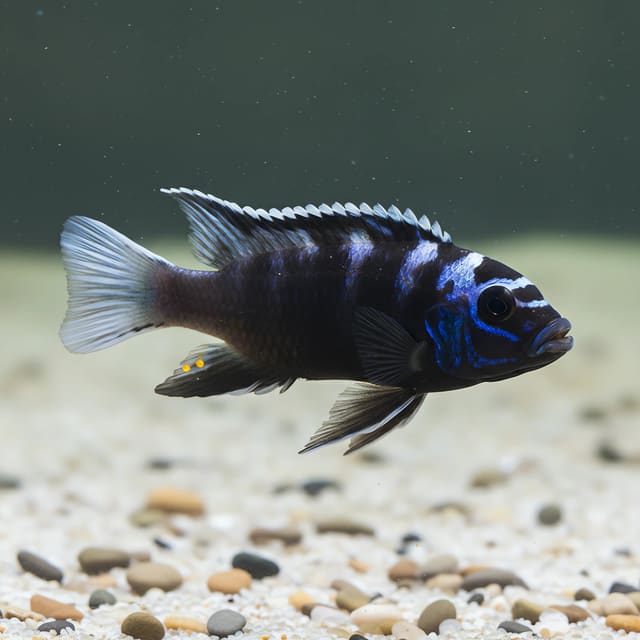
Acei Cichlid (Pseudotropheus sp. “acei”)
24–26°C · pH 7.5–8.5 · 300L
£7.99

Venustus (Haplochromis venustus) is a large Lake Malawi ambush cichlid for experienced keepers with a spacious, hard-water aquarium. One purchase supplies one live fish in the chosen dispatch size; sex is not guaranteed.
Haplochromis venustus
Save when buying multiple fish. Each quantity is one fish; sex and pair formation are not guaranteed unless the selected variant explicitly states them.
Venustus (Haplochromis venustus) is a large Lake Malawi ambush cichlid for experienced keepers with a spacious, hard-water aquarium. One purchase supplies one live fish in the chosen dispatch size; sex is not guaranteed.
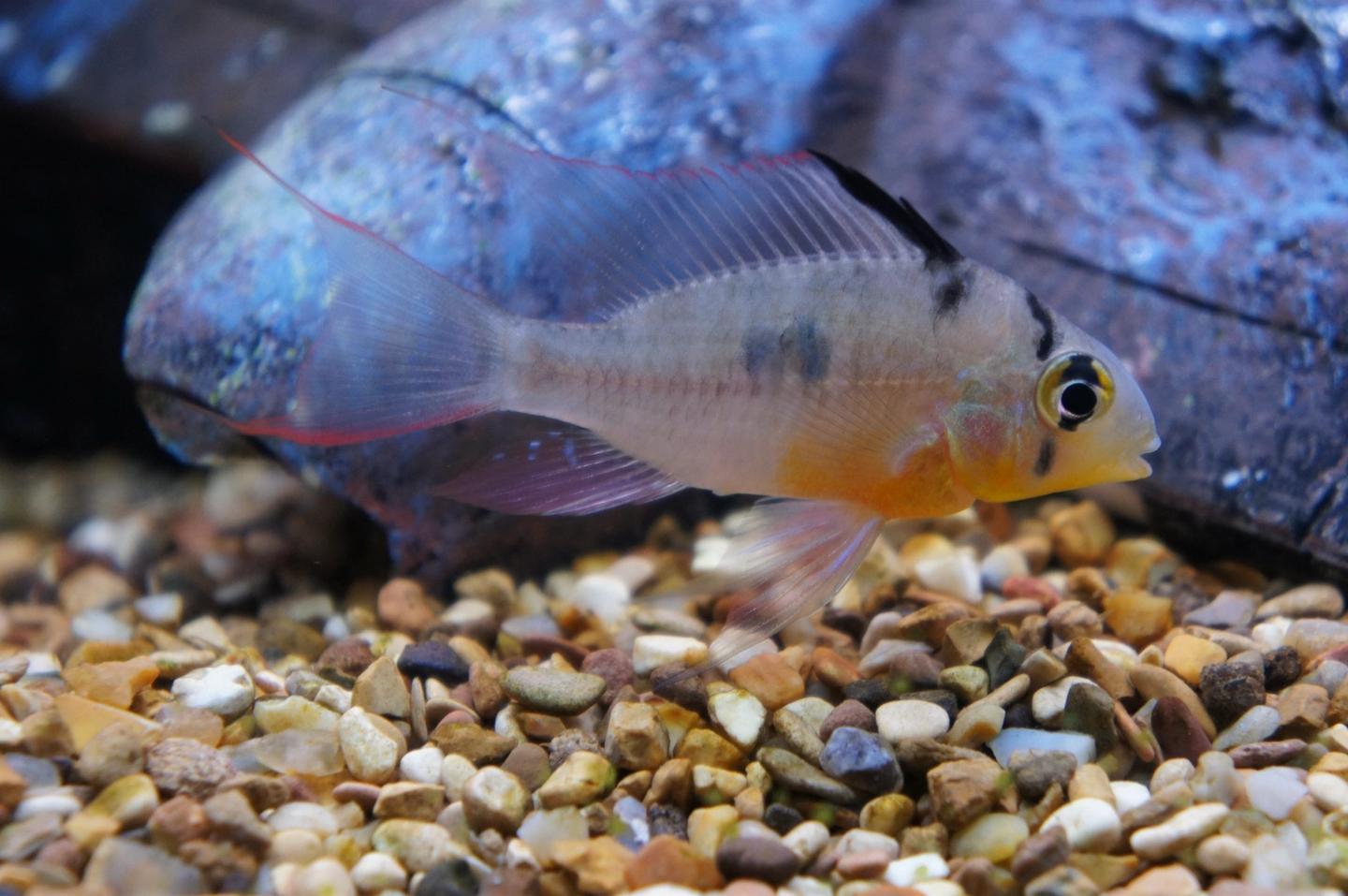
Cichlids are a family of roughly 1,800 accepted species, not one care type. Before buying, identify the exact species and source, then compare adult measurement, usable tank dimensions, social system, territory, tested water, diet and an exit plan. No family-wide minimum tank, water range or tank-mate list is safe.
Maintain these water conditions for optimal health and vibrant colors
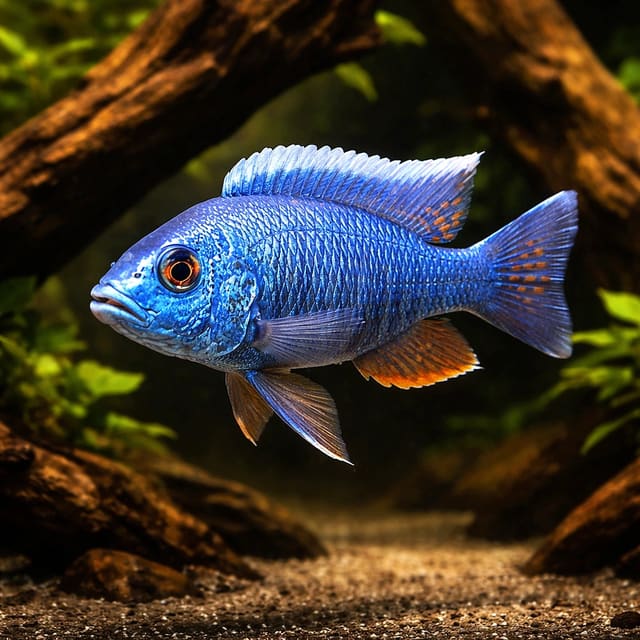
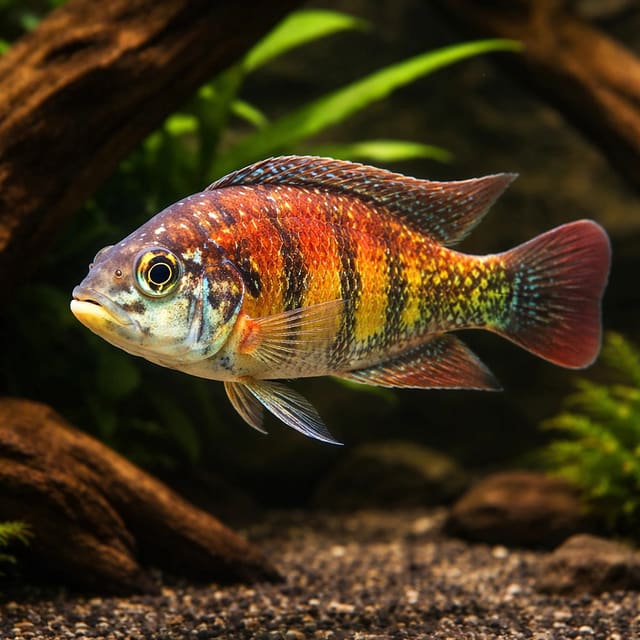
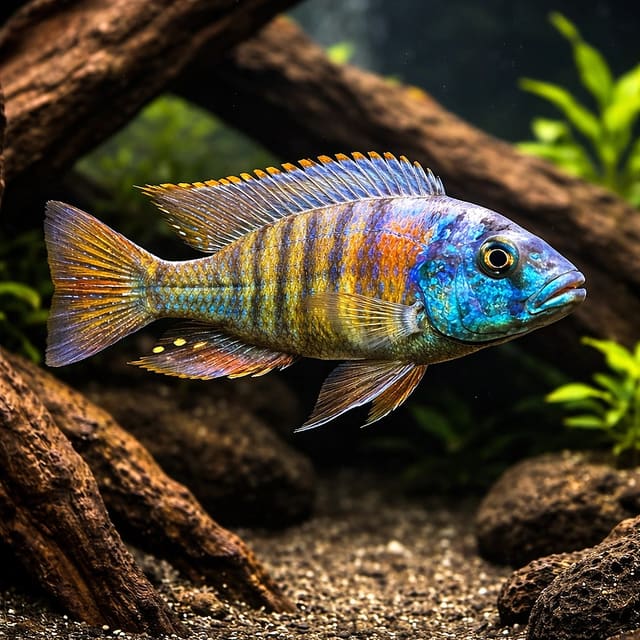
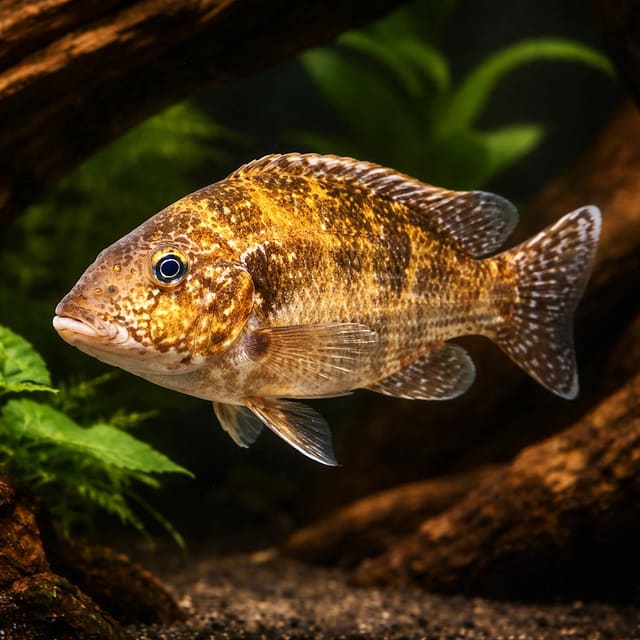
Venustus (Haplochromis venustus) is a substantial Lake Malawi cichlid with a patient ambush-predator strategy and the sort of adult scale that changes the whole stocking plan. The accepted scientific combination is Nimbochromis venustus; Haplochromis venustus is the supplier-linked synonym used for this offer. It is also widely known as the giraffe hap, a name inspired by the broken dark pattern seen across a yellowish body in many individuals. This is a fish to choose for its behaviour and long-term presence, not as a colourful addition to an ordinary mixed tropical community.
One purchase supplies one live fish in the dispatch size chosen from the five genuine size choices. The size you select is the size supplied, not the adult size. FishBase records a maximum of 25 cm total length for male or unsexed fish, while the specialist aquarium profile gives up to 25 cm standard length. Standard length excludes the tail; total length includes it. The records therefore use different conventions and should not be flattened into one unqualified maximum. For adult planning, allow for a body up to 25 cm standard length plus the tail, a long aquarium footprint and a considerable biological load rather than judging the animal by its juvenile dispatch size.
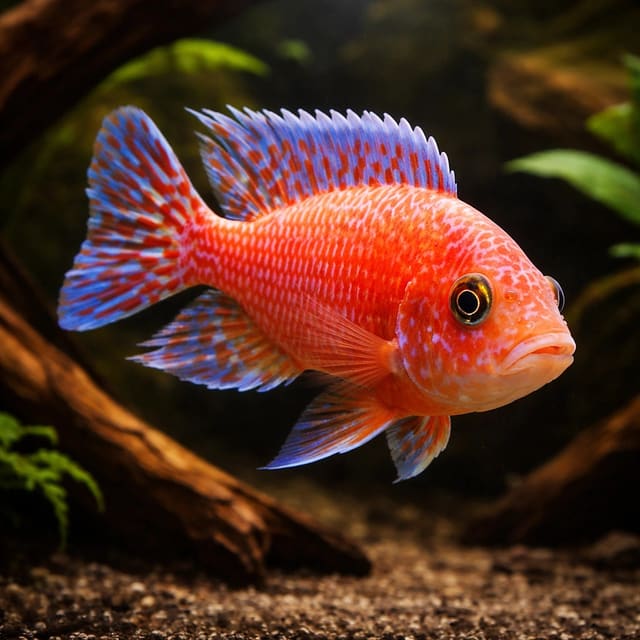
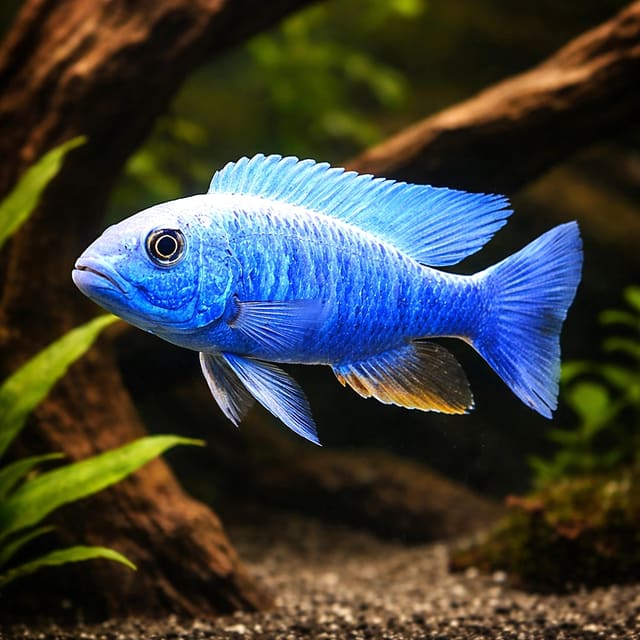
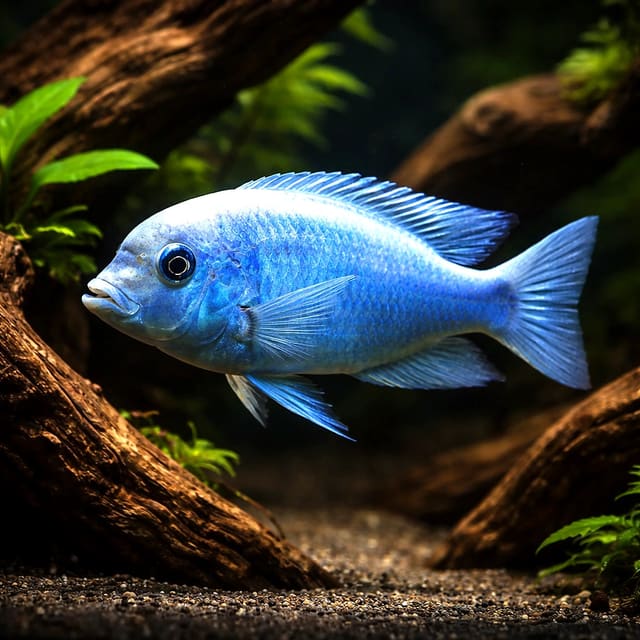
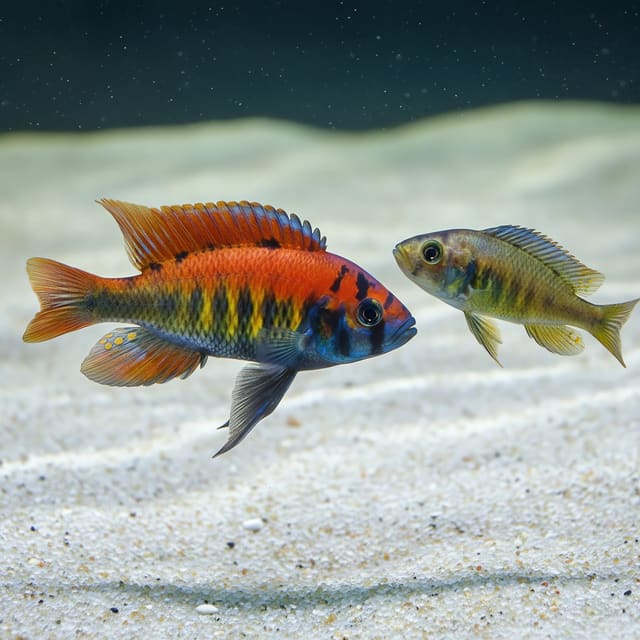
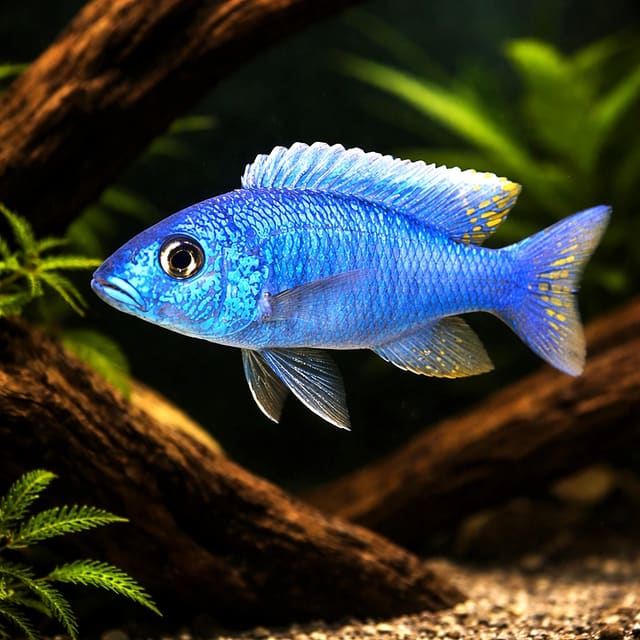
Sex is guaranteed only when the selected option explicitly states male or female. This Venustus listing has no sex-guaranteed option. Colour and pattern also change with age, maturity, mood and social setting, so neither a photograph nor juvenile colour should be used as a promise of sex. Mature males are often described as more intensely blue and yellow, but that biological tendency does not turn an unsexed offer into a male offer.
| Suits | Experienced African cichlid keepers who can provide hard alkaline water, a long footprint, mature filtration and deliberate companion choices. |
|---|---|
| Does not suit | Small community aquariums, tanks with bite-sized fish, soft acidic water or a stocking plan based only on the present juvenile size. |
| Adult records | Up to 25 cm standard length plus the tail in the specialist profile; FishBase separately records 25 cm total length for male or unsexed fish. |
| Planning minimum | A base around 120 × 45 cm and approximately 205 litres is the species-profile minimum; greater space gives more flexibility for a full adult and any companions. |
| Routine social plan | One specimen. A one-male, several-female harem is a purposeful breeding arrangement, not a casual group. |
| Water | 24–28 °C, pH 7.6–8.8 and 10–25 dGH under the species-level aquarium profile. |
Its wild range is Lake Malawi, where FishBase describes juveniles in shallower water near rocks and adults foraging deeper over sand. Half-grown fish have been observed lying partly buried and motionless before striking small fish that approach. That behaviour explains several practical needs at once: a sandy floor, open lanes, sturdy cover and companions that cannot be swallowed. It also makes Venustus absorbing to watch; stillness can be a hunting posture rather than inactivity.
A prepared keeper will enjoy this fish most. The tank needs biological capacity, oxygenation and enough floor space before the animal arrives; the companion list must be built around adult size and predatory risk; and food should be meaty without relying on feeder fish. If that sounds like the aquarium you are building, browse the African cichlid collection to place Venustus in the right specialist context rather than treating it as a general community choice for life.
Gallery images have been digitally enhanced to improve image quality. Natural colour, pattern, size and maturity can vary between live animals.
The specialist profile gives a minimum base of 120 × 45 cm, corresponding to roughly 205 litres at the dimensions quoted there. Treat the footprint as important as the volume. Venustus becomes a deep-bodied fish and needs room to turn, cruise and approach food without colliding with rockwork. A taller but short aquarium can hold the same nominal litres while giving much less useful territory. For a mixed display, extra length and width make it easier to separate feeding zones and avoid forcing robust fish into one another’s space.
Arrange secure rock piles or caves along parts of the aquarium, but keep broad open water and an accessible sandy area. The species profile specifically recommends rocks forming caves, open swimming water and a sandy substrate. The FishBase habitat account also links juveniles with rocks and adults with deeper sandy areas, so a layout that combines those elements has a clear behavioural purpose. Set heavy stone directly and securely so digging cannot undermine it. Avoid packing every centimetre with décor; the fish needs cover to retreat behind and clear routes between those areas.
Plants are optional rather than central to this setup. If used, give priority to the fish’s need for open water, stable rockwork and a clean sand surface. A restrained planted area can be used where it does not compromise the fish’s open-water and secure-rock needs. Keep the layout easy to inspect and siphon so the distinctive stalking behaviour remains visible.
Venustus belongs in a mature aquarium with a functioning biological filter. The RSPCA aquarium guide explains the reason plainly: fish release toxic ammonia, the filter’s beneficial bacteria convert it first to toxic nitrite and then to the safer nitrate. The useful standard is not a particular number of calendar weeks; it is a proven system in which ammonia and nitrite remain at zero when livestock is present and the filter can carry the expected waste load. The first aquarium setup guide is useful if you are preparing that process from the beginning.
The species profile’s example for a 205-litre setup uses turnover of four to five times the volume per hour. That is a sizing example, not a reason to create a harsh jet across the whole aquarium. Spread the return, preserve surface movement and make sure oxygen reaches the entire tank. A large predatory cichlid eating protein-rich food creates substantial waste, so allow spare filtration capacity and keep intake guards, hoses and media accessible for maintenance.
OATA’s broader Malawi guidance recommends oversized filtration and strong aeration for crowded Malawi communities. That group advice is useful when considering the whole stocking load, but it should not be used to justify crowding this predator. The species-level social plan remains one specimen for routine keeping. Build filtration for the animals actually present, check water after feeding changes and increase stock gradually so the bacterial population can respond.
For routine aquarium care, use the species profile’s 24–28 °C, pH 7.6–8.8 and 10–25 dGH. These are intentionally shown together because temperature, acidity and mineral content are a connected husbandry decision. FishBase records a wild environmental range of 25–27 °C, pH 7.2–8.8 and 10–18 dH, but field records are context rather than a second set of competing instructions. The aquarium range above is the practical target used throughout this listing.
Do not chase a single decimal point. Stability within a suitable hard, alkaline range is more useful than repeated chemical adjustments that create swings. Test the source water before choosing buffers or mineral products, then measure the aquarium often enough to understand how feeding, evaporation and water changes affect it. The aquarium water chemistry guide explains what the main tests mean, and the water matcher can help compare measured values with the range used here.
Use a reliable thermostat-controlled heater and verify it with a separate thermometer. Position flow so warmed water circulates through the aquarium rather than collecting in one area. In a large setup, equipment should be chosen around the actual room temperature, aquarium dimensions and flow pattern; the wattage example in a care article is not a universal answer for every home.
OATA’s Malawi sheet recommends, at least once every week, a partial water change of 25%. Siphon solid waste from accessible sand while removing water. Condition replacement tap water for chlorine or chloramine before it enters the aquarium, and bring it close enough to the aquarium temperature to avoid a sharp change. Test ammonia and nitrite at least weekly and after any event that changes the biological load, such as adding fish or substantially increasing food.
Check filter intakes and returns for blockage. When filter media needs cleaning, rinse it lightly in aquarium water removed during the change; do not run it under the tap, because chlorine or chloramine can damage the beneficial bacteria. Clean enough to restore flow without stripping the system of its biological capacity. If the aquarium begins to smell, cloud, lose flow or accumulate food, respond to the cause rather than disguising it with more chemicals.
Watch the fish as part of maintenance. OATA highlights changes in swimming, colour, temperament, breathing, body condition and appetite as reasons to investigate. A fish hanging at the surface, breathing unusually, hiding more than normal or refusing food should prompt an immediate water test. Check the whole system before assuming disease: heater function, oxygenation, filter flow, recent aggression and water chemistry can all change behaviour.
Look at the fish before feeding. Note where it rests, how quickly it reacts, whether both gill covers move evenly and whether fins and scales remain intact. A Venustus that sometimes waits motionless near sand or structure may be showing its natural ambush strategy; a sudden change accompanied by rapid breathing, loss of balance, damaged fins or lost appetite deserves attention. Compare the fish with its own established pattern and test the water whenever behaviour changes.
Check the thermometer and confirm that the filter return is moving the surface. Remove obvious leftover food before it disappears under rocks. These small observations make later problems easier to interpret because you know what normal looks like in that aquarium. They also help separate a hunting posture from oxygen shortage or social pressure.
Dispatch size is temporary. Reassess swimming clearance, feeding portion and companion relationships as the fish approaches adult dimensions. A rock gap that suits a 3 cm juvenile can become a trap for a much larger body, and a companion that was too large to swallow may later become the smaller fish. Growth is therefore a reason to revisit the aquarium, not a promise that the original layout remains suitable forever.
Keep simple notes after water tests, maintenance and unusual behaviour. Exact records are especially helpful in hard-water aquariums because they show whether pH and hardness remain steady between changes. If nitrate rises faster than usual, look at feeding, filter flow and the total livestock load together. If aggression increases, review space and retreats before adding more animals. A calm, repeatable routine is more valuable than frequent reactive changes.
FishBase reports small fish and invertebrates in the wild diet, and the specialist profile describes Venustus as an exclusive piscivore in nature. That does not mean live feeder fish are needed in the aquarium. The same profile says it readily accepts dead foods and recommends a meaty diet. This is both simpler and safer: prepared and frozen foods are easier to portion, less likely to introduce unwanted animals and allow the nutritional plan to be varied without turning the aquarium into a feeding spectacle.
Build the menu around an appropriate quality cichlid food with animal protein, then rotate suitable aquatic foods such as prawn, whitebait or similar items named by the specialist profile. Choose pieces the individual can swallow cleanly. Frozen foods should be stored, thawed and handled hygienically. Remove uneaten pieces before they break apart in the sand or filter. Avoid mammal and bird meat; the profile explicitly advises against animal meat of that kind.
OATA’s broader Malawi guidance says to offer only what the fish can consume within a few minutes and warns that excess food breaks down into toxic waste. Use that as a ceiling rather than a challenge. Begin with a modest portion, watch the fish take it, and stop while the water remains clean. Juveniles and adults differ in mouth size and energy use, so one rigid portion cannot serve every dispatch size or every aquarium.
Spread food so the intended fish receives it without having to charge through a crowd. In a mixed display, observe whether bold companions take everything first or whether small pieces drift where they can be swallowed by animals not meant to receive them. Body condition, appetite and waste production give better feedback than a fixed spoonful. A rounded, bloated outline and food lying on the floor both indicate that the routine needs adjusting.
A practical routine is deliberately simple: use varied meaty prepared or frozen aquatic foods, avoid terrestrial meat, keep portions controlled and protect water quality. Change one part of the menu at a time so appetite, digestion and waste remain easy to assess.
Venustus is not suitable for a standard peaceful community. The specialist profile says it will eat smaller mbuna and young fish, while FishBase describes a wild diet of small fish and an ambush strategy. Any animal that can fit into its mouth must therefore be treated as prey rather than a companion. That rule applies even when both fish look comfortable as juveniles; the size relationship changes as they grow.
For possible companions, the specialist profile points to robust large Rift Lake fishes that are too big to be eaten, including Frontosa, Dimidiochromis compressiceps, larger mbuna and other large Rift Lake species. These are examples, not an automatic shopping list. Tank dimensions, adult size, feeding speed, sex and individual aggression still matter. OATA’s broader Malawi guidance also limits Malawi communities to Malawi cichlids or suitable Synodontis and stresses cautious mixing. A companion sharing alkaline water can still be wrong if it is too small, timid or unable to reach food.
Assess every candidate in this order:
The species profile describes Venustus as a loner in nature and says males can be aggressive towards one another. Its routine aquarium recommendation is therefore a solitary specimen. That does not mean the tank must contain no other species; it means one Venustus is the cleanest starting point. Adding several unsexed juveniles in the hope of obtaining a harmonious group creates uncertainty about both future sex ratio and adult space.
For a deliberate breeding attempt, the same profile describes a harem with one male and several females. That is a specialised project requiring confirmed adult sex, a large dedicated arrangement and close observation. This listing supplies an unsexed fish and does not create that group for you. Do not assume two purchased fish form a pair, and do not use colour in the gallery as a sexing guarantee.
Territorial tension often increases when space, cover or feeding access is poor. Rock piles can define retreats, while open water keeps movement visible. OATA recommends adding more peaceful Malawi species before more aggressive ones and rearranging décor to disrupt established territories when new fish are introduced. Observe closely during the first hours and days rather than assuming a stocking chart can predict every individual.
A half-grown Venustus may remain motionless and partly buried in sand while waiting for smaller fish to approach. The specialist profile also describes the fish hanging still near rocks, plants or the lake floor, a hunting strategy sometimes called thanatosis. In a settled aquarium, stillness followed by a sudden strike at food can therefore be normal. Judge it alongside breathing, posture, appetite, colour and the water tests rather than treating one behaviour in isolation.
Concern rises when stillness comes with clamped fins, unusual breathing, loss of balance, refusal to feed or a sudden change from the individual’s normal pattern. OATA advises testing the water and contacting the retailer when health is concerning. Also inspect the social setting: chasing, blocked retreats and a companion guarding food can make a fish hide even when chemistry is acceptable.
Have the aquarium running, the water matched and the route from parcel to tank clear. Tropical Fish Co’s current delivery and Live Arrival Guarantee policy explains the packing, reception and claim process. Someone must be present to receive live fish. If a Live Arrival Guarantee claim is needed, the continuous unboxing video must begin with the parcel still sealed, show the outer box, opening and the fish still in the sealed bag before anything is disturbed.
After that record is secured, follow the policy’s acclimatisation direction: float the sealed bag for 20–30 minutes before releasing the fish, and do not pour bag water into the aquarium. Keep the first period calm and watch breathing and balance. Avoid introducing several territorial fishes at once unless the stocking plan was designed for it; the filter and the established hierarchy both need to absorb the change.
The specialist aquarium profile gives up to 25 cm standard length, which excludes the tail, so plan for a body of that length plus its tail rather than for an unqualified 25 cm total. FishBase separately records up to 25 cm total length, which includes the tail, for male or unsexed fish; the two records use different conventions.
The species profile gives a minimum base of 120 × 45 cm, approximately 205 litres at the quoted dimensions. A longer, wider aquarium gives more useful swimming and territorial space, especially if robust companions are planned.
One specimen is the routine recommendation because the species is a natural loner and males can be aggressive to each other. A one-male, several-female harem is a deliberate breeding arrangement for an experienced keeper, not a casual group.
Venustus is better suited to an experienced African cichlid keeper. Its adult size, predatory feeding, hard alkaline water and need for carefully selected companions make mistakes more consequential than they are with a small peaceful community fish.
Offer varied meaty prepared and frozen aquatic foods. Live feeder fish are unnecessary, and mammal or bird meat should be avoided. Give controlled portions that are eaten within a few minutes so protein-rich leftovers do not damage water quality.
Use the species-profile aquarium range of 24–28 °C, pH 7.6–8.8 and 10–25 dGH. Keep those values stable, and confirm ammonia and nitrite remain at zero with a mature biological filter.
It is a predator and can be territorial; males can also be aggressive towards one another. The larger danger to small fish is predation rather than a simple fin-nipping label, so exclude anything it could swallow and watch all introductions closely.
Consider only robust large Rift Lake fishes that are too big to be eaten and suit comparable hard alkaline water. The species profile names Frontosa, Dimidiochromis compressiceps, larger mbuna and other large Rift Lake species as possibilities, but each combination still depends on space and individual behaviour.
The fish is hand-bagged in oxygen, placed in an insulated box with a heat pack when conditions call for it, and carried by a licensed live-animal courier. Someone must receive it; for any Live Arrival Guarantee claim, film one continuous unboxing from the sealed parcel through to the fish still in the sealed bag, then contact Tropical Fish Co the same day.
No reviews for this item yet. Bought one? Honest reviews only, good or bad.
What customers say about ordering from us
I have a small group of long finned mountain minnows. So was delighted to be able to order ten of this variety to increase the genetics in my tank . The ones I recieved are healthy but it’s to early to give a verdict on wether they are of a long finned type since they are small currently.
Gordon Walker · 23 Sept 2026
100% success travel and "installation". Pleased with quality of purchase. The Siamese fighter a bit "shy" so have not yet seen him at his best yet but looking good. Happy customer. GG
George E Garratt · 21 Sept 2026
Reviews of our shop, collected by Judge.me, an independent third-party review collector. Newest first.