Moderate
Haplochromis hippo point salmon sp.
24–27°C · pH 7.8–8.6
£25.99
Haplochromis aeneocolor is a small cichlid from Lake George and the Kazinga Channel in Uganda, reaching 7.5 cm standard length. It is sold as one live fish per purchase and is best kept as a group in a species-focused aquarium with hard, alkaline water.
Adult size is the maximum length this species reaches at full maturity (scientific sources). The livestock you receive will be younger and smaller — pick a size above for the actual shipping size. Product-photo provenance and any image-specific limitations are stated on the listing.
Haplochromis aeneocolor
Save when buying multiple fish. Each quantity is one fish; sex and pair formation are not guaranteed unless the selected variant explicitly states them.
Haplochromis aeneocolor is a small cichlid from Lake George and the Kazinga Channel in Uganda, reaching 7.5 cm standard length. It is sold as one live fish per purchase and is best kept as a group in a species-focused aquarium with hard, alkaline water.
Adult size is the maximum length this species reaches at full maturity (scientific sources). The livestock you receive will be younger and smaller — pick a size above for the actual shipping size. Product-photo provenance and any image-specific limitations are stated on the listing.
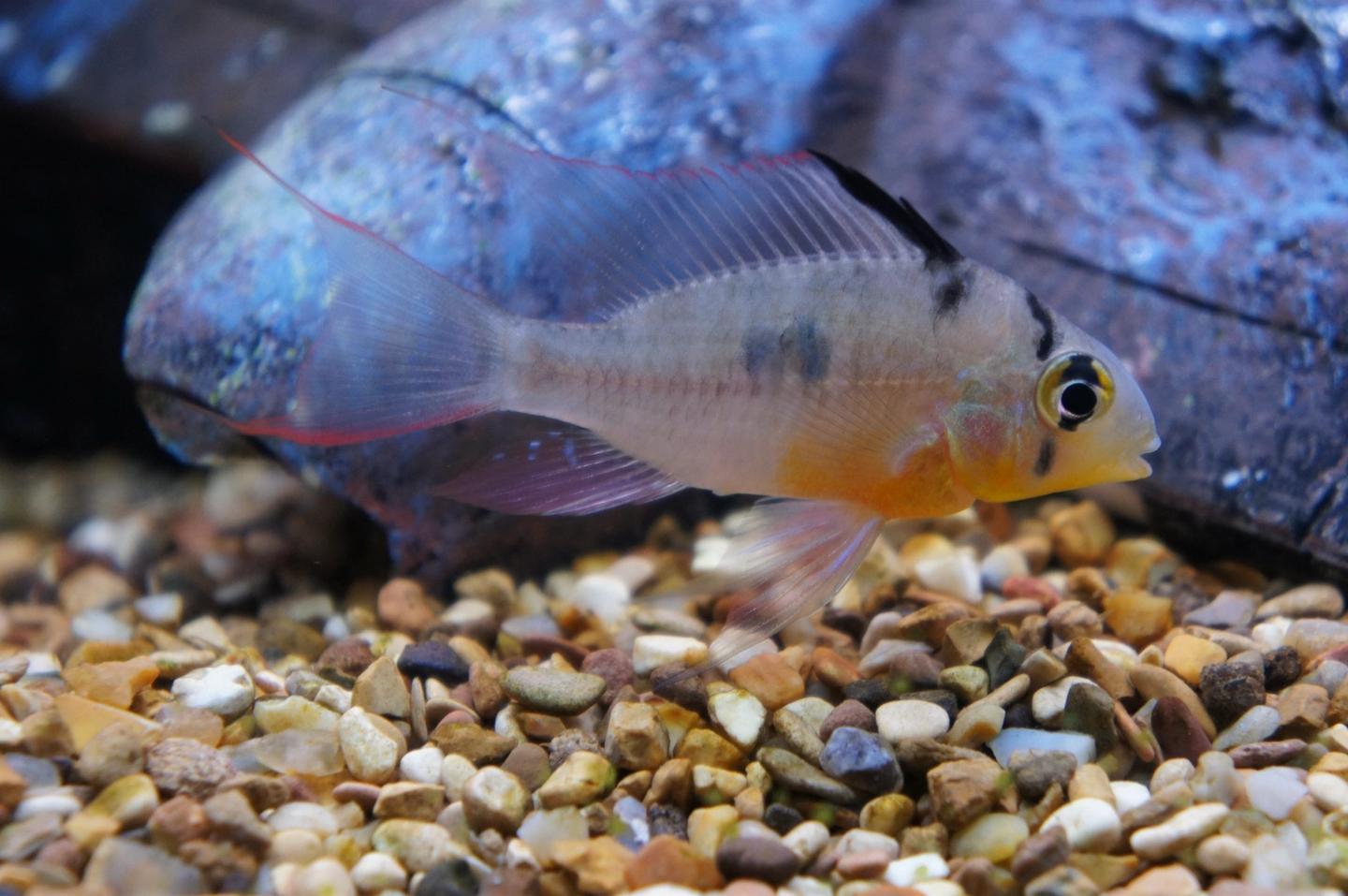
Cichlids are a family of roughly 1,800 accepted species, not one care type. Before buying, identify the exact species and source, then compare adult measurement, usable tank dimensions, social system, territory, tested water, diet and an exit plan. No family-wide minimum tank, water range or tank-mate list is safe.
Maintain these water conditions for optimal health and vibrant colors
Haplochromis aeneocolor is a small haplochromine cichlid from Lake George and the Kazinga Channel in Uganda. FishBase records a maximum of 7.5 cm standard length, and the species is listed as Vulnerable by the IUCN, which makes a well-kept aquarium group more than just another African cichlid tank. You buy one live fish per purchase, at 3–4 cm or 4–5 cm.
This is a cichlid for hard, alkaline water and a keeper who is happy to plan a group rather than add a single fish to a community aquarium. It suits a species-focused set-up where you can watch how the group behaves as it matures and adjust the balance of males and females. The two things to get right before buying are the water and the group; feeding, maintenance and tank mates all follow from those two decisions.
| Suits | Keepers with some cichlid experience and a hard-water aquarium |
|---|---|
| Native range | Lake George and the Kazinga Channel, Uganda |
| Recorded adult size | 7.5 cm standard length |
| You receive | One live fish per purchase, at the size you select |
| Keeping | A group, with more females than males once sexes show |
| Water | OATA Lake Malawi cichlid guidance: 23–27°C, pH 8.0–8.6, 12–18°dH |
| Diet | Varied sinking foods with plant content, plus small frozen foods |
| Conservation status | Vulnerable (IUCN, via FishBase) |
| Care level | Intermediate, in our assessment |
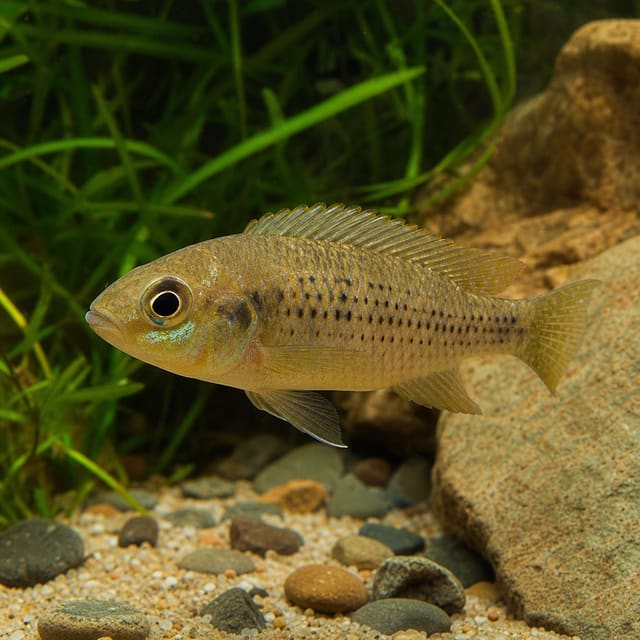
Much of the appeal is that it is a genuine, identified species with a small natural range, rather than a trade colour form. In the photograph it shows a silvery body with a gold-green metallic sheen and pale spots across the fins. A group gives you the chance to see how young fish develop as they grow, and to keep a Vulnerable species in good condition. Its modest adult size also means a group fits comfortably in a well-planned aquarium of the 200 litres or more that OATA recommends for a cichlid community.
| A dedicated aquarium | At least 200 litres for a group, set up and matured before the fish arrive |
|---|---|
| Hard, alkaline water | Held steadily within the OATA guidance shown above |
| A weekly routine | A 25% partial water change and water tests every week |
| Room to adjust | A plan for rehoming surplus males if the balance goes wrong |
If any of those are not in place yet, set them up first; the fish will be easier to settle and the group easier to manage.
Two sizes are offered: 3 - 4 cm and 4 - 5 cm. The size you select is the size supplied, not the adult size. Both are young fish well short of the 7.5 cm standard length recorded for adults, so the aquarium needs planning for grown fish. Sizes move in and out of stock independently, so check the product page when you order.
| 3 - 4 cm | The youngest fish, with the most growing ahead of them |
|---|---|
| 4 - 5 cm | A little further grown, but still juveniles |
Because you buy one fish per purchase, a group is built by ordering several. Choosing all of them at the same size keeps the group even while the fish settle.
OATA notes that many Lake Malawi cichlids only show differences between the sexes once they become adults, not as juveniles, so plan on not knowing which of your young fish are male or female until they mature. Sex is guaranteed only when the selected option explicitly states male or female. This Haplochromis aeneocolor listing has no sex-guaranteed option.
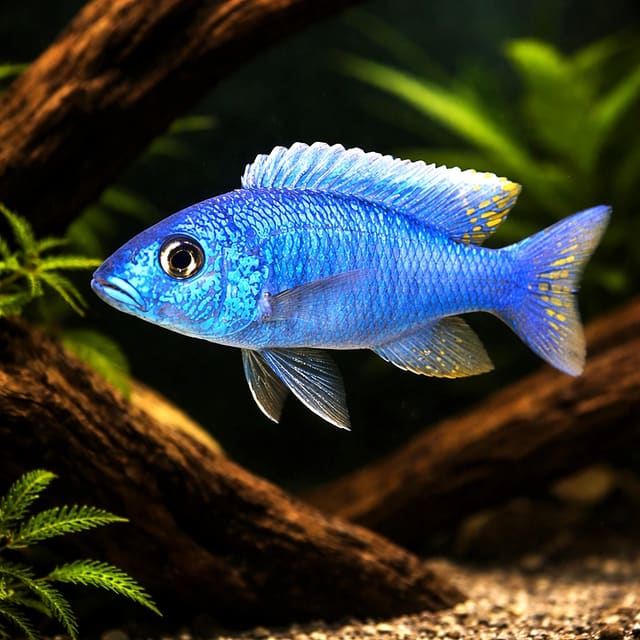
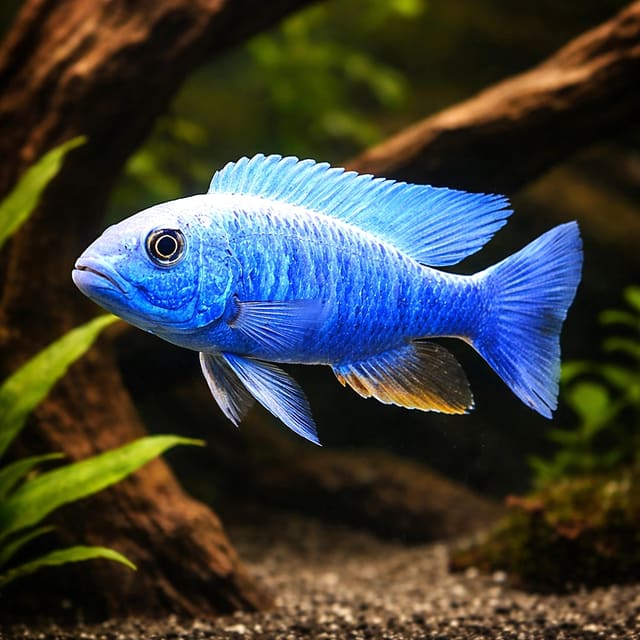
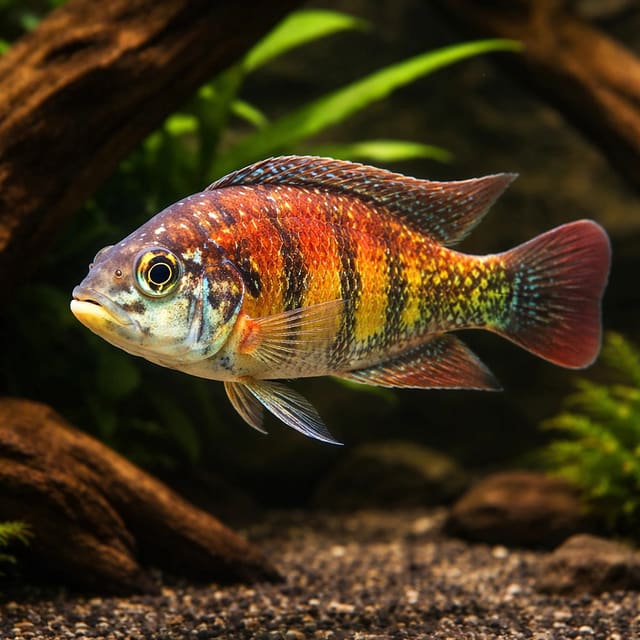
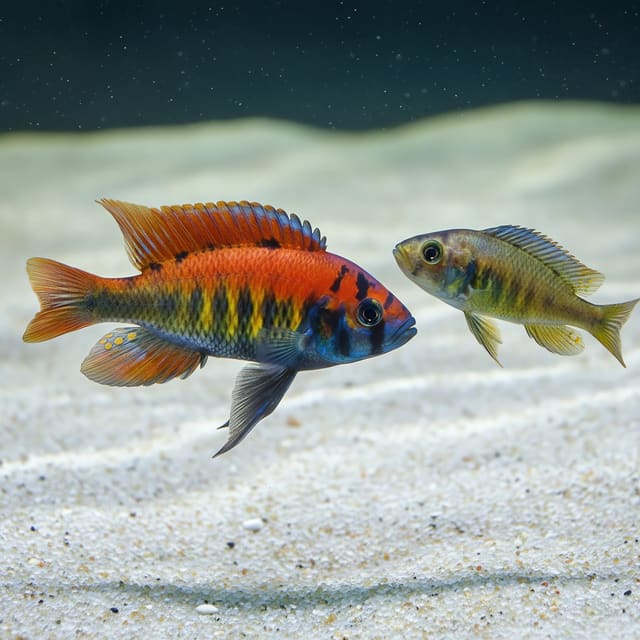
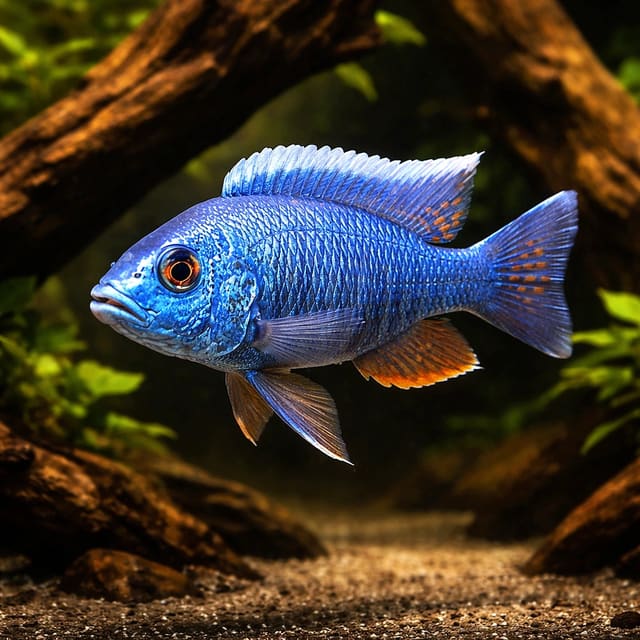
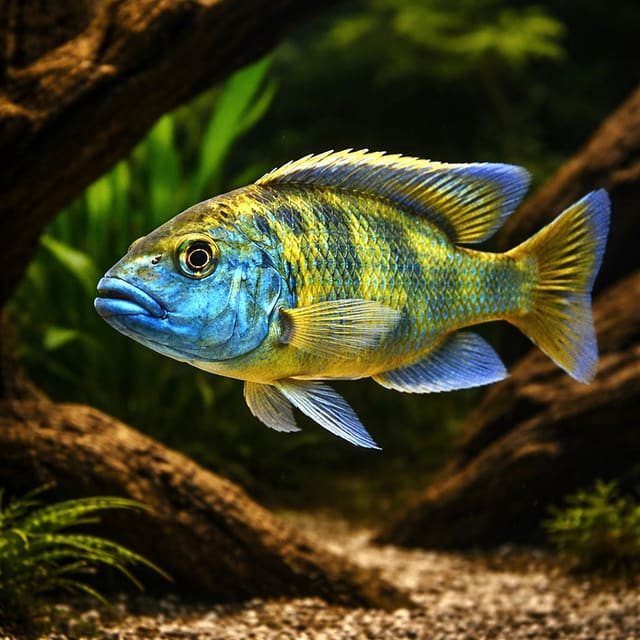
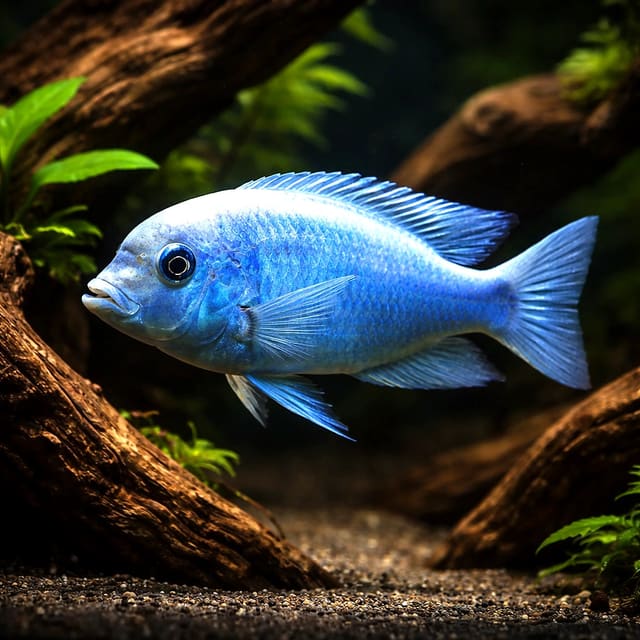
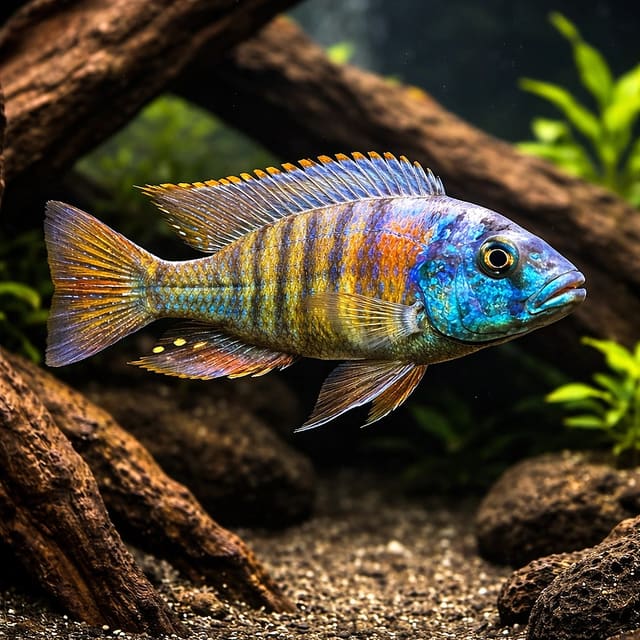
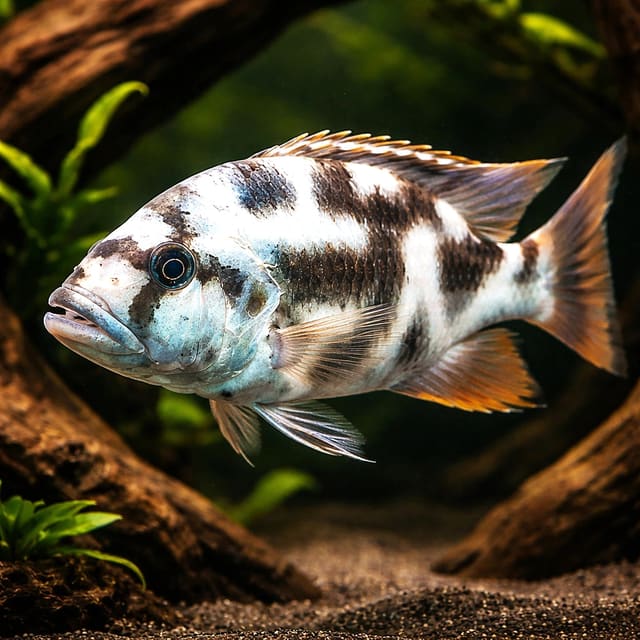
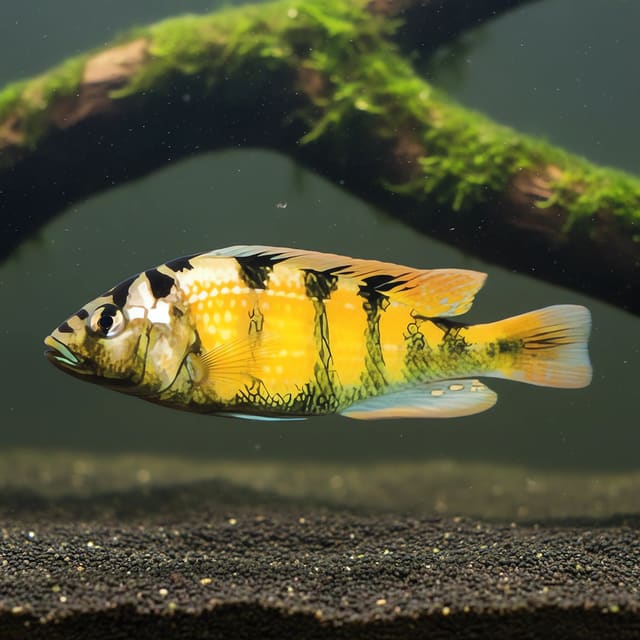
The photograph shows a single fish among plants over pebbles and dark rock. Gallery images have been digitally enhanced to improve image quality. Natural colour, pattern, size and maturity can vary between live animals.
FishBase places Haplochromis aeneocolor in the cichlid family, Cichlidae, and gives its distribution as Lake George and the Kazinga Channel. Wikipedia’s species summary describes it as endemic to Uganda. The range sits between 1°N and 1°S, almost on the equator.
A fish of papyrus-fringed shores is best served by an aquarium with cover around its edges and open water in front, rather than a bare tank. Its bottom-and-midwater habits suggest food that sinks as well as food taken in open water, and its gut contents point to a diet that mixes plant material with small invertebrate foods. These are practical readings of the natural history, and the care sections below turn them into routine steps.
FishBase lists the species as Vulnerable on the IUCN Red List. Its whole natural range is one lake and one channel, so aquarium fish are worth looking after carefully: a stable, well-planned group is the best way to keep them healthy for the long term. Buy only as many as your aquarium can hold, keep them for life or rehome them through another keeper, and never release aquarium fish into ponds, rivers or lakes.
Expect a group of Haplochromis aeneocolor to use the whole height of the aquarium, picking over the substrate and feeding near the bottom as well as moving through midwater, as FishBase’s benthopelagic classification suggests. As a fish of papyrus-lined shores, it is likely to appreciate cover, so a layout with rock, wood and hardy plants gives it somewhere to retreat.
The character of a cichlid group can change as the fish mature, and that is the stage to watch most closely: note which fish claim space, whether any one fish is being singled out, and how the balance of males and females is developing. Small adjustments, such as a change of layout or rehoming a surplus male, are easier early than late.
Temperament, hiding and colour are also on OATA’s list of changes to watch for, so a sudden shift in any of them is a reason to test the water as well as to look at the group.
The closest UK trade-body guidance for an East African lake cichlid kept in hard water is OATA’s care sheet for Lake Malawi cichlids. It advises buying an aquarium as large as possible within reason, and recommends at least 200 litres for a reasonable-sized community of fish. The larger the aquarium, the more stable its temperature and water quality will be.
| Filter | Always essential; OATA recommends an oversized filter for busy cichlid tanks |
|---|---|
| Aeration | Strong aeration so there is enough dissolved oxygen |
| Heater | Sized for the aquarium, to hold a steady temperature |
| Substrate | Coral sand or similar, which helps buffer the water |
OATA recommends an oversized filter for cichlid aquariums because the communities are kept relatively crowded, and it recommends strong aeration so there is enough dissolved oxygen. Warm water holds less oxygen than cool water, so surface movement and aeration matter at 23–27°C. Size the filter for the adult group you intend to keep rather than the small fish that arrive, and clean it gently so the bacteria in it are not lost.
Coral sand is mostly calcium carbonate, so it slowly releases carbonate into the water. That helps keep carbonate hardness up and the pH steady in the alkaline range, which is why OATA recommends coral sand or a similar substrate. It is a support for good water, not a substitute for testing and regular water changes.
OATA warns that Lake Malawi cichlids will often dig and rearrange the substrate, which will uproot any plants present, and that only the hardiest plants suit their aquariums. Start with robust plants attached to rock or wood, and see how your own group treats them before adding more delicate planting.
The aquarium should be running with a mature filter before any fish arrive. Our guide to setting up a tropical aquarium safely covers filling, heating and maturing the filter step by step. Allow for the coral sand and the hard-water targets below while you set up, so the water is already right when the fish are introduced.
OATA describes Lake Malawi cichlids as a specialised group that needs particular water parameters. Its figures are a general guide for that group rather than values for this species, but they are the most useful UK starting point, and FishBase’s wild record of tropical water from 22°C sits comfortably alongside them.
| Temperature | 23–27°C |
|---|---|
| pH | 8.0–8.6 |
| General hardness | Hard, 12–18°dH |
| Carbonate hardness | Hard, 10–15°dKH |
| Ammonia | Zero |
| Nitrite | Zero |
| Nitrate | No more than 20 mg per litre above normal tap water levels |
A pH of 8.0–8.6 is alkaline, well above the neutral point of 7. General hardness (GH) mainly measures dissolved calcium and magnesium, and carbonate hardness (KH) is the water’s buffering capacity, which resists swings in pH. High KH is what keeps the pH of a hard-water cichlid aquarium steady from one water change to the next, and a substrate of coral sand helps maintain it.
The nitrate figure is measured against your own tap water: whatever nitrate your supply already contains, the aquarium should not climb more than 20 mg per litre above it.
OATA stresses that good husbandry is essential because these cichlids can be stressed by even the smallest amounts of ammonia, and the same care makes sense here. Fish release ammonia into the water, and it is toxic. As the RSPCA explains, a working biological filter grows beneficial bacteria that convert ammonia to nitrite, which is also toxic, and then to nitrate, which is safer. That process only keeps pace if the filter is mature and the aquarium is not overstocked.
For a hard-water cichlid, steady conditions matter more than hitting an exact number. Aim to keep temperature, pH and hardness within the ranges above from week to week, and make any correction gradually over several water changes rather than all at once. OATA also advises checking species-specific requirements with the retailer before buying, so if you have a question about this species, ask us before you order.
Test the aquarium at least once a week, and test your tap water too, so you know what you are starting from before each water change. Our guide to aquarium water parameters explains each test and what the results mean, and the water parameter matcher lets you compare your readings with these targets.
In the wild, Haplochromis aeneocolor seems to be a detritus feeder: FishBase reports that plant fragments and insect larvae are the main items in its gut. A good aquarium diet mirrors that mix, with plant material and small invertebrate foods, delivered so that some of it sinks to the bottom where the fish forage.
| Everyday base | A quality sinking cichlid granule or pellet that includes plant ingredients |
|---|---|
| Plant content | A vegetable-based cichlid food as part of the rotation |
| Invertebrate foods | Small frozen foods such as bloodworm, which are insect larvae |
OATA’s Lake Malawi cichlid guidance is to feed only what the fish can eat within a few minutes, twice a day. Take care not to overfeed: uneaten food breaks down and releases toxic waste into the water, and it shows up as rising nitrate between water changes.
At 3–5 cm the fish you receive are juveniles, so choose granules or crumbs small enough for them to take whole, and move up in size as they grow. Offering each of the two daily feeds as a few small pinches, rather than one heap, makes it easier for young fish to eat and easier for you to see every fish feeding.
A steady weekly routine keeps hard, alkaline water where it should be. OATA strongly recommends a partial water change of 25% at least once every week, with the water tested at least once a week so ammonia and nitrite cannot build up.
Check carbonate hardness (KH) as well as pH. KH is what holds the pH steady, so a falling KH reading is an early warning that pH may start to drift. Check that the heater is holding the aquarium within 23–27°C, and look over the filter for blockages even if it does not need cleaning.
Rinsing media in removed tank water reduces the number of those bacteria that are lost. Keep a simple note of each week’s results, so a slow change in pH or nitrate stands out before it becomes a problem.
Our team hand-packs every order: each fish is bagged in pure oxygen inside an insulated poly box, with a heat pack when the weather calls for it, and a licensed live-animal courier carries the parcel on a tracked service. You will receive an email with the tracking number and your confirmed delivery date. Our delivery and Live Arrival Guarantee page sets out the full terms.
Before any fish go in, check that the aquarium is an appropriate size for the number you plan to keep and that ammonia and nitrite both read zero. Increase the population slowly: the bacteria in a matured filter need to grow every time more fish are added and feeding increases. Stocking too quickly can cause “new tank syndrome”, when there are not enough nitrifying bacteria for the extra waste and ammonia and nitrite rise to levels that may make fish ill or kill them.
OATA’s Lake Malawi cichlid sheet recommends adding fish in groups so no single newcomer takes all the attention while it settles, and adding more peaceful species before more aggressive ones. For a species-focused tank, that means introducing the group together and treating anything else as a later, careful addition.
Healthy fish have clear, bright eyes, undamaged fins, intact scales, no ulcerations or bumps and normal swimming. Small differences between fish are normal, so the useful skill is spotting change. Look out for:
| Swimming | Hanging at the surface, sitting on the bottom or darting erratically |
|---|---|
| Colour | Noticeably darker or paler than usual |
| Temperament | A change in aggression, or more hiding than normal |
| Breathing | Gill covers moving faster or slower than usual |
| Body and fins | White spots, fluffy growths, or lost fins or scales |
| Condition | Weight gain or loss |
| Feeding | Eating less or losing interest in food |
In a cichlid group, pay particular attention to temperament and hiding, because both can reflect how the group is getting on as well as the state of the water. If you are worried about any fish, test the water first, then contact us for further guidance.
OATA’s care sheet describes Lake Malawi cichlids, the closest group it covers, as aggressive fish that should be mixed with caution. It advises keeping them in groups, because those kept in small groups will often fight, and, where possible, keeping more females than males of each species so that males do not harass one individual female. For Malawi communities it suggests groups of at least 15, slightly overcrowded to spread aggression; that figure is written for Malawi cichlids, so treat it as context rather than a target for this species.
Apply the same principles to Haplochromis aeneocolor:
In Lake Malawi cichlids, OATA notes that the main differences between the sexes are colour or egg spots on the male’s anal fin, and that they appear in adults rather than juveniles. Watch your young fish as they mature to see how the differences show in your group, and use that to judge the balance of males and females. If you end up with more males than the aquarium can support, rehoming the surplus is kinder than letting one fish be chased constantly.
OATA also notes that rearranging the décor can help reduce aggression, because fish find new territories. If one fish is being targeted, a change of layout during a water change is a simple first step before anything more drastic.
We recommend keeping this species in its own aquarium. That keeps the water, feeding and group balance simple, and lets you see its natural behaviour without competition.
OATA advises that Lake Malawi cichlids should only be kept with other Malawi cichlids or some species of Synodontis catfish from the same lake. Haplochromis aeneocolor comes from Lake George in Uganda, so it does not belong in a Malawi community, even though the same water guidance is used for both.
Size is another reason to keep them apart. OATA notes that most Lake Malawi cichlids grow to around 10 cm and some reach 25 cm, while FishBase records a maximum of 7.5 cm standard length for this species. Many of the fish in a typical Malawi community would outgrow it.
Our African cichlid collection lists the other African cichlids we sell. Check each species’ lake or river of origin before planning any combination; a shared continent is not the same as a shared aquarium.
FishBase and Wikipedia both record a maximum of 7.5 cm standard length for this species, measured from the snout to the base of the tail. That makes it a small cichlid, but the fish you receive at 3–5 cm still have plenty of growing to do.
For a group, plan on at least 200 litres, the figure OATA recommends for a reasonable-sized community of Lake Malawi cichlids, the closest UK guidance. Within reason, buy the largest aquarium you can, because a larger volume keeps temperature and water quality more stable, and fit a generously sized filter.
Keep a group rather than a single fish or a pair, and aim for more females than males once the sexes become clear, so that males do not harass one female. OATA’s guidance for Lake Malawi cichlids, the closest UK care sheet, warns that cichlids kept in small groups will often fight.
It is better as a second step than a first fish. We rate it as intermediate: it needs hard, alkaline water, a mature filter, weekly maintenance and a keeper who will watch a cichlid group closely as it matures.
In the wild it seems to be a detritus feeder, with plant fragments and insect larvae the main items found in its gut. In the aquarium, offer a varied mix of sinking cichlid foods with plant content and small frozen foods such as bloodworm, fed twice a day in portions eaten within a few minutes.
OATA’s guidance for Lake Malawi cichlids, the closest UK care sheet, gives 23–27°C, pH 8.0–8.6, general hardness of 12–18°dH and carbonate hardness of 10–15°dKH. FishBase records the species in tropical water from 22°C in the wild. Keep conditions stable within that guidance.
Plan for cichlid behaviour rather than a peaceful community fish. OATA describes Lake Malawi cichlids, the closest group it covers, as aggressive fish to be mixed with caution, so watch your group for changes in aggression as the fish mature and keep more females than males.
We recommend a species-focused aquarium. Do not add Lake Malawi cichlids, which OATA advises keeping only with other Malawi cichlids or some Synodontis catfish from the same lake. Any other fish must suit the same hard, alkaline water and should be added slowly, with close watching.
Our team hand-bags each fish in pure oxygen, packs it in an insulated poly box with a heat pack when the weather calls for it, and sends it with a licensed live-animal courier on a tracked service. Be at the address to receive it, film one continuous unboxing video from the sealed parcel until the fish is seen still in its bag, and inspect it the same day, as our Live Arrival Guarantee requires. Float the bag for 20–30 minutes before releasing the fish, and never pour the bag water into the aquarium.
Species facts and care guidance on this page come from these public sources:
No reviews for this item yet. Bought one? Honest reviews only, good or bad.
What customers say about ordering from us
Easy website plenty of info on fish your buying great to pick a time slot
TRACEY DURRANT · 7 Oct 2026
Got some lovely fish thank you
Kevin Mackie · 7 Oct 2026
Reviews of our shop, collected by Judge.me, an independent third-party review collector. Newest first.