−11%
Moderate
Calico Peacock Cichlid (Aulonocara sp. calico)
24–28°C · pH 7.5–8.5 · 200L
£17.79£19.99

Jackson's Nkata (Haplochromis jacksoni ahli) is an open-water haplochromine cichlid endemic to Lake Malawi that reaches 18.3 cm. It suits keepers planning a mature Malawi community; the FishBase and OATA overlap is 23–27°C, pH 8.0–8.4 and 12–18°dH, while OATA describes groups of at least 15 Malawi cichlids. Sold individually in dispatch sizes of 3 - 4 cm, 4 - 5 cm, 6 - 7 cm, 7 - 9 cm or XL.
Adult size is the maximum length this species reaches at full maturity (scientific sources). The livestock you receive will be younger and smaller — pick a size above for the actual shipping size. Product-photo provenance and any image-specific limitations are stated on the listing.
Haplochromis jacksoni ahli
Save when buying multiple fish. Each quantity is one fish; sex and pair formation are not guaranteed unless the selected variant explicitly states them.
Jackson's Nkata (Haplochromis jacksoni ahli) is an open-water haplochromine cichlid endemic to Lake Malawi that reaches 18.3 cm. It suits keepers planning a mature Malawi community; the FishBase and OATA overlap is 23–27°C, pH 8.0–8.4 and 12–18°dH, while OATA describes groups of at least 15 Malawi cichlids. Sold individually in dispatch sizes of 3 - 4 cm, 4 - 5 cm, 6 - 7 cm, 7 - 9 cm or XL.
Adult size is the maximum length this species reaches at full maturity (scientific sources). The livestock you receive will be younger and smaller — pick a size above for the actual shipping size. Product-photo provenance and any image-specific limitations are stated on the listing.

Cichlids are a family of roughly 1,800 accepted species, not one care type. Before buying, identify the exact species and source, then compare adult measurement, usable tank dimensions, social system, territory, tested water, diet and an exit plan. No family-wide minimum tank, water range or tank-mate list is safe.
Maintain these water conditions for optimal health and vibrant colors
Jackson's Nkata is a freshwater haplochromine cichlid from Lake Malawi. FishBase now lists it as Copadichromis jacksoni, treats Haplochromis jacksoni as a synonym and places the fish in the family Cichlidae. It suits keepers prepared to manage hard alkaline water, a mature filter and aggression in a planned Malawi community. The familiar catalogue name remains useful when matching the animal to its aquarium history, while the accepted name helps distinguish it from unrelated blue cichlids.
FishBase records a maximum length of 18.3 cm total length for male or unsexed fish. Use that figure for long-term planning rather than judging space from a young dispatch size. An 18.3 cm fish needs room to turn, swim through open water and move away from confrontations without being trapped against rockwork or glass.
In nature, this species usually occupies sheltered bays with deep water, forms schools in the open water and feeds on plankton. Wikipedia's account of Copadichromis jacksoni also places breeding activity near clear water, steep rocky shores and large boulders defended by males. Those details point towards an aquarium with open swimming room supported by carefully arranged rocky structure, rather than a wall of rock that removes the open-water zone.
Wild schooling behaviour is useful context, but it is not a fixed aquarium group prescription. A domestic Malawi community must be planned around aggression, adult dimensions, filtration capacity and the behaviour of every resident. Treat the complete stocking plan as one system rather than adding this fish to an unrelated community because the water is warm.
We treat this as intermediate care. The routine itself is clear, but success depends on controlled water chemistry, a mature filter and deliberate aggression management rather than basic tropical-community stocking.
One purchase supplies one animal of the selected option. Use the live size selector to choose between 3 - 4 cm, 4 - 5 cm, 6 - 7 cm, 7 - 9 cm and XL. The size you select is the size supplied, not the adult size. Treat XL as a named dispatch size and continue to plan the aquarium around the recorded 18.3 cm maximum length.
Sex is guaranteed only when the selected option explicitly states male or female. This Jackson's Nkata listing has no sex-guaranteed option.
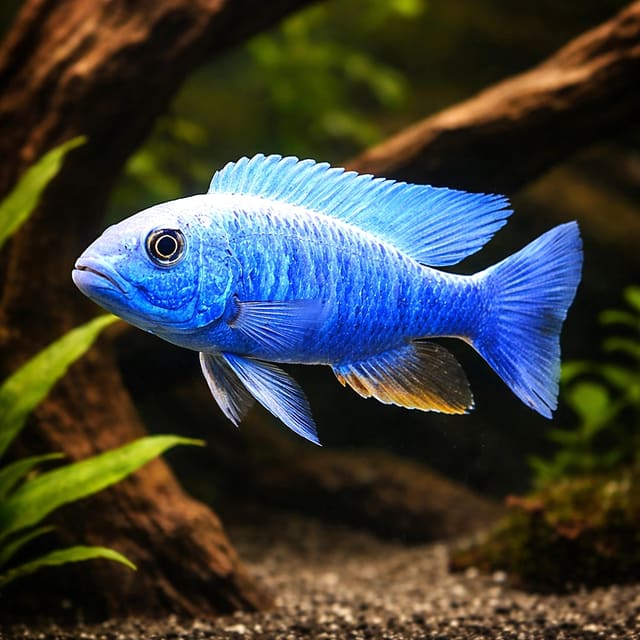
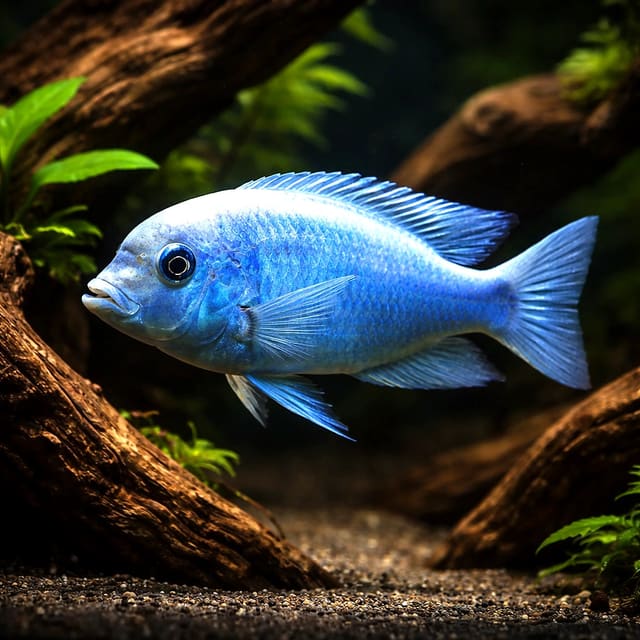
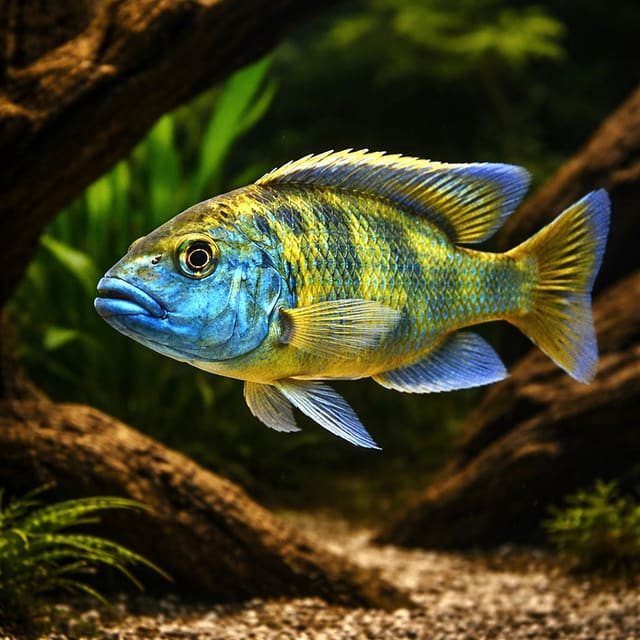
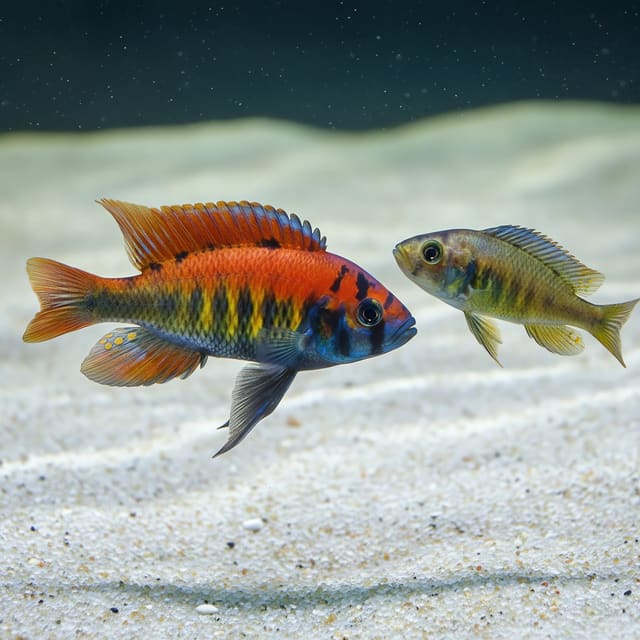
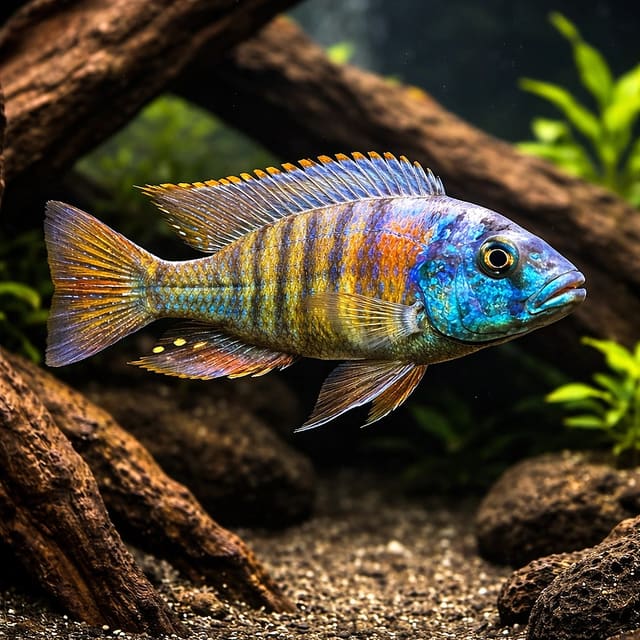
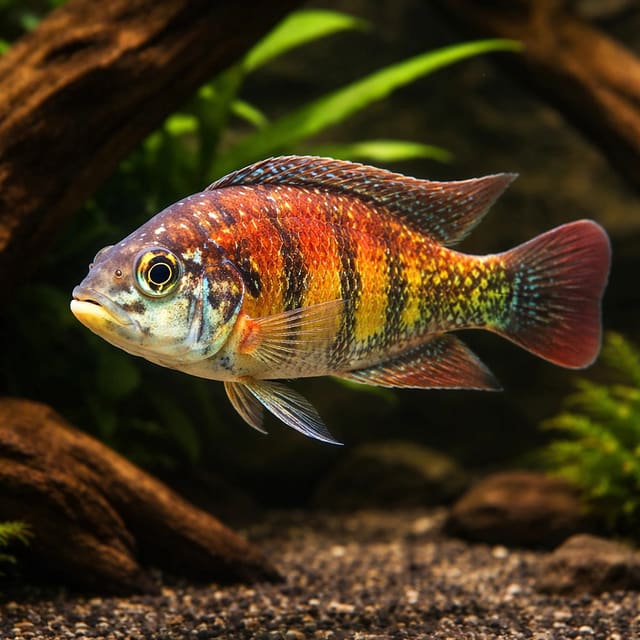
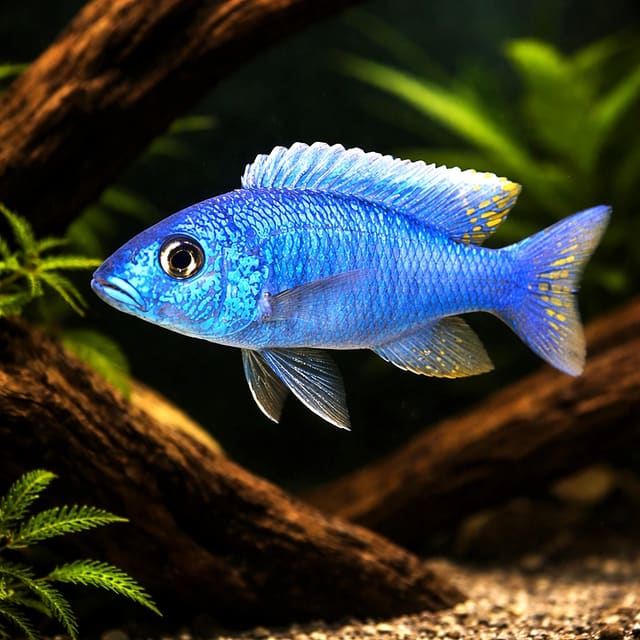
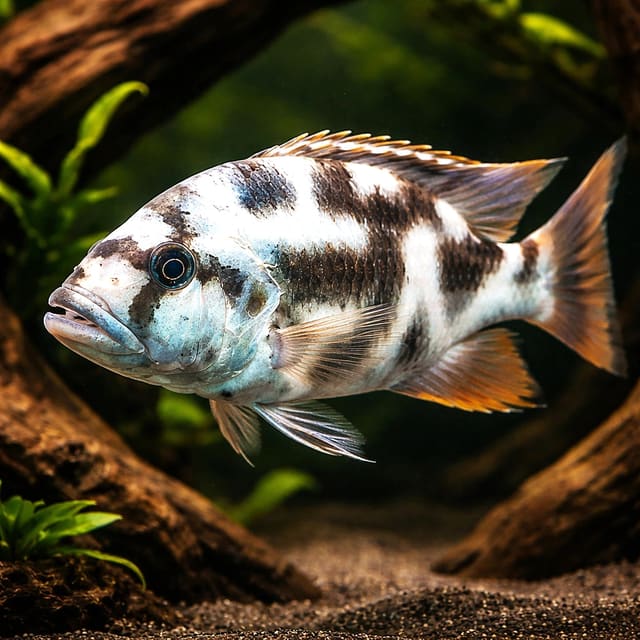
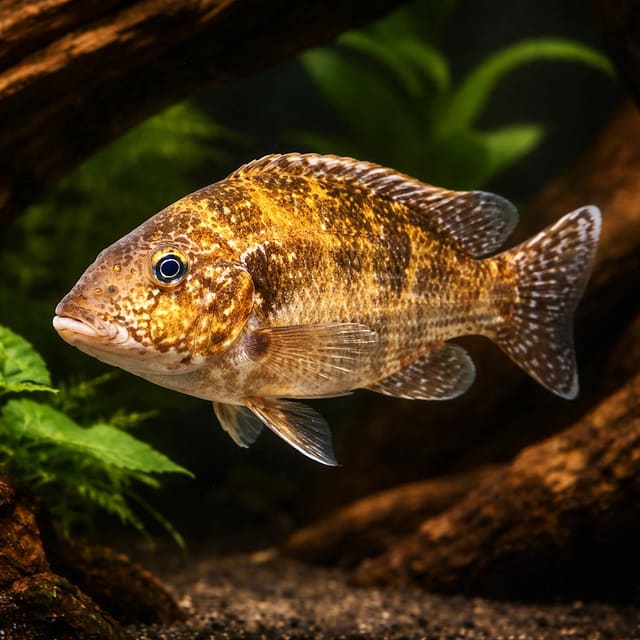
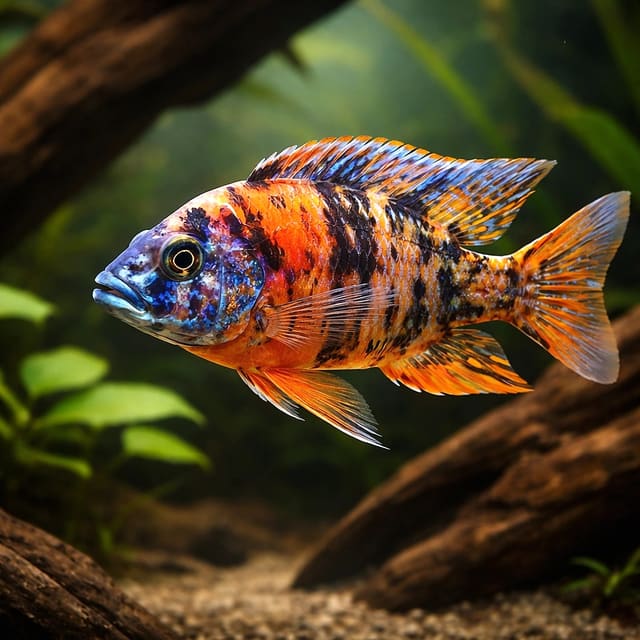
The gallery images are representative, based on reference photographs of this species, so colours can look slightly different from the live animal.
OATA's Malawi-cichlid guidance gives 23–27°C, pH 8.0–8.6 and hard water at 12–18°dH for the group. FishBase places this species within pH 7.4–8.4 and 7–30°dH, so the practical aquarium target is 23–27°C, pH 8.0–8.4 and 12–18°dH. This overlap keeps routine values within the species-level environmental bounds while following the narrower UK group advice.
| Decision | Planning figure |
|---|---|
| Adult length | Up to 18.3 cm total length |
| Temperature | 23–27°C |
| Routine pH | 8.0–8.4 |
| General hardness | 12–18°dH |
| Community volume reference | At least 200 litres |
| Suits | Not suited to |
|---|---|
| A mature, filtered Malawi community with hard alkaline water | A general community outside Malawi water guidance |
| A layout with open swimming water and secure rocky structure | An aquarium that cannot accommodate an 18.3 cm adult |
| A carefully screened community planned around aggression | A small Malawi group in which fighting may focus on one fish |
OATA recommends an aquarium of at least 200 litres for a reasonable-sized Malawi community. Treat 200 litres as the group starting reference, not an automatic answer for every collection of fish. The finished aquarium must also accommodate this species' recorded adult length, an open swimming zone, rock structure, the total number and size of residents, and the waste load placed on the filter.
A practical planning sequence is to list every intended adult fish, compare their water needs, reserve open water for Jackson's Nkata and then check whether each individual can retreat without being cornered. If the footprint or filtration leaves little margin, choose a larger aquarium or a lighter stocking plan before purchasing livestock.
Browse the African cichlid collection to compare identities and care requirements, but assess every combination individually rather than treating a shared category as automatic compatibility.
Set the heater to maintain 23–27°C and confirm the actual temperature with a thermometer. Stability matters more than chasing a single point within that range. A reading that moves repeatedly between the limits calls for a check of heater performance, water circulation, room-temperature changes and thermometer placement.
Keep routine pH between 8.0 and 8.4. This is the overlap between OATA's 8.0–8.6 Malawi guidance and FishBase's 7.4–8.4 environmental range for the species. General hardness should remain within 12–18°dH; OATA also gives hard carbonate hardness of 10–15°dKH for Malawi cichlids. Measure your aquarium and replacement water rather than assuming local tap water is suitable.
Our water chemistry guide explains what the main readings mean. Once you have measured the aquarium, use the water matcher to compare those readings with the target range.
| If you measure | Do this next |
|---|---|
| pH below 8.0 | Check source-water pH, hardness and carbonate hardness before making gradual corrections. |
| pH above 8.4 | Review buffering materials and replacement water, then bring the value back gradually. |
| Hardness below 12°dH | Confirm the test result and plan controlled mineral adjustment before adding the fish. |
| Temperature outside 23–27°C | Check the heater, thermometer and circulation before changing the setting. |
Avoid sudden chemical corrections. Rapid changes can create a more immediate welfare problem than a modest reading that is brought back towards the target in controlled stages. Recheck after each change and keep written results so a gradual drift becomes visible before fish behaviour changes.
A working biological filter is essential. The RSPCA explains that fish release toxic ammonia; filter bacteria convert it first to nitrite, which is also toxic, and then to safer nitrate. OATA sets ammonia and nitrite at zero mg per litre for Malawi cichlids, so both readings must be zero before this fish enters the aquarium and throughout routine care.
Prepare and mature the aquarium before arranging livestock. Our first tropical aquarium guide takes you through the setup sequence. Maturity is not defined by how clear the water looks: use water tests to show that the biological filter is processing waste.
OATA recommends an oversized filter because Malawi communities may carry a substantial combined waste load. Vigorous aeration is also recommended so dissolved oxygen remains adequate. Choose filtration with enough biological capacity for the complete adult stocking plan, then arrange circulation so waste reaches the filter and oxygenated water moves throughout the aquarium.
Add livestock gradually. A filter that supports one waste load needs time to develop enough bacteria for a larger one. Adding a complete community too quickly can cause new tank syndrome, in which ammonia or nitrite rises because bacterial capacity has not caught up.
Check the filter for blockages during maintenance. When media needs cleaning, rinse it lightly in aquarium water removed during a partial water change rather than under the tap. Chlorine or chloramine in tap water may damage the bacteria responsible for processing waste.
Preserve established biological media while cleaning only enough material to restore normal flow, and follow the filter manufacturer's safe maintenance instructions for the unit itself.
Build the layout around the way this haplochromine uses space. Wild Jackson's Nkata forms schools in the open water of sheltered bays, while breeding males defend territories around large boulders near steep rocky shores. In the aquarium, retain a generous open swimming route and use rock structure to break sight lines and create retreat choices.
OATA recommends coral sand or a similar substrate that helps buffer Malawi water. These cichlids will often dig and rearrange the substrate, so position heavy rockwork securely and ensure digging cannot undermine it. Stability matters more than building tall or elaborate piles.
Use the adult length of up to 18.3 cm as a scale when judging gaps and turns. A passage that looks open beside a 3 - 4 cm dispatch fish may become restrictive later. Check that mature fish will be able to pass structures, turn without scraping and leave a contested area by more than one route.
| Layout element | Purpose |
|---|---|
| Open central or front zone | Supports sustained open-water swimming. |
| Separated rock groups | Breaks sight lines and creates alternative routes. |
| Stable buffered substrate | Supports hard alkaline water and tolerates digging. |
| Unobstructed circulation | Helps oxygenated water and suspended waste reach all areas. |
Plants are optional accents rather than the basis of the layout. OATA notes that digging will uproot plants and recommends only hardy plants that grow attached to rocks or wood. Position any attached plants so they do not close the main swimming lane or restrict access for maintenance.
The result should feel structured but not crowded: open water for routine swimming, secure cover for retreat and enough access to maintain the aquarium without dismantling it.
Jackson's Nkata feeds on plankton in nature. Use that biology to guide food choice and portion size rather than treating it as a predator of small fish. Select an appropriately sized, complete Malawi cichlid food and watch how readily each portion is captured through the water column.
OATA advises feeding Malawi cichlids only what they can finish within a few minutes, twice a day. Its guidance notes that some larger open-water utaka may need pellets with a higher animal content and frozen foods such as brine shrimp, prawn or cockles. For this plankton-eating species, introduce foods conservatively and judge them by acceptance, body condition and the amount of waste left behind.
| Step | Action |
|---|---|
| First portion | Offer a small amount that disperses where the fish can collect it. |
| Observe | Watch whether food is eaten promptly or falls past the fish. |
| Adjust | Add only enough for the full feed to finish within a few minutes. |
| Second feed | Repeat later in the day without compensating for food already left behind. |
Match particle size to the selected dispatch size. A 3 - 4 cm fish needs food it can take cleanly, while a larger animal may handle larger pieces. The goal is easy capture, not the largest food the fish can swallow.
Overfeeding adds waste that becomes ammonia and places extra pressure on the filter. Portion control therefore protects both body condition and water quality. Keep a short feeding note during the first weeks so changes in appetite can be compared with test results and community behaviour.
Carry out a 25% partial water change at least once every week. OATA strongly recommends this schedule for Malawi cichlids, together with testing at least weekly. Consistency removes dissolved and solid waste while making changes in the aquarium easier to recognise.
Keep nitrate from rising more than 20 mg per litre above the normal tap-water level. This comparison matters because the starting nitrate concentration differs between water supplies. Record both tap and aquarium readings when assessing how much nitrate the aquarium has added.
| Result | Response |
|---|---|
| Ammonia above zero | Pause stocking, reduce feeding pressure and make conditioned partial water changes while checking the filter. |
| Nitrite above zero | Act as for ammonia and increase observation of breathing and surface behaviour. |
| Nitrate rise exceeds 20 mg/l | Review water-change frequency, waste removal, feeding and total biological load. |
| Filter flow is reduced | Check for blockages and lightly rinse dirty media in removed aquarium water. |
Do not rinse biological media under the tap. Use some of the water removed from the aquarium and clean only as much as needed to restore flow. This retains more of the bacterial population that converts ammonia and nitrite.
Monthly, review the written trend rather than looking only at the latest result. A slow movement in pH, hardness, nitrate or temperature can reveal a developing issue before it produces an obvious change in the fish.
Complete the aquarium, mature the filter and settle the stocking plan before the fish travels. On the day, arrange for someone to receive the parcel because live fish must not be left unattended. Read the current delivery and Live Arrival Guarantee policy before the delivery window so the arrival and claim steps are clear.
After release, observe from a distance before making further changes. Compare the animal's swimming level, breathing, colour, fin condition, feeding response and interaction with residents each day. Some variation follows a move, but a worsening pattern or several changes at once calls for prompt water testing.
| Checkpoint | What to establish |
|---|---|
| Arrival day | Steady breathing, controlled swimming and access to a retreat without sustained pursuit. |
| First feeds | Interest in appropriately sized food without excessive leftovers. |
| First water tests | Ammonia and nitrite remain at zero as the biological load changes. |
| End of week | Behaviour, colour and appetite are moving towards a consistent individual pattern. |
Add further fish only gradually. Every addition increases waste and feeding, so the biological filter needs time to adjust. In a territorial community, later additions also change the social balance. Reassess both water readings and aggression before taking the next stocking step.
Keep the first-week notes brief but consistent. A daily line covering food, breathing, swimming and interactions is more useful than relying on memory after a concern develops.
Learn the fish's normal appearance and behaviour so changes stand out. OATA recommends watching swimming, colour, temperament, breathing, physical condition and feeding response. Healthy fish should have clear bright eyes, intact scales and undamaged fins, with swimming appropriate to the species.
If Jackson's Nkata hangs at the surface, sits on the bottom, swims erratically, hides more than normal, changes colour, breathes faster or slower, loses condition or stops feeding, test the aquarium promptly. Check ammonia, nitrite, nitrate, temperature and pH, then inspect filter flow and aeration.
| Change you see | First action |
|---|---|
| Surface hanging or rapid breathing | Test ammonia and nitrite, confirm temperature and increase checks on aeration and filter flow. |
| Sudden hiding or aggression change | Review water results, recent additions, blocked routes and access to retreat areas. |
| Reduced feeding | Remove leftovers, test water and compare body condition and breathing with normal. |
| White spots, fluffy growths or damaged fins | Record the appearance clearly, test water and seek case-specific guidance before treatment. |
Do not medicate from one vague sign. Different problems can produce similar behaviour, and treatment choice depends on the actual condition, the aquarium and its other residents. Correct any clear water-quality or equipment failure immediately while preserving stable temperature and chemistry.
Check the social setting as well as the test kit. A fish repeatedly denied access to open water, food or retreat space may show declining condition even when routine readings are within range. Rearranging décor can reset territories, but first make sure all structures remain secure and the open swimming zone is retained.
Contact us for guidance when a health change persists, several symptoms appear together or you are considering medication. Share current test results, temperature, recent stocking changes, feeding behaviour and a clear description of what has changed.
OATA advises keeping Malawi cichlids only with other Malawi cichlids or some species of Synodontis catfish that naturally inhabit Lake Malawi. Use that as the outer compatibility boundary, then screen each proposed species for adult size, water range, diet, aggression and use of space.
Do not treat “Malawi cichlid” as a universal match. Members of the group are diverse and can be highly aggressive. Jackson's Nkata uses open water, while other fish may defend rocks, caves or feeding areas. A combination becomes risky when residents compete for the same route, cannot escape pursuit or need conflicting diets.
OATA notes that Malawi cichlids kept in small groups often fight and describes communities of at least 15 fish, with slight crowding used to spread aggression. That is broad community guidance, not a requirement to keep 15 Jackson's Nkata. A group of that scale also increases the demand for space, oxygenation, filtration and waste control, so never increase numbers without checking the whole system.
Where possible, OATA recommends more females than males of each species to reduce male harassment. This offer has no sex-guaranteed option, so do not build a precise sex-ratio plan around the selected dispatch size or gallery appearance.
Avoid placing this fish in a general community outside the Malawi guidance. For a proposed Malawi combination or a screened Synodontis species, ask us for a stocking assessment with the aquarium dimensions, volume, water readings and current residents.
Plan the order and method of introduction before changing a Malawi community. OATA recommends adding Malawi cichlids in groups so one newcomer is less likely to receive all the aggression, placing more peaceful species first and more aggressive species later. Additions must still be gradual enough for the biological filter to adjust.
Use separate rock groups and open-water lanes so a pursued fish has more than one direction of escape. A single cave can become a trap if another fish controls its entrance. Before release, check that structures are stable and that no route ends in a narrow corner.
Rearranging décor can reduce aggression by disrupting established territories. Make the smallest effective change, retain the open swimming area and observe whether pursuit becomes shorter and more evenly distributed. Décor changes do not compensate for an aquarium that is too small for the adult collection.
| If you observe | Respond by |
|---|---|
| Brief display and short pursuit | Continue close observation and confirm every fish can leave the contested area. |
| One fish repeatedly cornered | Intervene promptly, reassess barriers and routes, and separate fish when safety requires it. |
| One resident blocked from food | Distribute small portions across several points and reconsider the social combination. |
| Damaged fins or lost scales | Separate the immediate conflict, test water and assess the injured fish. |
| Aggression after a new arrival | Review introduction order, adult-size balance, territory layout and total stocking pressure. |
Individual outcomes remain uncertain even when water and adult sizes appear compatible. Observe actual behaviour instead of relying on a name-based chart. A pairing that works in one large, structured aquarium may fail where sight lines, sex balance, resident order or swimming space differ.
Review the community again as young fish grow. Dispatch size affects the animal you receive, but territorial pressure, waste production and space use change towards adulthood. Build enough margin into the original plan that growth does not turn an acceptable arrangement into a crowded one.
FishBase records a maximum of 18.3 cm total length for male or unsexed Jackson's Nkata. Plan swimming space, structure and filtration around that adult figure rather than its dispatch size.
OATA gives at least 200 litres as a starting reference for a reasonable-sized Malawi community. The aquarium must also provide open swimming water, secure rocky structure and enough room for this 18.3 cm fish and every other adult resident.
FishBase records wild schooling, while OATA describes planned communities of at least 15 Malawi cichlids to spread aggression. This is a Malawi community figure rather than a fixed number of Jackson's Nkata, so assess the complete adult stocking plan.
We rate Jackson's Nkata as intermediate because it needs hard alkaline water, mature filtration and deliberate aggression management. It suits a keeper prepared to maintain 23–27°C, pH 8.0–8.4 and 12–18°dH and to test water every week.
It feeds on plankton in nature. Offer appropriately sized complete Malawi cichlid food twice daily, giving only what it can finish within a few minutes; OATA also names frozen brine shrimp, prawn and cockles for larger open-water utaka.
Maintain 23–27°C, pH 8.0–8.4 and general hardness of 12–18°dH. These values are the overlap between FishBase's species environmental range and OATA's Malawi-cichlid guidance.
OATA describes Malawi cichlids as aggressive, so plan for pursuit and territorial conflict rather than relying on a fin-nipping label. Use open routes, secure retreats and close observation, and separate fish if one is cornered or injured.
Keep it only with carefully screened Malawi cichlids or some screened species of Synodontis from Lake Malawi. Match adult size, 23–27°C hard alkaline water, diet, aggression and space, and avoid a general community outside Malawi guidance.
Have someone present to receive it. Film every delivery continuously from the sealed parcel as it is opened, showing the fish still inside the sealed bag; then float the bag for 20–30 minutes before release and never pour the bag water into the aquarium.
No reviews for this item yet. Bought one? Honest reviews only, good or bad.
What customers say about ordering from us
I have a small group of long finned mountain minnows. So was delighted to be able to order ten of this variety to increase the genetics in my tank . The ones I recieved are healthy but it’s to early to give a verdict on wether they are of a long finned type since they are small currently.
Gordon Walker · 23 Sept 2026
100% success travel and "installation". Pleased with quality of purchase. The Siamese fighter a bit "shy" so have not yet seen him at his best yet but looking good. Happy customer. GG
George E Garratt · 21 Sept 2026
Reviews of our shop, collected by Judge.me, an independent third-party review collector. Newest first.