Dwarf Shell-Dweller, Brevis (Lamprologus brevis)
23–25°C · pH 8–8.6 · 40L
£13.99
Neolamprologus cylindricus is a rock-associated Lake Tanganyika cichlid for an experienced, carefully planned hard-water aquarium. One purchase supplies one fish in the selected dispatch size; allow for the 10.4 cm adult record, secure rock recesses, broad group guidance of 23–27 °C and pH 8.0–8.6, and territorial compatibility.
Adult size is the maximum length this species reaches at full maturity (scientific sources). The livestock you receive will be younger and smaller — pick a size above for the actual shipping size. Product-photo provenance and any image-specific limitations are stated on the listing.
Neolamprologus cylindricus
Save when buying multiple fish. Each quantity is one fish; sex and pair formation are not guaranteed unless the selected variant explicitly states them.
Neolamprologus cylindricus is a rock-associated Lake Tanganyika cichlid for an experienced, carefully planned hard-water aquarium. One purchase supplies one fish in the selected dispatch size; allow for the 10.4 cm adult record, secure rock recesses, broad group guidance of 23–27 °C and pH 8.0–8.6, and territorial compatibility.
Adult size is the maximum length this species reaches at full maturity (scientific sources). The livestock you receive will be younger and smaller — pick a size above for the actual shipping size. Product-photo provenance and any image-specific limitations are stated on the listing.

Cichlids are a family of roughly 1,800 accepted species, not one care type. Before buying, identify the exact species and source, then compare adult measurement, usable tank dimensions, social system, territory, tested water, diet and an exit plan. No family-wide minimum tank, water range or tank-mate list is safe.
Maintain these water conditions for optimal health and vibrant colors
Neolamprologus cylindricus is a strongly marked rock-associated cichlid from Lake Tanganyika. The accepted scientific name replaces the older combination Lamprologus cylindricus; both names may appear in aquarium conversations, but they refer here to the same identified species. The current WoRMS record places it in Cichlidae, while the species summary records it from the south-eastern part of the lake, close to rocky bottom and recesses at mainly less than 10 metres depth.
This is a fish for a deliberately planned Tanganyikan-style aquarium, not a general mixed community. Its natural use of rocky recesses, small benthic-invertebrate diet and cave spawning all point to the same practical priorities: secure rock structures, several usable retreats, hard alkaline water, careful feeding and enough room to keep territorial pressure from concentrating on one fish. The species is recorded to 10.4 cm total length, so the aquarium must be planned for an adult rather than for the fish's arrival size.
One purchase supplies one live fish in the size selected. The listed dispatch choices include S, 4–5.5 cm, 6–7 cm, 7–9 cm and 9–12 cm. The size you select is the size supplied, not the adult size. Sex is guaranteed only when the selected option explicitly states male or female. This Lamprologus cylindricus listing has no sex-guaranteed option.
| Accepted name | Neolamprologus cylindricus |
|---|---|
| Family and origin | Cichlidae; endemic to south-eastern Lake Tanganyika |
| Recorded maximum | 10.4 cm total length |
| Sold unit | One live fish per purchase |
| Dispatch sizes | S, 4–5.5 cm, 6–7 cm, 7–9 cm and 9–12 cm |
| Broad water guide | 23–27 °C; pH 8.0–8.6; 12–18 dGH; 10–15 dKH |
| Care level | Intermediate retailer assessment |
| Natural feeding | Small benthic invertebrates |
| Suits | A mature, hard-water aquarium built around secure rock territories |
The African cichlid collection is useful for comparing other fish, but a shared shop category is not evidence of compatibility. Begin with the water and layout this species needs, then examine every possible companion on its own merits.
A smaller arrival can be easier to settle into a carefully stocked growing-on setup, but it still needs an aquarium that can be adapted for the adult. A larger arrival reduces none of the requirements for cycling, water stability or territory. Compare the chosen dispatch length with cave entrances, feeding access and the present size of any established fish. Do not put a small newcomer into a community where it can be excluded from food, and do not add a larger newcomer where every existing retreat is already occupied.
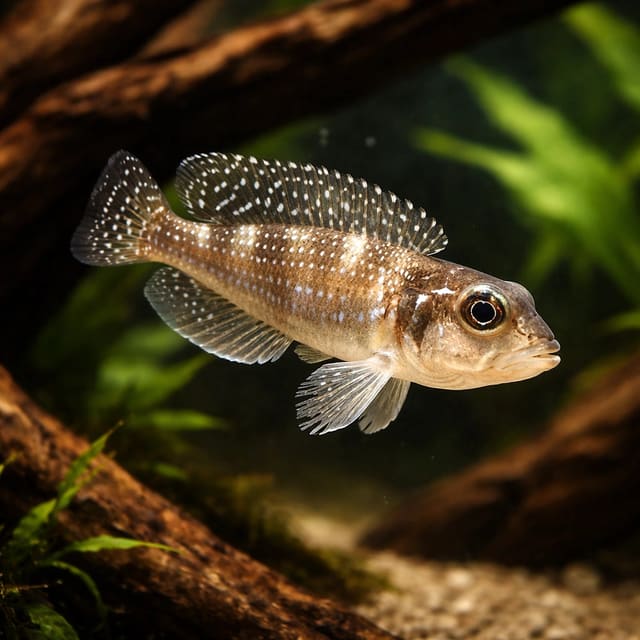
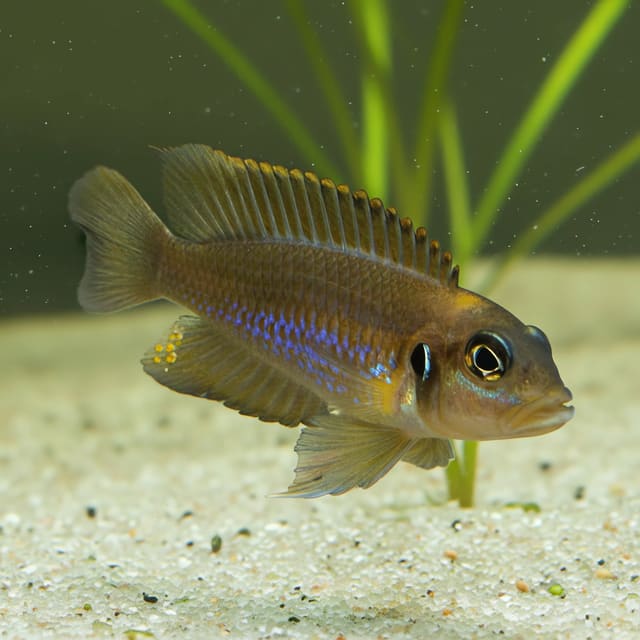
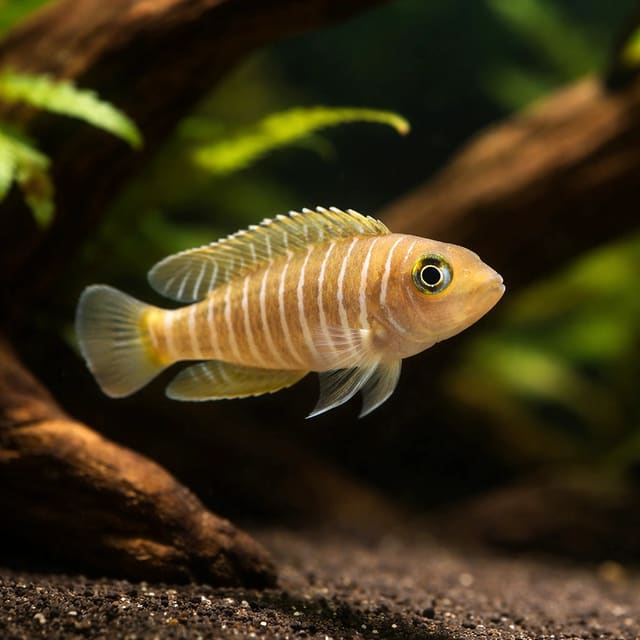
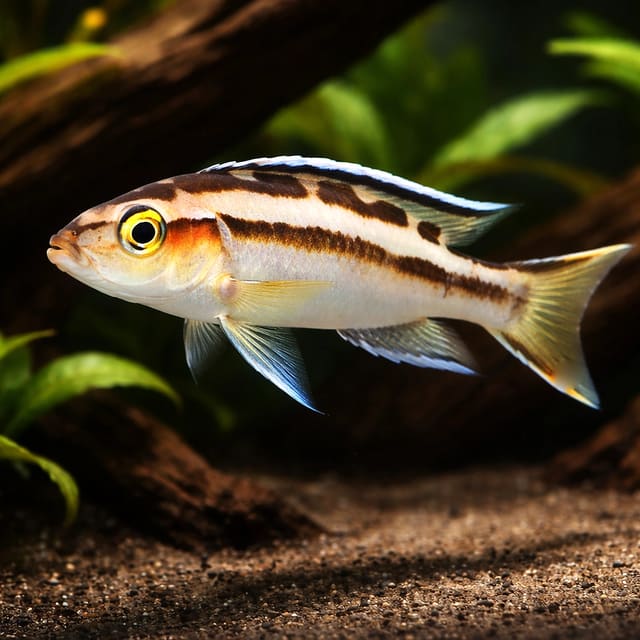
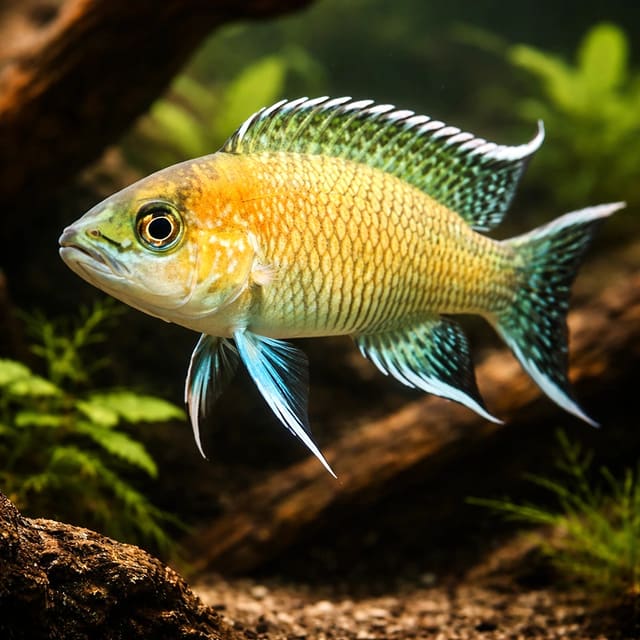
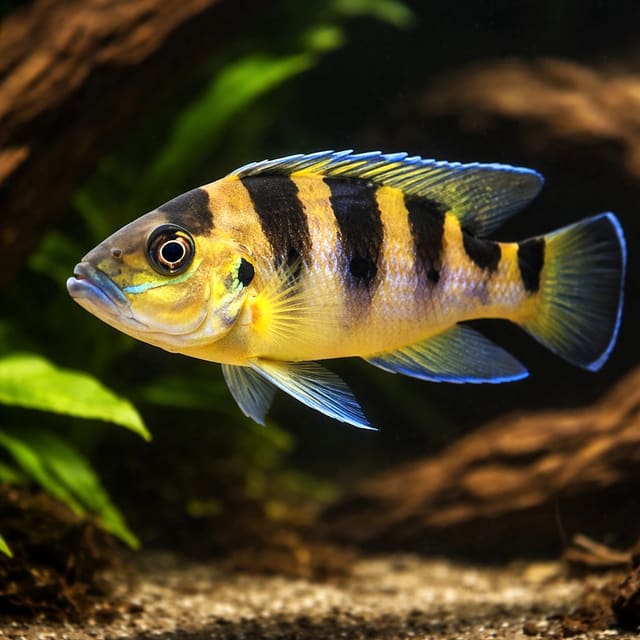
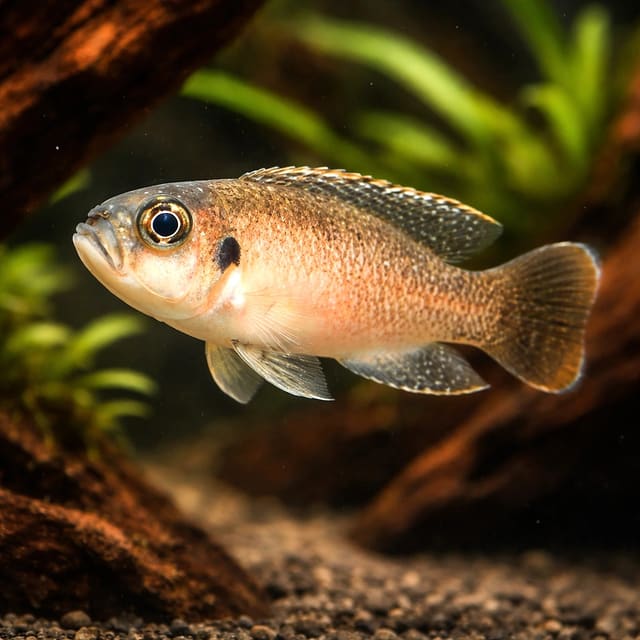
The striped body and blue-green fin accents are attractive, yet colour is not the right way to judge readiness. Stress, lighting, age and individual development can all affect how a live fish looks. Assess the aquarium instead: ammonia and nitrite must be zero, the heater and filter must be reliable, rocks must be secure, and the final community must have workable territories. The purchase decision is sound only when those conditions are ready before delivery day.
The accepted-name change does not create a different care subject. A customer who has encountered Lamprologus cylindricus in an older book or trade list can compare it with this page through the accepted name Neolamprologus cylindricus. Keep that distinction in labels and records so medicines, care notes and future research stay attached to the correct fish. Avoid extending either binomial with a colour, size or sales phrase, because those details belong to the offer rather than the taxonomy.
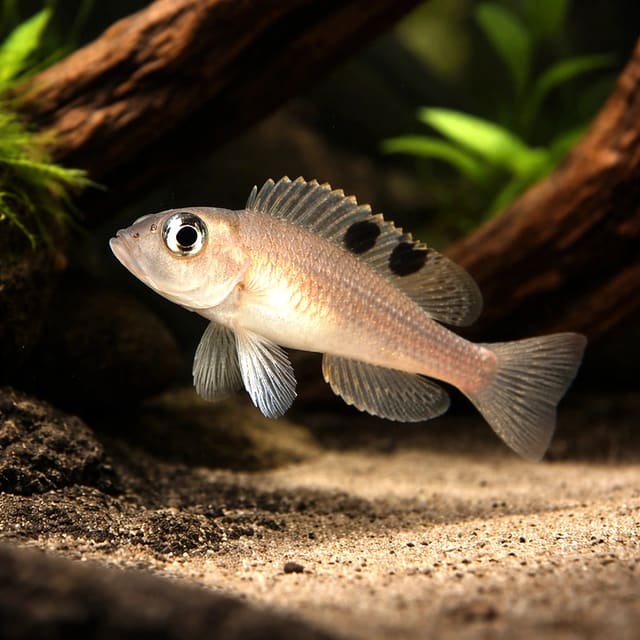
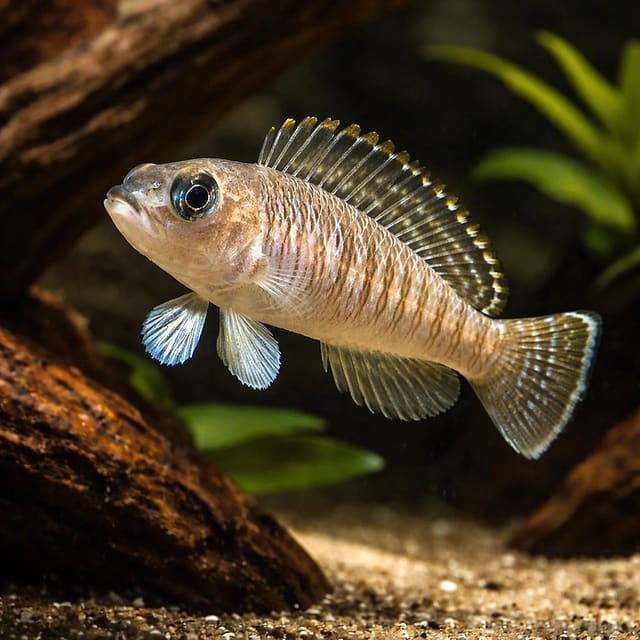
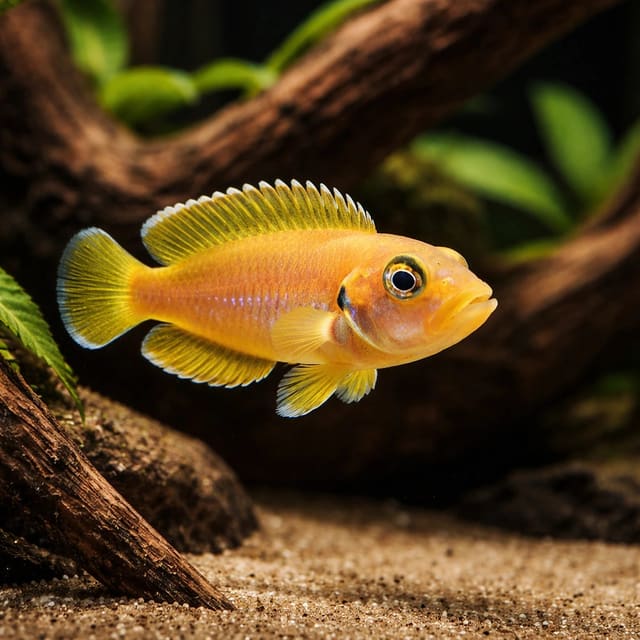
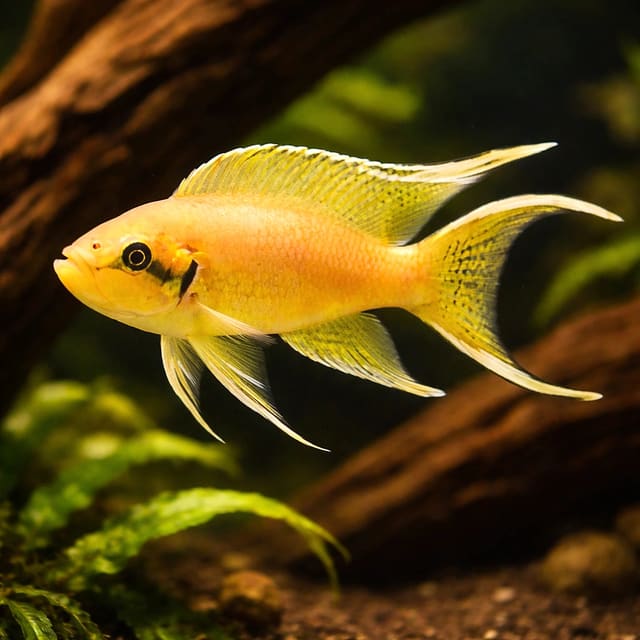
Gallery images have been digitally enhanced to improve image quality. Natural colour, pattern, size and maturity can vary between live animals.
A successful layout begins with the aquarium base. Place weight-bearing rocks securely so they cannot topple or press unevenly on the glass. If sand is added first and heavy structures balance on loose grains, digging or ordinary maintenance can undermine them. Create a stable foundation, then add a fine substrate around it. OATA's broad African lake cichlid guidance suggests fine coral sand or another substrate that helps maintain hard, alkaline conditions. The aim is not a decorative wall: it is a set of functional spaces the fish can enter, leave and defend without every route ending at the same cave.
Use rocks to form recesses of different heights and entrances, but keep every structure open enough to inspect. Narrow dead ends can trap a pursued fish. Broken lines of view matter because a fish that moves behind a rock should be able to drop out of another individual's attention. Preserve an open feeding area as well. More stone is not automatically better; a useful aquascape combines secure cover, clear swimming routes, accessible siphoning areas and enough surface movement for gas exchange.
No species-specific minimum volume is assigned here. A litre figure without dimensions would be especially misleading for a bottom-oriented territorial cichlid. Choose a long, wide aquarium by considering the recorded 10.4 cm adult length, the number and adult size of every fish, the territories that must fit on the base, and the filter's ability to process the total waste load. If the planned rocks consume most of the footprint or leave one fish exposed wherever it moves, the aquarium is too constrained for that stocking plan.
Fish release ammonia, which is toxic. An established biological filter supports bacteria that convert ammonia to nitrite and then to the less immediately harmful nitrate. Clear water can still contain dangerous ammonia or nitrite, so visual appearance is not a substitute for tests. Complete a fishless cycle, confirm that the filter can process waste, and keep both ammonia and nitrite at zero before adding livestock. The first tropical tank guide explains the preparation sequence.
Choose filtration that can cope with cichlid feeding and the community's adult waste load. Direct the outlet so it circulates water around rocks and disturbs the surface without pinning fish in a relentless jet. Hidden pockets behind dense stonework can collect waste, so check circulation during setup. The general RSPCA aquarium guidance explains why filtration, maturation, temperature control and regular testing are basic welfare requirements. When cleaning, preserve the beneficial bacteria: rinse dirty media gently in removed aquarium water and do not run it under the tap.
Add fish gradually rather than assuming a mature filter has unlimited capacity. Test more often after a new arrival, a filter interruption, heavy feeding or any change in behaviour. Rapid gill movement, surface hanging, clamped fins, unusual hiding or sudden refusal to eat should trigger a water check first. If ammonia or nitrite is detectable, treat that as an urgent water-quality problem while also checking temperature, oxygenation and equipment.
The OATA African lake cichlid sheet gives a broad group guide of 23–27 °C, pH 8.0–8.6, 12–18 dGH and 10–15 dKH. It is not a species-specific optimum for N. cylindricus; use it as broad planning guidance for this Lake Tanganyika cichlid. OATA also requires ammonia and nitrite at zero and says nitrate should not exceed 20 mg/l above the normal tap-water level.
General hardness describes dissolved calcium and magnesium, while carbonate hardness helps resist a sudden fall in pH. The distinction matters in a high-pH aquarium: a reading that is alkaline today does not guarantee adequate buffering tomorrow. Test the tap water and aquarium so you know both the starting point and the trend. The water chemistry guide explains the measurements, and the water matcher helps compare measured water with the broad range on this page.
| Temperature | 23–27 °C, broad African lake cichlid guidance |
|---|---|
| pH | 8.0–8.6, broad group guidance |
| General hardness | 12–18 dGH, broad group guidance |
| Carbonate hardness | 10–15 dKH, broad group guidance |
| Ammonia and nitrite | 0 mg/l |
| Nitrate | No more than 20 mg/l above the normal tap-water level |
Stability is more useful than chasing a particular decimal with repeated chemical doses. If the source water falls outside the broad guide, work out a consistent preparation method before the fish arrives. Changes to mineral content or pH should be measured and repeatable. Match replacement water for temperature and chemistry, and avoid abrupt shifts caused by a large unplanned correction.
At least once every week, OATA advises a partial water change of 25% for African lake cichlids, using dechlorinated replacement water. Treat that as a routine starting point and use test trends to understand the particular aquarium. Siphon exposed substrate and accessible pockets around rocks without destabilising the structure. Wipe algae where necessary, inspect the heater and filter flow, and remove trapped food before it decays.
Keep a simple log of temperature, pH, hardness, ammonia, nitrite and nitrate. A sequence of readings reveals drift that a single result hides. Rising nitrate may point to excess feeding, insufficient maintenance or too much stock. Falling carbonate hardness can make pH less stable. A change in filter noise or outlet flow can reveal a blockage before oxygenation and waste processing suffer. Correct the cause rather than repeatedly masking the reading.
Do not dismantle the whole aquarium for routine cleaning. Large-scale disturbance can remove established surfaces, release trapped debris and destroy territory boundaries at once. Work methodically in reachable areas and leave secure structural rock undisturbed unless there is a safety reason to rebuild it. Inspect joins and supports during each water change so a small shift is found early.
A useful weekly rhythm starts with observation before hands enter the aquarium. Check how every fish breathes, holds its fins, leaves cover and responds to food. Test the water and compare the results with the previous entry. Then remove 25% for the weekly partial change, siphoning accumulated debris without collapsing the rock structure. Refill with dechlorinated, temperature-matched water, restart or verify every item of equipment, and check the aquarium again after the water clears.
Monthly tasks should be driven by condition rather than a ritual of stripping everything down. Inspect hoses, impellers, seals, heater guards and the underside of accessible rocks. Clean only what restricts flow or collects waste, while protecting mature biological media. Compare the month's nitrate and hardness pattern with feeding and stocking. If readings worsen, solve the cause with maintenance, feeding or stocking changes instead of simply increasing chemical corrections.
Plan for interruptions. A power cut, failed heater or blocked filter can affect oxygen and waste processing quickly. Know how to keep the surface moving, have test kits and conditioner in date, and keep contact details for help accessible. After any equipment failure, test ammonia and nitrite more frequently and reduce feeding until the biological system is demonstrably stable again.
Run the completed layout before stocking it. Check that the heater holds a steady temperature at both ends of the tank, that the filter outlet reaches behind the rock structure and that no cave becomes a dead zone filled with debris. Test how easily a siphon can reach the exposed sand. A beautiful arrangement that cannot be cleaned will become a husbandry problem, so alter awkward pieces while the aquarium is empty rather than after territories form.
Observe the pH and carbonate hardness over several days, including before and after a normal water change. That trial shows whether the substrate and replacement-water method produce stable conditions. Confirm that the lid, cables and filter hoses sit securely. Leave no narrow gap where a startled fish could become trapped. Mark the normal water level so evaporation is obvious; top-up water replaces lost water, whereas a scheduled partial change removes dissolved waste.
Use the trial period to rehearse maintenance. Prepare replacement water, apply conditioner correctly, bring it close to aquarium temperature and measure it before use. Time the siphoning route around the rocks and make sure equipment can be disconnected safely. A routine that is easy to repeat is more reliable than one that depends on dismantling décor or making a different chemical correction every week.
Rock cichlids naturally spend time around cover, so entering a recess is not automatically a sign of illness. Look for change: a fish that stops leaving its shelter for food, breathes faster, loses condition or is driven back whenever it appears needs attention. Compare behaviour at quiet times and feeding times. Note which entrances are used and whether one fish controls more space than the aquascape was meant to give it.
Separate a social problem from a water problem by testing first and watching all residents. If several fish breathe rapidly or hold near the outlet, investigate oxygenation, temperature, ammonia and nitrite. If one fish alone is pinned to a corner while the others feed normally, territorial pressure becomes more likely. Either way, prolonged distress needs action; waiting for visible injury is not a suitable threshold.
The species' recorded natural diet is small benthic invertebrates. In the aquarium, use a varied diet appropriate for a Tanganyikan cichlid: a suitable quality prepared food supported by appropriately sized frozen or live foods. Avoid turning one wild-food observation into a rigid menu. The practical goal is complete nutrition, food of a manageable size and delivery that allows the fish to feed without fouling the substrate.
Offer small portions and watch them disappear. Food that drops behind rocks can be hard to recover and can drive ammonia and nitrate upward. If several fish share the aquarium, distribute food across more than one point so a dominant individual cannot intercept everything. Check the less assertive fish: a full-bodied dominant fish does not prove the entire group is eating. Adjust the portion to appetite, temperature and stocking rather than feeding by habit.
A fish that stops feeding deserves investigation. Test water, check that the temperature is stable, observe breathing, inspect for injury and look for repeated displacement by another fish. Do not solve every refusal by adding richer food. Sometimes the useful response is to restore water quality, improve access to a retreat or separate a fish under pressure.
Have the aquarium cycled, heated, tested and fully arranged before delivery day. Moving rocks after the fish enters adds avoidable disturbance. Have a clean container and net ready, and make sure someone will be at the address. Read the current delivery and Live Arrival Guarantee policy before the parcel is due.
Neolamprologus cylindricus belongs in a community designed around rock use and cichlid behaviour. The key question is not whether another fish is also called a cichlid; it is whether the two species can share the same water, footprint, food and social space as adults. A fish that tolerates pH 8.2 may still be a poor companion if it contests the same cave, grows much larger, feeds too aggressively or cannot escape repeated attention.
Sketch the aquarium base and mark the actual recesses. One rock pile with several holes can still function as one contested territory if every entrance leads to the same central chamber. Separate usable cave areas, break direct lines of view and leave neutral routes around them. Watch the fish after any change. Persistent chasing, one fish confined to a corner, torn fins, rapid breathing or missed meals are not harmless features of a lively cichlid display.
Potential companions must thrive in the same stable, hard and alkaline conditions. Soft-acidic specialists should not be placed in a Tanganyikan-style setup merely because an overlap can be found at the edge of two published ranges. Shared routine values are needed, not temporary tolerance. Temperature, pH, general hardness and carbonate hardness all matter, as do oxygenation and nitrate control.
OATA's broad guidance says different African-lake cichlids should only be mixed after checking that they come from compatible locations and have appropriate requirements. Lake Malawi, Lake Victoria and Lake Tanganyika are not interchangeable labels. Even within Lake Tanganyika, behaviour and diet differ widely. Confirm the exact species, adult size, preferred zone and feeding strategy before treating a fish as a candidate.
The offered dispatch size tells you what arrives; it does not freeze the fish at that length. Plan around the species' 10.4 cm total-length record and do the same for every proposed companion. A fish bought small may later dominate a recess or become vulnerable to a larger neighbour. Reassess the layout as bodies grow and routes narrow. Ensure every fish can reach food without crossing a defended entrance.
Do not use a generic numerical group rule. OATA explains at broad group level that very few African lake cichlids do well alone, but it also says the correct number depends on species. That is a prompt for species-level planning, not permission to buy an arbitrary trio. Work from the exact aquarium dimensions, the intended breeding or non-breeding plan, and the ability to create multiple territories. Keep a backup aquarium or divider-free relocation plan available before adding fish that may need separation.
The species is recorded as laying eggs in caves. That natural-history fact does not predict when a pair will form or guarantee breeding, but it does explain why a recess can become more strongly defended. If courtship or spawning occurs, watch the whole aquarium rather than focusing only on the cave. Another fish repeatedly driven across the tank needs intervention even if no obvious bite is seen.
Do not rearrange occupied cave areas casually. If a change is necessary for welfare, prepare the new structure before moving fish and make every rock secure. A mature aquarium can change socially after growth, a new addition or breeding. Compatibility is therefore something to monitor, not a one-time label attached at purchase.
Adding a fish changes more than the head count. It changes where food falls, which entrances are approached and how often established residents meet. Complete normal maintenance before the introduction rather than combining a new arrival with a major clean or complete aquascape rebuild. Confirm that the planned retreat for the newcomer is open and that existing fish do not already control every route to it.
During the first week, watch short periods several times a day instead of relying on one long glance. Observe before feeding, while food is distributed and after the aquarium settles. Record whether the newcomer emerges, eats, maintains normal breathing and can leave cover without immediately being pursued. Check established fish as well; a newcomer can displace a resident even when it appears confident itself.
Chasing has context, but repeated exclusion is a welfare problem. A brief interaction that ends when the fish separate is different from one animal patrolling every exit, interrupting every feed or forcing another to remain at the surface. Torn fins, fading condition and refusal to eat show that the arrangement is not working. Intervene before injury becomes severe, using a ready alternative aquarium rather than improvising after the conflict escalates.
A companion may match the water yet still be unsuitable if it consumes every portion before N. cylindricus can feed. Compare feeding speed, food size and feeding zone. Deliver small portions to more than one area and confirm that bottom-oriented fish receive food without leaving it to decay among the rocks. A predatory or highly competitive feeder can make an otherwise plausible water match fail.
Different dietary specialisms also matter. The small-benthic-invertebrate natural history of this species supports an animal-food component, but it does not justify forcing every fish in the aquarium onto the same menu. Choose companions whose own diet can be met without chronic excess, and keep prepared foods appropriate to each species. If a community requires contradictory feeding routines, separate setups are the safer choice.
A match that works at dispatch size can change as fish approach adult dimensions. Cave entrances feel smaller, feeding competition becomes more direct and a previously neutral route can fall inside a defended area. Review the layout whenever growth, breeding or a new resident changes how space is used. Do not wait for the original stocking plan to fail visibly before allowing more room.
Seasonal room temperatures and equipment changes can also alter behaviour indirectly through water temperature and oxygen demand. Keep the water within the broad 23–27 °C guide and maintain vigorous aeration. If activity or aggression changes, check temperature and water quality alongside the social layout. Compatibility is strongest when environment, feeding and space remain stable together.
Avoid large aggressive fish, animals requiring soft acidic water and any combination where the aquarium cannot supply separate bottom territories. Use caution with other Tanganyikan rock cichlids because matching water does not remove competition. A suitable companion is a species whose own care requirements match and whose adult behaviour can be accommodated in the actual layout; there is no universal named tank mate.
These answers cover the main buying and care decisions. They use the recorded species facts, broad group guidance where clearly labelled, and the store's delivery policy.
The species is recorded to 10.4 cm total length. The size sent is a dispatch size, not an adult ceiling, so allow for the full recorded length and the territory a rock-dwelling cichlid uses as it matures.
Choose the aquarium by adult length, usable bottom area and the whole territorial community, not by the 4–12 cm dispatch grades. No species-specific litre figure is used here. Build several secure rocky recesses, preserve open water and leave enough floor space for fish to move apart.
Do not apply one generic group number. OATA says at broad African-lake-cichlid level that very few do well singly, but it also says the correct number varies by species. Plan the final stocking and territories before purchase, and get species-specific advice for the exact aquarium.
It is best treated as an intermediate fish. A keeper should already be comfortable maintaining hard, alkaline water, testing ammonia and nitrite, building secure rockwork and managing cichlid territories. It is not a good choice for a new, uncycled aquarium.
In nature it eats small benthic invertebrates. In the aquarium, offer a varied cichlid diet in portions the fish finish promptly, using suitable prepared foods and appropriately sized frozen or live foods. Watch each fish feed and remove uneaten food.
OATA's broad African lake cichlid guide gives 23–27 °C, pH 8.0–8.6, 12–18 dGH and 10–15 dKH. These are group-level values rather than a species-specific optimum. Keep ammonia and nitrite at zero and prioritise steady, well-buffered conditions.
Treat it as a territorial rock cichlid rather than a passive community fish. Cave sites can become contested, especially when fish mature or breed. Use separated recesses and broken lines of view, watch for repeated chasing or missed meals, and be ready to separate an incompatible fish.
Consider only fish from compatible Lake Tanganyika-style hard, alkaline conditions whose adult size, feeding and territorial behaviour fit the same aquarium. Avoid soft-acidic specialists and do not mix fish merely because they are all sold as African cichlids. Assess every proposed species and available territory.
Tropical Fish Co uses oxygen-filled bags, insulation and a tracked licensed live-animal courier. Have someone receive the parcel and record one continuous video from the sealed box to the fish still in the sealed bag. Inspect it that day and send the order number and video the same day if a Live Arrival Guarantee claim is needed.
The care plan above separates species identity and natural history from broad group husbandry and store policy. That distinction matters because a Lake Tanganyika identity record does not itself provide an aquarium volume or a precise social number.
Retail size, sex selection and delivery wording follow Tropical Fish Co's current product and policy terms. Natural colour and maturity vary between live fish, and the aquarium should be ready for the adult animal before an order is placed.
No reviews for this item yet. Bought one? Honest reviews only, good or bad.
What customers say about ordering from us
Easy website plenty of info on fish your buying great to pick a time slot
TRACEY DURRANT · 7 Oct 2026
Got some lovely fish thank you
Kevin Mackie · 7 Oct 2026
Reviews of our shop, collected by Judge.me, an independent third-party review collector. Newest first.