Moderate
Gold Ocellatus Shell-Dweller (Neolamprologus ocellatus)
23–25°C · pH 8–9
£16.59
Telmatochromis vittatus is a small Lake Tanganyika cichlid that reaches 8.6 cm and is best kept as a pair in a rocky, hard-water aquarium. Each purchase is one fish, sold in S, 4 cm, 5–6 cm or XL, and companions should be other small to medium-sized Tanganyikan cichlids.
Adult size is the maximum length this species reaches at full maturity (scientific sources). The livestock you receive will be younger and smaller — pick a size above for the actual shipping size. Product-photo provenance and any image-specific limitations are stated on the listing.
Telmatochromis vittatus
Save when buying multiple fish. Each quantity is one fish; sex and pair formation are not guaranteed unless the selected variant explicitly states them.
Telmatochromis vittatus is a small Lake Tanganyika cichlid that reaches 8.6 cm and is best kept as a pair in a rocky, hard-water aquarium. Each purchase is one fish, sold in S, 4 cm, 5–6 cm or XL, and companions should be other small to medium-sized Tanganyikan cichlids.
Adult size is the maximum length this species reaches at full maturity (scientific sources). The livestock you receive will be younger and smaller — pick a size above for the actual shipping size. Product-photo provenance and any image-specific limitations are stated on the listing.

Cichlids are a family of roughly 1,800 accepted species, not one care type. Before buying, identify the exact species and source, then compare adult measurement, usable tank dimensions, social system, territory, tested water, diet and an exit plan. No family-wide minimum tank, water range or tank-mate list is safe.
Maintain these water conditions for optimal health and vibrant colors
Telmatochromis vittatus is a small cichlid found only in Lake Tanganyika. It is territorial but shy, needs an aquarium full of rock caves, and is kept as a pair because it is aggressive towards its own kind. Each purchase is one fish at the size you choose. The size you select is the size supplied, not the adult size.
FishBase’s species summary places it in the cichlid family, Cichlidae, and records a maximum length of 8.6 cm total length; the Seriously Fish species profile gives 85 mm standard length. Seriously Fish also describes it as ideal for the smaller Tanganyikan community and a good choice for the beginner, provided the aquarium offers hard, alkaline water and plenty of rock caves.
FishBase lists Telmatochromis vittatus as endemic to Lake Tanganyika and describes it as benthopelagic, and its biology notes say it swims in the open. The IUCN Red List assessment it cites is Least Concern. Its wild water conditions explain why the fish needs hard, alkaline water, and the care sections turn them into practical aquarium settings.
Seriously Fish notes that it is similar in lifestyle to the Julidochromis species and that it can be told apart from the similar Telmatochromis brichardi and T. bifrenatus mainly by its larger size, smaller eyes and more rounded nose. Like other lamprologine cichlids, it has fang-like teeth that it uses to scrape microorganisms from rock surfaces, and on adults these are clearly visible.
If you need to know the length of the S or XL grade before ordering, ask us. Which sizes can be ordered changes with stock, so check the size menu on this page. The 4 cm and 5–6 cm grades are well below the adult length above, so allow for growth when you plan the aquarium.
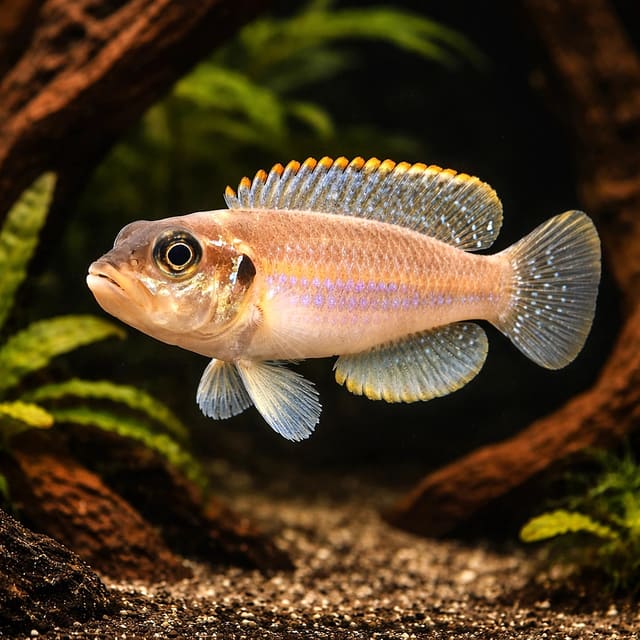
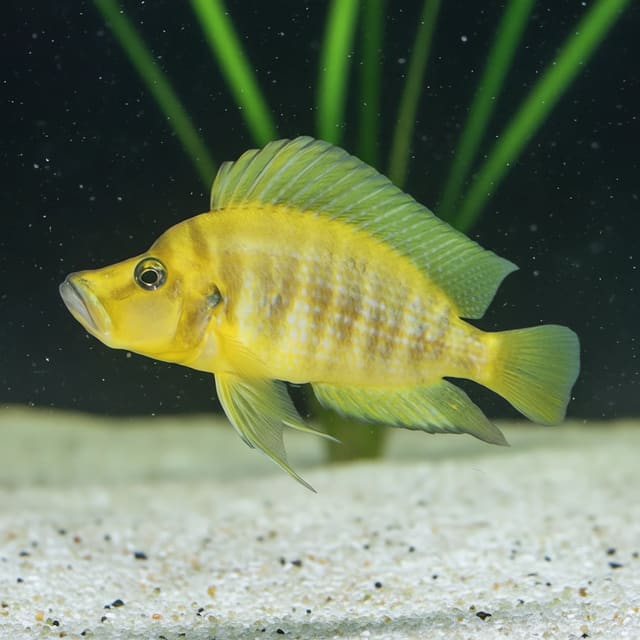
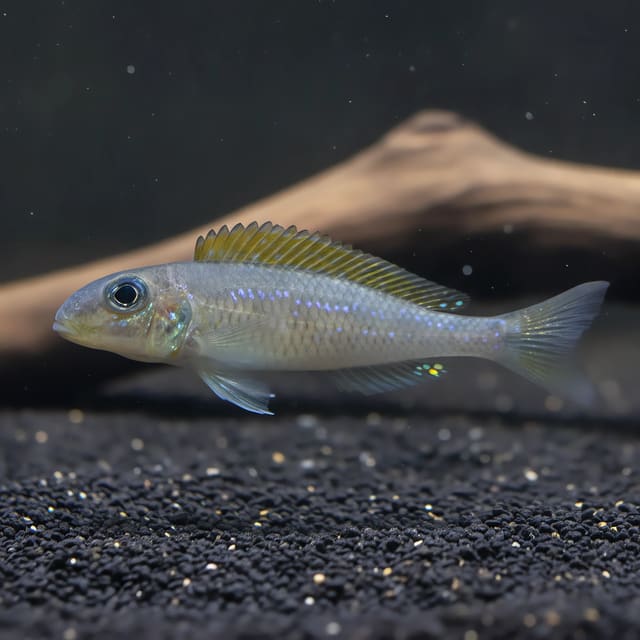
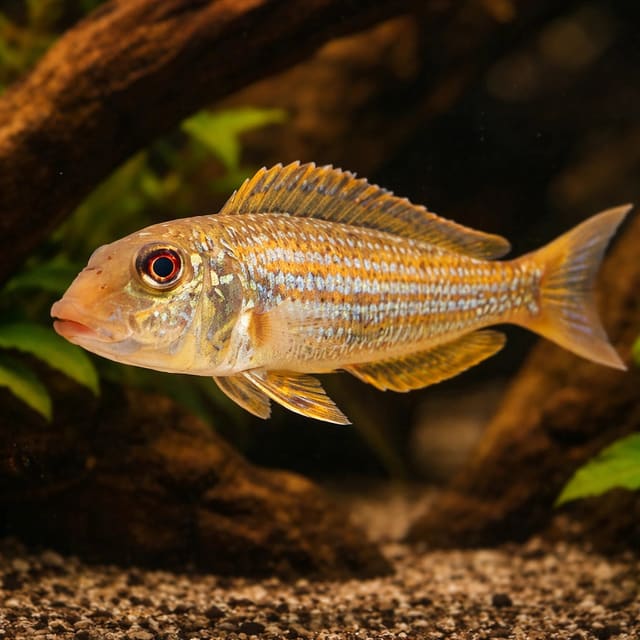
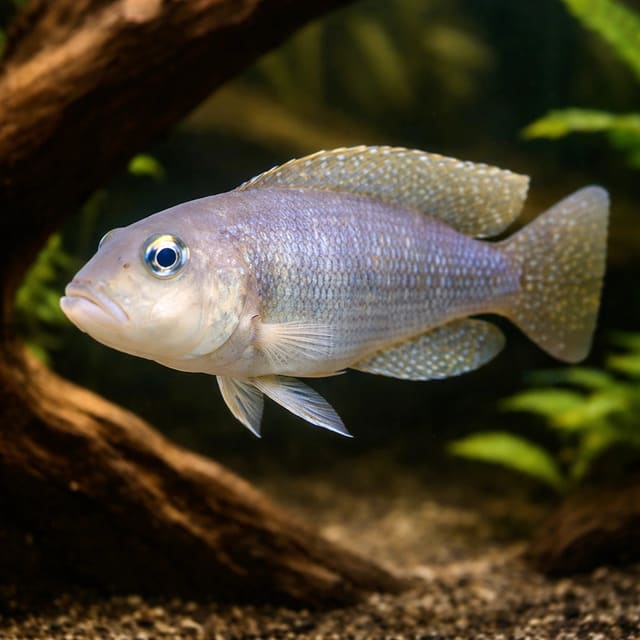
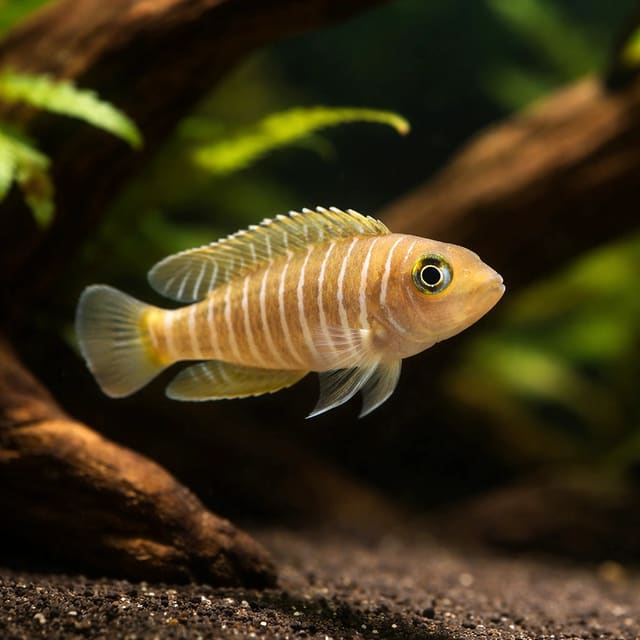
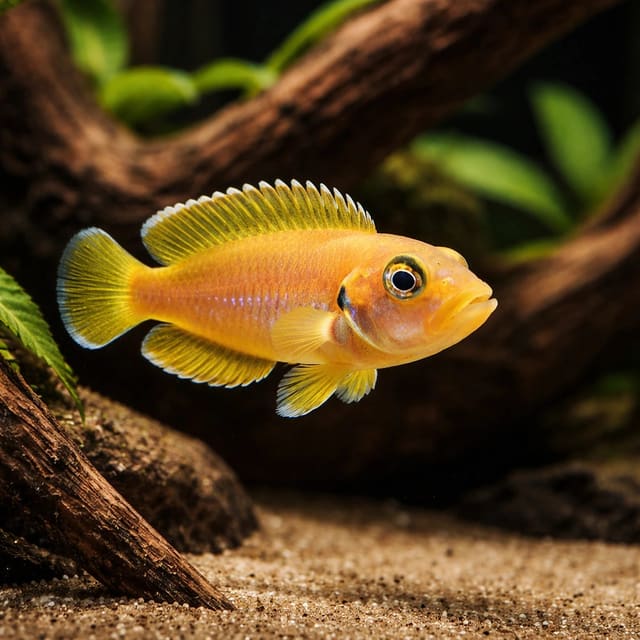
Gallery images have been digitally enhanced to improve image quality. Natural colour, pattern, size and maturity can vary between live animals.
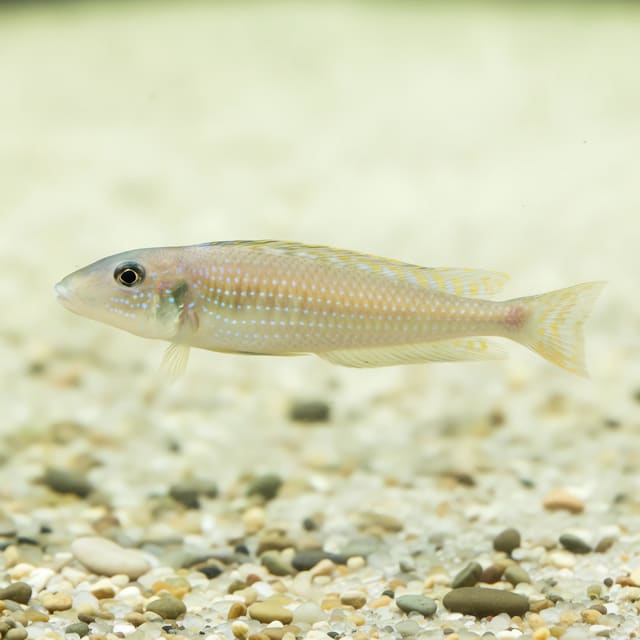
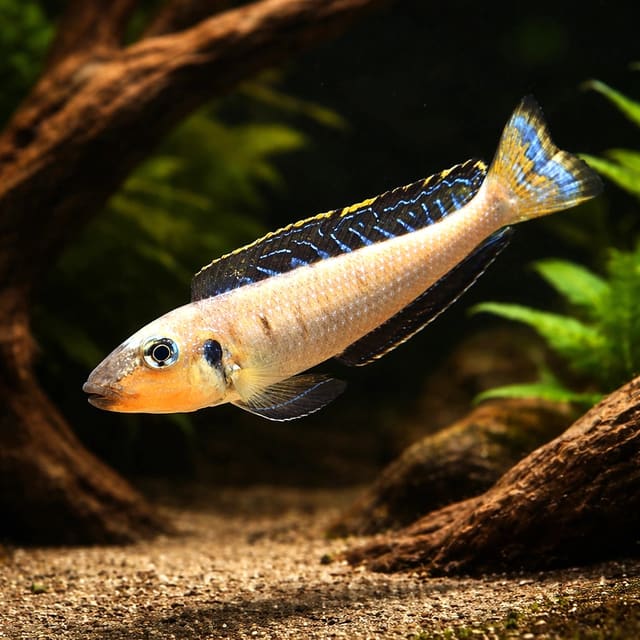
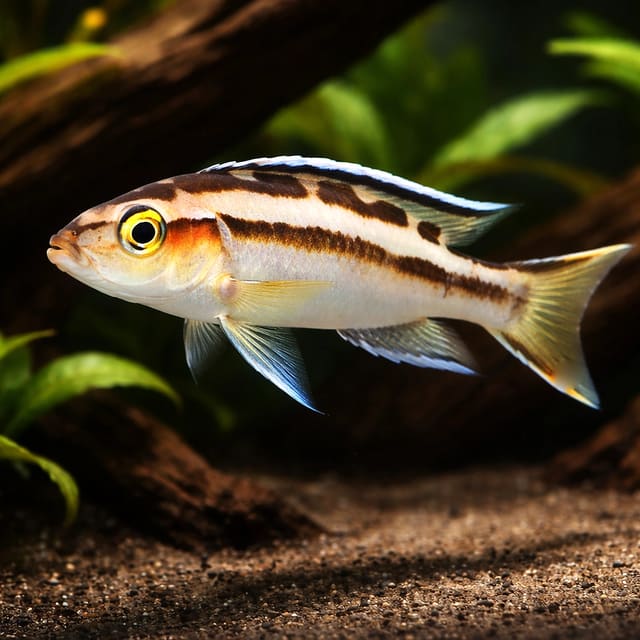
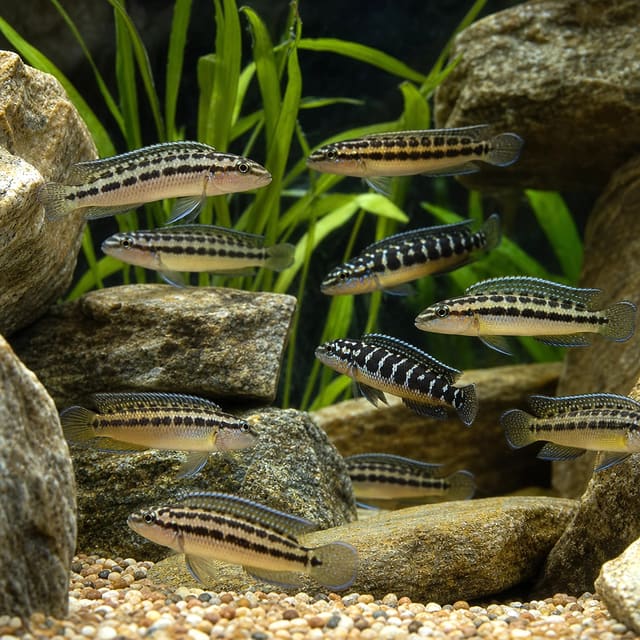
The photographs show pale golden fish with a broken dark stripe along the side, a darker line along the back and a stripe through the eye. Young fish at the sizes you can order may show the pattern less clearly than the fish pictured.
Sex is guaranteed only when the selected option explicitly states male or female. This Telmatochromis vittatus listing has no sex-guaranteed option.
Seriously Fish describes this as not a terribly easy species to sex: adult males tend to be slightly larger than females and more slender. Young fish give even fewer clues, so a pair cannot be chosen at the point of sale. Seriously Fish suggests buying a group of young fish, letting them pair off naturally and then moving the other fish on once a pair has formed. OATA adds that very few African lake cichlids do well kept singly, so plan to buy more than one.
Two fish may turn out to be the same sex, which is why buying a group of young fish and letting a pair form gives better odds. Before you order, check that the aquarium can hold the whole group until a pair has formed, and decide where the other fish will go afterwards.
| Suits | Think again if |
|---|---|
| A Lake Tanganyika aquarium with rock caves | You want a planted community of fish from other waters |
| Hard, alkaline water you can keep steady | Your water is soft and you would rather not buffer it |
| Keeping a pair, with room for young fish to pair off first | You want just one fish |
| A smaller Tanganyikan community with shell-dwellers or similar | You keep Malawi cichlids |
| Watching a pair defend a cave | You need a fish that is always out in the open |
Being shy, it can spend time close to its caves while it settles in, so give it plenty of caves from the start.
Seriously Fish gives a minimum tank base of 75 × 30 cm for this species, which at 30 cm deep holds about 68 litres, and adds that larger is preferable. That footprint suits a pair. A suitably large aquarium is needed if several are kept, for example while a group of young fish pairs off, and a community with other Tanganyikan cichlids needs more space again.
OATA’s general rule for African lake cichlids points the same way: buy an aquarium as large as you reasonably can, because a larger volume keeps temperature and water quality more stable.
Seriously Fish recommends a Lake Tanganyika biotope, with piles of rocks arranged into caves filling much of the aquarium. In the wild, FishBase notes that it lives in rather deep water for such a small species, with specimens found as deep as 20 m, although it seems to prefer depths of 5–10 m.
Plan the layout so that each fish in the aquarium has somewhere to claim. A pair will hold a cave and the area around it, and companions that use other parts of the tank, such as shell-dwellers living in shells on the sand, fit around them more easily.
Putting the figures on this page together, this is what a straightforward set-up for one pair looks like on Seriously Fish’s minimum footprint. Treat it as a starting point and scale it up for a larger group or a community.
| Item | For a tank of about 68 litres |
|---|---|
| Tank | 75 × 30 cm base and 30 cm deep, or larger |
| Filter | Rated at roughly 270–340 litres per hour |
| Heater | Roughly 75–100 W in a room at around 20°C |
| Substrate | Sand, ideally fine coral sand to help buffer the water |
| Décor | Rock piles forming caves through much of the tank, plus flower pots or large snail shells |
| Water | 23–27°C, pH 8.0–9.5 and 8–25 dGH, held steady |
| Weekly change | About 17 litres, which is 25% of the volume |
If you plan to raise a group of young fish until a pair forms, or to add Tanganyikan companions later, start with a larger tank than this so the fish do not have to move when the plan grows. A larger volume also gives more margin on temperature and water quality.
The RSPCA’s advice on aquarium environments starts with the filter: no fish should be kept without a well set-up and maintained one. For a tank of about 68 litres, Seriously Fish suggests a turnover of four to five times the volume an hour, which means a filter rated at roughly 270–340 litres per hour.
OATA recommends an oversized filter for the crowded conditions some African lake cichlid communities need, together with vigorous aeration so there is enough dissolved oxygen in the water. If you are building a community rather than housing a single pair, size the filter for the full stocking plan.
To hold 23–27°C in a tank of about 68 litres, Seriously Fish estimates roughly 75–100 W of heating, assuming a room at around 20°C. A larger tank or a colder room needs more. Use a separate thermometer so you can confirm the reading at a glance rather than relying on the heater’s own setting.
Lake Tanganyika cichlids need hard, alkaline water. Seriously Fish gives the aquarium range for this species below, and that is the range we recommend keeping it in. FishBase records the conditions of its wild habitat, which sit inside that range, and OATA’s care sheet for African lake cichlids gives general figures for the whole group that also sit inside it.
| Water value | Target in the aquarium |
|---|---|
| Temperature | 23–27°C |
| pH | 8.0–9.5 |
| Hardness | 8–25 dGH |
| Ammonia and nitrite | Zero |
| Nitrate | No more than 20 mg per litre above your tap water |
FishBase records the lake habitat at 24–26°C, pH 8.5–9.0 and 10–20 dH. These are wild measurements rather than aquarium targets, but they show why steady, well-buffered water suits the fish. OATA’s general guide for African lake cichlids is 23–27°C, pH 8.0–8.6, general hardness 12–18°dH and carbonate hardness 10–15°dKH; if you keep it alongside other Tanganyikan cichlids, those figures are a practical common ground inside the species range.
Test your tap water for pH and hardness before you choose how to buffer it. The water parameter matcher compares your readings with a fish’s stated values, and the guide to aquarium water values worth testing explains what each reading means. Coral sand helps to hold pH and hardness up; make any other adjustment slowly and prepare replacement water to match the aquarium.
Stability matters more than the exact number. A tank that sits steadily at pH 8.5 is better than one that swings between the ends of the range from one water change to the next.
For spawning, Seriously Fish suggests a pH around 8.2–9.0 and a temperature of 25–26.5°C, both inside the normal aquarium range. The breeding section below explains what to expect.
Fish release ammonia, which is toxic. In a matured filter, beneficial bacteria turn it into nitrite, which is also toxic, and then into nitrate, which is safer. The RSPCA explains that this biological filtration is what keeps a tank healthy, and it takes time to establish.
Follow our guide to setting up and maturing a new tropical aquarium before you order, and check that ammonia and nitrite both read zero before any fish goes in.
OATA warns that overstocking, or stocking too quickly, can lead to new tank syndrome: too few nitrifying bacteria for the extra waste, a rise in ammonia and nitrite, and fish that may become ill or die. The bacteria have to catch up every time more fish are added and feeding increases.
In practice, add one group of fish at a time and wait for stable readings before the next, whether that is a group of young Telmatochromis vittatus or their companions.
In the wild, FishBase describes Telmatochromis vittatus as omnivorous, feeding on microorganisms, and Seriously Fish explains that its fang-like teeth are used to scrape microorganisms from rock surfaces. In the aquarium, the Seriously Fish profile recommends a varied menu:
Choose small frozen foods that fit a small cichlid’s mouth, and rotate between them through the week so the fish sees variety.
| Feed | What to offer |
|---|---|
| Most morning feeds | Small frozen foods, thawed |
| Most evening feeds | A quality dried food |
| Two or three feeds a week | An algae-based food, spirulina or blanched spinach |
| When you can get them | Suitable small live foods |
Adjust the mix if one food is consistently ignored, and keep live and frozen foods as the larger share, as Seriously Fish advises.
OATA advises feeding African lake cichlids only what they can eat within a few minutes, twice a day. Too much food builds up uneaten and breaks down, releasing toxic waste into the water. In a small tank of around 68 litres, that happens quickly, so err on the side of less.
OATA’s maintenance routine for African lake cichlids is simple and weekly. It matters because these fish can be stressed by even the smallest amounts of ammonia.
Prepare the replacement water in advance and match its temperature, pH and hardness to the aquarium before it goes in. Siphon around the caves as well as the open sand, because waste collects out of sight among the rocks.
Keep a simple log of test results and water changes. With a pair that spends much of its time close to a cave, a written record makes slow changes in water quality or behaviour easier to spot.
Our team hand-packs every order. Each fish travels hand-bagged in pure oxygen inside an insulated poly box, with a heat pack when the weather needs one, carried by a tracked, licensed live-animal courier. We email your tracking number and confirmed delivery date in advance, and the delivery and Live Arrival Guarantee policy sets out the full terms.
Record the video for every parcel, whatever you expect to find inside. Our licensed courier may ask us for continuous unboxing evidence when we raise a claim, and it lets us see the fish’s condition before anything was disturbed.
A shy fish in a new tank may stay close to a cave at first. Give it time, feed small portions near the rocks and test ammonia and nitrite over the following days, because every new fish adds to the filter’s load.
OATA describes a healthy fish as having clear, bright eyes, undamaged fins, intact scales and no ulcers or bumps. Its list of changes to watch for applies to Telmatochromis vittatus as it does to other African lake cichlids:
| Sign | What to look for |
|---|---|
| Swimming | Hanging at the surface, sitting on the bottom, erratic movement |
| Colour | Darker or paler than usual |
| Temperament | A change in aggression, or hiding more than normal |
| Breathing | Gill covers moving faster or slower |
| Appearance | White spots, fluffy growths, lost fins or scales |
| Condition and feeding | Weight gain or loss, reduced interest in food |
Because this species spends time close to its caves, hiding on its own is not always a warning sign. Learn how much your fish normally shows itself in the first weeks, and treat a change from that pattern as the signal to act.
When something looks wrong, test the water first. If the readings are within range and the change continues, get in touch with the details and we will help you work through it.
Seriously Fish describes Telmatochromis vittatus as a bi-parental cave spawner and reports that breeding in the aquarium is possible. In the wild, FishBase notes that it is usually solitary but forms temporary pair bonds, with the male defending the territory while the female cares for her offspring. In the aquarium, Seriously Fish reports that a pair, once formed, stays together for life, which is why the other fish should be moved on.
Seriously Fish points out that it is often very difficult to tell whether a pair has spawned until the fry are seen. It suggests an aquarium at least 30 inches (about 75 cm) long, set up with caves as described above, and notes that once the fry are free-swimming you may wish to move either the fry or the parents to a separate aquarium.
Breeding is a bonus rather than a promise. Sex cannot be chosen when you buy, and a pair forms in its own time, so plan the aquarium for a pair first and treat any fry as a welcome extra.
Seriously Fish sums up the temperament as territorial but shy. The aggression is aimed mainly at its own kind: it should be kept as a pair because it is aggressive towards conspecifics, and a suitably large aquarium is needed if several are kept. In the wild, FishBase describes it as usually solitary, with the male defending a territory.
OATA also points out that African lake cichlids vary in size and temperament, so research the compatibility of every species before you add it.
Because this species is not easy to sex, and young fish show even less, Seriously Fish’s route to a pair is to let the fish choose. Buy a group of young fish, give them an aquarium with plenty of caves, and allow them to pair off naturally. Once a pair has formed, move the other fish out, because Seriously Fish reports that the pair will remain together for life.
Decide where the fish that do not pair will go before you start, whether that is a second aquarium or another keeper. Leaving them with an established pair invites the aggression towards its own kind that Seriously Fish describes.
OATA’s general rule for African lake cichlids is to stock them only with other species from the same location, such as a Lake Tanganyika community. It does not generally recommend mixing Malawi and Tanganyikan cichlids, because of differences in temperament and behaviour.
Within a Tanganyikan community, Seriously Fish says this species can be kept successfully with other small to medium-sized Tanganyikan cichlids that occupy different areas of the tank, naming Neolamprologus shell-dwellers and Cyprichromis species as examples.
| Better match | Poorer match |
|---|---|
| Small to medium-sized Tanganyikan cichlids | Malawi cichlids |
| Shell-dwellers that live on the open sand | Fish from outside Lake Tanganyika |
| Cyprichromis species, as Seriously Fish suggests | Other cichlids competing for the same caves |
| A layout with more caves than fish | A second pair in a tank too small for two territories |
OATA recommends adding more peaceful species first and more aggressive ones later, and notes that it may be best to add some African lake cichlids in groups so that no single fish receives unnecessary aggression as it settles. Some species need slight overstocking so that no individual is overly aggressive to weaker members of the group; check each species’ own needs before you buy.
Browse our African cichlid range to plan companions, and keep to Lake Tanganyika species for this aquarium.
FishBase records a maximum length of 8.6 cm total length, and Seriously Fish gives 85 mm standard length. Young fish have a good deal of growing still to do, so plan the aquarium for the adult size.
Seriously Fish gives a tank base of 75 × 30 cm, about 68 litres, for this species, and says larger is preferable. Plan more room if you keep several fish while a pair forms or add other Tanganyikan cichlids.
Plan for a pair. Seriously Fish advises keeping it as a pair because it is aggressive towards its own kind, and OATA notes that very few African lake cichlids do well kept singly. To form a pair, Seriously Fish suggests buying a group of young fish, letting them pair off naturally and then rehoming the rest.
Seriously Fish describes it as a good choice for the beginner and ideal for the smaller Tanganyikan community. It still needs hard, alkaline water, a mature filter and a layout full of rock caves, so set those up before it arrives.
Base the diet of Telmatochromis vittatus largely on live and frozen foods, with a quality dried food and some vegetable matter such as spirulina or blanched spinach, as Seriously Fish advises. Offer only what is eaten within a few minutes, twice a day.
Seriously Fish gives 23–27°C, pH 8.0–9.5 and 8–25 dGH as the aquarium range for Telmatochromis vittatus. FishBase records its wild habitat at 24–26°C and pH 8.5–9.0. Keep the water steady, with ammonia and nitrite at zero.
Seriously Fish calls it territorial but shy. It is aggressive towards its own kind, which is why it is kept as a pair, and it defends its caves, but it can live with small to medium-sized Tanganyikan cichlids that use other parts of the aquarium.
Other small to medium-sized Lake Tanganyika cichlids that occupy different areas of the tank, such as Neolamprologus shell-dwellers and Cyprichromis species, according to Seriously Fish. OATA advises keeping African lake cichlids with species from the same lake and not mixing Malawi and Tanganyikan cichlids.
We hand-bag each fish in pure oxygen and pack it in an insulated poly box, with a heat pack when the weather needs one, and a licensed live-animal courier carries it on a tracked service. Be home to take the parcel, record a continuous unboxing video from the sealed box through to the fish still in its bag, float the sealed bag for 20–30 minutes and release the fish without the bag water. Send us that video and your order number the same day if there is a problem.
No reviews for this item yet. Bought one? Honest reviews only, good or bad.
What customers say about ordering from us
Easy website plenty of info on fish your buying great to pick a time slot
TRACEY DURRANT · 7 Oct 2026
Got some lovely fish thank you
Kevin Mackie · 7 Oct 2026
Reviews of our shop, collected by Judge.me, an independent third-party review collector. Newest first.