Advanced
Jumbo Yellow Sardine Cichlid (Cyprichromis sp.)
24–27°C · pH 7.8–9
£39.99
Xenotilapia ochrogenys "ndole" is a schooling cichlid from Lake Tanganyika, found over sandy bottoms and reaching 11 cm. Keep a group over open fine sand in hard, alkaline water at 24–26 °C, within OATA's broad pH 8.0–8.6 guidance for African lake cichlids. Sold as one fish per purchase at 4–5 cm or 5–7 cm.
Xenotilapia ochrogenys
Save when buying more.
Xenotilapia ochrogenys "ndole" is a schooling cichlid from Lake Tanganyika, found over sandy bottoms and reaching 11 cm. Keep a group over open fine sand in hard, alkaline water at 24–26 °C, within OATA's broad pH 8.0–8.6 guidance for African lake cichlids. Sold as one fish per purchase at 4–5 cm or 5–7 cm.
Maintain these water conditions for optimal health and vibrant colors
Xenotilapia ochrogenys "ndole" is a cichlid found only in Lake Tanganyika. FishBase's species summary records adults living over sandy bottoms and forming schools, and that single line tells you most of what matters when planning for it: this is a fish for a group, a wide floor of open sand and the hard, alkaline water that Tanganyikan cichlids are kept in.
It is not a fish to add on impulse to a general community tank. It rewards a keeper who builds the aquarium around it and who is happy to keep it with other species from the same lake, rather than mixing fish from different parts of the world. In return you get a school that moves together over open sand instead of disappearing among rocks.
A Tanganyikan community, in the sense used throughout this guide, is an aquarium stocked only with species from that one lake and kept in the hard, alkaline water they share. Within such a tank, this fish belongs to the open sand floor, so the rest of the layout and stocking should leave that floor free for it.
FishBase gives a maximum recorded length of 11 cm total length, and the Wikipedia species account gives the same figure and notes that the species appears in the aquarium trade. Plan the tank and the stocking around that adult size. FishBase also lists the species as Least Concern on the IUCN Red List and places its range in the lake between about 3° and 9° south.
Each purchase supplies one live fish of the size you choose, either 4–5 cm or 5–7 cm. The size you select is the size supplied, not the adult size. Plan the space for full-grown fish from the start.
Because this is a schooling species, most keepers will want several fish. Order them together so they travel, arrive and settle as one group rather than joining the tank one at a time.
Both sizes are smaller than the 11 cm maximum recorded for the species, so either way the fish will grow in your care. The 4–5 cm size gives the longest period of growth in your own aquarium; the 5–7 cm size starts further along. Whichever you pick, buying the whole group in one size means the fish start level with one another when food goes in, and the school looks even from the first day.
Sex is guaranteed only when the selected option explicitly states male or female. This Xenotilapia ochrogenys \"ndole\" listing has no sex-guaranteed option. A group you order is therefore an unselected mix.
The word "ndole" is the trade name this line is sold under. It does not change how the fish should be kept: everything in this guide follows Xenotilapia ochrogenys as a species.
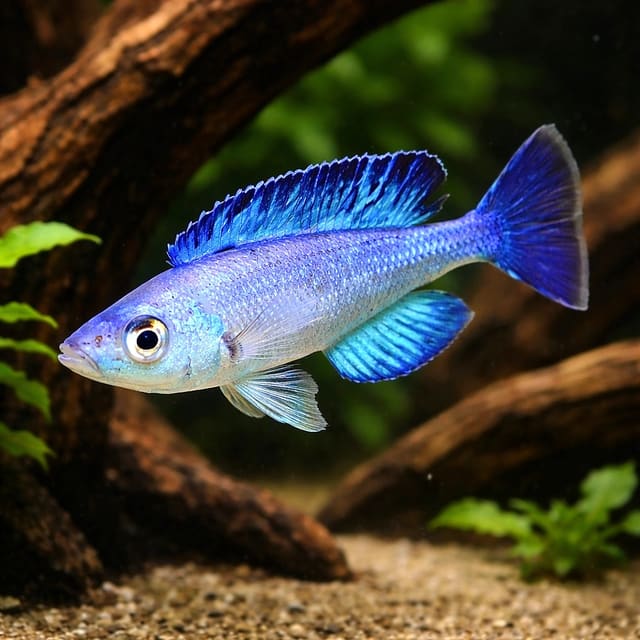
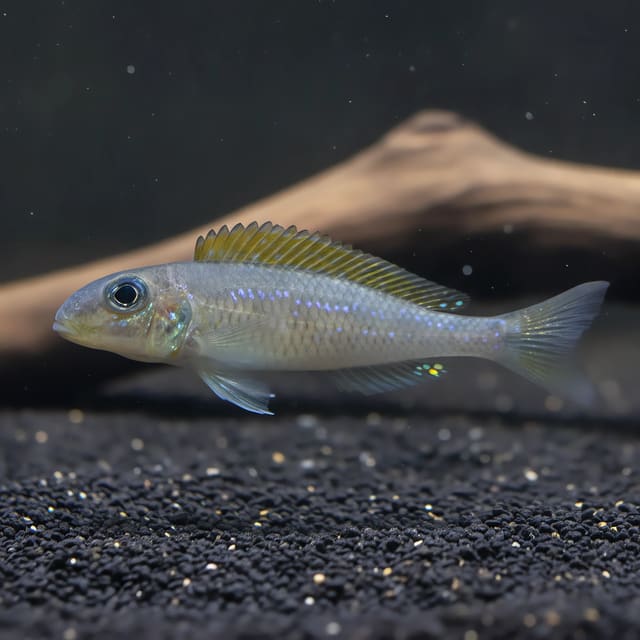
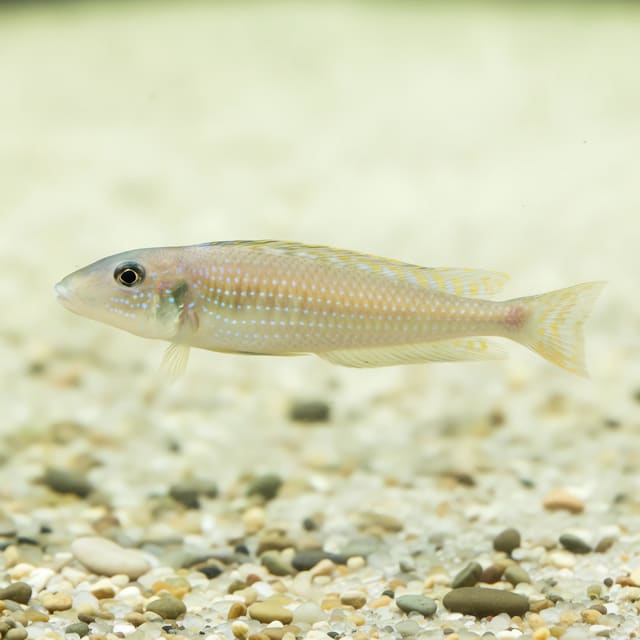
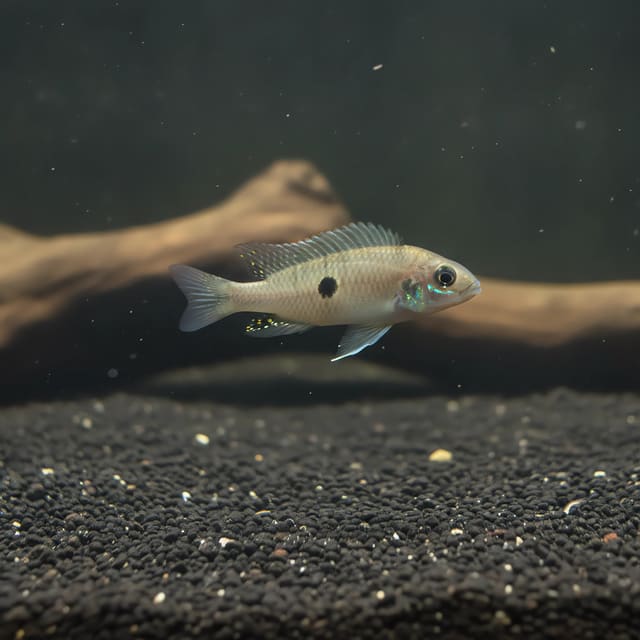
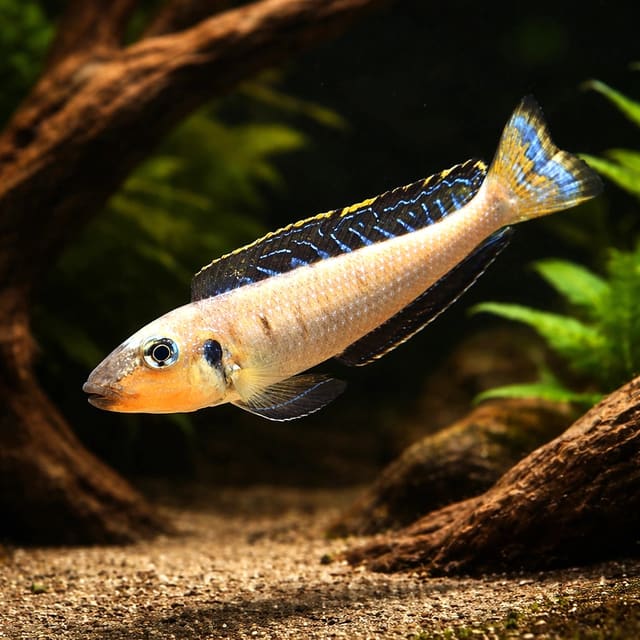
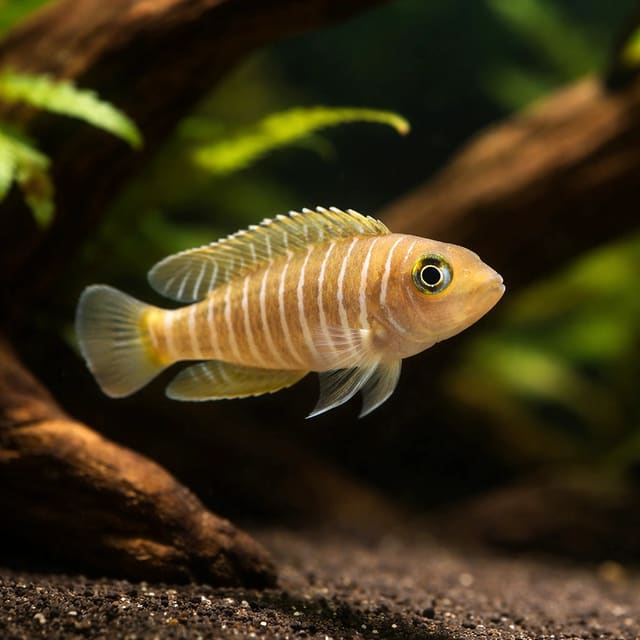
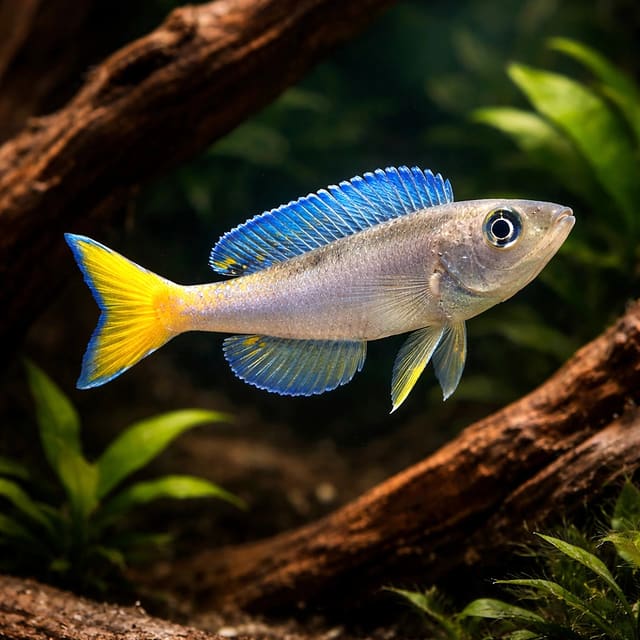
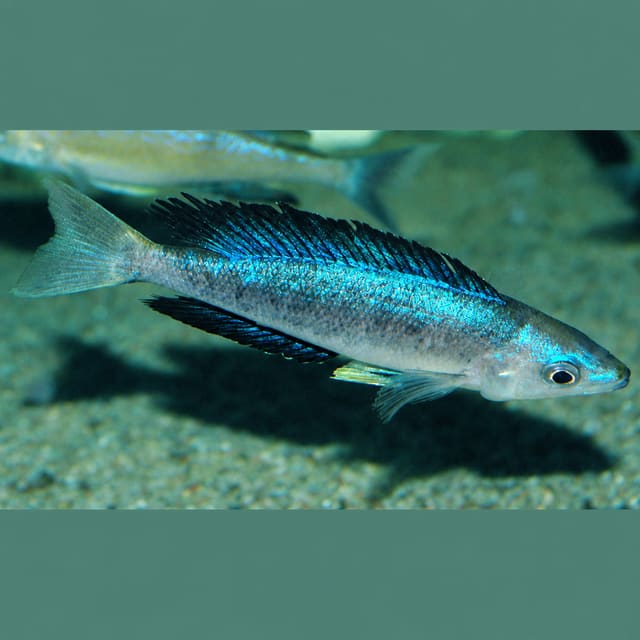
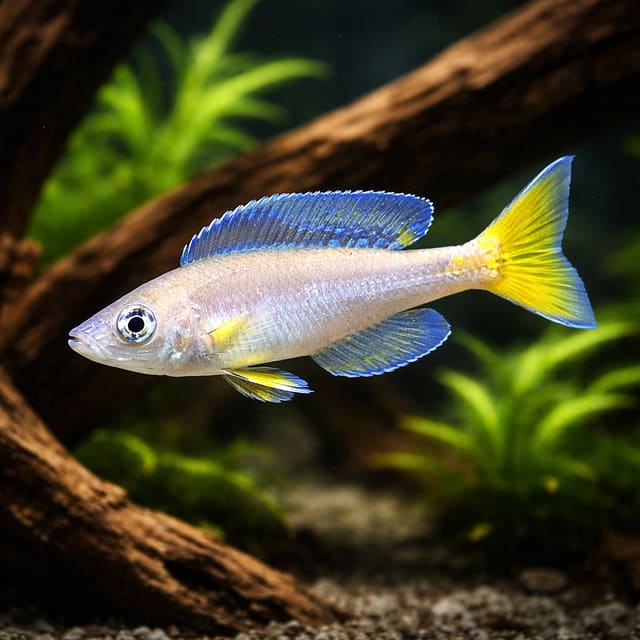
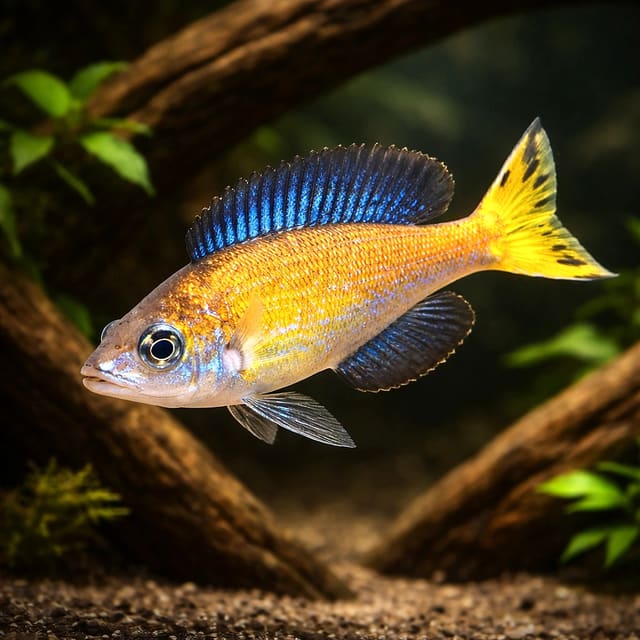
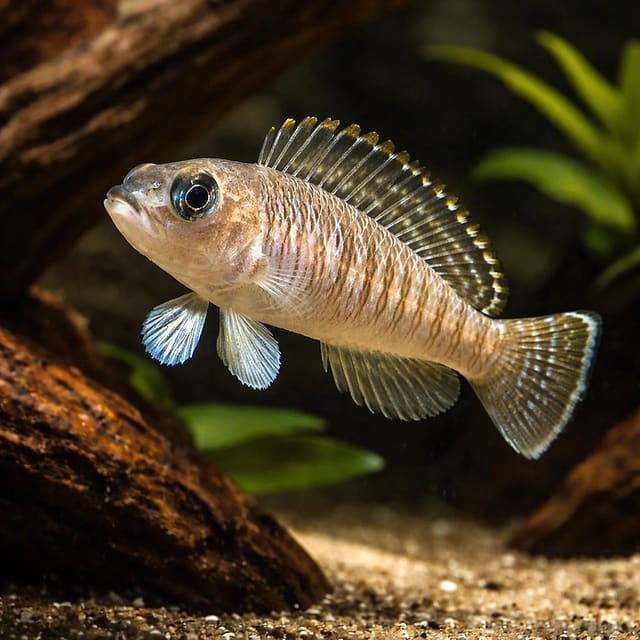
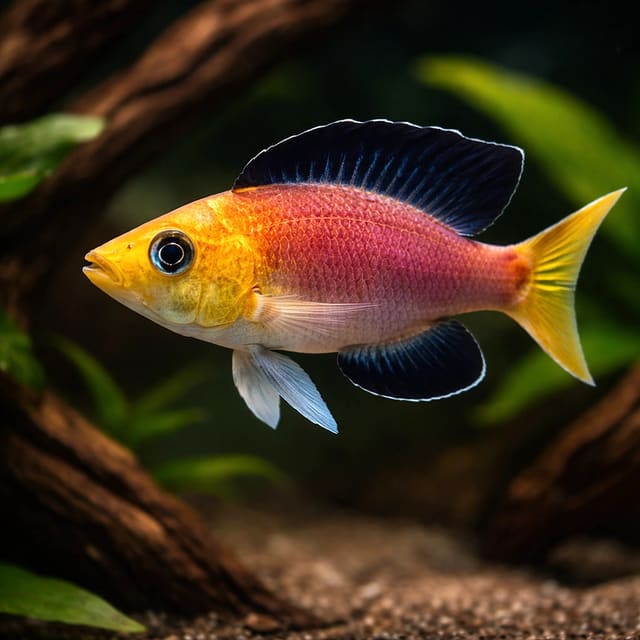
In the gallery the fish show a golden body with rows of pale, silvery-blue spots along the flanks, a spiny dorsal fin and a red eye. Gallery images have been digitally enhanced to improve image quality. Natural colour, pattern, size and maturity can vary between live animals.
| Suits | A matured, hard-water aquarium planned as a Lake Tanganyika community, with a wide area of open fine sand |
|---|---|
| Social needs | A group of its own kind; the species forms schools |
| Temperature | 24–26 °C |
| pH and hardness | pH 8.0–8.6 and 12–18 °dH general hardness, OATA's broad guidance for African lake cichlids |
| Adult size | Up to 11 cm total length |
| Keep apart from | Malawi cichlids and fish that need soft or acidic water |
If your tap water is soft, or your existing tank holds soft-water community fish, this species needs an aquarium set up specifically for it. If you already keep Tanganyikan species in hard water with a stretch of open sand, it may fit well, provided the fish already there leave room for a school on the sand.
Three things decide success with this fish more than anything else: water that is already hard, alkaline and fully matured; enough floor space for a group; and tank mates chosen from the same lake. The care guidance below sets out each one, including how to test your water and what to do on arrival day. If any of the three is not in place yet, get the aquarium ready first and order once your test results are stable.
The temperature below comes from FishBase's record for this species. The pH, hardness and waste figures come from the OATA care sheet for African lake cichlids, the UK ornamental aquatic trade body's guidance for the group as a whole. OATA presents them as a general guide for these fish, so treat them as the frame to work within and keep your own readings steady inside it.
| Temperature | 24–26 °C, inside OATA's 23–27 °C for African lake cichlids |
|---|---|
| pH | 8.0–8.6 |
| General hardness (GH) | 12–18 °dH |
| Carbonate hardness (KH) | 10–15 °dKH |
| Ammonia | Zero mg per litre |
| Nitrite | Zero mg per litre |
| Nitrate | No more than 20 mg per litre above your tap water |
FishBase records the species at 24–26 °C, a narrower band than OATA's 23–27 °C for the whole group. Holding the aquarium within the narrower band keeps you inside both figures at once. In most UK homes that means a heater with a thermostat, checked against a separate thermometer so that a heater stuck on or off does not go unnoticed. Glance at the thermometer every day; a slow drift is easy to miss unless you look for it.
General hardness (GH) is a measure of dissolved minerals such as calcium and magnesium. Carbonate hardness (KH) is a measure of the carbonates that resist a fall in pH. Both matter for this fish: OATA asks for hard water on both counts, and a healthy KH is what helps the pH hold steady between water changes.
Start by testing your tap water for GH, KH and pH. Some parts of the UK supply water that is already hard and alkaline; others supply soft water that would need raising before it suits this species. OATA recommends fine coral sand or a similar substrate for African lake cichlids because it helps to buffer the water, and that same choice gives the fish the sand it lives over. Make any adjustment gradually, in the water you prepare for changes, so each change matches the aquarium rather than jolting it.
Our guide to which water values to test and why explains GH, KH and pH in more depth, and the water parameter matcher lets you compare your own readings with the figures above before you order.
With hard-water fish, the replacement water matters as much as the aquarium water. If your tap water is already close to the targets, conditioning it and matching its temperature may be all that is needed. If it is softer, prepare each batch in advance so it reaches the same GH, KH and pH as the tank before it goes in, and test the batch rather than assuming it is right. A 25% change with water that differs sharply from the aquarium moves the tank's hardness a quarter of the way towards the new water in one go, so matching each batch is what keeps weekly changes gentle.
Fish release ammonia, which is toxic. In a working biological filter, bacteria convert it to nitrite, which is also toxic, and then to nitrate, which is safer. That is why OATA asks for zero ammonia and zero nitrite, and sets nitrate as no more than 20 mg per litre above your tap water rather than as a fixed number: what matters is the build-up above your own supply. Test regularly, at least once a week, and more often in the first weeks after new fish arrive.
OATA's rule for African lake cichlids is to buy an aquarium as large as you reasonably can, because the right size varies with the species. Its own examples show how wide that range is: a pair of the smallest shell-dwelling cichlids, which grow to about 6 cm, needs an aquarium at least 45 cm long, while frontosa, which can grow to over 30 cm, needs one of about 180 cm and sometimes more.
Xenotilapia ochrogenys sits between those examples in size, but it lives in schools over open sand rather than in a single shell, so floor area is what you are really buying. A long, wide tank gives the group room to move together and gives each fish space to find its place. OATA also points out that the larger the aquarium, the more stable its temperature and water quality, which matters for a fish kept in exacting water.
FishBase describes adults living over sandy bottoms, so the heart of the layout should be a broad, uninterrupted area of fine sand. With coral sand or a similar buffering substrate underneath the school, the floor of the tank does two jobs at once.
Rock, wood and plants can frame the sand around the edges and back of the tank. Keep them there, rather than scattered across the middle, so the open floor stays open. If you are building a Tanganyikan community with rock-dwelling species, give them their rockwork at one end or along the back and leave the sand free for this school.
A filter is always essential, and the RSPCA's aquarium guidance is plain that no fish should be kept without a well set up and maintained filter. For African lake cichlids OATA goes further: because some of their communities need crowded conditions, it recommends an oversized filter, together with vigorous aeration so that enough dissolved oxygen is available.
In practice that means a filter rated well above the tank's volume, run continuously, with the outlet and any air stones placed so the surface keeps moving and water circulates through the whole tank. The filter's bacteria are what keep ammonia and nitrite at zero, so treat the filter as part of the livestock rather than as a piece of equipment you can switch off.
A new aquarium needs time for the filter's bacteria to establish before any fish arrive. Our guide to setting up and maturing a first tropical tank walks through the process step by step. Order only once ammonia and nitrite read zero, the temperature holds at 24–26 °C, and pH, GH and KH sit where you want them on repeated tests.
Diets across African lake cichlids vary a great deal. OATA's care sheet contrasts herbivorous species such as tropheus, which appreciate specialised cichlid feeds with a high algae content, with larger predatory species that need foods with a higher animal content. Xenotilapia ochrogenys is a sand-dwelling fish of up to 11 cm, neither a tropheus nor one of the large predatory species, so a varied menu suits it better than a specialist one.
Use a good-quality prepared cichlid food as the base, in a pellet or granule size the fish can swallow easily, and vary it with a second prepared food so the group never relies on a single product. FishBase describes the species as benthopelagic, meaning it lives near the bottom as well as in midwater, so include food that sinks to the sand as well as food the fish can take as it falls. Increase the food size gradually as the fish grow from the size you bought towards their adult length.
OATA's rule for African lake cichlids is to feed only what the fish can eat within a few minutes, twice a day. Uneaten food breaks down and releases toxic waste into the water, so overfeeding works directly against the zero ammonia and nitrite you are aiming for. If food is still lying on the sand after a few minutes, feed less next time and siphon out the leftovers.
In a school, bolder fish can take more than their share. Spread each feed across the surface so food falls over a wider area, and watch that every fish in the group is eating. A fish that shows reduced interest in food is one of the early signs OATA lists as worth investigating.
In a mixed tank, faster midwater species can take most of the food before it reaches the sand. If that happens, feed in two places at once, or add a portion of sinking food after the first portion has drawn the other fish up, so the school on the sand gets its share. Keep the total within the few-minutes rule rather than adding extra food to make up for competition; uneaten food on the sand costs more in water quality than it gives in nutrition.
Every order is hand-packed by our team. Fish are bagged in pure oxygen and packed in an insulated poly box, with a heat pack when the weather calls for it, then carried by a licensed live-animal courier. We email the tracking number and your confirmed Thursday or Friday delivery date, so you know when to be in. The full terms are on our delivery and Live Arrival Guarantee page.
If anything has gone wrong, contact us the same day, by WhatsApp for the quickest reply, with your order number and the unboxing video, and we will arrange a replacement or refund.
OATA's advice on introducing African lake cichlids is to confirm, before adding any fish, that ammonia and nitrite are at zero and that the aquarium is large enough for the number you plan to keep. Increase the population slowly, because the filter's bacteria have to grow each time more fish are added and feeding increases. Stocking too quickly can cause 'new tank syndrome': there are not enough nitrifying bacteria to cope with the extra waste, and ammonia and nitrite rise to unhealthy levels, which may cause fish to become ill or die.
For this species that shapes how you stock. Build the tank up in stages, but make each stage a group: this school as one introduction, other species as later ones. OATA notes that adding some African lake cichlids in groups helps avoid any single fish receiving unnecessary aggression as it settles in, and it suggests adding more peaceful species first and more aggressive species later. In a mixed Tanganyikan tank, set the order of introductions by the temperament of each species you plan to keep.
At arrival and in the weeks that follow, look for the signs of a healthy fish that OATA describes: clear, bright eyes, undamaged fins, intact scales and no ulcerations or bumps. Test ammonia and nitrite more often than usual while the new group settles.
OATA stresses that good husbandry is essential with African lake cichlids, because they can be stressed by even the smallest amounts of ammonia. A routine kept every week, rather than a big clean-up once problems appear, is what holds hard, alkaline water steady for this fish.
Write down each test result with the date, alongside the temperature and the size of the water change. A few weeks of readings show you what normal looks like for your tank, so a drift in pH or KH, or a nitrate figure creeping upwards between changes, stands out early and can be corrected gradually.
Any ammonia or nitrite reading above zero means the filter is not keeping up with the waste going in. Stop adding fish, feed less for a while, carry out a partial water change with matched water, and test again the next day. Keep going until both read zero on repeated tests. A rise in nitrate between changes points to the same cause more slowly: more waste going in than the routine removes. Look at feeding and stocking first, before assuming the fish or the filter is at fault.
All fish vary a little in behaviour and appearance, but OATA lists changes that are worth noticing early:
With a schooling fish, also notice any individual that stays apart when the rest of the group moves together. If you are concerned about any of your fish, test the water quality first and then contact us with the readings so we can help you work out the next step.
FishBase records Xenotilapia ochrogenys forming schools, and OATA notes that very few, if any, African lake cichlids do well when kept singly and are likely to become stressed. The number to keep depends on the species and on your tank, so no single figure fits every aquarium, but the principle is clear: plan for a group of its own kind rather than one fish or a lone pair.
Because each purchase is one fish, choose the number with your tank's floor area in mind and order the group together. A school gives each fish the company of its own species and lets you see the behaviour the species is recorded for in the lake: fish moving together over open sand.
OATA's general rule is that African lake species should only be stocked with other species from the same location, which here means a Lake Tanganyika community. It does not recommend mixing Malawi and Tanganyikan cichlids because of differences in temperament and behaviour. Tanganyikan cichlids themselves vary widely in size and temperament, so research each species before it joins the tank.
| Plan | Reason |
|---|---|
| Keep with other Lake Tanganyika species | OATA advises stocking African lake species with fish from the same lake |
| Leave the open sand to this school | The species lives over sandy bottoms, so companions that claim the whole floor compete for its space |
| Keep Malawi cichlids out | OATA does not recommend mixing Malawi and Tanganyikan cichlids |
| Keep out fish that need soft or acidic water | They cannot share the hard, alkaline water this aquarium is built around |
When browsing our African cichlid range, check which lake each species comes from: the range includes Malawi species that should not share this tank. If aggression appears after a new fish is added, rearranging the aquarium décor can help to reduce it, as fish then have to find new territories.
Before adding any species to a tank that holds this school, check it against a few plain questions:
FishBase classes the species as benthopelagic, so expect a school that spends time close to the sand but also uses the water above it. Adults in the lake are found over sandy bottoms, which is why open floor matters more to this fish than caves or rock piles.
FishBase also records that females brood their young in the mouth. Because this listing sells fish without choosing their sex, a group may or may not contain both sexes, so breeding is a possibility rather than something to expect. If you keep a group long term, mouthbrooding is one of the natural behaviours you may see.
Temperament varies across Tanganyikan cichlids, so watch your own group closely, especially after any new fish goes in. OATA's watch list includes changes in the level of aggression and more hiding than normal; either one is a prompt to check the water and review the stocking.
FishBase records a maximum length of 11 cm total length for this species, and the Wikipedia species account gives the same figure. Plan the aquarium for fish of that adult size.
Choose the largest tank you reasonably can, with a long, wide area of open fine sand for a school of fish that can reach 11 cm. OATA gives 45 cm as the minimum length for a pair of the smallest shell-dwelling cichlids, so a school of this larger, sand-dwelling species needs considerably more floor space than that.
Keep a group rather than a single fish. FishBase records the species forming schools, and OATA notes that very few African lake cichlids do well kept singly and that they are likely to become stressed. Order the group together so the fish settle in at the same time.
It can suit a careful beginner whose aquarium is already matured, with ammonia and nitrite at zero, and whose water can be kept hard and alkaline. OATA describes African lake cichlids as usually undemanding and easy to keep, but also as specialised fish that need particular water parameters, so a new, unstable tank is not the place to start.
Offer a varied diet of good-quality prepared cichlid foods small enough to swallow easily, including some that sink to the sand. Feed only what the group eats within a few minutes, twice a day, as OATA advises for African lake cichlids, and avoid overfeeding.
Aim for 24–26 °C, the range FishBase records for the species. For pH and hardness, OATA gives broad guidance for African lake cichlids of pH 8.0–8.6, general hardness 12–18 °dH and carbonate hardness 10–15 °dKH.
Temperament varies widely among Tanganyikan cichlids, and OATA advises researching each species before mixing them. Give this schooling sand-dweller room on open sand, introduce it as a group, and watch for any increase in chasing or hiding after new fish are added.
Other Lake Tanganyika species that share its hard, alkaline water and leave the open sand to the school. OATA advises keeping African lake cichlids only with species from the same lake and does not recommend mixing Malawi and Tanganyikan cichlids.
Fish are hand-bagged in pure oxygen, packed in an insulated poly box with a heat pack when the weather calls for it, and carried by a licensed live-animal courier on your confirmed Thursday or Friday. Someone must be in to receive the parcel. Film a continuous unboxing video from the sealed parcel onwards, then float the bag for 20–30 minutes before releasing the fish.
No reviews for this item yet. Bought one? Honest reviews only, good or bad.
What customers say about ordering from us
Easy website plenty of info on fish your buying great to pick a time slot
TRACEY DURRANT · 7 Oct 2026
Got some lovely fish thank you
Kevin Mackie · 7 Oct 2026
Reviews of our shop, collected by Judge.me, an independent third-party review collector. Newest first.