Moderate
Multifasciatus Cichlid (Neolamprologus multifasciatus)
24–27°C · pH 7.5–9 · 40L
£10.89
One unsexed Cyprichromis zonatus in the selected size per quantity. Keep at least ten in a mature 300L+, 140cm Tanganyika aquarium; one or two fish are not a complete group.
Cyprichromis zonatus
Save when buying multiple fish. Each quantity is one fish; sex and pair formation are not guaranteed unless the selected variant explicitly states them.
One unsexed Cyprichromis zonatus in the selected size per quantity. Keep at least ten in a mature 300L+, 140cm Tanganyika aquarium; one or two fish are not a complete group.
Cichlids are a family of roughly 1,800 accepted species, not one care type. Before buying, identify the exact species and source, then compare adult measurement, usable tank dimensions, social system, territory, tested water, diet and an exit plan. No family-wide minimum tank, water range or tank-mate list is safe.
Maintain these water conditions for optimal health and vibrant colors
Zonatus Cichlid (Cyprichromis zonatus) is a compact open-water cichlid found only along the Zambian coast of Lake Tanganyika. It was formally described in 2002 and is readily distinguished in mature males by three or four broad vertical bands across the upper body. Females and subadult males gather in schools above rocky bottoms, while mature males establish courtship territories in the water above large rocks and boulders.
This is not a 200-litre pair fish or a general tropical community cichlid. A responsible long-term plan provides at least 300 litres and around 140 cm of aquarium length, a group of ten or more, hard alkaline water, strong oxygenation and extensive open swimming room. Its natural diet is zooplankton, so fine suspended foods are more appropriate than large generic cichlid pellets. One quantity buys one unsexed fish in the selected size. The size options do not guarantee sex, mature colour or a breeding pair, and one or two fish are not a complete social group.
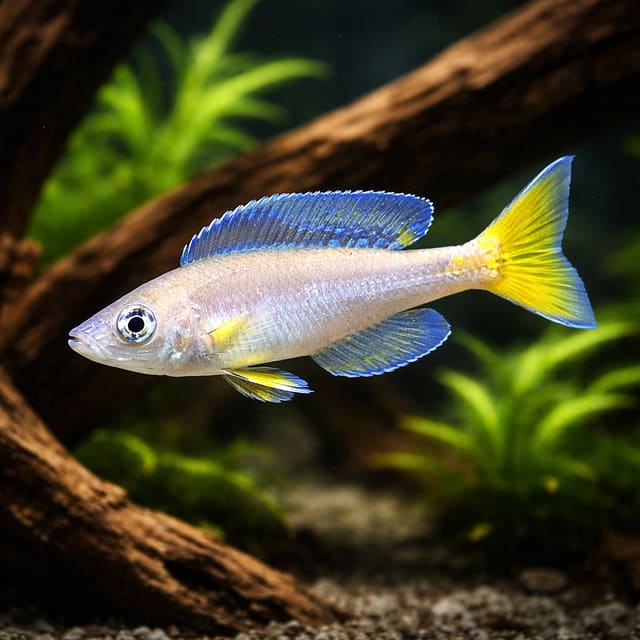
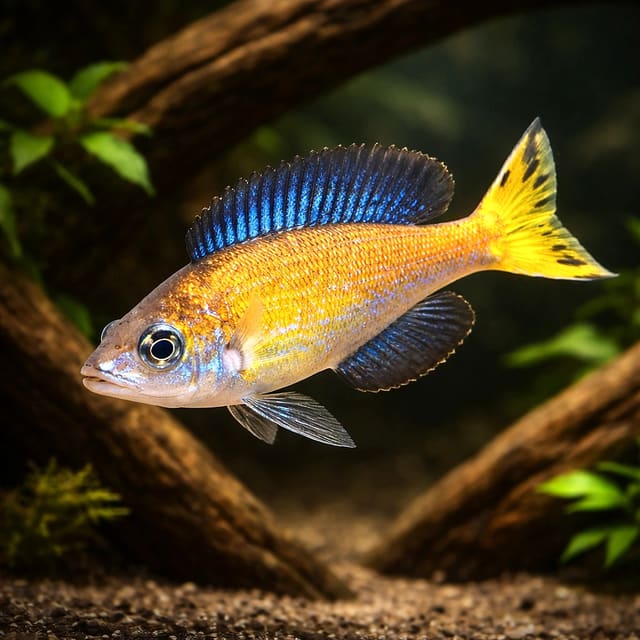
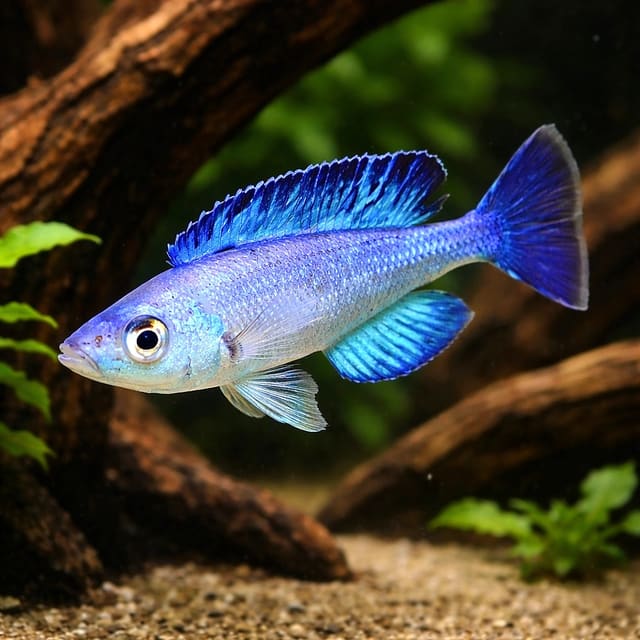
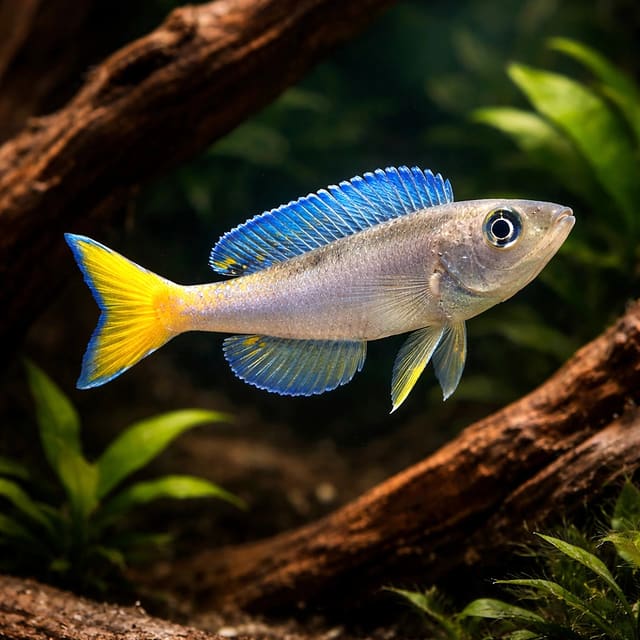
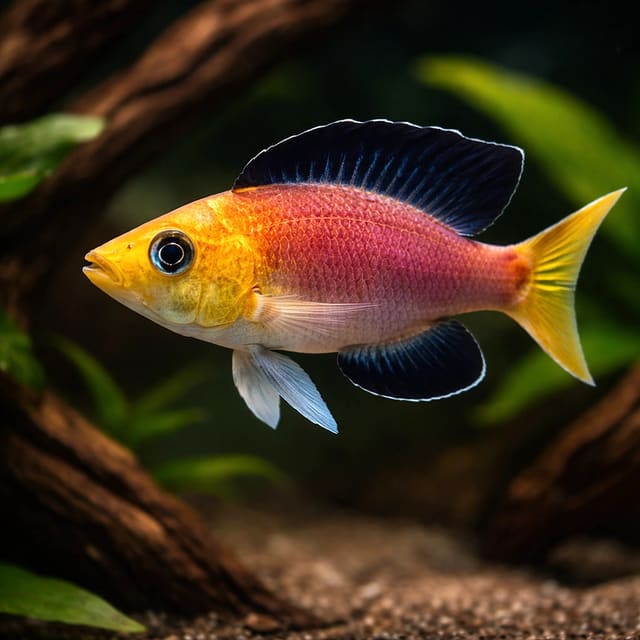
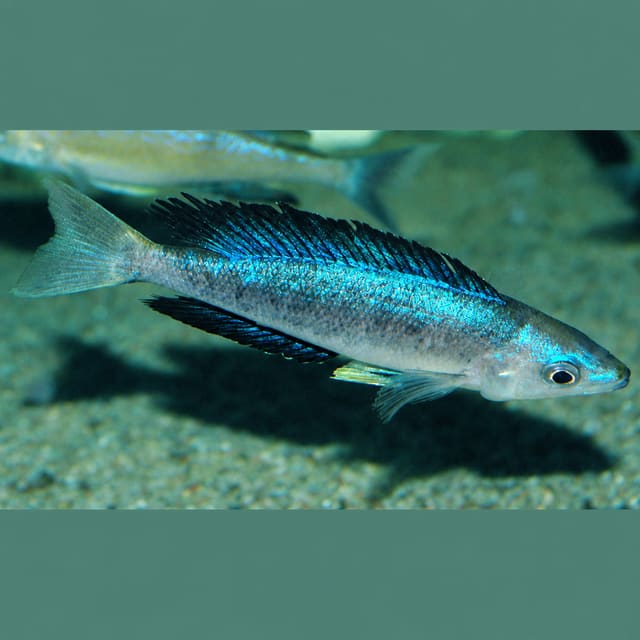
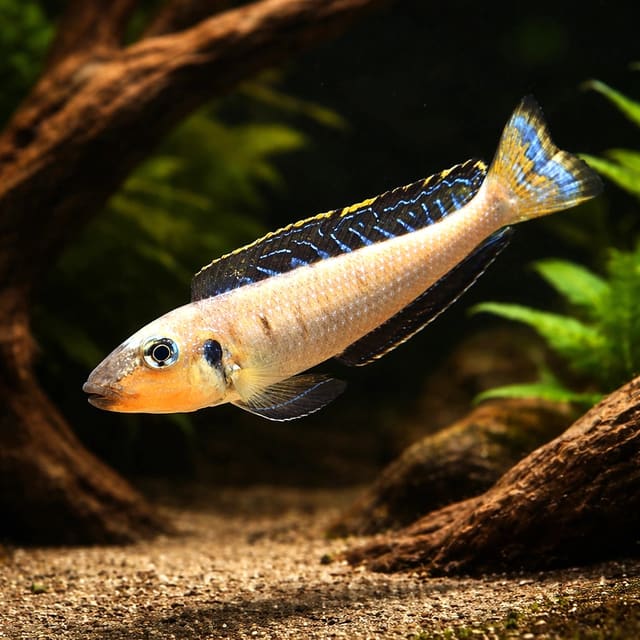
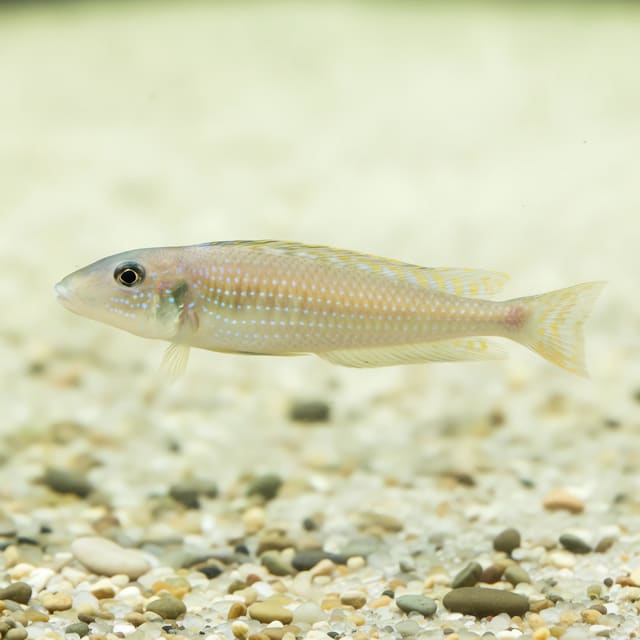
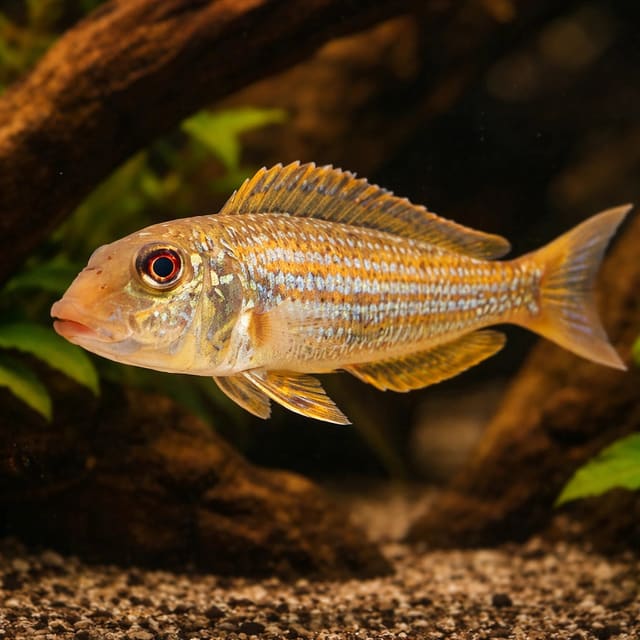
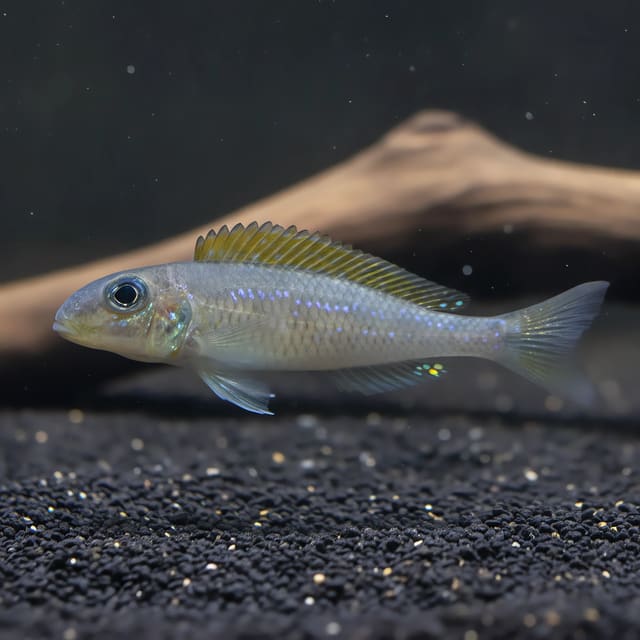
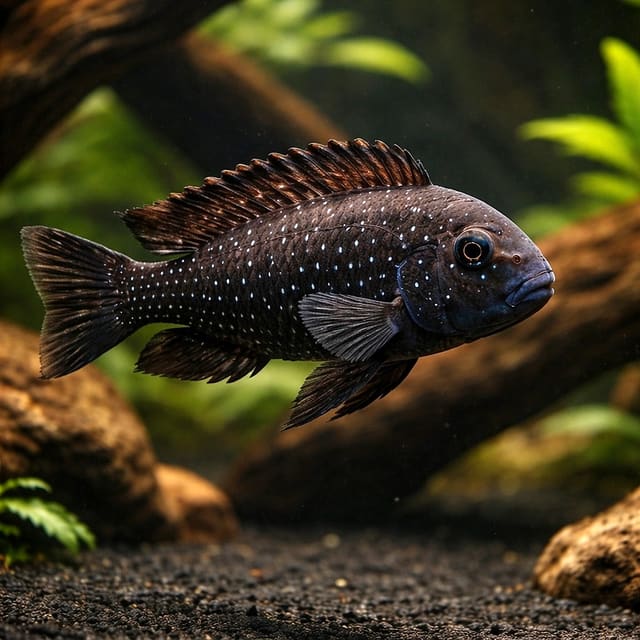
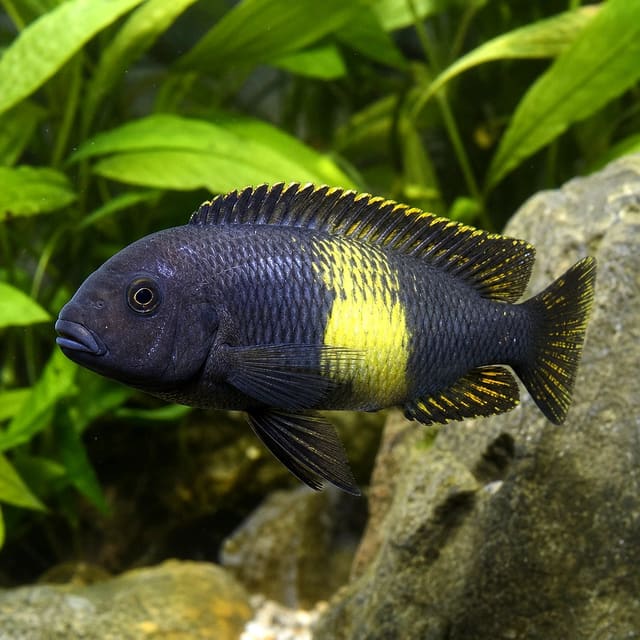
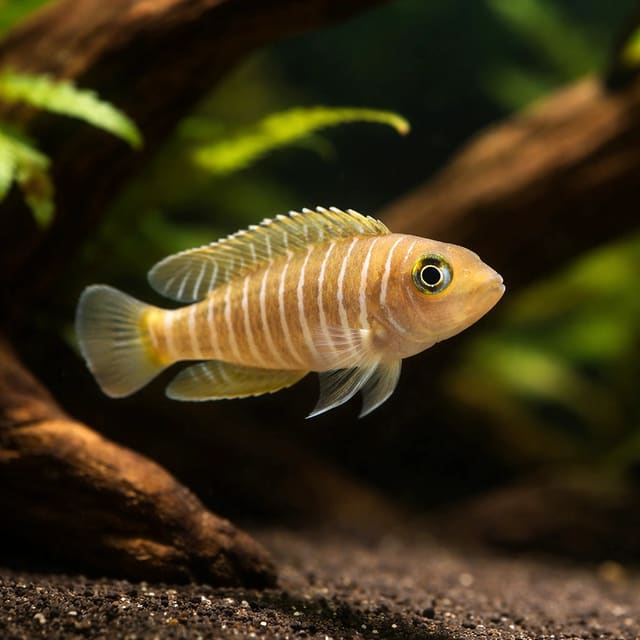
The first four gallery images are representative digital illustrations based on the species reference, while the fifth is a reference photograph. None is a photograph of the exact fish dispatched. Individual colour, banding and fin intensity vary with sex, age, social rank, lighting and transport.
Use the supplier photograph as the closest source reference and the illustrations as supporting views of the expected open-water form and mature male pattern. Females, juveniles and subordinate males can be much plainer than the brightest gallery fish. Choose this listing for the documented species identity, available size and care requirements, not for a guaranteed sex, locality, band count or colour intensity.
| Requirement | Planning target | Reason |
|---|---|---|
| Aquarium | 300 L+ and about 140 cm long | Provides a useful schooling lane and space for male open-water territories |
| Group | At least 10 | Supports normal social behaviour and distributes courtship pressure |
| Temperature | 24-27°C | Maintains stable Tanganyika conditions without using the extremes as a target |
| pH | 7.5-8.5 | Provides the alkaline conditions expected by Tanganyika cichlids |
| Hardness | 12-30 dGH | Maintains mineral-rich water; measure rather than guess |
| Food | Fine plankton-style foods | Matches the small mouth and feeding position in open water |
| Experience | Intermediate | Group structure and stable high-pH water require active management |
These figures should be used together. Ten fish in a short 200-litre tank do not become suitable because each fish is small, and a large aquarium does not compensate for acidic or unstable water. The filter must already process the intended bioload with zero ammonia and nitrite before the fish arrive.
Cyprichromis zonatus is a valid species, not a colour morph of C. leptosoma or C. microlepidotus. Takahashi, Hori and Nakaya described it from specimens collected along the Zambian coast, including the type locality near Kasenga. The Latin-derived species name refers to the banded appearance of mature males.
Male colour is unusually useful for recognition. FishBase summarises a yellowish body with a bluish or darker upper surface, three or four broad vertical bands beneath the dorsal-fin base, yellow lines along lower scale rows, a blue dorsal fin and contrasting colour in the remaining fins. Females show indistinct bands and much duller fin colour. Body measurements and scale counts separate the species scientifically from other Cyprichromis, but those technical characters are not a reliable way to sex a juvenile in a retail bag.
No collection locality is provided beyond the species' known Zambian distribution. Do not assume a Kombe, Kasenga or other locality, or wild-caught or first-generation provenance. If a documented locality line matters to a breeding project, request that evidence before purchase.
The formal account gives a maximum of 8.6 cm standard length for males and 8.1 cm for females. Standard length excludes the tail, so a practical total-length plan is approximately 10-11 cm. This makes C. zonatus compact, but not a nano fish: social space, not body length alone, determines the aquarium size.
| Fish or option | What to expect | What is not guaranteed |
|---|---|---|
| 4-5 cm grade | Young fish with developing proportions | Sex, adult bands or dominant-male colour |
| 5-6 cm grade | Larger juvenile or subadult | A male/female pair or immediate display colour |
| Mature male | Three or four upper-body bands and brighter fins | An exact match to one photograph |
| Female | Smaller adult with faint bands and subdued fins | The bright male pattern shown in display images |
Use the live selector for the size, price and availability offered at checkout. Each quantity is one unsexed fish. Ordering two does not prove that the fish are one male and one female, bonded or sufficient for welfare. Plan this species as a group of ten or more.
The species is endemic to Lake Tanganyika and known from the Zambian shoreline. Recorded depth spans roughly 9-30 metres. Females and subadult males have been observed in schools one to five metres above rocky bottoms, sometimes joining schools of related species. Mature males behave differently: they defend a three-dimensional territory above a large rock or boulder, particularly around 15-25 metres depth.
This combination explains why the aquarium needs open water and selected rock structure. The fish does not require a rock wall packed from base to surface. A few stable boulder-like features help define male display zones, while most of the middle and upper volume remains available to the school. Clear escape routes are vital; a subordinate male should be able to leave a territory without being trapped against glass.
Lake Tanganyika is consistently mineral rich and well oxygenated. Captive fish experience far faster changes than wild fish when a heater fails, a filter blocks or a large volume of chemically different water is added. Stability and oxygen are therefore part of habitat replication, not optional technical extras.
Keep at least ten. Eight is sometimes quoted as a lower aquarium minimum, but ten gives a better starting social spread. The aquarium must scale with the group. Several males can coexist when each has open-water territory and females can move between them, but a short tank compresses those territories into continual conflict.
Do not mistake “schooling” for perfectly synchronized movement. Adult males may hold position and display above a rock while females and subadults move as a looser group. Brief chases and postural displays are normal. Persistent pursuit, a fish pinned behind equipment, refusal to feed or progressive weight loss is not normal and requires intervention.
Juvenile groups may mature with an unfavourable sex balance. Keep a divider, mature spare aquarium or realistic rehoming route available. Retail size grades are not sex selections. Adding one new fish later to an established adult hierarchy can be much harder than establishing a similarly sized group together.
Specialist aquarium references converge around 300 litres and 120-140 cm as a minimum range for a group. Use the more conservative 140 cm planning length because mature males establish territories in open water rather than only occupying small caves.
Front-to-back width also matters. It allows the school to pass around a displaying male instead of crossing the same narrow line. A 300-litre tall column with a short front length is not equivalent to a long aquarium. Larger is sensible when adding other cichlids, multiple male territories or substantial rockwork.
A 4-5 cm fish still belongs in an adult-planned group and aquarium. A temporary grow-out system is only responsible when a mature final aquarium and transfer date already exist.
Build low or moderate rock groups at the back and ends, including one or more prominent boulders that break sight lines. Leave a broad uninterrupted lane through the middle and upper levels. Rocks must rest securely on the base, not on loose sand that another cichlid can excavate.
Fine sand suits the lake display and possible lower-level companions, although C. zonatus rarely depends on the substrate. Plants are optional. Vallisneria or well-secured hard-water-tolerant epiphytes can be used around the margins, but a dense planted layout removes swimming room. Driftwood is unnecessary and may work against the desired chemistry where buffering is weak.
Fit a close lid. Open-water fish can jump when startled by maintenance, abrupt lighting or pursuit. Close gaps around cables and returns without sealing ventilation. Use a timed light and soften the transition with room lighting so the school is not dropped instantly from bright illumination into darkness.
Choose filtration by mature biological capacity and real-world flow, not only the figure printed on the box. A well-maintained canister, sump or multi-filter system can work. The return should disturb the surface strongly and circulate the entire open zone without producing one harsh jet that forces fish to swim continuously.
High pH increases the toxic fraction of ammonia, so any detectable ammonia deserves immediate action. Nitrite must also remain zero. Test after power cuts, major media cleaning, medication, new stocking or unexplained rapid breathing. Mechanical media should be rinsed before it blocks, while biological media is cleaned gently and never all at once.
Use guards where fry are possible and inspect intakes for trapped food. The best circulation pattern carries fine waste toward the filter while leaving calmer areas where females and subordinate fish can rest without leaving the school entirely.
| Parameter | Range | Practical management |
|---|---|---|
| Temperature | 24-27°C | Hold a stable middle value and match new water closely |
| pH | 7.5-8.5 | Maintain alkalinity; do not dose impulsively to chase a decimal |
| GH | 12-30 dGH | Test tap water and use a repeatable remineralisation recipe if needed |
| Ammonia | 0 mg/L | Any reading is urgent in alkaline water |
| Nitrite | 0 mg/L | Confirms the second stage of nitrification is functioning |
| Nitrate | Low and stable | Use its trend to set water-change volume and frequency |
A 25-35% weekly water change is a reasonable starting routine. Adjust it for nitrate trend, group size and feeding. Dechlorinate fully and prepare replacement water before use. Sudden conductivity, pH or temperature changes can stress fish even when the final reading falls inside the published range.
Measure GH and preferably KH rather than assuming all hard-looking tap water is suitable. If buffers or mineral salts are required, mix them outside the aquarium. Never pour a corrective dose around fish in response to one unexpected test without confirming the result.
Cyprichromis zonatus feeds on zooplankton. It is therefore best described as a carnivorous zooplanktivore rather than a broad omnivore. Its mouth and feeding position suit small particles drifting through open water. Large bottom pellets are easily missed and may instead feed territorial substrate species.
| Food | Use | Serving approach |
|---|---|---|
| Fine slow-sinking granules | Measured staple | Scatter broadly so the whole school intercepts particles |
| Frozen Cyclops or copepods | Close plankton analogue | Thaw and release into gentle current in small portions |
| Daphnia | Varied small prey | Match the particle to the smallest fish in the group |
| Artemia | Conditioning and appetite support | Rotate rather than using it as the only food |
| Finely sized mysis | Occasional richer item | Chop if necessary and remove pieces that sink uneaten |
Crushed flake can be accepted but should be chosen for ingredient quality and freshness, not because it is cheap. Avoid mammal meat, unverified feeder fish, oversized pellets and a diet dominated by bloodworm. The goal is several appropriate foods, not an endless list of treats.
Offer two or three small meals to established adults. Add a little across the water surface, pause while the group intercepts it, and add more only if every area is still feeding. Food reaching the bottom in quantity indicates that the particle or portion is wrong.
| Observation | Possible cause | First response |
|---|---|---|
| One fish misses every meal | Hierarchy, illness or unfamiliar food | Distribute food more widely and observe breathing/faeces |
| Pinched abdomen | Chronic underfeeding or disease | Check competition and quarantine history promptly |
| Swelling after meals | Overfeeding, unsuitable food or illness | Stop feeding and investigate water and digestion |
| Food sinks untouched | Particle too large or feeding response poor | Reduce size and offer a familiar plankton-style item |
Compare body condition across the school weekly. Dominant males often reach food first and can make the group appear well fed while quieter females or subadults lose weight. A photograph from the same angle is a useful record.
Compatible companions must share the chemistry without crowding the same open-water territory or outcompeting the group at meals. Carefully selected shell dwellers and calm sand-associated Tanganyika cichlids may use lower levels in a larger aquarium. Some smaller Synodontis can work, but species, adult size and impact on fry must be considered.
Use the Lake Tanganyika cichlid collection to compare adult requirements. The Ocellated Shell Cichlid illustrates a bottom-territory strategy, while Blue Neon Paracyprichromis is a related but behaviourally distinct open-water comparison. A link is not a blanket stocking approval; calculate every adult group and territory.
Avoid aggressive mbuna, boisterous feeders, fin nippers, soft-water community fish and large predators. Do not place slender Cyprichromis with adult Frontosa or other piscivores capable of swallowing them.
Related species can share chemistry but still be a poor breeding combination. Females and subadult males of C. zonatus may join other Cyprichromis schools in nature, yet an aquarium is a restricted space and offspring identity matters. Avoid mixing close forms where hybridisation or uncertain parentage would compromise a locality or species line.
The Black Smallscale Cyprichromis belongs to C. microlepidotus, while the Jumbo Yellow Sardine Cichlid belongs to the C. leptosoma complex. Compare them as alternative school choices rather than buying several small groups to fill one tank.
Mature males display from open-water territories above a rock. A receptive female enters the display area, takes the eggs into her mouth and carries the brood herself. Ordering two unsexed fish does not create a breeding pair; spawning develops within a socially balanced group.
A holding female may stop eating and show a fuller throat. Avoid repeated netting, stripping too early or trapping her with persistent males. Some breeders leave a settled female in a spacious group; others move her later to a matched, mature release tank. Either method needs calm handling and identical water chemistry.
Incubation in related Cyprichromis is commonly around three weeks, but temperature, stress and individual condition affect timing. Released fry can take Artemia nauplii, copepods and fine prepared fry food. Protect filter intakes and keep portions tiny so a grow-out system is not overwhelmed.
| Sign | Check first | Action |
|---|---|---|
| Rapid breathing across the group | Oxygen, temperature, ammonia and nitrite | Correct the environmental emergency immediately |
| One fish isolated near the surface | Male pressure, injury, food access | Prepare separation before condition declines |
| Clamped fins or flashing | Recent additions, irritants, skin/gill signs | Quarantine and diagnose rather than dosing blindly |
| Female not eating with enlarged throat | Possible mouthbrooding | Observe behaviour before treating as digestive disease |
Water tests come before medication. Ammonia, nitrite, low oxygen and unstable pH can mimic disease, while unnecessary treatment can damage the filter. Quarantine new fish and use dedicated nets where possible. Seek aquatic-veterinary or experienced specialist help when signs do not point to a clear cause.
| Interval | Task | Useful record |
|---|---|---|
| Daily | Check breathing, school position, pursuit and appetite | Any fish repeatedly absent from the group |
| Weekly | Test nitrate and change 25-35% as required | pH, temperature and water-change volume |
| Weekly | Inspect intakes, lid gaps and flow | Reduced circulation or trapped debris |
| As needed | Rinse mechanical media in removed tank water | Flow before and after cleaning |
| Monthly | Compare GH/KH with prepared source water | Gradual mineral drift |
Do not replace all biological media, deep-clean every filter and rearrange every territory on one day. Regular modest work is safer than occasional corrective demolition. Recheck the school after maintenance; abnormal breathing can reveal a temperature, dechlorination or gas-exchange mistake quickly.
Confirm the mature aquarium, lid, filter and water chemistry before choosing a dispatch date. Have fine familiar food ready and ensure someone can receive the parcel. The live-fish delivery page carries the current service and guarantee terms.
Follow the order-specific acclimation instructions because sealed-bag chemistry changes during transport. Keep the room calm and lighting low, do not add shipping water to the aquarium, and avoid prolonging exposure after the bag is opened. The acclimation timer can organise the process, but the instructions supplied with the order take priority.
Report an arrival concern immediately under the current terms, retaining the bag, label and clear photographs. A pale fish after transport is not automatically misidentified: juveniles, females and stressed adults can all suppress colour.
The gallery contains four representative digital illustrations and one reference photograph. They show the deeper body, large eye and potential blue, yellow and banded male colour. They are not photographs of the exact fish dispatched. Sex, maturity, social rank, lighting and transport affect appearance.
Planted and driftwood backgrounds are illustrative, not habitat instructions. The species requires open water beside rock in a hard alkaline Tanganyika system. Use the scientific name and selected size as the identity basis rather than expecting a juvenile or female to reproduce one adult male picture.
| Question | Ready when... |
|---|---|
| Is the footprint adequate? | The aquarium is 300 L+ and around 140 cm long |
| Is the group complete? | You can maintain at least ten, not merely the discounted pair |
| Is the chemistry stable? | 24-27°C, pH 7.5-8.5 and 12-30 dGH can be sustained |
| Is filtration mature? | Ammonia and nitrite are zero under the planned load |
| Are companions safe? | No large predator, aggressive feeder or incompatible soft-water fish is present |
| Can you receive the parcel? | A responsible person can inspect and acclimate immediately |
Check dimensions with the tank-volume calculator, compare chemistry with the water matcher and use the tank-mate planner as a starting screen. Tools support species research; they do not turn an undersized or incompatible plan into a safe one.
The genus contains several slender schooling cichlids that can look confusingly similar in dealer photographs. C. zonatus is relatively deep bodied and large eyed, with the adult male's three or four broad upper-body bands providing its most accessible visual clue. The bands are absent or much less distinct in the other described species. C. microlepidotus has many more scales in its longitudinal series, while C. leptosoma, C. pavo and C. coloratus differ in combinations of scale counts, fin rays, body depth and live colour.
Those scientific differences matter because “sardine cichlid” is often used loosely across the genus. A generic common name should not overwrite the accepted identity. This fish is sold as Cyprichromis zonatus; do not relabel it as a Kasai smallscale fish or a C. leptosoma colour form.
Photographs still have limits. A female with indistinct bands and dull fins can be difficult to identify from colour alone, particularly after shipping. Reliable provenance begins with documented source identity and continues through separated breeding records. Do not distribute fry under a locality or species name when mixed parents make that identity uncertain.
| Mistake | Why it fails | Better plan |
|---|---|---|
| Buying the discounted pair only | Two fish do not provide a school and may mature as two males | Plan ten or more in the final aquarium |
| Using a tall 200 L tank | Litres do not replace the 140cm social and swimming axis | Choose a long 300 L+ footprint |
| Filling the tank with rock | A solid wall removes the open-water habitat and escape routes | Use selected boulders around a large swimming zone |
| Feeding large cichlid pellets | Food falls below the school and does not match its small mouth | Offer fine suspended plankton-style foods |
| Adding Frontosa because both are Tanganyikan | Matching chemistry does not remove predation risk | Select calm, non-predatory companions by adult behaviour |
| Judging identity from bright male colour | Females, juveniles and stressed fish can look much plainer | Use accepted identity, provenance and several characters |
Another frequent mistake is correcting pH rapidly. Buffers can move chemistry faster than fish can adapt, especially when the keeper does not know the source water's KH. Confirm the test, prepare matched replacement water and make controlled corrections. The same patience applies to social problems: observe which fish initiates pursuit and where the victim is trapped, then change the territory or separate the aggressor before injury occurs.
Availability is specific to each size and can change. Choose only a grade currently shown as available in the live selector; an unavailable size does not necessarily mean every size is unavailable.
It is better for an intermediate keeper who can manage a large group, stable Tanganyika chemistry and small suspended foods.
The formal maximum is 8.6 cm standard length for males and 8.1 cm for females. Plan approximately 10-11 cm total length including the tail.
Use at least 300 litres and around 140 cm of front length for a group. More space is appropriate for companions or several adult males.
No. This is a schooling species and should be kept in a group of at least ten. A two-fish quantity offer is not a welfare recommendation.
No. Ordinary centimetre grades are unsexed unless the selector explicitly states otherwise, and two fish are not a complete social group.
The name refers to the banded male pattern, especially three or four broad vertical bands on the upper body.
It is endemic to Lake Tanganyika and currently known from the Zambian coastline, at recorded depths of roughly 9-30 metres.
It is a zooplanktivore. Feed fine slow-sinking granules plus appropriately sized Cyclops, copepods, daphnia, Artemia and occasional finely sized mysis.
It is less aggressively substrate-focused than many cichlids, but mature males defend open-water territories. “Peaceful” must not hide its group and space requirements.
This is not recommended. Large predatory Cyphotilapia can treat slender Cyprichromis as prey.
Use stable boulder-like features to define territories, but leave most of the middle and upper water open for schooling.
Hard-water-tolerant plants can be kept at the margins, but dense planting must not replace the open swimming zone.
The female carries the brood. Males display from open-water territories above rock.
Females and juveniles are less strongly marked, and transport or subordinate status can suppress adult male colour temporarily.
The IUCN assessment cited by FishBase lists the species as Least Concern, assessed in 2014. That does not remove the need for honest provenance and responsible breeding records.
Use 24-27°C, pH 7.5-8.5 and 12-30 dGH as the practical water range. The 300-litre, 140 cm group plan is supported by specialist aquarium references and gives the school meaningful open-water space.
No reviews for this item yet. Bought one? Honest reviews only, good or bad.
What customers say about ordering from us
Easy website plenty of info on fish your buying great to pick a time slot
TRACEY DURRANT · 7 Oct 2026
Got some lovely fish thank you
Kevin Mackie · 7 Oct 2026
Reviews of our shop, collected by Judge.me, an independent third-party review collector. Newest first.