Pearly Compressiceps Zaire (Altolamprologus calvus) – Black Fin
24–27°C · pH 7.5–9
£23.99
Kasai Smallscale Cyprichromis is an open-water Lake Tanganyika cichlid for a 350L+, 150cm aquarium. Keep at least ten in stable hard alkaline water and feed small plankton-style foods.
Cyprichromis microlepidotus
Shoaling fish: kept in a group they feel safer, stay calmer and show their best colour.
Kasai Smallscale Cyprichromis is an open-water Lake Tanganyika cichlid for a 350L+, 150cm aquarium. Keep at least ten in stable hard alkaline water and feed small plankton-style foods.
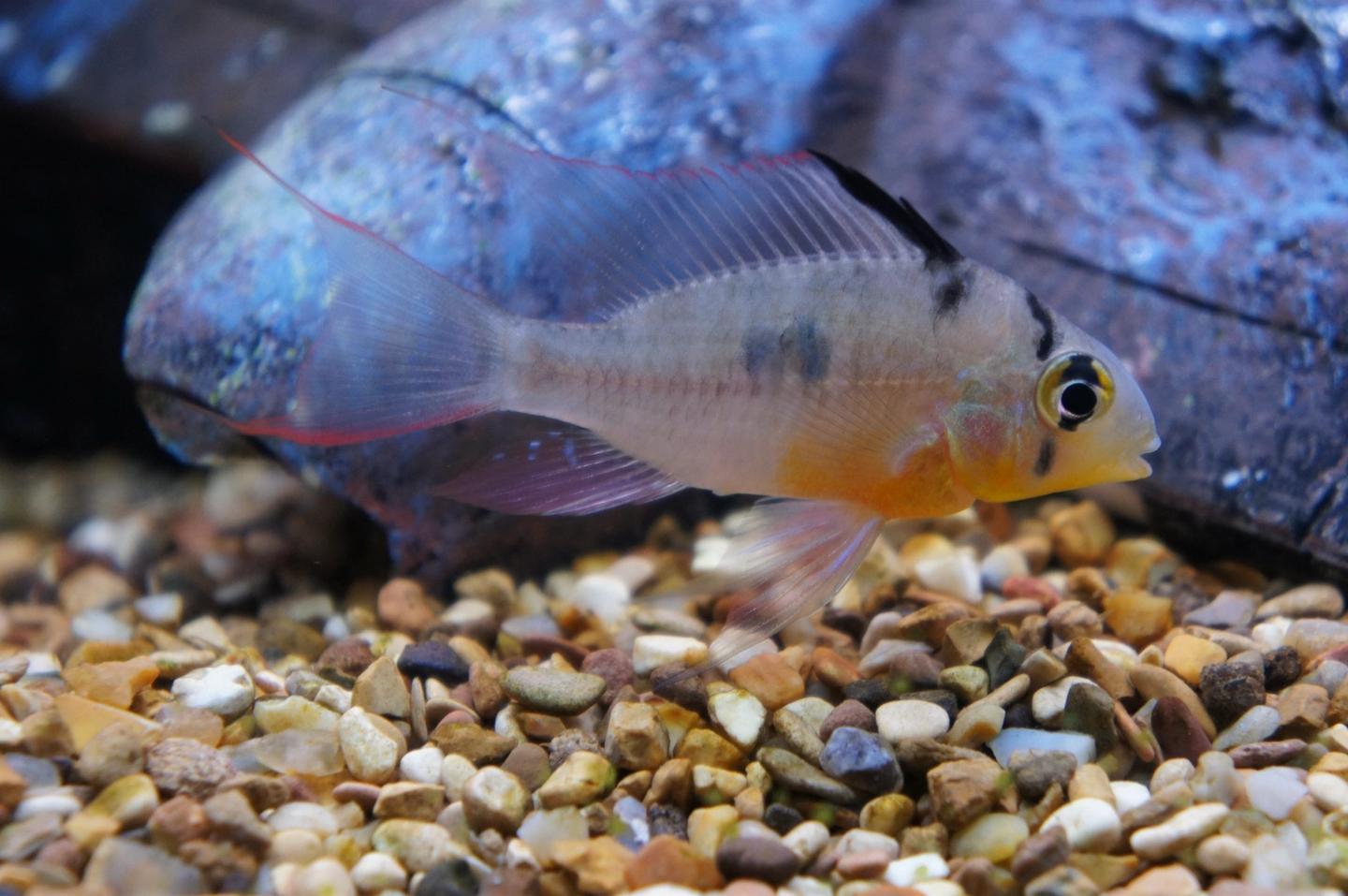
Cichlids are a family of roughly 1,800 accepted species, not one care type. Before buying, identify the exact species and source, then compare adult measurement, usable tank dimensions, social system, territory, tested water, diet and an exit plan. No family-wide minimum tank, water range or tank-mate list is safe.
Maintain these water conditions for optimal health and vibrant colors
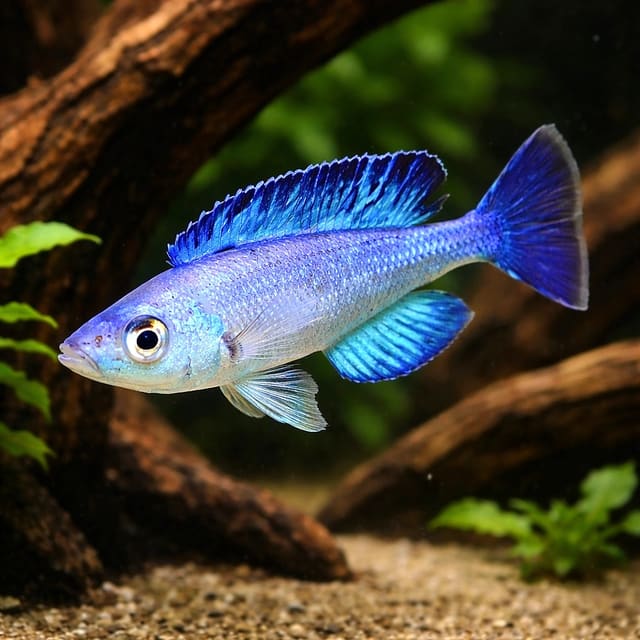
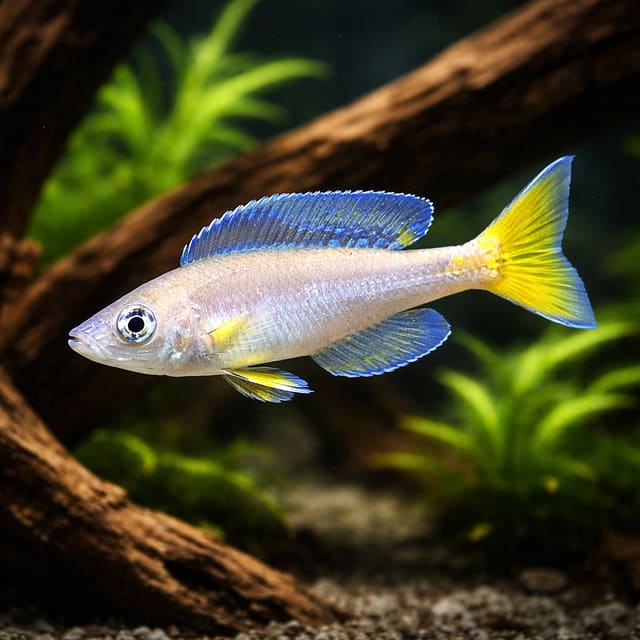
Kasai Smallscale Cyprichromis (Cyprichromis microlepidotus) is a slender, open-water cichlid from the northern part of Lake Tanganyika. The Kasai aquarium-trade form is associated with Milima Island on the Democratic Republic of the Congo shore. Rather than living in a cave or defending a patch of sand, these fish spend much of their time in the middle and upper water above deep rocky slopes, feeding on drifting plankton and moving in large social groups. Mature males can develop blue, gold and yellow display colours, while females and younger fish are more restrained.
This is a specialist Tanganyika fish, not a small general-community cichlid. A successful long-term plan needs a mature aquarium of at least 350 litres and about 150 cm long, a school of at least ten, hard alkaline water, excellent oxygenation and a broad, unobstructed swimming zone. Those requirements are more important than decorative rockwork. This guide explains the natural history behind them, what the available size options mean, how to feed a planktivore, how to avoid social and compatibility mistakes, and how to prepare for UK live-fish delivery.
| Care point | Practical target | Why it matters |
|---|---|---|
| Aquarium volume | 350 L+ for a school | Provides social space and dilution capacity for a substantial group |
| Tank length | About 150 cm or longer | Open-water fish need a long swimming lane, not simply extra height |
| Group size | 10 or more | Supports normal schooling and spreads male attention |
| Temperature | 23-27°C | Matches the supplier range while allowing a stable mid-range target |
| pH | 7.5-8.5 | Maintains the alkaline conditions expected by Tanganyika fish |
| Hardness | 12-30 dGH | Provides suitably mineral-rich water; test the source water before purchase |
| Food | Small plankton-style foods | The narrow mouth and mid-water feeding behaviour are poorly suited to large sinking pellets |
| Experience | Intermediate/advanced | Stable chemistry, group dynamics and food size all need active management |
These figures are planning targets, not permission to chase a number with sudden chemical adjustments. If tap water is unsuitable, prepare replacement water consistently before the fish arrive. A stable pH of 8.0 is preferable to repeated swings caused by adding buffers without testing alkalinity. The aquarium must also be fully cycled: clear water alone does not prove that ammonia and nitrite can be processed.
Cyprichromis microlepidotus is the accepted species name. “Smallscale Cyprichromis” is a useful English common name, while “Kasai” identifies the locality form in the aquarium trade rather than a separate species. Specialist locality records associate Kasai with Milima Island on the western, Congolese shore of Lake Tanganyika. Keeping that locality wording matters because colour and adult appearance can vary geographically within the species.
The species belongs to the family Cichlidae, but its ecology is unlike that of familiar rock-grazing mbuna or cave-spawning lamprologines. Published work places Cyprichromis in an open-water Lake Tanganyika lineage, and species accounts describe C. microlepidotus as a pelagic or semi-pelagic fish above rocky slopes. The body is narrow, the mouth is small and the fish is built to take zooplankton from the water column.
Kasai should not be treated as proof that an individual fish was wild-caught at Milima Island. The label describes the traded strain/locality association. Captive provenance can vary between consignments, and the listing does not claim a collection certificate.
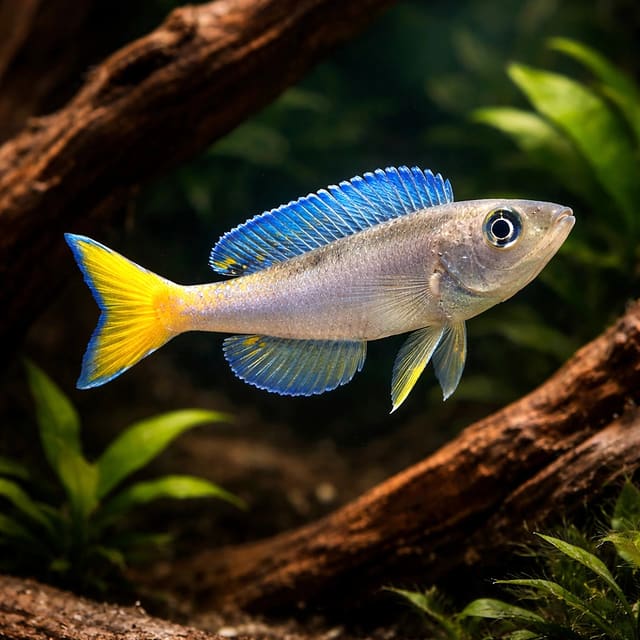
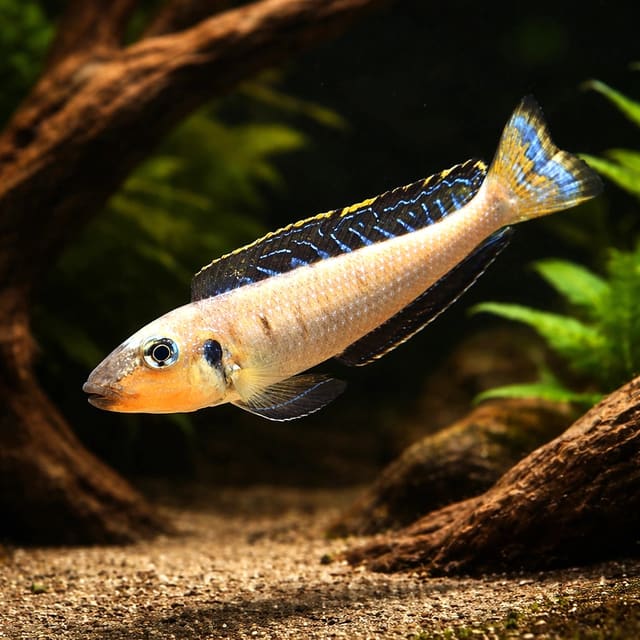
Adult males are the visual focus of a settled group. The Kasai form can show a warm gold or orange body, electric blue in the dorsal fin and yellow in the tail, but Cyprichromis microlepidotus males are polychromatic. Two mature males from the same locality can therefore display different colour balances. Mood, hierarchy, lighting, diet, age and breeding condition also change what a keeper sees from one hour to the next.
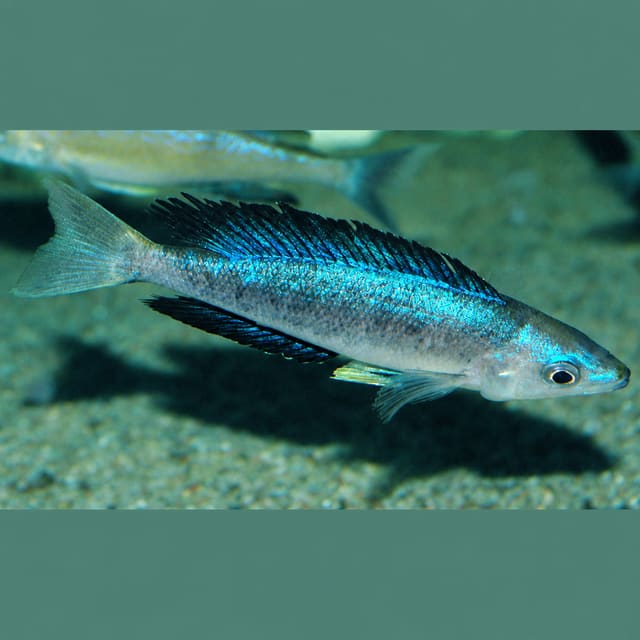
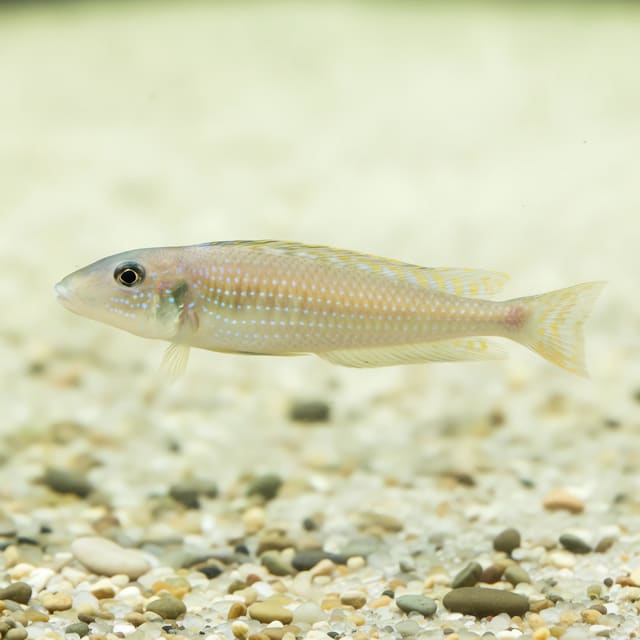
Females are generally smaller and less brightly coloured, often beige to light brown or silver-beige. Juveniles are also comparatively plain. A young fish must not be rejected as “wrong” because it does not match a fully displaying adult male photograph. Colour develops with maturity and social confidence; sex cannot be promised from an unsexed small size option.
| Fish | Typical appearance | Buying implication |
|---|---|---|
| Mature displaying male | Stronger blue, gold and yellow; longer, more emphatic fin colour | Reference images usually show this most photogenic state |
| Adult female | Smaller, beige or light brown, with restrained fins | Essential to a balanced breeding group despite subtler colour |
| Juvenile | Slim, pale and not reliably sexable | Plan the school first and allow colour to develop naturally |
| Recently transported fish | May be temporarily pale or hold fins close | Judge recovery over the settling period, not in the shipping bag |
The selector may show measured bands such as 3-4 cm, 4-5 cm, 5-6 cm and 6-8 cm alongside supplier labels such as S or XL. These are dispatch-size options, not separate species and not promises of sex, final colour or a bonded group. Fish are living animals, so a measured band is approximate rather than a precision manufactured dimension. The current live option and price shown by the selector are the ones that apply to the order.
| Option type | What it tells you | What it does not guarantee |
|---|---|---|
| Measured band | Approximate body-length band at dispatch | Exact millimetres, age, sex or mature colour |
| S | Small size option | A fixed centimetre measurement unless stated in the selector |
| XL | Extra-large size option | A specific sex or fully coloured dominant male |
| Multiple fish | Quantity selected by the customer | A bonded pair, breeding group or chosen sex ratio |
For a new school, similarly sized fish usually settle more evenly than a mixture of tiny juveniles and much larger established adults. If an exact grade matters to an existing group, contact the team before ordering. Do not use the lowest-priced option as a way to place one or two fish into a tank that cannot house the adult school.
Locality accounts place the Kasai/Milima Island form along deep rocky shores, commonly at approximately 5-30 metres, while broader accounts extend the species’ observed depth range further. The fish do not graze the rocks like mbuna. They form large schools in the water beside and above the slope, where currents carry copepods and other small planktonic prey.
This habitat explains three aquarium priorities. First, the central water column must remain open. Second, oxygen and water quality must be excellent. Third, the fish needs the visual security of a group. A decorative wall of rocks that fills the tank may look “African”, but it removes the habitat this species actually uses. Build modest rock structure at the back and ends, leaving most of the length free for schooling and display.
During courtship, males establish three-dimensional territories in open water rather than defending a cave floor. That unusual spatial behaviour needs width and length around each male. In a cramped tank, a subordinate fish cannot move out of a display zone, and normal courtship pressure becomes relentless harassment.
A practical starting point is 350 litres with a front length of about 150 cm. More space is appropriate for a large group, several mature males or a mixed Tanganyika community. Volume without length is not equivalent: a tall, narrow aquarium may hold the same litres but offers a much shorter social and swimming axis.
Use a secure, well-fitted lid. Active open-water fish can accelerate quickly when startled, particularly during maintenance, lighting changes or introduction to a new room. Cover filter and cable gaps without compromising ventilation. Keep a clear strip beneath the lid so fish are not driven against floating decor.
A 3-4 cm fish still needs an adult-sized home and an adult-sized social group. A small grow-out tank can be useful to an experienced breeder with a dated transfer plan, but it is not a substitute for the final aquarium.
Keep at least ten. A larger school can be even more natural when the aquarium is proportionately larger. The point is not a magic number: it is to provide enough fish and space for schooling while spreading display and courtship pressure. A pair or trio concentrates attention on too few females and removes the security created by the group.
Where confidently sexed adults are available, more females than males is a sensible objective. Small and medium fish are often not reliably sexable, so an exact ratio cannot be guaranteed from ordinary retail stock. Provide a plan for surplus males as the group matures. The seller’s shoal-pricing label is a quantity discount; it is not a statement that every discounted quantity is a complete or correctly sexed school.
Watch the whole group rather than only the brightest male. A healthy school occupies open water, approaches appropriately sized food and disperses after brief displays. Persistent hiding, a fish pinned into a top corner, repeated high-speed pursuit or a single individual losing condition indicates a social or environmental problem.
Start with a broad open middle and upper zone. Place stable rock structures around the back and ends, leaving gaps that give a pursued fish more than one exit. The rocks are visual boundaries and habitat for suitable lower-level companions, not a solid cliff across the full tank. Ensure every rock rests securely on the base rather than on loose substrate.
Fine sand suits a Tanganyika display and lower-level companions, although Cyprichromis itself rarely interacts with the substrate. Hardy plants such as Vallisneria, Anubias or Java fern can be used if they tolerate the water, but they are optional and must not crowd the swimming lane. Driftwood is not required to represent this mineral-rich lake and may be undesirable if it lowers pH in water with weak buffering.
Use moderate, even lighting with a predictable timer. Sudden darkness can startle an open-water school, so room light before and after the aquarium photoperiod can soften the transition. A dark background may improve visual contrast without turning the water column into a shaded cave.
Use mature biological filtration sized for the total stock and feeding load. External canisters, a sump or a well-designed combination can work; the label on the filter matters less than actual media capacity, maintenance access and circulation throughout the aquarium. Aim for strong surface movement and high dissolved oxygen without forcing the school to hold position in a narrow jet.
Position returns so that waste reaches the intake and the open water is gently circulated. Protect intakes if newly released fry are present. Clean mechanical media before it becomes a source of dissolved waste, but do not replace all biological media or deep-clean every filter at once. Rinse reusable biological media in removed aquarium water when needed.
Because ammonia becomes more toxic as pH rises, hard alkaline aquariums leave little room for neglected filtration. Test ammonia and nitrite whenever fish behaviour changes, after a power interruption, after major filter work or when stocking increases. Both should remain at zero.
| Parameter | Working range | Management note |
|---|---|---|
| Temperature | 23-27°C | Choose a stable point within the range; avoid rapid seasonal or water-change swings |
| pH | 7.5-8.5 | Alkaline and stable; test source and tank water before adding buffers |
| General hardness | 12-30 dGH | Mineral-rich water appropriate to the supplier range |
| Ammonia | 0 mg/L | Any detectable amount requires immediate investigation |
| Nitrite | 0 mg/L | Confirms the second stage of biofiltration is functioning |
| Nitrate | Kept low and stable | Use the trend to set water-change frequency rather than accepting chronic accumulation |
Lake Tanganyika chemistry is not reproduced by adding a spoonful of an unnamed salt and hoping for the best. Measure pH, GH and, ideally, KH in both tap and aquarium water. If remineralisation is necessary, use a consistent recipe and mix replacement water before it enters the aquarium. Large changes in conductivity or temperature can stress fish even when the final number falls inside a published range.
A routine 25-35% weekly water change is a sensible starting point, adjusted using stock density, feeding and nitrate trend. Match temperature closely and dechlorinate all new water. Never use pH-changing products directly in a stocked tank to correct a number quickly.
Cyprichromis microlepidotus is best described as a zooplanktivorous or carnivorous planktivore, not a general omnivore. Wild fish take copepods and other drifting animal plankton. Captive foods should therefore be small enough for the narrow mouth and should remain suspended or sink slowly through the school’s feeding zone.
A fine, high-quality carnivorous or plankton-oriented granule can provide the staple. Rotate suitable frozen Cyclops, daphnia, copepods, Artemia and finely sized mysis according to fish size. Newly imported or transported fish may accept moving frozen prey more readily than dry food, but transition gradually and avoid overloading an immature filter.
| Food | Role | How to offer it |
|---|---|---|
| Fine slow-sinking granule | Measured staple | Scatter across the surface so the school feeds without crowding one point |
| Frozen Cyclops or copepods | Close match to planktonic feeding | Thaw and distribute in small portions through the current |
| Daphnia | Useful varied prey | Offer in a size the smallest fish can swallow |
| Artemia | Conditioning and appetite support | Use as part of a rotation rather than the only food |
| Finely chopped mysis | Occasional richer food | Match particle size and remove uneaten pieces |
Avoid large pellets that fall past the group, fatty mammal or poultry ingredients, unverified live feeder fish and a diet dominated by one rich food. Bloodworm is not necessary and should not be the foundation of a Tanganyika planktivore diet. Ingredient quality and particle size are more important than a large “cichlid” picture on the packet.
Two or three small feeds can suit established adults better than one heavy meal. Add only what remains actively intercepted in the water column, pause, then add a little more if the whole school is still feeding. This reduces waste and gives subordinate fish a chance to eat away from dominant males.
| Observation | Likely meaning | Response |
|---|---|---|
| Food reaches the bottom uneaten | Particle size, food type or portion is wrong | Reduce the portion and use a slower-sinking, smaller food |
| One fish hangs back at every meal | Social pressure, illness or unfamiliar food | Observe breathing and faeces; distribute food over a wider area |
| Pinched abdomen | Insufficient intake or a health problem | Check competition, water quality and quarantine history promptly |
| Swollen abdomen after feeding | Overfeeding, unsuitable food or disease | Stop adding food and investigate rather than repeating the meal |
Do not judge intake by the dominant fish. Look along the full school and compare body condition over time. A simple weekly photograph from the same angle can reveal gradual loss that is hard to notice day to day.
The safest concept is a calm Lake Tanganyika community in a large aquarium, with each species using a different zone. Suitable possibilities can include carefully selected shell dwellers and peaceful sand-associated cichlids, provided the footprint, territories and group requirements of every species are met. Some smaller Synodontis may also work, but species choice matters and catfish can affect breeding success.
“Peaceful cichlid” does not mean passive or universally compatible. Mature males display to one another, and females need escape space. Lower-level companions can also be highly territorial around shells or sand. Add the adult sizes and territory footprints together rather than assuming that fish in different water layers consume no shared space.
For research and comparison, browse the Lake Tanganyika cichlid collection. The Ocellated Shell Cichlid illustrates a very different bottom-oriented niche, while Blue Neon Paracyprichromis offers a related but distinct open-water comparison. These links are planning aids, not automatic cohabitation approvals; check each product’s current adult-care requirements.
Avoid large predatory Tanganyika cichlids, including Cyphotilapia that can view slender Cyprichromis as prey. Avoid aggressive mbuna, fin-nipping species, very boisterous feeders and soft-water fish whose chemistry conflicts with the tank. A fish that merely survives alkaline water is not necessarily an appropriate companion.
Do not casually mix geographic forms or closely related Cyprichromis when maintaining locality purity matters. Hybridisation or uncertain fry identity can undermine conservation-minded breeding. The Black Smallscale Cyprichromis is another traded C. microlepidotus form, and the Jumbo Yellow Sardine Cichlid is a different Cyprichromis species/form; compare them before choosing one school rather than combining them by default.
Similar water chemistry is only the first test. Adult size, predation risk, feeding speed, territory, group size and the exact aquarium footprint all need to agree.
Prepare the aquarium before dispatch day. Confirm zero ammonia and nitrite, check temperature and pH, reduce bright lighting and ensure the lid is secure. Do not order first and cycle later. If the fish will enter quarantine, the quarantine system must also be mature, covered and capable of maintaining hard alkaline water.
On arrival, follow the instructions supplied with the order because bag chemistry changes during transit. Avoid prolonged exposure of opened shipping water to air, and never add bag water to the aquarium. Transfer calmly with minimal chasing. Keep lighting subdued for the settling period and offer a small familiar food only after breathing and orientation look normal.
Record any arrival concern immediately, keeping the bag, label and clear photographs while following the current guarantee procedure. The live-fish delivery page explains the current service and terms. The interactive acclimation timer can help organise the process, but the order-specific instructions take priority.
| Frequency | Task | What to record |
|---|---|---|
| Daily | Observe breathing, schooling, appetite and aggression | Any isolated fish, unusual pursuit or missed meal |
| Weekly | Test nitrate trend; change 25-35% as the system requires | Temperature, pH and water-change volume |
| Weekly | Clean viewing panes and inspect intakes | Reduced flow, trapped debris or damaged guards |
| As indicated | Rinse mechanical media in removed aquarium water | Flow before and after cleaning |
| Monthly | Compare GH/KH with the prepared source water | Any gradual mineral drift |
| After change | Recheck temperature and fish behaviour | Signs of shock or abnormal gasping |
Maintenance should be regular and unremarkable. Very large corrective clean-outs often indicate that routine export has been insufficient. Never wash biological media under chlorinated tap water, replace all media together or dismantle every territory during an ordinary water change.
Most preventable problems begin with unstable chemistry, poor oxygenation, social stress, overfeeding or unsuitable tank mates. Warning signs include rapid breathing, clamped fins, isolation, repeated surface hanging, loss of appetite, a pinched or swollen abdomen, white stringy faeces, spots, wounds or a fish continually driven into a corner.
Test water before selecting medication. A treatment cannot correct ammonia, nitrite or low oxygen, and unnecessary medication can damage biological filtration. Quarantine new fish and equipment where practical, use dedicated nets, and avoid sharing water between systems. If disease is suspected, identify the pattern across the group and seek aquatic-veterinary or experienced specialist advice.
| Sign | First checks | Urgency |
|---|---|---|
| Rapid breathing across the school | Oxygen, temperature, ammonia, nitrite, recent chemicals | Immediate |
| One fish hiding and losing weight | Bullying, food access, faeces, external marks | Prompt isolation plan |
| White spots or flashing | Recent additions, skin/gill irritation, confirmed diagnosis | Prompt treatment decision |
| Single female not eating with enlarged throat | Possible mouthbrooding versus illness | Observe carefully before intervening |
The female, not the male, mouthbroods the eggs. Males display in open water and establish three-dimensional courtship territories. During spawning, eggs are released individually and taken into the female’s mouth. The female then withdraws and normally eats little or nothing during incubation.
Published and specialist accounts vary by locality and conditions. Kasai-oriented accounts describe small clutches around 5-10, other specialist reports suggest roughly 5-15, and broader species summaries can report up to about 25 eggs. Incubation is usually around three to three-and-a-half weeks. These ranges are not a guarantee for an individual spawning.
A brooding female needs refuge from male attention without being chased around a bare isolation box. Some breeders leave her in a spacious, calm colony; others move her once she is stable. Either approach has risks. Stripping eggs too early, repeatedly netting the fish or returning a weakened female directly to persistent males can cause losses. Released fry are comparatively large and can take appropriately sized Artemia nauplii, copepods and fine prepared foods.
Build and condition a balanced school. Retail quantities and size grades do not guarantee a male/female pair, fertility, a bonded relationship or spawning.
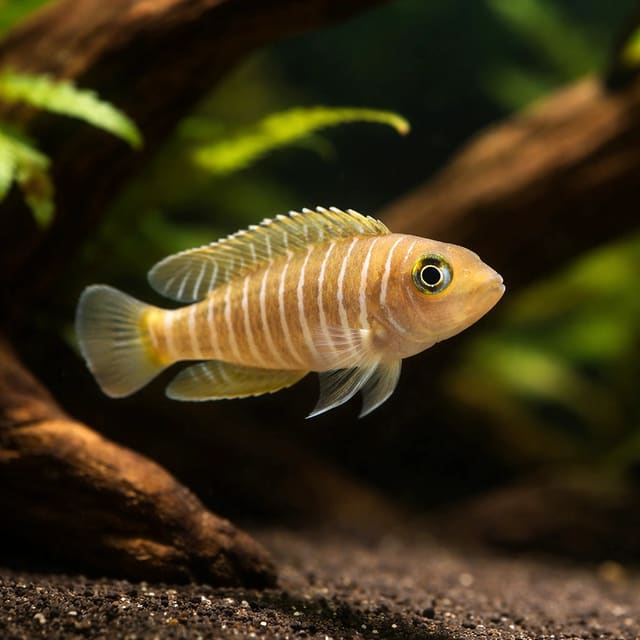
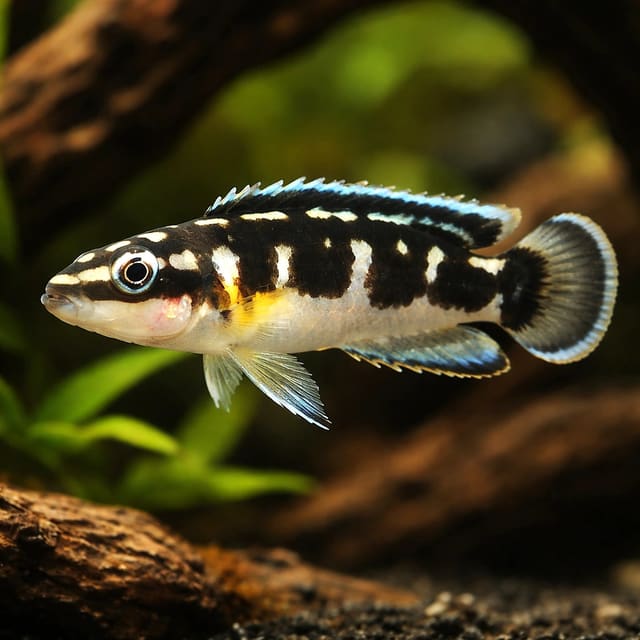
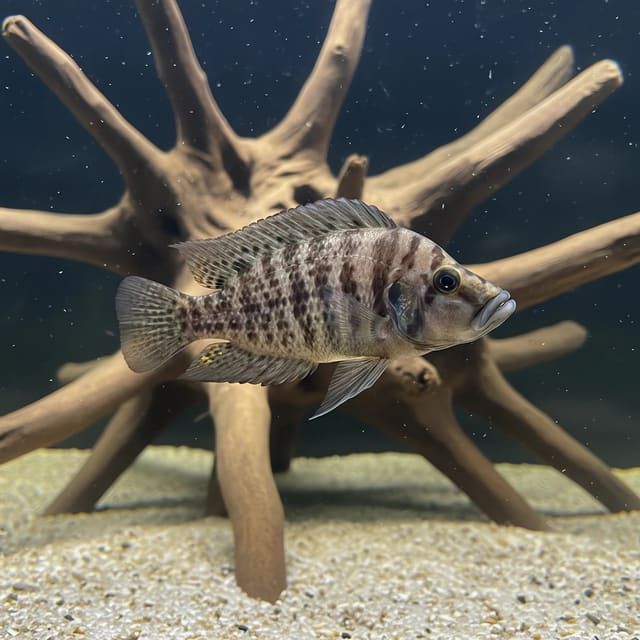
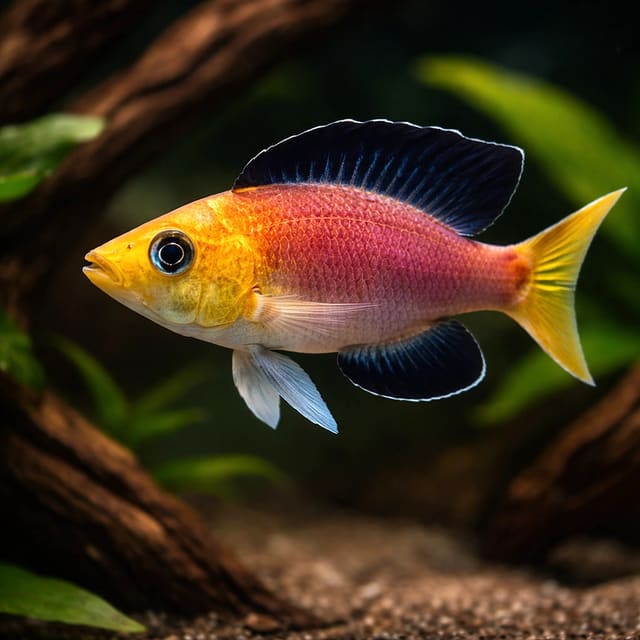
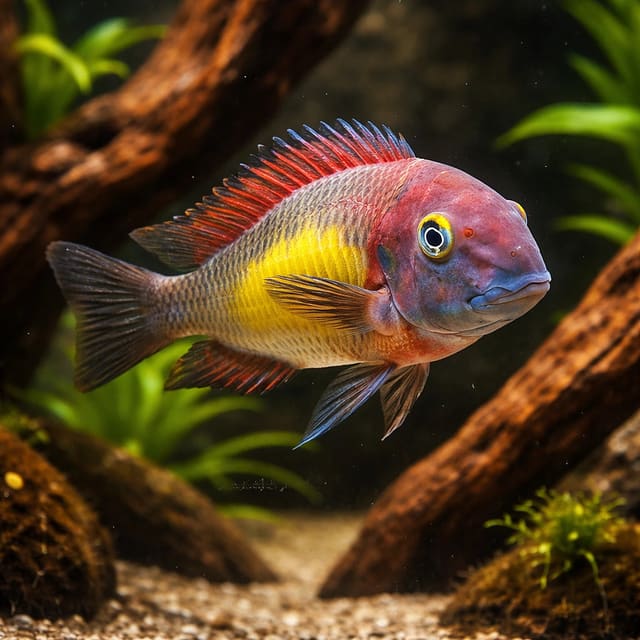
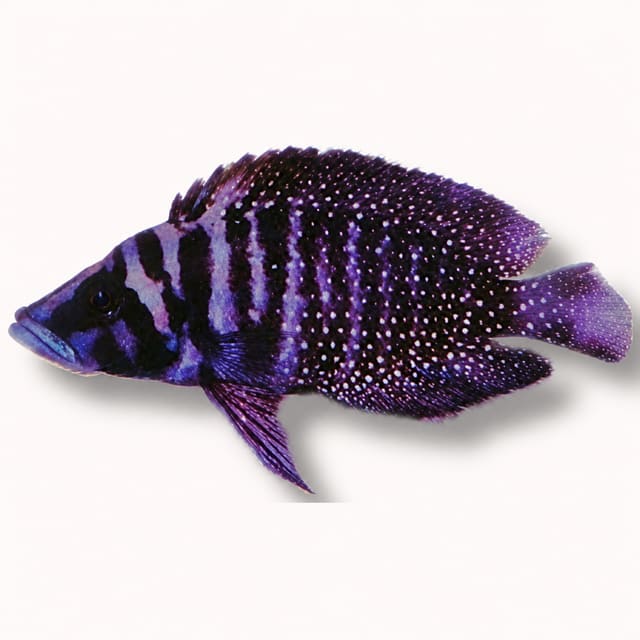
The gallery contains reference-led display images plus a reference photograph. They are there to show species shape and the potential colour of a mature displaying male. They do not promise that every juvenile, female or recently transported fish will have the same colour at dispatch. Aquarium backgrounds and lighting are illustrative; the correct natural-history plan is open Tanganyika water beside rock, not a densely planted driftwood aquascape.
Colour rendition also varies between screens. Use the scientific name, locality wording and live size selector as the primary identity information.
| Question | Ready when... |
|---|---|
| Is the aquarium large enough? | It is 350 L+ and roughly 150 cm long with a broad open water column |
| Is the social plan complete? | You can keep at least ten and have a plan if the mature sex balance is poor |
| Is the water suitable? | 23-27°C, pH 7.5-8.5 and 12-30 dGH can be maintained without swings |
| Is the filter mature? | Ammonia and nitrite are zero under the intended load |
| Are companions appropriate? | No large predators, aggressive feeders or incompatible soft-water fish are present |
| Is food ready? | Several small plankton-style frozen and prepared foods are available |
| Can you receive the delivery? | A responsible person can inspect and acclimate the fish under the current terms |
If any answer is uncertain, use the tank-volume calculator, water matcher and tank-mate planner as starting points, then verify the exact species requirements. Tools support judgement; they do not override adult husbandry.
No. It is best for an intermediate or advanced keeper who can maintain Tanganyika chemistry, a large mature aquarium, a proper school and a small-particle planktivore diet.
Plan at least 350 litres and approximately 150 cm of length for a school of ten or more. Larger groups, several males or companions need more room.
No. It is a strongly social schooling fish. One, a pair or a trio does not provide the social structure described for the species.
Plan a school of at least ten, but check that the adult aquarium can support the whole group. Quantity pricing does not guarantee a complete or sex-balanced school.
Not from ordinary unsexed size grades. Juveniles may not be reliably sexable, and the selector does not promise a pair or ratio unless a listing explicitly says so.
Use approximately 12-14 cm for planning. Specialist accounts commonly place males at the upper end and females slightly smaller.
Kasai is the aquarium-trade locality name associated with Milima Island on the DR Congo shore of northern Lake Tanganyika. It is not a separate species.
It is a carnivorous planktivore. Offer fine slow-sinking granules and suitably sized frozen Cyclops, copepods, daphnia, Artemia and occasional finely sized mysis.
That is a high-risk combination. Large predatory Cyphotilapia can prey on slender Cyprichromis, so they are not recommended companions here.
Hard-water-tolerant plants can be used sparingly, but they must not fill the open swimming zone. Plants are optional and not a substitute for an appropriate Tanganyika layout.
Not as its main territory. Rock at the back and sides provides boundaries and security, but the species schools and courts in open water.
The female is the mouthbrooder.
Juvenile size, female sex, transport stress and social status can all reduce colour. Mature male display colour develops in a settled, correctly managed group.
It is better to choose one locality-conscious school where hybridisation or fry identity matters. Similar chemistry does not remove breeding-lineage concerns.
Orders are covered by the live-arrival terms in force at dispatch. Read the delivery page, be present to receive the parcel and follow the evidence and acclimation procedure for any concern.
For species information and locality-specific husbandry, see:
Scientific and captive-care ranges can differ by population, sex and method. The recommended aquarium gives the school more room than a 250-litre aquarium; maintain stable water within 23-27°C, pH 7.5-8.5 and 12-30 dGH.
No reviews for this item yet. Bought one? Honest reviews only, good or bad.
What customers say about ordering from us
Easy website plenty of info on fish your buying great to pick a time slot
TRACEY DURRANT · 7 Oct 2026
Got some lovely fish thank you
Kevin Mackie · 7 Oct 2026
Reviews of our shop, collected by Judge.me, an independent third-party review collector. Newest first.