Moderate
Gold Head Compressiceps (Altolamprologus compressiceps)
23–27°C · 200L
£20.99

One unsexed Gombe Compressiceps Cichlid in the juvenile size chosen from two bands spanning 3–5 cm. Altolamprologus compressiceps is a Lake Tanganyika crevice specialist for a mature, rocky aquarium with stable hard alkaline water, carnivore feeding and carefully planned companions.
Altolamprologus compressiceps
Save when buying multiple fish. Each quantity is one fish; sex and pair formation are not guaranteed unless the selected variant explicitly states them.
One unsexed Gombe Compressiceps Cichlid in the juvenile size chosen from two bands spanning 3–5 cm. Altolamprologus compressiceps is a Lake Tanganyika crevice specialist for a mature, rocky aquarium with stable hard alkaline water, carnivore feeding and carefully planned companions.
Cichlids are a family of roughly 1,800 accepted species, not one care type. Before buying, identify the exact species and source, then compare adult measurement, usable tank dimensions, social system, territory, tested water, diet and an exit plan. No family-wide minimum tank, water range or tank-mate list is safe.
Maintain these water conditions for optimal health and vibrant colors
Gombe Compressiceps Cichlid is the locality-form label attached to this offer of Altolamprologus compressiceps, a cichlid endemic to Lake Tanganyika. The species has a deep, laterally compressed body and an elongated mouth suited to searching narrow cracks between rocks. It is an absorbing fish for a carefully designed Tanganyika aquarium, but it is not a general-purpose community cichlid.
One purchase supplies one live fish in the juvenile size chosen. The recurring options are 3–4 cm and 4–5 cm; check the live selector for the choice available when you order. The size you select is the size supplied, not the adult size. A living fish may measure a little differently depending on posture and the trade measuring method.
Sex is guaranteed only when the selected option explicitly states male or female. This Gombe Compressiceps Cichlid listing has no sex-guaranteed option. The species profile notes that mature males grow larger and may develop slightly extended fins, but that biology cannot sex the juvenile being offered. A single purchase is not a pair, while two fish chosen separately are not promised to be compatible.
| Best match | An established Lake Tanganyika setup with stable hard alkaline water, sand and secure rock crevices. |
|---|---|
| Adult planning point | A base of at least 120 × 45 cm, about 243 litres or an equivalent footprint for the species profile's minimum. |
| Aquarium range | 24–28°C, pH 8.0–9.0 and 7–25 dGH from the species-level Seriously Fish profile. |
| Feeding style | A specialist carnivore diet using suitable complete dry food and varied frozen or live invertebrate foods. |
| Social plan | A compatible pair is the usual plan; a group needs a larger aquarium with many separated refuges. |
| Main caution | Anything small enough to be food is at risk, while Tropheus and other low-protein specialists are poor dietary companions. |
The name matters. Altolamprologus compressiceps and Altolamprologus calvus are different species even though the trade sometimes blurs “calvus” and “compressiceps”. This listing is anchored to A. compressiceps. Gombe remains the offered locality-form label; it does not show that this particular fish was collected from the wild or from one precise shoreline.
Gallery images have been digitally enhanced to improve image quality. Natural colour, pattern, size and maturity can vary between live animals.
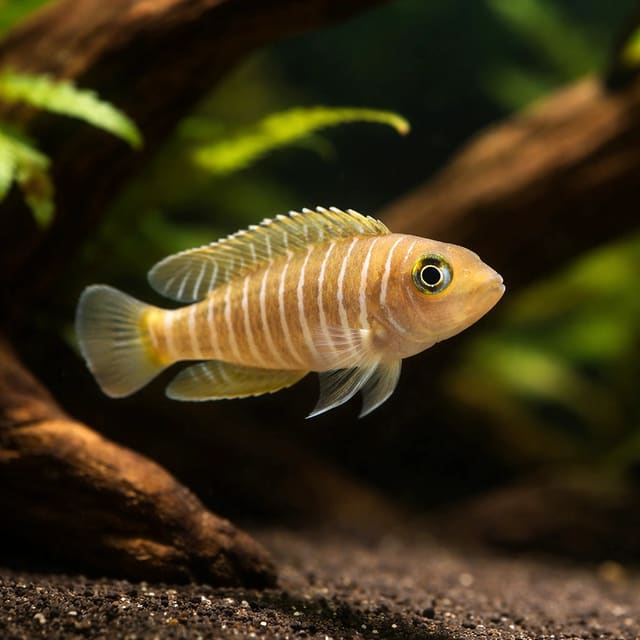
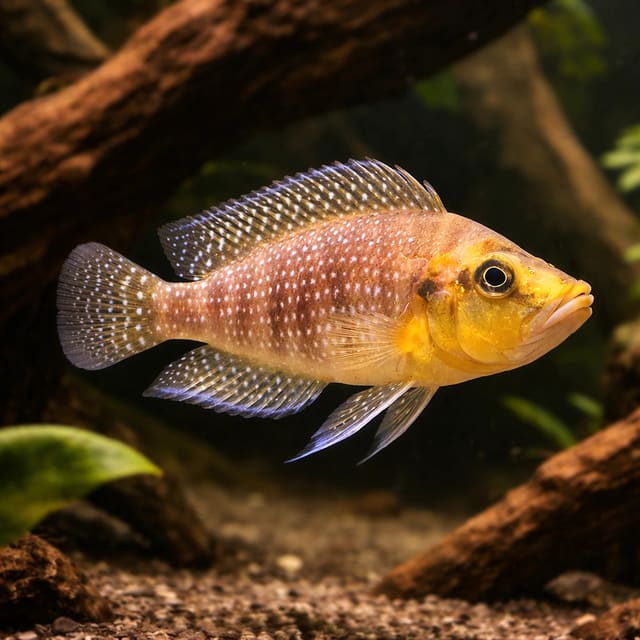
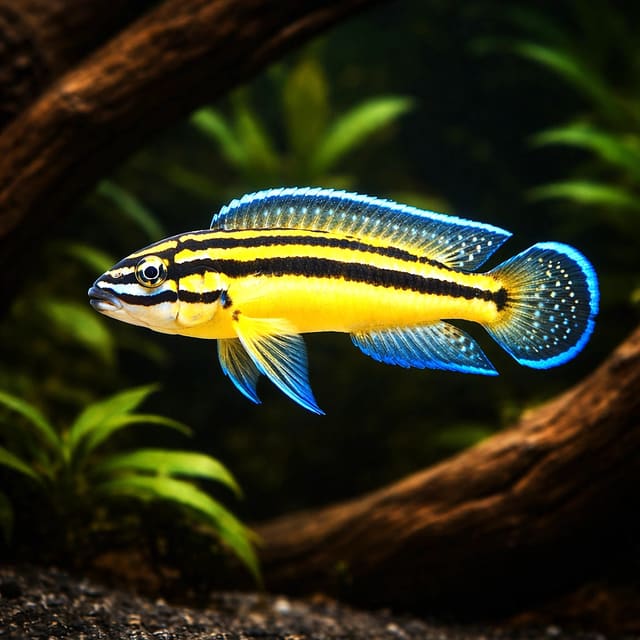
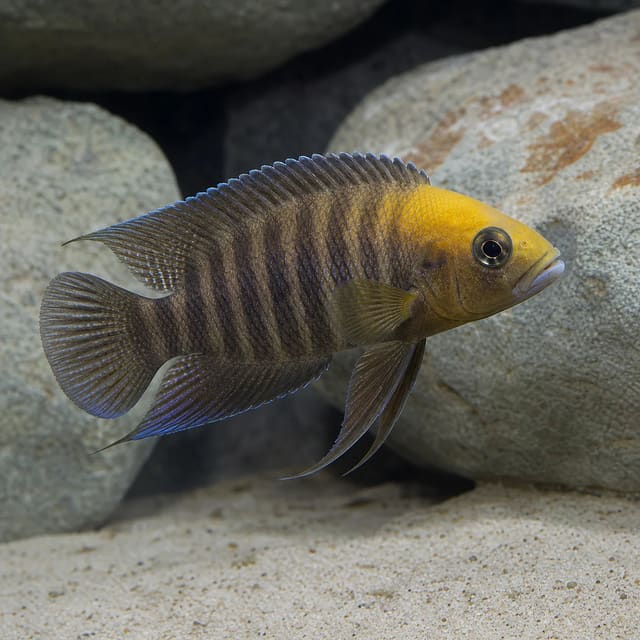
The single gallery image visibly shows one patterned cichlid in front of branching wood over a pale sandy substrate. It does not show planted aquarium foliage, establish the fish's sex or prove that the pictured animal is the exact specimen that will be sent.
This species suits a keeper who enjoys patient observation, careful water preparation and a restrained stocking plan. It is a poor fit for soft acidic community water, an immature filter, a small open tank without crevices, or a mixture chosen only because every fish is called an African cichlid. Prepare the biological filter and testing routine with the first tropical tank guide.
Check the aquarium as a complete system rather than looking only at litres. The base must provide room for secure rock zones, the filter must already process waste, and the source water must be suitable for a stable hard alkaline setup. Decide where a pressured fish could retreat, how detritus will be removed behind the rocks and how every inhabitant will receive food. These checks are especially important for a slow-growing juvenile because a short-term holding layout is not an adult plan.
Also plan for individual behaviour. This species can be quiet enough that exclusion shows as missed meals, prolonged hiding or loss of condition before obvious fighting appears. A spare established aquarium gives the keeper a practical response if two fish do not settle. Buying two does not remove the need for that contingency.
Browse the current African cichlid collection for other forms, but compare lake, water, adult size and diet before treating another cichlid as an alternative.
The scientific identity used here is Altolamprologus compressiceps in the family Cichlidae. FishBase describes the species as endemic to and widely distributed in Lake Tanganyika. The Gombe label is preserved because it is part of the supplier identity, while the accepted binomial remains the biological anchor for care.
FishBase gives a maximum of 12.3 cm total length for male or unsexed fish. Total length, or TL, includes the tail. The Seriously Fish profile gives 125 mm standard length, equal to 12.5 cm SL. Standard length stops at the base of the tail. Those figures come from different conventions and are not a 0.2 cm disagreement that needs averaging.
Use both records for honest planning: this is a substantial, deep-bodied cichlid even though the dispatch fish is only 3–5 cm. Males can become considerably larger than females according to the species profile, yet that adult dimorphism does not guarantee the sex of a juvenile. Do not use the shop size, fin extension or one image as a sexing shortcut.
The compressed body is important to husbandry because it allows the fish to work close to rock surfaces and enter narrow spaces. Judge usable shelter by the animal's depth and ability to turn, not only by the width of a cave entrance seen from the front. The shape also means length alone understates how substantial an adult can look and how much space it occupies around a refuge.
Keep the sale measurement and the biological records in their proper roles. The 3–4 cm and 4–5 cm choices describe the juvenile supplied. The 12.3 cm TL and 12.5 cm SL sources describe adult records under two measurement conventions. They are useful for long-term planning but do not predict the exact final length, growth rate or sex of one individual.
The accepted identity, endemic distribution and 12.3 cm TL record are available in the FishBase account. The 12.5 cm SL, aquarium dimensions and practical care figures come from the Seriously Fish species profile.
Seriously Fish recommends a minimum base of 120 × 45 cm, which it expresses as roughly 243 litres for a 120 × 45 × 45 cm aquarium. Footprint matters because the fish needs separated crevices and routes around the rockwork. A tall, narrow aquarium with the same nominal volume does not create the same territories.
That minimum is a starting point for the species profile, not spare capacity for unlimited companions. Subtract the space taken by rock foundations and consider where an adult can feed, turn and retreat. A larger footprint becomes increasingly valuable when more than a compatible pair is planned or when other rock-associated fish also need their own shelters.
Place stable base rocks directly on the tank base before adding sand, then build secure piles with crevices of different widths. This order reduces the risk of digging undermining a heavy structure. Every stone should remain stable when maintenance or a fish shifts substrate around it. Leave passages rather than forming a solid wall, and keep open sand where fish can move without being trapped between territories.
The body shape is adapted to narrow spaces, so crevices are more than decoration. They provide retreat, hunting surfaces and, for a mature female, possible spawning cavities. Spread refuges across the aquarium rather than creating one prized cave that every fish must contest. Opaque breaks and multiple entrances make it easier for a subordinate fish to leave another's sight.
For aquarium care, use 24–28°C, pH 8.0–9.0 and 7–25 dGH. These are the species-level ranges stated by Seriously Fish. Keep the chosen values stable and measure them; “hard alkaline” is a description, not a substitute for a thermometer and water tests.
FishBase lists an environmental record of 23–25°C, pH 6.5–7.5 and 8–12 dH. That database entry describes a different evidence scope from the aquarium profile. It should not be blended with the husbandry range into a supposedly more precise middle value. For the home aquarium, use the species-profile target above and acclimate the new fish gradually from its holding water.
Test the tap or prepared source water before adding buffers or mineral salts. KH supports resistance to sudden pH movement, while GH measures dissolved calcium and magnesium; neither can be inferred from pH alone. The water chemistry guide explains the measurements, and the water parameter matcher can compare your results with the stated range.
Water quality must be excellent. Use a mature biological filter, strong gas exchange and enough circulation to move waste out of rock crevices without turning the aquarium into a torrent. Complex rock piles can trap detritus, so place returns and siphon access before the structure becomes difficult to alter.
Seriously Fish treats weekly changes of up to 50% as mandatory for this species profile. Match replacement water closely for temperature and chemistry so a large change does not become a sudden shock. The percentage is paired with the word “up to”: use tests, feeding and stocking to set the working amount, while retaining a consistent weekly routine.
Ammonia and nitrite must remain at zero. The RSPCA explains that biological filtration converts toxic ammonia to toxic nitrite and then to the safer nitrate. Test the aquarium before adding livestock and whenever breathing, colour, appetite or behaviour changes. The general RSPCA aquarium guidance supports a filter-led, water-quality-first response.
Condition replacement tap water where chlorine or chloramine is present. Rinse filter media gently in removed aquarium water, never under the tap. Siphon debris from accessible sand without collapsing the fish's secure refuges.
Record temperature, pH and hardness before and after the first few substantial water changes. A brief log makes gradual drift visible and helps separate a chemistry problem from a territorial or feeding problem. It is more useful to reproduce a stable, measured routine than to chase a nominal ideal with repeated sudden adjustments.
Use each maintenance session to inspect the hidden parts of the layout. Check that the filter intake remains protected, the heater is unobstructed and no rock has shifted to create a trap. As the fish grows, a crevice that once served as a refuge may become too tight, so revise access carefully while keeping the whole structure secure.
In nature this species hunts invertebrates, crustaceans and smaller fishes among rocks. Seriously Fish cites a study in which shrimp made up more than 80% of the stomach contents of wild fish. That figure describes wild diet composition; it does not mean the aquarium should be fed one food exclusively.
Most captive fish accept suitable dried food, so use a quality small carnivore or cichlid pellet as a nutritional base. Add measured frozen or live foods such as Artemia, bloodworm, Tubifex, chopped prawn or small earthworms where appropriate and safe. Choose a food size the juvenile can swallow, and watch that it reaches the crevice-dwelling fish rather than disappearing into faster tank mates.
Variety means rotating suitable foods within a controlled plan, not combining every rich item at every meal. A complete prepared food supplies a consistent foundation, while invertebrate foods can encourage natural searching and provide texture. Increase particle size with growth, but continue to watch the fish swallow comfortably and keep fragments from accumulating inside the rockwork.
Do not use feeder livebearers or goldfish. The species profile notes parasite and disease risk and poor nutritional value unless feeders are properly conditioned. Suitable prepared and invertebrate foods deliver variety without deliberately introducing another fish as a disease vector.
Remove uneaten food before it decays among rocks. A rounded but not bloated body, steady growth and a reliable feeding response are more useful than pushing large portions. This species is reported to grow slowly, so avoid turning patience into chronic overfeeding.
Target feeding can help in a community. Deliver a modest portion close to the chosen refuge after faster fish have received theirs, then watch the compressiceps swallow rather than assuming food that vanished was eaten by it. Adjust particle size as the juvenile grows, but keep portions controlled so rich food does not undermine water quality.
Seriously Fish recommends a single pair as the usual arrangement and allows groups in larger aquaria. “Pair” means two compatible mature fish, not any two juveniles. Provide many separated refuges, observe feeding access and have another suitable aquarium ready if one fish is persistently excluded.
Mature males are described as considerably larger, with slightly extended fins. The listing nevertheless remains unsexed because those traits develop with maturity and can overlap. Ordering more than one animal does not create a sex ratio or a compatible pair guarantee.
Look for subtle pressure as well as chasing. A fish that is always last to feed, confined to one upper corner, unusually dark, clamped or losing body condition may be failing socially even if its fins are intact. Add visual breaks only when the structure can remain safe, and separate incompatible fish before chronic stress becomes injury.
Use appetite, breathing rate, posture, colour and refuge use as a daily baseline. A single unusual moment is less informative than a persistent change across several observations, but rapid breathing, loss of balance, visible sores or complete refusal of food deserves prompt attention. Test water first because poor chemistry can affect several fish at once and can make other treatments less safe.
Quarantine new companions where possible and do not share wet nets or siphons between systems without cleaning them. If treatment becomes necessary, identify the likely problem and confirm that any medicine is appropriate for the species and aquarium occupants. Avoid dosing a display tank merely because a fish is shy in a newly arranged territory.
Have the aquarium fully cycled, heated and chemically stable before delivery. Recheck that every rock is secure, the filter is moving water through the layout and small gaps cannot trap the arriving juvenile. Compare holding and aquarium water, then follow the current acclimation instructions rather than making an abrupt transfer between different chemistry.
Keep the room and aquarium calm during release. Confirm that the fish is breathing steadily and can enter and leave its chosen shelter, then observe from a distance. Offer a small suitable meal only when it is settled rather than leaving food to spoil because a newly arrived fish stays hidden.
Altolamprologus compressiceps can live in a carefully chosen Tanganyikan community, but “same lake” is only the first filter. Adult size, mouth size, refuge use, feeding method, protein needs and territory must all fit. Anything small enough to be considered food is unsuitable.
| Water | All inhabitants must thrive in stable hard alkaline Tanganyika conditions rather than merely tolerate them briefly. |
|---|---|
| Adult size | Avoid fish small enough to fit in the compressiceps' mouth, including small juveniles of otherwise larger species. |
| Diet | Do not mix with Tropheus or another low-protein specialist whose feeding plan conflicts with this carnivore's richer diet. |
| Territory | Each fish needs secure, separated shelter and a route away from neighbouring rock territories. |
| Feeding access | Fast open-water feeders must not prevent a slower crevice hunter from receiving appropriately sized food. |
A compatible pair is the most straightforward adult social plan. In a larger aquarium, a group can work when the rockscape provides multiple distinct refuges and the keeper watches for exclusion. A single dominant fish controlling every crevice means the layout or stocking plan has failed, even if no dramatic fight is seen.
Build more than one route between open water and shelter so a fish does not have to pass a dominant neighbour at every meal. Crevices at different heights and orientations can reduce competition, provided the construction remains stable. Count usable territories from a fish's perspective: several gaps inside one exposed pile may still function as a single contested resource.
Introduce fish with observation time available. Note which shelter each fish chooses, whether all animals emerge to feed and whether one remains dark, damaged or hidden. Moving decor can sometimes interrupt a claimed route, but secure rockwork should not be destabilised casually. Separation is the correct response when pressure continues.
Review the arrangement after growth spurts and whenever a new companion is considered. Compare the adult size and mouth size of both animals, then check whether they use the same feeding zone or refuge type. A fish can share the required water range yet still be unsuitable because it competes for every crevice or takes all food before the compressiceps emerges. Leave enough open sand to observe movement and enough access to remove waste without dismantling the territory at every water change.
The species varies in colour pattern by locality. Seriously Fish advises keeping populations apart and clearly labelled to avoid hybridisation. Preserve the Gombe label in records and do not mix locality forms for casual breeding. A locality name is useful husbandry information even when it does not prove that a shop fish was collected in the wild.
Keep the locality name with the fish if it is moved, rehomed or bred. Accurate records allow later keepers to make informed pairing decisions and prevent an attractive but uncertain cross from being presented as a known geographical form. This is record-keeping discipline, not a claim about the origin of the individual offered here.
This is a cavity-spawning cichlid. The female uses a rock cavity narrow enough that the male may not fit fully inside, and she guards the eggs during incubation. The male's role, the three-to-five-day incubation described by the species profile and the later free-swimming stage are biological context, not a breeding guarantee for an unsexed purchase.
Growth can be slow and sexual maturity may take a year or longer. Breeding increases the value of several secure cavities and reinforces why pair compatibility matters. Do not crowd a community around one spawning refuge or assume juvenile size predicts when reproduction will begin.
FishBase records 12.3 cm TL for male or unsexed Altolamprologus compressiceps, while Seriously Fish gives 12.5 cm SL. TL includes the tail and SL stops at its base, so the figures remain separately labelled rather than averaged.
Seriously Fish recommends a base of at least 120 × 45 cm, roughly 243 litres for a 120 × 45 × 45 cm aquarium. Footprint is essential because secure rock crevices and separated territories take space.
A compatible pair is the usual adult plan. Groups can be kept in larger aquaria with many separated rock refuges and close observation. Two unsexed juveniles are not guaranteed to be a pair, and this offer does not guarantee sex.
It is an intermediate choice for a keeper comfortable measuring hard alkaline water, building secure rockwork and managing carnivore feeding and territory. It should not be added to an immature aquarium or chosen as a general community fish.
Use an appropriately sized quality carnivore or cichlid pellet, with measured frozen or live invertebrate foods such as Artemia, bloodworm or chopped prawn for variety. Do not use feeder fish, and remove food trapped among rocks.
For aquarium care use the Seriously Fish species-profile range: 24–28°C, pH 8.0–9.0 and 7–25 dGH. Keep the chosen values stable, with zero ammonia and nitrite and closely matched replacement water.
It is a predatory rock cichlid rather than a routine fin-nipper. A pair is not described as strongly territorial in the species profile, but individuals still need secure refuges, feeding access and room to avoid one another.
Use only carefully chosen Tanganyikan fish that share its hard alkaline water, are too large to swallow and can hold their own without dominating food or caves. Avoid prey-sized animals and Tropheus or other low-protein specialists.
Tropical Fish Co hand-packs live fish in oxygen with an insulated box and a heat pack when conditions call for it, then uses a licensed live-animal courier. For a Live Arrival Guarantee claim, film continuously from the sealed parcel to the fish still in its bag and contact the store the same day.
See the current delivery and Live Arrival Guarantee page for the full conditions and arrival steps.
The principal care source is species-specific, while the broader welfare material is used only for general filtration and water-quality practice.
The OATA Malawi-cichlid sheet in the research packet is not used to set care for this Lake Tanganyika species. Its lake, group and stocking assumptions do not replace the available species profile.
Independently collected by Judge.me from customers who bought this item. All reviews are shown.
Impressed lovely fisg