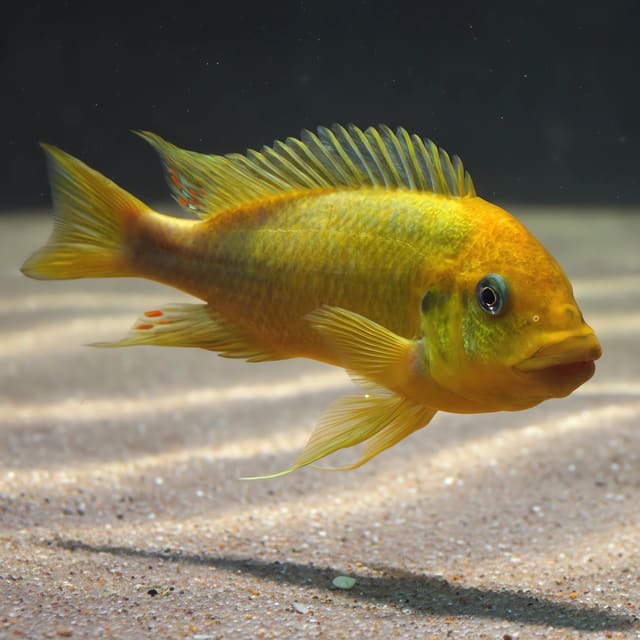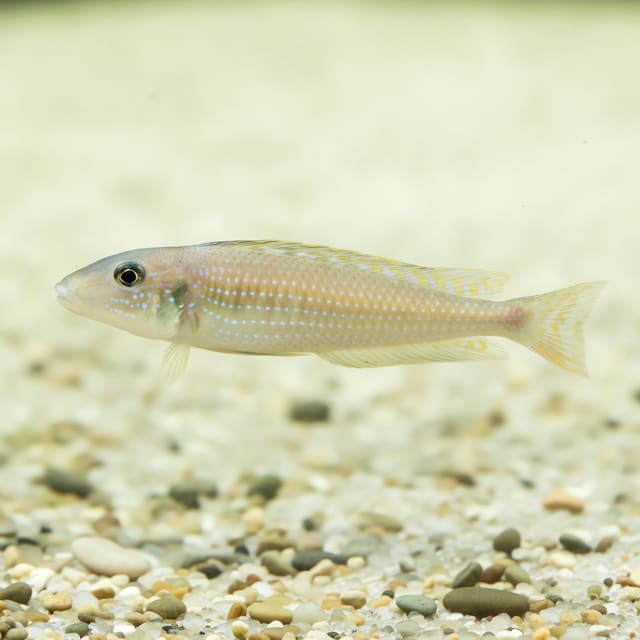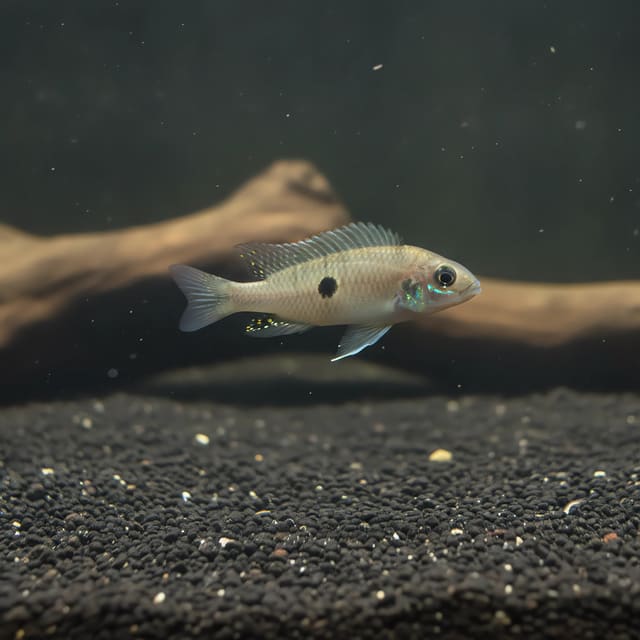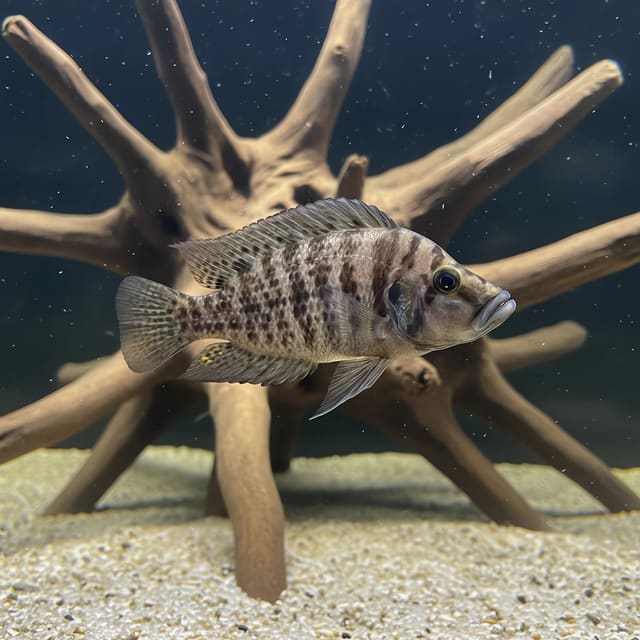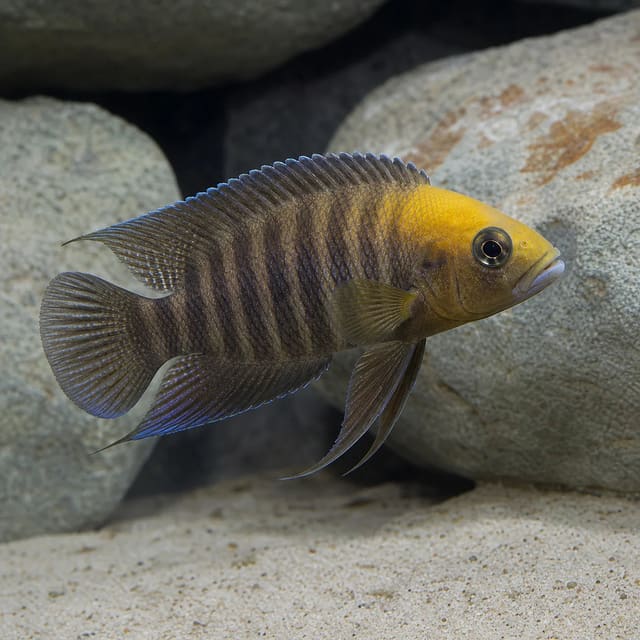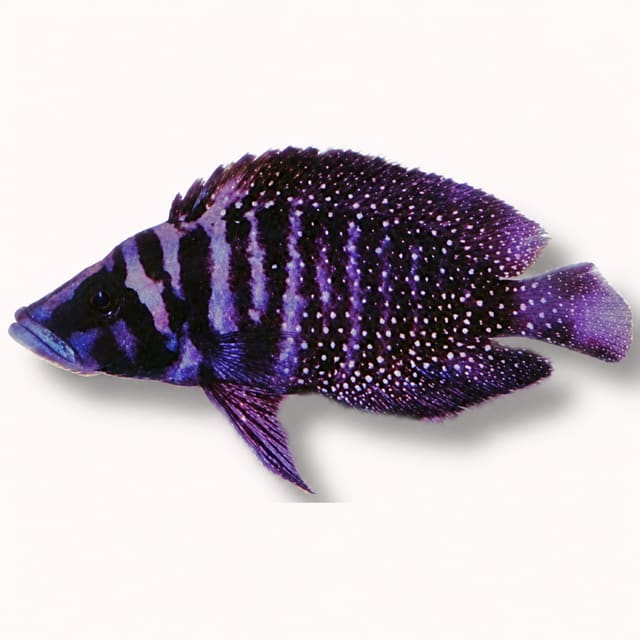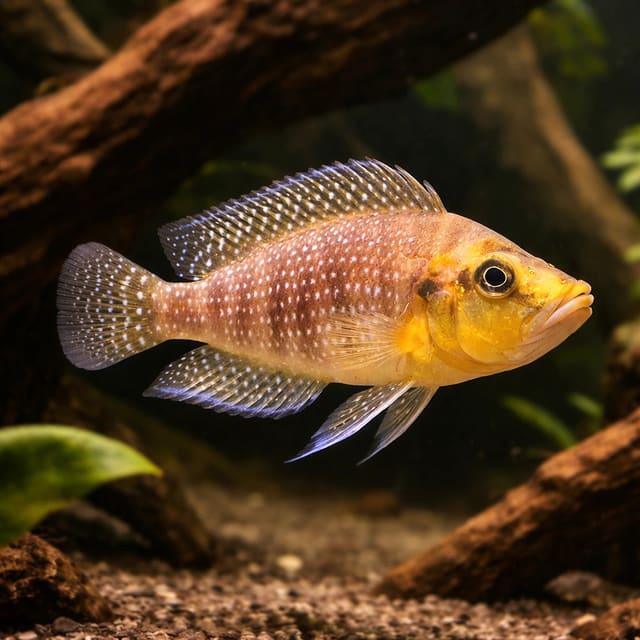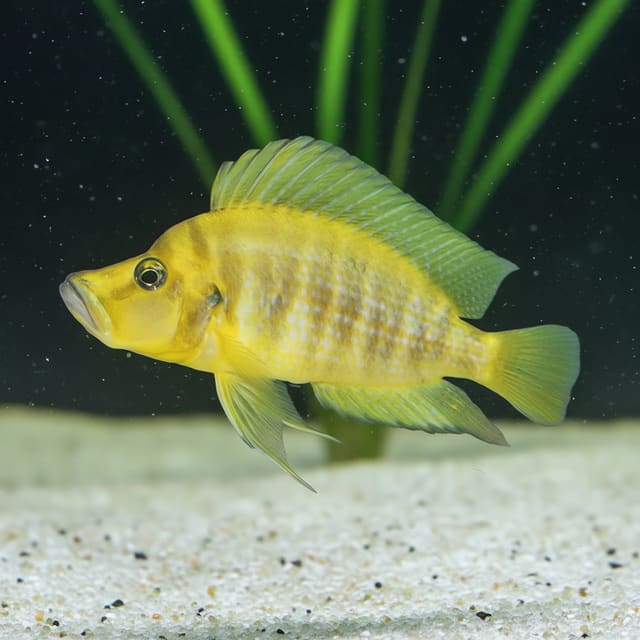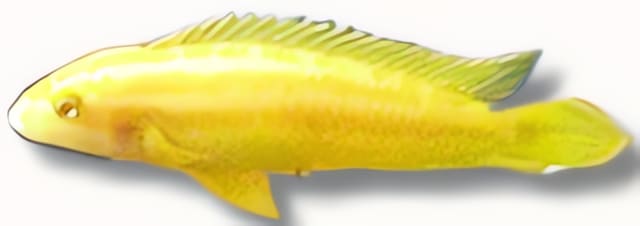
Albino Yellow Ornate Julie (Julidochromis ornatus)
23–24°C · pH 8–9 · 70L
£18.99
Black Calvus (Altolamprologus calvus) is a laterally compressed Lake Tanganyika cichlid supplied as one fish in the selected 5–6 cm or 6–7 cm dispatch size. It needs hard alkaline water, cave-rich rockwork, deliberate territories and calm tankmates too large to swallow.
Altolamprologus calvus
Save when buying multiple fish. Each quantity is one fish; sex and pair formation are not guaranteed unless the selected variant explicitly states them.
Black Calvus (Altolamprologus calvus) is a laterally compressed Lake Tanganyika cichlid supplied as one fish in the selected 5–6 cm or 6–7 cm dispatch size. It needs hard alkaline water, cave-rich rockwork, deliberate territories and calm tankmates too large to swallow.
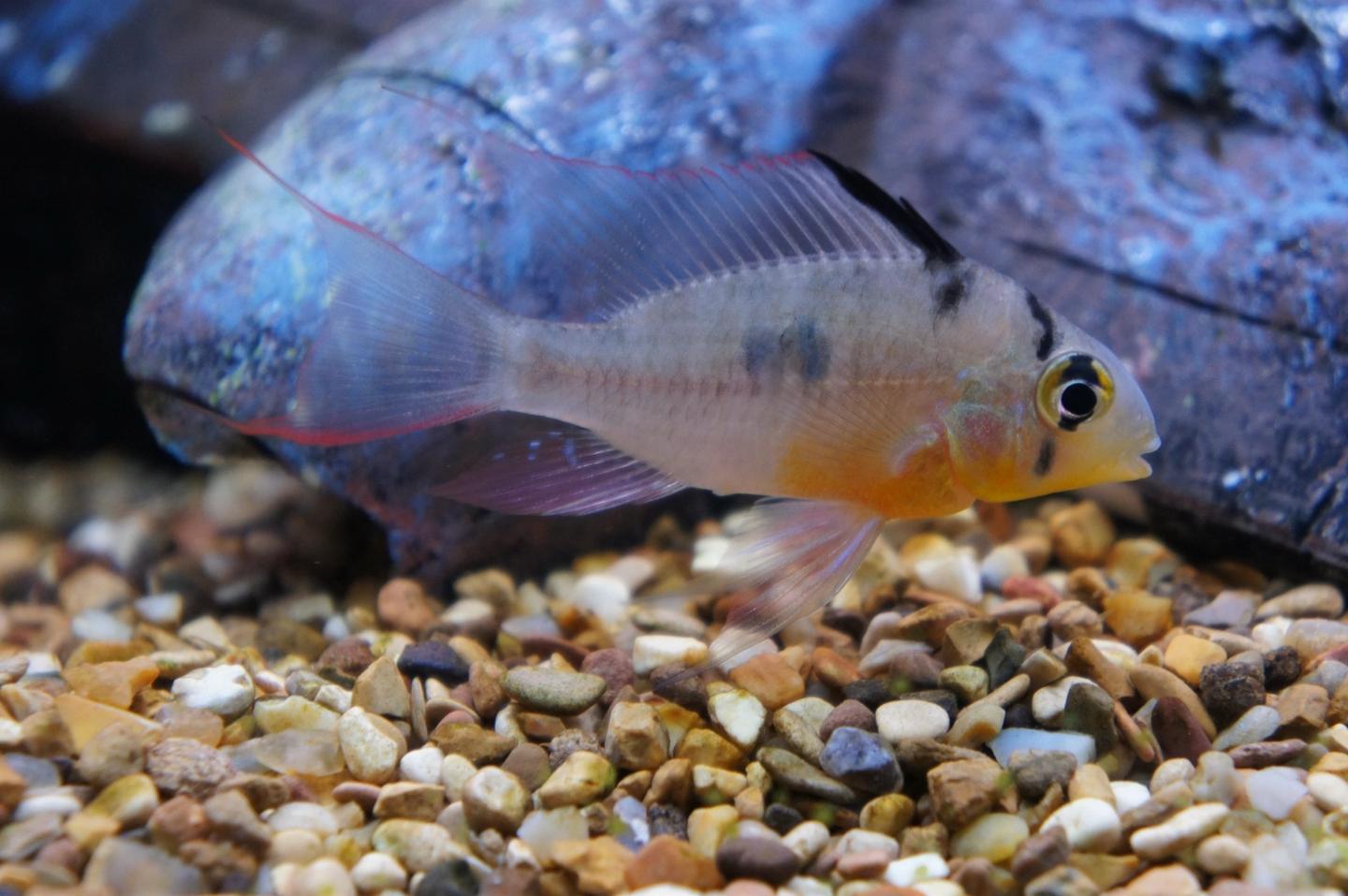
Cichlids are a family of roughly 1,800 accepted species, not one care type. Before buying, identify the exact species and source, then compare adult measurement, usable tank dimensions, social system, territory, tested water, diet and an exit plan. No family-wide minimum tank, water range or tank-mate list is safe.
Maintain these water conditions for optimal health and vibrant colors
Black Calvus is the dark aquarium form of Altolamprologus calvus, a specialised cichlid endemic to Lake Tanganyika. One purchase supplies one live fish in the chosen 5–6 cm or 6–7 cm dispatch size. The size you select is the size supplied, not the adult size. Published adult records describe 13.5 cm total length (TL) and 138 mm standard length (SL). Those measurements use different endpoints, so keep each value with its own measurement basis rather than merging them into a single maximum.
This is a deep-bodied, laterally compressed predator adapted to work around crevices and rock faces. It is not an all-purpose community cichlid. A suitable aquarium provides hard alkaline water, extensive stable rockwork, narrow retreats, dimmer areas and enough floor space to separate territories. Its deliberate stalking behaviour and shy side also matter: aggressive, hectic fish can keep a calvus hidden even when water chemistry appears compatible.
| Suits | Think again when |
|---|---|
| An established Lake Tanganyika aquarium with hard alkaline water and secure caves | The aquarium is soft and acidic, newly set up or built around vigorous Mbuna |
| A keeper prepared to feed meaty frozen or live foods and observe whether prepared food is accepted | The plan depends on a universal dry-food diet |
| A carefully planned pair, colony or calm Tanganyikan community with separated territories | Small fish, fry or crustaceans are expected to be safe because the calvus looks shy |
Sex is guaranteed only when the selected option explicitly states male or female. This Black Calvus, Pearly Compressiceps listing has no sex-guaranteed option. Do not infer sex from the selected dispatch size, fin length or the gallery.
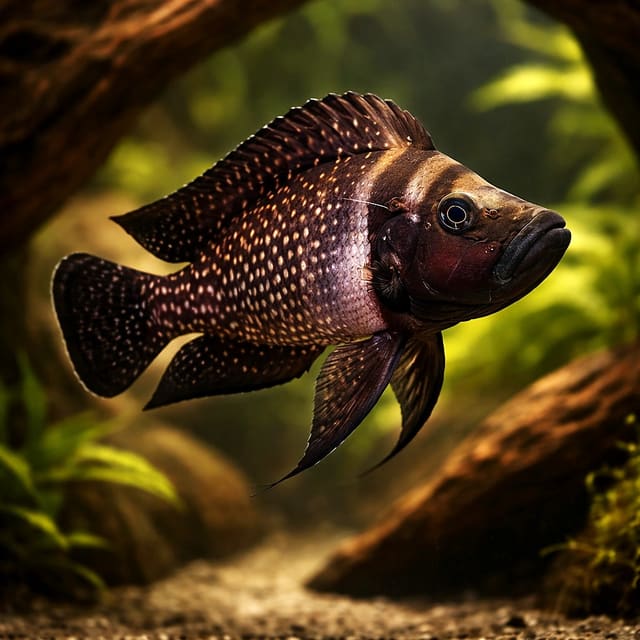
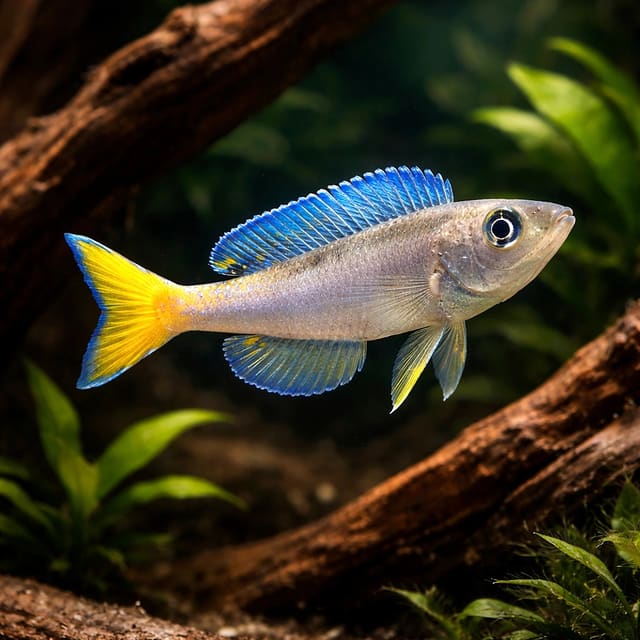
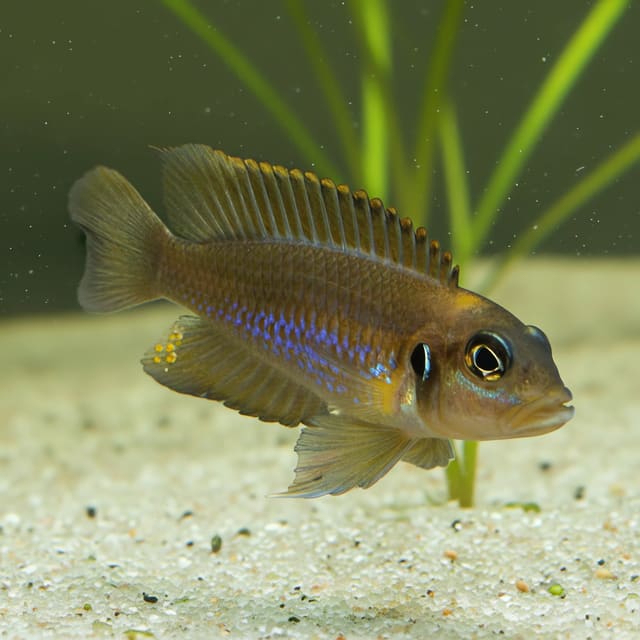
Gallery images have been digitally enhanced to improve image quality. Natural colour, pattern, size and maturity can vary between live animals.
Choose Black Calvus for its distinctive outline, patient movement and rock-dwelling behaviour, not merely for the word “black”. Several geographic colour forms of A. calvus occur in the hobby. They share species-level care, while their colour labels do not prove a locality, lineage or exact future appearance. Different forms should not be mixed for breeding because the specialist profile warns against hybridising the colour forms.
Routine aquarium planning can use the conservative overlap between the FishBase environmental record and the Seriously Fish aquarium profile: 24–25 °C, pH 8–9 and 9–19 dGH. Those values describe a hard, alkaline Tanganyikan direction. Stability and gradual matching remain more useful than driving the aquarium rapidly towards an exact number.
No single litre number completes the space decision. Plan a generous footprint around both published adult records—13.5 cm TL and 138 mm SL—while keeping their measurement bases distinct. Allow for the volume displaced by extensive rockwork, the territories needed by a pair or colony, and the adult size and behaviour of every companion. Rocks must be placed securely so digging or maintenance cannot destabilise them.
If you are comparing this fish with other African cichlids, the African cichlid collection shows the live range. It is a browsing route, not a compatibility list: water overlap alone does not make Mbuna or another cichlid a suitable tankmate for Black Calvus.
This fish should join an aquarium that already holds its planned temperature and hard alkaline chemistry, not one that will be adjusted after arrival. Rockwork, filtration, suitable foods and a social fallback need to exist before the order. If the household cannot maintain those foundations or provide another suitable space when aggression develops, a less specialised fish is the better decision.
Use stable piles of aquarium-safe rock to create caves, cracks and visual barriers through much of the aquarium. A calvus uses its narrow profile to investigate spaces that deeper-bodied fish cannot enter. Provide several retreats of different widths so the fish can choose a secure position without being trapped. Test every structure for movement before filling the aquarium, and support heavy rocks safely rather than balancing them on loose substrate.
A dark substrate can show the black form well and dimmer lighting may encourage the fish to remain visible. These are presentation and confidence benefits, not reasons to neglect maintenance access. Leave clear routes for siphoning debris and enough open water for feeding. Rock faces should not form dead pockets where uneaten meaty food accumulates.
The published adult records are 13.5 cm total length (TL) and 138 mm standard length (SL). The two methods use different endpoints, so neither figure should be converted into one unqualified maximum. Keep both labelled, distinguish them from the dispatch grades and add the space occupied by decor and the territories required by every adult occupant before choosing the aquarium.
A pair can be maintained, and the specialist profile also allows a colony in a suitably sized tank. “Colony” is not permission to crowd juveniles and hope they sort themselves out. Provide more retreats than the number of fish, broken sight lines and a way to remove an animal if aggression becomes persistent. If fish are being grown with the aim of forming a pair, plan for the individuals that do not pair.
Establish the biological filter before livestock arrives. Ammonia and nitrite must remain at zero; nitrate, pH and hardness need regular measurement in the context of the whole aquarium. The RSPCA explains why a working biological filter is central to processing fish waste, while general OATA guidance recommends regular tests and gradual stocking.
Surface movement should support gas exchange without turning the aquarium into a high-velocity environment. Calvus are deliberate rock-associated fish, and very boisterous conditions can reduce feeding confidence. Choose filtration for the real water volume and stocking, then diffuse the outlet if necessary while preserving biological capacity.
For a first aquarium, complete the cycling and equipment checks described in the first tropical tank guide before considering this specialised Tanganyikan cichlid.
FishBase records 23–25 °C, pH 8–9 and 9–19 dH for the species' environment. Seriously Fish gives an aquarium range of 24–27 °C, pH 7.5–9 and 8–20 dGH. For routine planning, 24–25 °C, pH 8–9 and 9–19 dGH sit inside both. The overlap is intentionally conservative; it does not define a survival boundary or prove that every value within it is equally suitable for every individual.
Measure the actual aquarium rather than assuming that UK tap water has one chemistry. The water-chemistry guide explains the core tests, and the water matcher can compare readings with the intended plan. If source water differs greatly, design a repeatable preparation method before buying the fish instead of making abrupt corrections after arrival.
Hard alkaline systems need dependable buffering, but adding products without measurement can overshoot the goal. Test pH and hardness before and after any method is introduced, and learn how the chosen substrate and rocks affect the water over time. Match new water for temperature and chemistry during partial changes. Sudden shifts can be more disruptive than a stable reading near one end of the planned range.
Use a dechlorinator appropriate for the local supply. Domestic softeners and some household filters can alter mineral balance, so test water after treatment. Keep written records of pH, hardness, temperature, nitrate and maintenance dates; trends reveal more than a single isolated reading.
A mature aquarium is a working biological system, not simply an older container of water. Keep filter bacteria, water preparation, feeding and stocking aligned. If water values begin to drift, identify the cause before applying another additive.
In Lake Tanganyika, Altolamprologus calvus feeds mainly on shrimps and other crustaceans and is adapted to stalk around rockwork for eggs, fry and small fish. In the aquarium, the specialist profile says meaty live and frozen foods are readily accepted. Offer a varied rotation of appropriately sized items rather than relying on one food.
Some calvus do not readily recognise dried products. A quality prepared food can be offered, but acceptance should be observed rather than promised. Remove anything the fish ignores before it lodges in a crevice and decomposes. Feed so the calvus has time to approach the food; fast surface feeders may take every item before a shy fish commits.
Food size, water temperature, age and body condition affect intake. Follow the maker's directions where a complete prepared product is used, then watch the fish's abdomen and response. A varied diet does not mean an unlimited one. Uneaten protein-rich food can deteriorate water quickly, especially in complex rockwork.
Use feeding as a daily health check. A fish that normally stalks and takes food but suddenly hides, spits repeatedly or breathes faster warrants a temperature and water-quality check. Changes after new livestock, maintenance or equipment failure provide useful context; a single symptom does not identify a disease.
A treatment selected from appearance alone can miss the real cause and may disrupt the biological filter. Correct urgent water-quality problems, preserve a clear history and avoid combining medicines without qualified guidance.
Complete the aquarium, establish the filter and verify hard alkaline water before delivery day. Someone must be present to receive live fish. Tropical Fish Co hand-packs in pure oxygen and insulated packaging, adds a heat pack when conditions call for one, and uses a licensed live-animal courier with a confirmed delivery date.
Read the current terms and contact route on the delivery and Live Arrival Guarantee page. The guarantee process and acclimatisation steps work only alongside a mature aquarium that is ready before the parcel is opened.
Black Calvus is territorial, yet the specialist profile describes it as generally peaceful towards fish too large to fit in its mouth. That sentence has two equally important parts. A calm adult Tanganyikan fish may coexist, while fry, tiny fish and small crustaceans remain potential prey. Do not use shy behaviour as proof that a small animal is safe.
Mbuna and other aggressive or very active tankmates can intimidate calvus and interfere with feeding. Similar A. calvus colour forms should not be combined for breeding, and care is needed with the congener A. compressiceps. Build territories with rockwork and sight breaks, then observe whether each fish can feed and rest without being displaced.
| Decision | Practical rule |
|---|---|
| Avoid | Mbuna, aggressive or very vigorous fish, swallowable animals, fry, and other calvus colour forms where breeding could mix them |
| Use caution | Any territorial cichlid, any animal competing for the same caves, and colonies without ample separated retreats |
| Consider after full screening | Calm Tanganyikan genera named by the species profile, including Julidochromis, Neolamprologus, Cyprichromis and Tanganyikan Synodontis, where water, size and behaviour align |
A pair or colony needs a larger and more structured plan than one fish. Watch access to food, cave possession, torn fins, hiding and breathing. Have a separate suitable aquarium ready before experimenting with social combinations; removing a victim after severe aggression is not a substitute for contingency planning.
Black Calvus often moves deliberately between rock faces and retreats. Dimmer areas and secure caves can make it more confident, while a bright open aquarium may keep it hidden. Hiding by itself is not a diagnosis; compare the duration, feeding response, breathing and posture with this individual's established routine.
Observe from a distance before approaching the glass. A calvus that feels secure may watch the room from the edge of a cave, stalk slowly along a rock face and emerge when food enters. Repeated dashing, refusal to leave one retreat, rapid breathing or loss of feeding response can point to water, aggression, excessive activity or illness and deserve investigation.
A rock pile is useful only when each fish can occupy it without being trapped or constantly displaced. Watch which caves are used, whether one fish guards every entrance and whether subordinate fish can cross the aquarium to feed. Add or rearrange secure structures only after considering stability; a rushed change can remove the sole refuge of a timid animal or create a dangerous collapse.
Visual barriers work best when they divide real routes rather than simply adding clutter. Place them so a fish can leave a dispute and settle out of view. Keep open feeding areas and maintenance access, and make sure filter flow reaches behind structures well enough to limit stagnant debris pockets.
The compressed body and narrow head help A. calvus investigate crevices for eggs, fry and small prey. That is normal biology, not misbehaviour. It does mean that a fish which ignores larger tankmates can still hunt newly hatched fish or small crustaceans. Do not use a quiet first week as a guarantee for future prey safety.
Likewise, a calvus may be peaceful towards a robust adult fish yet lose condition because it is outcompeted at every meal. Community success includes feeding access, rest and normal movement, not just the absence of visible wounds. Deliver food where the calvus can approach it and confirm that it actually eats.
When appetite, breathing, colour, posture or swimming changes, confirm temperature and test ammonia, nitrite, nitrate and pH first. Review the most recent water change, feeding, new animals, rockwork disturbance and filter maintenance. Look for aggression at different times of day rather than assuming a hidden fish is ill.
Water correction can be urgent without proving a disease. Avoid stacking medicines or increasing temperature from a guessed diagnosis. A clear timeline, measured water results and photographs of a developing sign give an experienced aquatic professional a better starting point than a symptom label alone.
Leave a responsible carer with pre-measured food, written equipment checks and the normal temperature and test results. Show them how the fish behaves when well and which signs require contact. A hidden calvus can be missed by someone who only drops food at the surface, so the carer should confirm that the fish appears and eats without dismantling its refuge.
The retail options do not guarantee sex, and the typical adult differences described in care literature are not a promise that a juvenile can be sexed from a photograph or dispatch size. If the long-term aim is a pair, be prepared for fish that do not form a compatible bond and maintain another suitable aquarium.
During courtship, the female uses a cave entrance narrow enough to exclude the larger male. That behaviour explains why varied crevice sizes matter, but breeding instructions are not the purpose of this sales listing. The practical lesson is to provide retreats that differ in width and to prevent one large fish from controlling every usable shelter.
Each additional calvus adds another territory, feeding position and possible conflict. Increase the footprint and the number of separated rock zones rather than simply adding caves to one contested pile. Introduce no colony without a removal plan and enough mature filtration for the final adult group.
Observe whether all fish feed and whether one remains pinned to the surface, a corner or an exposed area. Move an animal before chronic pressure becomes injury or severe weight loss. A colony that appears calm at a smaller juvenile size may change as fish mature and territories become more valuable.
The black form is one of several colour forms in the hobby. The specialist profile advises against allowing different calvus forms to hybridise. It also distinguishes A. calvus from A. compressiceps, so the vernacular phrase “Pearly Compressiceps” should not be read as permission to mix the two species or to replace the accepted name.
When choosing companions, start with the accepted identity, adult size, hard alkaline water and the fish's use of caves. A similar sales category is not enough. This is also why the related-product field remains empty: the supplied Mbuna candidates would make a misleading relationship for a fish whose care profile specifically warns against vigorous Mbuna.
Before ordering, run the aquarium long enough to confirm that the heater, filter and water-preparation method work together. Test the finished aquarium rather than the tap alone, because rock, substrate and maintenance can change its chemistry.
This checklist turns the attractive adult photograph into a practical welfare decision. If one item fails, finish the preparation first rather than expecting the fish to endure the experiment.
FishBase records 13.5 cm total length (TL), while Seriously Fish reports 138 mm standard length (SL). Those measurements use different endpoints, so keep each figure with its label instead of combining them into a single adult maximum. Both are distinct from the dispatch sizes.
Choose a spacious footprint that can hold extensive stable rockwork, several secure retreats and separated territories, using the 13.5 cm TL and 138 mm SL records as distinct adult planning references. Scale the aquarium to a single fish, pair or colony and to every adult tankmate rather than relying on one generic litre number.
The species profile allows one established pair, meaning two fish, or a colony in a suitably sized aquarium. Provide more retreats than fish, broken sight lines and a separate plan for individuals that do not settle together.
It is better for a prepared keeper comfortable with hard alkaline water, mature filtration, secure rockwork, meaty foods and territorial cichlid behaviour. A new or soft-water community aquarium is a poor starting point.
Use appropriately sized meaty frozen or live foods as the main diet and offer a quality prepared food only when the fish accepts it. Vary the foods, allow a shy fish time to feed and remove leftovers from the rockwork promptly.
Use 24–25 °C, pH 8–9 and 9–19 dGH as a conservative overlap between the species' environmental record and aquarium profile. Keep the values stable and match new water gradually.
It is territorial but generally peaceful towards fish too large to swallow. Problems are more likely around caves, prey-sized animals or vigorous tankmates; Mbuna and other aggressive, hectic fish should be avoided.
Consider only calm Tanganyikan fish with matching water, suitable adult size and different enough behaviour or space use. The species profile names Julidochromis, Neolamprologus, Cyprichromis and Tanganyikan Synodontis as examples, but each combination still needs room, territories and a separation plan.
Tropical Fish Co hand-packs live fish in pure oxygen and insulated packaging, adding a heat pack when weather calls for one, and uses a licensed live-animal courier. Be present, record continuous unboxing from the sealed parcel, inspect the fish in the bag and contact the store the same day with the video and order number if a claim is needed.
FishBase documents the accepted identity, family, Lake Tanganyika distribution, environmental values, wild feeding behaviour and 13.5 cm total-length record. The Seriously Fish species profile provides the aquarium range, 138 mm standard-length record, rock habitat, diet, pair-or-colony plan and conditional Tanganyikan compatibility.
The OATA freshwater aquarium guide covers filter maturation, testing, maintenance and gradual stocking at a general freshwater level. The RSPCA aquarium environment guide explains the welfare role of established biological filtration. These general publications support the routine, while the species profile owns the calvus-specific detail.
No reviews for this item yet. Bought one? Honest reviews only, good or bad.
What customers say about ordering from us
Easy website plenty of info on fish your buying great to pick a time slot
TRACEY DURRANT · 7 Oct 2026
Got some lovely fish thank you
Kevin Mackie · 7 Oct 2026
Reviews of our shop, collected by Judge.me, an independent third-party review collector. Newest first.