−13%
Moderate
Gold Ocellatus Shell-Dweller (Neolamprologus ocellatus)
23–25°C · pH 8–9
£17.39£19.99

Photo coming soon
The size, price and care details on this page are for this listing.
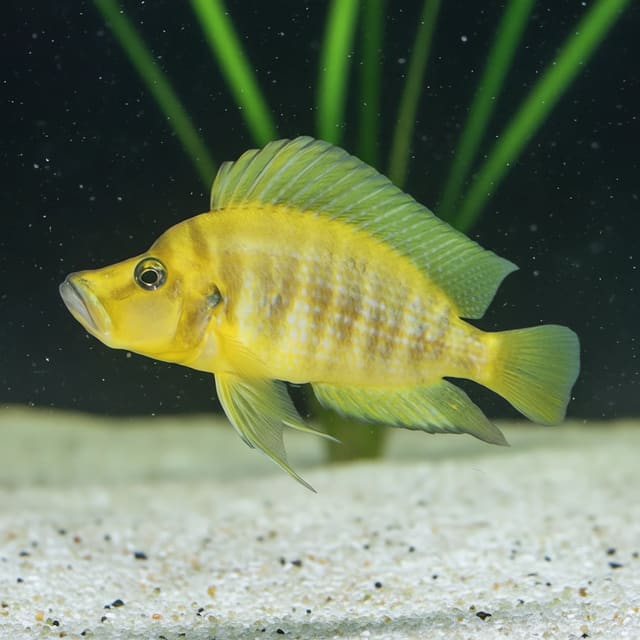
The Gold Compressiceps (Altolamprologus compressiceps) is a Lake Tanganyika cichlid that reaches 12.5 cm. It suits intermediate keepers planning a pair in around 243 litres; use the FishBase, Seriously Fish and OATA overlap of 24–25°C and 12 dGH, with the Seriously Fish/OATA pH overlap of 8.0–8.6. Sold individually at a dispatch size of 3–4 cm.
Altolamprologus compressiceps
Save when buying more.
The Gold Compressiceps (Altolamprologus compressiceps) is a Lake Tanganyika cichlid that reaches 12.5 cm. It suits intermediate keepers planning a pair in around 243 litres; use the FishBase, Seriously Fish and OATA overlap of 24–25°C and 12 dGH, with the Seriously Fish/OATA pH overlap of 8.0–8.6. Sold individually at a dispatch size of 3–4 cm.
Maintain these water conditions for optimal health and vibrant colors
The Gold Compressiceps (Altolamprologus compressiceps) is a freshwater cichlid from Lake Tanganyika in Africa, where it is endemic and widely distributed. FishBase places it in the Cichlidae family and records a maximum adult length of 12.3 cm. It suits an intermediate keeper who can provide a spacious, mature aquarium, stable hard and alkaline water, secure rockwork and a carnivorous diet.
This is a specialised predator rather than a general mixed-community fish. Seriously Fish describes a natural diet based mostly on invertebrates, crustaceans and smaller fishes. Its elongated mouthparts help it reach into cracks and crevices between rocks, so the aquarium should support that feeding behaviour with complex structure and carefully screened companions.
Keep the temperature at 24–25°C and general hardness at 12 dGH. These figures are the overlap of FishBase, Seriously Fish and OATA. Keep pH at 8.0–8.6, the aquarium overlap of Seriously Fish and OATA. OATA’s African lake cichlid sheet is group guidance, not a species-specific optimum.
| Suits | Not suited to |
|---|---|
| An intermediate keeper prepared to manage hard, alkaline water | An aquarium where temperature and water chemistry fluctuate |
| A pair plan with a 120 × 45 cm base or equivalent | A community containing animals small enough to be food |
| A well-chosen Lake Tanganyika community | Tropheus or other fish requiring a low-protein diet |
| A mature aquarium with secure rock structures | An unfiltered or newly established aquarium |
Browse our African cichlid collection when comparing aquarium plans, but assess every proposed companion against the compatibility rules below.
Plan for an adult length of 12.3 cm from the beginning. Seriously Fish separately lists 12.5 cm standard length, but use the FishBase figure of 12.3 cm consistently for this fish’s adult-size planning. Neither adult figure describes the size dispatched.
Provide minimum base dimensions of at least 120 × 45 cm or an equivalent footprint. Seriously Fish associates that footprint with approximately 243 litres. Floor area matters because the layout needs extensive rock structure, crevices and open access for maintenance without reducing the aquarium to a narrow route through unstable décor.
A tall aquarium with a restricted base is not an equivalent substitute merely because its stated volume is similar. Compare the actual base measurements first, then check that the resulting water volume remains close to the species plan after substrate and rocks are installed.
For example, an aquarium with the required 120 cm length but only 35 cm front-to-back depth misses the stated minimum depth. Likewise, a nominal 243-litre aquarium should still be rejected if its shape does not provide a 120 × 45 cm base or an equivalent footprint. Build the adult environment before the fish arrives so growth never forces a hurried move.
One purchase supplies one Gold Compressiceps at a dispatch size of 3–4 cm. This is the size of the fish when supplied, not its adult size; plan the permanent aquarium around 12.3 cm and the minimum 120 × 45 cm footprint.
Sex is guaranteed only when the selected option explicitly states male or female. This Gold Compressiceps listing has no sex-guaranteed option.
Do not assume that two unsexed fish will form the pair recommended for long-term maintenance. A social plan should allow you to observe how the fish settle and separate incompatible individuals if necessary. A larger group is possible only in a larger aquarium, and the number should be decided from the actual footprint, rock arrangement and observed interactions rather than from the dispatch size.
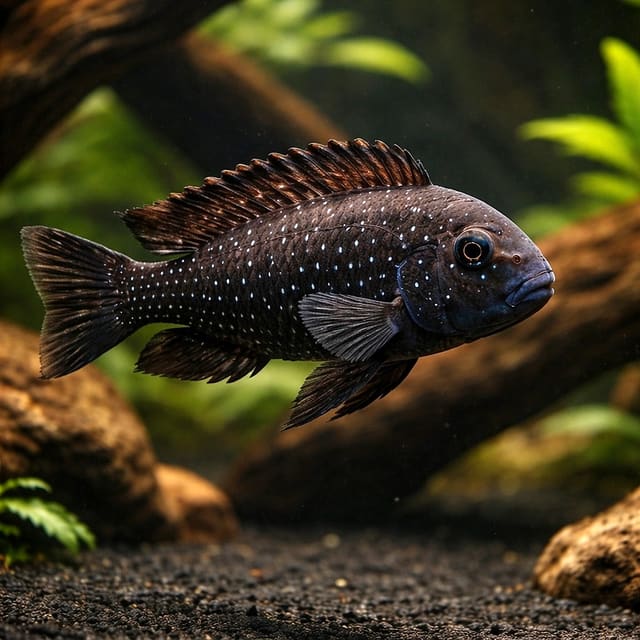
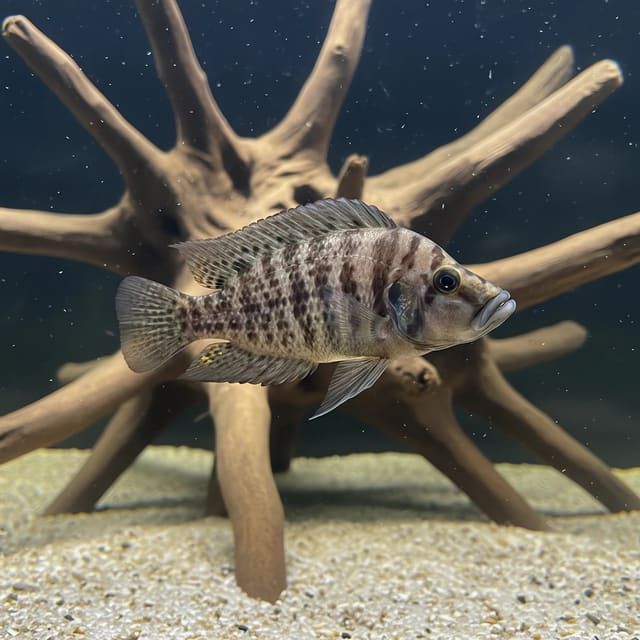
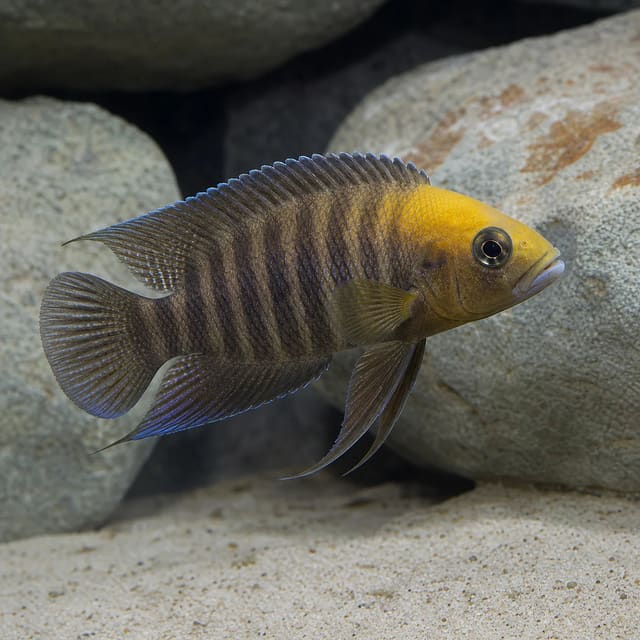
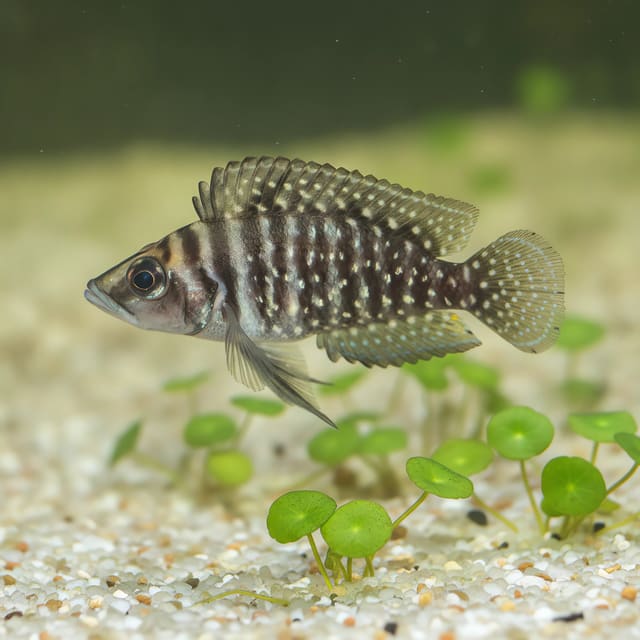
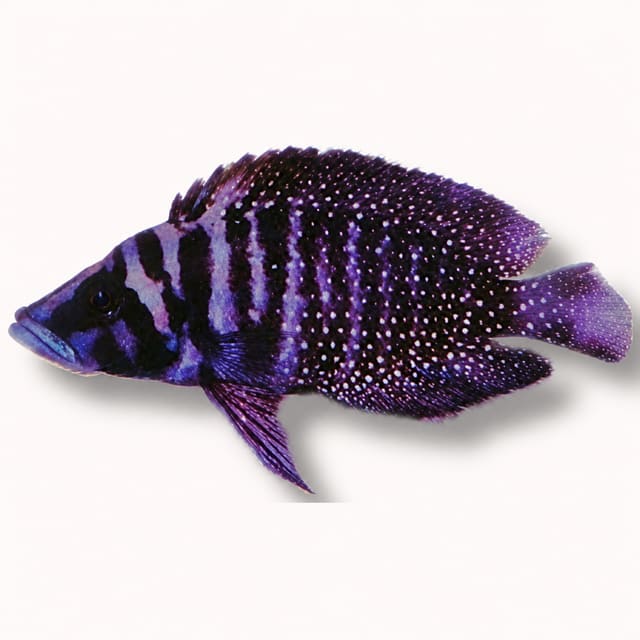
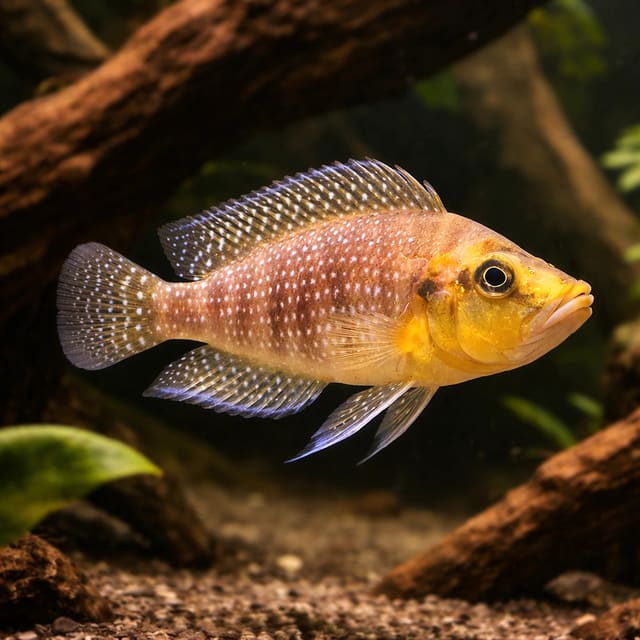
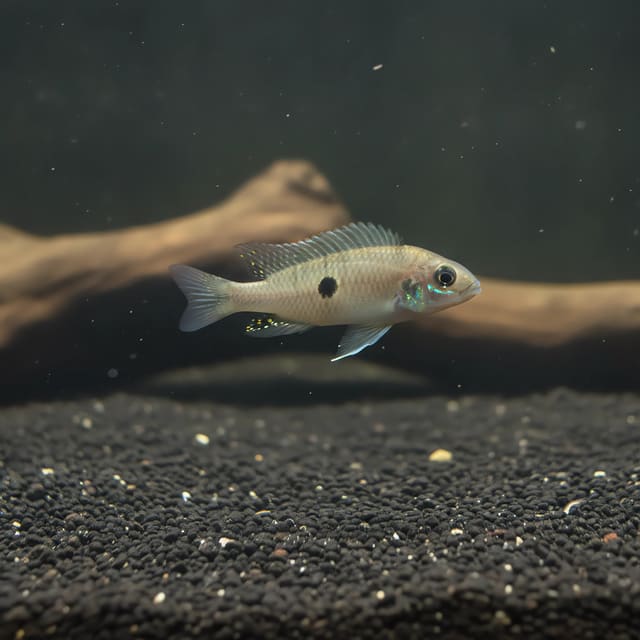
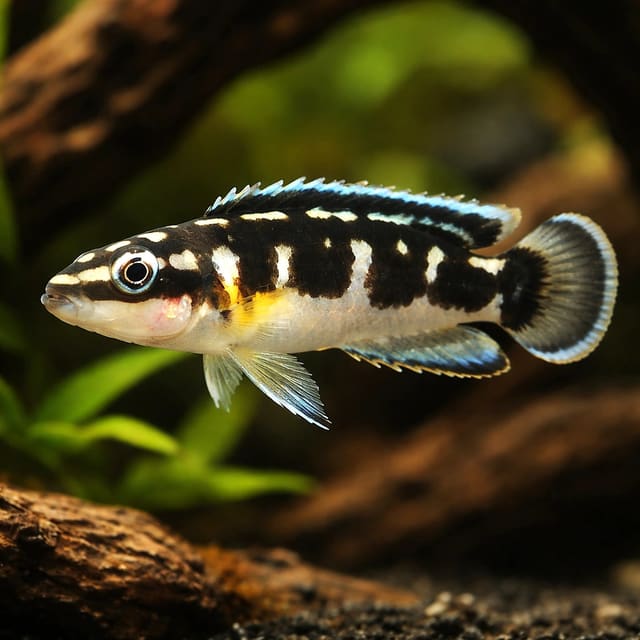
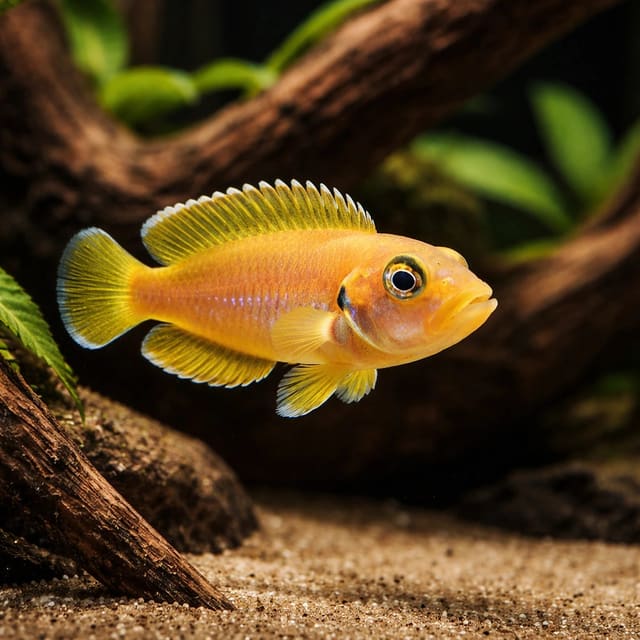
The gallery images are representative of this type of animal rather than photographs of the exact animal supplied, so colours can look slightly different from the live animal.
The word “Gold” identifies the trade form. Altolamprologus compressiceps varies in colour pattern between localities, and Seriously Fish advises keeping distinct populations apart and labelling collection localities clearly to avoid hybridisation. Treat an unidentified retail colour form as its stated trade identity rather than assigning it to a named wild locality.
Use a sandy substrate with complex piled-rock structures occupying much of the usable layout. Seriously Fish describes this as the ideal environment and instructs keepers to place the rocks directly on the aquarium base before adding the substrate. This prevents digging activity from undermining and toppling the structures.
A useful structure has more than one route around it. A single solid wall may create a dramatic display but can make observation, waste removal and separation difficult. Several secure structures allow the fish to move through the lower aquarium while giving the keeper clear sight of feeding and condition.
Do not balance heavy rocks on narrow contact points or rely on the sand to hold them upright. Digging can remove support gradually, and a pile that appears stable during setup may shift later. Press and test the finished structures before filling the aquarium, then check them whenever maintenance exposes movement or displaced sand.
Keep filter intakes, outlets and heater surfaces accessible. Rockwork should not create stagnant pockets that trap uneaten animal-based food, and it must not block the circulation needed to move waste towards the filter. Leave enough clearance to siphon exposed sand and inspect the base of each structure.
The layout has a behavioural purpose as well as an aesthetic one. This carnivore searches crevices for prey in nature, so complex rock structure supports deliberate exploration. It also helps divide the aquarium visually when a pair or carefully planned Tanganyikan community is maintained.
Keep the aquarium at 24–25°C, pH 8.0–8.6 and 12 dGH. Temperature and general hardness are the overlap of FishBase, Seriously Fish and OATA; the pH target is the overlap of the Seriously Fish aquarium range and OATA’s African lake guidance.
The underlying ranges differ. FishBase records 23–25°C, pH 6.5–7.5 and 8–12 dGH in its environmental entry. Seriously Fish recommends 24–28°C, pH 8.0–9.0 and 7–25 dGH for aquarium care, while OATA gives African lake cichlids 23–27°C, pH 8.0–8.6 and 12–18 dGH. The pH bands from FishBase and the aquarium references do not overlap, so use 8.0–8.6 as the practical aquarium target and avoid moving the fish repeatedly between different bands.
| Measurement | Routine target |
|---|---|
| Temperature | 24–25°C |
| pH | 8.0–8.6 |
| General hardness | 12 dGH |
| Ammonia | 0 mg/l |
| Nitrite | 0 mg/l |
| Nitrate | Not more than 20 mg/l above the normal tap-water level |
Measure the source water and mature aquarium before committing to this fish. Our water chemistry guide explains what each measurement means, while the water matcher helps compare measured values with the stated targets.
Test replacement water before a large change if its chemistry may differ from the aquarium. Treat tap water with conditioner to remove chlorine or chloramine before adding it, and match the temperature closely enough to avoid an abrupt shift. Stability comes from repeatable preparation, not from reacting to every small reading with a rapid chemical adjustment.
If ammonia or nitrite is detectable, pause further livestock additions, test again and address filtration and waste before proceeding. If nitrate rises beyond the target, use partial water changes and waste removal to restore control.
Use a mature, well-maintained biological filter. The RSPCA explains that fish release toxic ammonia, which filter bacteria convert first to toxic nitrite and then to the safer nitrate. A filter is therefore life-support equipment, not an optional way to make the water look clear.
For an aquarium of approximately 243 litres, Seriously Fish recommends turnover of four to five times the aquarium volume each hour. That equates to a filter rated at about 970–1,215 litres per hour. Use the aquarium’s working volume and the manufacturer’s rated flow as starting points, then check that rockwork has not left poorly circulated areas.
Our first tropical aquarium guide covers preparation and maturation before livestock arrives. Adding several fish or increasing food suddenly can outpace the filter bacteria and cause new tank syndrome, with harmful ammonia and nitrite accumulating in the water.
OATA recommends an oversized filter and vigorous aeration for crowded African lake cichlid communities. Apply that extra capacity when the aquarium contains a community or a heavier stocking plan, while still respecting the Gold Compressiceps compatibility rules. More filter flow does not make an incompatible or undersized aquarium acceptable.
Seriously Fish estimates that a 243-litre aquarium in a room around 20°C needs roughly 125–175 W divided across two heaters to maintain its wider stated temperature range. Select equipment for the real room and water volume, position it for even heat distribution and verify the result with a thermometer rather than relying only on the heater dial.
Base the diet on animal-rich foods suited to a specialised carnivore. In nature, this fish feeds mostly on invertebrates, crustaceans and smaller fishes; Seriously Fish notes that one study found various shrimp species made up more than 80% of the stomach contents examined.
Offer a quality dried carnivore food alongside live or frozen bloodworm, Tubifex, Artemia, chopped prawns, small earthworms and similar foods. Freeze-dried bloodworm and freeze-dried Artemia are also listed choices. Rotate suitable foods rather than relying on one item, while keeping the overall diet consistent with the species’ predatory biology.
A practical portion is one that is consumed within the stated few minutes without fragments accumulating on the sand or behind rocks. If food remains, reduce the next meal and siphon accessible waste. If the fish repeatedly misses food in a community, review where the food is delivered and whether faster companions are preventing access.
Do not use feeder livebearers or small goldfish. Seriously Fish states that they bring a risk of parasite or disease introduction and tend not to have high nutritional value unless properly conditioned. Suitable prepared, frozen and cultured foods meet the feeding plan without adding that avoidable risk.
Tropheus and other fish needing a low-protein diet are poor companions because their nutritional requirements conflict with this carnivore’s menu. Do not solve that conflict by diluting the Gold Compressiceps diet or feeding one compromise food to the entire aquarium. Choose a community in which every resident can receive an appropriate diet.
Carry out a partial water change every week. OATA strongly recommends a 25% change at least once every week for African lake cichlids, while Seriously Fish says weekly water changes of up to 50% should be considered mandatory for this species. Use testing, feeding load and accumulated waste to choose an effective change within that framework.
Do not run filter media under the tap. Chlorine or chloramine may kill the beneficial bacterial population established in the media. If cleaning is necessary, rinse the media lightly in aquarium water removed during the partial water change, preserving as much of the biological function as possible.
A weekly test result is a decision tool. Ammonia or nitrite above 0 mg/l calls for immediate attention to waste, feeding and filtration. Nitrate should not exceed 20 mg/l above the normal tap-water level. Compare nitrate against the source water rather than treating the aquarium reading in isolation.
During the first month, check whether the planned routine keeps the values steady from one week to the next. If nitrate climbs sharply, visible waste gathers in crevices or filter flow drops before the scheduled check, increase waste removal and review feeding. Do not treat larger water changes as permission to overfeed or overcrowd the aquarium.
Finish by confirming that rocks remain secure, heaters are unobstructed and water is circulating through the complete layout. Maintenance should preserve both water quality and the physical safety of the rockscape.
Prepare the mature aquarium and confirm its temperature and chemistry before the parcel arrives. Be present to receive live fish because the parcel cannot be left unattended.
These steps follow the current delivery and Live Arrival Guarantee policy. The fish is hand-bagged in oxygen and placed in an insulated poly box, with a heat pack when the weather calls for it. A licensed live-animal courier carries the parcel.
For a Live Arrival Guarantee claim, the continuous video must show the parcel sealed, the opening and the fish inside the sealed bag. Contact us on the same day with the order number and video if something has gone wrong. The current policy page contains the full claim terms.
Observe swimming, breathing and feeding without adding more livestock immediately. OATA advises increasing fish numbers slowly because the beneficial bacteria in a mature filter need to respond whenever livestock and feeding increase. A rapid increase can produce new tank syndrome and harmful ammonia or nitrite.
Test ammonia and nitrite during the settling period and keep both at 0 mg/l. Check that the fish can move through the rock layout without being trapped or continuously displaced by established residents. If an attempted pair or community shows persistent incompatibility, use the separation plan prepared before arrival rather than waiting for physical damage.
Know the fish’s normal swimming, colour, breathing, feeding and use of shelter. A change from its usual pattern is more useful than comparing every movement with another individual. OATA advises watching for changes in behaviour or appearance so action can be taken before a problem becomes severe.
| What you see | What to do |
|---|---|
| Hanging at the surface, sitting on the bottom or erratic swimming | Test water quality and check circulation and equipment |
| Breathing faster or slower than normal | Test ammonia and nitrite, then inspect aeration and filter flow |
| Darker or paler colour, increased hiding or changed aggression | Review interactions, shelter access and recent aquarium changes |
| White spots, fluffy growths, damaged fins, missing scales, ulcers or bumps | Check water quality and seek prompt livestock-health guidance |
| Weight change or reduced interest in food | Observe the next meal, remove waste and assess access to suitable food |
Start with water tests because ammonia and nitrite are toxic and should remain at 0 mg/l. Confirm temperature, pH and hardness as well, especially after maintenance, equipment failure or a source-water change. Correct the identified cause carefully rather than changing several values at the same time.
Inspect the physical environment next. Check for a blocked filter intake, reduced circulation, displaced rock, trapped debris or a failed heater. Confirm that food is reaching the fish and that a companion is not preventing access to shelter or feeding areas.
Do not diagnose a disease from one sign or add a treatment merely because the fish is hiding. The same outward change can accompany water-quality trouble, social pressure, injury or illness. Record what changed, when it began and the measured water values, then seek suitable health guidance if the fish remains abnormal or has visible lesions.
Use a well-chosen community of Lake Tanganyika species only after screening every resident for diet, predation risk and behaviour. Seriously Fish says Gold Compressiceps is not particularly territorial and can fit a carefully selected Tanganyikan community, but its specialised carnivory makes small animals and incompatible feeding regimes decisive exclusions.
Do not use broad labels such as “African cichlid” or “hard-water fish” as a compatibility decision. Two species can tolerate similar chemistry while differing in diet, behaviour or predation risk. The correct sequence is location first, then diet, adult predation risk, aquarium footprint and observed interactions.
For example, a Tanganyikan fish still fails the screen if it needs a low-protein diet. A fish that eats similar food still fails if it is small enough to become prey. A proposed community also fails if rockwork, filtration and usable footprint cannot support all residents within the minimum 120 × 45 cm base plan.
Add livestock gradually and monitor the existing fish after each change. OATA recommends adding more peaceful African lake cichlids first and more aggressive species later, and notes that rearranging décor can help fish establish new territories. Apply that guidance without treating décor changes as a cure for an inherently unsuitable combination.
Plan around one pair. Seriously Fish describes a single pair as the preferred arrangement and permits groups in larger aquaria. The pair plan requires at least a 120 × 45 cm base or equivalent and approximately 243 litres; a group needs more space than that baseline.
Two purchases should not automatically be treated as a formed pair because this offer does not guarantee sex. Build the aquarium so fish can be observed individually, and prepare a separate suitable space or divider plan before attempting to keep more than one. Do not wait for injury before deciding how separation would work.
There is no fixed group number to apply to every larger aquarium. Decide the group plan from the real footprint, usable rock structure, filtration capacity and observed interactions. The permission to keep a group does not turn the 243-litre pair aquarium into a group minimum.
OATA notes that very few African lake cichlids do well when kept singly and that the number depends on the species. The species-specific direction for Gold Compressiceps resolves that broad rule: use one pair as the primary plan, or a group only when the aquarium is enlarged and managed for the additional fish.
When assessing a Tanganyikan community, write down the adult plan for every resident before introduction. Exclude anything small enough to be food and any fish whose low-protein diet conflicts with this carnivore. Leave enough filtration and maintenance capacity to keep ammonia and nitrite at 0 mg/l as the population grows.
It reaches 12.3 cm, the maximum adult length recorded by FishBase. Plan the permanent aquarium around that adult size rather than the 3–4 cm dispatch size.
Provide at least a 120 × 45 cm base or equivalent, associated by Seriously Fish with approximately 243 litres. Use a larger aquarium for a group.
Plan around one pair. Seriously Fish says it can be maintained in groups in larger aquaria, but two unsexed fish should not be assumed to form a pair.
We rate it intermediate because the keeper must maintain stable hard, alkaline water, secure extensive rockwork, specialised carnivore feeding and carefully screened Tanganyikan companions.
Feed animal-rich dried food with live or frozen bloodworm, Tubifex, Artemia, chopped prawns or small earthworms. OATA advises two meals daily, limited to what it can eat within a few minutes.
Keep 24–25°C and 12 dGH, the FishBase, Seriously Fish and OATA overlap. Keep pH 8.0–8.6, the Seriously Fish/OATA aquarium overlap.
It is not particularly territorial, but it is predatory and anything small enough may be food. Monitor changes in aggression, hiding, fin condition and feeding access.
Use only a well-chosen Lake Tanganyika community after screening. Avoid animals small enough to be food, Tropheus, other low-protein feeders, Malawi cichlids and different collection-locality populations.
Start filming while the parcel is still sealed, then open it in one continuous take and show the fish inside the sealed bag. It is packed in oxygen in an insulated poly box, with a heat pack when needed; be present to receive it and float the bag for 20–30 minutes before releasing.
No reviews for this item yet. Bought one? Honest reviews only, good or bad.
What customers say about ordering from us
I have a small group of long finned mountain minnows. So was delighted to be able to order ten of this variety to increase the genetics in my tank . The ones I recieved are healthy but it’s to early to give a verdict on wether they are of a long finned type since they are small currently.
Gordon Walker · 23 Sept 2026
100% success travel and "installation". Pleased with quality of purchase. The Siamese fighter a bit "shy" so have not yet seen him at his best yet but looking good. Happy customer. GG
George E Garratt · 21 Sept 2026
Reviews of our shop, collected by Judge.me, an independent third-party review collector. Newest first.