−13%
Moderate
Gold Ocellatus Shell-Dweller (Neolamprologus ocellatus)
23–25°C · pH 8–9
£17.39£19.99

The Mutondwe Compressiceps (Altolamprologus compressiceps) is a Lake Tanganyika cichlid that reaches a recorded 12.3 cm total length. It suits a mature rocky aquarium of approximately 243 litres with a 120 × 45 cm base; keep 24–27°C, pH 8.0–8.6 and 12–18 dGH using Seriously Fish aquarium values narrowed by OATA’s African lake cichlid group guidance. Sold individually at 3–4 cm.
Adult size is the maximum length this species reaches at full maturity (scientific sources). The livestock you receive will be younger and smaller. Product-photo provenance and any image-specific limitations are stated on the listing.
Altolamprologus compressiceps
Save when buying multiple fish. Each quantity is one fish; sex and pair formation are not guaranteed unless the selected variant explicitly states them.
The Mutondwe Compressiceps (Altolamprologus compressiceps) is a Lake Tanganyika cichlid that reaches a recorded 12.3 cm total length. It suits a mature rocky aquarium of approximately 243 litres with a 120 × 45 cm base; keep 24–27°C, pH 8.0–8.6 and 12–18 dGH using Seriously Fish aquarium values narrowed by OATA’s African lake cichlid group guidance. Sold individually at 3–4 cm.
Adult size is the maximum length this species reaches at full maturity (scientific sources). The livestock you receive will be younger and smaller. Product-photo provenance and any image-specific limitations are stated on the listing.
Cichlids are a family of roughly 1,800 accepted species, not one care type. Before buying, identify the exact species and source, then compare adult measurement, usable tank dimensions, social system, territory, tested water, diet and an exit plan. No family-wide minimum tank, water range or tank-mate list is safe.
Maintain these water conditions for optimal health and vibrant colors
Mutondwe Compressiceps is the aquarium name used here for Altolamprologus compressiceps, a freshwater cichlid endemic to and widely distributed in Lake Tanganyika. Its deep, laterally compressed body and elongated mouthparts suit feeding around cracks between rocks. The Mutondwe name identifies the aquarium form, while the permanent care plan comes from the needs of the species rather than colour alone.
This fish suits a keeper prepared to build the aquarium around stable chemistry, excellent water quality, secure rockwork and deliberate companion choice. It is not a fit for a newly established aquarium or an unplanned general community. A mature biological filter, measured hard alkaline water and enough floor area for separate retreats should all be in place before the fish arrives.
FishBase records a maximum length of 12.3 cm total length for male or unsexed fish. The 3–4 cm measurement in the offer is the dispatch size, not the final size. Food size matters at dispatch, but the aquarium, territory and prey-risk decisions must be made for a fish that may reach the recorded maximum.
The Seriously Fish species profile gives minimum base dimensions of 120 × 45 cm or equivalent and a volume of approximately 243 litres. Rockwork displaces water and usable floor area, so both measurements matter. A tall aquarium with the same nominal volume may offer less useful territory than a longer layout with a 120 × 45 cm base.
| Suits | Not suited to |
|---|---|
| A mature filtered aquarium | A newly established aquarium |
| A base of at least 120 × 45 cm or equivalent | A layout without the stated permanent footprint |
| Sand and extensive secure rock structures | An unplanned general community |
| Stable hard alkaline aquarium water | Companions requiring incompatible water or diets |
| A carefully screened Tanganyika community | Animals small enough to be considered food |
Start with the adult stock list, then check the aquarium footprint, water, food competition and retreat use for every fish. The African cichlid collection is useful for comparing care requirements, but shared geography or family alone does not establish compatibility.
One purchase supplies one animal. The fish comes in the 3–4 cm dispatch size. That measurement helps you select suitably small food, but it must never replace the 12.3 cm adult planning figure.
Sex is guaranteed only when the selected option explicitly states male or female. This Mutondwe Compressiceps listing has no sex-guaranteed option.
Do not treat two purchases as a bonded pair. The species profile says it is best maintained as a single pair and may be kept in groups in larger aquaria, but successful pair or group planning depends on the relationship between the fish, the space and the layout. Provide distinct retreats and a practical separation option before trying more than one.
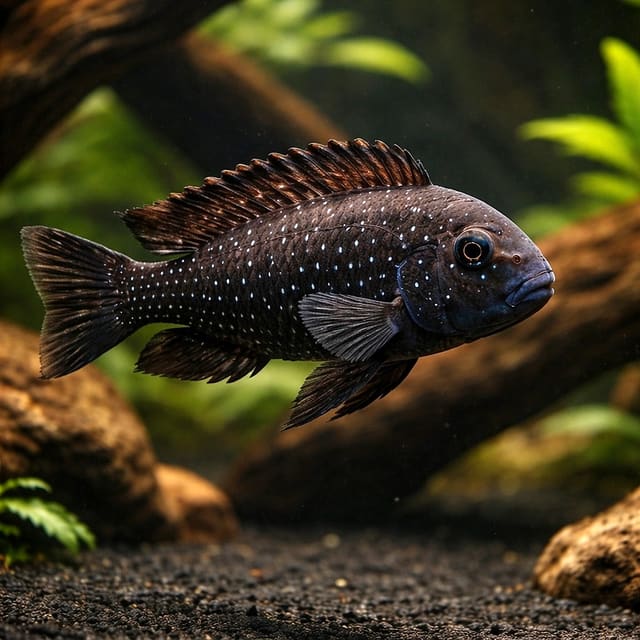
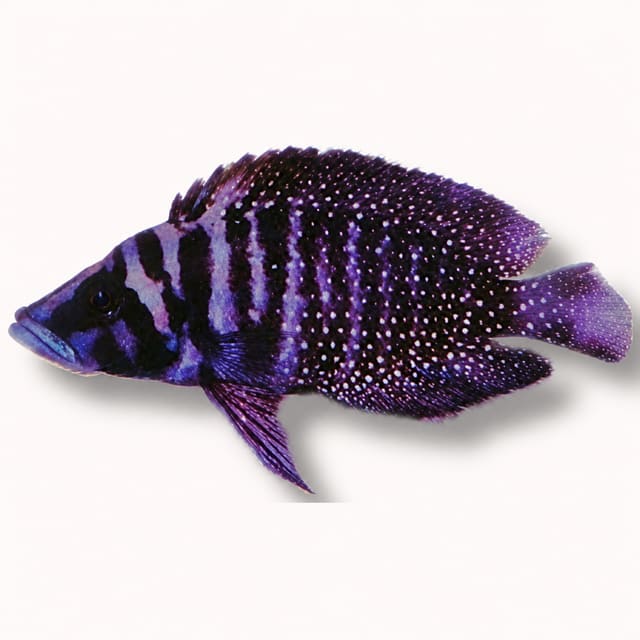
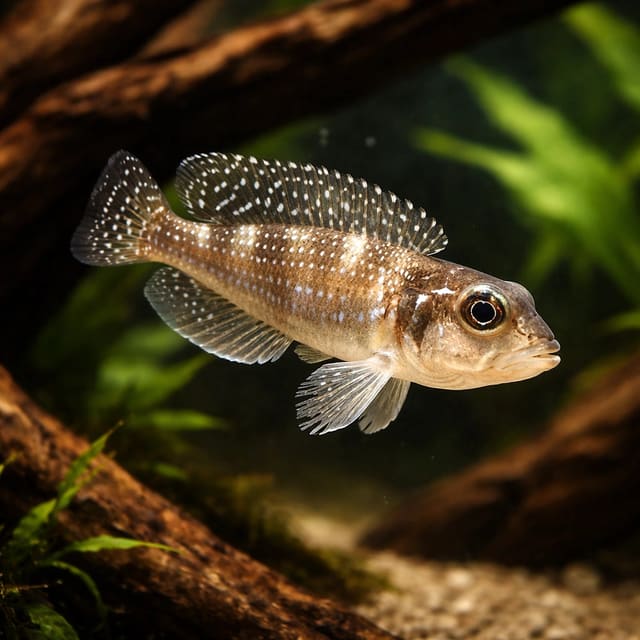
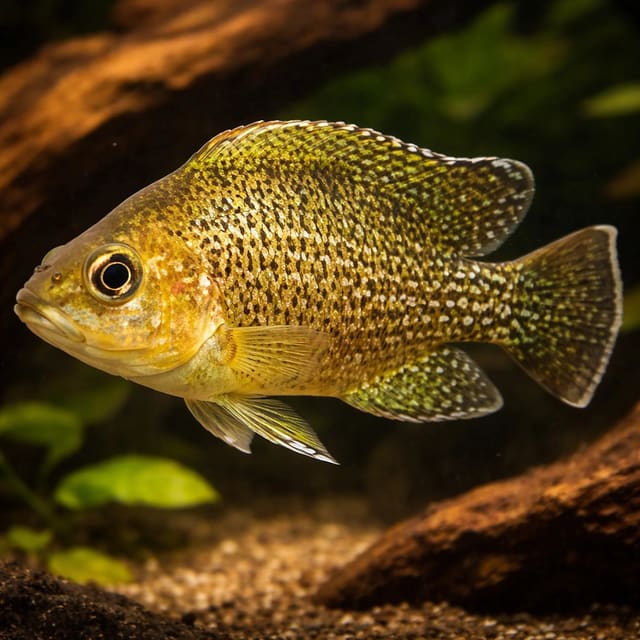
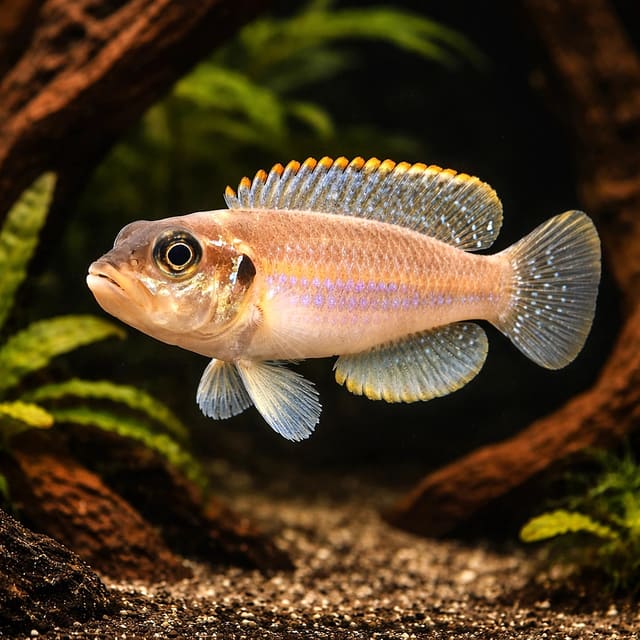
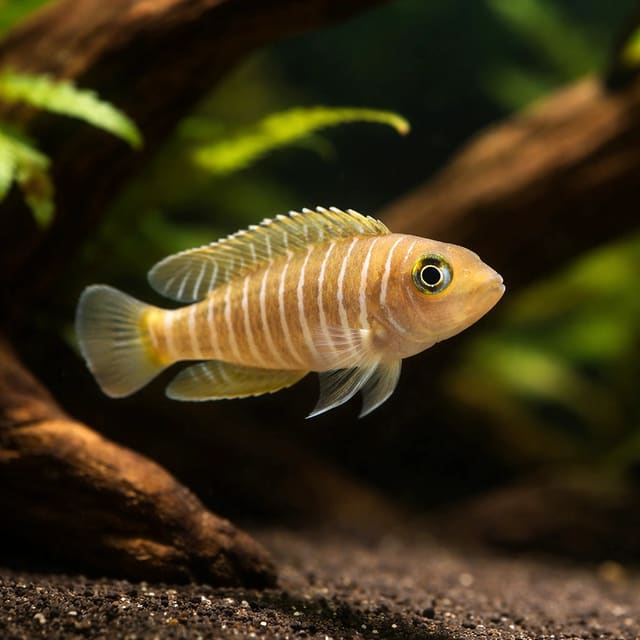
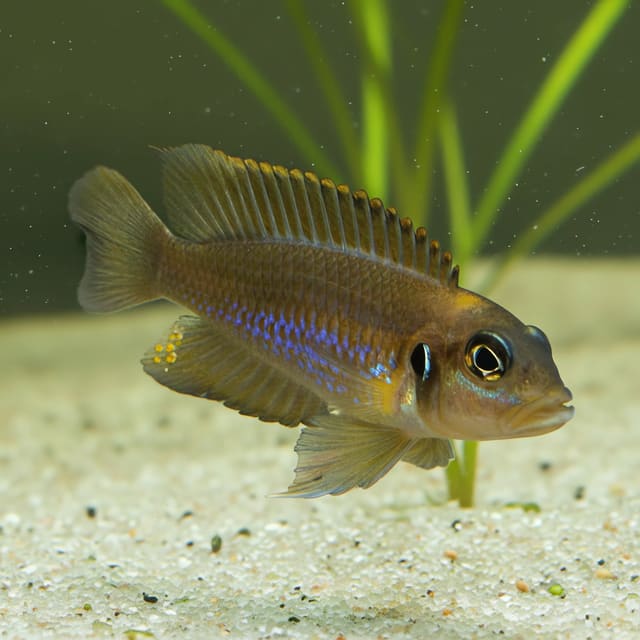
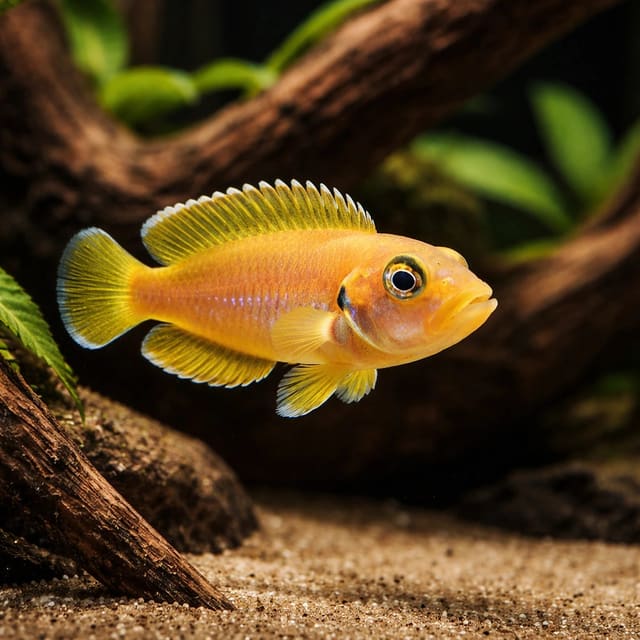
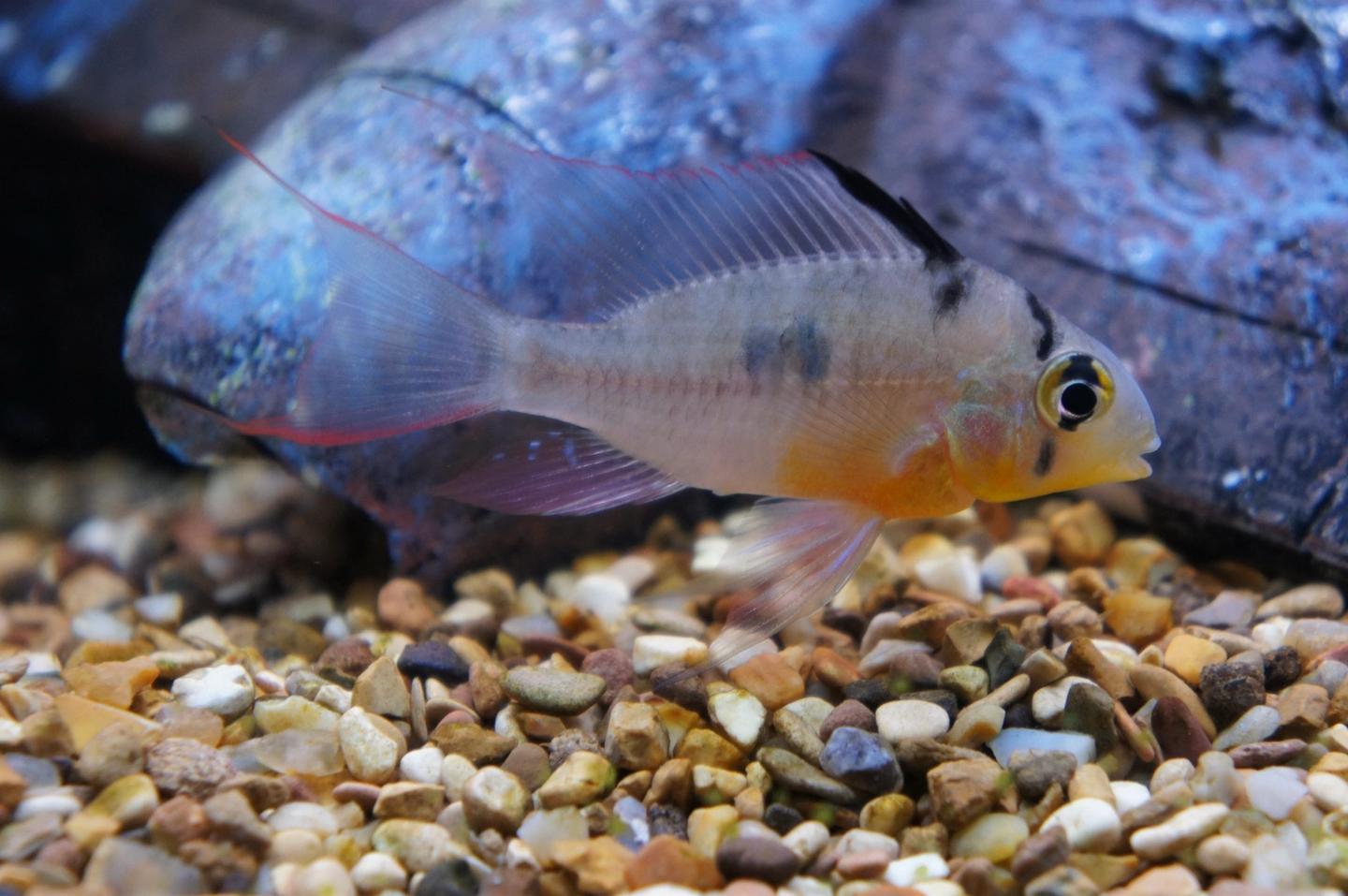
Some gallery images are representative, based on reference photographs of this species, and none shows the exact animal supplied, so colours can look slightly different from the live animal.
The gallery depicts the high-backed, compressed profile, pointed golden face and pale spotting associated with this form. One scene shows two fish as a social presentation; each purchase still supplies one animal. Aquarium backgrounds are also illustrative and do not replace the species requirement for extensive rock structures and hard alkaline water.
| What you purchase | What to plan |
|---|---|
| One purchase | One fish |
| 3–4 cm size | Food suited to the dispatch size |
| Permanent aquarium | Space for up to 12.3 cm total length |
| More than one fish | Larger space, separate retreats and a separation plan |
| Gallery appearance | Natural variation in colour, markings and posture |
This is an intermediate-care choice because several straightforward needs must work together: mature filtration, narrow routine water targets, high water quality, a substantial rocky footprint, carnivorous feeding and careful social screening. A keeper who can measure those conditions and respond early to appetite or behaviour changes has a clear framework for success.
Use an aquarium with a base of at least 120 × 45 cm or an equivalent footprint and approximately 243 litres. Treat those dimensions as a minimum starting point for the species, not an automatic approval for every stock combination. A group needs a larger aquarium, and a mixed Tanganyika community needs enough additional room for the adult territories of every species.
Measure the inside dimensions rather than relying only on the model name. A nominal 243-litre aquarium loses water volume and usable space to substrate, rocks and the air gap beneath the lid. The footprint remains decisive because this fish uses rock boundaries and crevices; extra height cannot replace adequate length and width.
For example, a 120 × 45 cm aquarium may meet the stated base dimensions before decoration. Once a deep rock pile occupies much of one end, however, the remaining retreat entrances may all face the same open area. Redesign the pile to create more independent approaches rather than assuming the volume alone has solved territory.
A temporary small aquarium is not a substitute for the permanent plan. Moving a growing fish after territories have formed adds disruption, while delaying the larger aquarium risks allowing a dispatch-size setup to become permanent. Prepare the full footprint before purchase whenever possible.
If this is your first livestock aquarium, follow the first tropical aquarium preparation guide before adding fish. Complete maturation, testing and layout work first; the fish should enter a stable system rather than being used to establish the biological filter.
Use a sandy substrate with complex piles of rock arranged across much of the aquarium. Place the main rocks directly on the tank base before adding sand. This prevents digging from undermining a heavy structure and turning a useful retreat into an unstable pile.
Create several crevices of different shapes rather than one dominant cave. The fish should be able to approach shelter without crossing every other cichlid’s territory, and a subordinate fish needs more than one route away from pressure. Offset rock faces while retaining enough open space for swimming and feeding.
Run the complete arrangement and observe its flow before the fish arrives. Fine food should not collect in dead pockets behind the rocks, yet every crevice should not be blasted by a direct outlet jet. Adjust the outlet or hardscape until there is visible surface movement and circulation around the structure without removing calm shelter.
The compressed body and elongated mouthparts let this carnivore investigate narrow cracks for prey. That biology explains why a complex rock boundary is useful, but it also means uneaten food can disappear into the same gaps. Keep the structure serviceable and remove waste during maintenance rather than building a sealed wall that cannot be cleaned.
Rock structures also provide the cavities used in the species’ reproductive behaviour. Females naturally use narrow spaces, while males grow considerably larger. Those biological differences reinforce the need for several secure choices, but the aquarium should never be arranged on the assumption that selected fish will form a pair.
For routine aquarium care, use 24–27°C, pH 8.0–8.6 and 12–18 dGH. These values take the Seriously Fish aquarium range of 24–28°C, pH 8.0–9.0 and 7–25 dGH and narrow it with OATA’s African lake cichlid group guidance of 23–27°C, pH 8.0–8.6 and 12–18 dGH.
FishBase separately records the wild environmental range as 23–25°C, pH 6.5–7.5 and 8–12 dH. Use the aquarium husbandry range for routine care and avoid abrupt movement between different chemistry. Choose a stable point that also suits every intended companion rather than chasing the top or bottom of each range.
| Routine check | Target |
|---|---|
| Temperature | 24–27°C |
| pH | 8.0–8.6 |
| General hardness | 12–18 dGH |
| Carbonate hardness | 10–15 dKH |
| Ammonia | 0 mg/l |
| Nitrite | 0 mg/l |
| Nitrate | No more than 20 mg/l above normal tap-water level |
Test the source water and aquarium before choosing buffers or mineral products. If pH or hardness sits outside the intended range, establish a repeatable preparation method before adding the fish. A sudden correction made immediately before release is less useful than water that remains consistent through feeding and weekly maintenance.
Use the water chemistry guide to understand how pH, general hardness, carbonate hardness and nitrogen waste relate. Enter measured values into the water parameter matcher rather than relying on a regional average.
Record results at the same stage of the maintenance cycle. If pH gradually falls or nitrate rises faster each week, respond to the trend by reviewing source water, stocking, feeding and maintenance. Avoid repeatedly adding chemicals to correct one isolated reading without identifying its cause.
A well-established biological filter is essential. RSPCA aquarium guidance explains that fish release toxic ammonia and that beneficial filter bacteria convert it first to nitrite and then to the safer nitrate. The aquarium must complete that process reliably before this cichlid is introduced.
For an aquarium of approximately 243 litres, the species profile recommends four to five times the aquarium volume per hour. That equates to a filter rating of about 970–1,215 litres per hour. Rated flow is a planning figure: media, pipework and accumulated debris can reduce actual circulation, while rock structures can create sheltered pockets.
Seriously Fish treats weekly changes of up to 50% as mandatory for this species, while OATA strongly recommends a 25% partial water change at least once every week for African lake cichlids. For this species, consider a change of up to 50% each week and prepare the replacement water consistently to avoid sudden chemical or temperature shifts.
When media needs cleaning, rinse it lightly in aquarium water removed during the water change. Do not run it under the tap, because chlorine or chloramine may harm the bacteria performing the nitrogen cycle.
Watch the aquarium after maintenance. A changed outlet angle, airlock or blocked intake can alter oxygenation and flow. If the fish breathes faster, hangs unusually near the surface or loses interest in food, test water promptly and check circulation before assuming the cause is behavioural.
This species is a specialised carnivore that feeds mostly on invertebrates, crustaceans and smaller fishes in nature. More than 80% of the stomach contents in one wild study consisted of various shrimp species. Its elongated mouthparts are adapted to reach prey in cracks between rocks.
Most aquarium fish of this species will accept dried food, but offer a varied routine that also includes suitable live or frozen bloodworm, Tubifex, Artemia, chopped prawns and small earthworms. Choose pieces that a 3–4 cm fish can take cleanly. Adjust size as the fish grows rather than offering chunks based on the expected adult mouth.
Feed only what can be eaten within a few minutes, twice a day. Observe each meal. This deliberate rock-edge feeder may lose food to faster companions even when plenty enters the aquarium, so place a small portion near its chosen boundary and confirm that the fish swallows it.
| If you see | Do this |
|---|---|
| Food taken by faster fish | Use separate feeding points and smaller targeted portions |
| Food entering rock gaps | Reduce the portion and move the feeding point |
| Food left after a few minutes | Remove it and reduce the next feed |
| Declining body condition | Check actual intake, competition and water quality |
| Rising nitrate | Review portions and remove trapped waste |
Do not use feeder livebearers or small goldfish. They may introduce parasites or disease and have poor nutritional value unless properly conditioned. There is no benefit to accepting that risk when appropriate prepared, frozen and invertebrate foods can form the routine.
This protein-rich feeding plan is also why compatibility with Tropheus and other fish requiring a low-protein diet is poor. Trying to meet two incompatible diets in one aquarium can leave one species overfed and the other undernourished. Screen feeding needs before relying on shared Lake Tanganyika origin.
Complete the aquascape, filter maturation and water adjustments before delivery day. Confirm 24–27°C, pH 8.0–8.6, 12–18 dGH, 0 mg/l ammonia and 0 mg/l nitrite. Leave the rockwork in its final position so the fish can settle without an immediate major rearrangement.
Someone must be present to receive the fish. Read the current delivery and Live Arrival Guarantee policy before delivery. Start filming every delivery while the parcel is still sealed, continue in one take as it is opened and show the fish still inside the sealed bag. Float the bag for 20–30 minutes before releasing the fish, and never pour bag water into the aquarium.
A newly moved fish may spend time in cover. Judge progress through posture, respiration and gradual exploration rather than trying to force it into view. Avoid repeatedly moving rocks or chasing it with a net during the first hours unless another fish is trapping or attacking it.
During the first week, check the fish at feeding time and from a distance. Confirm that it leaves cover voluntarily, eats an appropriate portion and can return without being intercepted. Test water immediately if breathing, colour, swimming, appetite or hiding changes markedly.
OATA’s warning signs include hanging at the surface, sitting on the bottom, erratic swimming, unusual darkening or paling, changed aggression, increased hiding, altered gill movement, white spots, fluffy growths, damaged fins or scales and declining body condition. If you are concerned about a health change, test the water and contact us for guidance.
The species profile recommends maintaining a single pair and says groups can be kept in larger aquaria. That does not make any two selected fish a pair. Begin with the social structure you can support, the minimum 120 × 45 cm footprint and a practical way to separate fish if the relationship changes.
Although the species is described as not particularly territorial, shelter, food and breeding cavities can still become points of conflict. Watch access rather than waiting for an obvious fight. A fish that remains hidden, misses meals or is repeatedly held at the edge of the aquarium may be under sustained pressure without showing severe fin damage.
| Plan | Required response |
|---|---|
| Single compatible pair | Provide several crevices and watch both fish’s access to food and cover |
| Group | Use a larger aquarium with additional retreats |
| Tanganyika community | Separate cave, rock and open-water demands before adding fish |
| Relationship changes | Use a divider or another mature aquarium before condition declines |
Males grow considerably larger than females and may develop slightly extended fins as they mature. Treat those features as adult biology, not as a promise about the animal selected. The offer disclosure remains the basis for what can be chosen.
This is a substrate-spawning species that naturally uses rock crevices or cavities. The female guards the brood through incubation, while parental care ends once the fry are free swimming. Growth is slow and sexual maturity may take a year or more. These facts help explain the importance of secure cavities and changing adult relationships; they are not a reason to assume ordinary selections will become a breeding pair.
Build compatibility around five questions: Can either fish swallow the other? Do their routine water ranges overlap? Do they require compatible diets? Can both reach food? Do they compete for the same rock cavity? A shared lake or similar pH answers only part of the assessment.
Avoid anything small enough to be considered food. This carnivore naturally takes invertebrates, crustaceans and smaller fishes, so a companion that looks safe beside a 3–4 cm dispatch-size fish may become prey as the Compressiceps grows. Use the recorded 12.3 cm maximum when screening.
Avoid Tropheus and other species requiring a low-protein diet. This fish benefits from carnivorous dried foods and live or frozen animal foods, while low-protein specialists need a different feeding plan. Combining them creates a dietary conflict even when the water chemistry overlaps.
| Candidate | Decision |
|---|---|
| Fish small enough to be food | Avoid because of predation risk |
| Tropheus or another low-protein specialist | Avoid because routine diets conflict |
| Well-chosen Tanganyika fish | Consider only after checking adult size, food and territory |
| Another Compressiceps | Plan as a pair or group project with larger space and separation capacity |
| Cave-dwelling cichlid | Map separate retreats and watch access closely |
| Fast, forceful feeder | Reject the mix if this fish cannot receive its portion |
A well-chosen Tanganyikan community may work because the species is not regarded as particularly territorial, but named combinations remain conditional. Individual behaviour, the relationship between fish and the exact hardscape can alter the result. Plan how a fish will be removed before adding it to a densely structured aquarium.
Keep different geographical populations of Altolamprologus compressiceps apart where maintaining the form matters. Colour-pattern populations are ideally clearly labelled and separated to avoid hybridisation. The Mutondwe form should therefore not be mixed casually with another locality form.
Observe the aquarium at feeding time, after lights come on and when fish return to shelter. Those moments reveal whether every animal can cross the aquarium, reach food and choose a retreat. A quiet fish is not necessarily comfortable if another cichlid controls the route between food and shelter.
First test ammonia, nitrite, temperature and oxygenation so a water-quality problem is not mistaken for social conflict. If results are within the established range and one fish is clearly excluding another, use the prepared divider or mature alternative aquarium. Do not wait for severe physical damage when repeated loss of food and shelter already shows that the arrangement is failing.
Rearranging rockwork may alter established territories, but it should not be the only contingency. A dominant fish may simply claim the redesigned structure. Make major changes with the fish safely controlled, keep heavy rocks supported on the base and restore several independent retreats.
When adding fish to a broader African lake cichlid community, introduce numbers gradually so the biological filter can adjust to increased feeding and waste. OATA recommends adding more peaceful species first and more aggressive species later. For this animal, the stronger rule remains case-by-case screening: reject any proposed mix that fails prey size, diet, water, feeding-access or territory checks.
FishBase records a maximum of 12.3 cm total length for male or unsexed Altolamprologus compressiceps. Plan the permanent aquarium around that adult figure rather than the 3–4 cm dispatch size.
Seriously Fish gives a minimum base of 120 × 45 cm or equivalent and approximately 243 litres, with sand and extensive rock structures. Groups require a larger aquarium.
Seriously Fish recommends a compatible single pair and says groups can be kept in larger aquaria. Two purchases do not establish a pair, so provide separate retreats and a practical separation option.
It is an intermediate-care choice suited to a keeper who can maintain a mature biological filter, hard alkaline water, excellent water quality, secure rockwork and carefully screened companions.
It is a specialised carnivore that feeds mostly on invertebrates, crustaceans and smaller fishes in nature. Offer suitable carnivorous dried food plus live or frozen bloodworm, Tubifex, Artemia, chopped prawns or small earthworms, twice a day in portions eaten within a few minutes.
Keep it at 24–27°C, pH 8.0–8.6 and 12–18 dGH. These are Seriously Fish aquarium values narrowed by OATA’s African lake cichlid group guidance; maintain ammonia and nitrite at 0 mg/l.
Seriously Fish describes it as not particularly territorial, but shelter, feeding and breeding cavities can still become points of conflict. Watch whether every fish can reach food and cover, and separate an animal that is persistently excluded or pursued.
A well-chosen Tanganyika community may work after adult size, water, diet, feeding access and cave use are checked. Avoid anything small enough to be food, plus Tropheus and other species requiring a low-protein diet.
Someone must be present to receive it. Film every delivery continuously from the sealed parcel as it is opened, showing the fish still inside the sealed bag; then float the bag for 20–30 minutes and release the fish without pouring bag water into the aquarium.
No reviews for this item yet. Bought one? Honest reviews only, good or bad.
What customers say about ordering from us
I have a small group of long finned mountain minnows. So was delighted to be able to order ten of this variety to increase the genetics in my tank . The ones I recieved are healthy but it’s to early to give a verdict on wether they are of a long finned type since they are small currently.
Gordon Walker · 23 Sept 2026
100% success travel and "installation". Pleased with quality of purchase. The Siamese fighter a bit "shy" so have not yet seen him at his best yet but looking good. Happy customer. GG
George E Garratt · 21 Sept 2026
Reviews of our shop, collected by Judge.me, an independent third-party review collector. Newest first.