Moderate
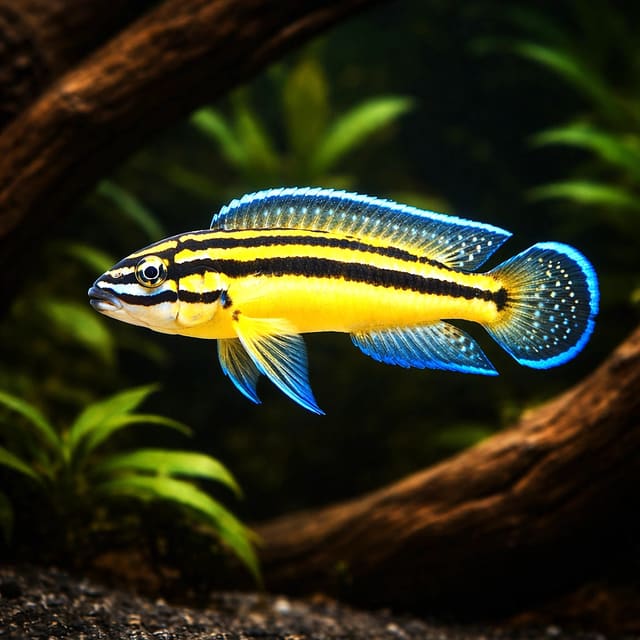
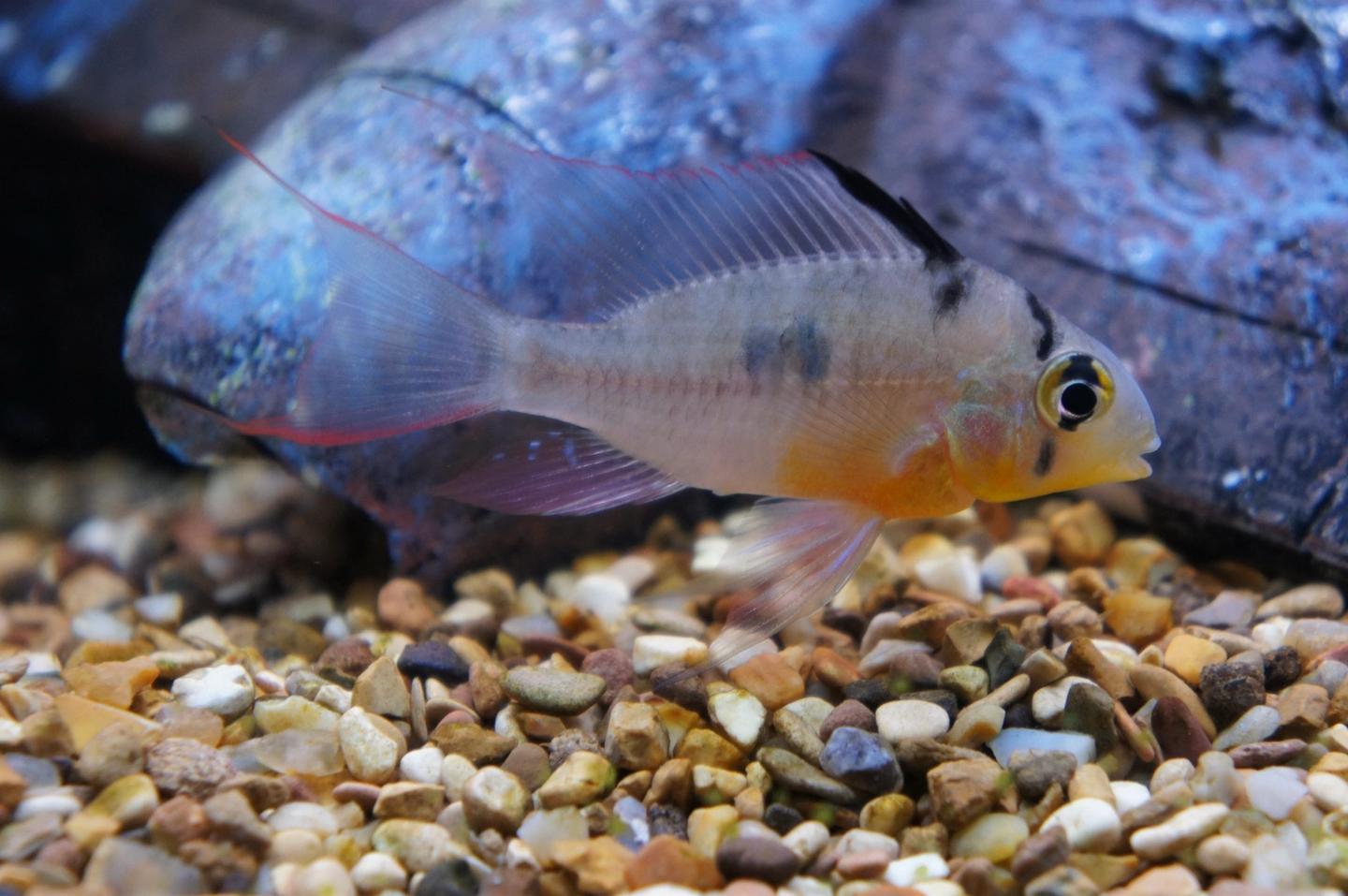
Striped Julie Kipili (Julidochromis marksmithi)
23–25°C · pH 8–9 · 150L
£13.99

A striking, rock-dwelling Tanganyikan cichlid with bold stripes, fascinating pair-bonding behavior, and rewarding cave-spawning habits. Moderate care, semi-aggressive. 24-27C, pH 7.8-9.0.
Adult size is the maximum length this species reaches at full maturity (scientific sources). The livestock you receive will be younger and smaller — pick a size variant above for the actual shipping size. Product-photo provenance and any image-specific limitations are stated on the listing.
Julidochromis regani
Save when buying multiple fish. Each quantity is one fish; sex and pair formation are not guaranteed unless the selected variant explicitly states them.
Confirm your email, then we’ll send an availability message for this exact item if it returns within 180 days.
This request is only for this product—no newsletter or other promotions. A mail-provider retry may very rarely duplicate the same availability message. Unconfirmed addresses are removed after 48 hours. See our privacy policy.
A striking, rock-dwelling Tanganyikan cichlid with bold stripes, fascinating pair-bonding behavior, and rewarding cave-spawning habits. Moderate care, semi-aggressive. 24-27C, pH 7.8-9.0.
Adult size is the maximum length this species reaches at full maturity (scientific sources). The livestock you receive will be younger and smaller — pick a size variant above for the actual shipping size. Product-photo provenance and any image-specific limitations are stated on the listing.
23–25°C · pH 8–9 · 150L
23–27°C · pH 8–9.2 · 68L
23–27°C · pH 7.5–9 · 70L
23–25°C · pH 8–8.6 · 110L
Cichlids are a family of roughly 1,800 accepted species, not one care type. Before buying, identify the exact species and source, then compare adult measurement, usable tank dimensions, social system, territory, tested water, diet and an exit plan. No family-wide minimum tank, water range or tank-mate list is safe.
Maintain these water conditions for optimal health and vibrant colors
Striped Julie is the customer-friendly name for Julidochromis regani, also known as Regan's Julie or Convict Julie. It is a rock-associated Lake Tanganyika cichlid with bold horizontal striping, strong pair behaviour and secretive cave-spawning habits. Adult planning size is around 12-13 cm, with some specialist sources recording larger females, so the small sale-size variants on this product should be treated as young fish rather than the final size.
This is a rewarding fish for aquarists who want a genuine Tanganyikan cichlid rather than a mixed community species. It suits hard, alkaline water, stable filtration, sand plus rockwork, and tank mates that enjoy the same mineral-rich lake conditions. The appeal is not just the striped pattern. A settled pair claims caves, patrols rock faces, watches the room and can raise fry in a way that makes the aquarium feel alive.
| Customer name | Striped Julie |
|---|---|
| Scientific name | Julidochromis regani |
| Other names | Regan's Julie, Convict Julie |
| Current size options | 4-5.5 cm, 6-7 cm, 7-8 cm and XL variants on the same Shopify product |
| Adult planning size | Plan for 12-13 cm; mature females may be larger in some lines |
| Origin | Endemic to Lake Tanganyika in East Africa |
| Care level | Moderate: hardy when kept in the correct hard-water setup |
| Temperature | 23-25C target; avoid warm, low-oxygen water |
| pH / hardness | Hard, alkaline water; aim around pH 8.0-9.0 with mineral hardness |
| Minimum aquarium | At least a 4 ft aquarium for a settled pair; 150 cm is better for a Tanganyika community |
| Temperament | Semi-aggressive, territorial around caves and when breeding |
| Diet | Omnivore with a strong invertebrate-grazing component; quality cichlid foods plus frozen foods and some green foods |
| Best tank zone | Lower and mid rock zones, especially around caves, cracks and rubble edges |
The supplier anchor for this product is Julidochromis regani, and that scientific name has been kept unchanged. FishBase lists the common name Convict Julie and records the species as endemic to Lake Tanganyika. In the UK hobby it is often sold as Striped Julie or Regan's Julie, both of which describe the same broad customer search intent without forcing sale phrases into the page.
There is one useful nuance for serious Tanganyika keepers: different Julidochromis locality forms and close relatives can be sold under similar trade names. Maidenhead Aquatics notes that the Kipili form historically associated with J. regani is now treated separately as Marksmith's Julie by some references. This product's supplier name is simply Julidochromis regani, so this page stays with that identity and does not over-claim a locality.
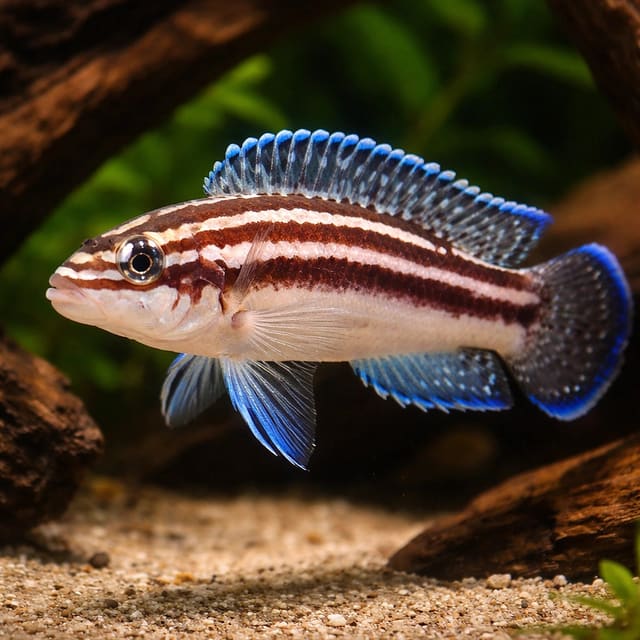
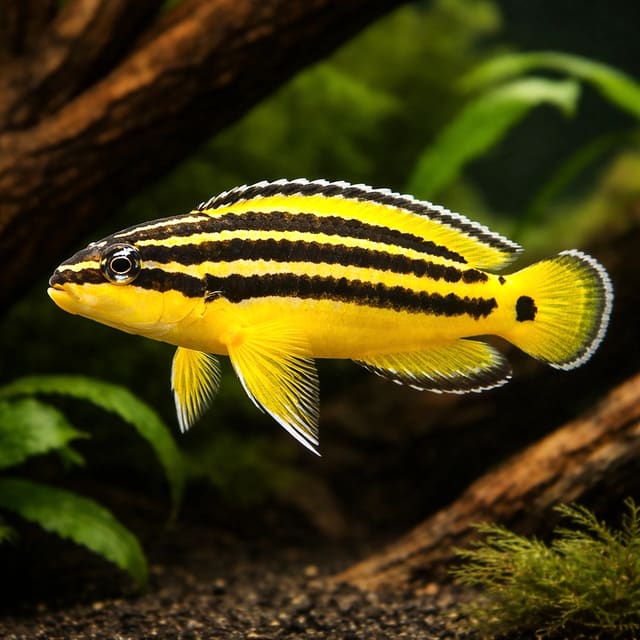
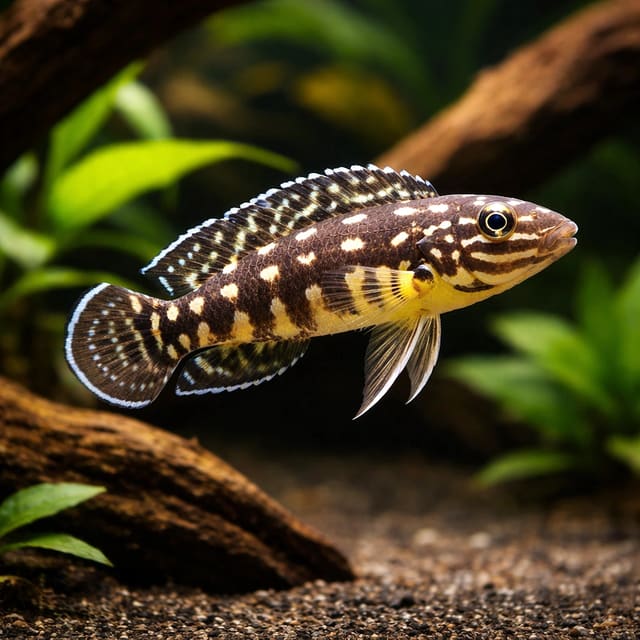
A good Striped Julie is instantly recognisable. The body is long and streamlined, with dark horizontal bands running along a pale cream, yellowish or tan base depending on line, mood and lighting. The fins can show fine edging and subtle yellow tones, while the face pattern gives the fish an alert, slightly intense look. It is not a neon-coloured show fish, but it has the clean graphic contrast that makes Tanganyika aquariums look crisp.
The visual effect is strongest in a rocky aquascape. Pale sand, stacked stone, broken sight lines and shaded caves make the fish feel secure, and a confident fish shows stronger posture and more purposeful movement. In a bare tank it may hide, fade or spend too much time pressed into one corner. In a good layout, it glides along rock faces, slips into narrow gaps and appears from a cave as if checking its territory.
Julidochromis regani is a Lake Tanganyika cichlid. FishBase records hard alkaline water, a shallow distribution and a maximum length of 13 cm. Fishkeeper / Maidenhead Aquatics describes Regan's Julie as living around shallow, sediment-rich rocky habitat where territories centre on cracks, fissures and rubble. AquaInfo also describes sandy areas mixed with rock formations, with territories built around hollows between stones.
This habitat explains the aquarium design. The fish does not want a soft, acidic, plant-only community tank. It wants oxygen-rich mineral water, firm structure and enough space to claim a cave without being forced to fight every other fish in the tank. Think Tanganyika shoreline: sand below, rocks above, gaps between the rocks and open water nearby.
Plan the aquarium around adult territory, not the smallest sale size. A pair can work in a 4 ft aquarium when the layout is thoughtful, while a mixed Tanganyika community is better in a longer 150 cm tank with several separated rock zones. The old 75 litre guidance was too small for a proper long-term adult setup and has been corrected.
Use fine sand or coral/aragonite-based substrate where suitable for your water chemistry, then build stable rock piles with caves, crevices and visual barriers. Do not create one single cave and expect peace. Several possible territories reduce pressure and let weaker fish move out of view. Keep some open sand between rock piles so territories are naturally separated.
Filtration and oxygenation matter. Tanganyikan cichlids can be hardy, but they are not tolerant of dirty, unstable water. Use a mature filter, steady circulation and regular partial water changes. Avoid sudden pH swings. If you use mineral buffers, add them consistently and test the water so changes are controlled rather than reactive.
A practical target is 23-25C, with strong oxygenation and stable hard alkaline water. FishBase records pH 8.5-9.2 and dH 8-14, while Fishkeeper gives pH 8.0-9.0 and dH 15-25 for aquarium care. Those values point in the same direction: this is a hard-water Tanganyika fish, not a soft-water tetra companion.
Keep the chemistry steady. If your tap water is already hard and alkaline, avoid overcomplicating it. If your water is soft, use a deliberate Tanganyika mineral routine rather than guessing. Stability, low nitrate, zero ammonia and zero nitrite are more important than chasing a perfect number every day.
In nature, Regan's Julie picks small crustaceans, insect larvae, molluscs and other foods from algae-coated rocks and sediment. In the aquarium, offer quality cichlid granules or pellets, slow-sinking foods, and a rotation of frozen brine shrimp, mysis, daphnia and similar small foods. A small amount of spirulina or green food is useful because these fish graze among algal growth rather than eating only meaty foods.
Feed small portions. This species often feeds close to the substrate and rockwork, so leftovers can disappear into cracks and damage water quality. A tidy feeding routine keeps the fish lean, active and confident.
The Striped Julie is semi-aggressive in the cichlid sense: not a random bully when settled correctly, but serious about its chosen cave and especially determined when breeding. It is usually best kept as a single compatible pair, or as juveniles grown together so a pair can form naturally. Multiple pairs need a large aquarium with repeated rock territories and clear sight breaks.
Good companions are other Lake Tanganyika fish that need similar water and occupy different niches. Suitable options can include carefully chosen shell dwellers, open-water Cyprichromis in larger tanks, and Tanganyikan Synodontis catfish where space allows. Avoid other Julidochromis species in the same aquarium because of aggression, confusion and hybridisation risk. Avoid soft-water community fish, tiny peaceful fish, fin-nippers and aggressive mbuna-style setups that do not match the same behaviour pattern.
This is one of the most interesting reasons to keep the species. Striped Julies form strong pair bonds and spawn in caves or narrow rock crevices. The spawning site may be hidden, so keepers sometimes notice fry before they ever see eggs. Parents defend the cave and young closely, and in a spacious tank older fry may remain near the territory for a time.
If breeding is your aim, start with a small group of juveniles, let a pair form naturally and then rehome surplus fish if pressure builds. Forcing two random adults together can lead to fighting. Give the pair several caves, dimmer retreat areas and stable water. Fry can be started on very small foods such as newly hatched brine shrimp and fine prepared fry foods once free-swimming.
A healthy Striped Julie should be alert, balanced and quick to use cover without looking panicked. New arrivals may hide after transport, so keep lights low and give the fish quiet time. Watch breathing, fin posture and feeding response over the first few days. The most common problems come from unstable water, cramped layouts, incompatible tank mates and overfeeding.
On delivery day, receive the parcel promptly, float and acclimate carefully, and introduce the fish into a mature aquarium with matching hard-water conditions. Do not add this fish to a brand-new tank. The Tropical Fish Co Live Arrival Guarantee applies to eligible livestock orders when the delivery and acclimation instructions are followed.
Choose Striped Julie if you want a compact but characterful Tanganyika cichlid with real behaviour, not just colour. It is a strong fit for keepers who enjoy rockwork aquariums, hard alkaline water and pair-bonding cichlids. It is also a good step into Tanganyika fishkeeping for someone ready to build the tank around the fish rather than drop it into a generic community.
Do not choose it for a small peaceful community, shrimp tank, soft-water aquascape or a setup where every fish must ignore every other fish. The right buyer will get a fascinating, structured, intelligent cichlid. The wrong setup will turn its best instincts into stress.
Plan for around 12-13 cm as an adult. Some specialist sources record mature females reaching larger sizes, so the 4-5.5 cm option on this product is a sale size, not the adult size.
It is semi-aggressive and territorial around caves, especially once a pair forms. It is usually manageable in a correctly sized Tanganyika aquarium with rockwork and visual barriers.
Use hard, alkaline, well-oxygenated water. A sensible aquarium target is 23-25C, pH around 8.0-9.0 and steady mineral hardness.
It is not a soft-water community fish. Keep it with suitable Lake Tanganyika species that share the same chemistry and temperament, not with delicate tetras, shrimp or slow long-finned fish.
Use quality cichlid pellets or granules, small frozen foods such as brine shrimp, mysis and daphnia, and some green or spirulina-based foods. Feed modest portions so food does not rot in the rockwork.
It can suit a careful aquarist who is new to Tanganyika cichlids, but it is not a casual beginner community fish. Success depends on the right hard-water setup and tank mates.
We list this fish under its clear common and scientific name, keep the size variants tied to the correct Shopify product, and pack eligible livestock for UK delivery by licensed live-animal courier. The product page shows live availability and price, while the care notes above help you decide if your aquarium is ready before ordering.
Eligible livestock orders are supported by our Live Arrival Guarantee, and new customers can use the 10% first-order code WELCOME10 where the promotion applies. Prepare the aquarium first, then choose the size option that suits your existing Tanganyika setup.
978.jpg.Max adult size is the length this species reaches at full maturity (from scientific sources). The livestock you receive will be younger and smaller — pick a size variant on the buy box for the actual shipping size. Product-photo provenance and any image-specific limitations are stated on the listing.
Can become territorial.
Always research specific species before adding them to your tank. Consider:
No reviews for this item yet. Bought one? Honest reviews only, good or bad.
What customers say about ordering from us
I have a small group of long finned mountain minnows. So was delighted to be able to order ten of this variety to increase the genetics in my tank . The ones I recieved are healthy but it’s to early to give a verdict on wether they are of a long finned type since they are small currently.
Gordon Walker · 23 Sept 2026
100% success travel and "installation". Pleased with quality of purchase. The Siamese fighter a bit "shy" so have not yet seen him at his best yet but looking good. Happy customer. GG
George E Garratt · 21 Sept 2026
Reviews of our shop, collected by Judge.me, an independent third-party review collector. Newest first.
