Advanced
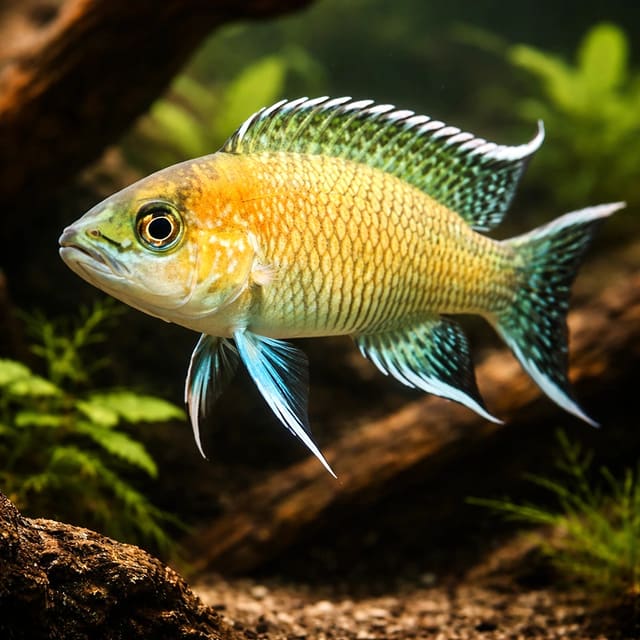
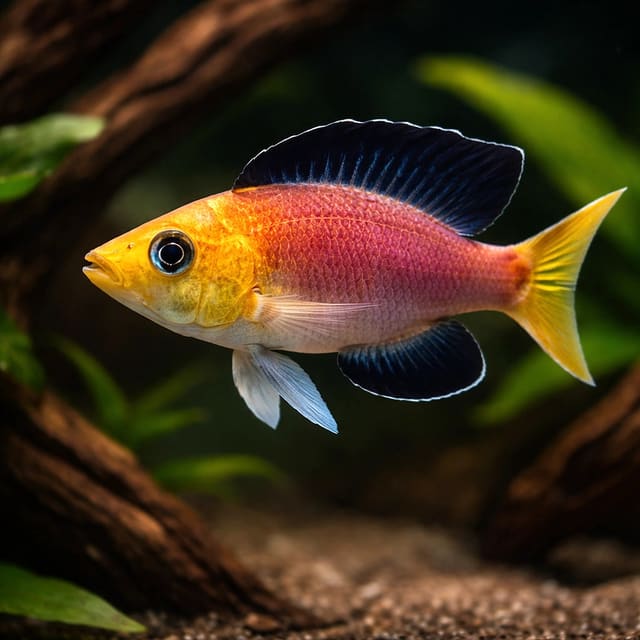
Jumbo Yellow Sardine Cichlid (Cyprichromis sp.)
24–27°C · pH 7.8–9
£39.99
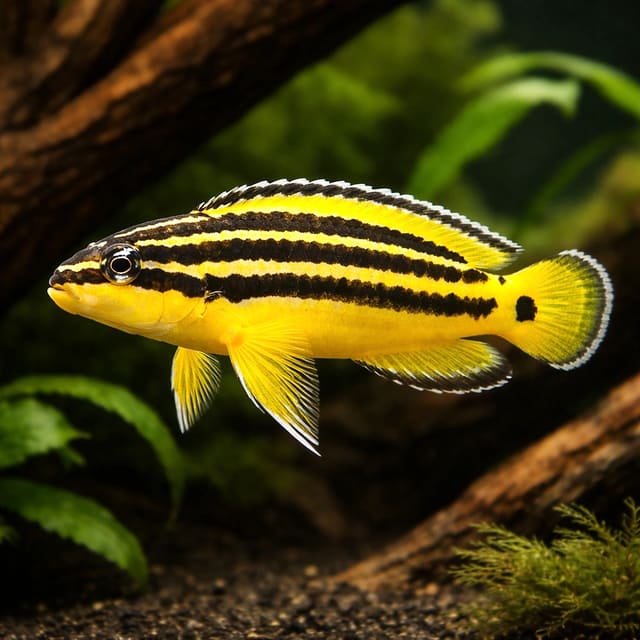
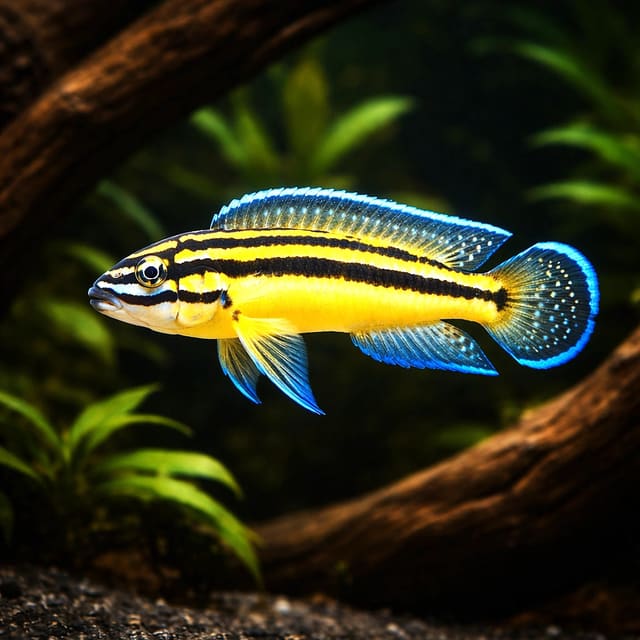
One Golden Julie of the Yellow Zaire form, Julidochromis ornatus, a cave-spawning Lake Tanganyika cichlid that grows to about 8.5 cm. Dispatched at roughly 3.5-4 cm and unsexed. Needs a rocky tank of at least 75 x 30 cm for a pair, hard alkaline water at pH 8-9 and small live or frozen foods.
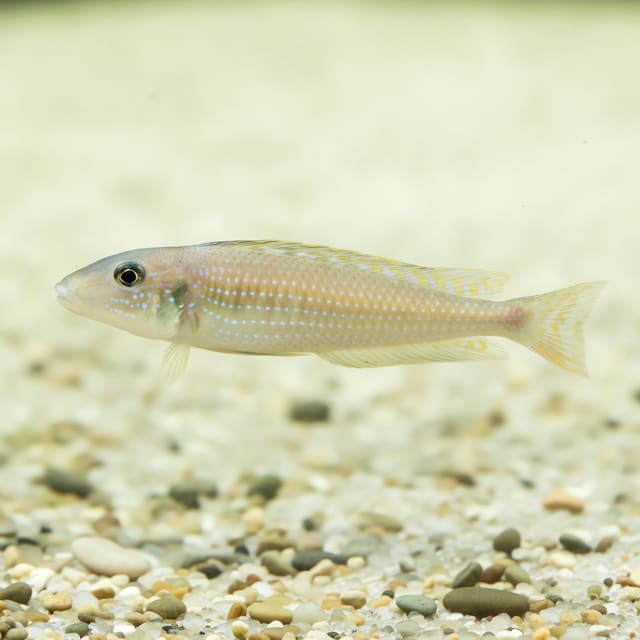
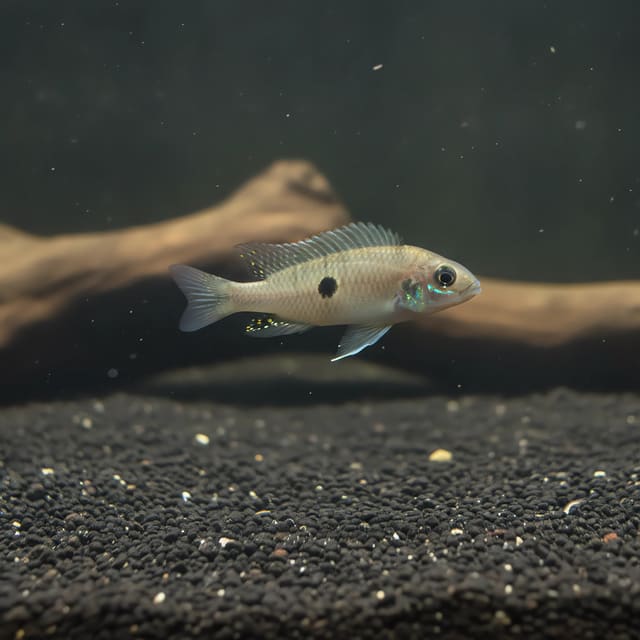
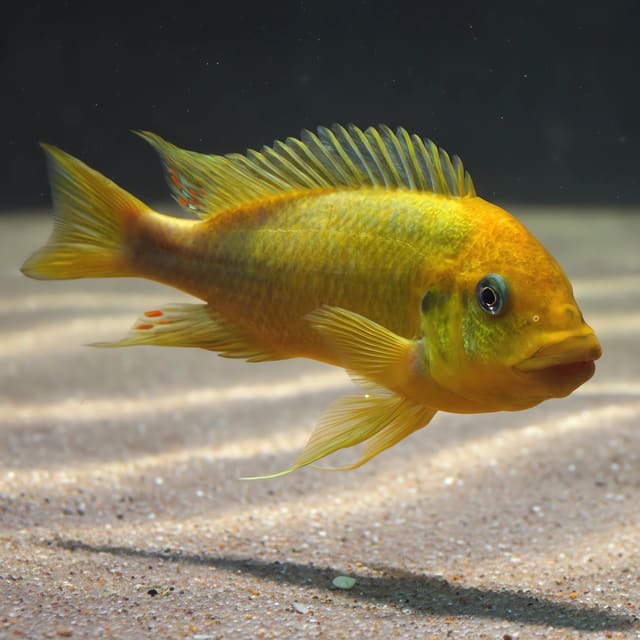
Adult size is the maximum length this species reaches at full maturity (scientific sources). The livestock you receive will be younger and smaller. Product-photo provenance and any image-specific limitations are stated on the listing.
Julidochromis ornatus
Save when buying multiple fish. Each quantity is one fish; sex and pair formation are not guaranteed unless the selected variant explicitly states them.
One Golden Julie of the Yellow Zaire form, Julidochromis ornatus, a cave-spawning Lake Tanganyika cichlid that grows to about 8.5 cm. Dispatched at roughly 3.5-4 cm and unsexed. Needs a rocky tank of at least 75 x 30 cm for a pair, hard alkaline water at pH 8-9 and small live or frozen foods.
Adult size is the maximum length this species reaches at full maturity (scientific sources). The livestock you receive will be younger and smaller. Product-photo provenance and any image-specific limitations are stated on the listing.
Cichlids are a family of roughly 1,800 accepted species, not one care type. Before buying, identify the exact species and source, then compare adult measurement, usable tank dimensions, social system, territory, tested water, diet and an exit plan. No family-wide minimum tank, water range or tank-mate list is safe.
Maintain these water conditions for optimal health and vibrant colors
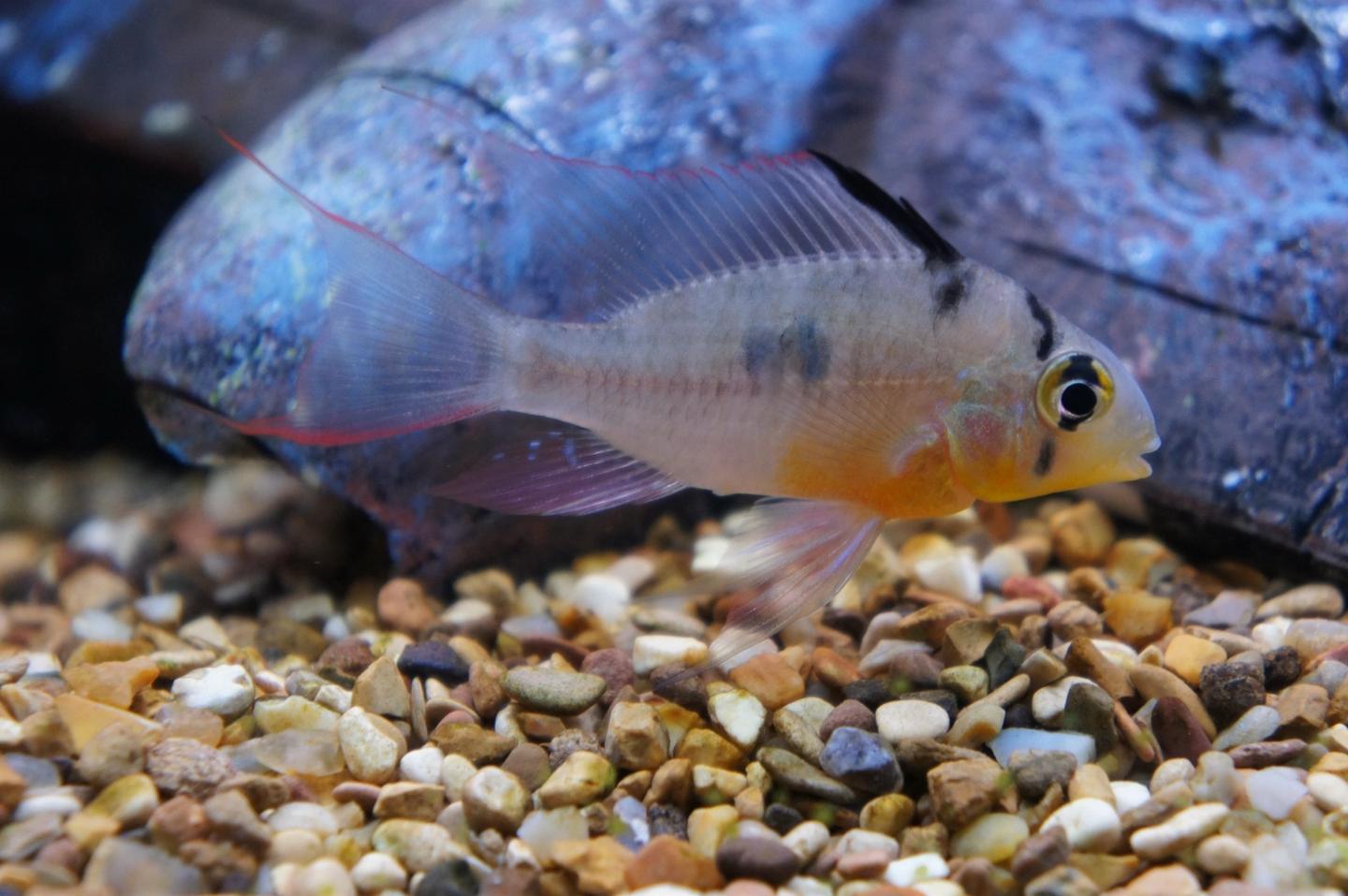
This listing sells one Yellow Zaire golden julie, Julidochromis ornatus. Our stock records give the dispatch size as roughly 3.5 to 4 cm, so the fish you receive is a youngster with growing still to do. There is a single option on the listing and no sex is stated, so we can't promise a male or a female. If you are hoping to end up with a breeding pair, read the section on pairs further down before deciding how many to order, because two julies picked at random are not necessarily a pair, and this species can be hard on its own kind.
The species is a small Lake Tanganyika cichlid. FishBase records a maximum of 8.5 cm total length, and Seriously Fish gives 80 mm standard length, so a fully grown fish is still a modest size. Most of what makes it worth keeping is behaviour rather than bulk: it lives among rocks, claims a cave, and in the right set-up raises its young in a family group.
| Point | Figure | Source |
|---|---|---|
| Adult size | 8.5 cm total length | FishBase (Seriously Fish: 80 mm SL) |
| Dispatch size | About 3.5-4 cm | Our stock records |
| Tank for a pair | 75 x 30 x 30 cm, about 70 litres | Seriously Fish |
| Temperature | 23-27 °C | Seriously Fish (lake records 22-24 °C on FishBase) |
| pH | 8.0-9.0 | FishBase; Seriously Fish allows from 7.5 |
| Hardness | 10-25 dGH | Seriously Fish (FishBase: 9-19) |
| Diet | Small live and frozen foods, some dried food and vegetable matter | Seriously Fish |
| Temperament | Territorial, aggressive towards its own kind | Seriously Fish, FishBase |
"Golden julie" is the common name FishBase and Wikipedia both give for Julidochromis ornatus, and Seriously Fish adds that the species is also sold as the yellow or ornate julie. "Yellow Zaire" is the form label this particular fish is traded under, and some buyers search for it under the scientific name with that label attached.
Zaire was the name of the Congolese state headed by Mobutu Sese Seko until 1997; the country is now the Democratic Republic of the Congo, which holds around 40% of Lake Tanganyika. The label therefore points to the Congolese side of the lake. We have no collection record for these fish or their parents, though, and we won't claim a particular site beyond what the name says.
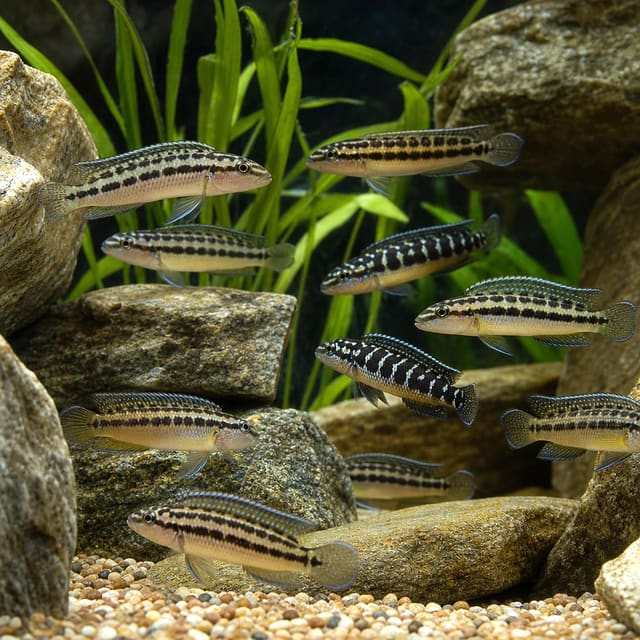
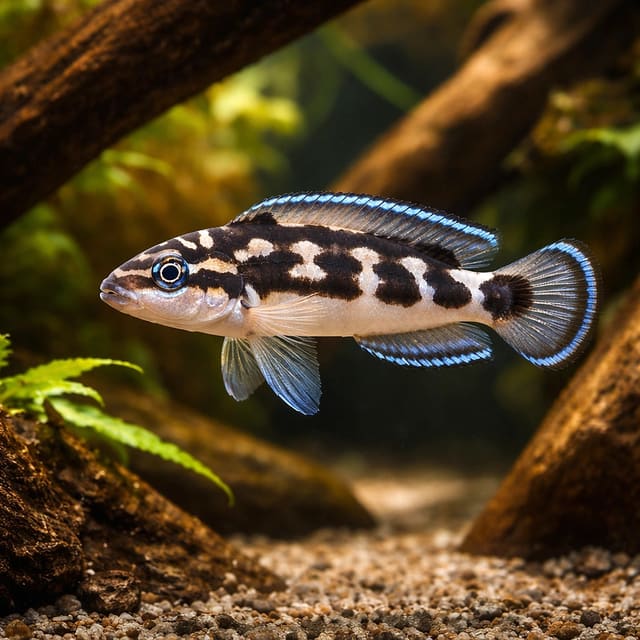
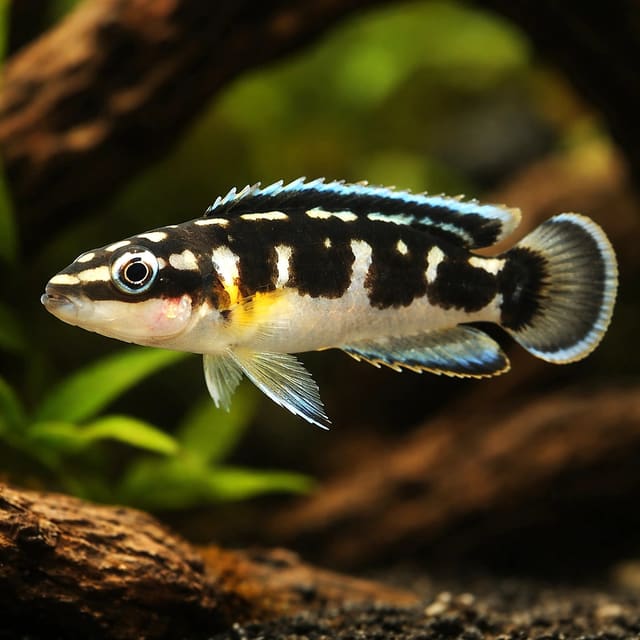
Julies are the cichlids of the genus Julidochromis, and all of them come from Lake Tanganyika. Wikipedia lists six species: J. dickfeldi, J. marksmithi, J. marlieri, J. ornatus, J. regani (the convict julie) and J. transcriptus (the masked julie). As a group they are small to mid-sized, around 7 to 15 cm, with a yellowish background colour marked by black lengthwise stripes or a chequered pattern.
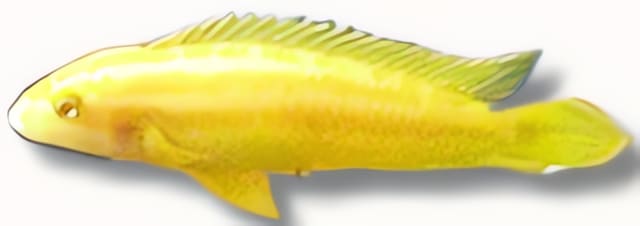
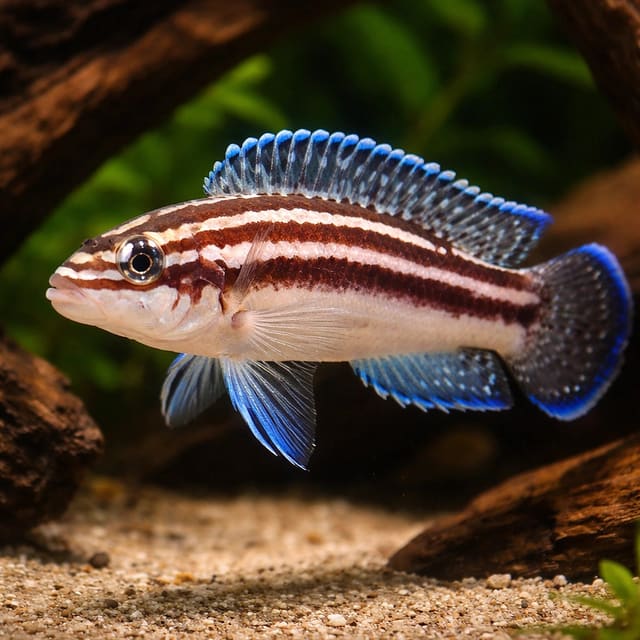
The golden julie sits at the small end of that range. Wikipedia describes the body as a mixture of yellow and white, with three black bands running along the sides and face, and a black spot at the base of the rounded tail fin. There is also a change with age worth knowing about: juveniles have a white dorsal fin, while adults have a yellow dorsal fin, sometimes with black markings at the tips.
At the size we dispatch, you may well see that juvenile fin colour rather than the finished adult look. That is normal and is one reason not to judge a young julie too quickly. FishBase also makes the point that the species does not always show its true colours, so a newly moved fish looking washed out on its first day tells you little about how it will look once it has settled.
Two of our sources make a point every buyer should hear. Seriously Fish notes that the majority of golden julies available are tank-bred and do not show colouring as bright as wild fish. FishBase goes further and records that breeding in captivity has led to changes in the species' colours and behaviours. We have no records of how many generations this Yellow Zaire line has spent in aquariums, so we don't promise wild-type colour. What you can expect is the golden julie's basic pattern of yellow ground colour and dark stripes, which the sources describe for the species as a whole.
Golden julies are not easy to sex, especially young ones. Seriously Fish gives two differences. The genital papilla of the male is longer and more pointed than the female's, which you will only see at close quarters on an adult. And adult females are larger than males, which is worth knowing if you are watching a group to pick out a pair. Neither difference is any use at 3.5 to 4 cm, which is why this listing does not offer a sexed fish.
Lake Tanganyika is a remarkable place to come from. Wikipedia describes it running for 676 km in a roughly north-south line, reaching a maximum depth of 1,471 m in its northern basin, and shared between four countries, with Tanzania and the Democratic Republic of the Congo holding most of it. Its water is alkaline, with a pH around 9 between the surface and 100 m. It is also home to at least 250 endemic cichlid species, which is why "Tanganyika cichlid" covers such a wide range of shapes and habits.
The golden julie has a small corner of that lake. FishBase describes it as endemic to the northern part of Lake Tanganyika, with one variety endemic to the southern part near Mpulungu. Wikipedia puts it the same way, describing the species as found only along the extreme northern and southern shorelines in rocky surroundings. Seriously Fish places it in rocky areas of the intermediate zone between the shoreline and open water.
The depth figures are similar across sources: usually 6 to 12 m according to FishBase, and typically 4 to 12 m according to Wikipedia. Down there the fish lives among rock, which explains almost everything about how it should be kept. FishBase sums up its life as rock-dwelling, usually solitary and territorial.
That description sits a little oddly next to Wikipedia's account of golden julies living in cooperative breeding groups, covered in the breeding section below. One reasonable reading is that both describe a fish that holds a patch of rock and defends it; the difference is who shares the patch, a lone fish or a breeding family. Either way, the practical lesson is the same: every golden julie, or every family, needs its own piece of rock.
The golden julie has a restricted range. FishBase lists it as Near Threatened on the IUCN Red List, assessed on 13 March 2025, and Wikipedia gives the reasons for that listing: a known range of only 200 km2, and the species' popularity in the live fish trade. That is worth bearing in mind when you buy. Looking after the fish you buy properly, and breeding it if you can, is a sensible response to that.
The sources describe a fish that picks small food from rock surfaces. FishBase says it feeds on microorganisms. Wikipedia describes golden julies as benthic feeders and omnivores that eat crustaceans and microorganisms, and that scrape prey off rocks with their teeth. That is a useful picture to hold when you plan the diet: many small items, plenty of animal food, and a share of plant matter.
Because the golden julie stays small, it doesn't need a vast aquarium, but it does need the right kind of space. Seriously Fish recommends a tank of 75 x 30 x 30 cm, about 70 litres, for a single pair. FishBase gives a minimum aquarium length of 60 cm and also recommends keeping the species in pairs. We would treat the Seriously Fish size as the minimum for a pair kept on their own, and go larger if you add tank mates or want room for a family group to build up.
The layout matters more than the volume. Seriously Fish describes a Lake Tanganyika biotope: piles of rocks arranged to form caves, filling much of the aquarium, over a sandy substrate. A julie spends most of its time in and around rock, so that is where your effort should go. Think in terms of caves, crevices and vertical rock faces rather than a scattering of ornaments.
Expect the fish to be retiring at first. Wikipedia describes julies as secretive fish that retreat to caves and rock crevices, and notes that they tend to stay hidden unless dither fish are present in the tank. In practice that means a small group of suitable open-water fish can make the julies more confident; the section on tank mates covers which ones the sources support.
Filtration should be steady and reliable rather than powerful. The aim is clean, well-oxygenated water moving gently through the rockwork, without blasting a small fish around its cave. A sponge on the filter intake is a sensible precaution once fry start to appear.
Lake Tanganyika water is hard and alkaline, and a golden julie needs the same in the aquarium. Here is how the figures compare across our sources:
| Source | Temperature | pH | Hardness |
|---|---|---|---|
| FishBase (wild records) | 22-24 °C | 8.0-9.0 | 9-19 dH |
| Seriously Fish (aquarium) | 23-27 °C | 7.5-9.0 | 10-25 °H |
| Wikipedia, golden julie habitat | 22-24 °C | 8-9 | not given |
| Wikipedia, Lake Tanganyika surface | about 24 °C to 28-29 °C, depending on season and area | around 9 in the top 100 m | not given |
The temperatures disagree a little. The species pages put the julie's habitat at 22 to 24 °C, while the lake article describes surface water running from about 24 °C in the south in early August to 28-29 °C late in the rainy season. The fish live several metres down, which may explain part of the gap. Seriously Fish's aquarium range of 23 to 27 °C sits across both, and that is the range we give.
Within that range we would lean towards the cooler half rather than the top. Wikipedia reports that researchers found, by experiment, that a rise in water temperature increased the aggression shown by golden julies. For a species already short-tempered with its own kind, there is no reason to push the heater up.
For pH and hardness, our target is pH 8.0 to 9.0 and 10 to 25 dGH. The pH range is where FishBase, Wikipedia and Seriously Fish agree, with Seriously Fish allowing down to 7.5. The hardness range is Seriously Fish's; FishBase's 9-19 overlaps most of it. If your tap water is soft or acidic, talk to us before you order. Raising hardness and holding pH steady is quite possible, but it has to be in place, and stable, before the fish arrive.
The basics in the Ornamental Aquatic Trade Association's freshwater care sheet apply here as to any tank. Ammonia and nitrite should both read zero. Test at least once a week. Change up to 25% of the water every week, dechlorinating the new water first, either by letting it stand for 24 hours or with a commercial dechlorinator. Clean filter media in old tank water, never under the tap, because tap water kills the beneficial bacteria.
On a 70-litre pair tank, that 25% is about 17 to 18 litres a week, which is a couple of buckets. Make the replacement water match the tank as closely as you can, not just for temperature but for hardness and pH too; with Tanganyika fish, the point is to keep conditions steady, and the weekly change shouldn't jolt them.
The OATA sheet is also clear that a tank must be cycled before fish go in, by the fish-in or fishless method, until ammonia and nitrite drop to zero and stay there. With a small, territorial cichlid, a fully mature tank should also mean the rock surfaces carry a film of tiny life for the julies to pick at between meals.
Seriously Fish gives a clear feeding plan for golden julies: live and frozen foods should make up a large share of the diet, dried foods can be fed but less often, and some vegetable matter, such as spirulina or blanched spinach, should also be offered. That matches the wild picture of an omnivore picking crustaceans and microorganisms off rock.
The fish arrives at 3.5 to 4 cm, so food size matters as much as food type. Good choices are:
Several small feeds a day suit a fish this size better than one large one. Feed what is eaten in a couple of minutes and lift out anything left lying in the rockwork, because food that rots in the crevices of a rocky tank is easy to miss and quickly fouls the water.
Watch where the food goes. Julies are cave fish, and in a tank with livelier open-water company the food can be gone before a julie leaves its rock. Target-feeding near the caves with a pipette or turkey baster makes sure the julies get their share. Once they are confident, they often come out to meet the food.
To make that concrete, a simple rotation for a pair might look like this: frozen brine shrimp or daphnia on most days, a fine cichlid granule on two or three days, and a spirulina-based food or a pinch of blanched spinach twice in the week, with live brine shrimp whenever you can get them. Nothing about that is fixed, but it keeps the balance Seriously Fish describes, with live and frozen food doing most of the work, dried food in a supporting role, and some greens in the mix. Once a pair has fry, add brine shrimp nauplii for the youngsters, as described in the breeding section.
This is the part to plan carefully. Seriously Fish describes the golden julie as a territorial species that should be kept as a pair because it is aggressive towards members of its own species. FishBase agrees: it lists the fish as usually solitary and territorial, and recommends keeping it in pairs.
That raises a practical question for a listing that sells one unsexed fish. A single golden julie can be kept on its own with suitable tank mates. If you want a pair, though, ordering two and hoping is a gamble: two young fish may be the same sex, and two fish of the same sex may fight. The approach Seriously Fish suggests is to buy a group of young fish and let them pair off naturally. If you go that route, have a plan in place for the fish that don't pair, either a second tank or a home to rehome them to, because once a pair forms they may turn on the rest.
Seriously Fish says the golden julie can be kept successfully with other small to medium-sized Tanganyikan cichlids that use different areas of the tank, and names Neolamprologus shell-dwellers and Cyprichromis species as examples. The point is that each kind of fish uses a different part of the tank, so the julies can hold the rockwork without constant disputes.
If you are considering Cyprichromis, our Jumbo Yellow Sardine Cichlid (Cyprichromis sp.) belongs to the genus Seriously Fish names. Check its own listing for the tank size and group it needs, which will be different from a julie pair's minimum, and make sure the combined plan fits your aquarium.
Seriously Fish warns that golden julies should not be kept with other Julidochromis because they may hybridise, and Wikipedia notes that julies hybridise easily with one another. So although we list several julies, they are alternatives to this fish, not companions for it. If you are still choosing a julie, you can compare our Golden Julie (Julidochromis ornatus), the Albino Yellow Ornate Julie (Julidochromis ornatus) and Marlier's Julie (Julidochromis marlieri), then pick one for each tank. If you want the Yellow Zaire line to stay what it is, don't mix it with other forms of ornatus either.
Golden julies are one of the more rewarding small cichlids to breed, because the sources describe an unusual family life. Seriously Fish calls the species a cave spawner. The female lays up to 100 eggs, usually fewer, inside a cave, and they hatch in two to three days. According to Seriously Fish, the fry can take brine shrimp nauplii straight away, and brood care lasts a long time: young fish can stay with their parents until they are about 1 inch, roughly 2.5 cm, long.
Wikipedia adds the social side. Golden julies live in social groups that mainly breed cooperatively, which means that as well as the two parents caring for the eggs, other members of the group help with care and protection. A group contains a dominant breeding male and female, with anywhere from none to six subordinate helpers. In a well-run tank, then, a pair can build up a little colony of its own young around the breeding cave.
Wikipedia's article on the genus describes julie pairs as largely monogamous, though larger fish may mate with more than one partner. It also describes two spawning patterns across the genus: a large batch of eggs, up to several hundred, every four to six weeks, or a small number of eggs every few days in sequence. The golden julie's figure of up to 100 eggs from Seriously Fish sits within that.
As covered above, the reliable route is a group of young fish allowed to pair off. Seriously Fish suggests exactly that. Give the group plenty of caves so that a forming pair can claim one without the others being trapped, and watch for two fish that start sharing a cave and seeing off the rest. At that point, the extra fish need to go somewhere else.
If the colony grows too large for the tank, move some young fish on before it becomes crowded. A cooperative group still has limits, and a 70-litre tank is sized for a pair, not a crowd.
Most of the problems people have with this fish come from a handful of avoidable decisions. Every point below follows directly from what the sources say about the species.
None of these is complicated to get right. A golden julie in a rock-filled, hard-water tank with suitable company is a rewarding fish to keep, and its family life can be watched unfolding over months.
Get the aquarium ready before you place the order: filter running, water tested, and temperature set to match what the julie needs. Someone has to be at the delivery address to take in the parcel, because live animals can't be left unattended. Please also read our delivery and live-arrival information first, so you know how the process works.
We send fish in oxygen-filled bags inside insulated boxes, adding heat packs when the conditions call for them, with a tracked courier licensed to carry live animals. You will receive the confirmed delivery date and tracking by email.
Begin filming a single continuous unboxing video while the parcel is still sealed, and carry on in the same take until the fish is visible in its unopened bag. If a fish has arrived dead, dying or clearly compromised, email hello@tropicalfishco.co.uk on the day of delivery, quoting your order number and attaching that video. Photographs on their own don't meet the policy. Depending on the guarantee terms, the resolution is either a replacement sent with your next order or a refund for the fish affected.
For the first week, keep an eye on breathing, appetite and behaviour. A young julie may spend its first days tucked into the rockwork; offer small amounts of food near its cave and remove what isn't taken. Once it is coming out to feed and patrolling its rock face, it has settled.
The OATA freshwater sheet lists the marks of a healthy fish: clear, bright eyes; undamaged fins; intact scales; no ulcers or lumps; normal swimming; and steady breathing. It also lists signs of trouble: hanging at the surface, sitting on the bottom or swimming erratically; a colour that turns darker or paler than normal; and white spots, fluffy growths, or loss of fins or scales.
With a julie, read colour cautiously. FishBase notes that the species does not always show its true colours, so a fish that looks pale on its first day in a new tank may simply be settling. A fish that stays pale, hides permanently and won't eat after the first few days is a different matter, and is worth looking into.
The likeliest causes of trouble in a golden julie tank come straight from the sources. The species is aggressive towards its own kind, so torn fins, a fish pinned in a corner or a fish that never leaves the top of the tank often point to bullying rather than disease. Water that drifts away from hard and alkaline is the other thing to check, so test pH and hardness as well as ammonia and nitrite if something looks wrong.
If you already have fish, a quarantine tank of a few weeks before the newcomer joins your Tanganyika set-up is good practice. Give the quarantine tank the same hard, alkaline water and some rock to hide in, so the fish isn't stressed by bare glass while you watch it.
These are the sources behind the figures on this page, if you would like to read further before you buy.
No reviews for this item yet. Bought one? Honest reviews only, good or bad.
What customers say about ordering from us
Easy website plenty of info on fish your buying great to pick a time slot
TRACEY DURRANT · 7 Oct 2026
Got some lovely fish thank you
Kevin Mackie · 7 Oct 2026
Reviews of our shop, collected by Judge.me, an independent third-party review collector. Newest first.
Moved by UK carriers licensed to handle live animals
Hand-packed with oxygen bags, poly box, heat pack
Email photos the same day; an optional unboxing video helps us review problems faster — claim terms apply
Klarna & PayPal Pay in 3 at checkout