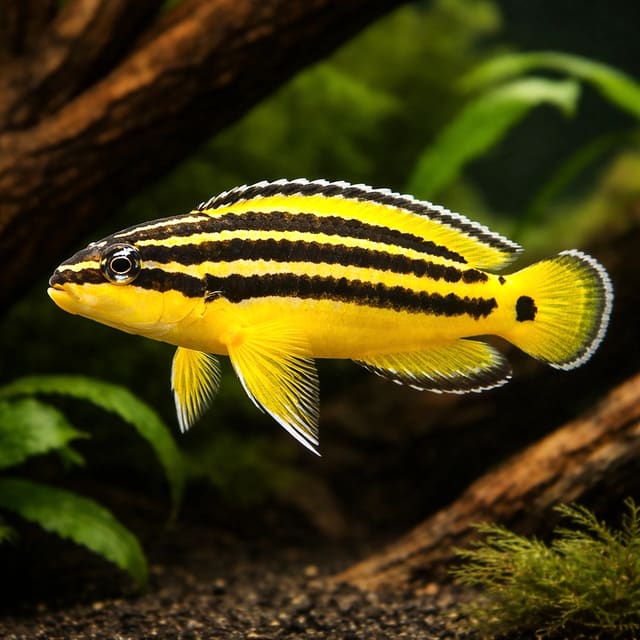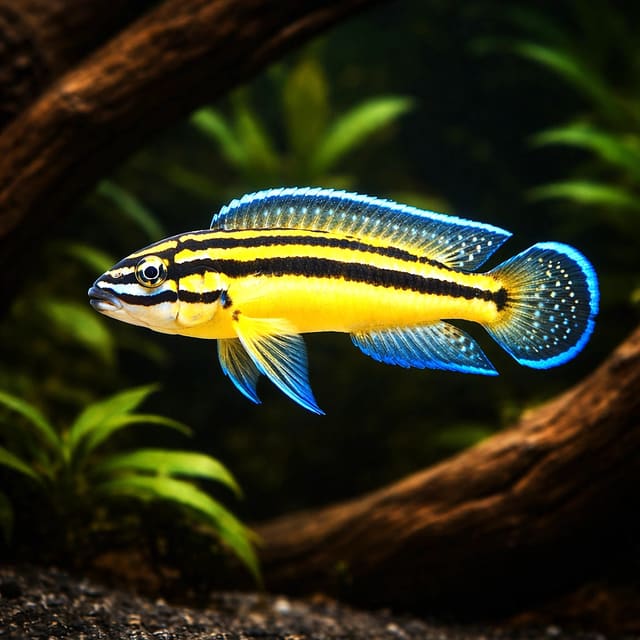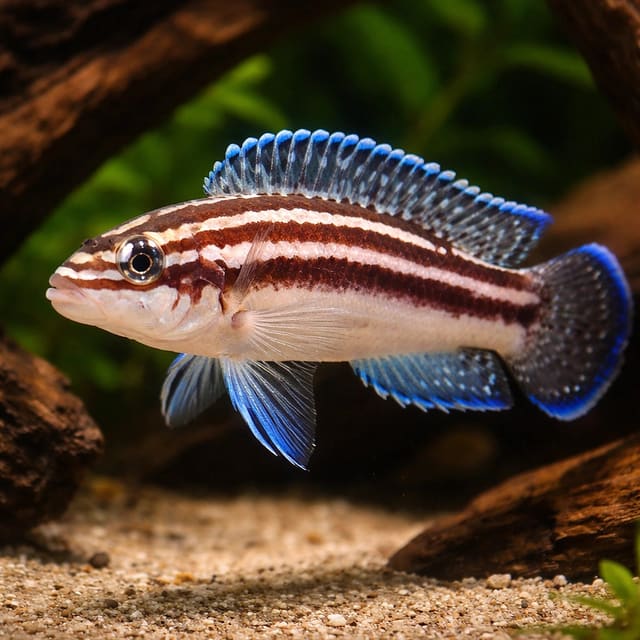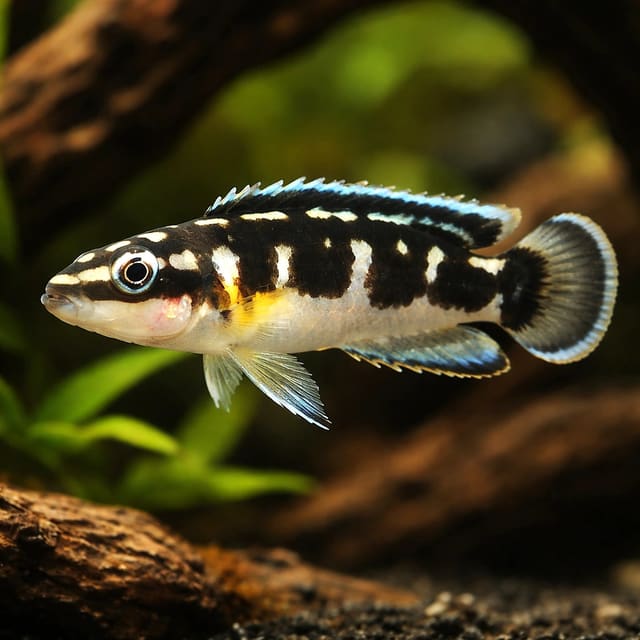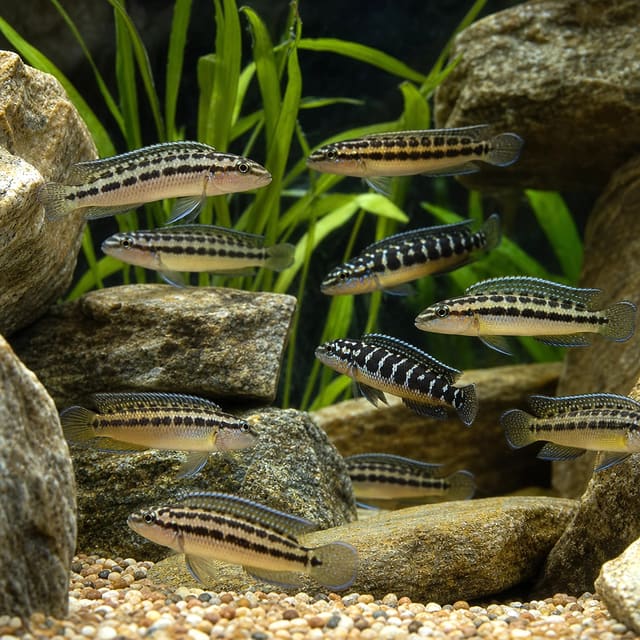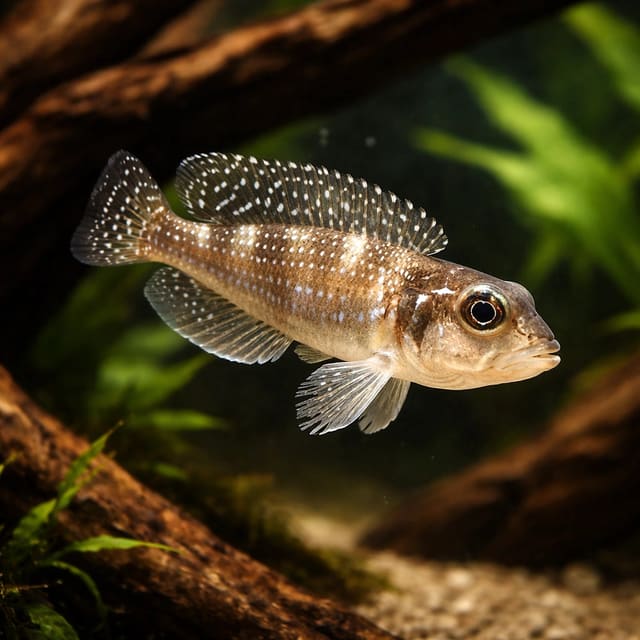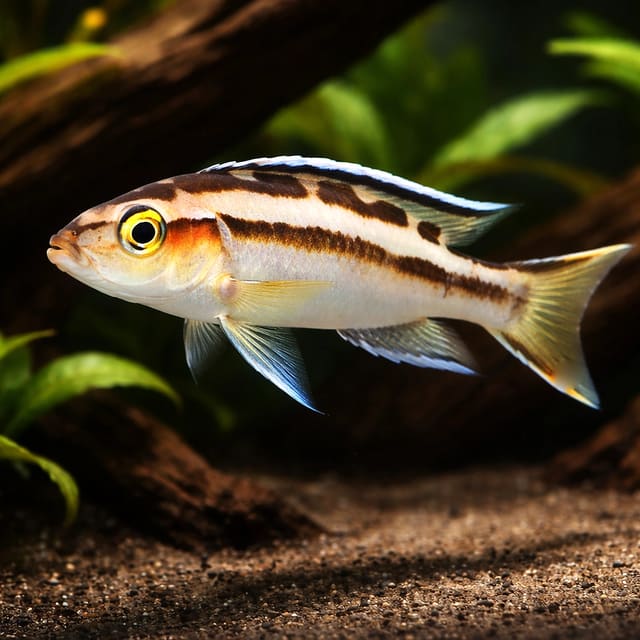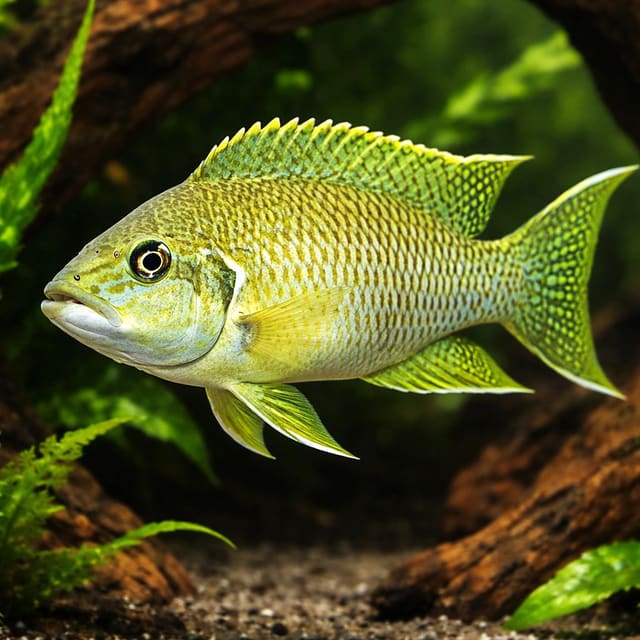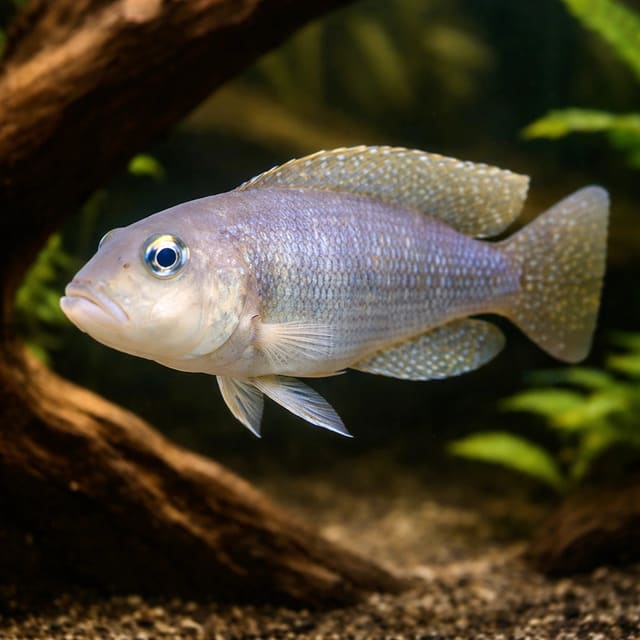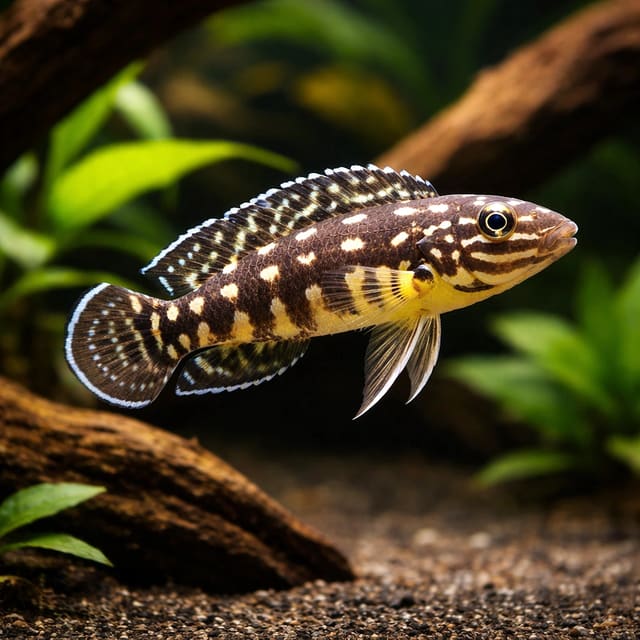
Marlier's Julie (Julidochromis marlieri)
23–25°C · pH 8–8.6 · 110L
£9.49
Masked Julie Gombi (Julidochromis sp.) is a rock-associated Tanganyikan cichlid trade form for a mature aquarium with stable water and carefully arranged caves. Sold as one live fish per purchase, without a guaranteed sex or breeding partnership. Plan around territorial behaviour rather than a general community-tank label.
Julidochromis sp.
Save when buying multiple fish. Each quantity is one fish; sex and pair formation are not guaranteed unless the selected variant explicitly states them.
Masked Julie Gombi (Julidochromis sp.) is a rock-associated Tanganyikan cichlid trade form for a mature aquarium with stable water and carefully arranged caves. Sold as one live fish per purchase, without a guaranteed sex or breeding partnership. Plan around territorial behaviour rather than a general community-tank label.

Cichlids are a family of roughly 1,800 accepted species, not one care type. Before buying, identify the exact species and source, then compare adult measurement, usable tank dimensions, social system, territory, tested water, diet and an exit plan. No family-wide minimum tank, water range or tank-mate list is safe.
Maintain these water conditions for optimal health and vibrant colors
Masked Julie Gombi (Julidochromis sp.) brings the close-up interest of a rock-associated Tanganyikan cichlid to a carefully planned aquarium. Its appeal is in watching how a Julie uses shelter, moves around the rockwork and responds to its neighbours. This is a fish to choose for an aquarium built around those needs: mature filtration, stable water, useful hiding places and enough room for the other inhabitants to stay out of its way.
Each purchase supplies one live, unsexed fish. Sex is guaranteed only when the selected option explicitly states male or female. This Masked Julie Gombi listing has no sex-guaranteed option. If you hope to keep more than one, plan their territories and a way to separate them before ordering; two purchases are not an established breeding pair.
The size choices are 4.5-5.5 cm, 3.5-4 cm and XL. The size you select is the size supplied, not the adult size. XL is a size label rather than a centimetre measurement; ask us about the current size if a precise measurement is important to your aquarium plan. Use the live size selector when ordering. The live selector shows which choice you can order.
Gombi is a trade-form name within Julidochromis. We list it as Julidochromis sp. because its exact species is unresolved. The genus is associated with rocky habitats around Lake Tanganyika; a wild collection locality or pedigree is not guaranteed for this offered fish.
Territorial behaviour matters more than a reassuring size label. A cichlid can occupy a relatively small cave while defending an area much larger than the cave itself. The important questions are where that area sits, whether another fish must cross it to feed, and whether a retreat leads somewhere safe. A display with attractive stonework can still be difficult for its residents if all routes end at one defended entrance.
Our starting aquarium guidance is 24–27°C, pH 7.8–9 and hardness 10–25 dGH for this trade form. These store planning values help you prepare a stable Tanganyika-style aquarium. Keep conditions steady and test the water you actually use. A change made simply to reach the middle of a printed range can be less helpful than maintaining suitable, stable conditions.
Plan a dedicated setup around the usable footprint and the intended residents, rather than treating a small volume as permission to add a group or several cichlid species. Rockwork takes up space; so do territory boundaries and escape routes. A wider, larger aquarium gives more opportunity to separate those areas. Decide on the layout and intended residents together before deciding that the volume alone is enough.
For a keeper who enjoys observing individual fish and adjusting the arrangement to their behaviour, a Julie can be a rewarding choice. For someone wanting to add a small fish to a busy soft-water community without changing anything else, it calls for more preparation. It is better to understand the water and territory requirements before buying than to discover that the only spare hiding place belongs to another fish.
Before ordering, make three practical checks. Confirm that your filter is established, that your normal water-change routine maintains the intended chemistry, and that you have a way to separate fish if an introduction fails. Then consider feeding access: a settled fish should be able to leave cover and find its food without being driven back immediately. Those checks are more useful than assuming all Tanganyikan cichlids will get along.
Start with the rockwork, because it shapes both the habitat and the interactions between fish. Provide secure caves and crevices, with different entrances and routes between them. Aim for several usable sheltered spaces rather than one impressive centrepiece. A fish that loses access to its preferred shelter still needs somewhere to go, and the keeper needs to be able to see whether it has been excluded.
Arrange stones securely before introducing livestock. A narrow gap that looks useful should not become a trap, and an unstable pile is a practical hazard whenever fish or maintenance disturb the substrate. Leave yourself enough access to remove waste and inspect the spaces around the stones. A layout that can only be cleaned by dismantling the whole territory will make routine care unnecessarily disruptive.
Think about sight lines at fish level. A continuous open view from one cave entrance to another can make it easy for one resident to watch and challenge its neighbour. Offsetting entrances or placing a substantial rock between areas can create some separation. Watch the residents after changing the layout to judge whether each can feed, rest and retreat comfortably.
Leave open routes alongside the shelters so a fish can move away without having to pass through another defended entrance. In a mixed aquarium, assess routes for every resident, not just the new Julie. A shy fish at the back may look as though it has plenty of cover, yet be unable to reach food at the front. Watch how the aquarium is used once it is occupied, and be willing to change the stocking plan.
Choose the tank for its usable footprint as well as its stated volume. Tall water above a dense stack of rocks does not create the same number of separate sheltered areas as a broader base. Assess the usable territories for your intended residents, and allow more room when other territorial fish are part of the plan.
Keep the aquarium on a sturdy surface, away from radiators and direct sunlight. A thermostat-controlled heater and a separate thermometer make it easier to maintain and confirm the temperature. The RSPCA also emphasises the importance of surface area and oxygen exchange. Arrange the filter outlet so there is useful surface movement, and check that decoration does not leave an area of the tank with poor circulation.
Lighting should let you observe the fish without turning every shelter into an exposed space. Give the aquarium a consistent day and night routine and keep the caves genuinely shaded. Leave access for checking fish with minimal disturbance rather than repeatedly lifting stones to find them. An aquarium lid also helps keep airborne pollutants out; avoid sprays, smoke and cleaning products around the open tank.
Complete these preparations before delivery. An empty aquarium gives you time to test the heater, check that the rocks remain stable and learn how water flows through the layout. Our guide to preparing a mature aquarium explains the general setup stages. Use it alongside the Julie's particular need for a considered rocky layout, rather than treating a generic tropical community as the finished plan.
Use our starting aquarium guidance of 24–27°C, pH 7.8–9 and 10–25 dGH for this Tanganyika-style setup. Temperature, pH and hardness describe different parts of the environment; matching one does not establish that the others are suitable. Measure your tap water and the aquarium water, and understand what your normal preparation method does before bringing the fish home.
Keep the chosen conditions steady within suitable aquarium guidance, rather than alternating between the endpoints. Your aim is an appropriate, repeatable environment. If your source water is far from the intended chemistry, discuss a sustainable preparation routine before purchasing rather than repeatedly making abrupt corrections after the fish arrives.
A mature biological filter is essential. Clear water can still contain harmful waste, and a running filter is not automatically a mature one. The RSPCA explains that beneficial bacteria convert ammonia to nitrite and then to nitrate. It recommends fishless cycling for new aquariums and testing through that process before adding fish. Establishing that capacity in advance is kinder than using the first livestock to test whether the filter is ready.
Ammonia and nitrite should both test at 0 mg/L. Include these tests in your routine, particularly during a new introduction, after a filter problem or whenever the fish behaves unusually. Do not judge water quality from colour or smell alone. Write down results so that a change is easier to recognise; a record is also useful if you need help deciding whether a problem began with the water, the equipment or an interaction between fish.
Water changes remove waste that filtration alone does not dispose of. Make them a consistent part of care, with the amount and frequency informed by testing and the demands of the aquarium. Prepare new water to be appropriate for the fish and close to the aquarium temperature. Use a suitable dechlorinating treatment for tap water and follow its directions; avoid adding untreated water merely because the tank looks clean.
When cleaning filter media, use water removed from the aquarium rather than washing it under the tap. That preserves the bacteria on which biological filtration depends. Keep the mechanical parts of the filter working too: a blocked intake or dirty impeller can reduce flow even when the media still contains bacteria. Watch the outlet after maintenance to confirm that the filter is actually moving water as expected.
Check the thermometer rather than relying only on the heater dial. Equipment can fail, and the room around the tank can alter the demands on it. A quick daily look at temperature, flow and the fish gives you a chance to notice a problem before the next planned maintenance day. During warmer weather, also pay attention to surface movement and oxygen exchange rather than treating heat as only a number on the display.
If a test result or sudden behavioural change worries you, establish what has changed before adding remedies. Check temperature, ammonia, nitrite and equipment function, then review recent feeding, cleaning and introductions. Seek advice for persistent abnormal breathing, injury or loss of balance. Avoid choosing medication from appearance alone; a water or social problem can continue while an unnecessary treatment adds another variable.
The practical goal is a routine you can sustain every week. Keep spare test reagents in date, allow time to prepare change water and leave enough access to clean around the rockwork. For help distinguishing the measurements, see our guide to understanding aquarium water chemistry. It is particularly useful when planning a hard-water aquarium from a different starting water supply.
Use an appropriately sized cichlid food as the practical basis of feeding, with suitable frozen foods and a spirulina-containing food providing variety. Those are the foods in the existing care guidance. Offer small portions that the fish can take comfortably, and watch the response rather than assuming that food disappearing elsewhere in the tank means every resident has eaten.
Julidochromis naturally pick at food around rocky surfaces. Ad Konings describes genus-level feeding on invertebrates and algae. That background helps explain why a Julie may spend time investigating surfaces. Choose suitable prepared and frozen foods that you can portion and observe easily.
Present aquarium foods where the fish has a clear route out of shelter. If faster inhabitants take every portion before the Julie approaches, change the feeding position or use more than one small feeding point. Make the adjustment visible and deliberate so you can judge whether it worked. Increasing the amount across the whole tank without checking access can simply leave more waste in the rockwork.
A varied diet should still be controlled. Give only what is being eaten and remove accessible leftovers. Frozen food settling into a crevice is easy to miss, so inspect the area after feeding and include it in maintenance. Good water quality and feeding are connected: uneaten food adds to the demands on the filter, while poor water can make a fish less willing to feed.
After arrival, begin cautiously and let observation guide the next meal. Keep disturbance low and avoid a heavy first-day feeding. Notice whether the fish takes food, spits it out repeatedly or is chased away. Appetite alone is only one sign; compare it with breathing, posture and access to shelter. If poor feeding persists, review water and social conditions and ask for advice rather than repeatedly changing foods without addressing the cause.
Build a short observation into normal feeding. Look at the fish before food goes in, watch it during the meal and glance at the tank afterwards. This makes it easier to notice an individual that is falling behind, especially in a rocky display where some residents can spend much of the day out of sight. Feed for the inhabitants you actually have, rather than for a future group you hope to establish.
A rocky aquarium should be planned for the keeper as well as the fish. Before you fill every available space, think through how you will reach the filter intake, siphon accessible waste and check a resident that has not appeared at feeding time. Leave a route for a net or another suitable transfer tool. Good access helps you respond calmly if a fish needs separating, instead of having to dismantle its shelter during an urgent problem.
Check the same points during each maintenance session. Look at the heater and thermometer, the filter outlet and intake, the stability of the stones and any accessible area where food collects. Then observe the residents after the work is finished. A familiar routine makes a new problem easier to spot, and it reduces the temptation to change several parts of the aquarium at once when one fish behaves differently.
Record useful details rather than only a list of products added. Water results, feeding response, the fish's usual shelter and the dates of introductions help describe the aquarium if you ask for advice. If an issue began after maintenance, note what was cleaned or moved. If it followed an introduction, describe which resident is pursuing which, where it happens and whether the affected fish is still able to eat.
A change to the rockwork can change the available routes and defended spaces. After moving a cave or clearing an area, watch how the fish use the new arrangement. A layout that worked before the change should not be assumed to work afterwards. Make deliberate adjustments for a reason, and give yourself enough observation time to judge their effect before adding more animals or rearranging another area.
Keep water care separate from decorating decisions. If ammonia or nitrite is detected, the immediate task is to restore appropriate water and investigate filtration or waste; a more attractive cave does not address that result. Conversely, normal test results do not establish that a repeatedly chased fish has a suitable social environment. Looking at both water and access to shelter prevents one kind of problem from hiding the other.
When planning an addition, revisit the whole aquarium rather than counting the number of apparently empty caves. An unused entrance may sit inside a territory that another fish already defends. Watch the routes between feeding and resting areas, and consider where a newcomer could retreat. A purchase is easier to plan when you know where each resident spends its time than when you judge capacity from a still photograph.
Keep enough flexibility to change the plan. An intended shared display may be better used as a dedicated aquarium if territorial exclusion continues. That decision does not require the fish to fit a promised temperament category; it follows what the residents show you. A smaller number of appropriately housed animals is preferable to maintaining an arrangement that only looks calm because an excluded fish stays hidden.
If you are preparing this aquarium around a particular space in your home, describe its dimensions, water conditions and intended residents when asking for advice. Include the usable base area after the rockwork is in place and whether you have a suitable separation option. Those details help with a practical discussion of the setup, using the residents' requirements and observed behaviour to guide the plan.
Have the mature aquarium ready before the parcel arrives. Check the water and temperature, confirm that the filter is running and clear your route to the tank. Someone must be at the delivery address to receive live animals. Read the current delivery and live arrival information before ordering, especially if your postcode or ability to receive the parcel needs checking.
Tropical Fish Co uses oxygen-filled bags in insulated packaging, with heat packs when conditions call for them, and a tracked courier licensed to carry live animals. The confirmed delivery date and tracking are sent by email. These arrangements help organise a safe journey, but they do not remove the need for immediate receipt, inspection and appropriate introduction to a prepared aquarium.
For arrival-claim evidence, start a continuous unboxing video while the parcel is still sealed. Show the outer box, open it in the same take and show the fish inside the still-sealed bag. This records the condition on arrival; it is separate from the steps you take to introduce the animal. The policy requires someone to receive the parcel, same-day opening and inspection, and continuous video evidence for a claim.
If a fish arrives dead, dying or clearly compromised, email hello@tropicalfishco.co.uk on the day of delivery with the order number and that video. Photos alone do not meet the policy. The stated resolution is replacement with your next order or a refund for the affected fish, subject to the guarantee terms. If the fish needs urgent help, contact us promptly while keeping the immediate welfare of the animal in view.
For a normal introduction, let the sealed transport bag come towards the aquarium temperature. The delivery guidance gives 20–30 minutes for floating the bag. Temperature matching does not by itself match pH or hardness, so ask for introduction advice in advance if the receiving water differs substantially. Avoid improvising a long procedure after opening a travelled bag.
Transfer the fish carefully with suitable equipment and discard the transport water rather than pouring it into the aquarium. Keep handling brief and avoid trapping the fish against a hard surface. Allow it to find shelter, and resist repeatedly moving rocks to make it visible. A settled observation point is more useful than a succession of disturbances whenever it disappears behind a stone.
Watch the first week for breathing, posture, appetite and interactions. Note where the new fish rests and whether it can leave that place without being pursued. A fish spending time in cover is not automatically a problem; a fish prevented from feeding or continually forced into an exposed corner needs attention. Keep tests and separation equipment available so you can respond to what is happening, rather than waiting for an introduction to resolve itself.
A Masked Julie Gombi belongs in a stocking plan that respects a rock-associated, territorial cichlid. Sharing a broad habitat label is only the beginning. Potential neighbours need compatible water, enough usable space and a layout that lets them feed and rest without constant contact. There is no universal list of safe companions that can replace watching the actual aquarium.
First consider the residents already using the rockwork. A fish defending a cave and a new fish seeking that cave can be a difficult combination even if their water requirements match. Map where the existing inhabitants rest, feed and defend space. Then decide where the Julie could establish itself. If there is no distinct area left, adding another rock on top may not solve the underlying lack of room.
Observe the difference between a brief challenge and sustained exclusion. A short interaction that ends with each fish returning to its own space is different from repeated pursuit that stops the same individual eating. Look for the effects: missed meals, damage, abnormal breathing or a fish confined to a corner. These signs matter more than whether a general temperament label says the species is semi-aggressive.
Provide a realistic separation option before attempting a combination. This may mean a suitable established spare aquarium or another arrangement agreed with an experienced keeper. A divider changes access and swimming room, so consider whether it actually provides an appropriate temporary space. Do not wait until a fish is injured to decide how it could be removed safely from an elaborate rocky display.
Another Julidochromis is not an automatic partner. The genus includes variable social and breeding arrangements, and two unsexed fish can be incompatible. Use the social observations as background while planning around the space and fish in your own aquarium. Introduce additional fish only as part of a considered plan with enough space, close observation and a way to intervene.
If your aim is breeding, discuss appropriate stock and the space available before buying. This offered fish is unsexed; plan the intended arrangement with an experienced keeper. Even animals that tolerate each other initially should continue to be observed as their behaviour changes.
Do not assume that very small fish or ornamental shrimp will be safe around a cichlid that picks at invertebrate foods. A peaceful-looking interval does not settle the longer-term risk. Make the needs of those animals part of the decision before mixing them. For any proposed companion, check its own adult size, feeding needs and behaviour, then consider how those requirements fit the entire aquarium.
A fast feeder can create a problem without overt fighting. If a Julie stays in shelter while other fish take the food, the aquarium may look calm yet fail to meet its needs. Check that every resident reaches food and returns to cover safely. Feeding in separate small areas can help you assess access, but if the same fish remains excluded, reconsider the combination rather than covering the problem with extra food.
When comparing Lake Tanganyika cichlids, read each fish's individual requirements. The category is useful for exploring different aquarium plans; membership does not establish that its fish can share one tank. Choose the residents around the available water, floor space and territories, and let the observed behaviour determine whether the final plan is suitable.
Plan for growth beyond the purchase size. Masked Julie Gombi is listed as Julidochromis sp., so a precise adult measurement is not promised for this trade form. Allow space for mature behaviour and territorial use of the rockwork rather than choosing a tank around a single small size figure.
Plan the aquarium around the intended residents and their use of space, rather than a fixed volume promise for this trade form. Usable floor space, caves, escape routes and the other residents determine suitability. A larger, wider aquarium gives more room to separate territories.
Plan additional fish around usable territories, close observation and a separation option. Julidochromis show variable social arrangements, so discuss the intended number and layout with an experienced keeper before combining fish.
We assess Masked Julie Gombi as intermediate because the keeper needs to maintain appropriate stable water and manage territorial interactions. A beginner can prepare carefully, but a mature dedicated aquarium and a practical separation plan are more suitable than an unplanned addition to a community tank.
Offer appropriately sized cichlid food with suitable frozen foods and a spirulina-containing food for variety. Watch that Masked Julie Gombi can leave shelter and reach each meal. Give small portions and remove accessible leftovers rather than compensating for poor feeding access with more food.
Our starting aquarium guidance is 24–27°C, pH 7.8–9 and hardness 10–25 dGH. Test the receiving water before introduction, prepare change water consistently and keep suitable conditions steady.
Masked Julie Gombi should be planned as a territorial rock-associated cichlid. Watch for sustained chasing or exclusion from food and cover, rather than relying on a temperament label. Arrange distinct sheltered areas and be ready to separate fish if the combination is not working.
Other cichlids need compatible water and their own usable territories; no companion is universally safe. Masked Julie Gombi is an invertebrate-feeding cichlid, so ornamental shrimp should not be assumed safe. Review each animal's needs and the whole layout before combining them.
Tropical Fish Co packs fish in oxygen-filled bags inside insulated boxes, with heat packs when needed, for a tracked licensed live-animal courier. Someone must receive and inspect the parcel on arrival. For a Live Arrival Guarantee claim, email on the delivery day with the order number and a continuous video showing the sealed parcel being opened and the fish still in the sealed bag; photos alone are insufficient. Guarantee terms apply.
Ad Konings on Julidochromis habitats and social behaviour explores rocky Tanganyikan habitats, variable relationships and the difficulty of applying species names to some forms. Its individual breeding examples provide useful background to the genus’s social diversity.
The RSPCA's advice on the aquarium environment explains mature filtration, water testing, oxygen exchange and careful introduction. Use it for general fish-welfare preparation and maintenance.
No reviews for this item yet. Bought one? Honest reviews only, good or bad.
What customers say about ordering from us
Easy website plenty of info on fish your buying great to pick a time slot
TRACEY DURRANT · 7 Oct 2026
Got some lovely fish thank you
Kevin Mackie · 7 Oct 2026
Reviews of our shop, collected by Judge.me, an independent third-party review collector. Newest first.