Advanced
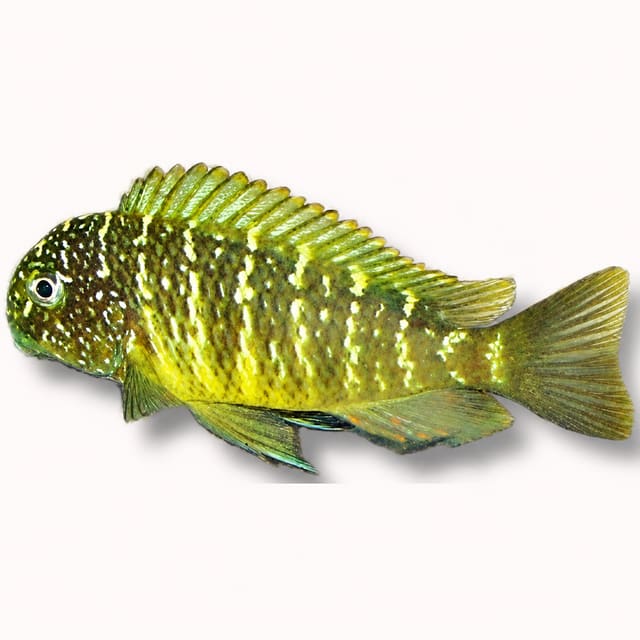
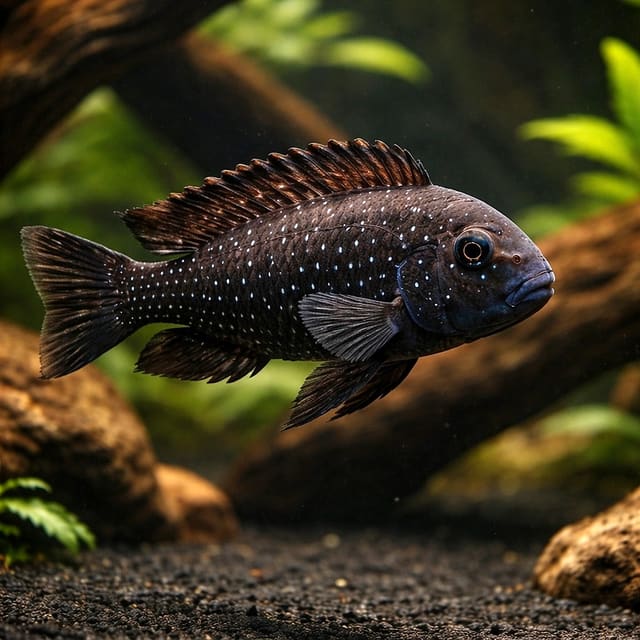
Duboisi, White-Spotted Cichlid (Tropheus duboisi)
23–27°C · pH 8–8.6 · 110L
From £17.39Some sizes on sale
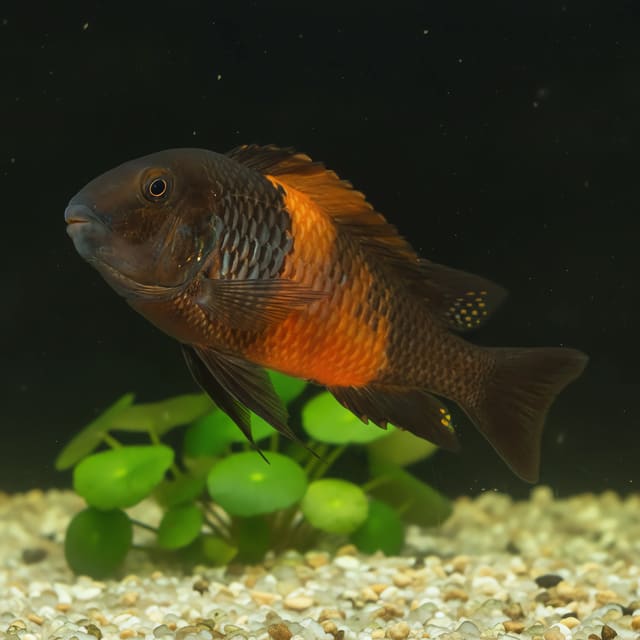
Tropheus moorii Caramba is a colour form of the blunthead cichlid from Lake Tanganyika, kept as a colony of 15–20 in a long aquarium with hard, alkaline water. It needs a mainly vegetable diet and consistently clean water, so it suits experienced keepers rather than beginners.
Adult size is the maximum length this species reaches at full maturity (scientific sources). The livestock you receive will be younger and smaller — pick a size above for the actual shipping size. Product-photo provenance and any image-specific limitations are stated on the listing.
Tropheus moorii
Save when buying multiple fish. Each quantity is one fish; sex and pair formation are not guaranteed unless the selected variant explicitly states them.
Tropheus moorii Caramba is a colour form of the blunthead cichlid from Lake Tanganyika, kept as a colony of 15–20 in a long aquarium with hard, alkaline water. It needs a mainly vegetable diet and consistently clean water, so it suits experienced keepers rather than beginners.
Adult size is the maximum length this species reaches at full maturity (scientific sources). The livestock you receive will be younger and smaller — pick a size above for the actual shipping size. Product-photo provenance and any image-specific limitations are stated on the listing.
Cichlids are a family of roughly 1,800 accepted species, not one care type. Before buying, identify the exact species and source, then compare adult measurement, usable tank dimensions, social system, territory, tested water, diet and an exit plan. No family-wide minimum tank, water range or tank-mate list is safe.
Maintain these water conditions for optimal health and vibrant colors
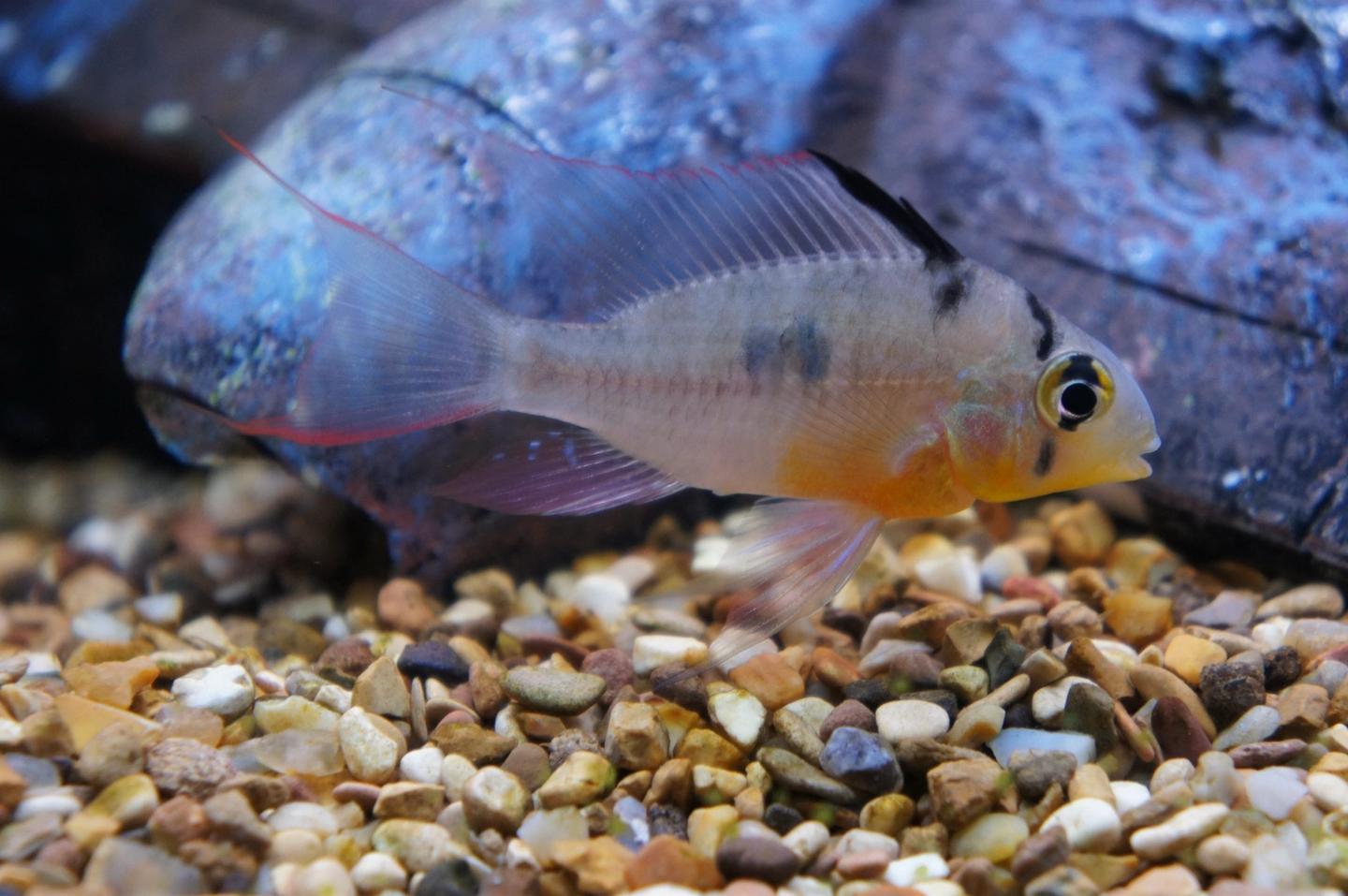
Tropheus moorii Caramba is one of the named colour forms of the blunthead cichlid, a cichlid found only in Lake Tanganyika. Each purchase is one live fish of the size you choose. This is a colony fish for a dedicated aquarium: it is usually kept in a group of 15–20, it needs hard, alkaline water and a diet built on vegetable foods, and it is very sensitive to poor water quality. If you can plan a long aquarium around a single colony, it is a fascinating fish to keep. If you want one or two fish for a mixed community, it is the wrong choice.
FishBase places Tropheus moorii in the cichlid family, Cichlidae, records it as endemic to Lake Tanganyika and gives a maximum length of 14.5 cm. It also lists the species as Near Threatened on the IUCN Red List. Seriously Fish counts more than 50 geographical colour forms of Tropheus moorii, and Caramba is the trade name for one of them. You will sometimes see the name spelled Tropheus moori, which FishBase treats as a synonym of Tropheus moorii.
Part of the appeal is that Tropheus keeping still rewards thought and careful observation. Seriously Fish calls the species something of an enigma in the aquarium hobby: despite its popularity, keepers still debate the best way to maintain it, and what works for one aquarist may not work for another. The approach on this page follows the generally accepted method of a large colony, a vegetable-based diet and excellent water quality, which is the safest starting point for a first colony.
| Suits | Think twice if |
|---|---|
| Keepers ready to give a long aquarium to one colony of 15–20 fish | You want one or two fish for a mixed community |
| Hard, alkaline water held at pH 8.0 or above | Your water is soft and acidic and you would rather not manage it |
| A feeding routine built on vegetable foods | You like to feed meaty foods to the whole tank |
| A Lake Tanganyika aquarium with active fish that share a similar diet | You keep shy fish or Lake Malawi cichlids |
| A weekly routine of water changes and testing | Maintenance tends to slip for weeks at a time |
| Feature | Detail |
|---|---|
| Family | Cichlidae |
| Native range | Lake Tanganyika only |
| Maximum recorded length | 14.5 cm |
| Social needs | Colony of 15–20 recommended |
| Temperament | Squabbles with its own kind; relatively peaceful towards other species |
| Aquarium water | 23–27 °C, pH 8.0–9.5, 8–25 dGH |
| Diet | Mainly vegetable foods |
| Conservation status | Near Threatened (IUCN) |
This listing offers four sizes: 3 cm, 3.5–5 cm, 5–7 cm and 7–9 cm. The size you select is the size supplied, not the adult size. Even the largest fish in that range still has several centimetres to grow, so plan the aquarium for adults of around 14.5 cm from the very start.
Smaller fish are the natural choice if you want to grow a colony on together from a young age. Larger fish are further along in growth, but they still need the same full-sized aquarium, the same group size and the same careful introduction. Whichever size you pick, have the aquarium matured and running at the right water values before you order.
Seriously Fish recommends buying young fish and letting them grow up together, which is usually easier than assembling a colony from adults. Whichever size you choose, buy the whole group at once. OATA's advice for African lake cichlids is that some species are best added in groups, so that no single fish takes the brunt of the aggression while it settles in, and Tropheus are exactly that kind of fish.
Males and females are hard to tell apart, and Seriously Fish advises that the only reliable way to tell them apart is a close examination best left to experienced keepers. Sex is guaranteed only when the selected option explicitly states male or female. This Tropheus moori Caramba listing has no sex-guaranteed option. For a breeding project, Seriously Fish suggests starting with 20–30 young fish, as explained in the breeding notes further down this page.
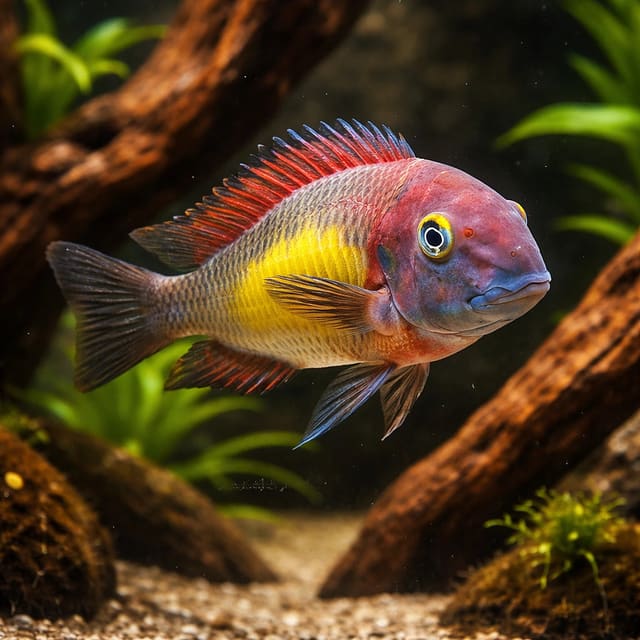
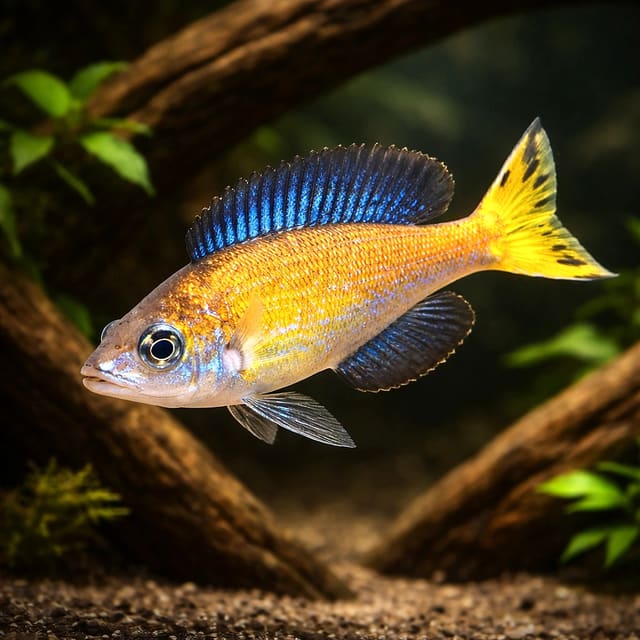
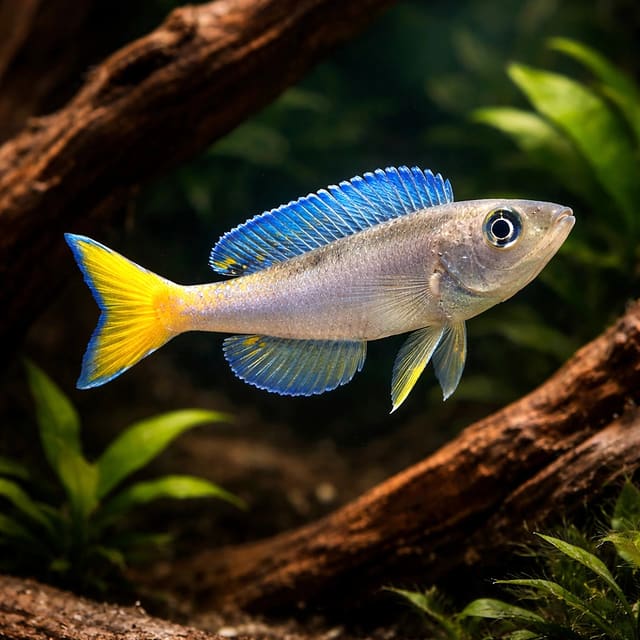
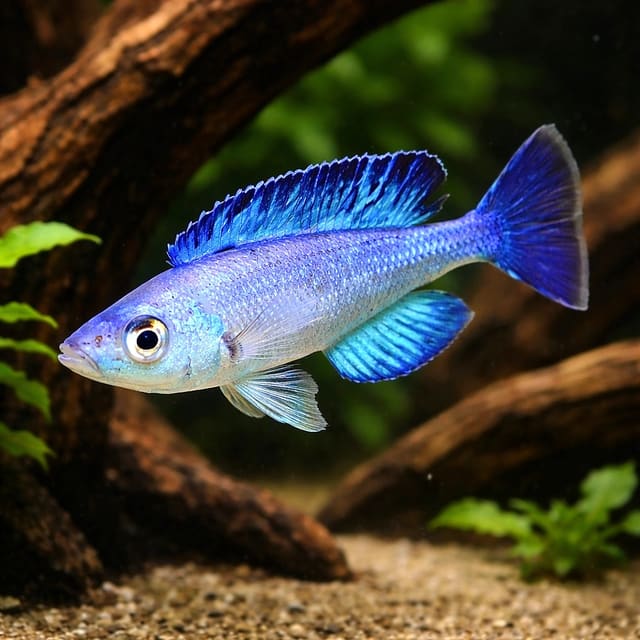
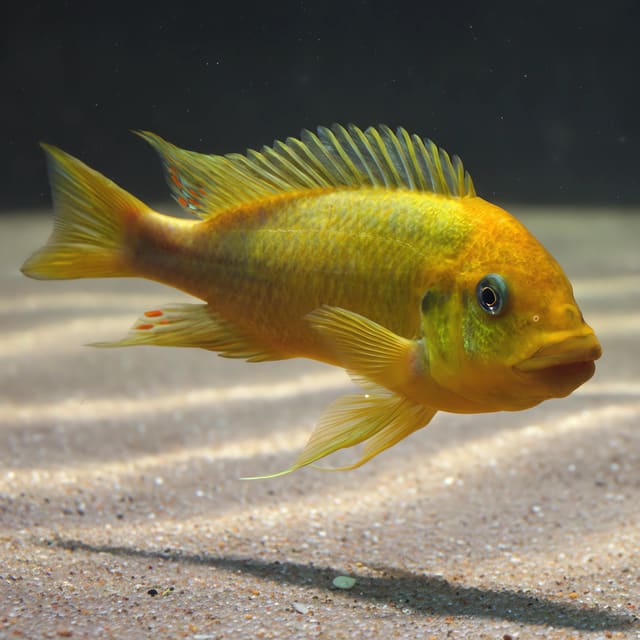
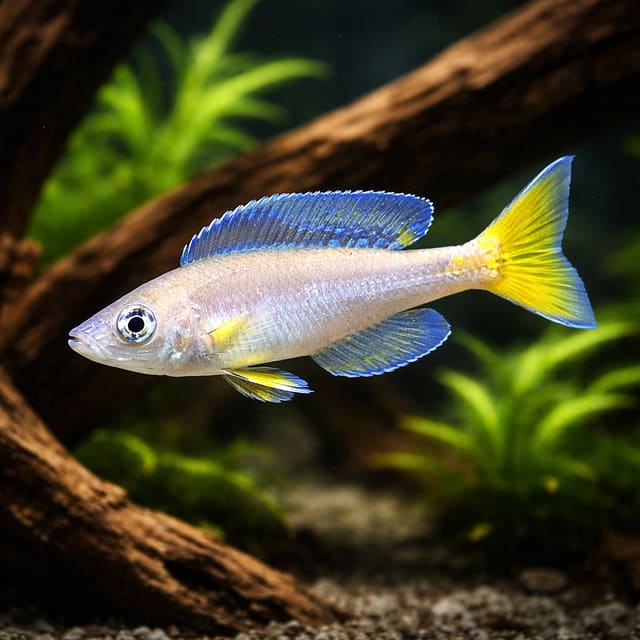
Gallery images have been digitally enhanced to improve image quality. Natural colour, pattern, size and maturity can vary between live animals.
Space is the first decision. FishBase gives 150 cm as the minimum aquarium length for Tropheus moorii. Seriously Fish sets a base of 120 × 30 × 30 cm, about 110 litres, for a single specimen, and adds that a much larger tank is required for a group. Because this is a colony fish, read the single-fish figure as a floor that a group quickly outgrows, and treat 150 cm as the starting length rather than the goal.
OATA's general rule for African lake cichlids points the same way: within reason, buy the largest aquarium you can. A bigger volume keeps temperature and water quality more stable, and for a fish this sensitive to water quality, that stability matters as much as the extra floor space.
Seriously Fish describes two approaches that both work. Many keepers run Tropheus in bare aquariums, which reduces territorial behaviour. Others build piles of rockwork with plenty of caves and hiding places, interspersed with open areas for swimming. In either style, use sand as the substrate.
Seriously Fish stresses well-oxygenated water. OATA recommends an oversized filter for African lake cichlid communities, which are often stocked more heavily than a typical community aquarium, together with vigorous aeration to keep enough dissolved oxygen in the water. A filter is not optional: the RSPCA's welfare guidance is that no fish should be kept without a well set up and maintained filter, because fish release ammonia that the filter's bacteria must convert, first into nitrite and then into the safer nitrate.
Those bacteria take time to build up, so the aquarium must be fully matured before the colony arrives. Our guide to setting up and maturing a tropical tank walks through that process step by step. The same principles apply to a large cichlid system, just on a bigger scale, and a colony of fish growing towards 14.5 cm puts a far heavier load on the filter than a tank of small community fish.
Tropheus moorii comes from hard, alkaline lake water, and every source points the same way: high pH, high hardness and a warm, steady temperature. The table sets out the aquarium ranges Seriously Fish gives for this species, followed by the values for keeping the water clean from the OATA care sheet.
| Measure | Aim for |
|---|---|
| Temperature | 23–27 °C |
| pH | 8.0–9.5 |
| General hardness | 8–25 dGH |
| Ammonia | Zero |
| Nitrite | Zero |
| Nitrate | No more than 20 mg per litre above your tap water level |
FishBase's record for the wild habitat is a little narrower: 24–26 °C, pH 8.0–9.0 and 9–19 dH. Those are lake figures rather than aquarium limits, but they are a useful reminder that the species comes from warm, hard and alkaline water. In practice, aim for a steady temperature in the middle of the aquarium range and a pH comfortably above 8, rather than letting either drift towards an edge.
The OATA care sheet for African lake cichlids suggests 23–27 °C, pH 8.0–8.6, general hardness of 12–18 °dH and carbonate hardness of 10–15 °dKH. That is broad guidance written for many species at once rather than a species-specific optimum, but it sits within the Tropheus ranges above and makes a sensible everyday target if you are unsure where to settle.
Test your tap water before you buy the fish, not after. If its pH or hardness sits well below these ranges, you will need a plan to raise and hold them; a coral sand substrate helps, but it is no substitute for regular testing. Our guide to aquarium water parameters explains what each test measures and why it matters, and the water parameter matcher lets you compare your own readings with the ranges on this page.
Stability is the real goal. Seriously Fish notes that water quality is of the utmost importance in a Tropheus tank because the species is very susceptible to bloat. Keep ammonia and nitrite at zero, stop nitrate from building up, and make any change to temperature or chemistry gradually rather than in sudden jumps.
Soft tap water is not a barrier, but it does mean extra work at every water change. Each change dilutes the hardness and alkalinity in the aquarium, so prepare replacement water to the same values before it goes in, and test afterwards to confirm the tank has not dipped. Matching the new water to the old is far kinder than letting pH and hardness swing up and down from week to week.
Diet matters as much as water for Tropheus. In the wild, FishBase records the species feeding on worms, crustaceans, insects and plant matter, and for aquariums it notes that Tropheus moorii feeds on epiphyton, the fine growth of algae on submerged surfaces. Seriously Fish says the fish will accept most foods offered, but that vegetable matter should form the basis of the diet.
Never feed beefheart or any other animal meat. Seriously Fish warns that it interferes with the digestive system of these fish. The OATA care sheet draws the same line at group level: herbivorous species such as tropheus appreciate specialised cichlid foods with a high algae content and fresh vegetables, whereas the meatier pellets and frozen foods used for predatory lake cichlids belong to a different feeding plan altogether.
OATA's guidance for African lake cichlids is to feed only what the fish can eat within a few minutes, twice a day. Take care not to overfeed. Uneaten food breaks down and releases toxic waste into the water, and in a Tropheus tank that waste works directly against the clean, stable conditions the fish depend on. Remove anything left over once the fish have finished. Vegetable extras such as blanched spinach and nori should be offered in small amounts and taken out if they are not eaten, for the same reason.
Seriously Fish links Tropheus health most closely to water quality, noting that the species is very susceptible to bloat, and it warns separately against animal meat. Put those together and the safest routine is clear: a vegetable-based diet, fed in modest portions, in water that is kept consistently clean. A colony that stops feeding keenly deserves a water test the same day.
A Tropheus aquarium rewards a routine that never slips. The OATA care sheet for African lake cichlids recommends the following as a minimum:
OATA adds that good husbandry is essential because African lake cichlids can be stressed by even the smallest amounts of ammonia. That is doubly true for Tropheus. The RSPCA makes the underlying point for every aquarium: a working biological filter is what turns toxic ammonia into nitrite and finally into nitrate, and it only keeps doing so if it is maintained.
Keep a simple log of test results and water changes. Gradual trends, such as nitrate creeping up between changes or pH drifting down, are much easier to spot on paper than from memory, and a log gives you time to act before the fish show any sign of trouble.
Get to know how your fish normally look and behave, so that any change stands out. OATA lists these changes to watch for:
If you notice any of these, test your water quality first, as OATA advises, and get in touch with us if you would like guidance. With a species as susceptible to bloat as Tropheus moorii, a fish that stops eating should never be left to see how it goes.
Most Tropheus problems start before the fish arrive, so it pays to have everything in place first. Work through this list before you order:
It also helps to decide in advance how you would respond if one fish were persistently targeted. Rearranging the rockwork is the first tool, since OATA notes that it can reduce aggression as fish find new territories, and Seriously Fish recommends the larger colony precisely because it reduces territorial behaviour.
We hand-bag fish in pure oxygen and pack them in an insulated poly box, with a heat pack when the weather calls for it. A licensed live-animal courier carries the parcel on a tracked service, and we email you the tracking number and your confirmed delivery date so that you know when to be in. The full conditions are set out on our delivery and Live Arrival Guarantee page.
Before adding any fish, OATA advises checking that the aquarium is an appropriate size for the number of African lake cichlids you plan to keep, and that ammonia and nitrite both read zero. It also warns that stocking too many fish too quickly can cause new tank syndrome, when there are not enough nitrifying bacteria to cope with the extra waste.
A Tropheus colony has to balance that warning against its own social needs. The answer is preparation: mature the filter fully, size it for the finished colony, and then introduce the group together so that no single newcomer faces an established set of residents. Test the water often while the filter adjusts to the extra waste. OATA also notes that rearranging the décor can help to reduce aggression, because the fish have to find new territories, which is worth remembering if you ever need to add fish to an existing group.
Healthy fish, OATA notes, have clear bright eyes, undamaged fins and intact scales, with no ulcers or bumps. Check each fish as it settles, and keep an eye on feeding during the first week.
Breeding is possible in a well-run colony. Tropheus moorii is a maternal mouthbrooder: FishBase notes that the females brood their young in the mouth, and Seriously Fish describes spawning in open water, usually over rocks, in an aquarium set up as described above.
Seriously Fish recommends buying 20–30 young fish and allowing them to grow on together. It is honest that the perfect group is hard to achieve and that some fish, particularly subdominant males, may be lost along the way. The other approach it describes is to remove dominant males as they develop until you reach the ratio you want.
Telling the sexes apart is not easy. Seriously Fish describes subtle differences in growth rate and body shape, but the only reliable method is examining the genital papillae, which are pointed in the male and rounded in the female, and it recommends this to experts only. For most keepers, the practical route is to buy a generous group of young fish and let the colony reveal its own balance as it matures.
In the wild, FishBase notes that adult Tropheus moorii are solitary, and Seriously Fish adds that the fish do not school in nature. In an aquarium, where they cannot spread out along a lake shore, they squabble with their own kind and will usually fight amongst themselves until a natural pecking order is established.
Group size is how keepers manage that. Seriously Fish warns that smaller groups of 5–6 fish do not settle easily and may fight to the death, and it generally recommends a group of 15–20 to reduce territorial behaviour. It acknowledges exceptions, including small groups and even pairs, but its general recommendation remains the larger colony.
The warning signs of a fish that is struggling within the group are the same ones OATA lists for health in general: hiding more than normal, torn or missing fins, losing condition or losing interest in food. Spot them early, and you have time to try a change to the rockwork or the group balance.
Seriously Fish describes Tropheus moorii as relatively peaceful towards other species and calls its reputation for aggression undeserved. The fish are very active, however, and should not be kept with shy species. Its possible tank mates are Julidochromis, Eretmodus and Tanganicodus species, which it names because they need a similar diet to Tropheus.
| Consider | Avoid |
|---|---|
| Julidochromis species | Shy or timid fish |
| Eretmodus species | Lake Malawi cichlids |
| Tanganicodus species | A second colour form of Tropheus moorii |
The OATA care sheet sets the wider rule for African lake cichlids: stock them only with species from the same location, such as a Lake Tanganyika community, and do not mix Malawi and Tanganyikan cichlids because of their differences in temperament and behaviour. It also suggests adding the more peaceful species first and the more aggressive species later. Our African cichlid range includes fish from more than one lake, so check each species' origin before you plan a mixed Tanganyikan aquarium.
Diet is the other deciding factor. A companion that needs a meaty diet will tempt you to feed foods that do not suit Tropheus, which is why the similar-diet species above make the most sense.
OATA notes that some African lake cichlids need a slight overstocking, so that no individual becomes overly aggressive towards weaker members of the group, and that crowded set-ups call for an oversized filter. A Tropheus colony of 15–20 is already a substantial load, so each companion species adds to the demands on the filter and on your weekly maintenance. Follow OATA's order of adding the more peaceful species first and the more aggressive species later, and increase numbers slowly so that the filter bacteria can keep pace.
Seriously Fish records more than 50 geographical colour forms of Tropheus moorii, some with truly stunning colouration, and states that they should not be mixed in aquaria because they hybridise freely. It also expects some of these forms to be described eventually as distinct species. Plan each aquarium around a single colour form, so a Caramba colony stays Caramba only.
If another Tropheus moorii form catches your eye, give it an aquarium of its own rather than adding it to the Caramba group.
There is a conservation reason too. FishBase lists Tropheus moorii as Near Threatened, and Seriously Fish describes its many colour forms as geographical morphs. Keeping every form separate in the aquarium preserves what makes each one distinct, and it is part of keeping the species responsibly.
FishBase records a maximum length of 14.5 cm for the species, and Seriously Fish lists 145 mm standard length. Plan the aquarium around adults of about that size.
FishBase gives 150 cm as the minimum aquarium length for Tropheus moorii. Seriously Fish puts a single fish in 120 × 30 × 30 cm, about 110 litres, and says a group needs a much larger tank, so start at 150 cm long for a colony and go bigger where you can.
Seriously Fish recommends a group of 15–20 Tropheus moorii to reduce territorial behaviour, and warns that groups of 5–6 do not settle easily and may fight to the death. Introduce the colony together rather than a few fish at a time.
No. Seriously Fish describes Tropheus moorii as not a good species for the beginner. It needs a large colony, hard and alkaline water, a vegetable-based diet and excellent water quality, because it is very susceptible to bloat.
Base the diet on vegetable foods such as spirulina flakes, blanched spinach and nori, alongside a quality dried food and an algae-based food. Small feeds of live or frozen food can supplement this, but never feed beefheart or other animal meat. Offer only what the fish can eat within a few minutes, twice a day.
Seriously Fish gives 23–27 °C, pH 8.0–9.5 and 8–25 dGH for aquarium care. FishBase records the wild habitat at 24–26 °C and pH 8.0–9.0. Keep the water hard, alkaline and steady.
Seriously Fish says its reputation for aggression is undeserved: it is relatively peaceful towards other species but squabbles with its own kind until a pecking order forms. It is very active, so it is a poor match for shy fish.
Choose active Lake Tanganyika species. Seriously Fish names Julidochromis, Eretmodus and Tanganicodus species as possible companions because they need a similar diet. Do not add shy fish, Lake Malawi cichlids or a second colour form of Tropheus, which would hybridise.
We hand-bag fish in pure oxygen inside an insulated poly box and send them with a licensed live-animal courier on a tracked service. Be in to receive the parcel, film one continuous unboxing video from the sealed parcel to the fish still in the bag, then float the bag for 20–30 minutes before releasing the fish without the bag water.
No reviews for this item yet. Bought one? Honest reviews only, good or bad.
What customers say about ordering from us
Easy website plenty of info on fish your buying great to pick a time slot
TRACEY DURRANT · 7 Oct 2026
Got some lovely fish thank you
Kevin Mackie · 7 Oct 2026
Reviews of our shop, collected by Judge.me, an independent third-party review collector. Newest first.