Moderate
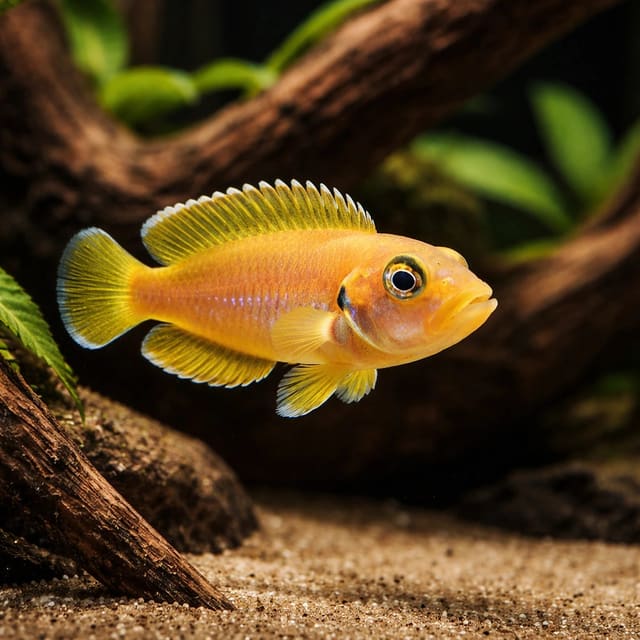
Gold Ocellatus Shell-Dweller (Neolamprologus ocellatus)
23–25°C · pH 8–9
£16.59

Popelin's Chalinochromis (Chalinochromis popelini) is a freshwater cichlid from Lake Tanganyika that reaches 15 cm total length. It suits keepers planning a mature, hard-water Tanganyikan aquarium; OATA's African lake cichlid guidance gives 23–27°C, pH 8.0–8.6 and 12–18°dH, while the number kept depends on the species plan. Sold individually in sizes from 4–5 cm to 5–7 cm.
Adult size is the maximum length this species reaches at full maturity (scientific sources). The livestock you receive will be younger and smaller — pick a size above for the actual shipping size. Product-photo provenance and any image-specific limitations are stated on the listing.
Chalinochromis popelini
Save when buying multiple fish. Each quantity is one fish; sex and pair formation are not guaranteed unless the selected variant explicitly states them.
Popelin's Chalinochromis (Chalinochromis popelini) is a freshwater cichlid from Lake Tanganyika that reaches 15 cm total length. It suits keepers planning a mature, hard-water Tanganyikan aquarium; OATA's African lake cichlid guidance gives 23–27°C, pH 8.0–8.6 and 12–18°dH, while the number kept depends on the species plan. Sold individually in sizes from 4–5 cm to 5–7 cm.
Adult size is the maximum length this species reaches at full maturity (scientific sources). The livestock you receive will be younger and smaller — pick a size above for the actual shipping size. Product-photo provenance and any image-specific limitations are stated on the listing.

Cichlids are a family of roughly 1,800 accepted species, not one care type. Before buying, identify the exact species and source, then compare adult measurement, usable tank dimensions, social system, territory, tested water, diet and an exit plan. No family-wide minimum tank, water range or tank-mate list is safe.
Maintain these water conditions for optimal health and vibrant colors
Popelin's Chalinochromis (Chalinochromis popelini) is a freshwater cichlid from Lake Tanganyika that reaches 15 cm total length. FishBase places it in the family Cichlidae and records it from the western coast of the lake in the Democratic Republic of the Congo and the eastern coast in Tanzania. It suits a keeper prepared to maintain hard, alkaline water, run a mature biological filter and plan the aquarium around its adult size and territorial use of the lower area.
In nature, this is a sedentary rubble-dweller. It feeds on invertebrates growing on rocks and hidden by the biological covering, and it builds a nest within rubble. Those facts make lower structure central to planning: provide usable rubble areas and routes through the lower aquarium rather than relying on open water alone.
Wikipedia's account of Chalinochromis places the genus within the Lake Tanganyika fauna of the East African Rift. It also notes specialised jaws that enable members of the genus to feed on sponges. Use the species account for this fish's recorded rock-invertebrate feeding and the genus account as wider natural-history context.
We class its care level as intermediate. The main decisions are maintaining the required chemistry, creating usable rubble territories, screening companions and increasing stocking gradually enough for the filter to respond.
One purchase supplies one animal of the selected size. Use the live size selector when ordering; the labels are 4–5 cm and 5–7 cm. These are dispatch sizes and should not be used to estimate sex, life stage, eventual social role or the space the mature fish will require.
The size you select is the size supplied, not the adult size. FishBase records a maximum of 15 cm total length for a male or unsexed fish. Plan the aquarium, filtration capacity, rock layout and companion selection around that 15 cm planning reference.
Sex is guaranteed only when the selected option explicitly states male or female. This Popelin's Chalinochromis listing has no sex-guaranteed option.
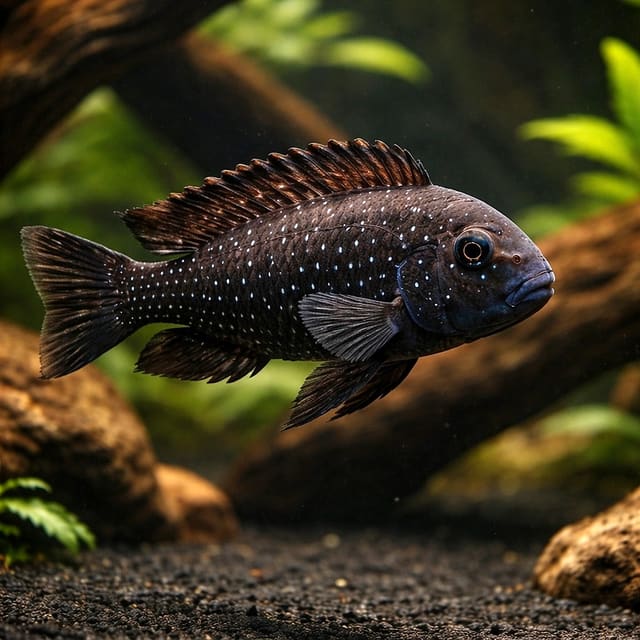
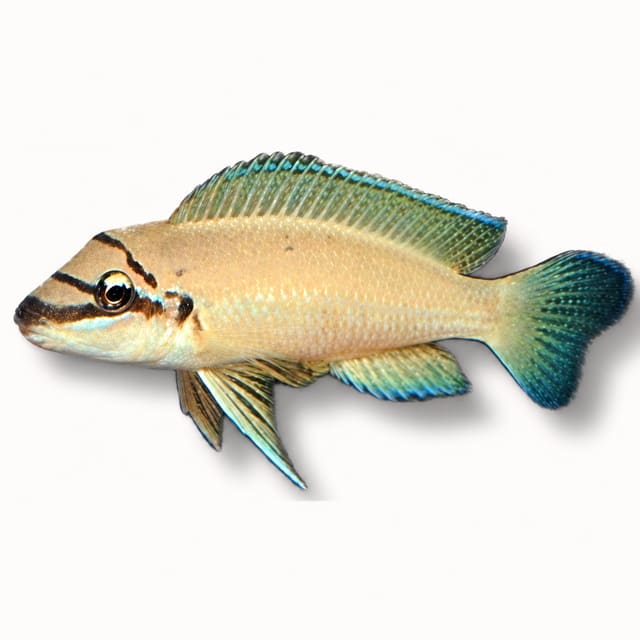
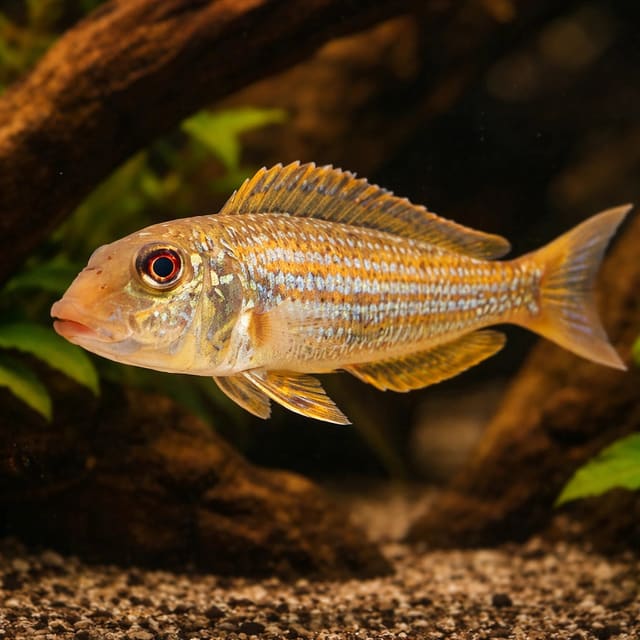
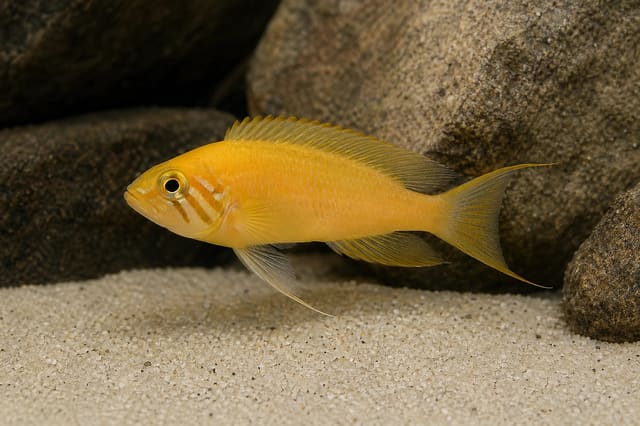
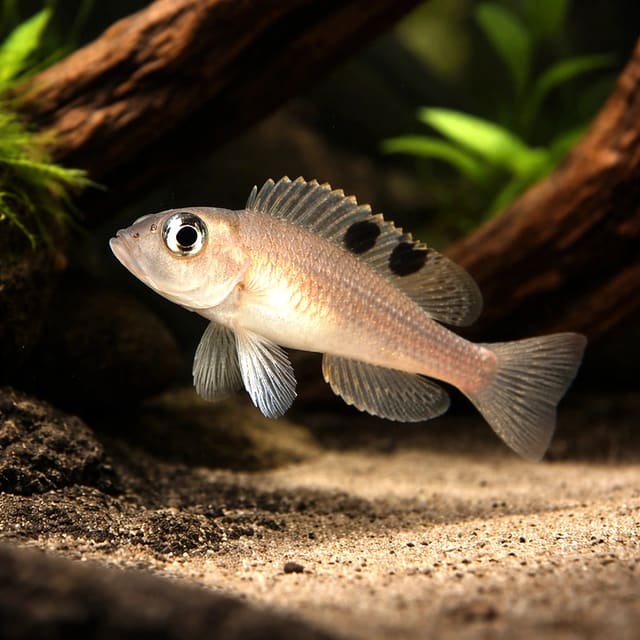
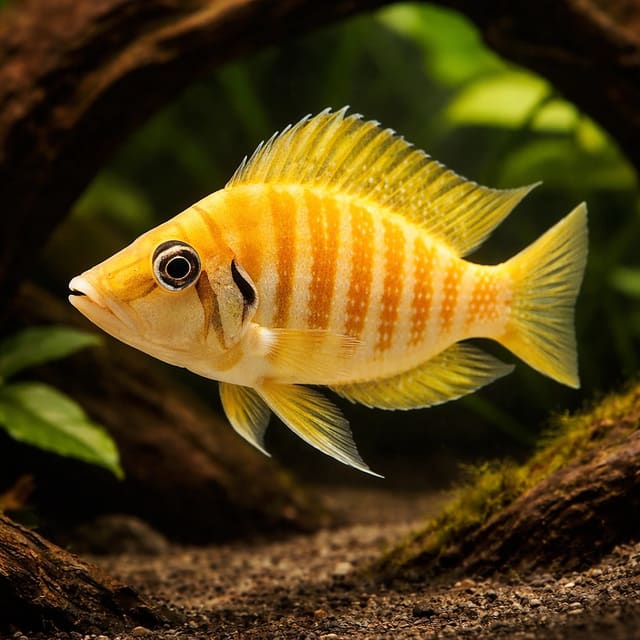
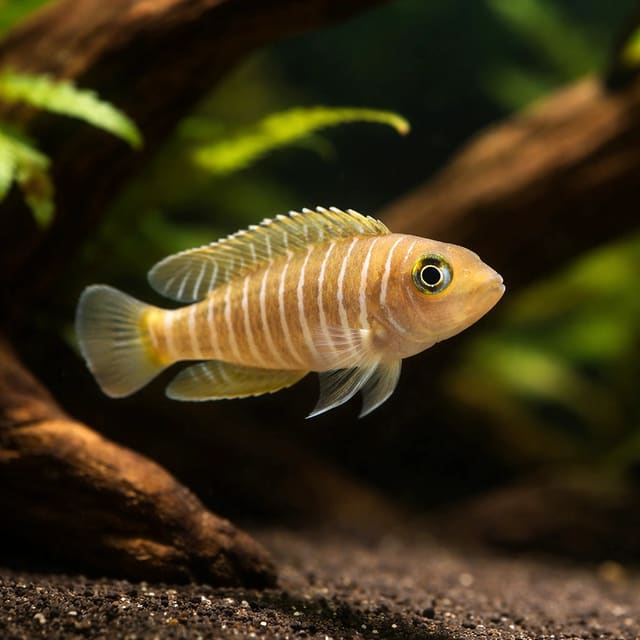
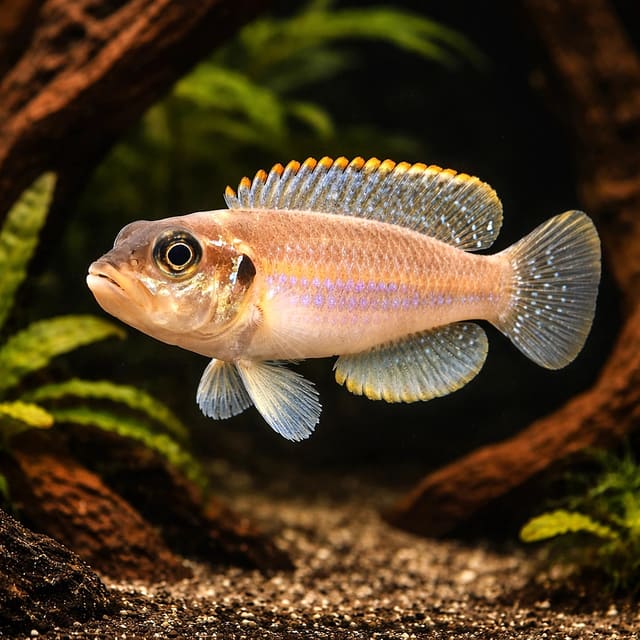
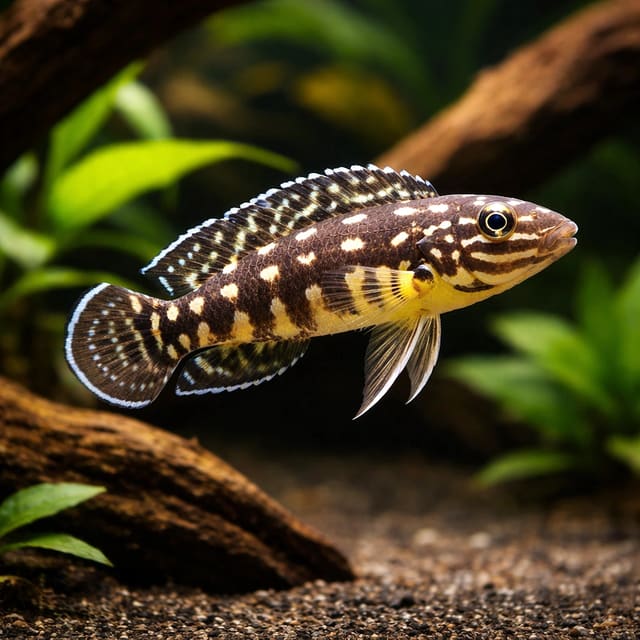
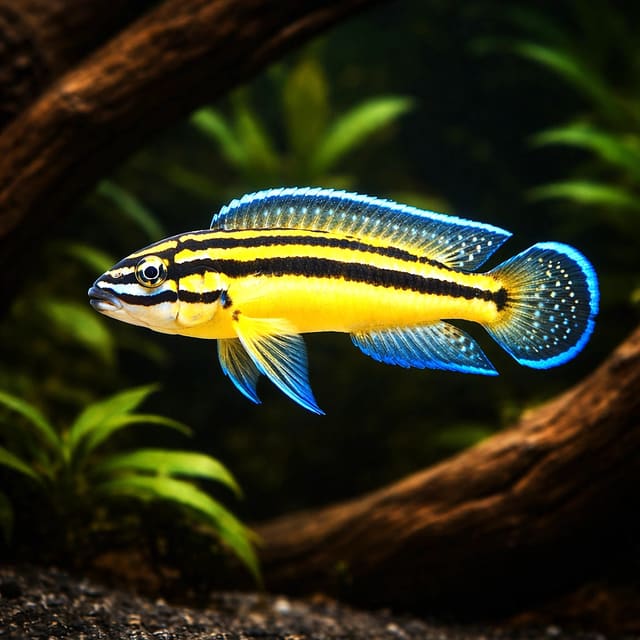
The gallery images are representative, based on reference photographs of this species, so colours can look slightly different from the live animal.
Do not use gallery scenes to infer purchase quantity: an image may show one or two fish for visual context, while each purchase supplies one animal.
The decisive planning figures are a recorded maximum of 15 cm total length, a routine temperature of 23–27°C, pH 8.0–8.6 and general hardness of 12–18°dH. OATA's African lake cichlid guidance gives those aquarium water values for the group rather than as a species-specific optimum.
| Suits | Not suited to |
|---|---|
| A mature, filtered hard-water aquarium | An unfiltered or biologically immature aquarium |
| A Lake Tanganyikan plan with each species assessed | Routine mixing of Malawi and Tanganyikan cichlids |
| Planning around a 15 cm adult | Planning permanent space around the dispatch size |
| 23–27°C, pH 8.0–8.6 and 12–18°dH | Soft, acidic aquarium conditions |
Choose the aquarium by usable territory and water stability, not by a generic litre claim. OATA advises buying as large an aquarium as reasonably possible for the chosen African lake cichlid. Provide enough lower area for a 15 cm rubble-dweller, separated structured areas and filtration capable of supporting the final stocking plan.
A larger water volume generally changes more slowly and gives greater scope for separate territories. Extra volume does not make incompatible fish compatible; adult size, temperament, lake origin, water requirements and territorial use still need to be checked individually.
Before purchase, measure temperature, pH and hardness rather than judging water by clarity. If stable readings do not fit the target range, adjust the setup and confirm stability before adding the fish.
Use the fish's rubble-dwelling biology to guide the layout. Build distinct lower zones with rockwork, passages and separate usable areas instead of leaving one uninterrupted open floor. The aim is to give each territorial fish access to lower structure and more than one route through the aquarium.
FishBase describes the wild fish as sedentary and records nest building in rubble. That makes rock structure functional rather than decoration placed only for appearance. Create more than one usable route through the lower area, and avoid arranging all desirable spaces around a single point that several fish may attempt to occupy.
OATA recommends fine coral sand or a similar substrate for African lake cichlids because it can help buffer the water. Treat buffering substrate as support for a tested water plan, not as a substitute for measuring pH, general hardness and carbonate hardness. Its effect depends on the aquarium and replacement water, so follow the readings rather than assuming the substrate has produced the target conditions.
When several territorial fish are planned, arrange the aquarium before stocking and photograph or sketch the main routes. OATA notes that rearranging décor may help reduce aggression by prompting fish to establish new territories, but rearrangement does not compensate for insufficient space or an incompatible combination.
A well-established biological filter is essential. The RSPCA's aquarium welfare guidance explains that fish release toxic ammonia, biological filtration converts it to nitrite and then to safer nitrate, and no fish should be kept without a properly set up and maintained filter. Clear water alone is not a measure of biological readiness.
Prepare and mature the aquarium before the animal arrives. Our first tropical aquarium guide explains the setup sequence; for this Tanganyikan cichlid, pair that process with the hard, alkaline range in this profile. Confirm 0 mg/l ammonia and 0 mg/l nitrite before adding livestock.
OATA recommends an oversized filter for crowded African lake cichlid communities and vigorous aeration to maintain dissolved oxygen. Decide from the intended adult stocking level, feeding load and aquarium size rather than the dispatch size of one fish. A filter that appears adequate for a small arrival may not remain adequate as fish grow or further livestock increases waste production.
| Checkpoint | Action |
|---|---|
| Before arrival | Confirm stable heat, flow and zero ammonia and nitrite |
| After adding fish | Increase stocking slowly and continue regular tests |
| Flow falls | Check the filter for blockages |
| Media needs cleaning | Rinse lightly in removed aquarium water |
Never rinse established biological media under the tap. Chlorine or chloramine may kill part of the beneficial bacterial population. During a partial water change, retain some removed aquarium water and use it to rinse away loose debris without stripping the media unnecessarily.
Do not add several fish rapidly merely because the test results were good before stocking. Beneficial bacteria must respond to each increase in waste and feeding. Add livestock gradually, keep testing and pause further additions if ammonia or nitrite appears.
Maintain 23–27°C, pH 8.0–8.6, general hardness 12–18°dH and carbonate hardness 10–15°dKH. Keep ammonia and nitrite at 0 mg/l. OATA advises that nitrate should not exceed 20 mg/l above the normal level in the tap water used for the aquarium.
Measure the starting water before choosing a method of adjustment. Our water chemistry guide explains what the principal readings mean, while the water matcher can compare measured aquarium values with the stated range. Record results with the date so that you can distinguish a stable pattern from one isolated reading.
Match replacement water carefully enough to avoid abrupt change. A water change improves conditions only when the incoming water is suitable for the animals and biological filter. If a reading moves outside the target range, identify whether replacement water, accumulated waste, buffering capacity or equipment operation has changed before making repeated adjustments.
| If you find | Do this |
|---|---|
| Any ammonia or nitrite | Pause stocking, review feeding and check filtration immediately |
| Rising nitrate | Review waste removal, feeding and the water-change routine |
| Falling pH or hardness | Test replacement water and reassess buffering |
| Unstable temperature | Check heating and thermometer readings before adding fish |
Make changes from measured results rather than adding mineral products automatically. Stability within the stated range is more useful than repeatedly chasing one exact number.
In nature, Chalinochromis popelini feeds on invertebrates growing on rocks and concealed by the biological covering. Members of the genus also have specialised jaws associated with feeding on sponges. Build the aquarium diet around an appropriately sized complete cichlid food that reflects this animal-content feeding biology rather than treating the fish as an algae-only grazer.
OATA notes that African lake cichlid diets vary markedly: some members of the group are herbivorous, while more carnivorous forms require food with a higher animal content. For Popelin's Chalinochromis, its recorded wild feeding provides the deciding direction. Do not centre the diet on vegetables or algae merely because rock surfaces form part of its habitat.
Feed only what the fish can consume within a few minutes, twice a day. Start with a measured small portion, watch the fish eat and stop adding food when pieces begin to remain beyond the feeding period. Remove uneaten food where practical because decomposition adds waste and can raise ammonia, nitrite and nitrate.
| What you see | Feeding decision |
|---|---|
| Food remains after a few minutes | Reduce the next portion and remove leftovers |
| One fish intercepts every portion | Review territorial access and feeding position |
| Interest in food falls | Test water and compare behaviour with its normal pattern |
| Body condition changes | Review portion size, competition and water quality |
Use feeding as a daily observation point. A sudden reduction in intake can be an early warning of stress or deteriorating water conditions. Check the aquarium before trying to solve reduced feeding by simply adding a different or larger meal.
A young dispatch-size fish and a 15 cm adult will not take identical portions. Keep the same time-based rule while adjusting food size and amount to the individual. This approach responds to growth without turning a fixed quantity into a source of persistent overfeeding.
Prepare and test the aquarium before the parcel arrives, and make sure someone is present to receive the live fish. Start filming while the parcel is still sealed and before it is opened.
Follow our delivery and Live Arrival Guarantee policy: film every delivery continuously from the sealed parcel as it is opened, showing the fish while it remains in the sealed bag. Float the bag in the aquarium for 20–30 minutes before releasing the fish, and never pour the bag water into the aquarium.
Keep the receiving aquarium within 23–27°C, with ammonia and nitrite at 0 mg/l and the hard, alkaline conditions already established. These aquarium checks come from OATA's African lake cichlid guidance.
Do not combine arrival day with a major aquascape rebuild, filter clean or rapid addition of several other fish. The aquarium should already be mature, structured and chemically stable. This keeps the new arrival from facing several avoidable changes at once and gives you a clear baseline for observation.
Retain the continuous video and order number. If a Live Arrival Guarantee claim is required, follow the current policy process the same day.
The first week establishes the individual fish's normal pattern in your aquarium. Observe at consistent times, especially around feeding, and record where it spends time, whether it reaches food, how quickly it breathes and whether another fish repeatedly blocks access to structured areas.
| Checkpoint | What to assess |
|---|---|
| Swimming | Compare steady lower-level movement with surface hanging, prolonged bottom sitting or erratic motion |
| Breathing | Watch for gill covers moving noticeably faster or slower than the established pattern |
| Appearance | Look for changes in colour, fins, scales, body condition, white spots, growths, bumps or ulceration |
| Feeding | Confirm that the fish reaches food and consumes its share within a few minutes |
| Interactions | Note repeated pursuit, exclusion from structure or a sharp increase in hiding |
If behaviour changes, test water first. Confirm ammonia and nitrite remain at 0 mg/l, temperature remains within 23–27°C and filtration is operating normally. This prevents an environmental problem from being mistaken for a feeding or compatibility issue.
Keep the twice-daily feeding limit and adjust each portion from what is actually eaten. Do not leave extra food in the hope that a hidden fish will return later; uneaten food adds waste. If one individual monopolises the feeding area, reassess access to structured areas rather than continually increasing the total portion.
A single observation can be misleading. Use brief notes across several checks to identify direction: stable, improving or deteriorating. Record water readings beside behaviour so that a later change can be linked to a measurable event such as added livestock, altered feeding, reduced filter flow or replacement-water differences.
Delay further additions while the new fish and biological filter settle into a stable pattern. OATA warns that increasing livestock too quickly can leave too few nitrifying bacteria for the higher waste load, causing ammonia or nitrite to rise.
Act on changes in swimming, breathing, colour, temperament, body condition, appearance or appetite. Begin with the aquarium because poor water quality can affect every fish and may require immediate correction. Test ammonia, nitrite, temperature and the hard, alkaline values, then check heater operation, aeration and filter flow.
If ammonia or nitrite is detectable, stop further stocking and review the biological load immediately. Check for uneaten food, blocked filtration and whether livestock or feeding was increased too quickly. Keep replacement water treated for chlorine and chloramine, and do not clean biological media under the tap.
If water remains within range but one fish is persistently excluded, treat the problem as a stocking and territory decision. More food does not create more territory. Review adult size, the number and position of structured areas, routes through the lower aquarium and the behaviour of every fish.
Maintain a weekly log after the first month. Record whether the 25% water change was completed at least once that week, along with ammonia and nitrite results, nitrate direction, pH, hardness, filter observations and any change in feeding or behaviour. A simple sequence of readings makes gradual deterioration easier to detect than memory alone.
Do not apply a disease treatment solely from one general sign such as hiding or reduced appetite. Several environmental and social problems can produce similar changes. Correct measurable husbandry problems promptly and seek guidance when signs continue or the animal's condition worsens.
Plan this fish primarily within a Lake Tanganyikan context. OATA advises that African lake species should generally be stocked with species from the same location and does not generally recommend mixing Malawi and Tanganyikan cichlids because their temperament and behaviour differ. Avoid routine Malawi–Tanganyika mixtures rather than treating all African cichlids as interchangeable.
No named fish is a universal companion for Popelin's Chalinochromis. Check every proposed animal against the same decision sequence: lake origin, adult size, temperature, pH, hardness, temperament, territorial use and the amount of usable space in the actual aquarium. A match on water alone is incomplete when both fish may compete for the same lower structure.
| Question | Pass condition |
|---|---|
| Is it Tanganyikan? | Its geographic and behavioural context fits the planned community |
| Do the water ranges overlap? | Both can be maintained at 23–27°C, pH 8.0–8.6 and 12–18°dH |
| Is adult size accounted for? | The plan uses mature dimensions, including 15 cm for this fish |
| Will territories overlap? | The layout provides separate usable areas and more than one lower route |
| Can filtration carry the load? | Ammonia and nitrite remain at 0 mg/l as stocking rises gradually |
If any answer is unclear, pause the addition. Ask us when you can provide the aquarium dimensions, water readings, existing livestock with adult sizes and a description of the rock layout. That allows a stocking and compatibility assessment based on the actual system rather than a generic list.
You can browse the African cichlid collection to compare identities, but do not assume that appearing in the same collection establishes compatibility. Complete the screen for each intended combination.
Add African lake cichlids slowly so that the biological filter and social structure are not forced to absorb several changes together. OATA recommends adding more peaceful species before more aggressive species and notes that some cichlids may be best introduced in groups to prevent one individual receiving unnecessary aggression. The appropriate number depends on the species, so decide the Popelin's Chalinochromis plan from the complete combination rather than applying a fixed group number.
Very few African lake cichlids do well when kept singly, according to OATA, and solitary fish may become stressed. Choose the number for this species from the complete stocking plan. Map the intended adult territories, identify which fish already controls each structured area and leave capacity for a 15 cm adult.
Rearranging décor may reduce aggression by making fish find new territories. Use that option deliberately and monitor the result; it is not a cure for excessive stocking, incompatible temperaments or an aquarium that lacks usable lower area.
When conflict appears, distinguish a brief encounter from sustained pressure. Repeated chasing, continual hiding, reduced feeding or exclusion from a territory requires action. Test water at the same time because deteriorating conditions can increase stress throughout the aquarium.
Do not solve pressure by automatically adding more fish. OATA notes that slight overstocking is used for some African lake species, but that method is species-dependent and increases demand on filtration and oxygen. For this fish, use individual compatibility assessment and gradual stocking rather than a generic crowding formula.
FishBase records a maximum of 15 cm total length. Plan the aquarium around that adult figure rather than the smaller dispatch size.
OATA advises choosing as large an aquarium as reasonably possible. Plan it around a 15 cm rubble-dweller, usable lower territories, mature filtration and the adult needs of every companion.
OATA advises that very few African lake cichlids do well singly and that the appropriate number depends on the species. Decide the number from the adult territories, complete stocking plan and filter capacity.
It suits a keeper prepared to manage hard, alkaline water, mature biological filtration, rubble-based territory and carefully screened companions. We class that combination as intermediate care.
FishBase records a wild diet of invertebrates growing on rocks and hidden by the biological covering. Use an appropriately sized complete cichlid food that reflects that animal-content diet, feeding only what is eaten within a few minutes twice a day.
Keep it at 23–27°C and pH 8.0–8.6, with general hardness of 12–18°dH. These are OATA's group values for African lake cichlids; keep ammonia and nitrite at 0 mg/l.
Its individual aggression and fin-nipping risk should be treated as uncertain. OATA says African lake cichlids vary in temperament, so provide separate territories, monitor repeated pursuit or damage and assess every intended companion before stocking.
Consider carefully assessed Lake Tanganyikan species whose adult size, water requirements, temperament and territorial use fit the aquarium. Avoid routine mixing with Malawi cichlids, which OATA does not generally recommend.
Tropical Fish Co packs live fish in pure oxygen inside an insulated box, with a heat pack when the weather calls for it. Someone must be present to receive the parcel. Film every delivery continuously from the sealed parcel as it is opened, showing the animal still in the bag; float the bag for 20–30 minutes, then release the fish without pouring the bag water into the aquarium.
No reviews for this item yet. Bought one? Honest reviews only, good or bad.
What customers say about ordering from us
I have a small group of long finned mountain minnows. So was delighted to be able to order ten of this variety to increase the genetics in my tank . The ones I recieved are healthy but it’s to early to give a verdict on wether they are of a long finned type since they are small currently.
Gordon Walker · 23 Sept 2026
100% success travel and "installation". Pleased with quality of purchase. The Siamese fighter a bit "shy" so have not yet seen him at his best yet but looking good. Happy customer. GG
George E Garratt · 21 Sept 2026
Reviews of our shop, collected by Judge.me, an independent third-party review collector. Newest first.