−10%
Advanced
Bemba Tropheus (Tropheus moorii “Bemba”)
24–26°C · pH 8–8.6
£38.69£42.99

One unsexed Red Bishop Tropheus in the selected size per quantity. Plan a mature 300L+, 150cm Tanganyika aquarium and a compatible colony of at least twelve.
Adult size is the maximum length this species reaches at full maturity (scientific sources). The livestock you receive will be younger and smaller — pick a size above for the actual shipping size. Product-photo provenance and any image-specific limitations are stated on the listing.
Tropheus sp. 'black' Caramba
Shoaling fish: kept in a group they feel safer, stay calmer and show their best colour.
Confirm your email, then we’ll send an availability message for this exact item if it returns within 180 days.
This request is only for this product—no newsletter or other promotions. A mail-provider retry may very rarely duplicate the same availability message. Unconfirmed addresses are removed after 48 hours. See our privacy policy.
One unsexed Red Bishop Tropheus in the selected size per quantity. Plan a mature 300L+, 150cm Tanganyika aquarium and a compatible colony of at least twelve.
Adult size is the maximum length this species reaches at full maturity (scientific sources). The livestock you receive will be younger and smaller — pick a size above for the actual shipping size. Product-photo provenance and any image-specific limitations are stated on the listing.

Cichlids are a family of roughly 1,800 accepted species, not one care type. Before buying, identify the exact species and source, then compare adult measurement, usable tank dimensions, social system, territory, tested water, diet and an exit plan. No family-wide minimum tank, water range or tank-mate list is safe.
Maintain these water conditions for optimal health and vibrant colors
Red Bishop Tropheus (Tropheus sp. 'black' Caramba) is a captive-bred ornamental strain developed from the Caramba population of Lake Tanganyika. Its broad red body colour is the result of selective breeding; Red Bishop is not a separate wild species and this listing does not claim that the fish offered are wild-caught. The correct trade identity is Caramba, although the supplier's older name used the misspelling "Cramba".
One quantity buys one unsexed fish in the selected size. The size selector shows the available centimetre grades and current stock. It does not promise a male, female, breeding pair, exact shade of red or a particular social rank. Tropheus are demanding, social and territorial cichlids, so a single fish or casually assembled pair is not a complete long-term plan.
Prepare a mature, strongly oxygenated Lake Tanganyika aquarium before ordering. For a Red Bishop colony, use at least 300 litres with about 150 cm of front length, keep 12 or more compatible fish, provide extensive stable rockwork and feed a consistent, plant-rich aufwuchs-style diet. A practical target is 24-26°C, pH 7.8-9.0 and hard, alkaline water. Stability, group structure, grazing space and disciplined feeding matter as much as any single number.
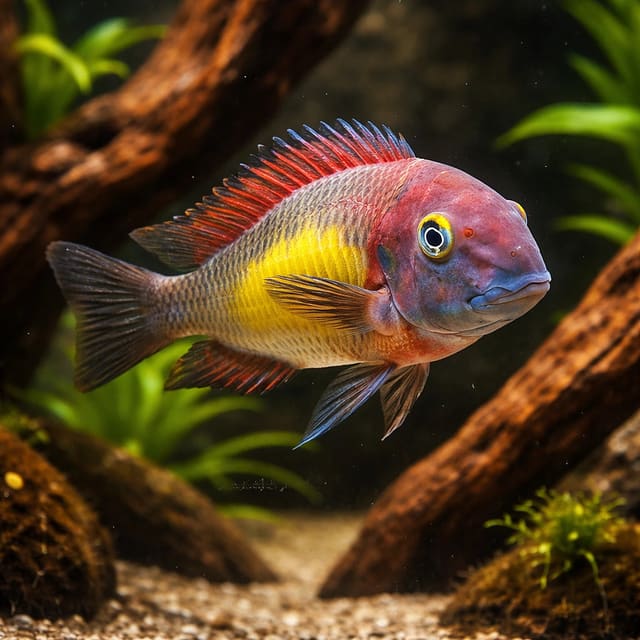
The gallery currently contains one representative digital illustration. It is useful for showing the general Red Bishop colour concept, but it is not a photograph of the exact fish dispatched and individual colour can vary with age, condition, lighting, hierarchy and breeding line. Read the size, social and care guidance below before deciding whether this specialised cichlid is suitable for your aquarium.
| Planning point | Guidance for this listing |
|---|---|
| Trade identity | Red Bishop Tropheus, a selectively bred form derived from Tropheus sp. 'black' Caramba |
| What one quantity includes | One unsexed fish in the selected centimetre grade |
| Adult planning size | About 14 cm total length; allow for a robust adult body and territorial movement |
| Experience level | Advanced or well-prepared intermediate; not recommended as a first cichlid |
| Social plan | A deliberately planned colony of at least 12 compatible Tropheus, normally introduced together |
| Aquarium floor | 300 litres and approximately 150 cm long; larger is preferable when keeping several mature males |
| Temperature | 24-26°C as a practical target; specialist references commonly give 23-26°C |
| pH | 7.8-9.0, stable and alkaline |
| Hardness | Hard, mineral-rich water; approximately 10-25 dGH is a useful planning range |
| Diet | Plant-rich, high-fibre foods suited to an aufwuchs grazer, offered in small measured meals |
| Behaviour | Active, hierarchical and territorial; aggression risk rises with poor group structure or inadequate space |
| Breeding | Maternal mouthbrooder; sex and breeding compatibility are not guaranteed by an ordinary size grade |
| Image | Representative digital illustration, not the exact animal dispatched |
The clearest identity for this fish is Tropheus sp. 'black' Caramba 'Red Bishop'. Caramba refers to a Lake Tanganyika population associated with Cape Caramba on the Democratic Republic of the Congo side of the lake. Scientific literature also uses Tropheus sp. "Caramba" for this population and places it within the informal Tropheus sp. 'black' grouping.
Red Bishop is a captive ornamental line rather than a naturally occurring locality colour form. A first-hand Tropheus breeding account records an unusually red individual produced among Caramba stock and describes subsequent breeding with other Caramba fish to establish the Red Bishop form. That history is important because it prevents two common mistakes: treating Red Bishop as a separately described species, or presenting every Red Bishop as a fish collected from Cape Caramba.
The supplier name used "Cramba", but independent sources consistently use Caramba. The corrected spelling appears in the customer-facing title and care information while the original supplier wording remains preserved privately as provenance. This keeps the product's supply history intact while giving customers the name they are most likely to encounter in reliable references.
Older aquarium references may place Caramba forms under Tropheus moorii. The safer current trade anchor for this listing is Tropheus sp. 'black' Caramba. General ecological research on T. moorii helps explain characteristic Tropheus grazing, territorial and maternal mouthbrooding behaviour, but this page does not silently rename Red Bishop as T. moorii. No IUCN status is assigned to a captive-bred strain.
Each quantity is one fish from the size option selected at checkout. If you choose a quantity of twelve, the order is for twelve fish in that selected grade, subject to live stock shown by the selector. The permanent description does not repeat a price or claim a particular size is in stock because those details are live commerce information and can change independently.
Ordinary size grades are unsexed. Juveniles and subadults may not show reliable external sex differences, and colour intensity is not a dependable way to guarantee sex. We therefore do not promise a male-to-female ratio, bonded pair, breeding group, exact adult pattern or show-quality individual. A keeper intending to breed a line should plan for natural sex ratios, observe the colony as it matures and have a humane contingency for excessive male pressure.
Centimetre grades describe the approximate dispatch size, not the final adult size. Plan the aquarium for adults from the beginning. A fish sold at 4-5 cm still needs the same long-term colony, rockwork, filtration and water-quality plan as a larger grade. Buying a smaller fish does not make a small aquarium appropriate.
Choose a size by considering the whole group, not by assuming that the largest grade is automatically best. Fish of broadly comparable size are usually easier to introduce together because very large differences can affect feeding access and social pressure. A smaller grade may allow the colony to mature together, while a larger grade can be more robust physically but may arrive with a more established social character. Neither choice removes the need for quarantine, careful acclimation or behaviour monitoring.
If the aquarium already contains Tropheus, compare the selected grade with every resident before ordering. A newcomer should not be small enough to be persistently displaced or so large that it immediately dominates the group. The safest route is still to plan and introduce the intended colony together. When that is impossible, seek advice based on the exact aquarium dimensions, resident sizes, sex information if genuinely known and the history of the existing hierarchy.
Live fish can appear paler after transport. Temporary colour reduction, clamped posture or hiding can reflect darkness, shipping stress and a new hierarchy. Colour should be assessed only after careful acclimation and a period of stable husbandry. Persistent rapid breathing, loss of balance, marked swelling, white string-like waste or refusal to feed deserves prompt investigation rather than being dismissed as ordinary settling.
This fish is best for a keeper who already understands mature biological filtration, hard alkaline water, cichlid social management and restrained feeding. Red Bishop Tropheus are rewarding because the colony is active and visually distinctive, but they are not forgiving of an improvised setup. The aquarium must be ready before the group arrives, and the keeper must be willing to watch behaviour as carefully as test results.
Use the aquarium volume calculator to check the real filled volume rather than relying only on the model name printed on a tank. Rock, substrate and an air gap reduce usable water volume. More importantly, litres do not replace length: a long aquarium gives territorial fish more room to spread out and gives the keeper more options for visual barriers.
A responsible minimum plan is 300 litres and approximately 150 cm of front length for a colony of at least twelve. The 150 cm footprint agrees with specialist Caramba guidance, while 300 litres provides a conservative margin above a bare numerical minimum. A larger aquarium is preferable for several mature males, unusually forceful individuals or any carefully chosen companions.
Footprint matters because Tropheus establish a hierarchy and use rocky feeding territories. A tall but short aquarium can hold the same litres while offering fewer escape routes and less horizontal separation. Prioritise length and useful rock-facing area, then depth and water volume. Do not fill every centimetre with stone: fish also need clear movement lanes, and the keeper needs access for maintenance.
Overcrowding is sometimes presented as a simple aggression cure, but that description is incomplete. A sufficiently large, deliberately formed group can spread social attention, yet high stocking also increases oxygen demand, waste production and competition at feeding time. It only works alongside generous filtration, circulation, maintenance and a layout that prevents one fish from controlling the whole aquarium.
Do not use the minimum as a target to exceed in every other way. A 300-litre aquarium with a short footprint, unstable filter or unsuitable companions is not made safe by the number alone. Conversely, a larger aquarium still needs correct group structure. Tank size, social plan, rockwork and water management work together.
Red Bishop Tropheus belong in a rock-focused Tanganyika-style aquarium. Build stable formations that create multiple feeding faces, shaded retreats and broken sight lines. Place major stones securely on the tank base or on a suitable load-spreading support before adding loose substrate. A territorial cichlid can excavate around unsecured stones, so decorative balance is not enough; the structure must remain safe when sand moves.
Use several separate rock zones rather than one single central fortress. Gaps, ledges and irregular faces allow a subordinate fish to leave another fish's view. At the same time, avoid narrow traps where a pursued fish can be pinned. Observe the completed layout from both ends of the aquarium: if one dominant fish can see almost every route, add or reposition barriers before the colony arrives.
Fine sand is suitable for the exposed floor, although the fish's main interest is the rocky feeding surface. Avoid sharp substrate that can damage mouths or bellies. The aquarium does not need to be clinically bare. Mature, safe biofilm on rock creates natural browsing opportunities and helps occupy the colony between meals.
Do not scrub every rock face spotless at the same time. Rotate cleaning so some established grazing film remains while detritus is controlled. This is not permission to allow heavy organic decay or nuisance algae to overwhelm the tank. The aim is a clean, mature system with biologically active surfaces, not a sterile display and not a neglected one.
Hard-water-tolerant plants may be used at the margins if they are well anchored, but dense planting should not replace suitable rockwork. Choose plants for the water chemistry and accept that active cichlids may disturb them. Wood that strongly acidifies or stains the water is usually a poor fit for a Tanganyika setup.
| Parameter | Practical target | Why it matters |
|---|---|---|
| Temperature | 24-26°C | Within the specialist 23-26°C range while avoiding unnecessary warmth and reduced oxygen margin |
| pH | 7.8-9.0 | Reflects the alkaline conditions expected by this Tanganyika population |
| Hardness | Approximately 10-25 dGH | Supports stable mineral-rich water; match the source and destination water gradually |
| Ammonia | 0 mg/L | Any detectable ammonia is an urgent husbandry problem |
| Nitrite | 0 mg/L | Nitrite impairs oxygen transport and should never be accepted as normal |
| Nitrate | Kept low and stable | Trend, feeding load and maintenance matter more than chasing one universal number |
| Oxygen and flow | High oxygen with broad circulation | Tropheus originate from oxygen-rich rocky habitat and a stocked colony has a substantial demand |
Stability is more important than repeatedly dosing the aquarium to hit a perfect reading. Test the source water and understand its alkalinity before choosing buffers or mineral products. Large sudden corrections can be more stressful than a slightly different but stable value. The water matcher can help compare a planned setup with the needs of hard-water fish, but it does not replace liquid testing and observation.
Provide broad circulation across and behind rock structures so waste does not collect in dead zones. Surface movement and an appropriate air supply improve gas exchange. Filter output should not create one violent jet that exhausts fish; distribute flow through the aquarium. Check oxygen risk whenever temperature rises, a filter is cleaned, medication is used or the group begins breathing faster than usual.
Never assume clear water is safe water. Ammonia and nitrite are invisible. A recently installed aquarium, a filter that has been allowed to dry or a heavily cleaned biological stage can look clear while being biologically unsafe. Test after any event that could reduce filtration capacity.
Introduce Red Bishop Tropheus only to a fully cycled, mature aquarium. A cycle is established when the system can process the intended waste load without detectable ammonia or nitrite. Calendar time alone is not proof. The aquarium cycle tracker can organise readings, but the evidence comes from reliable tests and a stable trend.
Use filtration sized for a heavily stocked, active cichlid colony. Mechanical filtration should capture suspended waste without starving the biological stage of oxygen. Biological media needs continuous flow and must never be rinsed under untreated chlorinated tap water. Clean different filter components on a rotation so the whole system is not disturbed at once.
Keep a simple maintenance record. Note water-change dates, test results, filter work, food changes and unusual behaviour. Patterns are easier to recognise when they are written down: a gradual nitrate rise, repeated appetite loss after one food or aggression after every rescape can otherwise look like unrelated incidents. A record also gives a veterinarian or experienced fish-health adviser better evidence than a single photograph.
Regular partial water changes dilute nitrate and dissolved waste while restoring mineral balance. Match replacement water for temperature and chemistry, dechlorinate it correctly and avoid exposing the colony to abrupt changes. The appropriate frequency depends on feeding, stock, source water and measured trends; a disciplined weekly routine is a useful starting framework, then adjust from evidence.
Siphon detritus from accessible areas and behind rocks without dismantling the entire territory map at every clean. A complete rescape can reset the hierarchy and trigger renewed fighting. If a major layout change is necessary, plan it deliberately and monitor the whole colony afterward.
Tropheus are social in the sense that they live within a structured group, but that does not mean they are peaceful schooling fish. Individuals form a pronounced hierarchy and can defend feeding space. The long-term plan for this listing is at least twelve compatible fish. A larger group may be appropriate in a larger aquarium, but only when filtration, feeding access and oxygen capacity also increase.
Whenever possible, establish the intended group together while the fish are of comparable size. Adding one newcomer to a settled adult colony can focus aggression on that fish. If later additions are unavoidable, quarantine them properly, review size and lineage compatibility, consider a controlled territory reset and be prepared to separate fish. There is no universal trick that makes a risky introduction safe.
Watch the entire group at feeding time. A subordinate fish that remains behind the rockwork, loses weight or is repeatedly driven away may receive almost no food even when the aquarium appears well fed. More food is not automatically the answer because excess can harm water quality and digestion. Improve food distribution, reassess barriers and act before chronic exclusion becomes severe.
Normal hierarchy can include brief chasing and displays. Repeated cornering, torn fins, continuous darkening, rapid breathing, isolation at the surface or inability to feed is not a harmless display. Record which fish initiates and receives aggression, because removing a random fish can create a new imbalance. A mature spare aquarium with matched water is safer than an improvised container when intervention is needed.
The functional `pricing:shoal` tag on this product supports quantity purchasing, but it is not a biological statement that two or three fish form a shoal. Each quantity remains one unsexed fish. The care recommendation is a planned colony, and the customer must select a suitable quantity explicitly.
Wild Tropheus graze aufwuchs from rock. Aufwuchs is more than pure algae: it is a living surface community containing algae and small organisms. In the aquarium, the practical lesson is to use a plant-rich, high-fibre staple formulated for grazing African cichlids rather than rich, high-fat meaty meals.
Suitable staples include quality spirulina-based flakes, small granules and herbivorous cichlid foods that soften readily and can be shared across the group. Our Super Spirulina Forte granules, small herbivore cichlid pellets and Tanganyika flakes are relevant options, but always read the current product ingredients and choose a particle size the fish can take comfortably.
Feed small measured portions, distributed widely enough that lower-ranking fish have access. Two or three modest feeds can be easier to manage than one heavy meal, provided the daily total remains controlled. Food should be eaten promptly; a cloud of leftovers entering the rocks means the portion or distribution needs adjustment.
Avoid sudden switches between very different foods. If a new staple is needed, transition gradually while watching appetite, waste and abdominal shape. Avoid mammalian meat and frequent rich feeds such as large bloodworm portions. This does not require pretending the natural grazing mat contains no animal material; it means respecting the digestive strategy of an aufwuchs grazer.
Preserve some safe natural grazing growth on rock, but do not expect algae alone to provide a complete captive diet. A varied, consistent commercial routine gives better control of nutrition. Fasting or medication should not be used casually as a cure for every appetite problem; first check water, aggression, food quality and whether the affected fish can reach the feed.
A species-focused Red Bishop or compatible same-line Tropheus colony is the clearest option. It keeps feeding, chemistry and behaviour easier to manage and reduces confusion if the fish breed. Even within Tropheus, do not assume that any locality or colour form can be mixed safely. Similar forms may hybridise, social pressure can be intense and offspring can lose reliable lineage identity.
Advanced keepers sometimes combine Tropheus with carefully selected Lake Tanganyika fish that use different areas and share the same water and diet constraints. Any proposed companion must be assessed for adult size, feeding speed, aggression, predation risk, territory and disease risk. A generic compatibility label is not enough.
Avoid soft-water community fish, slow timid feeders, long-finned species, aggressive mbuna and large piscivores. Do not add tetras simply because both are called tropical fish. Their preferred chemistry, feeding and social environment are different. Avoid companions that require frequent rich meaty feeding because one mixed feeding routine can be unsuitable for Tropheus.
For comparison, review the existing listings for Orange Bemba Tropheus, Tropheus Ilangi, White-Spotted Duboisi and Ikola Tropheus. These links are for care comparison, not a recommendation to mix all four forms.
Red Bishop Tropheus are maternal mouthbrooders. The female carries the developing brood in her mouth. Long-term research on Tropheus sp. "Caramba" found that maternal incubation and early social experience affected later reproductive success, which is one reason not to treat mouthbrooding simply as an inconvenience to be mechanically bypassed.
External sexing is difficult, especially in smaller grades. Adult size, colour or dominance can suggest possibilities but does not provide a sale guarantee. Reliable vent examination requires skill and careful handling, and unnecessary handling itself creates risk. The listing therefore sells unsexed fish unless an option explicitly states otherwise.
A settled colony, appropriate sex ratio, excellent water, stable territory and good condition support natural breeding behaviour. Do not buy two fish expecting an instant pair. A holding female may eat less and behave differently, but appetite loss also has other causes. Observe the mouth, breathing, social context and body condition before drawing conclusions.
Do not strip eggs or isolate a holding female without understanding the welfare and social consequences. Returning a female to a rearranged colony can be difficult. Keep lineage records if fry are raised, and do not sell uncertain crosses as Red Bishop Caramba.
Check the current live-fish delivery and Live Arrival Guarantee terms before dispatch. Be present for the delivery, prepare the aquarium in advance and keep the unopened bag away from direct sun, children and pets. Do not order first and plan the colony afterward.
Compare bag water and aquarium conditions without unnecessarily exposing the fish to cooling or prolonged transport water. Use a method appropriate to the measured difference and the shipping conditions. The acclimation timer can help organise the process, but it cannot choose the method for you. Once a shipping bag is opened, rising pH can increase the proportion of toxic ammonia, so an extremely long open-bag drip is not automatically safer.
Dim the lights, release the fish without adding shipping water to the aquarium where practical, and allow the group to settle. Avoid a large celebratory feed immediately. Offer a small familiar meal after the fish are breathing normally and moving through the aquarium, then observe whether every individual can feed.
A two-to-four-week quarantine is valuable only when the quarantine system itself is mature, adequately sized, oxygenated and matched to hard alkaline water. A tiny uncycled box can cause more harm than it prevents. For a social Tropheus order, plan quarantine capacity for the group rather than isolating each fish alone without reason.
During quarantine, monitor appetite, waste, breathing, balance, skin, fins and interaction. Use separate nets and equipment. Do not medicate preventively without a diagnosis or a clear protocol, because unnecessary treatments can stress fish, damage filtration and obscure the real cause of a problem.
Tropheus keepers often use the word "bloat" for a cluster of signs that can include appetite loss, swelling, abnormal waste and lethargy. It is not a complete diagnosis. Similar signs can arise from water-quality failure, social stress, inappropriate feeding, parasites, infection or organ disease. Treating every case with the same medicine can waste critical time.
Do not make several major changes at once unless an emergency demands it. A huge water-chemistry correction, complete rescape, new food and broad medication applied together make it difficult to identify the cause and can add stress. Stabilise verified problems first and document the response.
Quarantine a sick fish only when the receiving tank is biologically safe and the social consequences are considered. Returning an individual after a long absence may provoke renewed aggression. Humanely isolate an actively attacked fish rather than waiting for serious injury, but do not leave it in an unheated or unfiltered emergency vessel.
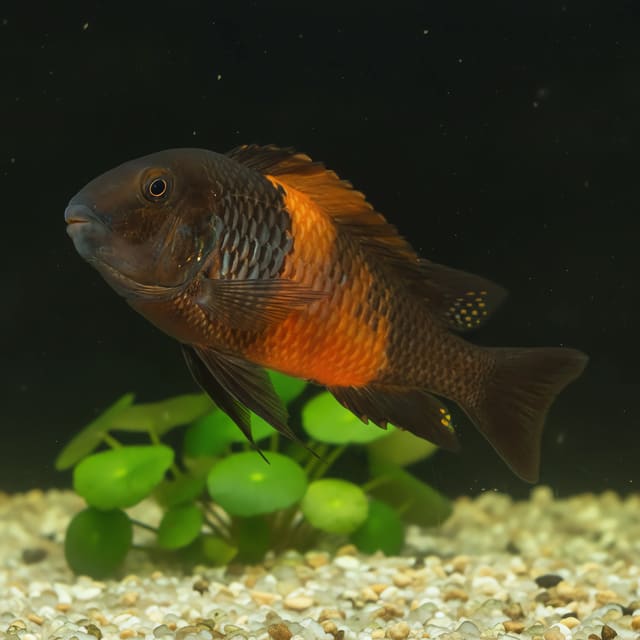
Red Bishop is selected for extensive red pigmentation, yet living fish are not identical products. The amount and intensity of red can differ among individuals and change with age, health, stress, hierarchy, background and lighting. Juveniles may develop colour gradually. A temporary pale arrival is not evidence that the fish will never colour, and a vivid illustration is not a promise of an exact adult pattern.
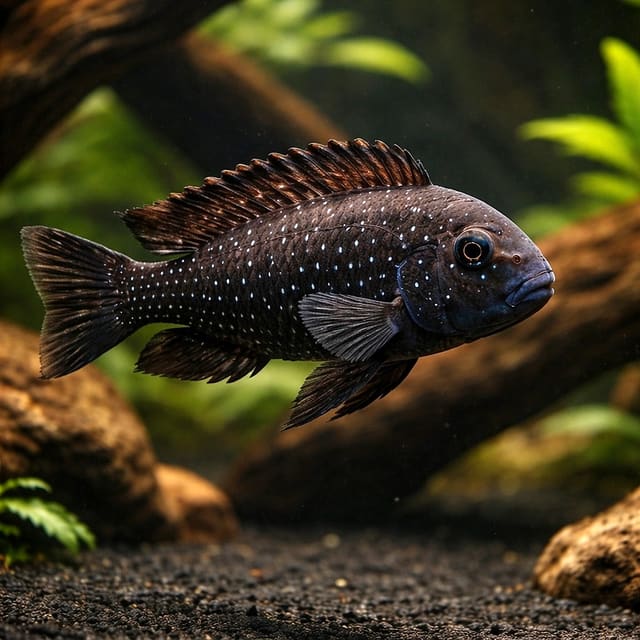
The current gallery image is a digital illustration showing a dark Tropheus-like fish with a broad red central body area in a rocky aquarium. It is labelled as representative because it is not documentary evidence of the actual animal in stock. The image remains on the listing and has not been removed, replaced, reordered or altered.
Evaluate the purchase using the written identity, size selector and care requirements rather than image colour alone. If exact specimen selection becomes available in the future, it must be stated explicitly with specimen-specific media; an ordinary catalogue image cannot provide that guarantee.
If any essential point is missing, delay the order and correct the setup first. The most successful Tropheus purchase begins with preparation, not with trying to solve avoidable problems after the fish arrive.
The first month should be planned as a sequence rather than a single release day. Before dispatch, record the established aquarium's temperature, pH, hardness, ammonia, nitrite and nitrate. Photograph the layout and identify at least two places where a fish could be isolated without dismantling the entire aquarium. Prepare food, test kits, water conditioner and separate equipment in advance.
Keep lighting subdued, avoid unnecessary work around the aquarium and watch breathing before focusing on colour. Check each individual from both sides if possible. Record any transport marks, damaged fins or unusual abdominal shape so later changes are not confused with arrival condition. Feed only after the group is breathing normally and exploring, then use a small familiar portion rather than testing several new foods.
Count the fish during every observation and note where each one rests. A fish that repeatedly disappears behind the same filter or rock may already be under social pressure. Test ammonia and nitrite daily during this period even when the filter was mature before arrival; the new bioload can expose a capacity problem quickly.
Divide a normal meal into several small pinches and release them at different points. Watch which fish reaches each point first and which fish abandons feeding when a dominant individual approaches. The purpose is not merely to confirm that food disappears. It is to prove that every fish can obtain an appropriate share without remaining in a dangerous territory.
Compare the group's waste, abdomen profile and activity after meals. If several fish produce abnormal waste or lose appetite together, investigate water and food before assuming an isolated disease. If only one fish is affected, examine its social access and arrival history. Continue using the food that the group accepts consistently rather than changing the menu every day.
By the second week, the hierarchy is becoming clearer. Map persistent territories and note any route that one dominant fish controls. Minor fin nicks can heal in excellent water, but repeated damage shows that the underlying social or layout problem remains. Adjust one variable at a time and record the result.
Set the long-term water-change schedule from measured nitrate trend and the aquarium's real feeding load. Rinse mechanical media when flow begins to fall, while leaving biological media stable. Continue checking that broad circulation reaches behind rockwork. At the end of four weeks, compare new photographs with arrival records for body condition, fin recovery and colour development.
A healthy colony is not defined by the brightest dominant individual. Look for a group in which all fish can move between feeding and shelter areas, breathing is even, bodies remain filled without swelling, and brief displays end without one fish being trapped. The quietest member often provides the earliest warning that the system is becoming unbalanced.
| Pattern | Likely interpretation | Useful response |
|---|---|---|
| Short chases that stop at a boundary | Territory communication within an established hierarchy | Continue observation and confirm that the chased fish can feed and rest |
| One fish continuously held at the surface | Serious exclusion, low oxygen or illness | Test water immediately and prepare safe separation while identifying the aggressor |
| The whole group breathes rapidly | Environmental problem is more likely than one social dispute | Check temperature, oxygen, ammonia, nitrite and recent filter changes |
| Several fish darken after a rescape | Territories and hierarchy have been reset | Reduce disturbance, verify escape routes and monitor until the new pattern settles |
| One fish eats but steadily thins | Food quality, chronic stress or disease may be involved | Review diet and waste, compare photographs and seek diagnostic help |
Colour alone is a weak health measure. A dominant fish may intensify while a subordinate fades, and both responses can occur in the same water. Use colour together with breathing, posture, appetite, waste, fin condition and weight trend. A phone photograph taken weekly from the same distance can reveal gradual change that daily viewing misses.
Prepare the response before a crisis. A divider can protect an injured fish temporarily while preserving the same water, but only if both sides retain heat, oxygen and filtration. A separate hospital aquarium provides more control for treatment but must already be cycled and matched. A floating breeder box is not suitable long-term accommodation for a robust territorial cichlid.
When aggression escalates, first establish whether one fish is the consistent aggressor, one fish is unusually weak, or the whole layout concentrates traffic through one territory. These causes require different responses. Removing the victim alone may allow the aggressor to select another target. Removing the aggressor may change the ranking and create a new conflict. Changing the rockwork may help, but a complete rescape also resets every boundary.
Use the least disruptive response that protects welfare, then observe the entire group after intervention. Keep photographs and notes of the before-and-after territory pattern. If a fish cannot be returned safely, use a responsible rehoming route rather than repeated stressful reintroductions. The possibility of rehoming is part of keeping a territorial colony, not an admission that planning has failed.
Keep the purchase identity, size grade and date with the colony's husbandry record. If sex becomes reliably known later, record how it was determined rather than relying only on colour. Note deaths, removals, additions and suspected parentage. These records become especially important when the fish reproduce.
Red Bishop is a named captive line. Fry should be offered under that name only when the parent group has credible identity and has not been mixed with another Tropheus form. When parentage is uncertain, label the offspring honestly. Attractive colour does not restore lost provenance, and an uncertain cross should not be sold as a locality-pure Caramba line.
Review the aquarium's future capacity before juveniles mature. Home-bred young increase filtration demand and can alter the hierarchy well before they reach adult length. Decide early which fish can remain, which require a separate grow-out aquarium and how surplus fish will be placed responsibly. This keeps breeding from turning a stable adult colony into an overcrowded system.
Research sources establish identity and biological context; the conservative 300-litre, 150 cm, 12+ colony plan is our aquarium welfare guidance for this product. Always combine published ranges with the actual source water, the fish's condition and measured stability in your own mature system.
No reviews for this item yet. Bought one? Honest reviews only, good or bad.
What customers say about ordering from us
I have a small group of long finned mountain minnows. So was delighted to be able to order ten of this variety to increase the genetics in my tank . The ones I recieved are healthy but it’s to early to give a verdict on wether they are of a long finned type since they are small currently.
Gordon Walker · 23 Sept 2026
100% success travel and "installation". Pleased with quality of purchase. The Siamese fighter a bit "shy" so have not yet seen him at his best yet but looking good. Happy customer. GG
George E Garratt · 21 Sept 2026
Reviews of our shop, collected by Judge.me, an independent third-party review collector. Newest first.