Advanced
Duboisi, White-Spotted Cichlid (Tropheus duboisi)
23–27°C · pH 8–8.6 · 110L
From £17.39Some sizes on sale
Photo coming soon
The size, price and care details on this page are for this listing.
The Firecracker Tropheus, Moliro Orange (Tropheus moorii) is a Lake Tanganyika cichlid that reaches 14.5 cm. It suits advanced keepers planning 15–20 fish; the FishBase, Seriously Fish and OATA overlap is 24–26°C, pH 8.0–8.6 and 12–18 dGH. Sold individually in sizes from 2–3 cm to 4–5 cm.
Adult size is the maximum length this species reaches at full maturity (scientific sources). The livestock you receive will be younger and smaller — pick a size above for the actual shipping size. Product-photo provenance and any image-specific limitations are stated on the listing.
Tropheus moorii
Shoaling fish: kept in a group they feel safer, stay calmer and show their best colour.
The Firecracker Tropheus, Moliro Orange (Tropheus moorii) is a Lake Tanganyika cichlid that reaches 14.5 cm. It suits advanced keepers planning 15–20 fish; the FishBase, Seriously Fish and OATA overlap is 24–26°C, pH 8.0–8.6 and 12–18 dGH. Sold individually in sizes from 2–3 cm to 4–5 cm.
Adult size is the maximum length this species reaches at full maturity (scientific sources). The livestock you receive will be younger and smaller — pick a size above for the actual shipping size. Product-photo provenance and any image-specific limitations are stated on the listing.
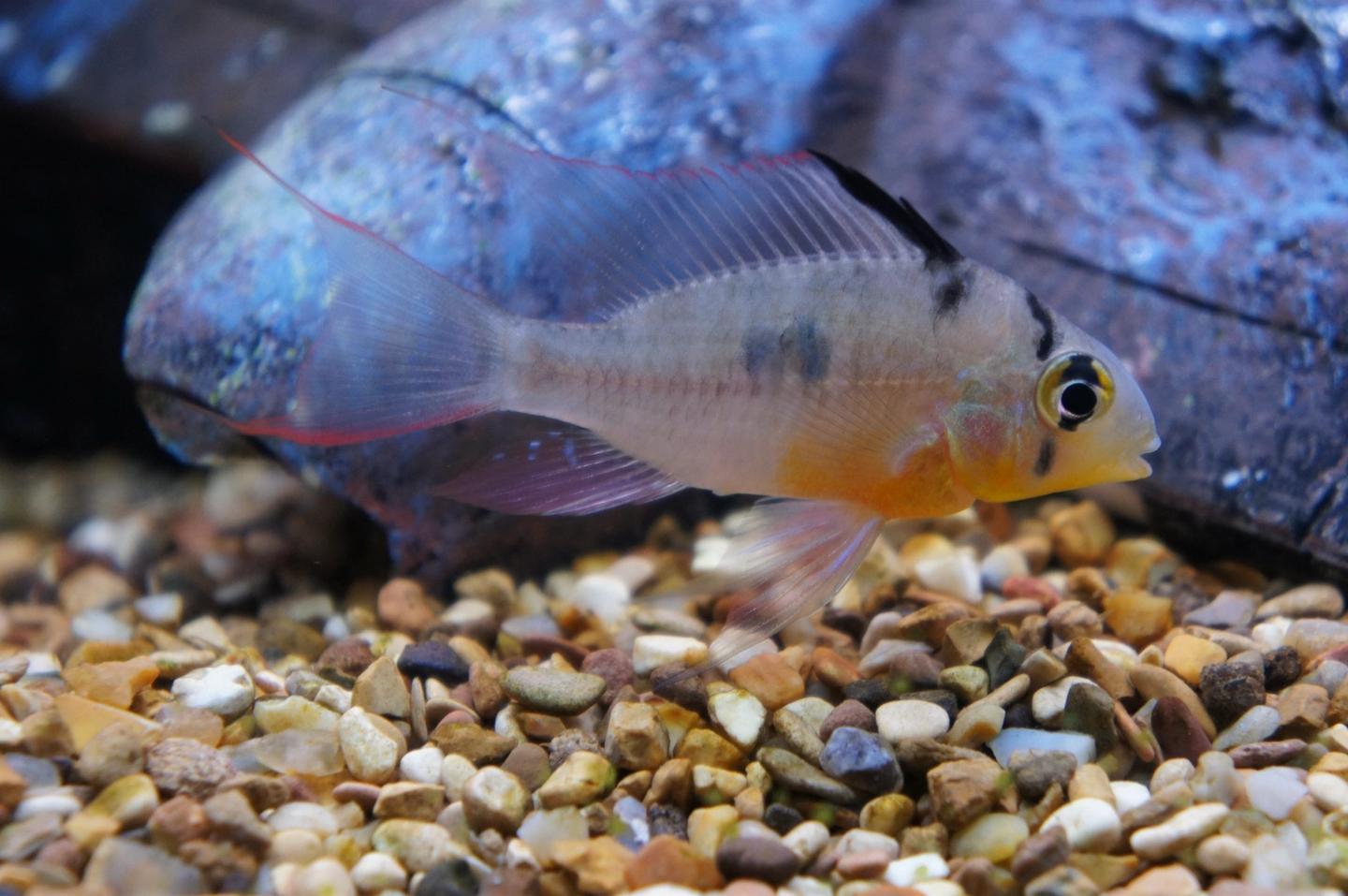
Cichlids are a family of roughly 1,800 accepted species, not one care type. Before buying, identify the exact species and source, then compare adult measurement, usable tank dimensions, social system, territory, tested water, diet and an exit plan. No family-wide minimum tank, water range or tank-mate list is safe.
Maintain these water conditions for optimal health and vibrant colors
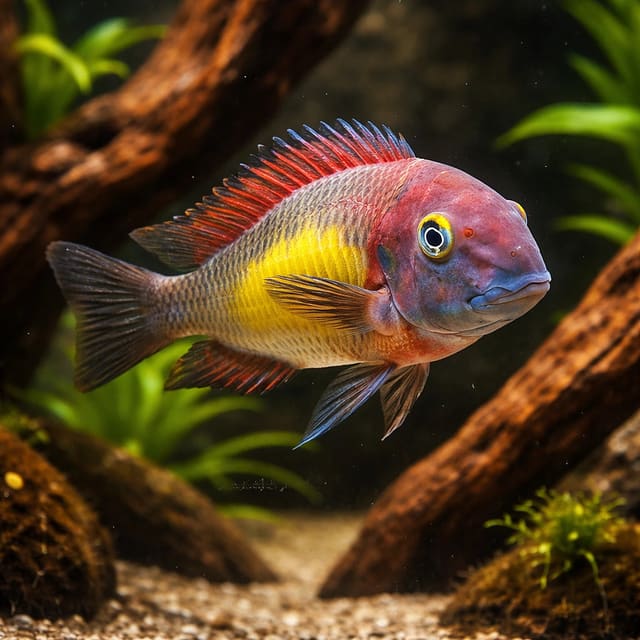
Firecracker Tropheus, Moliro Orange is a colour form of Tropheus moorii, a freshwater cichlid endemic to Lake Tanganyika that reaches 14.5 cm. Its trade name refers to the broad orange-red area associated with the Moliro form. The fish belongs in a specialist Tanganyikan setup rather than a general first community aquarium, and we rate its care level as advanced because group dynamics, diet and water quality all need deliberate management.
| Suits | Not suited to |
|---|---|
| Advanced keepers able to plan a large, managed group | Beginners or a casual small group of five or six fish |
| Hard, alkaline Lake Tanganyika aquaria with strong filtration and vigorous aeration | Soft-water community aquaria or setups without a mature biological filter |
| Layouts with sand, separated rock piles and open swimming space | Aquaria shared with shy fish or Malawi cichlids |
You can compare its place among our African cichlids, but select companions only after checking their location, temperament, diet and adult space.
FishBase records Tropheus moorii at up to 14.5 cm total length and gives a minimum aquarium length of 150 cm. It also describes wild adults as solitary. That natural behaviour matters: the aquarium group is not a shoal moving as one, and each fish still needs a territory, visual breaks and room to retreat.
Seriously Fish gives 110 litres in a 120 × 30 × 30 cm aquarium for a single specimen, while saying that a group requires a much larger tank. It generally recommends 15–20 fish because groups of five or six may fail to settle and can fight severely. Treat 110 litres as a single-specimen reference, not as a group target. For a group, begin with the 150 cm length reference and assess the complete footprint, rock arrangement, filtration capacity and territory plan; simply reaching one dimension does not turn a cramped layout into suitable group accommodation.
| Decision | Planning figure |
|---|---|
| Maximum recorded length | 14.5 cm total length |
| Minimum length reference | 150 cm |
| Single-fish volume reference | 110 litres in 120 × 30 × 30 cm |
| General aquarium group plan | 15–20 fish |
| Routine water target | 24–26°C, pH 8.0–8.6, 12–18 dGH |
This combination makes the fish best suited to a keeper who can prepare the whole system before purchase. The decisive questions are whether the aquarium can remain hard, alkaline and highly oxygenated, whether the biological filter can process the waste from the intended population, and whether the rockwork provides separate areas without removing open swimming space.
The live selector uses the dispatch-size labels 2-3 cm, 3-4 cm and 4-5 cm. One purchase supplies one animal of the selected option. The size you select is the size supplied, not the adult size. Plan the aquarium, filtration and group around the mature fish rather than using the dispatch size as a guide to its eventual space requirement.
Sex is guaranteed only when the selected option explicitly states male or female. This Firecracker Tropheus, Moliro Orange listing has no sex-guaranteed option.
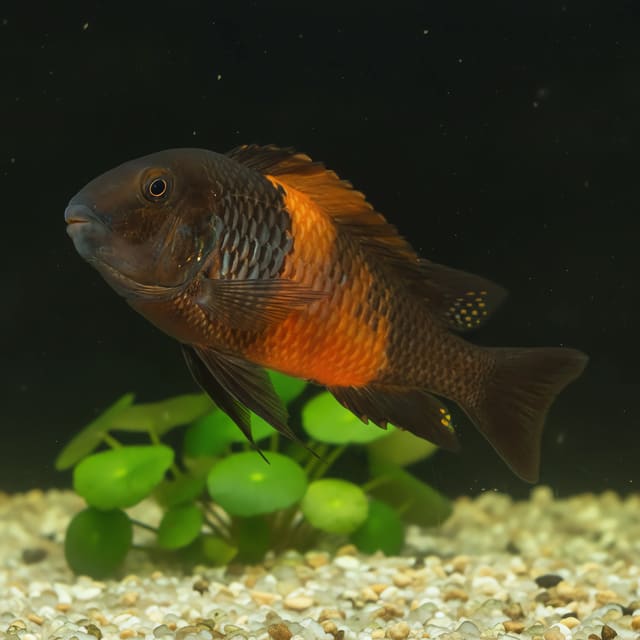
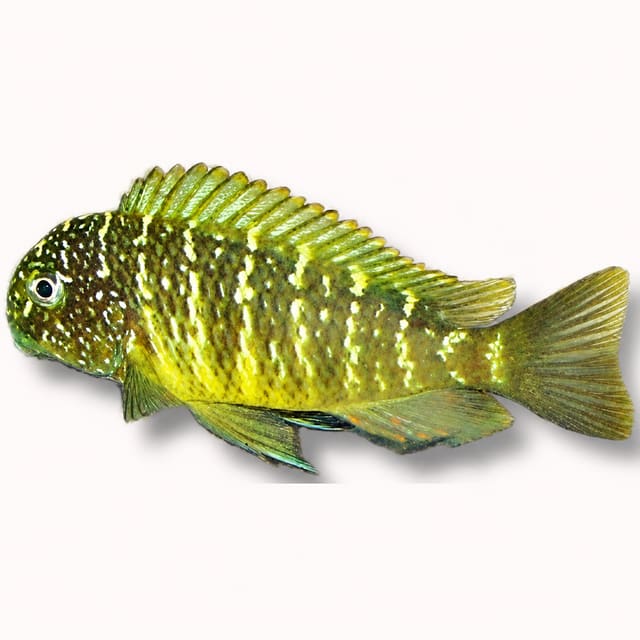
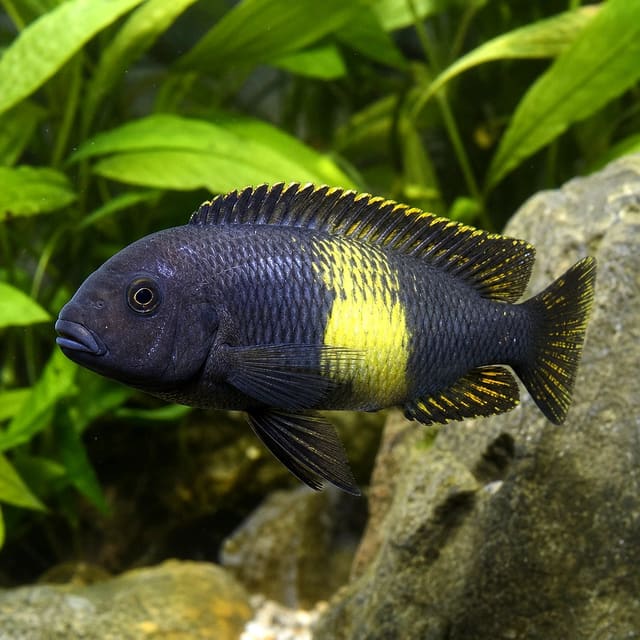
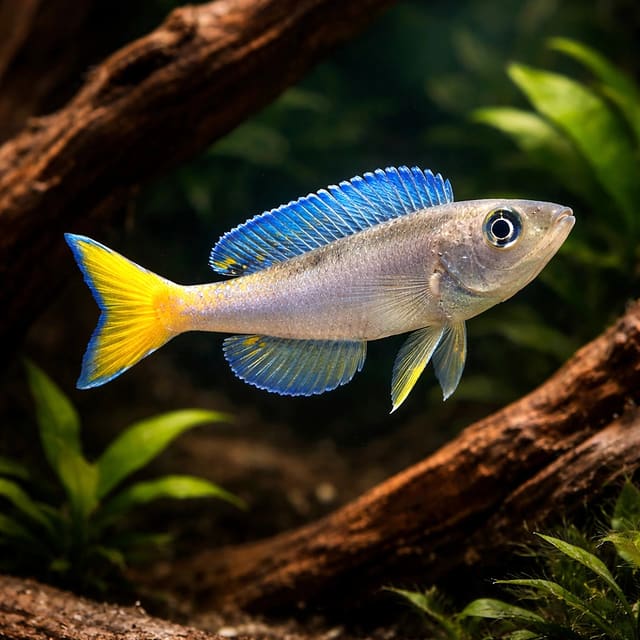
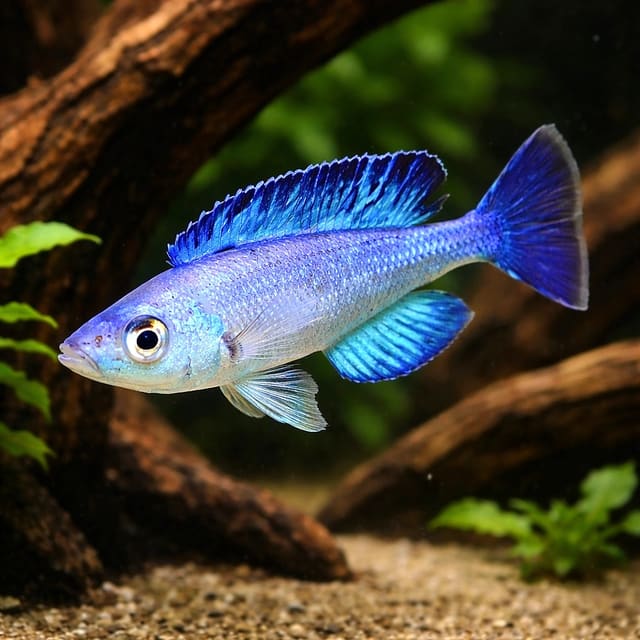
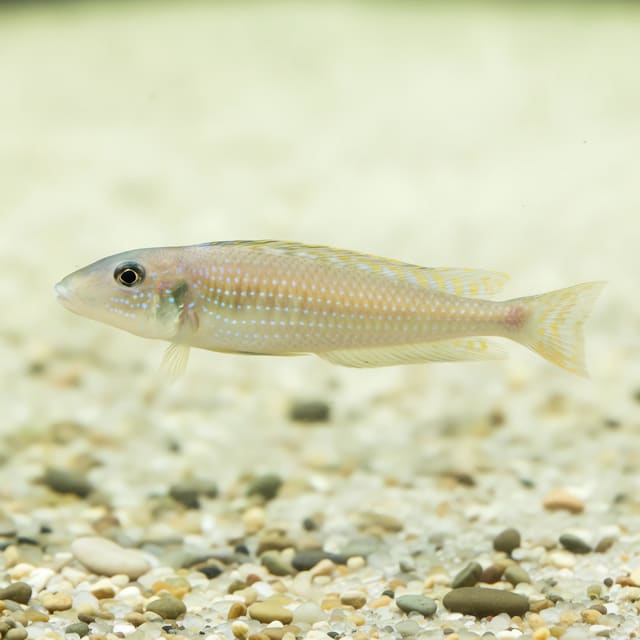
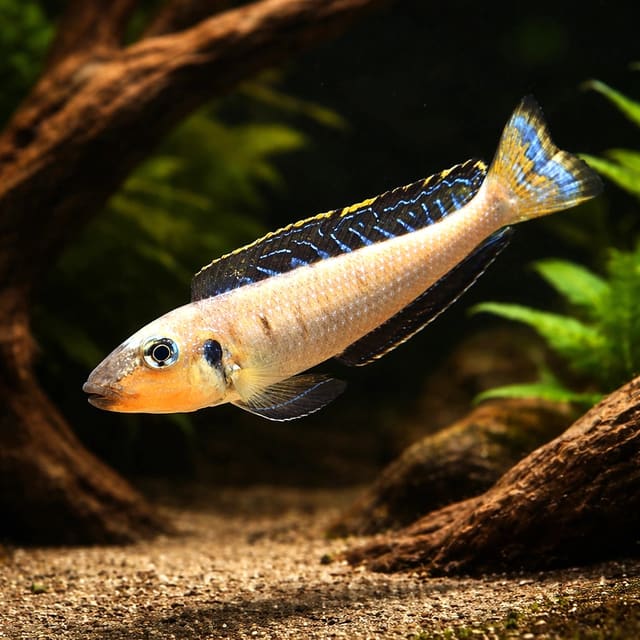
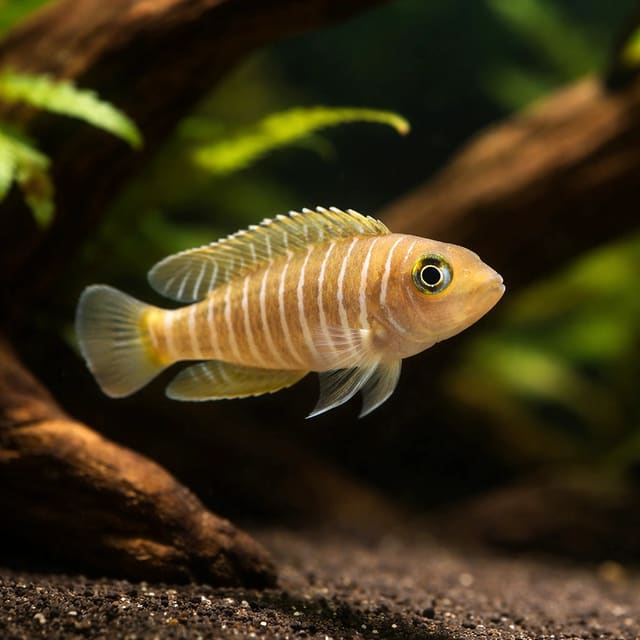
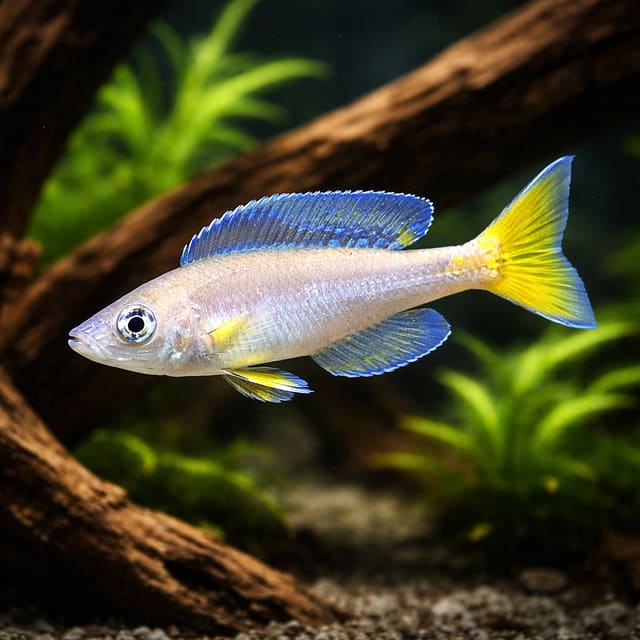
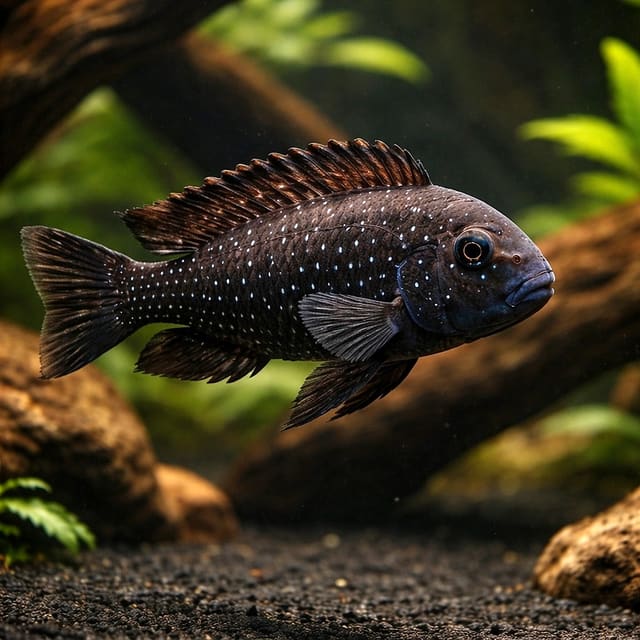
The gallery images are representative of this type of animal rather than photographs of the exact animal supplied, so colours can look slightly different from the live animal.
A carefully prepared aquarium is more important than choosing the largest dispatch size. Smaller fish still grow towards the same adult plan, while larger dispatch fish do not reduce the need for managed group dynamics or stable water.
Keep this fish at 24–26°C, pH 8.0–8.6 and 12–18 dGH. These figures are the overlap of FishBase and Seriously Fish species ranges with OATA’s African lake cichlid group guidance. FishBase records 24–26°C, pH 8.0–9.0 and 9–19 dGH, Seriously Fish gives 23–27°C, pH 8.0–9.5 and 8–25 dGH, and OATA gives 23–27°C, pH 8.0–8.6 and 12–18 dGH.
OATA also gives a carbonate hardness range of 10–15 dKH. Carbonate hardness helps define the alkaline setup, but measure it separately from general hardness rather than treating dKH and dGH as interchangeable readings. Use our aquarium water chemistry guide to identify each test, then compare the measured values with the target through the water matcher.
Keep replacement water within the planned chemistry and treat tap water with conditioner before it enters the aquarium. Regular, measured maintenance is safer than allowing waste to accumulate and then making a large reactive adjustment.
Seriously Fish describes two workable layout styles: a bare aquarium intended to reduce territorial behaviour, or a decorated aquarium with rock piles, cave-like structures and hiding places separated by open swimming areas. For a display setup, the decorated plan gives fish places to break contact while preserving room for their active movement.
The 150 cm length reference is only one part of the decision. Width affects how many separate rock areas can be formed, and filtration equipment or décor can reduce usable space. A long but very narrow aquarium may therefore offer less territorial choice than its length suggests.
For a single specimen, Seriously Fish gives a 120 × 30 × 30 cm, 110-litre reference. A group needs substantially more room, so do not multiply 110 litres by guesswork or treat it as a formula. Instead, map the proposed number of rock areas, the open routes between them and the space occupied by filters before choosing the aquarium.
Observe how the group uses the layout. Repeated pursuit through every section means the weaker fish cannot break visual contact. OATA advises rearranging décor when aggression needs to be reduced because the fish then establish territories again. Use that intervention deliberately rather than changing the layout during routine cleaning when the group is settled.
A Tropheus aquarium needs a mature biological filter and vigorous aeration. OATA recommends an oversized filter for crowded African lake cichlid communities and vigorous aeration to maintain dissolved oxygen. Seriously Fish likewise calls for well-oxygenated water, while also stressing that water quality is especially important for this species.
RSPCA aquarium guidance explains the biological process: fish produce toxic ammonia, filter bacteria convert it to nitrite, and another stage converts nitrite to the safer nitrate. The aquarium is ready only when that biological process can cope with the intended livestock and feeding load. Prepare and mature the system with our first tropical aquarium guide before arranging the fish’s arrival.
| Check | Action |
|---|---|
| Ammonia or nitrite above zero | Check filter flow, feeding and stocking pressure immediately |
| Reduced surface movement | Inspect aeration and filter outlets for restricted flow |
| Debris collecting around rocks | Siphon accessible areas during the weekly water change |
| Filter media needs cleaning | Rinse it lightly in removed aquarium water, never under the tap |
Size the filter for the intended group rather than the dispatch size of one fish. Beneficial bacteria increase in response to waste, so every addition and every rise in feeding creates extra demand. OATA warns that stocking too quickly can cause new tank syndrome when the bacterial population cannot process the increased ammonia and nitrite.
Good flow must work with the layout. Check for still areas behind rockwork, but retain places where fish can move out of direct territorial pressure. The aim is an oxygenated aquarium with waste carried towards the filter, not a single harsh current running through every refuge.
Wild adult Tropheus moorii are described by FishBase as solitary. In aquaria, Seriously Fish reports that they squabble with their own kind until a pecking order forms. It generally recommends a group of 15–20 fish to spread territorial behaviour because smaller groups of five or six may not settle and can fight to the death.
This is a deliberate aggression-management plan, not a claim that the fish naturally school. One purchase supplies one fish, so decide the intended group and aquarium capacity before choosing the purchase quantity. Avoid beginning with a casual handful and assuming more fish can always be added later; each addition increases both social disruption and the load placed on the biological filter.
FishBase advises many females for one male in aquarium keeping, and Seriously Fish discusses keeping six to ten females per male where breeding groups are deliberately managed. Do not build a sex-ratio plan around visual guesses. The sexes are difficult to distinguish, and the selected fish should be treated according to the offer disclosure rather than assumed to be male or female from colour, shape or size.
A group that appears settled still needs observation at feeding and after décor changes. Dominance is useful only as a description of what the fish are doing; it is not a reason to leave a repeatedly injured or excluded fish without reviewing the layout and stocking plan.
FishBase says wild Tropheus moorii eat worms, crustaceans, insects and plant matter, and its aquarium note directs keepers towards epiphyton. Seriously Fish turns that biology into a practical aquarium menu: vegetable matter such as spirulina flakes, blanched spinach and nori should form the basis of the diet, supported by a quality dried food and an algae-based food.
Small feeds of live or frozen food may supplement that basis. They should not displace the algae-rich daily menu. Seriously Fish specifically warns never to feed beefheart or other animal meat because it interferes with the digestive system of these fish.
Use appetite as one daily observation. A fish that approaches food but is chased away presents a different decision from a whole group that loses interest. In the first case, review territorial access and food distribution. If several fish feed less or stop feeding, test ammonia, nitrite, temperature and pH as part of the response.
Do not add extra food merely to make sure some reaches a subordinate fish. That can increase waste without solving exclusion. Distribute an appropriate portion across more than one point and observe which fish actually eat.
OATA strongly recommends a 25% partial water change at least once a week and testing at least weekly for ammonia and nitrite. Treat replacement tap water with conditioner before adding it so chlorine or chloramine does not harm the fish or filter bacteria. Use a siphon to remove accessible solid waste, including debris trapped around the edges of rockwork.
OATA highlights surface hanging, bottom sitting, erratic swimming, unusually fast or slow gill movement, greater aggression, persistent hiding, colour changes, white spots, fluffy growths, missing scales, damaged fins and loss of appetite as signs requiring attention. These signs do not all have the same cause, so begin with measured water readings and a close review of recent feeding, stocking or décor changes.
If ammonia or nitrite is detected, filter flow falls, or several fish change behaviour together, address water quality before assuming the issue is purely social. If one fish alone is repeatedly chased, cannot reach food or develops damage, review the territory plan and whether the group can use separate areas.
For health changes, test the water and contact us with the readings, the behaviour observed and when it began. Avoid choosing a disease treatment from appearance alone; white marks, altered breathing and reduced feeding need an accurate assessment before medication is considered.
Complete the aquarium checks before the delivery window. Ammonia and nitrite should both read 0 mg/l, the temperature should sit within 24–26°C, and the filter and aeration should be running normally. Make sure someone can receive the parcel because live fish must not be left unattended.
Read the complete delivery and Live Arrival Guarantee policy before the delivery date, including the same-day inspection, continuous unboxing-video and order-number requirements for a claim.
| Checkpoint | Decision |
|---|---|
| Before release | Confirm 0 mg/l ammonia and 0 mg/l nitrite |
| At each feed | Check that every fish can reach food within the group |
| After an addition | Watch territorial access and test for extra filter load |
| At least once a week | Test the water and change 25% |
OATA advises increasing fish numbers slowly because the filter’s beneficial bacteria need to respond whenever livestock and feeding increase. Balance that filtration rule against the Tropheus social plan: decide the complete intended group in advance, mature sufficient filtration, and make additions through a considered stocking plan rather than repeatedly changing direction.
Do not use an uneventful first day as a reason to relax testing. Waste processing, appetite and territorial behaviour become clearer through repeated observations, so keep the same feeding, testing and maintenance routine through the first month.
Seriously Fish describes Tropheus moorii as relatively peaceful towards other species but says it will squabble with its own kind. It is highly active and should not be kept with shy species. That distinction is more useful than a general aggressive label: the main questions are whether another fish will be intimidated by constant activity and whether it can share the algae-led feeding plan.
Possible companions named by Seriously Fish include Julidochromis, Eretmodus and Tanganicodus species because they can require a similar diet. These are candidates for assessment, not automatic matches. Adult dimensions, territory use, group size, aquarium footprint and the needs of the exact species still decide whether a proposed combination works.
| Candidate | Screening decision |
|---|---|
| Shy fish | Avoid; active Tropheus can intimidate them |
| Julidochromis species | Consider only when diet, space and territories fit |
| Eretmodus species | Consider only when diet, space and territories fit |
| Tanganicodus species | Consider only when diet, space and territories fit |
| Other Tropheus | Expect intraspecific territorial pressure |
OATA recommends building African lake communities around fish from the same location and advises avoiding a mix of Malawi and Tanganyikan cichlids because their temperament and behaviour differ. Keep this aquarium focused on Lake Tanganyika candidates and reject a proposed combination if its feeding requirements would pull the Tropheus away from an algae-led diet.
Space must be assessed after the complete population is known. A tank that meets a length reference for Tropheus may still lack enough separate rock areas for another territorial cichlid. Map where each species is expected to feed, shelter and defend space, then check whether open swimming routes remain.
Do not mix different geographical forms of Tropheus moorii. Seriously Fish warns that the many forms can hybridise freely in aquaria. Keeping the Moliro Orange form separate protects the identity of the group and avoids adding another set of very similar territorial competitors.
Choose only a Lake Tanganyika candidate whose adult space, activity, territories and algae-led feeding needs fit the completed aquarium. Avoid shy species, avoid mixing Malawi and Tanganyikan cichlids, and treat every named possible companion as conditional rather than guaranteed.
OATA advises introducing more peaceful African lake cichlids before more aggressive ones and notes that some species are best added as groups. It also recommends rearranging décor when aggression must be reduced because established territories are then formed again. Use that step with care: changing the layout may interrupt territorial control, but it also requires every fish to establish its place again.
Compatibility remains conditional because individual behaviour and the exact aquarium layout affect the outcome. For a stocking assessment, contact us with the aquarium dimensions, planned fish numbers, measured water values and the scientific names of every proposed companion.
After any addition, observe access to food, refuge and open swimming space. If a fish hides continuously, is excluded from meals or is pursued throughout the tank, reconsider the combination rather than assuming the hierarchy simply needs unlimited time.
It reaches the FishBase recorded maximum of 14.5 cm total length. Plan its aquarium around that adult figure rather than the 2-3 cm, 3-4 cm or 4-5 cm dispatch sizes.
FishBase gives a minimum aquarium length of 150 cm. Seriously Fish gives 110 litres in a 120 × 30 × 30 cm aquarium for one specimen and says a group requires a much larger aquarium, so assess the full footprint, territories and filtration for the intended population.
Seriously Fish generally recommends 15–20 fish to spread territorial behaviour. Groups of five or six may fail to settle and can fight severely, while wild adults are recorded as solitary rather than schooling.
No. Seriously Fish describes it as unsuitable for beginners, and we rate it advanced because its managed group, algae-led diet, hard alkaline water and high water-quality demands require deliberate planning.
Make spirulina flakes, algae-rich dried food, blanched spinach or nori the basis of two small daily feeds eaten within a few minutes. Small live or frozen feeds may supplement the menu; never feed beefheart or other animal meat.
Keep it at 24–26°C and pH 8.0–8.6, with hardness at 12–18 dGH. These figures are the overlap of FishBase and Seriously Fish species ranges with OATA’s African lake cichlid group guidance.
It is relatively peaceful towards other species but squabbles with its own kind, and groups of five or six may fight severely. Watch for relentless pursuit, persistent hiding, damaged fins, missing scales and exclusion from food.
Possible candidates include suitable Julidochromis, Eretmodus and Tanganicodus species when diet, space and territories fit. Avoid shy fish, avoid mixing Malawi and Tanganyikan cichlids, and do not mix different Tropheus geographical forms.
Someone must be present to receive the parcel. Start filming every delivery continuously before opening the sealed parcel, show the fish still in the sealed bag, float the bag for 20–30 minutes, and never pour the bag water into the aquarium.
No reviews for this item yet. Bought one? Honest reviews only, good or bad.
What customers say about ordering from us
Easy website plenty of info on fish your buying great to pick a time slot
TRACEY DURRANT · 7 Oct 2026
Got some lovely fish thank you
Kevin Mackie · 7 Oct 2026
Reviews of our shop, collected by Judge.me, an independent third-party review collector. Newest first.