Advanced
Petrochromis sp. "Kazumbe" Cape Kabogo
23–27°C · pH 8–8.6
£62.99
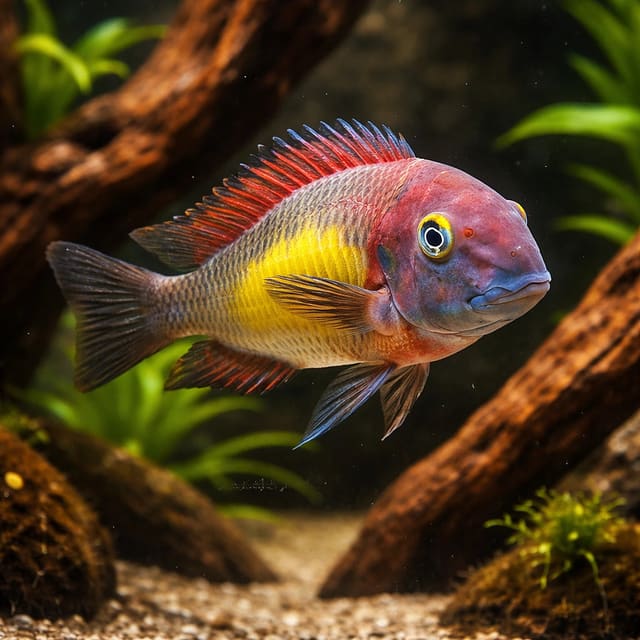
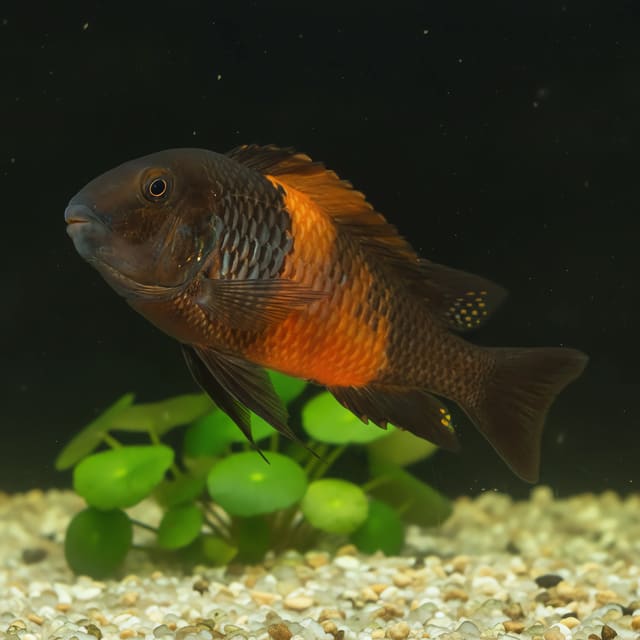
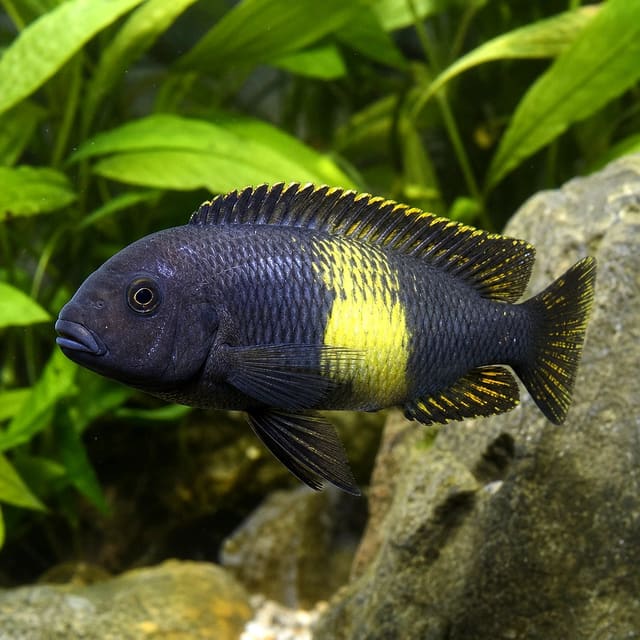
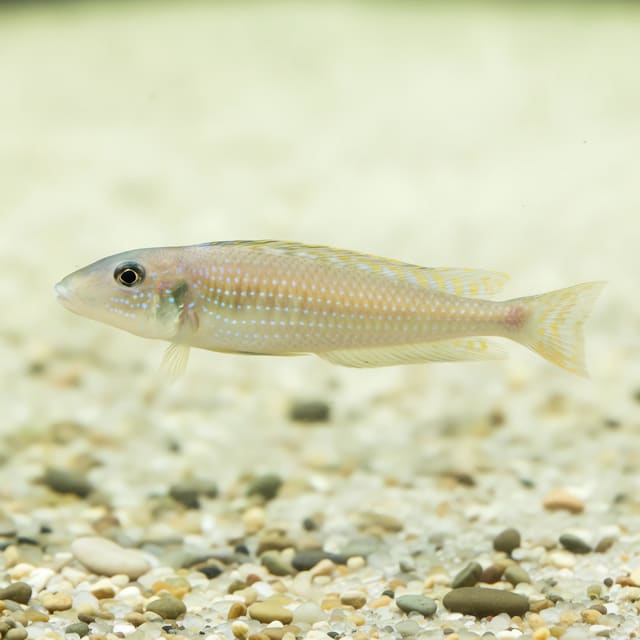
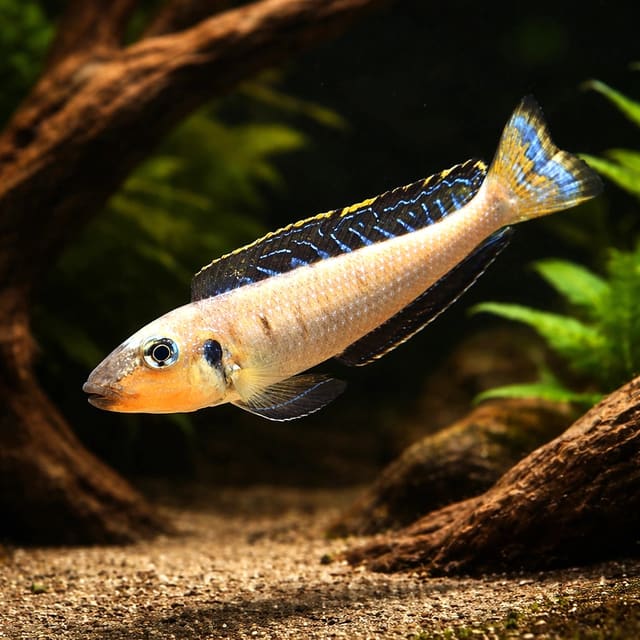
Tropheus brichardi namansi gold is an advanced Lake Tanganyika cichlid best planned as a 15–20-fish group in a large, well-oxygenated rock aquarium. One purchase supplies one animal in the selected 3 - 4 cm, 5 - 7 cm or XL dispatch size. Keep 23–27°C, pH 8.0–8.6 and 12–18 dGH, and make algae-rich vegetable food the dietary base.
Adult size is the maximum length this species reaches at full maturity (scientific sources). The livestock you receive will be younger and smaller — pick a size above for the actual shipping size. Product-photo provenance and any image-specific limitations are stated on the listing.
Tropheus brichardi
Shoaling fish: kept in a group they feel safer, stay calmer and show their best colour.
Tropheus brichardi namansi gold is an advanced Lake Tanganyika cichlid best planned as a 15–20-fish group in a large, well-oxygenated rock aquarium. One purchase supplies one animal in the selected 3 - 4 cm, 5 - 7 cm or XL dispatch size. Keep 23–27°C, pH 8.0–8.6 and 12–18 dGH, and make algae-rich vegetable food the dietary base.
Adult size is the maximum length this species reaches at full maturity (scientific sources). The livestock you receive will be younger and smaller — pick a size above for the actual shipping size. Product-photo provenance and any image-specific limitations are stated on the listing.
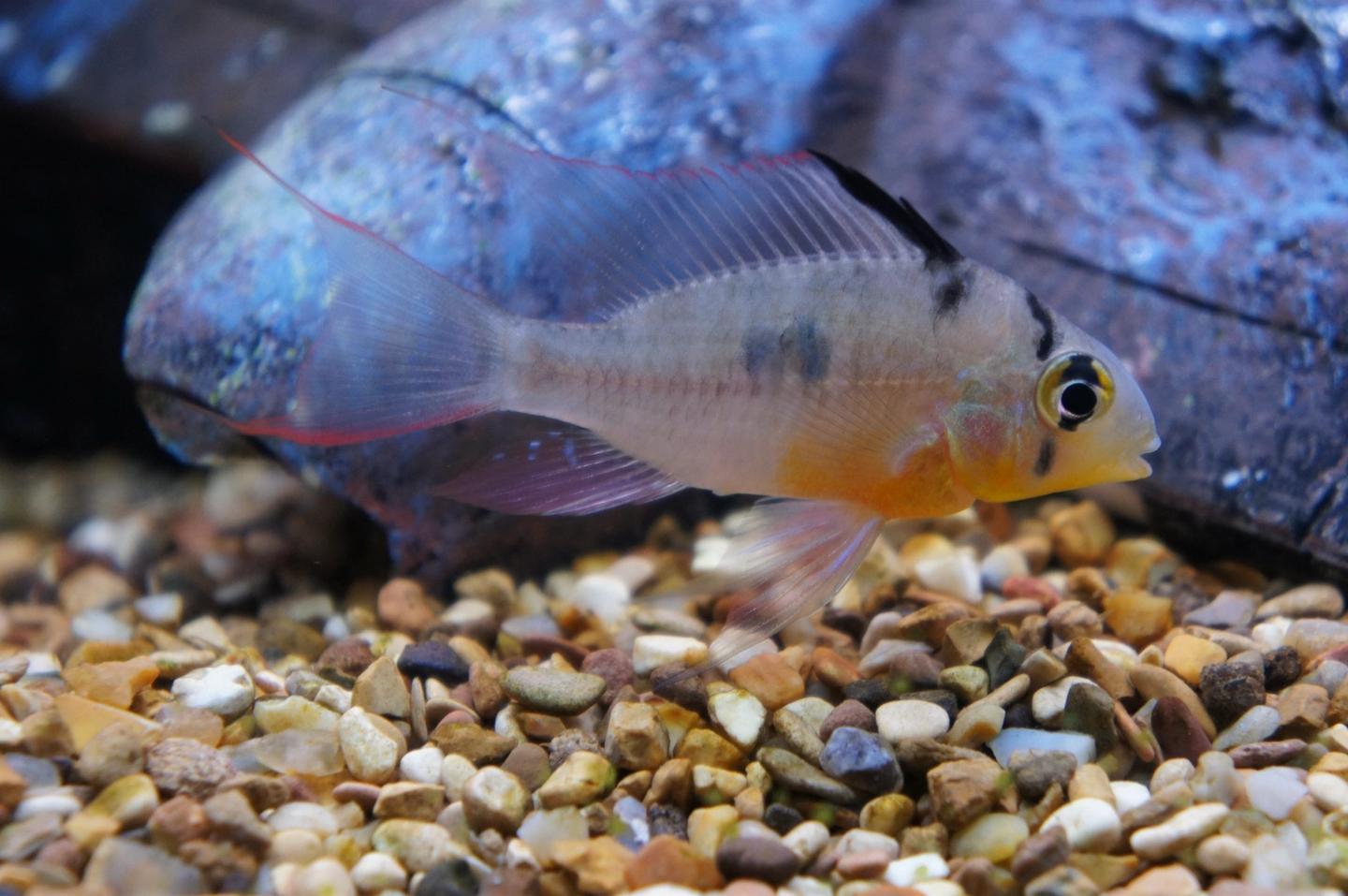
Cichlids are a family of roughly 1,800 accepted species, not one care type. Before buying, identify the exact species and source, then compare adult measurement, usable tank dimensions, social system, territory, tested water, diet and an exit plan. No family-wide minimum tank, water range or tank-mate list is safe.
Maintain these water conditions for optimal health and vibrant colors
Tropheus brichardi namansi gold is a freshwater cichlid form for an experienced keeper who can combine hard, alkaline water with disciplined feeding and carefully managed social behaviour. It belongs to the Cichlidae family and represents the gold Namansi form of Tropheus brichardi. This is an advanced choice rather than a first community fish: the aquarium must be planned around a group, strong oxygenation, excellent water quality and the disputes that arise while the fish establish their hierarchy.
FishBase records Tropheus brichardi as endemic to Lake Tanganyika and associated with solid rock, interlocking rubble and sandstone slabs. It does not form schools in nature. In the aquarium, that combination matters: the fish need swimming room and clearly separated rock territories, but living together does not turn them into a placid shoal. Expect active interactions and plan enough structure to let an individual move away from another fish.
FishBase records a maximum of 10 cm total length for male or unsexed fish. The Seriously Fish husbandry profile uses 11.5 cm standard length as its aquarium planning reference. Plan the layout, filtration and group aquarium around the larger 11.5 cm figure rather than treating a dispatch size as the eventual size. A planning length describes the space that should be reserved; it is not a promise that every individual will reach exactly that measurement.
| Decision | Planning point |
|---|---|
| Keeper experience | Advanced; consistent water and social management are essential |
| Adult planning length | Allow for 11.5 cm standard length |
| Natural setting | Rock-associated Lake Tanganyika cichlid |
| Social character | Active, non-schooling fish that squabble with their own kind |
Keep the Namansi gold form separate from other Tropheus brichardi colour forms because they may hybridise. If you are comparing other African cichlids, use our African cichlid collection as a starting point, then screen every candidate for location, activity, diet and water requirements.
One purchase quantity supplies one animal of the selected option. Use the live size selector to choose between the labels 3 - 4 cm, 5 - 7 cm and XL. The size you select is the size supplied, not the adult size. XL is a named grade rather than a centimetre measurement, so plan the aquarium from the adult references and group requirements instead of interpreting that label as a final length.
Sex is guaranteed only when the selected option explicitly states male or female. This Tropheus brichardi namansi gold listing has no sex-guaranteed option. Sexing this species is difficult, and neither colour nor dispatch size should be used to assign sex. Build the social plan around the recommended group and territorial layout rather than assuming a particular male-to-female composition from appearance.
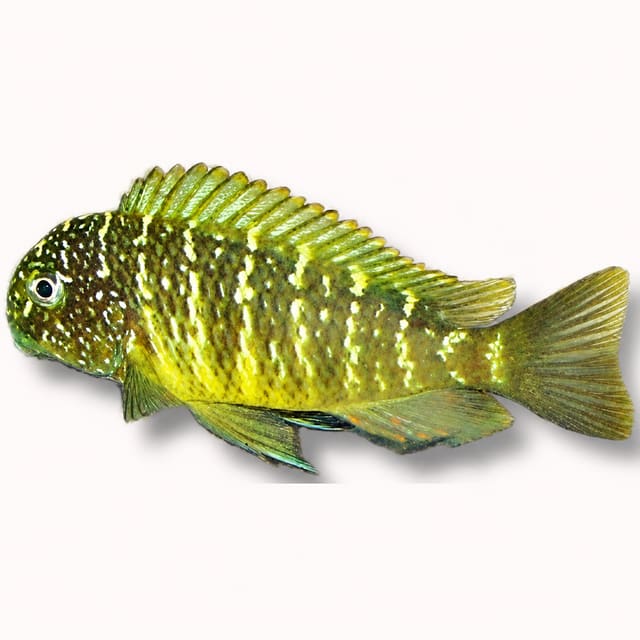
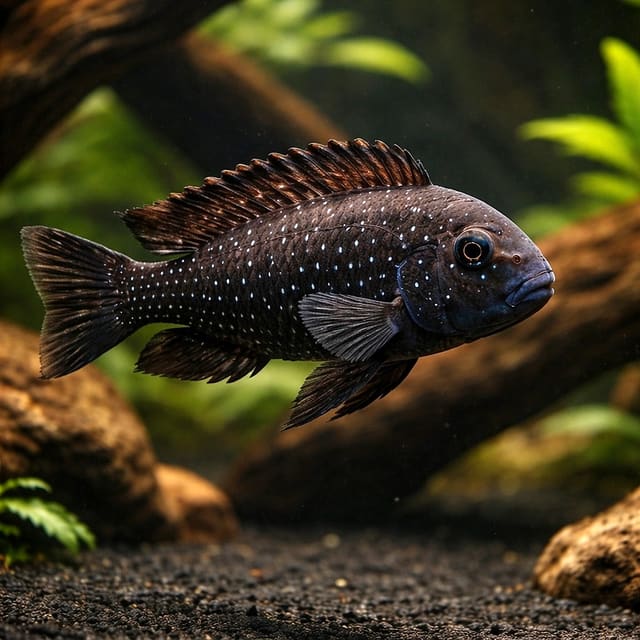
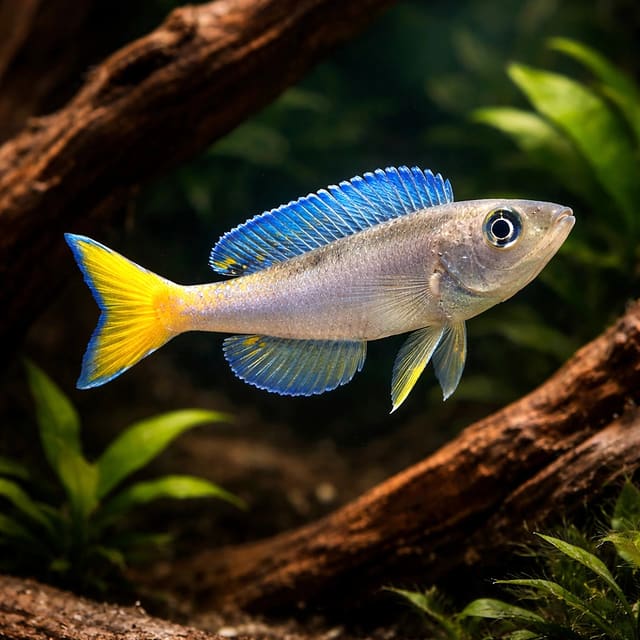
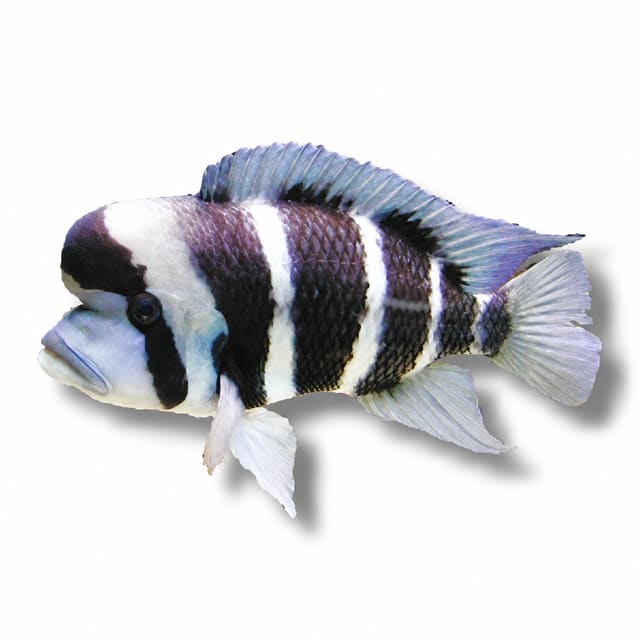
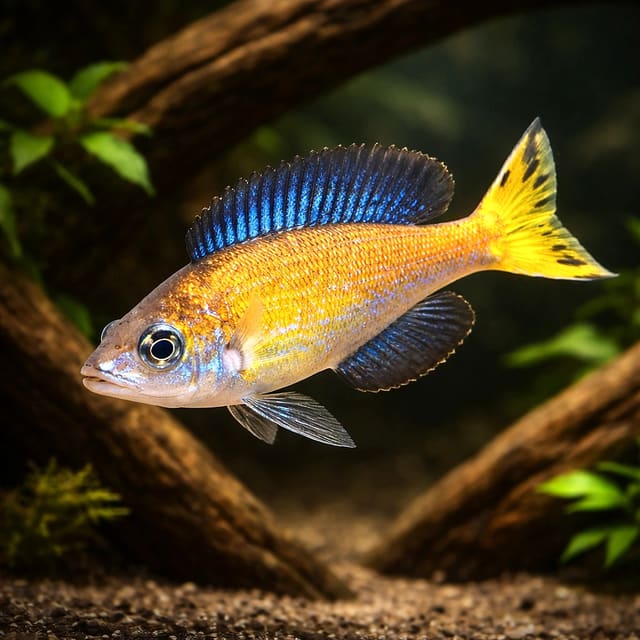
Some gallery images have been digitally enhanced to improve image quality. They show the listed type of animal rather than guaranteeing the exact markings of the individual supplied, so natural colour and pattern can vary.
The decisive numbers are 23–27°C, pH 8.0–8.6 and 12–18 dGH for routine aquarium management, with zero ammonia, zero nitrite and nitrate kept within the stated care limit. Seriously Fish recommends 15–20 fish to reduce territorial pressure and gives an aquarium measuring 120 × 30 × 30 cm, about 110 litres, only as a single-specimen reference. A group requires a much larger aquarium. The footprint must accommodate many territories, open swimming areas and a suitably capable filter rather than merely holding the calculated volume.
This is not a fish to add casually to an established mixed community. Decide on the whole group, rock plan, feeding regime and compatible neighbours before purchase. A mature biological filter, vigorous oxygenation and a repeatable weekly maintenance routine are central parts of that decision.
| Suits | Not suited to |
|---|---|
| Stable aquarium water maintained at 23–27°C and pH 8.0–8.6 | Water outside 23–27°C and pH 8.0–8.6 |
| Julidochromis, Eretmodus or Tanganicodus species after screening water, diet, activity and territory needs | Shy species |
Reference: reviewed public source.
Start with the whole social plan rather than multiplying the dispatch length by a simple litres-per-fish rule. Seriously Fish gives at least 120 × 30 × 30 cm, approximately 110 litres, for a single specimen and explicitly calls for a much larger aquarium for a group. Because the recommended group contains 15–20 fish, 110 litres is a comparison point, not the target group aquarium.
A suitable footprint must hold several separated rock piles, cave-like retreats and open swimming areas without turning the aquarium into one continuous defended wall. Each extra territory needs a route into open water and more than one way out. If every fish entering the rocks must pass the same dominant individual, the layout is not distributing pressure effectively.
| Check | What to look for |
|---|---|
| Footprint | Room for multiple rock territories and open swimming lanes |
| Filtration | Capacity for a large, actively fed cichlid group |
| Oxygen | Vigorous aeration and well-oxygenated water |
| Substrate | Sand, with fine coral sand or similar material where buffering is appropriate |
| Access | Rockwork that still allows waste removal and maintenance |
OATA advises choosing as large an aquarium as is practical for African lake cichlids because greater water volume improves environmental stability. It also recommends an oversized filter and vigorous aeration for the crowded conditions used with some communities. Those measures are especially relevant here because group management and water quality cannot be separated.
Before adding fish, mature the biological filter and confirm that ammonia and nitrite are both zero. Our first tropical aquarium guide explains how to prepare and mature a filter before livestock arrives. A physically large aquarium is not ready until its filter can process the waste generated by the intended population and feeding routine.
When comparing two aquariums of similar volume, favour the one that provides the more useful footprint for territories, access and swimming. Height contributes water volume, but it cannot replace the horizontal separation needed by active rock-dwelling cichlids.
Use 23–27°C, pH 8.0–8.6 and 12–18 dGH as the routine aquarium range. OATA’s African lake cichlid sheet gives 23–27°C, pH 8.0–8.6 and 12–18 dGH as group guidance. Seriously Fish gives the wider aquarium ranges of 23–27°C, pH 8.0–9.5 and 8–25 dGH for Tropheus brichardi, while FishBase records the wild environment at 24–26°C, pH 7.0–9.0 and 10–15 dH. The routine targets stay inside the aquarium range while using OATA’s narrower alkaline and hard-water bands.
| Measurement | Routine target |
|---|---|
| Temperature | 23–27°C |
| pH | 8.0–8.6 |
| General hardness | 12–18 dGH |
| Carbonate hardness | 10–15 dKH |
| Ammonia | 0 mg/l |
| Nitrite | 0 mg/l |
| Nitrate | Up to 20 mg/l above the normal tap-water level |
Test the aquarium and replacement water rather than adjusting from guesswork. Our water chemistry guide explains what the main readings mean, and the water matcher helps compare measured values with these targets. Record temperature, pH, general hardness, carbonate hardness, ammonia, nitrite and nitrate so that a trend is visible before it becomes a sudden problem.
If the measured pH or hardness sits outside the target, plan how the aquarium and replacement water will be brought into line before introducing the fish. Fine coral sand or a similar substrate may help buffer an African lake cichlid aquarium, but testing remains the deciding check. Do not use buffering material as a substitute for measuring the result.
Stability depends on repeating the same preparation at every water change. Treat replacement tap water for chlorine or chloramine, check that its conditions suit the aquarium and avoid abrupt changes. When behaviour, breathing, colour or appetite changes, test the water first because even small amounts of ammonia or nitrite can stress African lake cichlids.
A working biological filter is essential. The RSPCA explains that biological filtration supports bacteria that convert toxic ammonia to nitrite and then to the safer nitrate. OATA sets the operating targets at zero ammonia, zero nitrite and nitrate no more than 20 mg/l above the normal tap-water level.
Choose filtration capacity for the intended 15–20-fish group and its twice-daily feeding, not for the aquarium’s empty volume. OATA recommends an oversized filter for crowded African lake cichlid communities and vigorous aeration to maintain dissolved oxygen. Position the return and aeration so water circulates around rockwork rather than leaving obvious pockets where debris can collect.
Tap water may contain chlorine or chloramine that can harm the filter bacteria, so never rinse established biological media beneath the tap. Avoid cleaning every component so aggressively that the bacterial population is stripped back. The aim is to restore flow while preserving the biological filter.
For a worked monthly plan, changing 25% at least once every week means four partial changes across a typical four-week period, not one 100% replacement at the end. Regular partial maintenance removes waste while reducing sudden shifts. If ammonia or nitrite rises above zero, treat that reading as an immediate water-quality problem: reduce the load on the system, remove uneaten food, check filtration and carry out appropriate conditioned partial changes while monitoring the fish.
Recreate the functional parts of the natural habitat rather than trying to copy a decorative scene. FishBase associates the wild species with solid rock, interlocking rubble and sandstone slabs rather than loose pebbles or silty areas. In the aquarium, Seriously Fish recommends piles of rockwork that form numerous cave-like structures and hiding places, separated by open swimming areas.
Sand is the recommended substrate. Fine coral sand or a similar material may also support buffering in a hard-water African lake aquarium, provided testing confirms the resulting chemistry remains within the target. Loose décor must not be allowed to compromise the planned routes and territories.
Some aquarists maintain Tropheus in bare aquariums to reduce territorial behaviour, while decorated aquariums can work when rockwork is divided into useful retreats and swimming spaces. Choose one deliberate strategy. A few isolated ornaments in an otherwise exposed aquarium do not create the multiple territories described by the husbandry guidance.
Observe how the fish use the layout after introduction. If one individual controls the only major rock pile or repeatedly intercepts others at the same narrow route, rearranging the décor may help reduce aggression by forcing the group to establish new territories. Make the change purposefully: create more broken sight lines and alternative paths instead of simply moving one stone.
Keep different Namansi gold individuals within the same coherent layout, but do not combine this form with other Tropheus brichardi colour forms. The species profile warns that colour forms hybridise freely in aquaria.
Make algae-rich vegetable food the foundation of the diet. Seriously Fish recommends spirulina flakes, blanched spinach and nori as suitable vegetable matter, with a quality dried product and an algae-based food forming the core. OATA likewise describes Tropheus as herbivorous and recommends specialised cichlid feeds with a high algae content alongside fresh vegetables.
Feed only what the group can finish within a few minutes, twice a day. That schedule comes from OATA’s African lake cichlid guidance and gives a clear limit for each meal. If food remains after a few minutes, remove the excess and reduce the next portion rather than leaving it to break down into ammonia-producing waste.
| Part of the diet | Instruction |
|---|---|
| Daily base | High-algae cichlid food or spirulina flakes |
| Vegetable variety | Blanched spinach or nori |
| Supplement | Low-protein live or frozen food in a supporting role |
| Meal limit | Only what is eaten within a few minutes |
| Frequency | Twice daily |
Never feed beefheart or other animal meat. Seriously Fish warns that animal meat interferes with the digestive system of these fish. Low-protein live or frozen varieties may supplement the vegetable-led diet, but they must not displace the algae-rich base or turn routine feeding into a high-animal-protein regime.
Distribute food so several fish can feed at the same time. A single concentrated feeding point gives dominant individuals more opportunity to exclude subordinates. Watch the whole group until the food is gone and check whether any fish repeatedly hangs back, spits food out or loses condition.
Feeding and filtration are one system. Two controlled meals are preferable to adding extra food in the hope that a shy individual will eventually find some, because leftovers increase the waste load. If one fish is not feeding, first check social pressure, breathing, body condition and water readings. Reduced intake is a health warning rather than a reason to leave excess food in the aquarium.
Plan a group of 15–20 Tropheus brichardi. Seriously Fish recommends that range to spread territorial behaviour and warns that smaller groups of five or six may fail to settle and may fight fatally. The fish do not school in nature, so the group recommendation is a way to manage hierarchy and territorial pressure rather than an expectation of synchronised shoaling.
Keeping one fish is also a poor default social plan. OATA advises that very few African lake cichlids do well singly and that isolated fish are likely to become stressed, while the species profile focuses on managing a group. The 110-litre single-specimen aquarium reference therefore remains a space comparison, not a recommendation to keep this form alone.
Do not infer the group’s sex ratio from colour, body shape or size. Correct sexing is difficult, and the genital examination described by Seriously Fish is recommended only for experts. This offer carries no sex guarantee, so the practical decision is to build sufficient space and structure for the group rather than planning around assumed sexes.
Adding fish gradually helps a biological filter adjust to increased waste, but adding one individual to a settled territorial group can focus aggression on that newcomer. Reconcile those risks before changing the population: confirm filter capacity, use an appropriate grouped introduction where needed and rearrange décor to disrupt established territories. Contact us with the aquarium dimensions, existing stock and intended group before combining these fish with an established community.
Prepare the aquarium before the parcel arrives. Confirm the heater, filtration and aeration are operating; test for zero ammonia and zero nitrite; and ensure the planned hard, alkaline conditions are stable. Someone must be present to receive live fish, so use the date shown for the order and follow the current delivery and Live Arrival Guarantee policy.
Slow acclimatisation helps address the temperature transition, but it cannot compensate for an immature filter or unsuitable water. Complete the chemistry and social checks before arrival rather than trying to correct the aquarium while the fish remains in its bag.
During the first month, continue the same weekly cycle: test the water at least once a week, change 25% at least once every week, condition replacement tap water and check filter flow. Do not rinse filter media under the tap. If colour, breathing, swimming, temperament, condition or appetite changes, test water quality immediately and contact us for health guidance.
Build a Lake Tanganyika community only after screening each candidate for activity, diet, water chemistry and territorial use. OATA advises keeping African lake species with fish from the same location and does not generally recommend mixing Malawi and Tanganyikan cichlids because their temperament and behaviour differ. Sharing a lake still does not make two species automatically compatible.
Seriously Fish describes Tropheus brichardi as relatively peaceful towards other species but prone to squabbling with its own kind. It is highly active and should not be kept with shy species. Possible neighbours include Julidochromis, Eretmodus and Tanganicodus species because they can share a similar dietary approach. These are candidates, not universal matches: the exact aquarium dimensions, numbers, territories and needs of the chosen species still decide the outcome.
| Screen | Pass condition |
|---|---|
| Water | The candidate thrives in hard, alkaline Tanganyika conditions |
| Diet | Routine feeding is compatible with an algae-rich, vegetable-led regime |
| Activity | The fish is not shy or easily displaced by active Tropheus |
| Territory | The layout can provide its required space without removing group retreats |
Avoid shy fish because the species profile gives a direct warning against that combination. Avoid mixing Namansi gold with other Tropheus brichardi colour forms because they may hybridise freely. Treat small groups of five or six conspecifics as a serious risk rather than a compatibility shortcut; they may not settle and may fight fatally.
Do not solve a poor match by adding more fish without checking filter capacity. OATA notes that slight overstocking is used for some African lake cichlids to distribute aggression, but it also requires suitable filtration, vigorous aeration and controlled additions. For this species, the supported planning point is a 15–20-fish group in a much larger aquarium than the 110-litre single reference.
Expect some conspecific squabbling while a hierarchy develops, but do not dismiss every chase as normal. A practical threshold is whether an individual can still reach food, use shelter and rest without repeated interception. Persistent hiding, damaged fins, loss of scales, reduced feeding, weight change or a marked change in colour indicates that the pressure requires action.
OATA recommends adding more peaceful African lake species before more aggressive ones and notes that rearranging décor may reduce aggression as fish establish new territories. Apply that principle without treating it as a guarantee. The established group size, aquarium footprint and behaviour of every individual can change the result.
Keep water quality central to the response. A social disturbance can coincide with increased waste, missed feeding or a blocked filter, while poor water may also alter breathing, colour and temperament. Test ammonia, nitrite and nitrate before assuming that every behavioural change is purely aggression.
Do not combine different Tropheus brichardi colour forms as a way to increase numbers. They may hybridise, and adding visually different fish does not remove the need for a coherent 15–20-fish group plan. Where compatible Tanganyikan species are considered, protect the vegetable-led feeding regime and reject candidates that are shy or require conflicting water conditions.
It is a freshwater cichlid form of Tropheus brichardi from the Lake Tanganyika species group. FishBase records the species with a maximum length of 10 cm total length, while the aquarium planning reference is 11.5 cm standard length.
One purchase quantity supplies one animal of the selected option. Sex is not guaranteed because none of the selectable options explicitly states male or female.
The live selector uses the dispatch-size labels 3 - 4 cm, 5 - 7 cm and XL. XL is a named grade without a centimetre measurement, and every option should be planned around the adult length rather than its dispatch size.
Seriously Fish gives at least 120 × 30 × 30 cm, about 110 litres, for one specimen and calls for a much larger aquarium for a group. Use sand, multiple separated rock piles, open swimming areas, oversized filtration and vigorous aeration.
Plan a group of 15–20 fish to spread territorial behaviour. Avoid planning a smaller group of five or six because it may fail to settle and the fish may fight fatally.
Maintain 23–27°C, pH 8.0–8.6 and 12–18 dGH, with carbonate hardness at 10–15 dKH. Ammonia and nitrite should remain at 0 mg/l, and nitrate should stay up to 20 mg/l above the normal tap-water level.
Base the diet on high-algae cichlid food, spirulina flakes and vegetables such as blanched spinach or nori. Feed only what is eaten within a few minutes twice daily, use low-protein live or frozen food only as a supplement, and never feed beefheart or other animal meat.
Start filming while the parcel is still sealed, then show the outer box, open it in one continuous take and show the fish inside the sealed bag. Float the bag in the prepared aquarium for 20–30 minutes before release, then transfer the fish without pouring transport water into the aquarium.
Screen active Lake Tanganyika candidates for matching hard, alkaline water, an algae-led diet and compatible territorial needs. Julidochromis, Eretmodus and Tanganicodus species are possible candidates, but avoid shy fish and do not mix different Tropheus brichardi colour forms.
No reviews for this item yet. Bought one? Honest reviews only, good or bad.
What customers say about ordering from us
Easy website plenty of info on fish your buying great to pick a time slot
TRACEY DURRANT · 7 Oct 2026
Got some lovely fish thank you
Kevin Mackie · 7 Oct 2026
Reviews of our shop, collected by Judge.me, an independent third-party review collector. Newest first.