Advanced
Duboisi, White-Spotted Cichlid (Tropheus duboisi)
23–27°C · pH 8–8.6 · 110L
From £17.39Some sizes on sale

Tropheus moorii — Murago is a specialist Lake Tanganyika cichlid for experienced keepers. One purchase supplies one unsexed fish in the chosen 3.5–7 cm or XL dispatch grade; plan a spacious, mature, well-oxygenated aquarium around a carefully managed 15–20 fish group.
Adult size is the maximum length this species reaches at full maturity (scientific sources). The livestock you receive will be younger and smaller — pick a size above for the actual shipping size. Product-photo provenance and any image-specific limitations are stated on the listing.
Tropheus moorii
Save when buying multiple fish. Each quantity is one fish; sex and pair formation are not guaranteed unless the selected variant explicitly states them.
Tropheus moorii — Murago is a specialist Lake Tanganyika cichlid for experienced keepers. One purchase supplies one unsexed fish in the chosen 3.5–7 cm or XL dispatch grade; plan a spacious, mature, well-oxygenated aquarium around a carefully managed 15–20 fish group.
Adult size is the maximum length this species reaches at full maturity (scientific sources). The livestock you receive will be younger and smaller — pick a size above for the actual shipping size. Product-photo provenance and any image-specific limitations are stated on the listing.
Cichlids are a family of roughly 1,800 accepted species, not one care type. Before buying, identify the exact species and source, then compare adult measurement, usable tank dimensions, social system, territory, tested water, diet and an exit plan. No family-wide minimum tank, water range or tank-mate list is safe.
Maintain these water conditions for optimal health and vibrant colors
Tropheus moorii — Murago is a specialist cichlid for a carefully planned Lake Tanganyika aquarium. The accepted species, Tropheus moorii, belongs to the cichlid family Cichlidae and is endemic to Lake Tanganyika. FishBase records a maximum length of 14.5 cm total length for the species. Murago is the supplier-backed trade or locality wording attached to this offer. Treat it as a shopping name rather than a collection-point, ancestry or breeding-history record.
This is an active rock-associated fish with demanding social management, a plant-led diet and little tolerance for casual water maintenance over its full life, with steady routines that remain workable as the group matures. It is best suited to an experienced keeper who can establish hard alkaline water, strong biological filtration and generous oxygenation before the fish arrives. It is not a beginner community fish, and a purchase should begin with a plan for the whole long-term group rather than with the space needed by one juvenile.
One purchase supplies one live fish in the dispatch grade selected at checkout. The listed grades are 3.5–4.5 cm, 4.5–5.5 cm, 5–7 cm and XL. The size you select is the size supplied, not the adult size. The centimetre bands are dispatch sizes rather than age, sex or maturity promises, while XL is a trade grade rather than a fixed measurement. Use the live product page for the current choice and do not assume every grade is available at the same time.
Sex is guaranteed only when the selected option explicitly states male or female. This Tropheus moorii murago listing has no sex-guaranteed option. Seriously Fish notes that the sexes are difficult to distinguish and that reliable examination is specialist work. A larger fish, brighter fish or fish shown near another in a gallery image is therefore not evidence of sex, a bonded pair or breeding readiness.
| Suits | Useful planning answer |
|---|---|
| Experience | Advanced store assessment. Suitable for a keeper confident with mature filtration, weekly testing, hard alkaline water and management of conspecific aggression. |
| Adult planning | FishBase records 14.5 cm total length for Tropheus moorii. Plan around the adult group, not the juvenile dispatch grade. |
| Social plan | Seriously Fish generally recommends 15–20 fish because groups of five or six can fail to settle and may fight severely. |
| Routine water | Species-level aquarium guidance is 23–27°C, pH 8.0–9.5 and 8–25°dGH. Stability, oxygen and zero ammonia or nitrite matter alongside the numbers. |
| Diet | Spirulina flakes, blanched spinach, nori and other suitable vegetable matter form the basis; only small supplementary live or frozen feeds. |
| Tank community | Build around the Tropheus group. Consider only active Lake Tanganyika species with compatible water and dietary needs, checking each exact species. |
For a group, Seriously Fish gives a minimum aquarium footprint of 60 by 18 by 18 inches, approximately 152 by 46 by 46 cm. Its separate 110-litre figure is explicitly for a single specimen and is not a group recommendation. Because Tropheus social needs make the group the practical project, compare the full dimensions, rock plan, filter capacity and eventual animal count before buying.
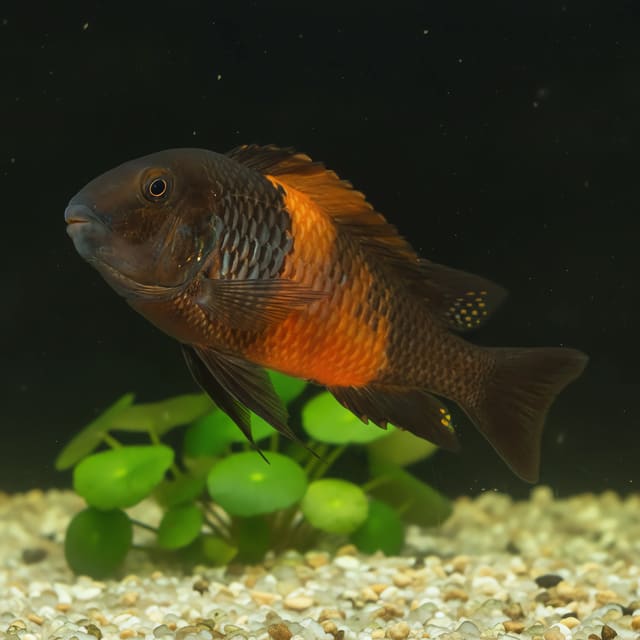
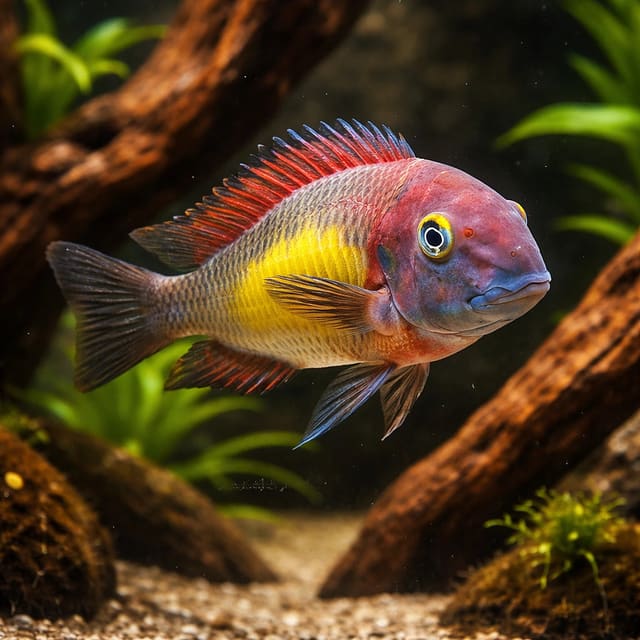
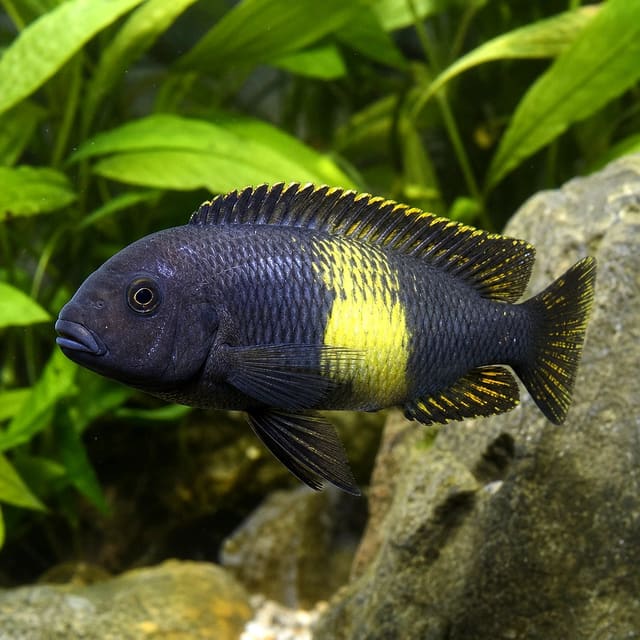
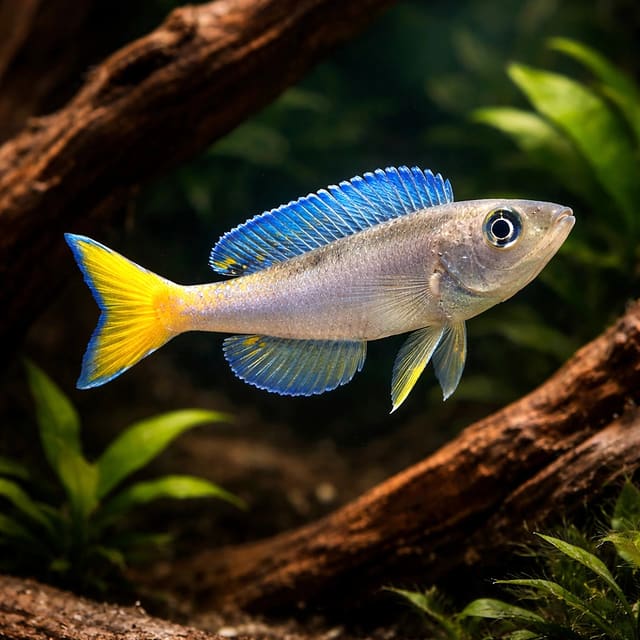
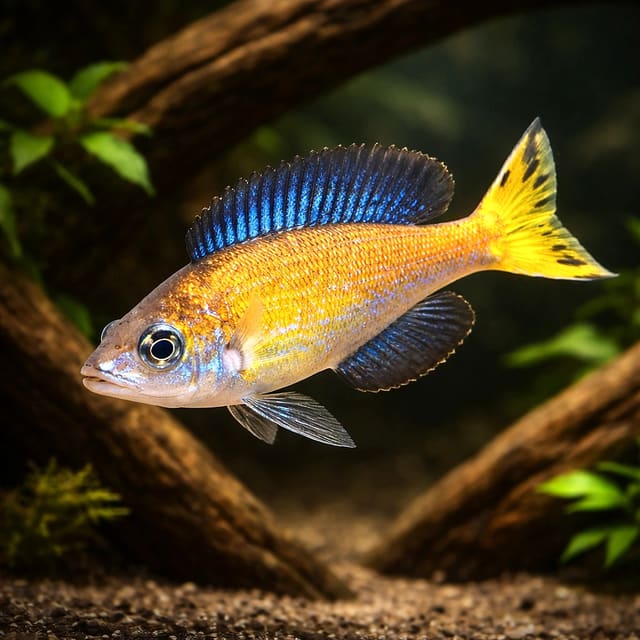
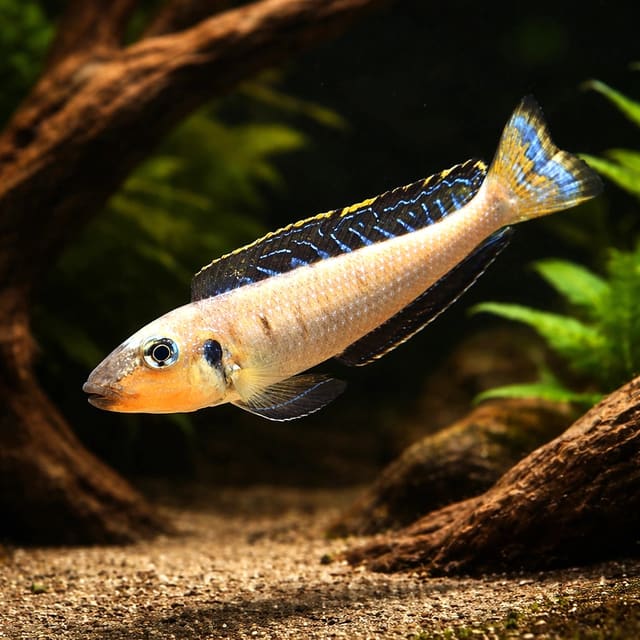
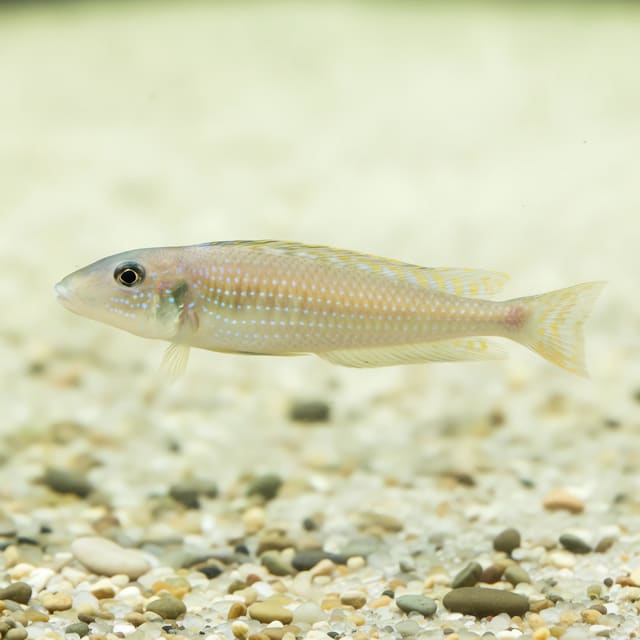
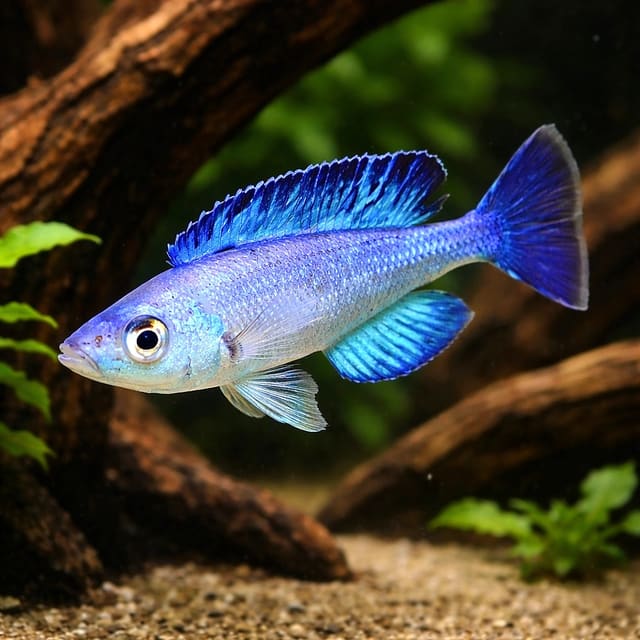
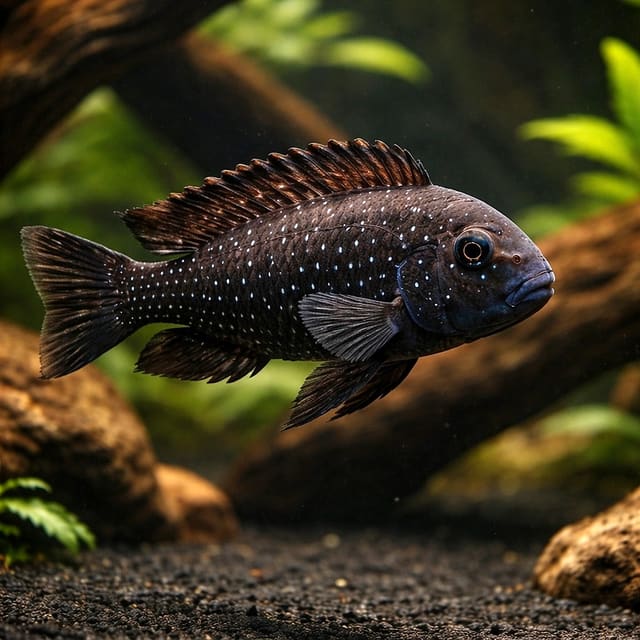
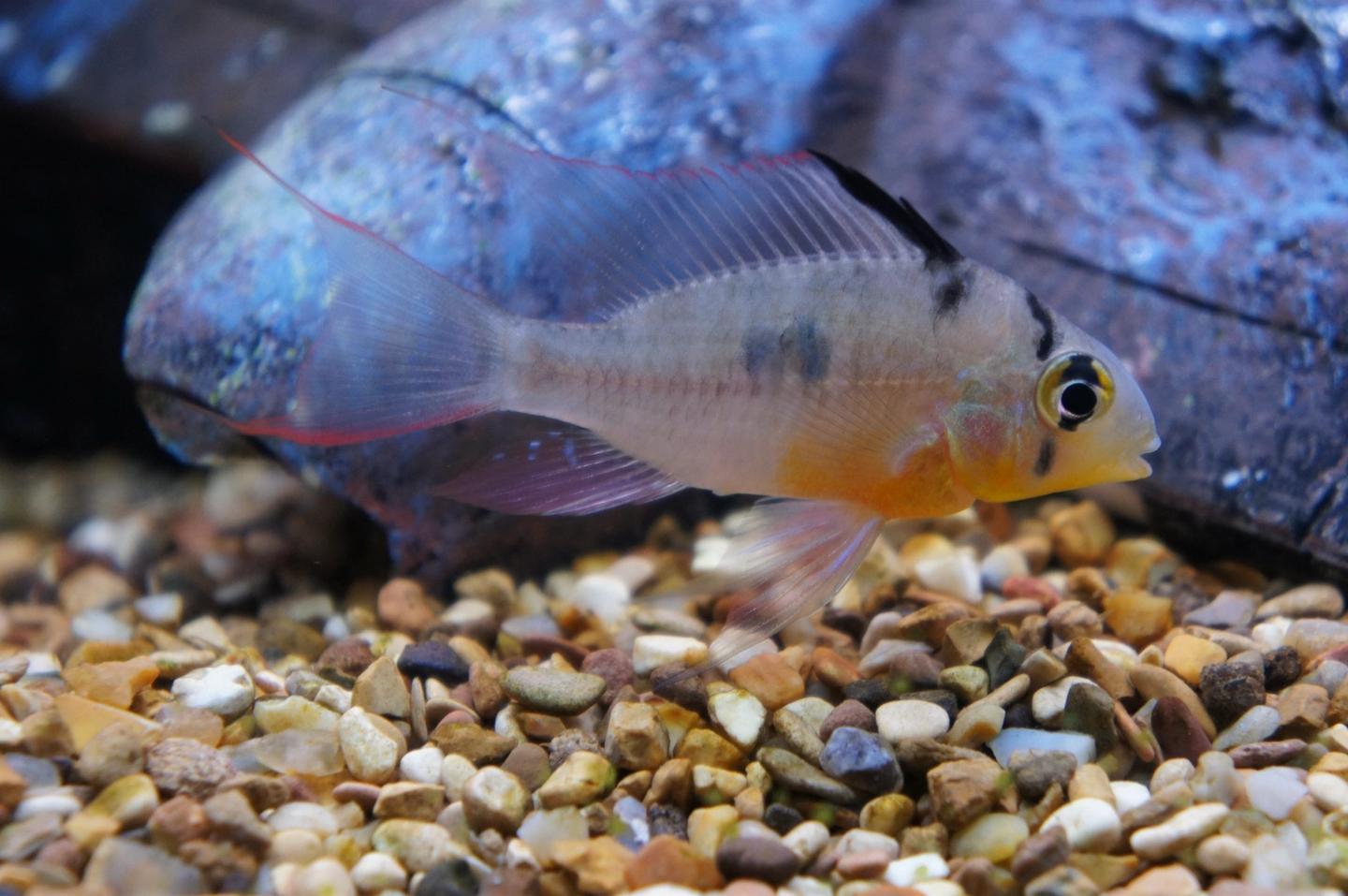
The four supplied images show bright orange-red cichlid-like fish in staged aquarium views: a single fish near wood, two fish in a planted scene, a side view against blue and a fish beside a green plant. Visual review cannot establish that these are the exact fish offered, their sex, locality, lineage or final adult colour. The two-fish scene is not a quantity or pair promise. Gallery images have been digitally enhanced to improve image quality. Natural colour, pattern, size and maturity can vary between live animals.
Colour is therefore a shopping cue, not a welfare specification. Make the decision from accepted identity, group needs and water requirements. If the commitment fits, the current African cichlid collection provides context for comparing other listings, but similarity in category never guarantees compatibility.
A successful Tropheus aquarium begins with measured water and a mature filter, not with decoration. For routine captive care, the species profile from Seriously Fish gives 23–27°C, pH 8.0–9.5 and 8–25°dGH. FishBase separately reports wild environmental values of 24–26°C, pH 8.0–9.0 and 9–19°dH. Those FishBase figures describe the recorded natural environment; they are useful biological context, but they are not a replacement for the species-level aquarium routine target on this page.
OATA's African lake cichlid sheet offers a narrower broad-group reference of 23–27°C, pH 8.0–8.6, general hardness 12–18°dH and carbonate hardness 10–15°dKH. It explicitly labels that table general guidance and tells keepers to check species-specific requirements. This page therefore uses the wider Tropheus moorii aquarium ranges as the customer target, while OATA's full table supplies important waste limits: ammonia zero, nitrite zero and nitrate not to exceed 20 mg per litre above normal tap water levels.
A target is not an instruction to change chemistry abruptly. Test the source water and the established aquarium, then choose a stable point within the care range that can be maintained through ordinary water changes. Avoid chasing daily readings with sudden chemical corrections. Our water chemistry guide explains what common tests measure, and the water matcher can help compare measured conditions with the care ranges. A match on three numbers still does not replace a mature filter, oxygen or an adequate group aquarium.
Seriously Fish states that a 120 by 30 by 30 cm, 110-litre aquarium is for a single specimen and that a much larger aquarium is required for a group. In its group guidance it gives 60 by 18 by 18 inches as the minimum. The distinction is crucial: one fish may physically fit into 110 litres, yet the same profile says Tropheus groups are difficult, smaller groups of five or six may fight to the death, and 15–20 are generally recommended to reduce territorial behaviour.
Use the larger group dimensions as the relevant starting point and consider going beyond them when the rock structure, filter equipment or companion species reduce usable space. Length and front-to-back depth matter because the aquarium must contain several rock areas, sight breaks and open swimming routes at the same time. Litres alone can conceal an unhelpfully tall or narrow shape. Make sure the support, cover, heater, filtration and power provision suit the final aquarium, not a temporary juvenile arrangement.
Seriously Fish supports sand as the substrate and either a bare arrangement or piles of rocks forming cave-like refuges with open swimming areas between them. OATA likewise recommends complex rockwork to create territories and break obvious lines of sight, while preserving swimming room for active species. Place heavy rocks securely so digging cannot undermine them. The goal is a stable structure with more than one route through the aquarium, not a wall of loose stone or a maze that traps a pursued fish.
Fine coral sand is one group-level OATA option where buffering is appropriate, but the material is not a substitute for testing. Confirm what it does in your own source water rather than assuming every mineral substrate will create or hold the desired chemistry. Plants are optional and may be uprooted; do not sacrifice swimming room or secure rock placement to reproduce the planted gallery scenes.
RSPCA guidance explains why a working biological filter is essential: beneficial bacteria convert toxic ammonia first to nitrite and then to the less toxic nitrate. OATA recommends an oversized filter and vigorous aeration for the crowded conditions used in some African lake cichlid communities. Seriously Fish also specifies well-oxygenated water for Tropheus moorii. Provide visible surface movement and arrange the outlet so oxygenation reaches the whole aquarium without leaving waste trapped behind rock piles.
Filter capacity is not permission to stock the whole group into an immature system. OATA warns that adding animals too quickly can overwhelm the bacterial population as feeding and waste increase. Prepare the aquarium with fishless cycling and confirm that ammonia and nitrite have risen and returned to zero before livestock is introduced. The first tropical tank guide covers the basic maturation process, but this demanding Tanganyika project also needs the species plan described here.
Before purchase, record temperature, pH, general hardness, carbonate hardness, ammonia, nitrite and nitrate on more than one day. Check that the heater holds temperature, the filter restarts after a power interruption and the rockwork remains secure during maintenance. A stable written baseline is more useful than a claim that the water looks clear, because clear water can still contain harmful nitrogen waste.
Tropheus moorii is adapted to grazing, but wild and captive records require careful separation. FishBase describes the wild diet as worms, crustaceans, insects and plant matter and separately says aquarium fish feed on epiphyton. Its ecology record characterises the species as mainly plant and detritus feeding and as a grazer of aquatic plants. Seriously Fish gives the practical captive rule: vegetable matter such as spirulina flakes, blanched spinach and nori should form the basis, with only small feeds of suitable live or frozen foods as supplements.
The combined record supports a plant-led aquarium diet without describing an animal that never consumes animal material. Use a reputable algae-rich cichlid food or spirulina flake as the regular prepared staple, rotating appropriate vegetable items such as blanched spinach or nori for variety. If a live or frozen food is used, keep it a small supplement rather than the foundation of the menu.
Seriously Fish specifically says never to feed beefheart or other animal meat because it interferes with the digestive system. This is narrower and more defensible than the inherited copy's sweeping claim that every protein food causes fatal bloat. Avoid mammal or bird meat, avoid rich improvised mixtures, and do not turn a general frozen community food into the default ration. A product described as high protein is not automatically useful simply because the fish accepts it.
OATA's African lake cichlid guidance says to offer only what the fish can consume within a few minutes, twice daily, and warns that uneaten food breaks down into toxic waste. For a Tropheus group, divide food across the aquarium so more than one fish can feed without every portion falling into one defended patch. Small controlled meals make it easier to confirm participation and remove leftovers than one heavy feed.
Observe the group rather than judging success by an empty surface. Check that every fish approaches food, takes it and continues swimming normally afterwards. A fish that hangs back repeatedly, spits food, develops an unusual outline, breathes faster, darkens or isolates itself needs attention. OATA lists reduced intake, changes in body condition, unusual colour, breathing changes and altered swimming or aggression among signs worth investigating. Test the water first when behaviour changes, because a social problem and a water-quality problem can look similar at the start.
Rock surfaces allow natural picking behaviour, but visible algae is not a complete diet and a clean-looking rock does not prove hunger. Keep a repeatable feeding record that notes food type, amount and whether all fish fed. This is especially useful after arrival, after group changes or whenever one individual begins losing access.
Do not sterilise the whole aquarium in pursuit of spotless stone. Maintain the filter biologically, siphon trapped solids from accessible areas and clean viewing panes as needed while keeping the established system stable. At the same time, do not let the idea of beneficial biofilm excuse accumulated waste. The aim is a mature, oxygenated habitat with measured nitrogen waste and controlled feeding.
Diet also limits companion choice. Seriously Fish names Julidochromis, Eretmodus and Tanganicodus as possible companions partly because they can share broadly similar feeding requirements. Even within those genera, check the exact species and make sure food reaches each animal. A fish that needs frequent rich meaty meals can make a poor practical companion even if its water range overlaps.
A strong appetite after transport can appear before a fish is fully settled or socially secure. Conversely, a brief hesitation on arrival does not by itself diagnose a condition. Use appetite together with breathing, posture, waste, colour, injuries and water tests. If several fish change at once, treat that as a prompt to check temperature, oxygen, ammonia and nitrite immediately rather than adding more food.
The inherited listing made confident claims about bloat causes, strict feeding schedules and breeding conditioning without a reliable basis for all of them. This rewrite keeps the actionable parts the sources actually support: vegetable matter as the basis, small supplements, no animal meat, twice-daily measured feeding as broad OATA guidance, and close observation of every group member.
Tropheus social advice can sound contradictory unless wild and captive contexts are separated. FishBase reports that adults are solitary in the wild. Seriously Fish explains that they do not school naturally yet usually fight among themselves in an aquarium until a social order develops. OATA offers broader captive guidance that Tropheus require a group of more than ten. These statements can all be true: a captive group is a management strategy for distributing territorial pressure, not proof that the species forms a close natural school.
Seriously Fish generally recommends 15–20 fish, warns that five or six may not settle and may fight to the death, and gives a large group aquarium as the practical minimum. A number alone cannot make a poor layout safe. Space, rock distribution, sight breaks, sex ratio, individual temperament and the way the group was assembled all matter. Plan the full group and aquarium together, and have a safe response ready if one fish becomes persistently excluded or injured.
Do not purchase two fish because the gallery shows two. The image shows two fish, while this offer supplies one unsexed fish per purchase. Seriously Fish says sexing is difficult, while FishBase aquarium notes favour many females for one male. Without sex-guaranteed options, ordering a particular number cannot guarantee a desired sex ratio. Breeding sits outside this offer and should not drive a first-time Tropheus purchase.
Seriously Fish advises against introducing new individuals to an established Tropheus community because the resident fish may not tolerate them. That makes gradual one-by-one expansion a poor default, even though cautious staged stocking is sensible for filter capacity in many ordinary aquariums. Resolve this tension before buying: the biological filter must be ready, but the social plan must not depend on repeatedly dropping isolated newcomers into an established territorial group.
Ask for experienced help if completing or rebuilding a group. Rockwork rearrangement can alter established territories, and OATA mentions it as one broad way to reduce aggression while fish find new areas, but it is not a guarantee. Observe continuously through introductions, ensure that more than one retreat route exists and be ready to separate an injured fish safely. Do not simply add another animal to distract a pursuer.
Seriously Fish describes Tropheus moorii as relatively peaceful towards other species but quarrelsome with its own kind. It also says the fish is active and should not share space with shy species. Possible companions named in that profile include Julidochromis, Eretmodus and Tanganicodus species because of broadly similar diet. OATA's group-level rule also favours animals from the same lake and discourages mixing Malawi and Tanganyika cichlids because behaviour and temperament differ.
Those names are starting points, not a universal approval list. Check the exact candidate's adult size, water range, diet, territory, activity, group needs and likely feeding access. Two species from Lake Tanganyika can still compete for the same rock space or require incompatible social structures. Avoid shy feeders, soft-water community fish and animals likely to be overwhelmed by constant movement.
| Candidate | Decision rule |
|---|---|
| Another Tropheus locality or colour form | Do not mix geographical morphs: Seriously Fish warns they can hybridise. Social introduction risk also remains high. |
| Julidochromis species | Possible genus named by the species source; check the exact species, territory, adult size and feeding plan. |
| Eretmodus or Tanganicodus | Possible genera named because of similar diet; exact-species water, space and behaviour checks still apply. |
| Shy or slow-feeding fish | Avoid. The activity and feeding pressure of Tropheus can prevent timid animals settling or eating properly. |
| Malawi cichlids | Generally avoid mixing with Tanganyika cichlids under OATA's broad lake-community guidance. |
Brief displays and chasing are not the same as a fish being trapped away from food. Watch for repeated cornering, torn fins, rapid breathing, darkening or paling, refusal to emerge and declining body condition. Map where each fish spends time at several points in the day. A fish that has no path to food or shelter is not successfully integrated simply because it remains alive.
Water quality can amplify or mimic social stress. Test ammonia, nitrite, nitrate, pH and temperature when behaviour changes; check oxygen and filter flow as well. If only one fish is targeted, review sight lines and group dynamics. If several fish breathe rapidly or stop eating at once, investigate the shared environment urgently. Compatibility is a monitored condition, not a label fixed at the day of purchase.
The two supplied related listings—Duboisi and Bemba Tropheus—are useful for comparing identity and care information, not as automatic tank-mate recommendations. Mixing morphs is specifically discouraged, and an established colony may reject newcomers. Treat each product alternative as a separate stocking decision.
Prepare the permanent aquarium before dispatch. Temperature, pH and hardness should already be within the species care range, ammonia and nitrite should read zero, and the filter should be mature and operating normally. Confirm that rockwork is stable, surface movement is strong and the planned group has sufficient space. Do not use the delivery day to finish cycling or make a large chemistry correction.
Read the current delivery and Live Arrival Guarantee policy before ordering because reporting requirements and delivery coverage belong to that live policy. It currently says someone must be present at the delivery address, the sealed parcel should be opened and inspected on the day it arrives, and a continuous unboxing video is required for a guarantee claim. It also says fish travel in oxygen-filled bags inside insulated boxes with temperature support when conditions call for it.
Record the parcel and fish while following the store policy, then keep handling calm and deliberate. OATA's African lake cichlid introduction method says to switch off the aquarium lights, float the closed bag to equalise temperature, then after ten minutes introduce small amounts of aquarium water to the bag for up to twenty minutes. Release the fish while allowing as little bag water as possible into the aquarium, discard the remaining transport water and monitor the new fish closely for the first week.
The store policy currently describes floating for 20–30 minutes before release, while OATA's complete method adds gradual chemistry adjustment. Follow the current store instructions and use OATA's water-addition step to avoid treating temperature matching as the whole acclimatisation process. Do not pour transport water into the aquarium. Where an established Tropheus group is involved, social introduction is an additional specialist problem; acclimatisation alone does not make a lone newcomer safe.
Keep the aquarium lighting subdued during the introduction and avoid feeding heavily to provoke a response. Observe posture, breathing, balance and whether resident fish block access to cover. A transported fish may show temporary colour change, but persistent distress, injury or inability to escape needs action. Retain the order details and contact the store promptly if the arrival condition worries you.
OATA strongly recommends a 25% partial water change at least once every week for African lake cichlids. Match the replacement water carefully, treat it with conditioner to remove chlorine or chloramine and avoid sudden temperature or chemistry shifts. Test ammonia, nitrite, nitrate, pH and hardness weekly, with extra attention during initial setup and after livestock changes.
Check filter intakes and outlets for reduced flow. If media needs cleaning, do not run it under the tap; rinse it lightly in aquarium water removed during the water change so fewer beneficial bacteria are lost. Never replace all mature media at the same time merely because it looks stained. Clean mechanical material enough to restore flow while protecting the biological function that processes waste.
The nitrate ceiling in OATA's table is not a universal reading of 20 mg/l. It is nitrate not to exceed 20 mg per litre above normal tap water levels. Test the source water as well as the aquarium so the comparison is meaningful. Ammonia and nitrite remain zero targets, and any detectable result should prompt immediate investigation of feeding, stocking, filter operation and the maturity of the system.
A concise record helps distinguish a gradual social problem from a sudden environmental one. It also gives useful evidence when asking an experienced retailer or aquatic vet for help. Avoid guessing at medication from a single sign; first verify water, observe the whole group and obtain qualified advice where illness is suspected.
Long-term stability comes from repeatable maintenance rather than dramatic intervention. Keep water-change volume, replacement temperature and feeding routine consistent; inspect equipment before it fails; and reassess usable space as the juveniles grow. The dispatch size is temporary, but the adult group, rock territories and waste load are the permanent responsibility.
FishBase records a maximum length of 14.5 cm total length for Tropheus moorii. That is the adult planning figure; the 3.5–7 cm and XL labels on this listing are dispatch grades, temporary grades rather than final sizes.
Seriously Fish gives 120 by 30 by 30 cm and 110 litres for a single specimen, then says a much larger aquarium is required for a group. Its group guidance gives 60 by 18 by 18 inches as the minimum. Use the group footprint for practical planning, with extra room where rockwork or companions reduce usable space.
Seriously Fish generally recommends 15–20 fish to reduce territorial pressure and warns that smaller groups of five or six may fail to settle and can fight severely. Aquarium dimensions, rock layout, sex ratio and individual behaviour still determine how the group functions.
No. Our store assessment is advanced because the fish needs stable hard alkaline water, mature filtration, generous oxygenation, specialist feeding and careful group management. Seriously Fish likewise says Tropheus moorii is not a good species for a beginner.
Base the aquarium diet on vegetable matter such as spirulina flakes, blanched spinach and nori. Seriously Fish allows small supplementary live or frozen feeds but says never to offer beefheart or other animal meat. Feed controlled amounts and make sure every group member eats.
Seriously Fish gives species-level aquarium guidance of 23–27°C, pH 8.0–9.5 and 8–25°dGH. Keep a stable point in that range, with ammonia and nitrite at zero, strong oxygenation and regular tests rather than abrupt chemical adjustments.
Seriously Fish describes it as relatively peaceful towards other species but quarrelsome with its own kind. It is active and should not be kept with shy fish. Persistent chasing, blocked feeding, injury or a fish forced into one corner means the social plan needs attention.
Seriously Fish names Julidochromis, Eretmodus and Tanganicodus species as possible companions with similar dietary needs. Check each exact species for adult size, water, territory and feeding behaviour; each candidate still needs an exact-species compatibility check.
Tropical Fish Co uses oxygen-filled bags, insulated boxes and a tracked courier licensed for live animals, with temperature support when needed. Someone must receive the parcel; inspect it the same day and follow the current delivery and unboxing-video requirements on the store policy page.
This page separates exact offer evidence from public care evidence. The accepted species, family, endemic Lake Tanganyika distribution, maximum recorded length, wild environmental figures and wild biology come from FishBase. FishBase's wild context is not presented as the routine aquarium target.
The practical species-level aquarium ranges, single-specimen and group dimensions, plant-led diet, conspecific behaviour, 15–20 group recommendation, difficult sexing and possible companion genera come from Seriously Fish. Its 110-litre figure is retained only with its single-specimen context and is not used as a group minimum.
The full water table, African lake cichlid setup, maintenance, feeding and introduction method were read from the current OATA African lake cichlid care sheet. These are broad group recommendations where the page says so. General filter biology and cycling context was checked against the RSPCA aquarium environment guide.
Delivery, packing and claim wording comes only from Tropical Fish Co's current delivery policy. Offer size grades and the sold unit come from the frozen catalogue evidence. No source supplied proof of the exact gallery specimens, sex, capture location, breeder, lineage, current availability, a bonded pair or a guaranteed final colour, so none is promised.
No reviews for this item yet. Bought one? Honest reviews only, good or bad.
What customers say about ordering from us
I have a small group of long finned mountain minnows. So was delighted to be able to order ten of this variety to increase the genetics in my tank . The ones I recieved are healthy but it’s to early to give a verdict on wether they are of a long finned type since they are small currently.
Gordon Walker · 23 Sept 2026
100% success travel and "installation". Pleased with quality of purchase. The Siamese fighter a bit "shy" so have not yet seen him at his best yet but looking good. Happy customer. GG
George E Garratt · 21 Sept 2026
Reviews of our shop, collected by Judge.me, an independent third-party review collector. Newest first.