Expert
Xenotilapia flavipinnis Nyanza Lac
24–27°C · pH 8–9 · 200L
£54.99
Tembwe locality Xenotilapia papilio for a mature Tanganyika aquarium: pair-forming, sand-filtering and best kept over fine sand beside secure rockwork.
Adult size is the maximum length this species reaches at full maturity (scientific sources). The livestock you receive will be younger and smaller — pick a size above for the actual shipping size. Product-photo provenance and any image-specific limitations are stated on the listing.
Xenotilapia papilio
Save when buying multiple fish. Each quantity is one fish; sex and pair formation are not guaranteed unless the selected variant explicitly states them.
Confirm your email, then we’ll send an availability message for this exact item if it returns within 180 days.
This request is only for this product—no newsletter or other promotions. A mail-provider retry may very rarely duplicate the same availability message. Unconfirmed addresses are removed after 48 hours. See our privacy policy.
Tembwe locality Xenotilapia papilio for a mature Tanganyika aquarium: pair-forming, sand-filtering and best kept over fine sand beside secure rockwork.
Adult size is the maximum length this species reaches at full maturity (scientific sources). The livestock you receive will be younger and smaller — pick a size above for the actual shipping size. Product-photo provenance and any image-specific limitations are stated on the listing.
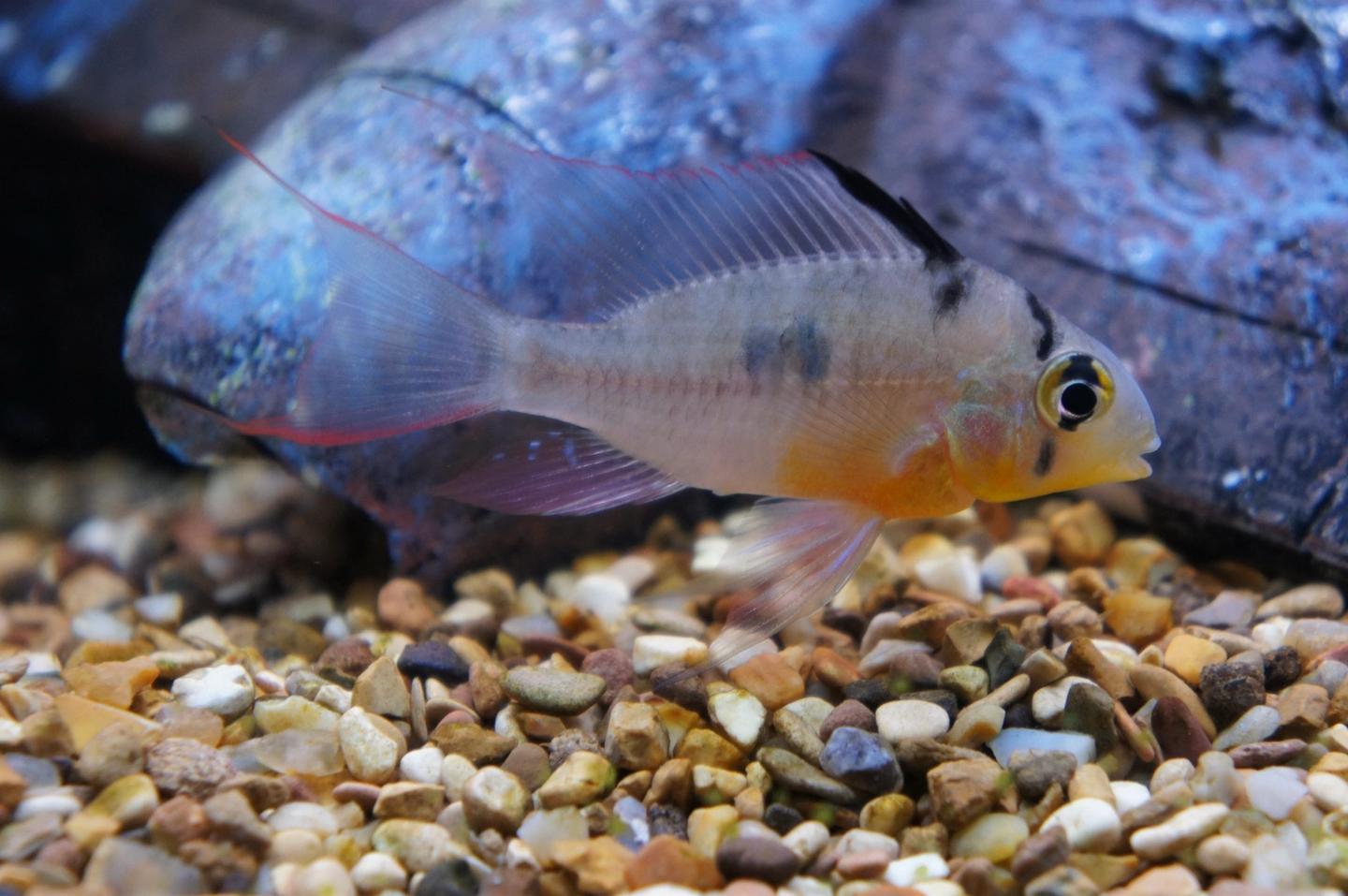
Cichlids are a family of roughly 1,800 accepted species, not one care type. Before buying, identify the exact species and source, then compare adult measurement, usable tank dimensions, social system, territory, tested water, diet and an exit plan. No family-wide minimum tank, water range or tank-mate list is safe.
Maintain these water conditions for optimal health and vibrant colors
Tembwe Butterfly Cichlid is the Tembwe locality form of Xenotilapia papilio, a small, specialised cichlid found only in Lake Tanganyika. It lives where rock gives way to sand, filters tiny food from sediment and forms adult pairs. The broad fins, poised movement and blue-yellow iridescence seen on settled fish explain the butterfly name, but this is not a general community cichlid. It needs a mature, hard-water aquarium with open fine sand, secure rock boundaries and calm companions.
This guide separates published species evidence from practical aquarium advice. FishBase records a maximum length of 7.8 cm, while aquarium and supplier sources often round a well-grown adult to about 8-10 cm. Adults are territorial with their own kind and usually pair, whereas subadults may occur in small groups. A juvenile group can therefore be a route to finding a compatible pair only when the keeper has enough floor space and a plan to separate fish that are excluded. The current size, availability and price are shown by the live product options above rather than being repeated in the description.
| Care point | Practical guidance | Why it matters |
|---|---|---|
| Scientific name | Xenotilapia papilio Büscher, 1990 | The Tembwe locality should not be mixed up with Kanoni or unnamed sunflower forms. |
| Adult size | Published maximum 7.8 cm; allow for roughly 8-10 cm in aquarium planning | Floor area and territory matter more than body length alone. |
| Minimum aquarium | 150 litres and at least 100 cm long for an established pair | A long footprint provides sand, feeding space and separate retreats. |
| Social plan | Established pair; a juvenile group only in a larger tank with a separation plan | Adults are territorial and a rejected fish can be trapped in a small aquarium. |
| Water | 24-27°C; pH 7.8-9.0; about 10-25 dGH | Stable, oxygen-rich, mineralised water reflects Lake Tanganyika conditions. |
| Diet | Small crustacean and invertebrate foods, fine sinking granules and modest plant matter | The species filters small food from sediment rather than taking large predator meals. |
| Breeding | Biparental mouthbrooder | Both parents participate, so pair stability and low disturbance are important. |
| Experience level | Intermediate to advanced | It is sensitive to poor water, rough tank mates and poorly managed social pressure. |
Xenotilapia papilio was described by Heinz Büscher in 1990. The species is endemic to the western shore of Lake Tanganyika in the Democratic Republic of the Congo, with its recorded range running between Tembwe Deux and Kanoni. Locality names matter in Tanganyika cichlids because geographically separated populations can differ in colour and pattern. This listing is for the Tembwe Butterfly Cichlid; it should be maintained and described as that locality rather than blended with Kanoni stock.
The word papilio means butterfly and refers to the fish's comparatively broad, expressive fins. It is sometimes called the Tanganyikan Butterfly Cichlid, but that common name can create confusion with unrelated West African butterfly cichlids or butterfly peacock cichlids. Searching and labelling with both Xenotilapia papilio and Tembwe gives the clearest identity. The accepted placement is family Cichlidae, subfamily Pseudocrenilabrinae, within the Lake Tanganyika tribe Ectodini.
| Name on a listing | What it means | Use for this fish? |
|---|---|---|
| Tembwe Butterfly Cichlid | Clear English trade name tied to the locality | Yes |
| Xenotilapia papilio Tembwe | Species plus locality designation | Yes |
| X. papilio Kanoni | A different locality form from the same restricted range | No |
| African Butterfly Cichlid | An ambiguous common name used for unrelated cichlids | Avoid as the primary name |
| Sunflower Xenotilapia | A trade label used for other papilio-like populations | Do not substitute |
FishBase places Xenotilapia papilio at depths of about 3-40 metres in deeper rocky habitat, especially where rock surfaces are covered by sand. This is not the featureless open-sand environment associated with some showy sand sifters, nor is it a cave-bound rock fish. It uses the transition between the two. In an aquarium, the closest useful interpretation is a broad area of fine sand beside a limited number of secure rock structures. Sand provides the feeding surface; rock creates shelter, boundaries and visual breaks.
The published diet helps explain that habitat choice. Wild fish take in sediment and filter it through the gills to extract small invertebrates. Recorded stomach contents include copepods, ostracods, insect larvae, filamentous algae and sand. A coarse or sharp substrate works against this natural behaviour and can abrade the mouth or gill area. Fine inert aquarium sand is therefore functional husbandry, not decoration.
Lake Tanganyika is unusually stable, alkaline and mineral-rich. The aquarium does not need a collection of chemical powders if the source water already meets the target, but it does need consistency. Test tap and tank water before changing chemistry. The water matcher can help compare the aquarium with the species range, while the tank volume calculator is useful for checking actual water volume after rock and substrate displacement.
Leave more uninterrupted sand than the fish appears to need. A broad feeding surface reduces forced contact between pair members and allows the fish to move away from rock territories without entering a dead end.
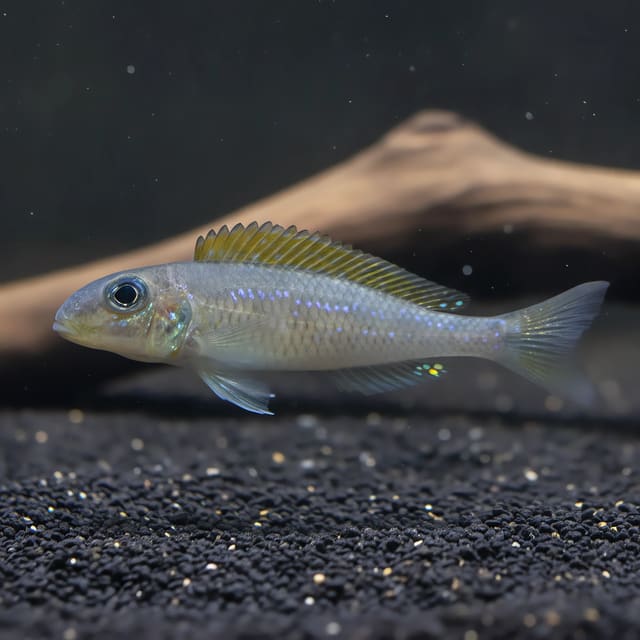
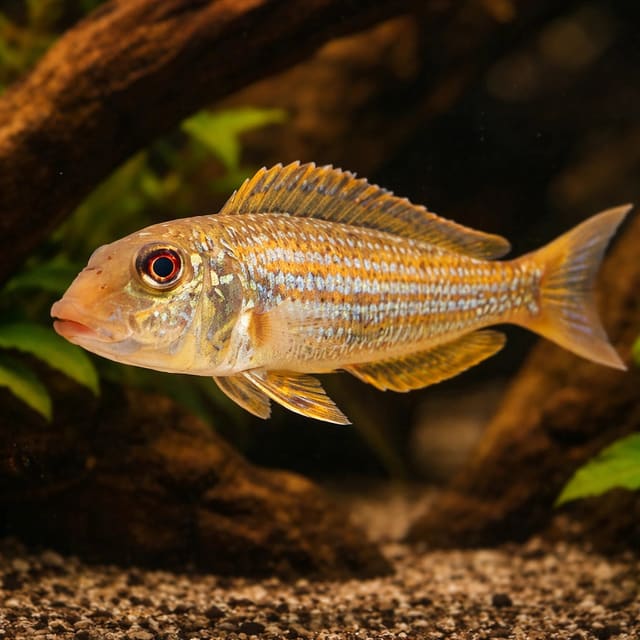
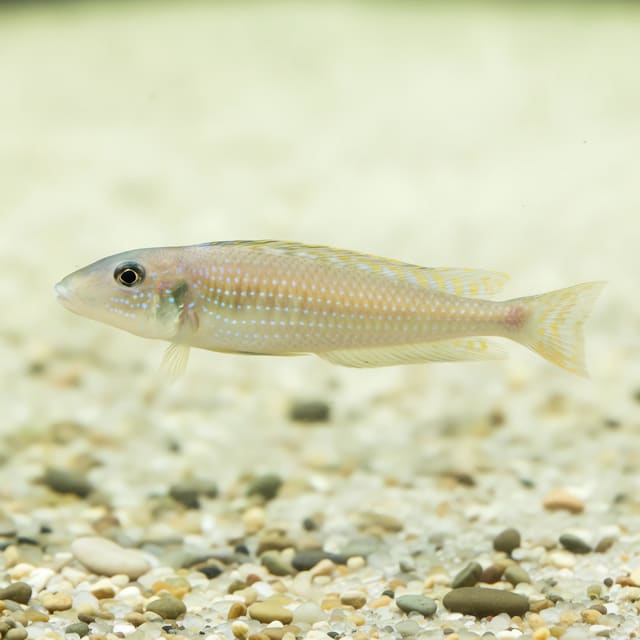
Tembwe fish have a compact, laterally compressed body, relatively large dorsal and anal fins and an elegant hovering posture. Depending on mood, age, light and social status, the base colour can shift through beige, yellow and grey-brown, with dark vertical or irregular markings and blue iridescence on the body and fins. The appearance is subtle when a fish is newly moved and much stronger after it has settled into stable water.
Sexing by colour alone is unreliable. Published descriptions do not identify strong permanent sexual dimorphism, although mature females can appear fuller when carrying eggs and adult males may look more robust or develop slightly stronger finnage. A seller or keeper should not promise a sex from a single juvenile photograph. Observed pair behaviour, body shape at maturity and breeding history provide better evidence than one colour trait.
The existing gallery image is labelled naturally with the species and locality so Google Images and visual-search systems can connect it to the page context. It remains an illustrative aquarium image rather than a promise that every live fish will show identical colour on arrival. Stress, transport, hierarchy and lighting all affect immediate appearance.
This species suits a keeper who already understands the nitrogen cycle, can hold hard alkaline water stable and is comfortable watching social behaviour closely. It rewards careful observation: a settled pair forages methodically, uses the sand-rock boundary and communicates through posture and fin display. It is less suitable for a first aquarium, a busy Malawi community or a tank where every species must compete aggressively at feeding time.
| Your aquarium | Fit | Reason |
|---|---|---|
| Mature 100 cm or longer Tanganyika tank planned around a compatible pair | Good candidate | Provides the correct footprint, water and social focus. |
| Large Tanganyika community with calm open-water fish and separated territories | Possible with care | Needs generous floor space and tank mates that do not dominate feeding. |
| 150-litre tank already full of rock-dwelling cichlids | Poor fit | Nominal volume does not compensate for missing sand or contested bottom area. |
| Malawi mbuna aquarium | Not recommended | Activity, aggression and diet are a poor match. |
| Soft-water tetra or ram community | Not suitable | The chemistry requirements conflict. |
| New or uncycled aquarium | Not suitable | Ammonia or nitrite exposure can quickly damage a specialist Tanganyika fish. |
If the aquarium is still being planned, the care planner and cycle tracker provide a useful sequence for equipment, testing and stocking. They do not replace liquid testing, but they make it easier to spot an incomplete setup before livestock is added.
A 150-litre aquarium with a footprint of at least 100 cm is a sensible minimum for an established pair. Length and floor area matter more than height. Rockwork and sand reduce the actual water volume, and two tanks sold as 150 litres can provide very different usable territories. A deeper front-to-back dimension is especially valuable because it allows rock to be placed without turning the remaining sand into a narrow corridor.
A juvenile group needs more room than a pair, not less. Groups are sometimes recommended because young fish are difficult to sex and natural bonds can form as they mature. That approach is only responsible if the keeper can monitor exclusion and remove surplus fish. Once adults pair, aggression towards conspecifics can rise sharply. A bullied fish may stop feeding while still looking outwardly intact, so body condition and access to sand should be checked daily.
| Stocking plan | Recommended starting footprint | Management note |
|---|---|---|
| Established compatible pair | 100 cm long, 150 litres or more | Provide two retreats and an open feeding area. |
| Pair with calm mid-water Tanganyika fish | 120 cm and 240 litres or more | Increase space and keep the lower zone lightly stocked. |
| Juvenile group to establish pairs | 120-150 cm, depending on group size | Keep spare accommodation and remove excluded fish early. |
| Multiple adult pairs | Specialist large aquarium only | Requires substantial separated territories; not a routine home setup. |
Use a tight-fitting lid. Sudden movement, chasing or work in the aquarium can make many sand-associated Tanganyika cichlids dart rapidly. Keep a clear gap around heater guards and filter intakes, and avoid narrow rock traps where a frightened fish could wedge itself.
Start with fine, smooth sand laid deeply enough for natural mouthing but not so deep that unmanaged anaerobic pockets develop. Place the main rocks directly on a stable base before adding loose sand around them. This prevents a foraging fish from undermining a structure. Use two or more separated rock clusters rather than one continuous wall, and keep the front and central areas open.
Plants are optional. Most soft-water aquascaping plants are a poor match for the chemistry, but hardy epiphytes can sometimes be attached above the main feeding area if they tolerate the water. Do not fill the sand with rooted plants or ornaments simply to make the aquarium look busy. The negative space is part of the habitat.
| Feature | Recommended | Avoid |
|---|---|---|
| Substrate | Fine, rounded inert sand | Sharp gravel, crushed material with abrasive edges |
| Rockwork | Stable clusters with visual breaks | Loose piles resting on diggable substrate |
| Open area | Broad continuous feeding surface | Narrow decorative strips of sand |
| Lighting | Moderate, predictable day cycle | Sudden switching or intense light without refuge |
| Flow | Good circulation and surface movement | A jet that continually lifts sand or pins fish to one zone |
| Plants | Optional hardy epiphytes above rock | Dense planting that removes the feeding area |
A practical target is 24-27°C, pH 7.8-9.0 and roughly 10-25 dGH. Our stock is kept at 23-27°C, pH 7.5-8.5 and 12-30 dGH. Do not chase the extreme edge of any range. Choose a stable point that suits the source water and compatible livestock, then keep daily and weekly movement small. Ammonia and nitrite must remain at zero; nitrate should be kept low through stocking control, feeding discipline and regular water changes.
Use mature biological filtration with enough mechanical capture to remove fine waste without stripping the sand every day. Surface agitation matters because warm hard-water aquariums still need strong gas exchange. A canister filter, sump or well-sized internal system can all work when intake, return and maintenance are appropriate. Place the return so the full aquarium circulates while calm feeding areas remain.
| Test | Working target | Action if outside target |
|---|---|---|
| Temperature | 24-27°C, stable | Check heater accuracy with a separate thermometer; correct gradually. |
| pH | 7.8-9.0 without sudden swings | Test source water and alkalinity before adding buffers. |
| General hardness | About 10-25 dGH | Use a measured mineral strategy only where source water requires it. |
| Ammonia | 0 mg/L | Stop feeding, protect oxygen and perform appropriate conditioned water changes. |
| Nitrite | 0 mg/L | Treat as an urgent filtration or cycling problem. |
| Nitrate | Low and stable | Review feeding, stocking, maintenance and replacement-water nitrate. |
Match replacement water for temperature and chemistry before a water change. Routine changes of around 20-30% are often easier on a stable aquarium than occasional very large corrections, but the right schedule depends on measured nitrate, feeding and stock. Clean filter media in removed aquarium water or conditioned water as appropriate; never replace all mature biological media at once.
In nature, Xenotilapia papilio filters sediment for small invertebrates. FishBase records copepods, ostracods and insect larvae alongside filamentous algae and sand in stomach contents. This is a small-particle feeder with an omnivorous component, not a large-food predator and not a dedicated algae grazer. Feed in a way that allows the pair to forage without being rushed by faster fish.
Use a high-quality fine sinking or slow-sinking granule as the staple. Add small frozen foods such as cyclops, daphnia, finely graded mysis or brine shrimp in rotation. Foods should be small enough to take without tearing. Several tiny portions are safer than one heavy meal, particularly in a species that searches the bottom and may continue finding leftovers after the visible feeding rush.
| Food | Role | Frequency |
|---|---|---|
| Fine quality sinking granule | Balanced staple with consistent vitamins and minerals | Most days in small portions |
| Cyclops or daphnia | Small crustacean food close to natural prey size | Several times weekly |
| Brine shrimp or finely graded mysis | Variety and conditioning | In rotation, not as an excessive single-food diet |
| Fine spirulina-containing food | Modest plant and algal component | Part of a varied schedule |
| Large pellets or chunks | Poor match for mouth size and feeding method | Avoid |
| Mammal or bird meat | Inappropriate fat and tissue profile | Do not feed |
Watch both fish eat. A dominant individual can intercept food without obvious fighting. Spread small portions across the open sand, but remove persistent leftovers. Loss of appetite is not automatically a disease: first check social exclusion, temperature, oxygen, ammonia, nitrite and whether the fish can reach food without crossing a defended boundary.
The old shorthand of “peaceful, keep 6+” is too simple. Published species accounts describe territorial adults that form pairs, while subadults live in small groups. In practical terms, a compatible pair is the normal long-term unit. Starting with juveniles can help a pair form, but it creates a management obligation. Once a bond develops, extra fish may be driven away and an aquarium has no distant shoreline for them to escape to.
Signs of a workable pair include shared use of the same general territory, feeding without one fish being continually displaced and courtship or coordinated defence without sustained damage. Warning signs include one fish confined behind equipment, pale colour combined with a hollow belly, repeated surface hovering, torn fins or refusal to cross the tank for food. Separate early rather than waiting for serious injury.
Two adults of opposite sex are not automatically compatible. Introductions need space, observation and a divider or spare aquarium. Never add a second fish to a small established territory and assume the pair label will prevent aggression.
The safest design is species-focused. In a larger aquarium, calm Tanganyika fish that use a different level may be considered, provided they share the chemistry and do not overwhelm the pair at feeding. Avoid boisterous Malawi cichlids, aggressive bottom dwellers and multiple sand-sifting species competing for the same floor. Small ornamental shrimp are not appropriate.
| Potential companion or alternative | Assessment | Planning note |
|---|---|---|
| Calm Cyprichromis in a large aquarium | Possible | Uses open mid-water, but needs its own group and enough swimming length. |
| Small Synodontis from Tanganyika | Caution | Can disturb feeding and breeding; assess floor-space overlap carefully. |
| Shell dwellers | Usually better as an alternative display | They also defend bottom territories and should not be crowded into 150 litres with this pair. |
| Julidochromis | Caution in a much larger structured tank | Rock territories can become assertive, especially during breeding. |
| Tropheus or Malawi mbuna | Avoid | Activity, aggression, feeding style and territory pressure are mismatched. |
| Soft-water community fish | Avoid | Water requirements conflict even when temperament seems calm. |
Use the tank-mate checker as a first filter, then verify adult size, feeding zone, group requirement and breeding behaviour separately. Browse the Lake Tanganyika cichlid category to compare habitats. The Karilani Herring Cichlid illustrates the different open-water Cyprichromis body plan, while the Signatus Shell-Dweller is a better comparison for a separate shell-focused aquarium than an automatic tank mate.
Prepare the aquarium before delivery. Confirm zero ammonia and nitrite, stable temperature and suitable pH, and switch off intense lighting before opening the transport box. Follow the acclimation instructions supplied with the order rather than extending the process unnecessarily. Transport water changes after a bag is opened, so a very long improvised drip can sometimes increase rather than reduce stress.
Quarantine is strongly recommended where a stable separate system can match hard alkaline water. Observe respiration, balance, fins, skin, waste and feeding. Do not medicate preventively without a diagnosis. A bare medical tank may be useful for treatment, but a normal observation quarantine benefits from simple cover and a thin suitable substrate or feeding dish so the fish is not left exposed.
| Period | What to monitor | Good sign |
|---|---|---|
| First hours | Breathing, balance, collisions and harassment | Steady posture and access to shelter |
| Days 1-3 | Feeding response and use of sand | Small foods taken without frantic competition |
| Week 1 | Ammonia, nitrite, pH and social access | Zero toxins and both fish using more than one zone |
| Weeks 2-4 | Weight, fins, waste and pair dynamics | Stable body condition and no fish permanently excluded |
Most early problems begin with environment or social pressure. Rapid breathing can reflect ammonia, nitrite, poor oxygen, excessive heat, gill irritation or disease; clamped fins and dark colour can reflect stress; a hollow belly can reflect poor access to food, parasites or an unsuitable diet. Test the water and observe interactions before choosing a treatment. Blind medication can suppress appetite and disturb biological filtration without addressing the cause.
A temporary sand cloud after a fish sifts or the keeper adjusts the substrate is different from a persistent bacterial haze. Persistent cloudiness calls for checks on cycling, feeding, filter flow and maintenance. Green water or surface algae usually reflects light and nutrients, not a need for an “algae-eating” tank mate. This fish should never be purchased as a cleanup animal.
| Sign | Check first | Escalate when |
|---|---|---|
| Rapid breathing | Ammonia, nitrite, temperature and surface movement | Water is correct but breathing remains abnormal or worsens |
| One fish hiding constantly | Pair compatibility and blocked escape routes | It misses meals, loses weight or sustains damage |
| Refusal to feed | Social access, food size, recent transport and water quality | It persists or is accompanied by abnormal waste or swelling |
| Sand cloud | Substrate grain, filter direction and recent disturbance | Cloudiness persists with poor water readings |
| Torn fins | Chasing, rock edges and intake guards | Damage continues, reddens or develops a secondary infection |
Xenotilapia papilio is a biparental mouthbrooder. The pair spawns on or close to the substrate, and both parents participate in caring for the developing brood. This reproductive strategy is one reason pair compatibility matters so much. Breeding is possible in a mature home aquarium, but it should not be encouraged by repeatedly changing temperature or chemistry. Stable conditions, low disturbance and good body condition are more important.
Condition the pair with small varied foods while keeping nitrate and dissolved waste low. Courtship may include closer joint use of a site, fin display and increased defence. A brooding fish may eat less or stop eating while carrying. Do not assume every reduced appetite is brooding; check the mouth, behaviour and partner before reaching a conclusion. Avoid catching or transferring a carrying parent unless welfare requires it, because stress can lead to a brood being swallowed or released too early.
Once fry are released, provide very small appropriate foods, excellent water quality and safe intake protection. The exact timing and division of brooding can vary with the pair and conditions. The broader scientific literature shows that biparental care strategies have evolved repeatedly within Xenotilapia, making parental behaviour an important biological feature rather than a marketing curiosity.
| Fish type | Main aquarium zone | Social emphasis | Best reason to choose it |
|---|---|---|---|
| Tembwe Butterfly Cichlid | Sand-rock transition near the bottom | Compatible adult pair | Subtle display, sediment feeding and biparental care |
| Open-water Cyprichromis | Mid and upper water | Group | Movement and colour above the rockwork |
| Shell-dwelling Lamprologus | Shell bed on the bottom | Pair, harem or colony depending on species | Compact territory and shell-based behaviour |
| Julidochromis | Rock faces and crevices | Pair and rock territory | Strong pattern and cave-oriented behaviour |
| Tropheus | Rocky littoral | Large managed group | Active grazing and complex colony dynamics |
These are ecological comparisons, not automatic mixing suggestions. A fish that occupies a different zone can still be too fast, territorial or demanding for the available volume. For a dedicated look at the genus, visit the Xenotilapia category.
Use the live variant selector for the current size, stock status and price. Both listed sizes may not be available at the same time, and no static price in a care guide should override the store's live product data. Because pair compatibility cannot be guaranteed from size alone, contact the team before ordering if the option wording or intended social plan is unclear.
Eligible livestock orders are covered by the Tropical Fish Co Live Arrival Guarantee when the published conditions are followed. Review the current livestock delivery and guarantee details before choosing a delivery date. The code WELCOME5 may provide 5% off an eligible first order under the current promotion terms; checkout confirms whether the product and order qualify.
FishBase records a maximum of 7.8 cm total length. Aquarium sources and suppliers often round the expected adult size to about 8-10 cm. Plan the tank around territorial floor area rather than treating a small body length as permission to use a small aquarium.
Adults normally form pairs and are territorial. Subadults can occur in small groups, so a roomy juvenile group is sometimes used to let a pair form. The keeper must be ready to remove fish that are rejected once adults pair. A permanent group of six is not a safe universal rule.
Use at least 150 litres with a 100 cm footprint for an established pair. Increase to 120 cm and roughly 240 litres or more when adding compatible mid-water fish. A juvenile group needs still more territory and spare accommodation.
Yes. It naturally filters sediment for tiny food, so fine rounded sand supports normal feeding and reduces abrasion risk. Keep a large uninterrupted sand area next to secure rock clusters rather than covering the floor with coarse gravel or decoration.
Offer fine sinking granules plus small frozen foods such as cyclops, daphnia, brine shrimp and finely graded mysis. Include a modest algal or plant component in a varied diet. Avoid oversized pellets, heavy predator meals and mammal meat.
No. They can be calm beside carefully selected Tanganyika fish, but they are territorial with their own kind and sensitive to boisterous companions. They are not suitable for Malawi mbuna, soft-water community tanks or crowded bottom zones.
Not reliably, especially when young or stressed. Mature females may look fuller with eggs and males can appear more robust, but there is no single dependable colour marker. Pair behaviour and mature body condition are better evidence.
The guarantee applies to eligible livestock orders that meet the current delivery, receipt and reporting conditions. Read the linked delivery page before ordering and keep the required arrival evidence. Promotion eligibility, including WELCOME5, is confirmed at checkout.
Care facts were checked against the FishBase species account for Xenotilapia papilio, which summarises Büscher's 1990 description and published distribution, habitat, diet, size and reproductive references. The evolutionary context for parental care was checked against Koblmüller et al., Repeated Parallel Evolution of Parental Care Strategies within Xenotilapia. Locality and practical aquarium observations were cross-checked with the specialist Xenotilapia papilio Tembwe profile. Aquarium targets above are conservative operating ranges, not claims that a captive aquarium reproduces the lake exactly.
No reviews for this item yet. Bought one? Honest reviews only, good or bad.
What customers say about ordering from us
Easy website plenty of info on fish your buying great to pick a time slot
TRACEY DURRANT · 7 Oct 2026
Got some lovely fish thank you
Kevin Mackie · 7 Oct 2026
Reviews of our shop, collected by Judge.me, an independent third-party review collector. Newest first.