−14%
Advanced
Six-Bar Cichlid (Lamprologus sexfasciatus)
23–27°C · pH 7.5–9 · 110L
£19.77£22.99

One live, unsexed Moore's Lamprologus (Variabilichromis moorii) in the selected 4-5 cm or 5.5-7 cm size. A pair-forming Lake Tanganyika cichlid for stable hard, alkaline rocky aquariums.
Adult size is the maximum length this species reaches at full maturity (scientific sources). The livestock you receive will be younger and smaller — pick a size above for the actual shipping size. Product-photo provenance and any image-specific limitations are stated on the listing.
Variabilichromis moorii
Save when buying multiple fish. Each quantity is one fish; sex and pair formation are not guaranteed unless the selected variant explicitly states them.
Confirm your email, then we’ll send an availability message for this exact item if it returns within 180 days.
This request is only for this product—no newsletter or other promotions. A mail-provider retry may very rarely duplicate the same availability message. Unconfirmed addresses are removed after 48 hours. See our privacy policy.
One live, unsexed Moore's Lamprologus (Variabilichromis moorii) in the selected 4-5 cm or 5.5-7 cm size. A pair-forming Lake Tanganyika cichlid for stable hard, alkaline rocky aquariums.
Adult size is the maximum length this species reaches at full maturity (scientific sources). The livestock you receive will be younger and smaller — pick a size above for the actual shipping size. Product-photo provenance and any image-specific limitations are stated on the listing.
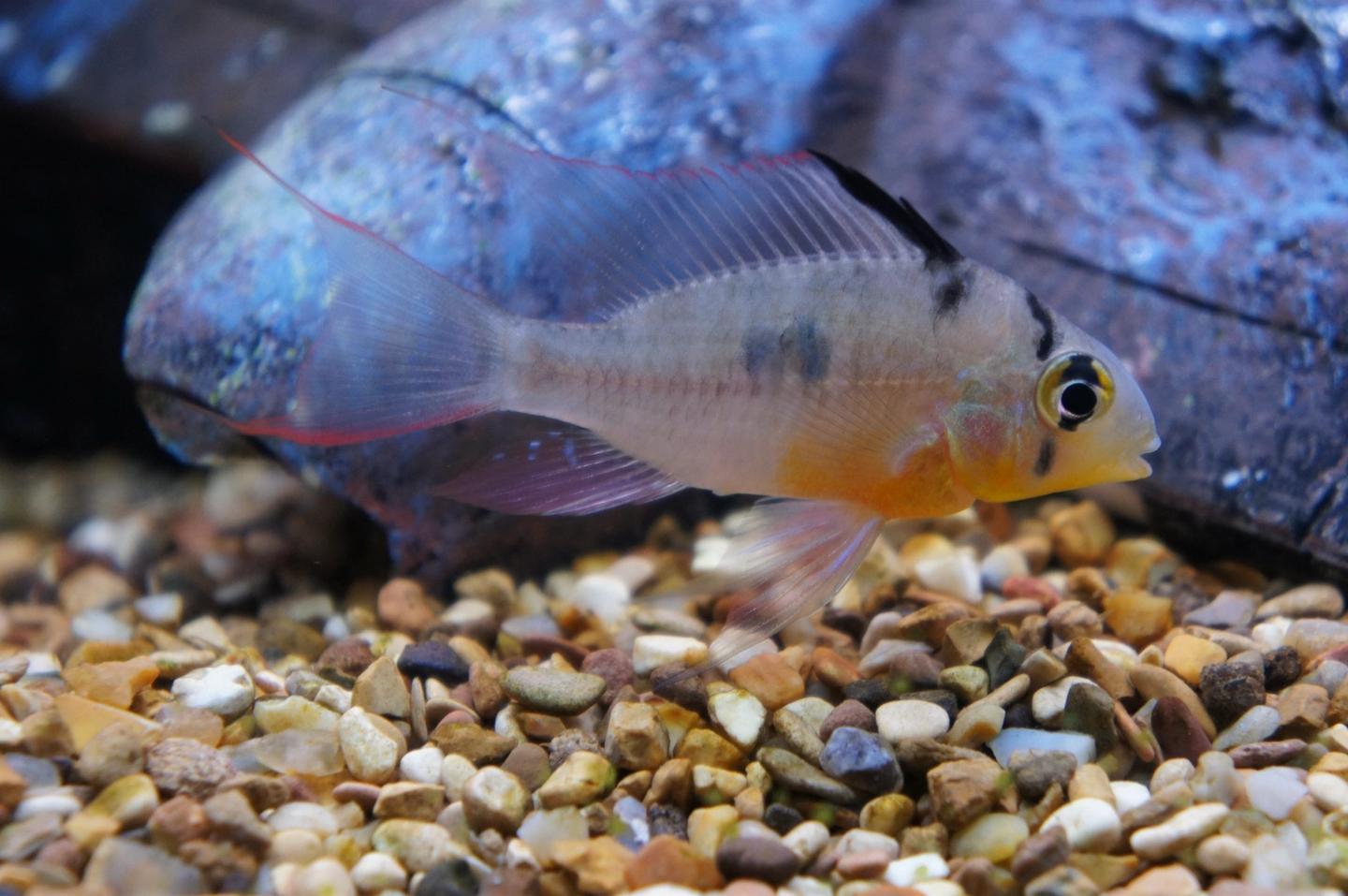
Cichlids are a family of roughly 1,800 accepted species, not one care type. Before buying, identify the exact species and source, then compare adult measurement, usable tank dimensions, social system, territory, tested water, diet and an exit plan. No family-wide minimum tank, water range or tank-mate list is safe.
Maintain these water conditions for optimal health and vibrant colors
Moore's Lamprologus is Variabilichromis moorii, a compact cichlid endemic to the rocky southern shores of Lake Tanganyika. Older aquarium and our stock records also use Lamprologus moorii and Neolamprologus moorii; those are historical names for the same fish, not different varieties.
One quantity buys one live, unsexed fish in the selected approximate dispatch size: 4-5 cm or 5.5-7 cm. It is not a bonded pair, and ordering two does not guarantee one male and one female. Plan for hard, alkaline water, secure rockwork, a mature filter and a territory that remains workable when the fish reaches about 10 cm.
| Accepted name | Variabilichromis moorii (Boulenger, 1898) |
|---|---|
| Historical names | Lamprologus moorii and Neolamprologus moorii |
| What one quantity buys | One live fish; sex and pair formation are not guaranteed |
| Dispatch sizes | Choose approximately 4-5 cm or 5.5-7 cm |
| Maximum recorded length | 10.3 cm total length; use about 10 cm for aquarium planning |
| Practical aquarium plan | About 120 litres and at least 90 cm long for one established pair; larger for a community or fish that have not yet paired |
| Temperature | 23-27°C specialist range; 24-26°C is a useful stable target |
| pH | 7.8-9.0, stable and alkaline |
| General hardness | Hard, mineral-rich water; approximately 8-25 dGH |
| Diet | Small live or frozen foods, quality prepared foods and an algae or spirulina component |
| Social behaviour | Pair-forming and territorial towards its own kind, especially around a brood |
| Breeding | Cave or sheltered-substrate spawner with care from both parents |
The current accepted scientific name is Variabilichromis moorii. Eschmeyer's Catalog of Fishes records the original 1898 description as Lamprologus moorii and the later combination Neolamprologus moorii before recognising the current placement. Keeping those older names on this page helps aquarists reconcile books, stock lists and search results without pretending that the taxonomy is uncertain.
The fish is the only recognised species in Variabilichromis. It should not be confused with Tropheus moorii, the Blue Dolphin Cichlid Cyrtocara moorii, or any other fish that shares the species epithet moorii. The broader phrase "moorii cichlid" is therefore too ambiguous to use as the product identity.
Wild records place this species in the southern half of Lake Tanganyika. It occupies shallow rocky littoral habitat, where adults hold feeding and breeding territories around stones, caves and algae-covered surfaces. Explore the wider Lake Tanganyika cichlid range for fish with broadly compatible water chemistry, but assess every candidate's adult behaviour separately.
Select the size before adding the fish to your basket. The sizes are approximate dispatch bands rather than exact measurements or adult sizes. A fish can sit near either edge of its band.
Sex is not selected on either size option. Juveniles are difficult to sex reliably, and adult fin differences are not a guarantee at dispatch size. A quantity of two is simply two unsexed fish; it is not a promise of a compatible pair. If your aim is breeding, start with a suitable social plan and be prepared to separate fish that do not pair or cannot share the available territory.
FishBase reports a maximum of 10.3 cm total length for male or unsexed specimens. That makes this a relatively compact Tanganyika cichlid, but body length alone does not predict space needs. A breeding pair can defend a much larger area than a peaceful fish of the same size, so aquarium length and visual barriers matter more than squeezing the fish into a minimum litre figure.
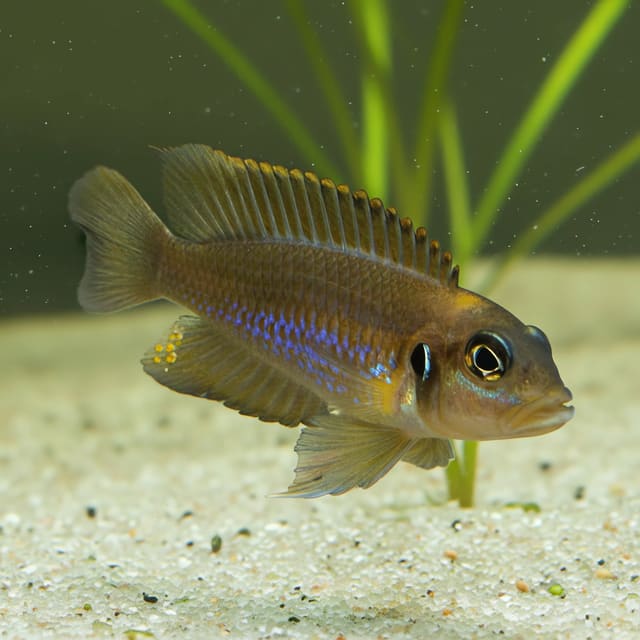
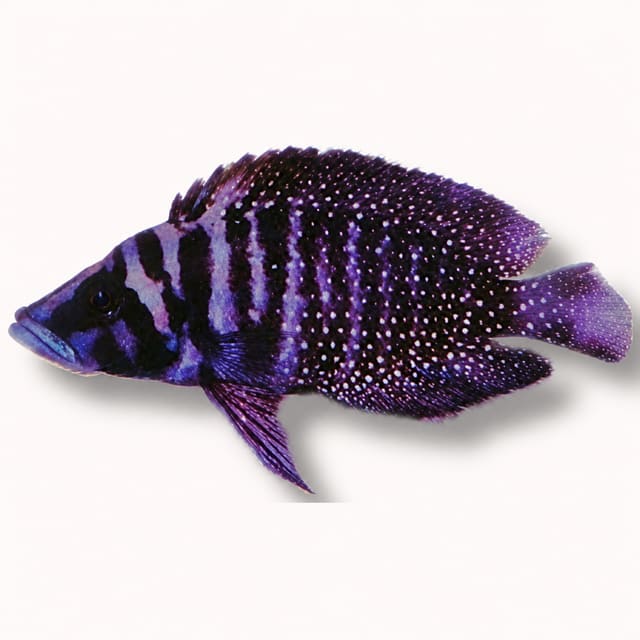
Adults are usually dark brown to black with pale blue or electric-blue edging on the fins. Juveniles vary by locality and may be yellow, orange or dark before taking on adult colour. A pale juvenile is not automatically unhealthy or the wrong species, and a young fish should not be expected to look like a mature dark adult immediately.
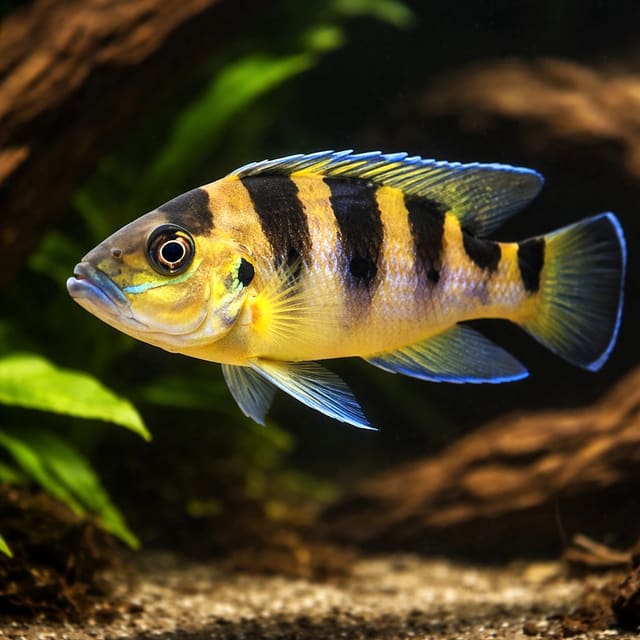
Do not use colour alone to identify this species. The four polished gallery illustrations show a representative dark adult form; the final reference image is a small reference image retained for provenance.
A specialist profile lists a 75 x 30 cm footprint, around 70 litres, as a pair-only minimum. That figure leaves little margin for unsuccessful pairing or a mixed community. For a practical long-term plan, Tropical Fish Co recommends about 120 litres with at least 90 cm of length for one established pair. Use a 120 cm or longer aquarium when combining them with other Tanganyika fish, managing juveniles before pairing, or giving a breeding territory more separation.
Build the layout around stable rock piles, caves and broken sight lines. Place heavy rocks on a secure protected base before adding loose substrate so digging cannot undermine them. Use fine sand around the structure. Leave some open water between rock groups, but make sure a fish being pursued can leave the dominant fish's line of sight.
The driftwood and plants in the digital gallery scenes are decorative rather than a model of the natural habitat. A faithful functional layout is rock-led. Hardy attached plants can be used if desired, but they do not replace caves, mineral stability or territorial boundaries.
| Feature | Purpose | Practical check |
|---|---|---|
| Secure rock piles | Create caves, spawning surfaces and broken sight lines | Rocks cannot shift when substrate is moved |
| Open lanes | Allow normal swimming and maintenance access | No fish is trapped in the only exposed route |
| Sand or smooth substrate | Supports digging without sharp edges | Rock weight is not resting on loose sand alone |
| Strong biological filtration | Processes waste in hard, high-pH water | Ammonia and nitrite remain at zero |
| Surface movement | Supports oxygenation and even circulation | No stagnant pocket develops behind the rockwork |
Lake Tanganyika fish are adapted to stable, mineral-rich water. FishBase gives 24-26°C, while specialist husbandry references use a broader 23-27°C range. A stable value around 24-26°C is a sensible everyday target. Keep pH alkaline, normally 7.8-9.0, and use approximately 8-25 dGH as a working hardness range.
Do not add buffers by habit without testing the source water and the aquarium. Some UK tap water already contains substantial carbonate hardness, while very soft water needs a measured mineral plan. Repeatedly changing chemistry to chase a perfect number is less safe than maintaining a suitable value consistently.
| Parameter | Working guide | Why it matters |
|---|---|---|
| Temperature | 23-27°C; aim for a stable 24-26°C | Avoids abrupt thermal stress |
| pH | 7.8-9.0 | Matches alkaline Tanganyika conditions |
| General hardness | Approximately 8-25 dGH | Supports stable mineral-rich water |
| Ammonia | 0 mg/l | Any detectable amount needs immediate investigation |
| Nitrite | 0 mg/l | Confirms the mature filter is processing waste |
| Nitrate | Kept low and stable | Use regular tests and water changes to control the trend |
Use a fully cycled aquarium with dependable biological filtration and good surface movement. High pH increases the proportion of more toxic un-ionised ammonia, so clear-looking water is not enough: test it. Match replacement water for temperature and mineral character, and make changes gradually.
In the wild, this species bites or picks at biocover on rock surfaces to find small invertebrates and also uses algae-associated food. That is more precise than labelling it simply "omnivorous" and feeding any generic cichlid mix. The captive diet should combine suitable animal foods with a genuine algae or spirulina component.
Offer small live or frozen foods such as daphnia, Artemia, mysis or similar appropriately sized invertebrate foods, alongside a quality prepared cichlid food. Include spirulina or another suitable algae-based food in the rotation. Feed modest portions that are cleared promptly; food trapped behind rocks can damage water quality before it is noticed.
| Food type | Role | How to use it |
|---|---|---|
| Small live or frozen invertebrate foods | Important natural-style variety | Rotate suitable foods rather than relying on one rich item |
| Quality cichlid granule or flake | Convenient prepared component | Choose a particle size the current fish can swallow cleanly |
| Spirulina or algae-containing food | Plant and algae component | Keep it in the regular rotation |
| Large fatty meals or mammalian meat | Not appropriate | Avoid as a routine food |
Observe every fish during feeding and confirm that each can reach food without entering a defended territory. Watch body condition rather than feeding more because the most confident fish still begs. The Tanganyika flake food listing is one prepared-food option to compare; always check its current label and use it as part of a varied plan.
Variabilichromis moorii is socially pair-forming and provides care from both parents, but that does not mean every two juveniles will form a pair or that a bond is guaranteed for life. Field studies describe socially monogamous breeding pairs and joint territory defence while also showing that the species' mating system is more complex than a simple permanent-pair label.
An established pair is strongly territorial towards its own kind and can defend a brood from both conspecific and other-species intruders. Outside that context, it can coexist with carefully chosen small or medium Tanganyika cichlids that use different areas of a sufficiently large aquarium. This is more accurate than calling it either completely peaceful or generally aggressive.
| Potential companion | Guidance |
|---|---|
| Open-water Cyprichromis-type fish | Possible in a larger aquarium because they use a different zone; verify the exact species and adult group size |
| Small to medium Tanganyika rock fish | Possible only with enough footprint, separate territories and a backup separation plan |
| Another pair of the same species | Avoid unless the aquarium is very large and territories can remain separate |
| Boisterous mbuna or oversized aggressive cichlids | Avoid; a shared African-cichlid label does not make the social plan compatible |
| Soft-water community fish or slow long-finned fish | Avoid because water chemistry and territorial behaviour do not align |
Browse the Lamprologus trade category for related listings, but do not assume that close names mean identical care. Compare adult size, feeding niche, breeding territory and water needs before choosing a companion.
This is a cave or sheltered-substrate spawner. A compatible pair normally chooses a protected rock surface, cave wall or overhang. Both parents defend the brood, and published field work describes coordinated territory defence around fry. Territorial pressure can therefore increase sharply even if the same fish appeared tolerant before spawning.
Breeding is not promised by the product. Do not buy two unsexed juveniles and assume they will become a pair. Specialist practice is to allow a group of young fish to form compatible pairs, but that requires a larger temporary aquarium and a definite plan to remove surplus or rejected fish. A simple two-fish purchase does not reproduce that process safely.
Prepare the aquarium before ordering. Rockwork should be stable, the filter mature and the target temperature and mineral chemistry already established. When the fish arrives, follow the current live-fish acclimation instructions supplied with the order rather than applying a generic method from an unrelated soft-water species.
Reduced feeding, rapid breathing, persistent hiding, clamped fins or fresh damage are reasons to test the water and review the social layout immediately. No single symptom proves a diagnosis. Separate a fish if it cannot feed or escape repeated attacks, and seek qualified aquatic-health advice when abnormal signs persist.
The first four gallery images are representative digital illustrations of the dark adult form. They are useful for showing the broad body plan and mature colour direction, but the driftwood, plants, eye detail, scale pattern and exact fin edging should not be treated as a promise about the fish supplied. The two-fish illustration does not change the one-fish sale unit.
The fifth image is a reference image retained for provenance. It is lower resolution than the digital illustrations and is not used as the hero.
Identity and natural-history checks use Eschmeyer's Catalog of Fishes and the FishBase species summary. Pairing and brood-defence context is supported by peer-reviewed work on biparental nest defence and social pairing and parentage. Aquarium planning is cross-checked against the Seriously Fish species profile. For broader preparation, read the Tropical Fish Co cichlid care guide.
No reviews for this item yet. Bought one? Honest reviews only, good or bad.
What customers say about ordering from us
I have a small group of long finned mountain minnows. So was delighted to be able to order ten of this variety to increase the genetics in my tank . The ones I recieved are healthy but it’s to early to give a verdict on wether they are of a long finned type since they are small currently.
Gordon Walker · 23 Sept 2026
100% success travel and "installation". Pleased with quality of purchase. The Siamese fighter a bit "shy" so have not yet seen him at his best yet but looking good. Happy customer. GG
George E Garratt · 21 Sept 2026
Reviews of our shop, collected by Judge.me, an independent third-party review collector. Newest first.