Moderate
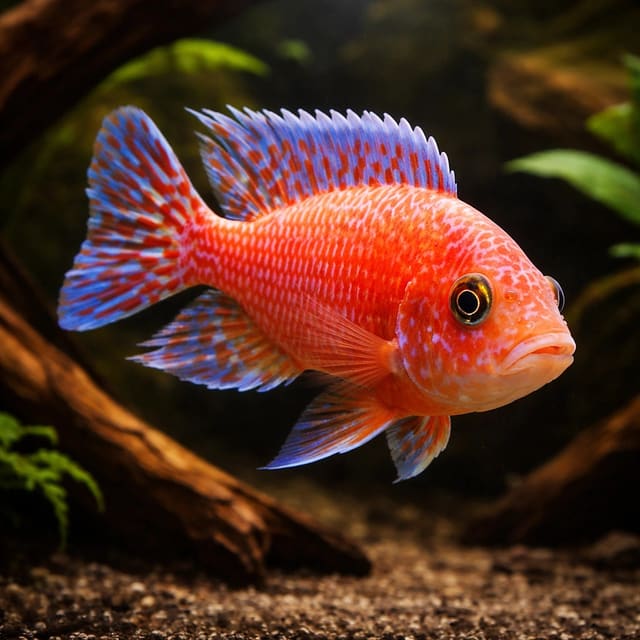
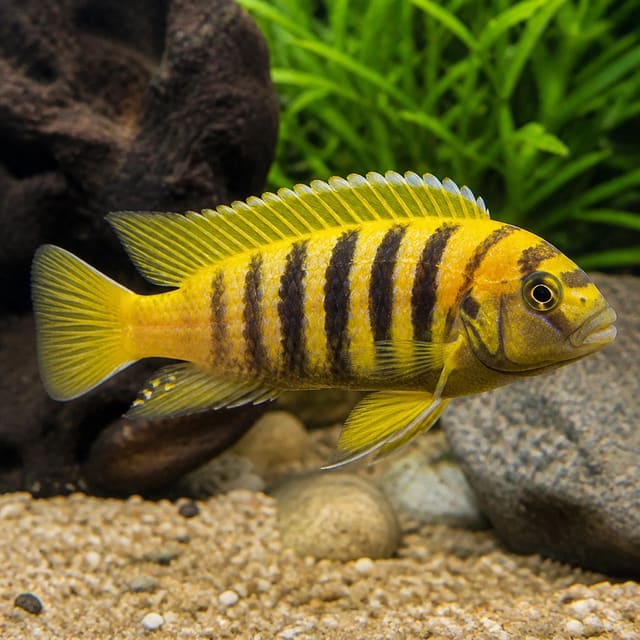
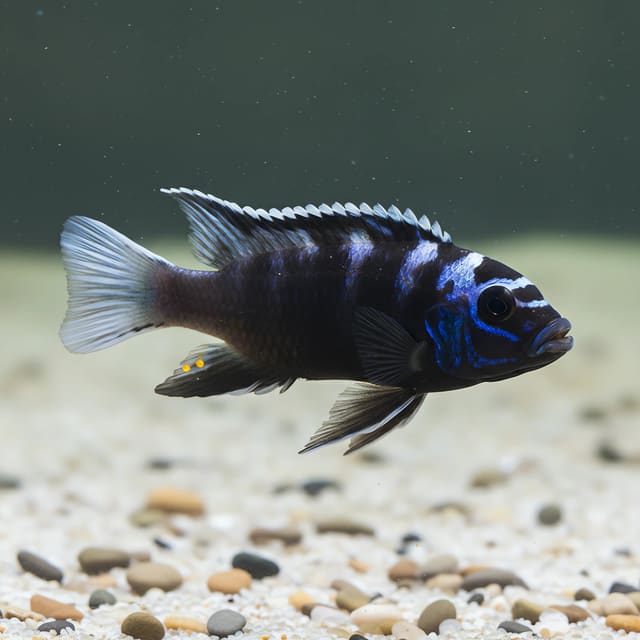
Acei Cichlid (Pseudotropheus sp. “acei”)
24–26°C · pH 7.5–8.5 · 300L
£7.99

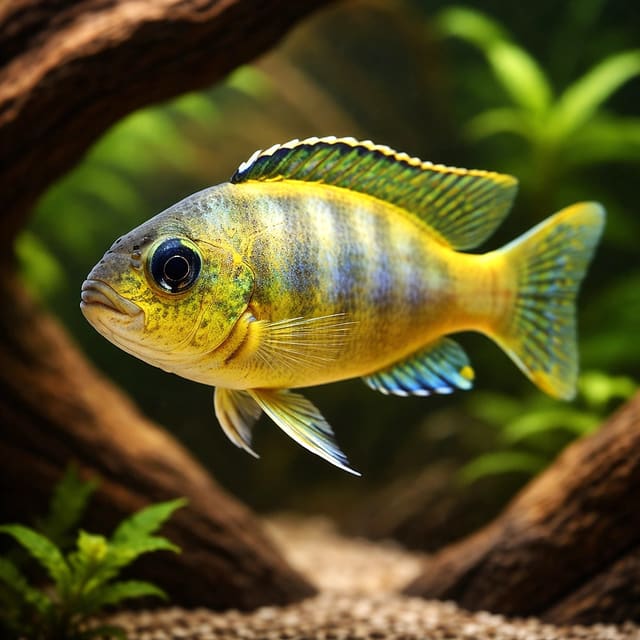
Bumblebee Cichlid (Pseudotropheus crabro) is a cave-associated Lake Malawi cichlid for advanced keepers who can provide stable hard alkaline water, mature filtration, substantial rockwork and carefully observed companions. One purchase supplies one fish.
Adult size is the maximum length this species reaches at full maturity (scientific sources). The livestock you receive will be younger and smaller — pick a size above for the actual shipping size. Product-photo provenance and any image-specific limitations are stated on the listing.
Pseudotropheus crabro
Save when buying more. Each quantity is one crab; sex is not guaranteed unless the listing explicitly states it.
Bumblebee Cichlid (Pseudotropheus crabro) is a cave-associated Lake Malawi cichlid for advanced keepers who can provide stable hard alkaline water, mature filtration, substantial rockwork and carefully observed companions. One purchase supplies one fish.
Adult size is the maximum length this species reaches at full maturity (scientific sources). The livestock you receive will be younger and smaller — pick a size above for the actual shipping size. Product-photo provenance and any image-specific limitations are stated on the listing.
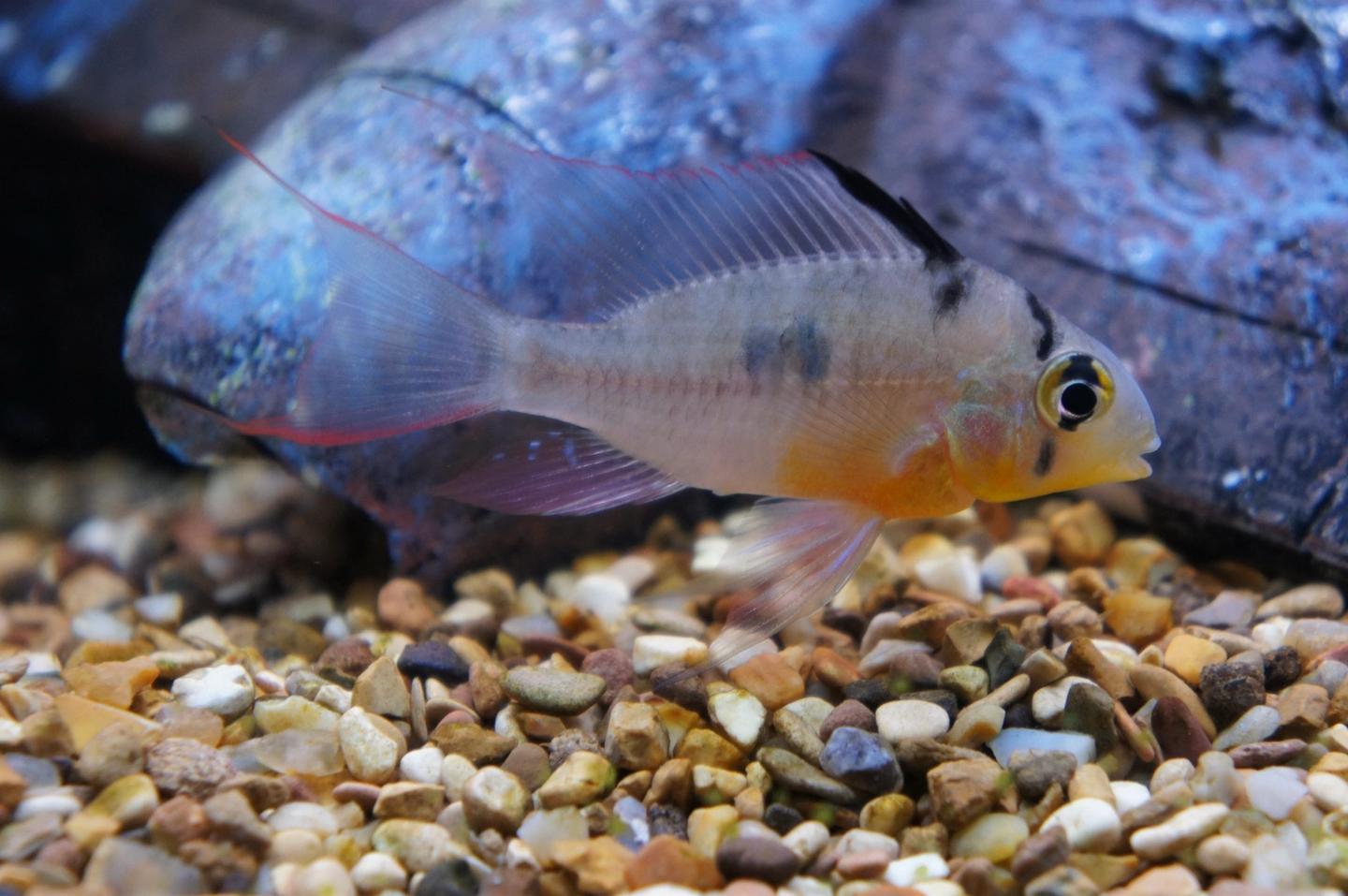
Cichlids are a family of roughly 1,800 accepted species, not one care type. Before buying, identify the exact species and source, then compare adult measurement, usable tank dimensions, social system, territory, tested water, diet and an exit plan. No family-wide minimum tank, water range or tank-mate list is safe.
Maintain these water conditions for optimal health and vibrant colors
Bumblebee Cichlid (Pseudotropheus crabro), also called Hornet Cichlid, is an endemic Lake Malawi fish for keepers prepared to build the aquarium around caves, hard alkaline water and close observation. FishBase records the species most often in large caves or beside large boulders at 15–18 metres depth. It is also known for an unusual feeding relationship with the kampango catfish Bagrus meridionalis, cleaning parasites from the larger fish when the opportunity arises. These details make it a fascinating animal, but they do not turn it into a general-purpose community fish.
One purchase supplies one live fish. The established offer includes five dispatch choices from 2–3 cm through 7–9 cm and XL. The size you select is the size supplied, not the adult size. Published adult records differ: FishBase gives a maximum of 9.4 cm SL, while the encyclopedic species summary reports 16 cm SL. Use the larger record for space planning, and do not blend the two measurements into a false average.
| Suits | Experienced Malawi keepers with stable hard water, mature filtration, a generous footprint and several large-boulder cave zones. |
|---|---|
| Not suited to | Soft or acidic community aquariums, small decorative tanks, or homes expecting a guaranteed sex, colour or temperament. |
| Sold unit | One live fish per purchase in the selected dispatch size. |
| Care position | Advanced, because several important decisions depend on layout, observation and conservative planning. |
The right home is planned at the larger adult scale before the smallest fish is selected. It has an established biological filter, stable measured water, rock structures that cannot shift and several routes between shelter and open water. The keeper also needs time to watch feeding and social pressure, plus a safe way to separate a fish if the arrangement stops working.
The five listed sizes describe the fish at dispatch. They do not reduce the mature space, filtration or shelter commitment, and XL does not identify a sex or promise one colour state. Choose a size that fits the prepared aquarium and its existing residents, then judge the animal as an individual as it settles and grows.
Compare the wider African cichlid collection when deciding whether this is the right type of aquarium project. A similar water preference does not by itself make two fish safe companions.
The accepted scientific name on this listing is Pseudotropheus crabro. The FishBase species profile supports the identity, Lake Malawi distribution, environmental values, habitat and 9.4 cm SL maximum. The species summary supports Bumblebee Cichlid and Hornet Cichlid as common names and gives the larger 16 cm SL report. Rather than hiding that difference, this guide keeps both figures in context and recommends planning for the larger animal.
Sex is guaranteed only when the selected option explicitly states male or female. This Bumblebee Cichlid listing has no sex-guaranteed option. Size, barring, darkness and posture are not checkout guarantees. Avoid using a juvenile appearance to construct a harem or to promise how an adult will look. Natural colour, pattern, maturity and behaviour vary between individuals and can change as a fish settles into a new physical environment.
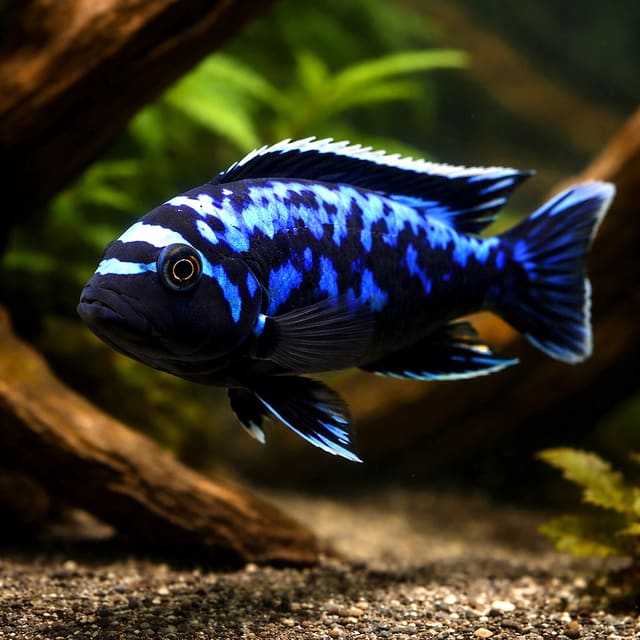
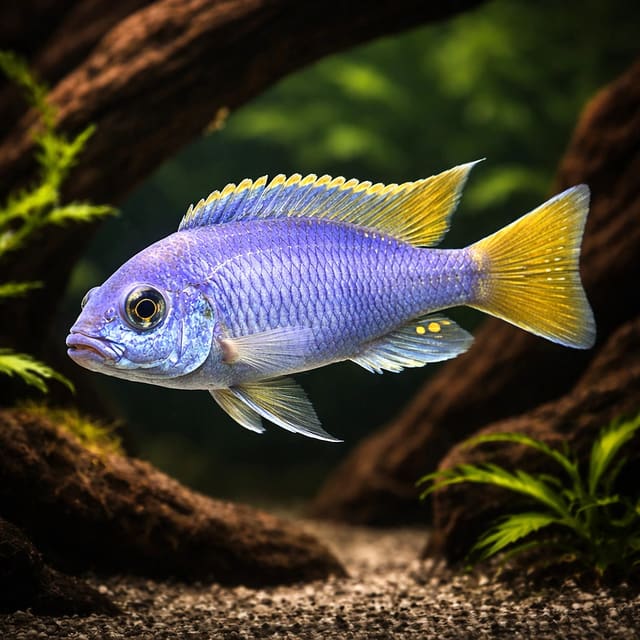
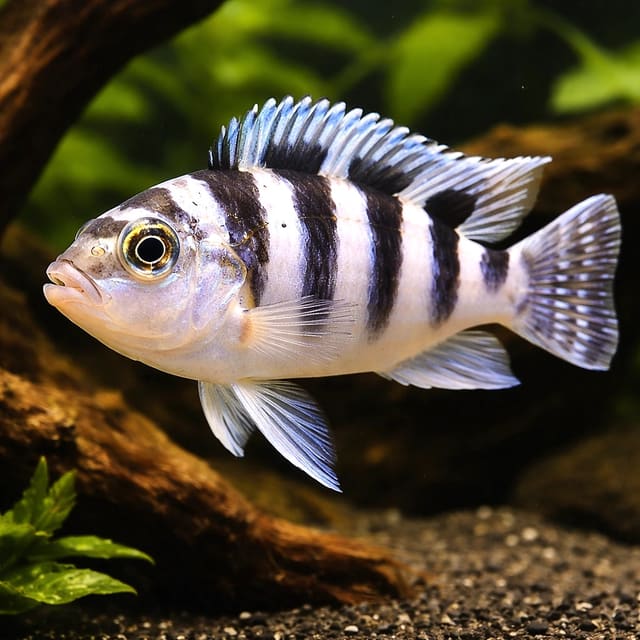
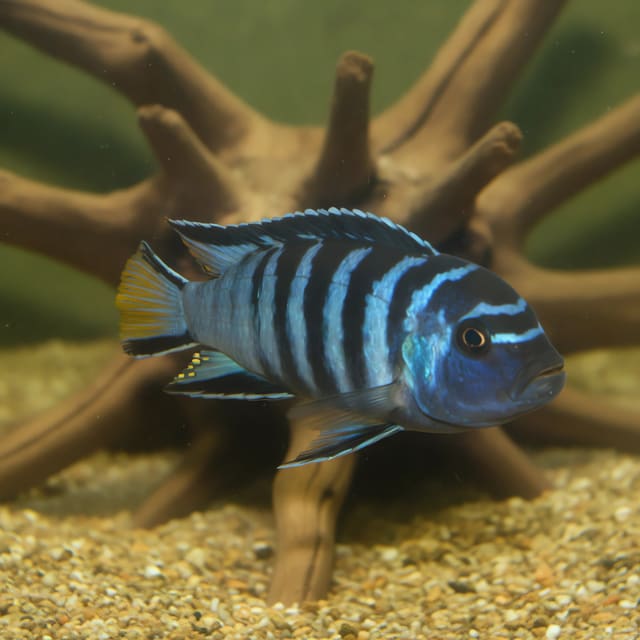
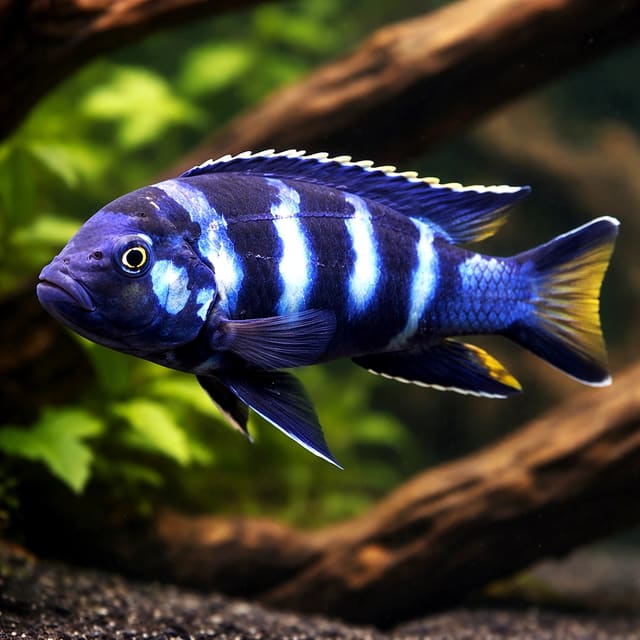
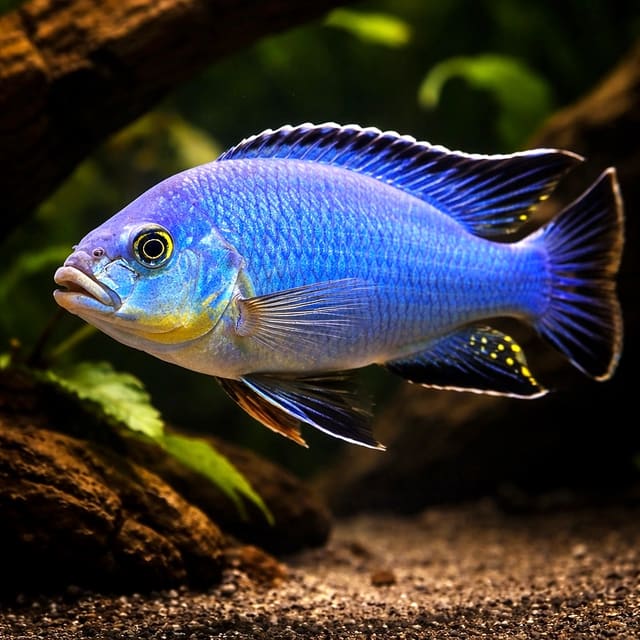
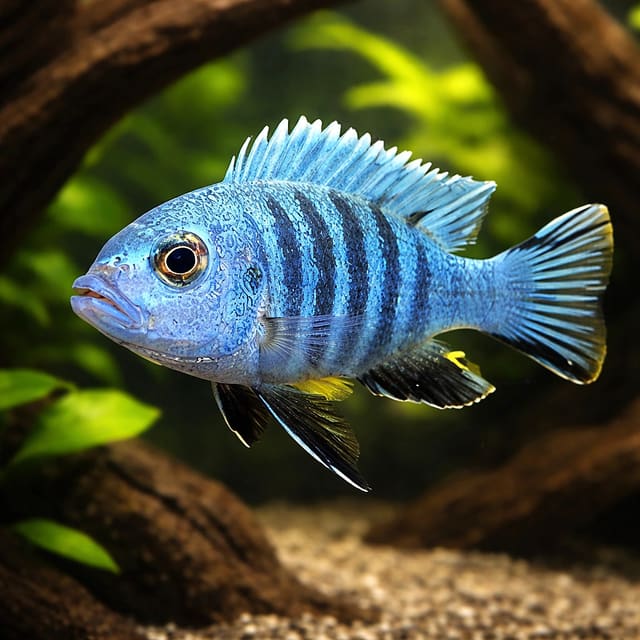
Gallery images have been digitally enhanced to improve image quality. Natural colour, pattern, size and maturity can vary between live animals.
Pseudotropheus crabro is endemic to Lake Malawi. FishBase reports it from reefs and islands including Eccles Reef, West Reef, Chinyankwazi, Chiyamwezi, Maleri, Mbenji, Likoma and Chisumulu, as well as Nkhata Bay. It occurs across different habitats but is found especially in or near large caves and boulders. That is the strongest practical clue for aquarium design: the fish needs a layout with substantial shelter, not a thin line of ornaments against the back glass.
Start with the footprint. Create separate stable structures so one animal cannot look straight through every shelter. Use stones large enough to form durable cavities, support them securely and leave open routes around each pile. A cave should have enough room for the fish to turn without scraping, and more than one way out is valuable when another cichlid approaches. Open water remains useful, but it should connect shelters rather than leave the fish exposed across the whole tank.
Plan for the larger published adult record. A 16 cm SL report describes a markedly more substantial fish than the 9.4 cm SL FishBase value, and measurement conventions can differ. A conservative aquarium therefore allows the fish to turn freely at the larger scale, preserves a retreat route and carries the waste load of an active cichlid. This is a more useful decision than trying to calculate a false midpoint between the two records.
If you are preparing a new system, complete the first-aquarium setup process before livestock is ordered. The filter needs an established bacterial population, equipment needs a stable running period and the cave plan should be finished before a territorial fish enters. A mature layout lets the keeper observe the animal rather than making repeated disruptive changes during its first days.
Dry-plan the rockwork from the normal viewing position and from both ends of the aquarium. The fish should be able to leave a cave without travelling through the mouth of every other shelter. Keep a clear route to intakes and heater guards, and allow a siphon to reach open areas where solid waste settles. Secure heavy stones on a dependable base before loose substrate surrounds them; a cave that shifts during maintenance is a physical danger as well as a loss of shelter.
Once water is circulating, look for quiet pockets behind the largest boulders. The cave-associated habitat does not imply stagnant water. Adjust the return so oxygenated water reaches the structures without producing a single harsh jet that the fish must fight all day. A well-planned arrangement gives a choice between cover and open movement while still allowing the keeper to inspect the animal, remove debris and notice a blocked route early.
FishBase records the natural environment at 24–26°C and pH 7.5–8.2. These species-level values are the best numerical anchors for routine care. Use stable hard, mineral-rich Lake Malawi water inside that temperature and pH window. Measure the source water, understand its alkalinity and choose a repeatable mineral strategy before the fish is introduced; do not set a precise hardness target where no species-specific figure is established.
| Temperature | 24–26°C from the FishBase natural-environment record |
|---|---|
| pH | 7.5–8.2 from the same species profile |
| Hardness approach | Hard, mineral-rich Malawi water maintained by a consistent tested method |
| Ammonia and nitrite | Keep at zero through mature biological filtration |
| Main priority | Stable readings and adequate oxygen, with no abrupt corrective swings |
Read the water-chemistry guide before adjusting the aquarium, then use the water matcher with measured values. pH is only one part of a stable system. Buffering capacity, temperature, dissolved waste, oxygen and the chemistry of replacement water determine whether the fish experiences each water change as routine or as a shock.
The RSPCA aquarium guidance explains that fish release toxic ammonia and that a working biological filter houses bacteria which convert ammonia to nitrite and then to safer nitrate. Choose enough filtration for the completed aquarium rather than the smallest dispatch fish. Provide surface movement, keep intakes clear and arrange rockwork so circulation reaches behind the main structures.
Test ammonia, nitrite, nitrate, temperature and pH on a regular schedule and whenever breathing, appetite or activity changes. Record the results so a slow trend is visible. Treat replacement water for chlorine or chloramine, bring it close to the aquarium temperature and avoid large last-minute chemistry corrections. Clean accessible mechanical waste without dismantling all shelter at once; the fish benefits from a familiar physical map as well as stable water.
Compare replacement water with the aquarium before a change. Similar temperature and a consistent mineral method reduce abrupt movement, while a repeatable volume makes test trends easier to understand. If a reading changes, check the test procedure, source water and equipment before correcting several variables together. The goal is a stable environment within the recorded temperature and pH range, not a succession of rapid adjustments around one isolated result.
Filter maintenance should preserve both flow and biological activity. Remove trapped debris from accessible mechanical material, but avoid stripping every surface and cave in one session. Check the return after cleaning, confirm surface movement and look behind the boulders for accumulated waste. The RSPCA nitrogen-cycle explanation is especially relevant here: clear water can still contain dangerous ammonia or nitrite, so appearance never replaces testing.
FishBase describes Pseudotropheus crabro as eating whatever is available and specialising in cleaning parasites from the kampango catfish Bagrus meridionalis. That unusual relationship is a natural-history observation, not a recipe to feed only animal protein in captivity. It does show that a strict algae-grazer label would be misleading. Use a varied complete Malawi cichlid food and evaluate the routine through body condition, appetite and water quality.
Offer a modest portion that allows the keeper to see the fish take food. Distribute food so it does not all fall into one defended cave, and remove material that remains trapped behind rockwork. Base portion timing on the animal's size, condition and the aquarium's ability to process waste rather than importing a rigid schedule from unrelated animals.
Feed across more than one open area when companions are present. A cave holder that intercepts every piece may gain condition while a quieter fish loses it, even though the total amount looks generous. Stand far enough back to see who actually swallows food. If one animal waits until food has disappeared behind rocks, change the distribution rather than adding a large second portion that will decay out of sight.
Review appetite together with measured water and waste. A growing fish may need a different particle size, but a larger mouth is not a reason for richer food at every meal. Choose variety within a complete routine, keep portions controlled and use changes in body depth over time to guide adjustments. Clean water and predictable feeding make it much easier to distinguish ordinary caution from a genuine loss of appetite.
Feeding time is also the easiest daily assessment. Note whether the fish leaves its shelter, finds food without frantic competition, holds balance and breathes normally afterwards. Loss of appetite may reflect water quality, social pressure or illness. Test the aquarium and inspect equipment first. A diagnosis should follow observations rather than begin with a medication chosen at random.
Finish the aquarium before dispatch: heat and filter it, confirm the water readings, secure the largest rocks and leave an unoccupied cave available. Tropical Fish Co's delivery and Live Arrival Guarantee policy governs packing and claims. Live fish are hand-bagged in pure oxygen, placed in an insulated poly box and supplied with a heat pack when weather calls for one. Tracking and the confirmed Thursday or Friday delivery date are sent by email, and a licensed live-animal courier carries the parcel.
The receiving person must be at the delivery address, inspect the parcel on the day it arrives and retain the continuous video if a Live Arrival Guarantee claim is needed. Report a problem the same day with the order number and video. Recording from the sealed box protects the sequence; beginning after the box is open cannot show the original condition in the same way.
Keep the first hours quiet. Bright display lighting, repeated netting and immediate hardscape changes make observation harder. Allow the fish to orient around the cave structure, then offer a very small feed only when it is swimming normally. Check temperature and equipment again that evening. If the fish cannot leave one corner because another animal blocks every route, use the prepared separation option rather than waiting for physical damage.
During the first week, prioritise stable water and clear observation. Note breathing, appetite, shelter use and any damage. A new fish need not display continuously to be healthy, but it should gain access to oxygenated water and a secure resting place. Keep the normal maintenance rhythm; avoid a series of large reactive changes unless a measured water-quality problem demands action.
The species record establishes a powerful cave-associated Lake Malawi cichlid, but it does not supply a universal home-aquarium tank-mate list or a fixed social number. Treat compatibility as a design problem with four parts: adult scale, water chemistry, use of space and the behaviour of the actual individuals. A companion that fails any one of those tests can be at risk even if a generic chart labels both fish as African cichlids.
| Consider with caution | Robust hard-water Lake Malawi cichlids of compatible adult scale, provided the aquarium gives each fish a different shelter zone and the keeper has a separation plan. |
|---|---|
| Avoid | Soft-water or acidic-water community fish, small animals likely to be overwhelmed, and delicate long-finned fish that cannot leave a contested cave area. |
| Never infer | Sex, compatibility or future colour from a dispatch size or gallery image. |
Large caves and boulders are central to the animal's natural habitat. Give each cichlid more than one route between shelter and open water, and keep food from landing exclusively in the most valuable cave. Observe at different times of day. A fish that seems calm when the keeper stands nearby may resume persistent chasing once the room is quiet.
Watch for one animal being kept away from every cave, prevented from feeding, pinned near the surface or forced to breathe rapidly after pursuit. Fin damage, lost condition and continuous hiding mean the arrangement needs action. Moving a rock is useful only when it creates genuinely separate shelter; random disturbance can simply restart a contest in the same inadequate footprint.
One purchase supplies one fish and this product has no sex guarantee. A fixed harem formula would therefore be misleading. Add animals only when the mature aquarium can accommodate them regardless of an assumed sex, and reassess as individuals grow. Keep a cycled contingency aquarium or safe divider arrangement available before trying a demanding combination.
Judge the whole aquarium at the larger adult scale before adding the smallest dispatch fish. Count the shelters that will remain useful after every inhabitant matures, then look at whether a fish can reach food and open water without crossing one defended entrance. A combination that appears roomy around juveniles can become restrictive as body depth, confidence and waste production increase. Leave capacity for growth instead of treating empty water today as permanent spare room.
Plan the response to conflict before an animal is introduced. A divider is useful only if both sides retain filtration, oxygen and shelter, while a separate aquarium must already be cycled. Decide how a fish will be moved without dismantling every boulder. This preparation turns close observation into a practical safeguard: when a fish loses access to food or cover, the keeper can act promptly rather than improvising after injury.
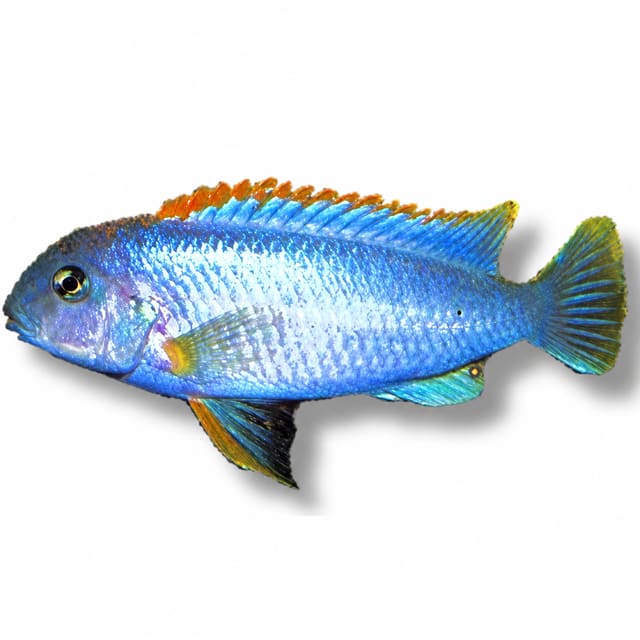
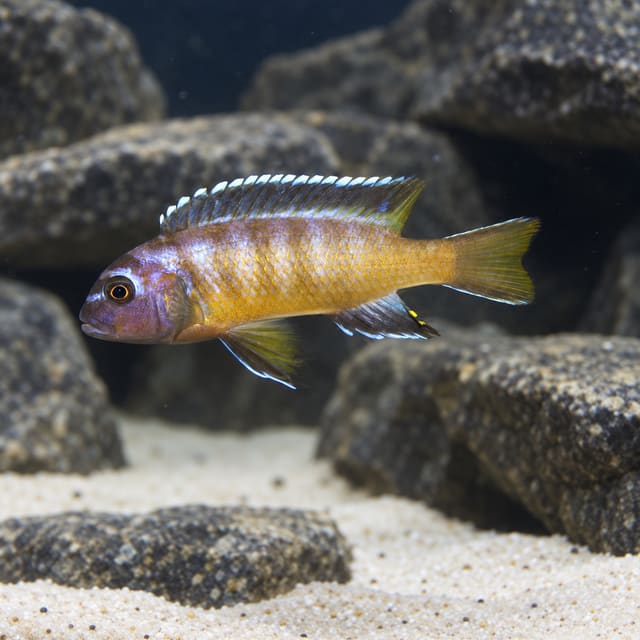
The two related products shown elsewhere on the page are alternatives for comparison, not endorsements as companions. An Acei cichlid or a Firefish peacock has its own body size, behaviour and social needs. Read each animal's care independently and never use proximity in a catalogue as a stocking instruction.
Healthy assessment begins with a baseline. Learn where the fish normally rests, how it approaches food and how quickly its breathing settles after activity. Bumblebee and hornet names describe a familiar pattern, but colour alone cannot prove health, sex or emotional state. The most useful signs combine behaviour, body condition, fins and measured water.
If several fish change behaviour together, measure ammonia, nitrite, temperature and pH immediately and confirm aeration and filter flow. If one animal is affected, complete the same checks before assuming the cause is individual disease. RSPCA guidance explains the toxic ammonia-to-nitrite pathway and why an established biological filter matters even when the water appears clear.
Keep notes of water tests, maintenance and significant interaction. The value lies in comparison: a gradual rise in nitrate may show increasing load, while a repeated loss of appetite after one neighbour matures may point towards social pressure. Acting on a trend is more reliable than trying to remember whether a symptom looked slightly different last week.
This fish's most interesting biology—large-cave habitat and specialised cleaning around a giant catfish—also explains why a simplistic label is inadequate. Good home care does not attempt to reproduce the catfish relationship. It provides stable water, a secure physical environment, varied complete nutrition and enough attention to notice when the individual animal's needs are not being met.
Published species summaries differ: FishBase records Pseudotropheus crabro at 9.4 cm SL, while a broader species summary reports 16 cm SL. Plan the aquarium around the larger record rather than the dispatch size.
Choose a long, spacious aquarium that can carry several large-boulder cave zones, open routes, mature filtration and the fish at the larger published adult record. A cramped footprint with one prized cave gives this cave-associated cichlid too few choices.
One purchase supplies one fish and sex is not guaranteed. Do not build a fixed male-to-female ratio by guessing from size or colour; add each animal only when the aquarium has a separate shelter and a safe fallback if interactions become harmful.
It is best treated as an advanced choice because the keeper must manage hard alkaline water, substantial cave structure, uncertain adult-size reports and compatibility by observation rather than relying on a generic community formula.
FishBase describes an opportunistic natural diet and specialised parasite-cleaning behaviour around the catfish Bagrus meridionalis. Use a varied complete Malawi cichlid food, watch body condition and water quality, and avoid reducing it to a strict herbivore or carnivore label.
FishBase records 24–26°C and pH 7.5–8.2 for the species' natural environment. Use stable hard, mineral-rich Malawi water, keep ammonia and nitrite at zero through mature filtration, and avoid sudden attempts to chase readings.
Treat it as a powerful cave-associated cichlid and judge the individual fish in the actual layout. Watch for blocked access to food or shelter, repeated chasing, rapid breathing and fin damage; separate animals promptly when one cannot escape normal contact.
Consider only robust hard-water Lake Malawi cichlids that match its adult scale and can use a different shelter zone. Exclude soft-water community fish and small or delicate animals, and never treat an alternative product link as proof of compatibility.
Tropical Fish Co hand-packs live fish in oxygenated bags inside an insulated box, with a heat pack when weather calls for one, and uses a licensed live-animal courier. Keep a continuous unboxing video from the sealed parcel, inspect the fish the same day and float the sealed bag for 20–30 minutes before release; the delivery policy gives the complete Live Arrival Guarantee conditions.
No reviews for this item yet. Bought one? Honest reviews only, good or bad.
What customers say about ordering from us
I have a small group of long finned mountain minnows. So was delighted to be able to order ten of this variety to increase the genetics in my tank . The ones I recieved are healthy but it’s to early to give a verdict on wether they are of a long finned type since they are small currently.
Gordon Walker · 23 Sept 2026
100% success travel and "installation". Pleased with quality of purchase. The Siamese fighter a bit "shy" so have not yet seen him at his best yet but looking good. Happy customer. GG
George E Garratt · 21 Sept 2026
Reviews of our shop, collected by Judge.me, an independent third-party review collector. Newest first.