Moderate
Acei Cichlid (Pseudotropheus sp. “acei”)
24–26°C · pH 7.5–8.5 · 300L
£7.99

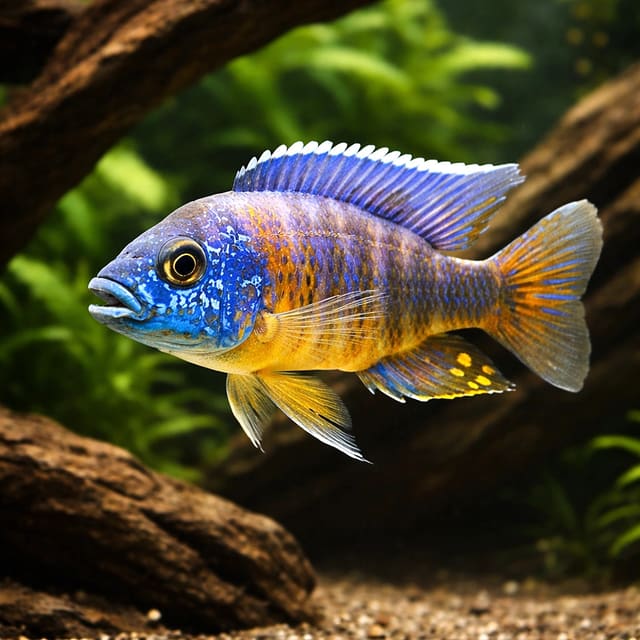
The Benga Peacock Cichlid (Aulonocara baenschi) is a Lake Malawi cichlid that forages over sand beside scattered rocks and reaches 13 cm total length. It suits keepers prepared for the 25–26°C, pH 8.0–8.2 and 12–18 dGH overlap of FishBase, Seriously Fish and OATA, with one male alongside 4–6 females in all but the largest aquaria. Sold individually in sizes from 3–4 cm to 7–9 cm, plus XL.
Adult size is the maximum length this species reaches at full maturity (scientific sources). The livestock you receive will be younger and smaller — pick a size above for the actual shipping size. Product-photo provenance and any image-specific limitations are stated on the listing.
Aulonocara baenschi
Save when buying multiple fish. Each quantity is one fish; sex and pair formation are not guaranteed unless the selected variant explicitly states them.
The Benga Peacock Cichlid (Aulonocara baenschi) is a Lake Malawi cichlid that forages over sand beside scattered rocks and reaches 13 cm total length. It suits keepers prepared for the 25–26°C, pH 8.0–8.2 and 12–18 dGH overlap of FishBase, Seriously Fish and OATA, with one male alongside 4–6 females in all but the largest aquaria. Sold individually in sizes from 3–4 cm to 7–9 cm, plus XL.
Adult size is the maximum length this species reaches at full maturity (scientific sources). The livestock you receive will be younger and smaller — pick a size above for the actual shipping size. Product-photo provenance and any image-specific limitations are stated on the listing.
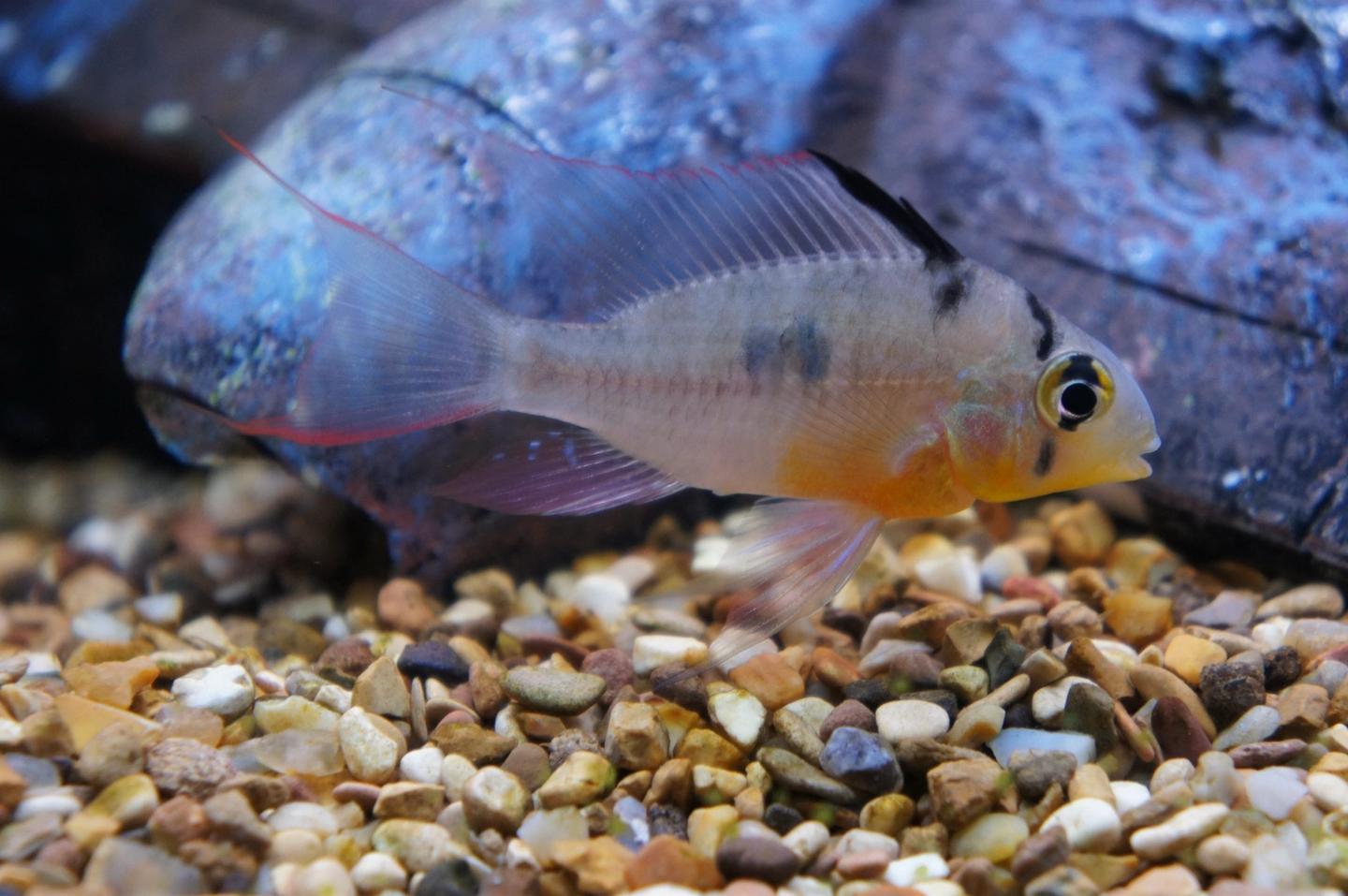
Cichlids are a family of roughly 1,800 accepted species, not one care type. Before buying, identify the exact species and source, then compare adult measurement, usable tank dimensions, social system, territory, tested water, diet and an exit plan. No family-wide minimum tank, water range or tank-mate list is safe.
Maintain these water conditions for optimal health and vibrant colors
The Benga Peacock Cichlid (Aulonocara baenschi) is a freshwater cichlid from Lake Malawi in Africa. FishBase places it in the family Cichlidae, records it around sandy bottoms broken by scattered rocks and gives a maximum length of 13 cm total length. It suits a keeper who can maintain hard, alkaline water, provide a mature biological filter and manage territorial behaviour rather than expecting a peaceful mixed community.
In nature, this bottom-oriented fish searches for invertebrates over sand. Its enlarged sensory system and substrate-sifting behaviour make open fine sand functional aquarium space, not merely decoration. Scattered rock groups provide boundaries and shelter, while clear sandy areas leave room for natural searching and displays.
FishBase classifies the wild species as Critically Endangered. Responsible ownership means planning for the full adult commitment, preventing escapes and never releasing aquarium animals, water, plants or substrate into natural waterways.
| Suits | Not suited to |
|---|---|
| Hard, alkaline Lake Malawi aquaria | Soft, acidic community aquaria |
| Keepers able to maintain stable water chemistry | New or biologically immature filters |
| Layouts with fine sand, secure rocks and open space | Sharp or coarse substrate that interferes with feeding |
| Carefully assessed Malawi companions | Unplanned mixtures chosen by colour alone |
| Keepers with a separation plan for aggression | Homes without space to manage territorial conflict |
One purchase supplies one Benga Peacock Cichlid in the size named on the live selector. The labels are 3 - 4 cm, 4 - 5 cm, 6 - 7 cm, 7-9 cm and XL. The size you select is the size supplied, not the adult size. Treat XL as its named dispatch grade and still plan the aquarium around the recorded 13 cm adult maximum.
Sex is guaranteed only when the selected option explicitly states male or female. This Benga Peacock Cichlid listing has no sex-guaranteed option.
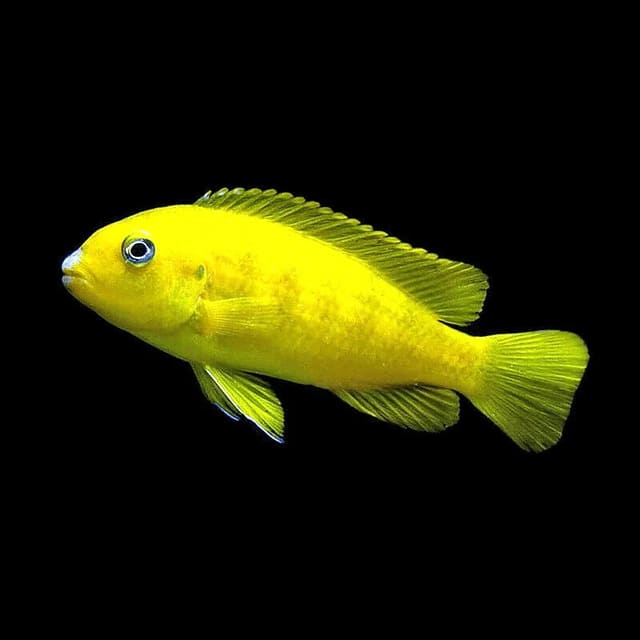
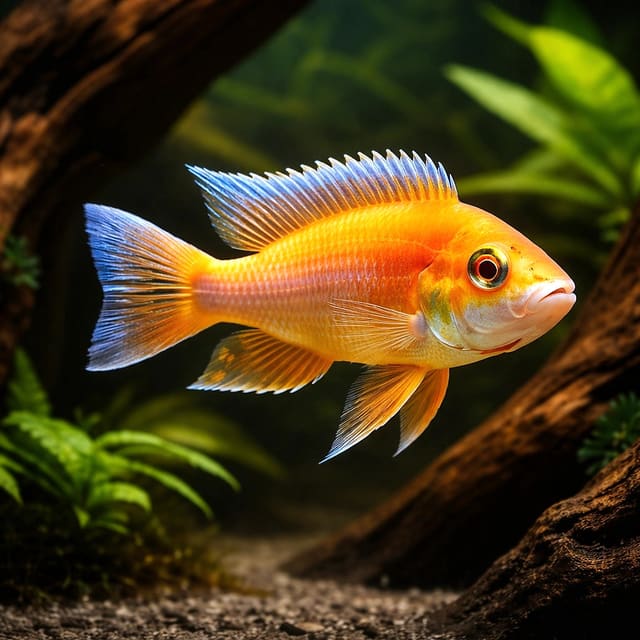
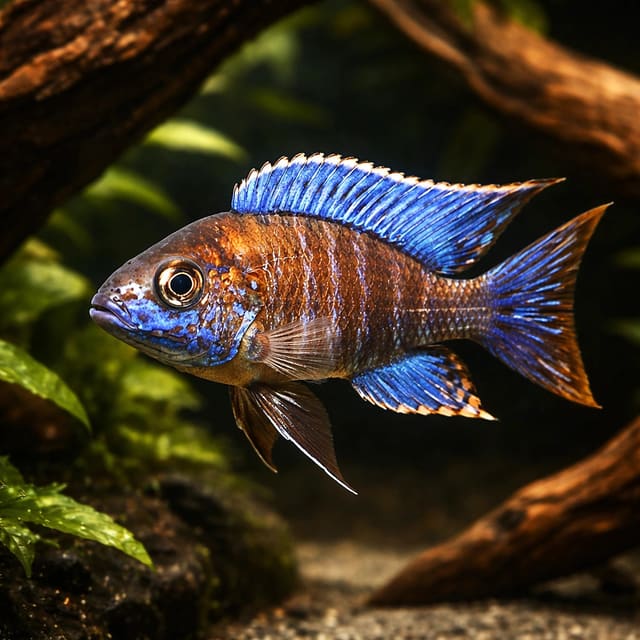
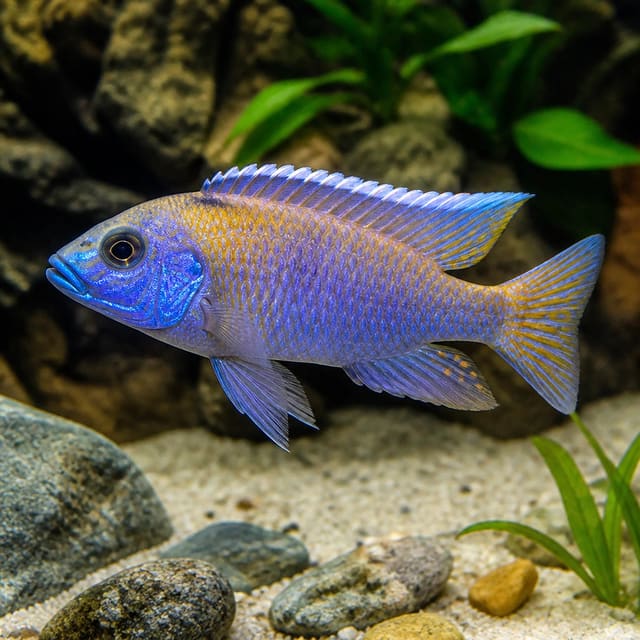
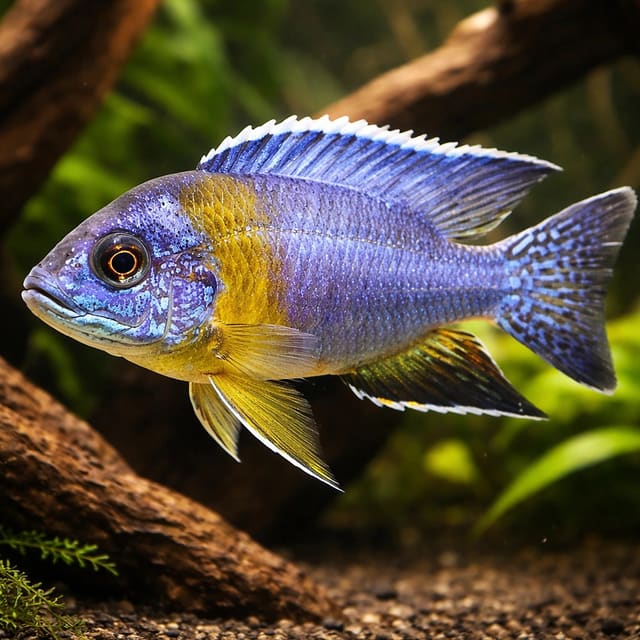
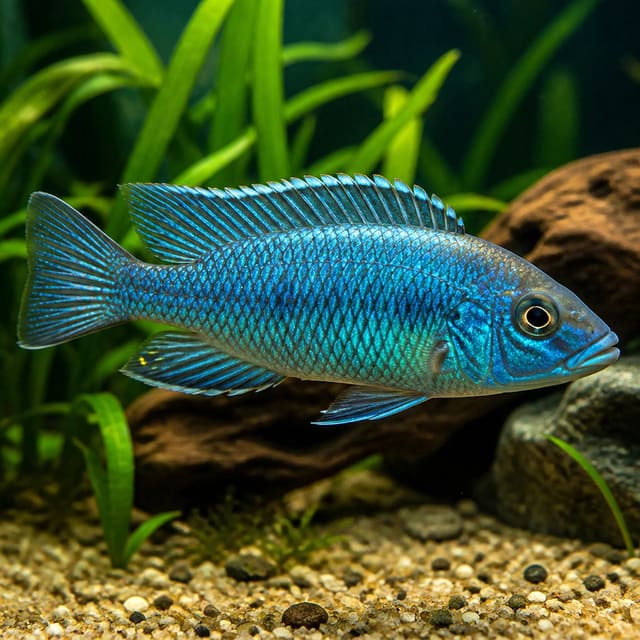
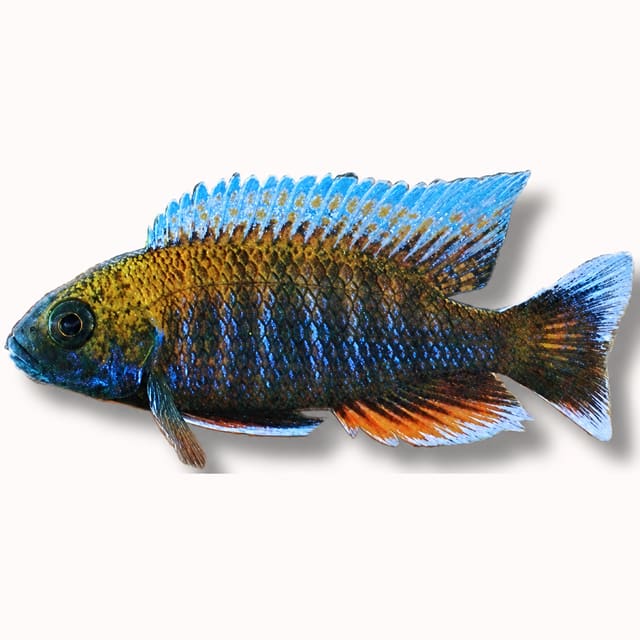
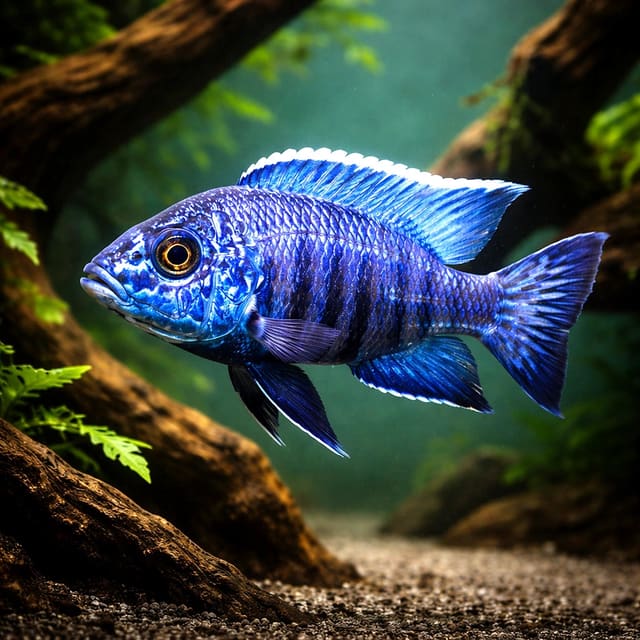
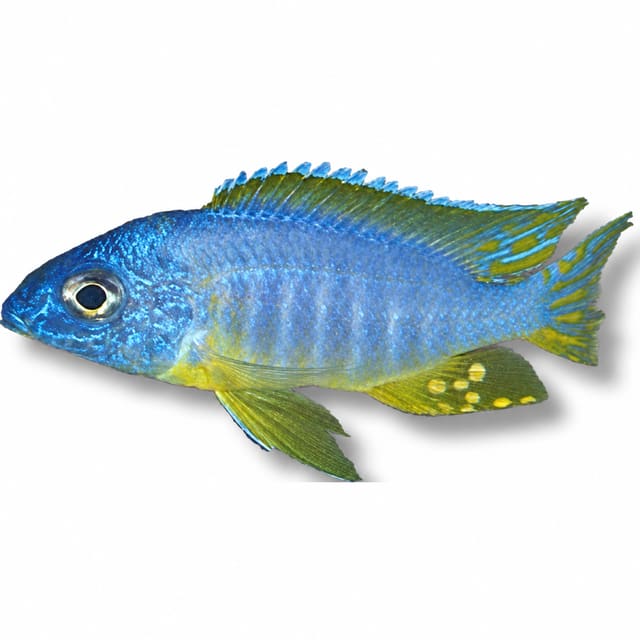
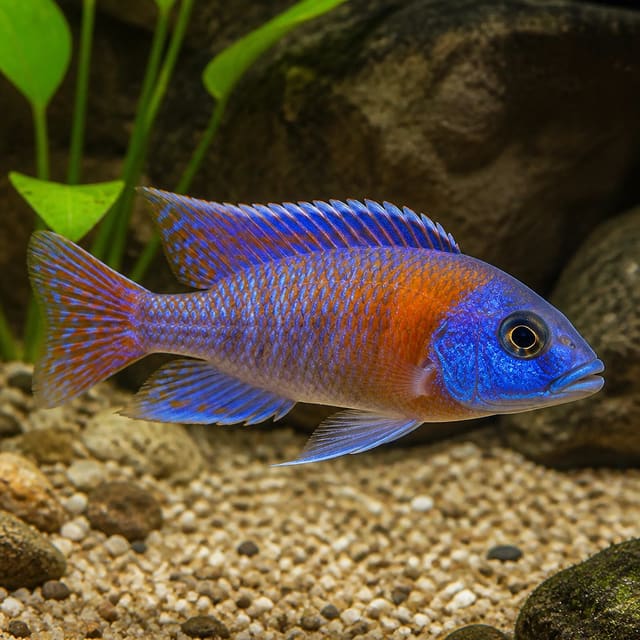
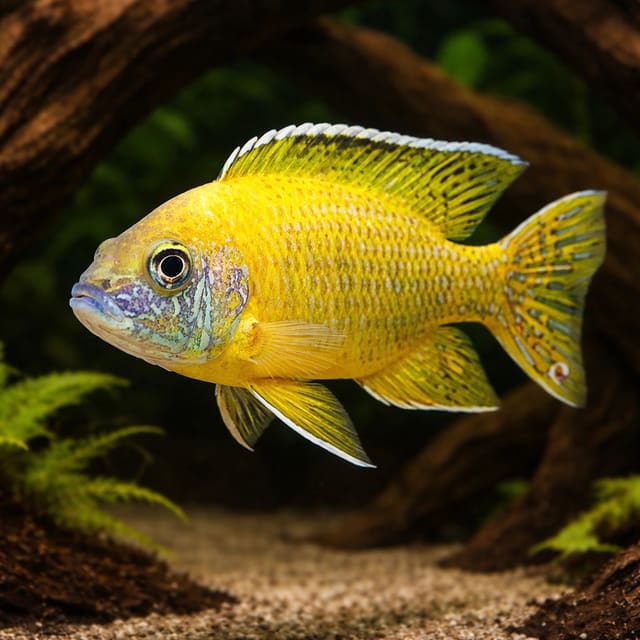
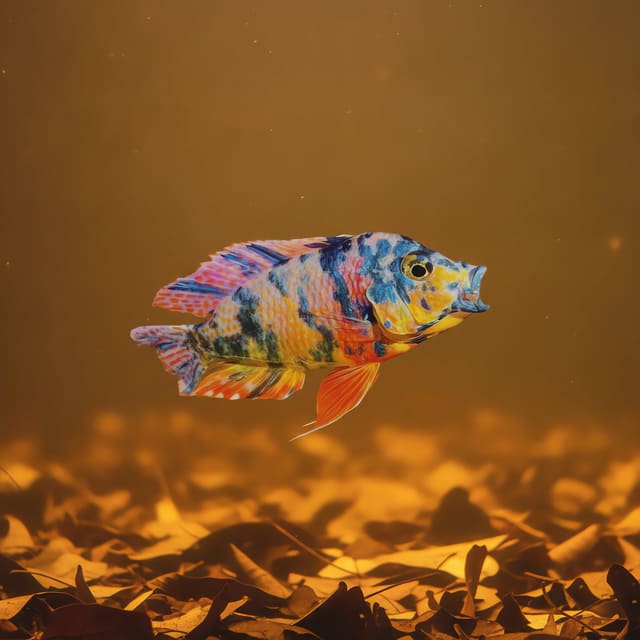
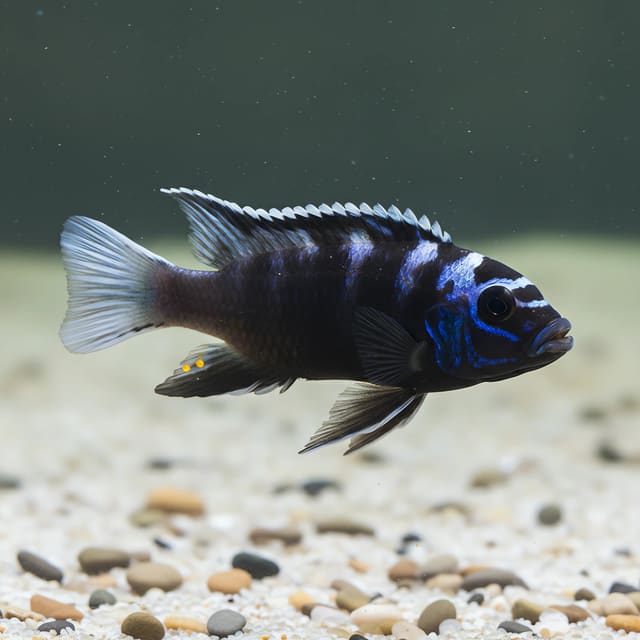
Some gallery images have been digitally enhanced to improve image quality. They show the listed type of animal rather than guaranteeing the exact markings of the individual supplied, so natural colour and pattern can vary. One gallery scene shows two fish, but each purchase still supplies one animal. Use the images to understand the broad body shape and colour idea rather than to predict the exact markings or colour intensity of an individual.
Plan for a fish reaching 13 cm total length and an aquarium with minimum base dimensions of 120 × 45 cm or equivalent. The Seriously Fish species profile associates that footprint with about 243 litres and recommends it as the minimum outside smaller breeding aquaria. OATA’s broader Malawi-community figure is at least 200 litres, so the species profile gives the more useful long-term starting point here.
The 13 cm FishBase maximum is the single adult figure used for planning. Seriously Fish separately lists 12 cm standard length for males and 9 cm standard length for females; these are different measurements and should not be substituted for the 13 cm total-length figure.
A long footprint matters because territory is organised horizontally. Rock displacement, substrate and equipment also reduce usable water volume, while a tall aquarium can hold many litres without creating extra horizontal space. Leave open sand between secure rock groups, monitor how each fish uses the floor and separate individuals if pursuit becomes persistent.
Keep the aquarium at 25–26°C, pH 8.0–8.2 and 12–18 dGH. This is the overlap of FishBase’s recorded environment of 22–26°C, pH 7.2–8.2 and 10–30 dGH, the Seriously Fish aquarium range of 25–29°C, pH 7.5–9.0 and 10–25 dGH, and OATA’s African Malawi cichlid guidance. OATA gives 23–27°C, pH 8.0–8.6 and 12–18 dGH for the broader group; the narrower overlap keeps this species inside every named range.
Use the water chemistry guide to understand pH, GH and KH before altering the aquarium. Measure both the source water and aquarium water, then use the water matcher to compare those readings with the target. A repeatable preparation method is safer than reacting to every small test variation.
| Reading | Action |
|---|---|
| Temperature 25–26°C | Hold it steady and check with a separate thermometer. |
| pH 8.0–8.2 | Keep replacement water consistent rather than making abrupt corrections. |
| GH 12–18 dGH | Maintain hard water and retest after changing the preparation method. |
| Ammonia or nitrite above 0 mg/l | Pause additions, test again and restore biological filtration capacity. |
| Rising nitrate or solid waste | Increase maintenance and review feeding before adding fish. |
OATA also calls for ammonia and nitrite at zero and nitrate no more than 20 mg/l above the normal tap-water level. Test after stocking changes because additional feeding and waste increase the work required from the biological filter.
Take water readings at a similar point in the maintenance cycle so comparisons remain useful. For example, a result taken immediately after a water change answers a different question from one taken just before the next change. Record the aquarium temperature, pH and hardness alongside ammonia, nitrite and nitrate, then note any change in feeding or stocking that could explain a shift.
If pH or hardness begins moving away from the target, compare the aquarium with freshly prepared replacement water before making an adjustment. A difference between those readings can reveal whether the change develops inside the aquarium or begins with the source water. Change one part of the preparation routine at a time, retest and keep the method consistent at later water changes.
Add this cichlid only after the aquarium’s biological filter is established and ammonia and nitrite both remain at 0 mg/l. The RSPCA’s aquarium welfare guidance explains that beneficial bacteria convert toxic ammonia first into nitrite and then into safer nitrate. A new tank needs time to build that bacterial population before livestock increases the waste load.
If this is your first aquarium, follow the first tropical tank guide before planning the introduction. Maturity means more than running equipment for a few days: testing must show that the filter can process the aquarium’s waste consistently.
Seriously Fish gives a turnover of four to five times the aquarium volume each hour for its approximately 243-litre example. That equates to roughly 970–1,215 litres per hour before allowing for the reduction caused by filter media, pipework and accumulated debris. Use dependable biological capacity, effective mechanical capture and strong gas exchange without directing an exhausting jet across every open area.
Malawi cichlid communities produce substantial waste, particularly when several fish are fed twice daily. Check intakes and outlets for obstruction, keep rocks clear of equipment and ensure digging cannot expose or trap a heater.
Stocking, larger meals and growing fish all increase the amount of waste entering the system. Test more closely after any of those changes instead of assuming that a filter which handled the previous load will immediately handle the new one. Clear water alone is not a measure of biological capacity because ammonia and nitrite can be present without visible cloudiness.
Use the first week after an addition as a checkpoint. Confirm that flow remains steady, solid waste reaches the mechanical media and oxygen exchange is not restricted. If ammonia or nitrite appears, stop further additions, reduce the immediate waste input and restore stable filtration before continuing the stocking plan.
Use fine sand with secure groups of rock and open feeding space between them. FishBase places this species over sandy bottom where rocks are scattered, while Seriously Fish explains that Aulonocara take mouthfuls of substrate and sift out edible material. The aquarium floor therefore needs to support feeding as well as territory management.
Coarse gravel and small pebbles can inhibit that feeding method, damage gill filaments or be swallowed. Fine sand allows the fish to investigate and expel substrate naturally. Keep the surface clean enough that searching for food does not repeatedly lift trapped organic waste.
This fish does not harm plants according to the species profile. Hard-water-tolerant Vallisneria, Anubias or Sagittaria may be used, but plants should not replace the open sand and rock structure. OATA notes that Malawi cichlids often dig and will uproot plants, so anchor planting securely and expect the fish to rearrange loose substrate.
Observe how every individual uses the layout. If one fish controls all feeding space or repeatedly corners another, alter the arrangement while keeping the rockwork stable. The goal is not to fill every gap with stone; it is to provide shelter and enough open sand for normal searching behaviour.
View the aquarium from both ends as well as from the front. Each rock group should remain stable and leave more than one usable route through the open sand. Check that the arrangement provides separate shelter areas without blocking the space needed for feeding.
Watch feeding to see whether the layout works in practice. If food repeatedly collects behind rocks or one individual occupies the only open feeding patch, adjust the position of the groups while preserving their stable foundations. Remove trapped waste during maintenance and recheck every structure after substantial digging.
Make fine-grade prepared cichlid food with a substantial animal-based component the staple, then add small live or frozen invertebrate foods for variety. FishBase records bottom-dwelling invertebrates as the wild diet, and Seriously Fish describes this species hovering over substrate, detecting movement and sifting sand for edible items.
Suitable variety named by the species profile includes chironomid larvae, Tubifex, Artemia and mosquito larvae. Some dried food should also contain vegetable matter such as spirulina, but a high-algae herbivore food should not displace the animal-rich staple for this invertebrate-feeding peacock.
Feed only what the fish can finish within a few minutes, twice daily. This schedule comes from OATA’s Malawi-cichlid guidance. Start with a small amount, watch the fish swallow it and add another small amount only while food is being eaten cleanly.
| Observation | Feeding response |
|---|---|
| Food remains after a few minutes | Remove it and reduce the next portion. |
| One fish takes every item | Distribute small portions across separate open areas. |
| A smaller fish struggles with the food | Use a finer grade rather than increasing feeding time. |
| Waste accumulates on the sand | Reduce portions and review mechanical filtration. |
| Interest in food falls suddenly | Test water and check breathing, posture and social pressure. |
Match particle size to the fish’s mouth rather than the dispatch label alone. A smaller individual needs fine food it can swallow safely, while a larger fish still benefits from controlled portions. Overfeeding leaves organic waste that raises the filtration load and undermines the stable water chemistry this species requires.
A meal is not complete merely because the dominant fish has eaten. Watch each animal and distribute the portion across more than one open area when necessary. The aim is for every fish to take appropriately sized food without a cloud of leftovers settling into the sand or rockwork.
Review the result after feeding as well as during it. Food remaining after a few minutes means the next portion should be smaller, while repeated displacement of one fish calls for a different distribution pattern and a check of the social layout. A sudden change in appetite should trigger water testing and observation of breathing, posture and aggression before the food itself is changed.
In all but the largest aquaria, plan a mature group around one male with 4–6 females. Seriously Fish recommends this structure because males can be aggressive in pursuit of females and spreading attention across several females reduces pressure on one individual. Apply the ratio only after adult sexes can be identified; size and gallery colour are not substitutes for sex identification.
Adult males are larger and more colourful than females. Behaviour, feeding access and physical condition are more useful daily checks than colour alone.
Growth changes the amount of waste, swimming room and territory each animal requires. A group that appears calm while small may behave differently as adults, so review the layout and stocking plan before the fish fill the available footprint.
Female mouthbrooding may occur in a mature group. A holding female carries developing young in her mouth. Protect her from harassment and distinguish that behaviour from illness by checking breathing, balance, body condition and the water readings together.
Review the group whenever one fish begins controlling food, shelter or the main open area. A brief chase is different from repeated pursuit that prevents another animal from feeding or resting. Record which fish starts the interaction, where it happens and whether the targeted animal can leave the area.
Do not wait for the adult arrangement to resolve itself when several fish mature in a limited footprint. Use the prepared divider, second mature aquarium or rehoming route before condition declines. Any change to the group should be followed by renewed checks of feeding access, territorial boundaries and filter capacity.
Arrange for someone to receive the parcel so live fish are not left unattended. Tropical Fish Co hand-bags fish in pure oxygen, uses an insulated poly box and adds a heat pack when weather conditions call for it. A licensed live-animal courier carries the parcel, with tracking and the confirmed arrival date sent by email.
These steps come from the current delivery and Live Arrival Guarantee policy. Read that page before purchase so someone can be present and the current claim procedure can be followed if the fish arrives in difficulty.
OATA advises checking that ammonia and nitrite are both zero before adding fish and increasing the population slowly as the filter’s bacterial capacity adjusts to greater waste and feeding. Confirm the receiving aquarium is mature, within the FishBase, Seriously Fish and OATA overlap of 25–26°C, and ready for the additional fish.
Observe the established residents as the new fish enters their space. Rearranging some décor can interrupt fixed territorial boundaries, but all stones must remain secure. If aggression becomes concentrated on the newcomer, use the separation plan rather than relying on the fish to resolve persistent conflict unaided.
During the first feeding opportunities, confirm that the newcomer can reach food and withdraw from other fish. Watch whether one resident repeatedly follows it between shelters or blocks the open sand. Persistent pressure calls for separation or a revised territory layout, not extra food scattered into an unresolved conflict.
Test ammonia and nitrite after the population changes because the additional animal and feeding increase the biological load. Keep further additions on hold until both remain at zero and the new social arrangement allows every fish to feed and rest.
Perform a water change of 30–50% at least weekly, using conditioned replacement water with closely matched temperature and consistent chemistry. Seriously Fish recommends this level of maintenance because these cichlids are particularly sensitive to deteriorating water quality and swings in chemical parameters.
Test ammonia, nitrite, nitrate, pH and hardness at least weekly. OATA calls for ammonia and nitrite at zero and nitrate no more than 20 mg/l above the tap-water level. Record the results so a trend can be acted on before the fish’s behaviour changes.
If any of these changes appears, test the water first and check temperature, filtration and recent maintenance. Correct environmental problems promptly. Contact us for guidance when the change persists, the fish is injured or several signs appear together.
Confirm that the newcomer can reach food, move between open space and shelter and rest without being cornered. During the first month, compare body condition and behaviour from week to week. A stable hierarchy still requires every animal to feed and occupy usable space without continuous pursuit.
Choose companions by adult size, water chemistry, colour pattern, feeding behaviour and temperament. A shared Lake Malawi origin is only the first screen. Seriously Fish describes the Benga Peacock Cichlid as relatively peaceful but warns that males tend to act aggressively towards fish with a similar colour pattern.
Possible companions named by the species profile include differently patterned Copadichromis, Placidochromis, Otopharynx lithobates and the peaceful mbuna Labidochromis caeruleus. Treat these as candidates for assessment, not automatic matches. Compare adult dimensions, the aquarium footprint and the behaviour of each individual before combining them.
OATA limits Malawi-cichlid companionship to other Malawi cichlids or some Synodontis catfish associated with Lake Malawi. Avoid mixing this fish with animals outside those groups. A proposed catfish still needs enough adult space, suitable retreats and reliable feeding access.
| Candidate | Decision rule |
|---|---|
| Differently patterned Copadichromis | Consider only when adult size, diet and territory use fit. |
| Placidochromis | Assess the exact species and aquarium footprint. |
| Otopharynx lithobates | Provide sufficient space and monitor male behaviour. |
| Labidochromis caeruleus | Use peaceful individuals and protect feeding access. |
| Some Lake Malawi Synodontis | Confirm adult size, hiding space and food access. |
Compatibility remains conditional because individual cichlids establish territories differently. A workable plan includes a divider, another mature aquarium or a responsible rehoming route before fish are combined.
Start with the adult dimensions and routine water needs of every candidate, then compare where each fish feeds and holds territory. Two animals can share suitable chemistry yet still compete for the same open sand, shelter or feeding position. A candidate that only fits while small should not be treated as a long-term match.
After any introduction, judge success by access rather than by the absence of visible injury. Every fish must be able to eat, rest and leave another animal’s territory. Repeated displacement, hiding through feeding or constant pursuit means the combination needs intervention even when fins and scales still look intact.
Avoid other Aulonocara species because most can hybridise. Similar-looking females can make parentage difficult to follow, and fry should not be distributed under a pure species name when parent identity is uncertain.
Avoid most mbuna because Seriously Fish describes the majority as excessively boisterous. The named exception, Labidochromis caeruleus, is still a conditional candidate rather than a promise of harmony. Similar water chemistry does not remove differences in aggression, feeding pressure or territory use.
When adding compatible Malawi cichlids, OATA recommends adding the more peaceful species first and more aggressive species later. Adding Malawi cichlids in groups can also reduce the chance of all aggression being directed at one newcomer. Increase the total population slowly enough for biological filtration to keep pace.
Browse the African cichlid collection to compare identities, then assess each proposed combination on its own facts. Stop an introduction if one fish cannot feed, leave a territory or recover between chases.
The Benga Peacock Cichlid reaches 13 cm total length according to FishBase. Plan for that adult maximum rather than the animal’s dispatch size.
Aulonocara baenschi needs minimum base dimensions of 120 × 45 cm or equivalent, associated with about 243 litres by Seriously Fish. More space may be needed when several territories or species share the aquarium.
In all but the largest aquaria, keep one mature male alongside 4–6 females. Apply that structure only after adult sexes are known, and separate fish if one animal receives persistent aggression.
Aulonocara baenschi suits a keeper who can mature a biological filter, maintain the 25–26°C overlap of FishBase, Seriously Fish and OATA, keep hard alkaline water and manage cichlid territories. It is a poor choice for an uncycled aquarium or an unplanned peaceful community.
The Benga Peacock Cichlid naturally feeds on bottom-dwelling invertebrates. Use fine-grade prepared cichlid food with a substantial animal component as the staple, add small foods such as Artemia for variety, and feed only what is eaten within a few minutes twice daily.
Keep it at 25–26°C and pH 8.0–8.2, with general hardness of 12–18 dGH. These routine values are the overlap of the FishBase recorded environment, Seriously Fish aquarium values and OATA Malawi guidance.
It is relatively peaceful for a Malawi cichlid, but males may act aggressively towards fish with a similar colour pattern. Provide open space between secure rock piles and intervene if chasing prevents another fish from feeding, resting or leaving a territory.
Conditional candidates include differently patterned Copadichromis, Placidochromis, Otopharynx lithobates, peaceful Labidochromis caeruleus and some Lake Malawi Synodontis. Avoid other Aulonocara because of hybridisation, avoid most mbuna because they are excessively boisterous and avoid animals outside the Malawi cichlid and named Synodontis groups.
It is hand-bagged in pure oxygen, packed in an insulated poly box with a heat pack when weather calls for one, and carried by a licensed live-animal courier. Someone must receive the parcel; start filming before opening it, float the bag for 20–30 minutes before releasing the fish and never pour transport water into the aquarium.
No reviews for this item yet. Bought one? Honest reviews only, good or bad.
What customers say about ordering from us
I have a small group of long finned mountain minnows. So was delighted to be able to order ten of this variety to increase the genetics in my tank . The ones I recieved are healthy but it’s to early to give a verdict on wether they are of a long finned type since they are small currently.
Gordon Walker · 23 Sept 2026
100% success travel and "installation". Pleased with quality of purchase. The Siamese fighter a bit "shy" so have not yet seen him at his best yet but looking good. Happy customer. GG
George E Garratt · 21 Sept 2026
Reviews of our shop, collected by Judge.me, an independent third-party review collector. Newest first.