Easy
Assorted Peacock Cichlids (Aulonocara mix)
24–28°C · pH 7.5–8.5
From £10.99Some sizes on sale

Six assorted Aulonocara peacock cichlids, sent as 3-4 cm juveniles. Colours, varieties and sexes are not chosen, and mixed peacocks may include line-bred forms or crosses. For a 120 cm Malawi tank with hard, alkaline water at 24-27°C.
Adult size is the maximum length this species reaches at full maturity (scientific sources). The livestock you receive will be younger and smaller. Product-photo provenance and any image-specific limitations are stated on the listing.
Aulonocara sp.
Six assorted Aulonocara peacock cichlids, sent as 3-4 cm juveniles. Colours, varieties and sexes are not chosen, and mixed peacocks may include line-bred forms or crosses. For a 120 cm Malawi tank with hard, alkaline water at 24-27°C.
Adult size is the maximum length this species reaches at full maturity (scientific sources). The livestock you receive will be younger and smaller. Product-photo provenance and any image-specific limitations are stated on the listing.
Cichlids are a family of roughly 1,800 accepted species, not one care type. Before buying, identify the exact species and source, then compare adult measurement, usable tank dimensions, social system, territory, tested water, diet and an exit plan. No family-wide minimum tank, water range or tank-mate list is safe.
Maintain these water conditions for optimal health and vibrant colors
This is a ready-made group of six assorted Aulonocara peacock cichlids, sent together in one order. Our stock records list them at around 3–4 cm, so they arrive as juveniles with nearly all of their growing still to do. The word that matters most on this listing is “assorted”. We do not choose colours for you, we cannot promise any named variety, and we cannot tell you how many of the six will turn out male or female. Fish this small are very hard to sex by eye, and the colour peacocks are famous for belongs to grown males, so the fish you lift out of the bag will look a good deal plainer than the fish they become.
Peacock cichlids make up the genus Aulonocara. Wikipedia lists nineteen recognised species, every one of them found only in Lake Malawi in East Africa, and describes the genus as strongly sexually dichromic, even by the standards of the Malawi haplochromines. Put simply, a mature male and a mature female can look like two different fish. Males take on the blues, golds, oranges and reds; females stay far more muted. Seriously Fish adds that males also grow noticeably larger, which comes into the tank plan further down.
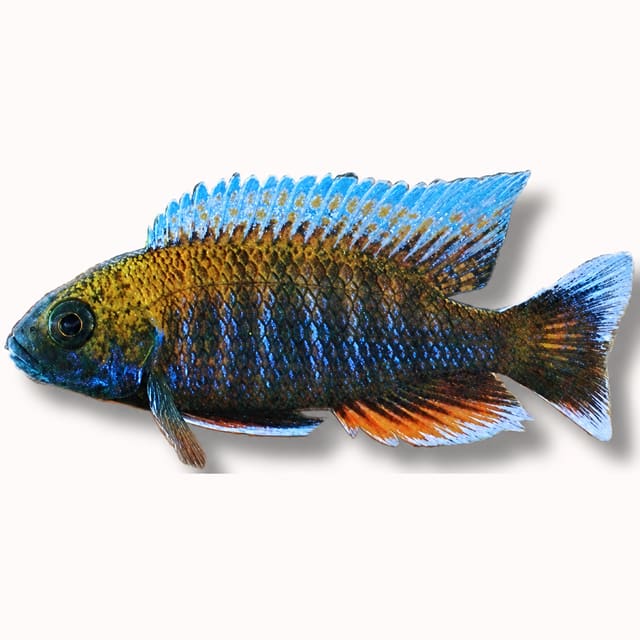
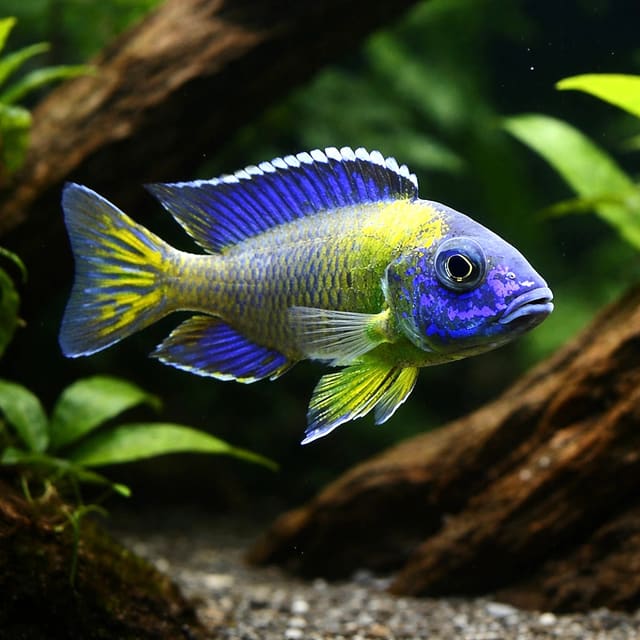
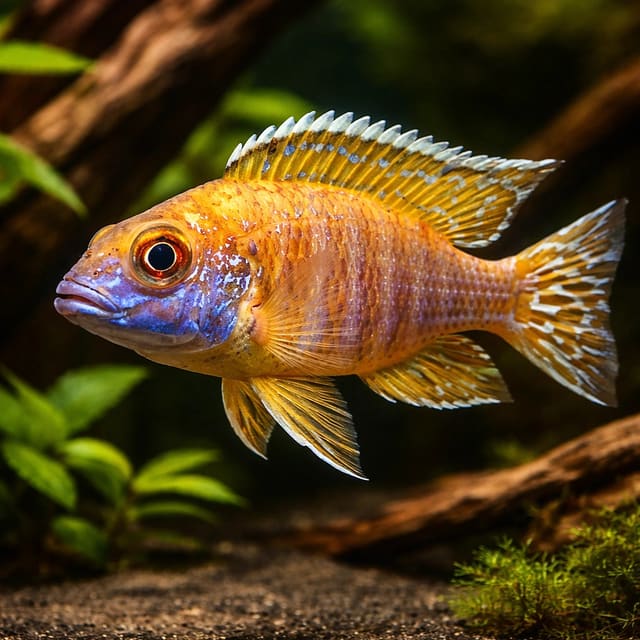
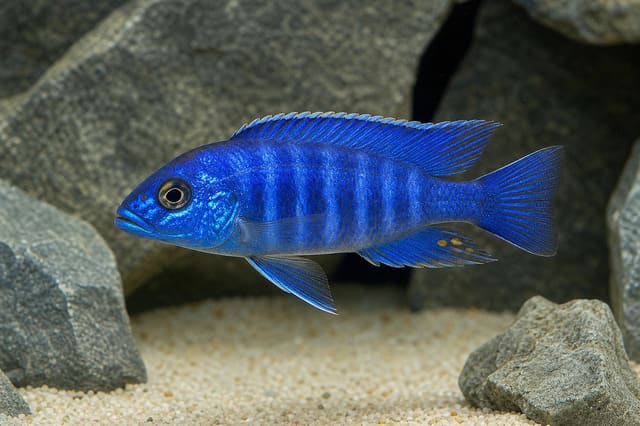
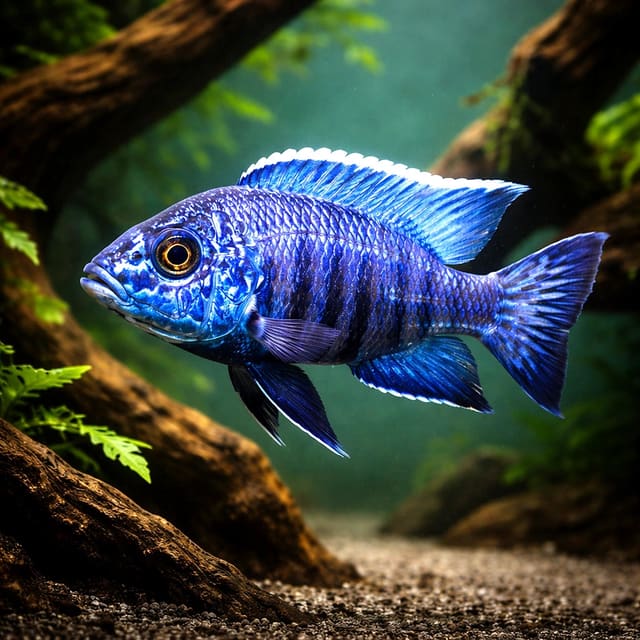
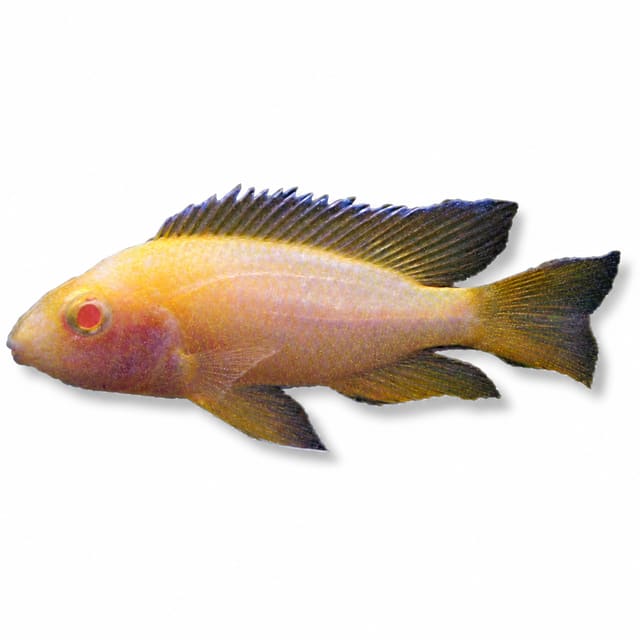
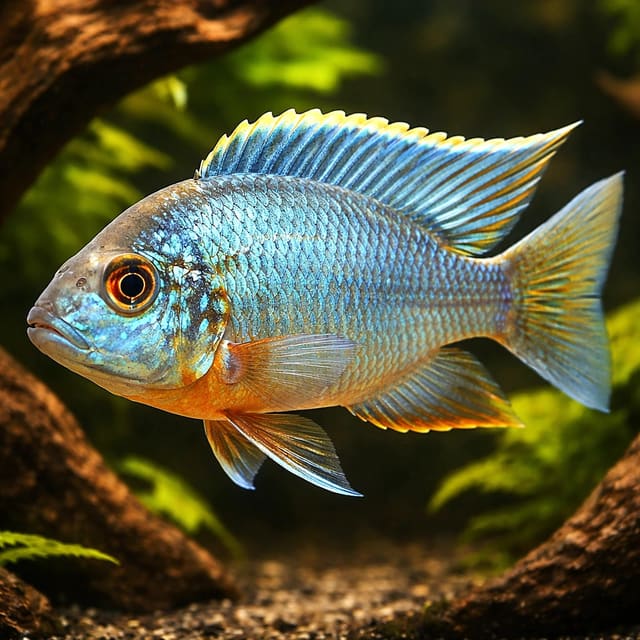
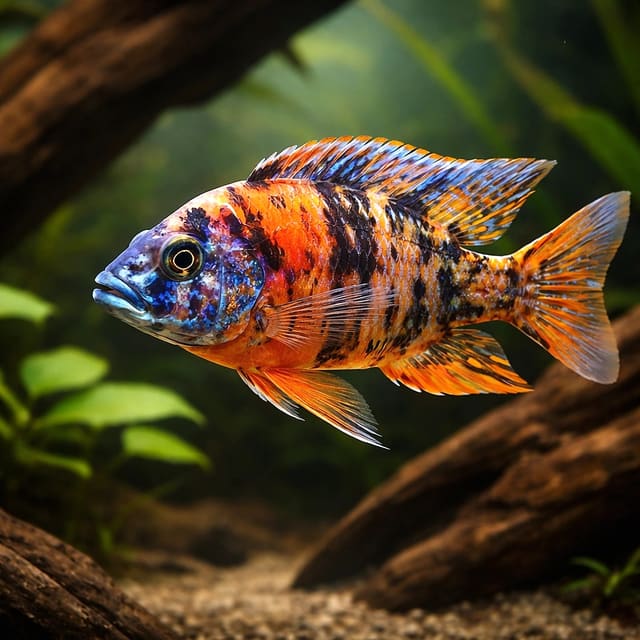
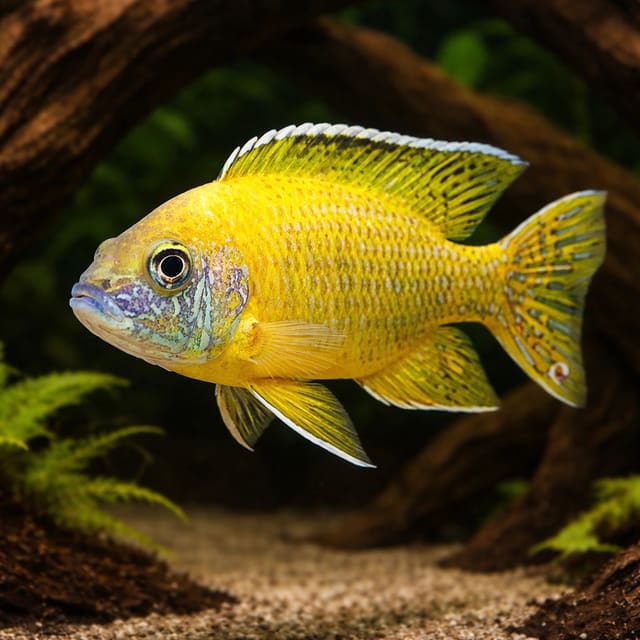
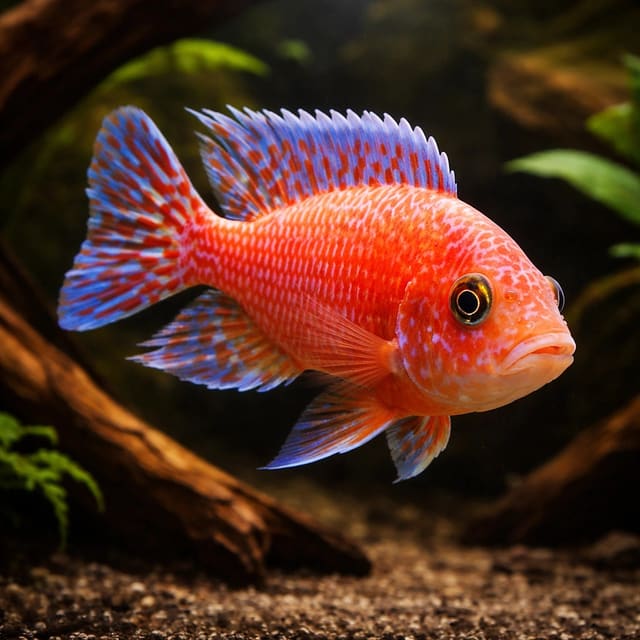
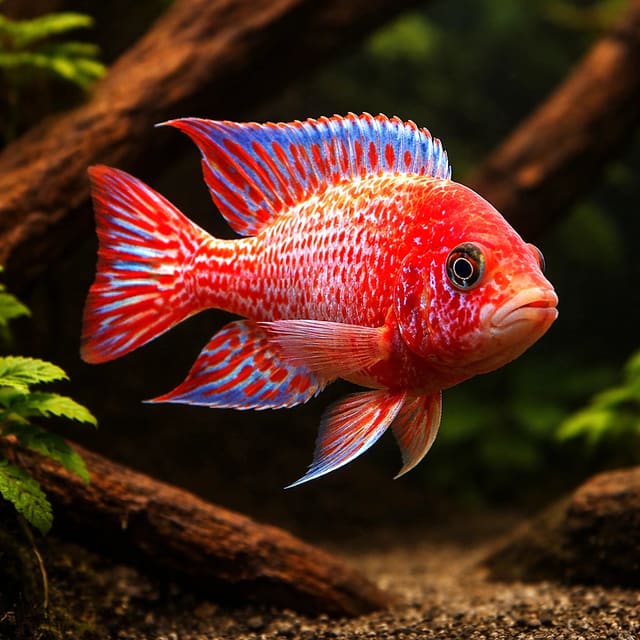
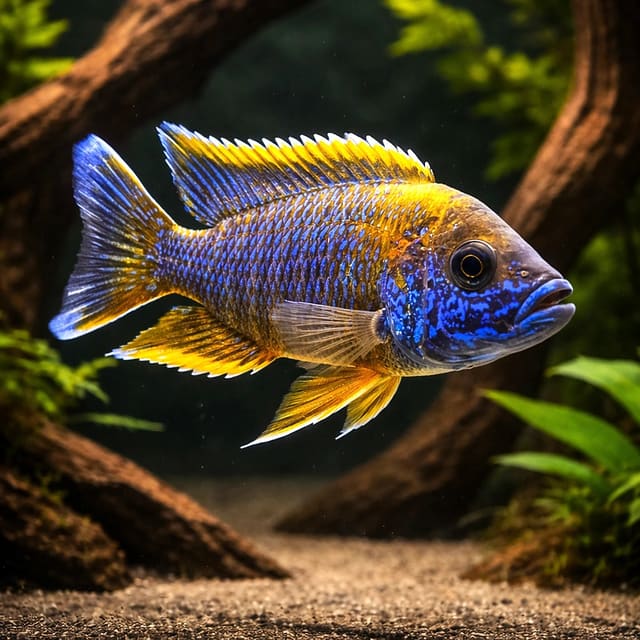
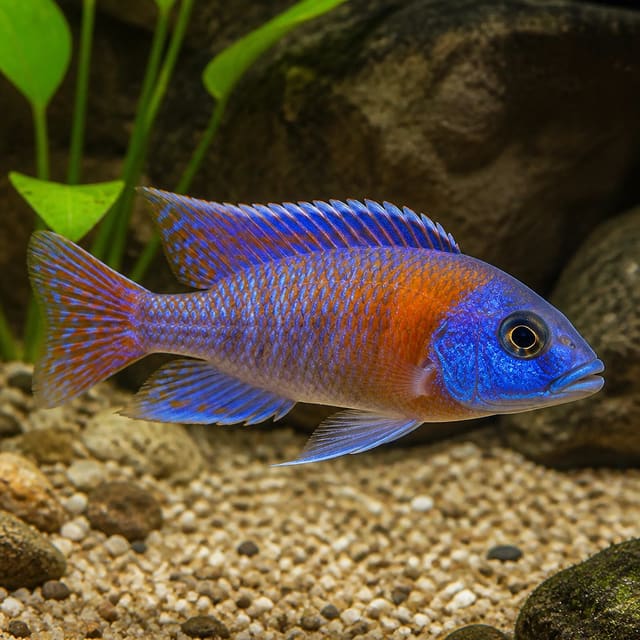
The picture on this listing shows a mixed group of adult-coloured peacocks in yellow, speckled red and orange with blue on the face. Read it as a guide to the range a mixed peacock group can reach once mature, not as a preview of the six fish in your box. Some of yours may finish in one of those looks; others may settle into blue, gold or something in between, and the females will stay quieter whatever the males do.
So who is this group for? It suits a keeper planning a Lake Malawi display who wants a busy, colourful centrepiece and is happy not to know the exact species behind each fish. It is the wrong buy if you want to breed a pure, named species, keep accurate records for a club or society, or sell on fry under a variety name. For that, start with fish sold under a species name, such as our Freiberg's Peacock Cichlid (Aulonocara jacobfreibergi) or Steveni Blue Neon Peacock Cichlid (Aulonocara stuartgranti). The next section explains why that difference matters more with peacocks than with most fish.
Peacocks carry a reputation in the hobby, and it is fairer to talk about it before you buy a mixed group than after. On several of its Aulonocara species pages, Seriously Fish advises against keeping other Aulonocara species in the same tank, giving the reason plainly: most of them are able to hybridise. Two different peacock species sharing an aquarium will often breed with each other, and the young carry a blend of both parents.
Decades of captive breeding have folded that willingness to cross into the trade. Seriously Fish records selectively bred ornamental forms of Aulonocara jacobfreibergi sold as ‘eureka’, ‘albino’ and ‘colour select’, and illustrates an adult male of an ornamental A. baenschi strain known as ‘red-orange’. Line breeding for colour is not the same thing as hybridising, but a strain kept beside other peacocks for generation after generation can pick up another species' genes without anyone noticing. Once that has happened, nobody can sort the descendants back into tidy species by looking at them.
The wild fish are not tidy either. Seriously Fish notes that A. baenschi, A. korneliae and A. hueseri were all once treated as forms of A. stuartgranti, and that some authors still regard A. hansbaenschi as a geographical variant of A. stuartgranti rather than a species of its own. A. stuartgranti alone is known from around twenty named local populations, and its males vary in colour by locality, with blue forms found mostly in the north of the lake and yellow forms in the south. When specialists still debate where one species ends and the next begins, naming an unlabelled juvenile from its colour is guesswork.
Here, then, is where we stand on this group. Every fish in it is an Aulonocara peacock, but any one of them may come from a wild-type species line, a line-bred ornamental form or a cross between peacocks. That is exactly why we sell them as assorted and never attach a species name to an individual fish. If you breed from them later, please describe the youngsters the same way, as mixed or hybrid peacocks, rather than under a species name.
That request is not fussiness. Wikipedia lists Aulonocara baenschi, the Nkhomo-benga peacock, as Critically Endangered, and names capture for the aquarium trade as the main threat. Pure, properly labelled captive lines are part of what keeps fish like that available without more collecting from the lake. Mixed fry passed off under a species name quietly undo that work, even when nobody means any harm. If you would like a single named species instead, our Benga Peacock Cichlid (Aulonocara baenschi) listing is the place to look.
Most peacocks are neither open-water fish nor pure rock-dwellers in the way the mbuna are. Seriously Fish describes the typical home of A. stuartgranti and A. baenschi as the intermediate zone, where rocky shores give way to open expanses of sand with scattered rocks. For A. baenschi it gives a usual depth of 4–6 metres, with a recorded depth of 16 metres; Wikipedia gives 2–6 metres for the same fish. FishBase records A. stuartgranti along the entire coast between Ngara and Chizi Point, and Seriously Fish lists it from both the eastern and western shores.
Within that general picture there is plenty of variation. FishBase notes that northern populations of A. jacobfreibergi live among pure rock and large boulders, while southern populations use intermediate habitats in which males occupy small caves. For A. stuartgranti it records that some individuals in a population are very shy and stay hidden in caves, while others form large schools over sand. A mixed group in your tank may well show both temperaments, with one fish living under a rock and another cruising the open floor.
The way peacocks feed explains a lot about how they should be kept. FishBase lists sand-dwelling invertebrates as the main food of A. stuartgranti. Seriously Fish calls the genus benthophagous: the fish take mouthfuls of substrate and sift them for anything edible, and A. jacobfreibergi has enlarged sensory pores on the head that help it pick up the movements of prey hidden in the sand. You will see the aquarium version of this every day. A peacock hovers just above the sand, dips to take a mouthful, sifts it and lets the grains fall away again.
Translate the lake into glass and you get a clear brief: a broad floor of fine sand for that hunting behaviour, rock piles with caves at the edges of the sand for shy fish and territorial males, and open water above for cruising. Wikipedia adds that peacocks do best in warm water with a slightly basic pH, which brings us to tank size and water chemistry.
Because this is a mixed group, no single adult size covers every fish. The table below sets out what the main sources record for four commonly kept species. It is there to help you plan for the larger end, not to suggest your fish will all reach the top figure. Standard length (SL) runs from snout to the base of the tail and leaves the tail fin out; total length (TL) includes it. The two sources do not agree perfectly, so plan for males of roughly 12–15 cm, with the biggest peacocks capable of more.
| Species | FishBase maximum | Seriously Fish maximum | Seriously Fish minimum tank |
|---|---|---|---|
| A. stuartgranti | 11.8 cm TL | 13 cm SL | 120 × 45 cm base, about 243 litres |
| A. baenschi | see Seriously Fish | males 12 cm SL, females 9 cm SL | 120 × 45 cm base, about 243 litres |
| A. hansbaenschi | see Seriously Fish | 12 cm SL | 90 × 45 cm base, about 182 litres |
| A. jacobfreibergi | 15 cm TL | 17 cm SL | 120 × 60 cm base, about 432 litres |
For six peacocks of unknown species and unknown sex, we would treat a tank of 120 cm in length and roughly 240 litres as the sensible floor for the adult group, and go bigger if you can. OATA, the UK ornamental fish trade association, recommends at least 200 litres for a community of Malawi cichlids and advises buying a tank as large as you reasonably can. Length counts for more than height with these fish, because a male peacock claims ground along the floor rather than up the glass, and a longer tank gives a second or third male somewhere to be that is out of the first one's patch.
At 3–4 cm your six will look lost in a tank that size for a while, and that is fine. Setting up the adult tank from the start means the group grows into one stable home rather than being moved just as the males begin to colour and stake out territories, which is the moment you least want to disturb them.
| Item | Why it matters for this group |
|---|---|
| Tank of 120 cm or longer, about 240 litres or more | Room for adult males of 12–15 cm to hold separate territories |
| Heater sized for the volume | Holds the water at 24–27°C all year |
| Filter rated above the tank volume, plus aeration | OATA calls for an oversized filter and vigorous aeration in Malawi tanks |
| Fine sand, coral sand or a mix | Lets peacocks sift for food and helps buffer pH |
| Rock for several cave piles | Breaks sight lines and gives each male and any shy fish a retreat |
| Test kit for ammonia, nitrite, nitrate, pH, GH and KH | Weekly testing is part of OATA's routine for Malawi cichlids |
| Fine sinking granules and small frozen foods | Sized for 3–4 cm juveniles, moving up to pellets as they grow |
Lake Malawi peacocks need hard, alkaline water, and they need it to stay that way. The sources give slightly different ranges, as the table shows, but they agree on the direction: warm, mineral-rich water well above neutral pH.
| Source | Temperature | pH | Hardness |
|---|---|---|---|
| FishBase, A. stuartgranti | 22–26°C | not given | not given |
| FishBase, A. jacobfreibergi | 24–26°C | 7.5–8.0 | 9–19 dH |
| Seriously Fish, several species | 23–29°C | 7.4–9.0 | 10–25 dGH |
| OATA, Malawi cichlids | 23–27°C | 8.0–8.6 | 12–18 dGH, KH 10–15 dKH |
Where those overlap gives a comfortable working range for a mixed peacock group: 24–27°C, pH 7.5–8.6 and general hardness of about 10–20 dGH. Steadiness matters more than hitting a precise number. A tank that sits at pH 8.0 every week is far better than one that swings between 7.2 and 8.4 because the buffering runs out between water changes. Tap water varies a great deal from one part of the country to another, so test yours before you set up rather than assuming. If it is soft, a coral sand substrate or a Malawi buffer will be needed to hold the pH and carbonate hardness where peacocks want them.
OATA's Malawi care sheet sets the targets for waste: ammonia and nitrite at zero, and nitrate no more than 20 mg/l above the level in your tap water. To keep there, it recommends:
A heater is needed all year round. OATA also suggests placing the tank away from draughts, radiators, direct sunlight and loud noise, all of which make temperature and nerves harder to keep steady.
Two hardness figures matter, and they do different jobs. General hardness (GH) measures dissolved calcium and magnesium, the minerals peacocks are used to living in. Carbonate hardness (KH) measures the carbonates that act as a buffer, holding pH steady between water changes. A tank can show a decent GH but a low KH, and that is the tank whose pH drifts downwards over a week as the fish produce waste. OATA's figure of 10–15 dKH is the one to watch: if your KH test reads well below that, the buffer is too thin and the pH will not stay put. Test both before the fish arrive, write the numbers down, and test again at the same point in the week so you are comparing like with like.
The tank must be fully cycled before the six arrive. A new filter cannot cope with the waste from a group of growing cichlids that eat well, so allow the time to mature the filter and confirm zero ammonia and zero nitrite on your test kit first.
In the lake, peacocks are hunters of small animals in the sand rather than algae grazers. FishBase lists sand-dwelling invertebrates as the main diet of A. stuartgranti, and Wikipedia describes A. baenschi as carnivorous, hunting small invertebrates in the sand while readily taking frozen, flake and pellet foods in captivity, with a liking for bloodworm and brine shrimp.
Seriously Fish recommends a diet built on high-quality, fine-grade prepared foods, backed up with small live or frozen foods such as chironomid larvae (bloodworm), Tubifex, Artemia (brine shrimp) and mosquito larvae. It also advises including some vegetable matter, such as foods containing Spirulina, so the diet is not purely meaty.
Seriously Fish suggests three or four small portions a day rather than one large meal. OATA's general guidance for Malawi cichlids is to feed twice a day, giving only what the fish clear within a few minutes. Both point the same way: small amounts, eaten quickly, with nothing left to rot in the sand. A sand-sifting fish will find leftovers eventually, but uneaten food that sinks into the substrate becomes a nitrate problem long before it becomes a meal.
For 3–4 cm juveniles, choose a small sinking or slow-sinking granule they can actually swallow, and crumble anything larger. As they grow, move up to a cichlid pellet sized to their mouths. Use frozen bloodworm, brine shrimp and similar foods as part of a varied week rather than the whole menu.
OATA points out that the smaller mbuna are largely herbivorous and do best on Malawi foods high in algae with fresh vegetables, while the larger open-water utaka may need pellets with more animal content plus frozen foods such as brine shrimp. Peacocks are neither, but their meaty natural diet puts them much closer to the second group. If you keep peacocks with mbuna, you are feeding two different kinds of fish. A good-quality Malawi pellet that includes both animal protein and plant matter is a workable compromise, with frozen foods aimed at the peacocks and vegetable foods at the mbuna. Watch that the faster mbuna do not take every meal before the peacocks have finished hovering over the sand.
Peacocks are keen feeders, and a healthy group will come to the front at feeding time once settled. A fish that hangs back or loses its appetite for more than a day or two deserves a closer look and a water test.
Seriously Fish notes that young peacocks usually become sexable at around four months old. Before that, most look much the same. As they mature, the differences pile up: males grow larger (Seriously Fish gives about 12 cm SL for male A. baenschi against about 9 cm for females), males colour up, and Wikipedia notes that males carry egg-like spots on the anal fin that play a part in spawning. Females stay smaller and plainer.
The standard advice for a single species is clear. Seriously Fish recommends, in all but the largest aquaria, keeping just one male with four to six females, because males are territorial and can be aggressive towards fish of a similar colour pattern. Six juveniles of unknown sex will not follow that recipe on their own. The split is chance. You might end up with two males and four females, or four males and two females, and there is no way to know at 3–4 cm.
Go in with a plan rather than hoping for the best:
A peacock that is struggling with a bully tends to give itself away. It spends its time hiding and shows several of the warning signs OATA lists for Malawi cichlids: clamped fins, faded colour, reduced feeding, and damaged fins or missing scales. One fish behaving like that while another repeatedly chases it is a sign to change something: rearrange the rockwork to reset territories, add more cover or remove the most aggressive male.
If you want to add more fish to even up the numbers later, our single Assorted Peacock Cichlids (Aulonocara mix) listing offers the same kind of mixed fish one at a time. Bear in mind that it is assorted too, so sexes are just as uncertain.
Wikipedia describes peacocks as less aggressive than mbuna and best kept with other medium-sized, non-aggressive cichlids from Lake Malawi. That is the heart of good stocking: share the water chemistry, match the temperament and keep the size roughly even.
Fish that need soft or acidic water do not belong in a peacock tank, however peaceful they are, because the water that suits one will stress the other. Boisterous, aggressive mbuna are a poor match for peacocks, which hunt slowly over the sand and can be pushed off their food and out of their territories. Very small fish are a risk too: peacocks are hunters of small animals, and anything that fits in an adult's mouth may be treated as prey.
Other Aulonocara deserve a word. In a group like this, which is already mixed, adding more assorted peacocks changes little. If you also keep a pure, named peacock species and want to breed it true, keep it in a separate tank from this group, because most peacocks can hybridise.
OATA recommends adding peaceful species first and more aggressive ones later, and adding fish in groups rather than singly so no newcomer arrives alone into settled territories. Since peacocks are among the calmer Malawi cichlids, that makes them a sensible group to put in first when stocking a new Malawi tank. Rearranging a little rockwork when new fish go in can also help, since it breaks up territories that have already been claimed.
Wikipedia states that all Aulonocara species are maternal mouthbrooders, and the species pages on Seriously Fish describe a sequence that peacock keepers come to recognise. A coloured male sets up a spawning site on a rock or a patch of sand and displays to passing females. The female lays her eggs and gathers them into her mouth. The egg-like spots on the male's anal fin play a part in fertilisation: Seriously Fish describes the female taking in the male's milt from around those spots once she has picked up the eggs.
She then carries the brood in her mouth. Seriously Fish and Wikipedia both give a holding time of up to about four weeks, after which she releases fully free-swimming fry. FishBase records broods of up to 50 eggs for A. jacobfreibergi.
Seriously Fish recommends a ratio of at least one male to four females, which spreads the male's attention and reduces harassment of any one female. A holding female needs peace and cover. If you want to raise fry, a quiet separate tank gives them the best chance, because a busy Malawi tank offers newly released youngsters very few safe places. Seriously Fish notes that fry may still have some yolk sac left when released and need no food until it has gone; once it has, newly hatched Artemia nauplii or a similar fine food can be offered straight away.
Here is where the mixed nature of this group matters most. Fry from six assorted peacocks may be the offspring of two different species, a species and an ornamental strain, or fish that were already crosses. Nobody can tell which by looking. They can make fine, colourful fish for your own tank, but please do not sell or give them away under a species name. Call them what they are, mixed or hybrid peacocks, so the next keeper knows what they have.
If breeding a pure line is your main aim, start again with a single named species, ideally one male with several females, kept in its own tank.
OATA's description of a healthy Malawi cichlid is a good checklist to run through every day as you feed: clear, bright eyes; undamaged fins; intact scales; no ulcers or lumps; normal swimming; and steady breathing. Healthy peacocks are curious and come forward when food goes in.
The same care sheet lists the signs that something is wrong: clamped fins, flicking or rubbing against the sand or rocks, shimmying on the spot, changes in colour, white spots, fluffy growths, damaged fins or scales, weight loss or gain, and a fish going off its food. In a Malawi tank, water quality and bullying are the first two things to rule out, so test the water and then watch who is chasing whom before reaching for a treatment.
Please read the delivery and live-arrival information on our delivery page before ordering. The aquarium needs to be ready before the parcel arrives: filter running and matured, water tested, and the temperature matched to the range above. Someone must be at the delivery address to receive live animals. We send the confirmed delivery date and tracking details by email.
The six travel in oxygen-filled bags inside insulated packaging, with heat packs when conditions call for them, carried by a tracked courier licensed to carry live animals.
Start a continuous unboxing video while the parcel is still sealed, then open it in the same take and show the fish in their still-sealed bag. If a fish arrives dead, dying or clearly in poor condition, email hello@tropicalfishco.co.uk on the day of delivery with your order number and that video. Photos on their own do not meet the policy. Where a claim is accepted, the resolution is a replacement with your next order or a refund for the affected fish, subject to the guarantee terms.
Over the first week, watch breathing, appetite and behaviour. Offer a small feed the following day and build up gradually. If the six are going into a tank that already holds fish, the advice in the tank mates section about adding fish in groups and loosening up claimed territories applies here too.
These are the sources used for this guide. They are well worth reading in full if you are planning a peacock tank:
No reviews for this item yet. Bought one? Honest reviews only, good or bad.
What customers say about ordering from us
I have a small group of long finned mountain minnows. So was delighted to be able to order ten of this variety to increase the genetics in my tank . The ones I recieved are healthy but it’s to early to give a verdict on wether they are of a long finned type since they are small currently.
Gordon Walker · 23 Sept 2026
100% success travel and "installation". Pleased with quality of purchase. The Siamese fighter a bit "shy" so have not yet seen him at his best yet but looking good. Happy customer. GG
George E Garratt · 21 Sept 2026
Reviews of our shop, collected by Judge.me, an independent third-party review collector. Newest first.