−11%
Moderate
Calico Peacock Cichlid (Aulonocara sp. calico)
24–28°C · pH 7.5–8.5 · 200L
£17.79£19.99
The Steveni Blue Neon Peacock Cichlid (Aulonocara stuartgranti) is a cichlid endemic to Lake Malawi that reaches 11.8 cm. It suits mature aquariums of about 243 litres with a 120 × 45 cm base; the FishBase, Seriously Fish and OATA overlap is 23–26°C, pH 8.0–8.6 and 12–18 dGH. Sold individually in sizes from 3–4 cm to 7–9 cm, plus XL.
Adult size is the maximum length this species reaches at full maturity (scientific sources). The livestock you receive will be younger and smaller — pick a size above for the actual shipping size. Product-photo provenance and any image-specific limitations are stated on the listing.
Aulonocara stuartgranti
Save when buying multiple fish. Each quantity is one fish; sex and pair formation are not guaranteed unless the selected variant explicitly states them.
The Steveni Blue Neon Peacock Cichlid (Aulonocara stuartgranti) is a cichlid endemic to Lake Malawi that reaches 11.8 cm. It suits mature aquariums of about 243 litres with a 120 × 45 cm base; the FishBase, Seriously Fish and OATA overlap is 23–26°C, pH 8.0–8.6 and 12–18 dGH. Sold individually in sizes from 3–4 cm to 7–9 cm, plus XL.
Adult size is the maximum length this species reaches at full maturity (scientific sources). The livestock you receive will be younger and smaller — pick a size above for the actual shipping size. Product-photo provenance and any image-specific limitations are stated on the listing.

Cichlids are a family of roughly 1,800 accepted species, not one care type. Before buying, identify the exact species and source, then compare adult measurement, usable tank dimensions, social system, territory, tested water, diet and an exit plan. No family-wide minimum tank, water range or tank-mate list is safe.
Maintain these water conditions for optimal health and vibrant colors
Steveni Blue Neon Peacock Cichlid is an aquarium trade identity for Aulonocara stuartgranti, a freshwater member of the cichlid family endemic to Lake Malawi that reaches 11.8 cm total length. FishBase places the species in Lake Malawi, where it occurs over sand and around caves. Wild individuals may hide in caves or form large schools over sand, and they feed on sand-dwelling invertebrates. It suits a keeper prepared to manage hard alkaline water, territorial behaviour and a substantial aquarium footprint.
That feeding biology should shape the aquarium. This is a sand-sifting peacock cichlid rather than a rock-grazing mbuna, so it needs fine substrate, open feeding space and carefully arranged rockwork.
| Suits | Not suited to |
|---|---|
| A mature hard-water aquarium with a 120 × 45 cm base | A biologically immature aquarium |
| A keeper prepared to manage territorial cichlid behaviour | A community containing the majority of excessively boisterous mbuna |
| Fine sand, open feeding space and arranged rockwork | Coarse gravel or small pebbles in the feeding area |
| A deliberately planned Malawi community | Mixing with other Aulonocara where hybridisation matters |
| Identity point | What it means |
|---|---|
| Scientific name | Aulonocara stuartgranti |
| Trade identity | Steveni Blue Neon Peacock Cichlid |
| Natural setting | Freshwater habitats in Lake Malawi |
| Wild feeding style | Searching sand for invertebrates |
| Temperament | Relatively peaceful for a Malawi cichlid, with territorial males |
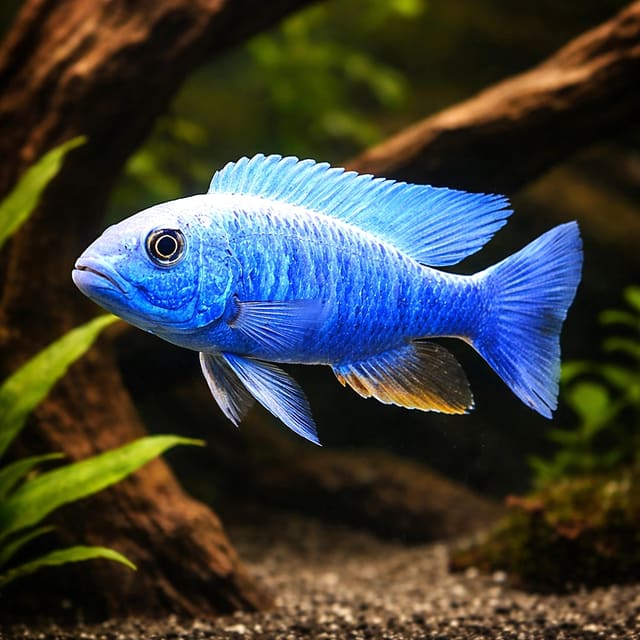
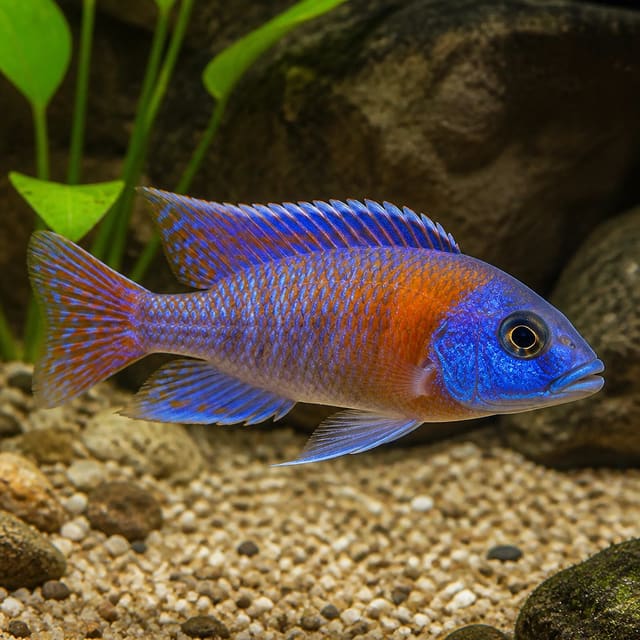
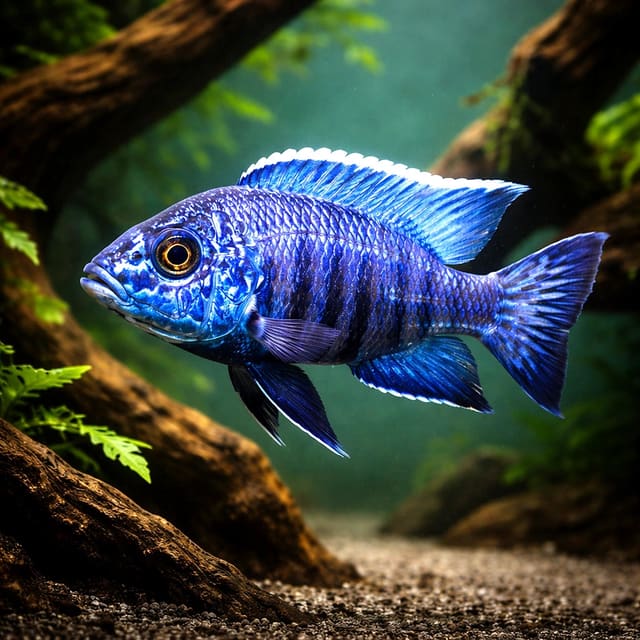
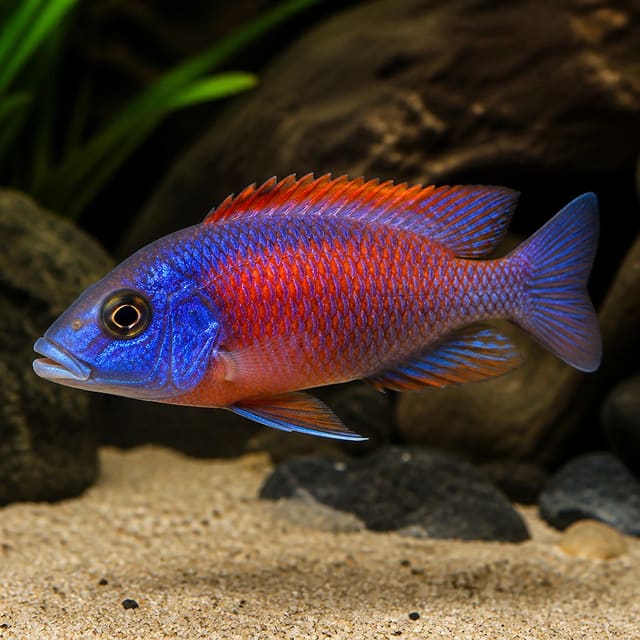
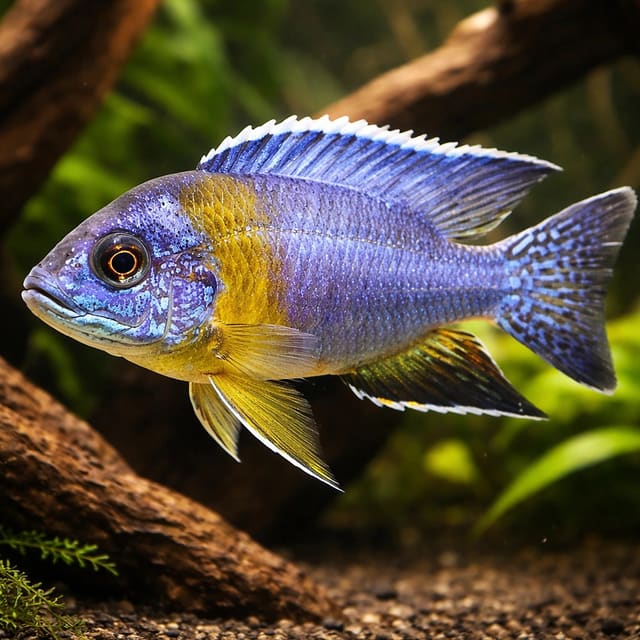
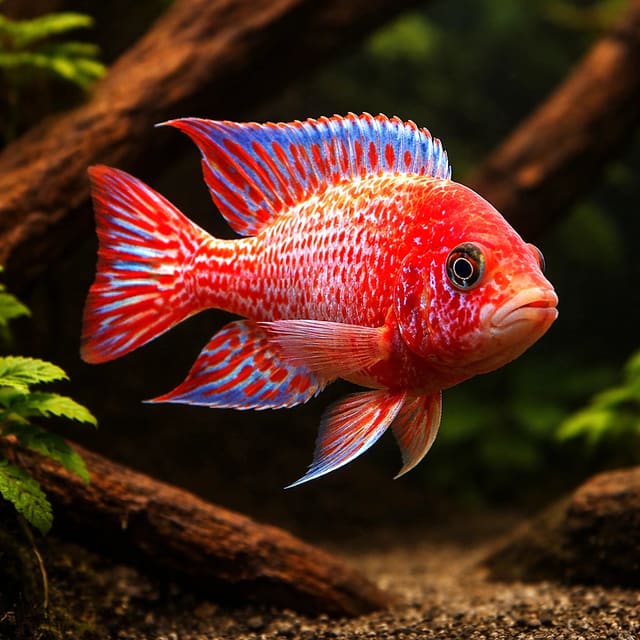
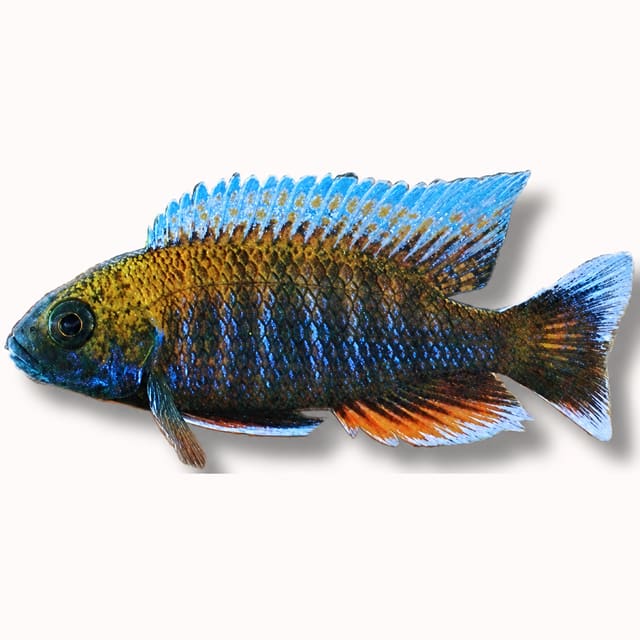
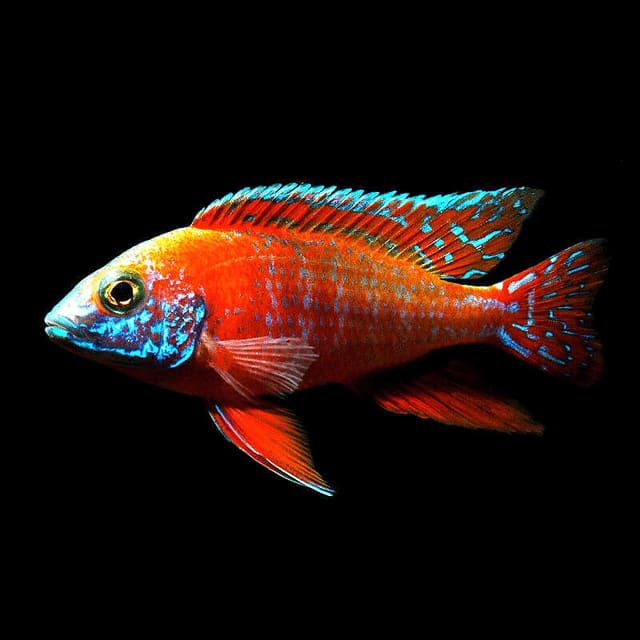
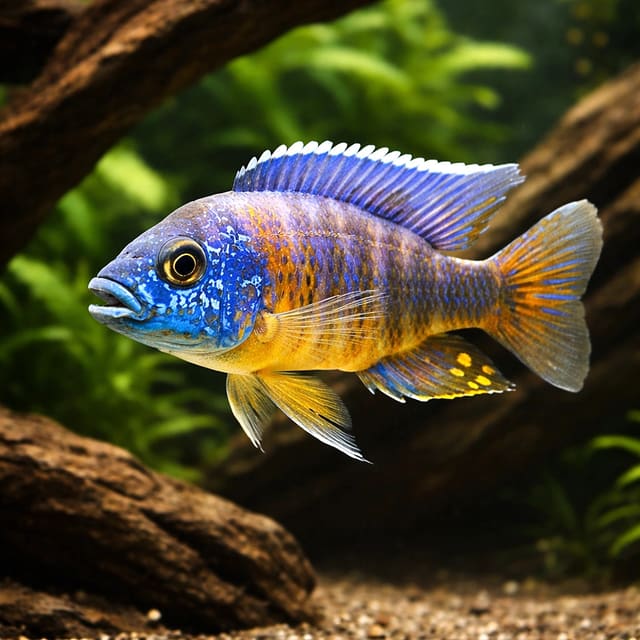
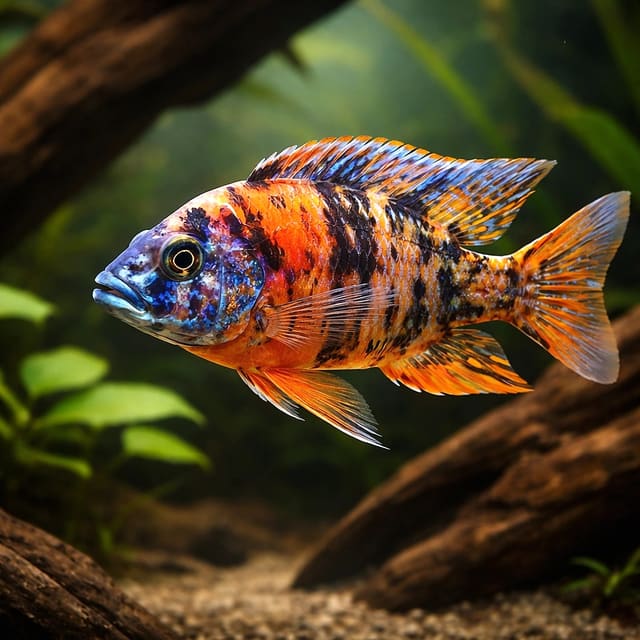
Males of this species occur in varied colour forms, and mature males are generally larger and more colourful than females. Choose this fish for its care requirements and adult behaviour rather than assuming a particular colour, sex or social role from a dispatch size or gallery scene.
One purchase supplies one animal in the size chosen from the live size selector. The size you select is the size supplied, not the adult size. Use the label to match a new fish to the physical size of an established community, but plan every choice around the full adult aquarium requirements.
| Size label | How to use it |
|---|---|
| 3 - 4 cm | A centimetre-based dispatch size for one fish |
| 4 - 5 cm | A larger centimetre-based dispatch size for one fish |
| 6-7 cm | A mid-sized dispatch choice to compare with existing residents |
| 7-9 cm | A larger dispatch choice for carefully matched communities |
| XL | A named dispatch size; adult planning remains unchanged |
Do not use size as a shortcut for sex, maturity or eventual colour. Sex is guaranteed only when the selected option explicitly states male or female. This Steveni Blue Neon Peacock Cichlid listing has no sex-guaranteed option.
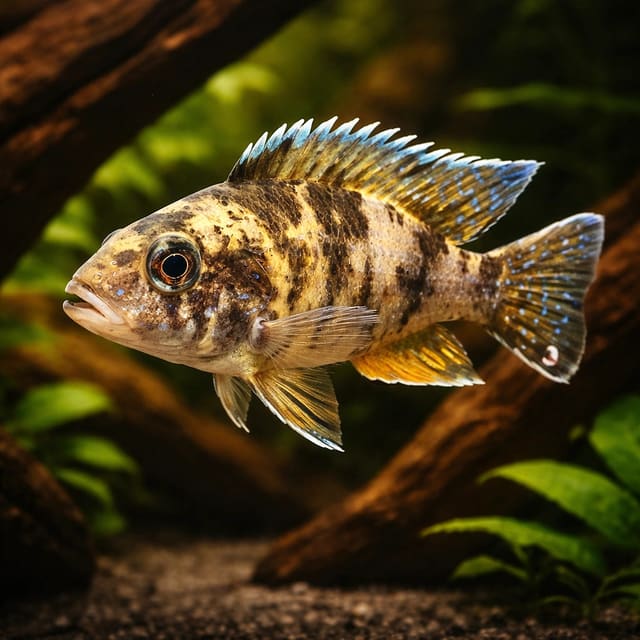
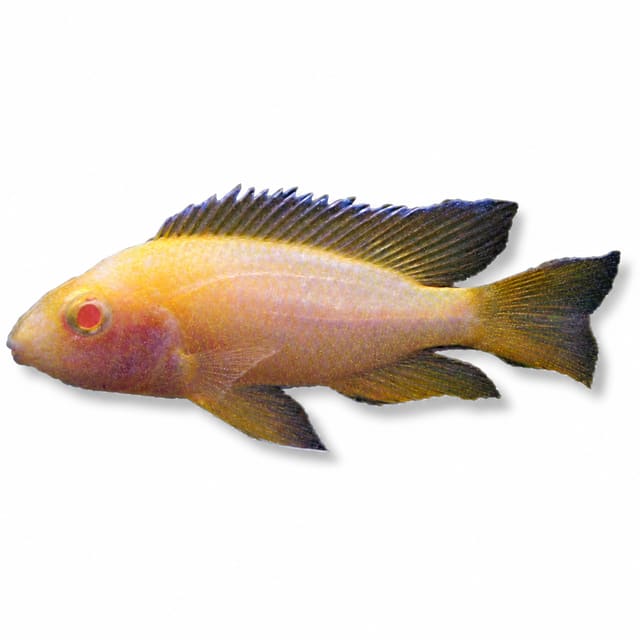
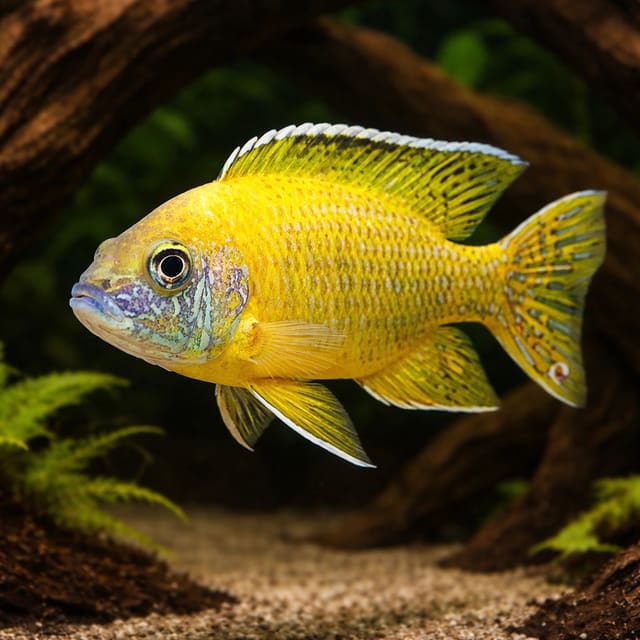
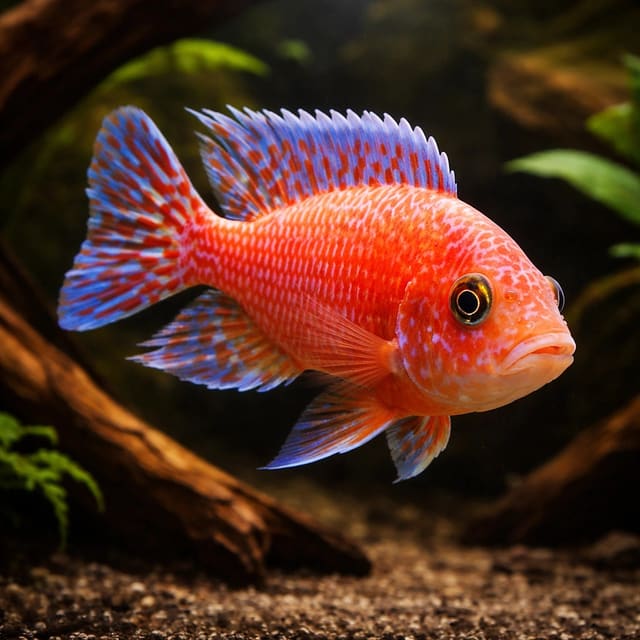
The gallery images are representative, based on reference photographs of this species, so colours can look slightly different from the live animal. The scenes are representative views for identifying the general peacock-cichlid form, not a way to select sex, markings or an individual fish.
FishBase records a maximum length of 11.8 cm total length for male or unsexed Aulonocara stuartgranti. Use that recorded maximum for identity data, while allowing enough room for the 13 cm standard-length planning reference used by the aquarium husbandry profile. A dispatch label never reduces the space required by the mature fish.
Seriously Fish recommends minimum base dimensions of at least 120 × 45 cm, or an equivalent footprint, with a volume of approximately 243 litres. Length and front-to-back space create feeding ground, territorial distance and routes around rockwork; extra height alone does not replace that footprint.
For water, the species profile gives 23–29°C, pH 7.5–9.0 and 10–25 dGH. OATA’s Malawi cichlid sheet gives 23–27°C, pH 8.0–8.6 and 12–18 dGH for the group. FishBase records 22–26°C for the wild environment, so the practical overlap is 23–26°C, pH 8.0–8.6 and 12–18 dGH.
| Decisive requirement | Planning figure |
|---|---|
| Recorded maximum length | 11.8 cm total length |
| Aquarium footprint | At least 120 × 45 cm or equivalent |
| Approximate volume | 243 litres |
| Routine temperature | 23–26°C |
| Routine pH | 8.0–8.6 |
| Routine general hardness | 12–18 dGH |
Prepare the aquarium before choosing a dispatch size. A biologically mature filter, stable chemistry and a compatible social plan are essential because this species is particularly susceptible to deteriorating water quality and swings in chemical parameters.
Use fine sand as the substrate and leave broad open areas between groups of rockwork. Aulonocara take substrate into the mouth, sift out edible items and expel the remainder through the mouth and gills. A smooth sand bed therefore supports a natural feeding action as well as creating the right visual setting.
Avoid coarse gravel and small pebbles in the feeding area. The species profile warns that coarse material can inhibit feeding, damage gill filaments or be swallowed, creating a risk of internal damage or blockage. Watch the fish while it feeds: it should be able to take and release substrate without struggling against oversized particles.
| Area | Purpose |
|---|---|
| Open fine sand | Allows searching, sifting and unobstructed movement |
| Rockwork groups | Provide caves, boundaries and places to leave direct view |
| Spaces between rocks | Keep movement routes open around claimed areas |
| Open water above sand | Supports the hovering and hunting behaviour described for the species |
Do not turn the entire base into a dense rock wall. This peacock needs open sand as well as caves, and a territorial individual should not be able to control every route through the aquarium from one position. When chasing begins, check whether the pursued fish can move out of sight and still reach food.
Plants may be used because the species does not tend to harm them, although any planting must suit hard alkaline water and leave the feeding area accessible. OATA notes that Malawi cichlids will often dig and rearrange the substrate, which will uproot plants, so treat plants as optional structure rather than the foundation of the layout.
Review the aquascape from the fish’s level before introduction. Open feeding patches, several routes through the rockwork and clear access to the water flow make the footprint more useful than decorative height or a single prominent cave.
Set the routine temperature to 23–26°C, pH to 8.0–8.6 and general hardness to 12–18 dGH. These targets are the overlap of FishBase, Seriously Fish and OATA’s Malawi-group guidance. Stability matters because rapid chemical swings and deteriorating water quality place this cichlid under avoidable stress.
Use the water chemistry guide to identify the measurements that need routine attention. Test the aquarium and replacement water rather than adding buffers by guesswork. If adjustment is necessary, build a repeatable method that prepares each water-change batch to closely match the aquarium.
| Measurement | Action |
|---|---|
| Temperature | Keep within 23–26°C and investigate unexpected movement |
| pH | Hold between 8.0 and 8.6 without abrupt correction |
| General hardness | Maintain 12–18 dGH |
| Carbonate hardness | Use OATA’s hard-water range of 10–15 dKH |
| Ammonia | Maintain 0 mg per litre |
| Nitrite | Maintain 0 mg per litre |
| Nitrate | Keep within 20 mg per litre above the normal tap-water level |
A worked check starts with the tap-water baseline. If tap water contains 10 mg per litre nitrate, OATA’s ceiling makes 30 mg per litre the upper planning point for the aquarium. Do not wait for that point before maintaining the tank; regular water changes and controlled feeding should prevent a continuing rise.
The water matcher can compare measured aquarium values with the stated routine ranges. Use the result as a preparation check, then keep testing after livestock is introduced because feeding and waste change the load on the filter.
At the warmer end of the range, pay particular attention to aeration. OATA recommends strong aeration for Malawi communities, while the species profile places high importance on water quality. Surface movement and unobstructed filter flow should keep oxygen moving throughout the aquarium without removing all quieter areas behind rockwork.
Introduce this fish only to a biologically mature aquarium. The RSPCA explains that a working biological filter supports bacteria that convert toxic ammonia first into toxic nitrite and then into safer nitrate. A clear-looking aquarium can still be dangerous when that bacterial population is too small for the waste load.
If this is your first setup, follow the first tropical aquarium maturation guide before livestock is introduced. Confirm 0 mg per litre ammonia and 0 mg per litre nitrite with tests; elapsed time alone is not a substitute for those readings.
For an aquarium of approximately 243 litres, the species profile uses four to five turnovers per hour as a planning reference. That gives a stated filter range of 970–1,215 litres per hour. Canister filters, a sump or a combination can provide the heavy filtration recommended for the species, but the water tests decide whether the complete system is coping.
| Routine | Supported action |
|---|---|
| Every day | Check flow, temperature, breathing, feeding response and behaviour |
| At least weekly | Test ammonia and nitrite |
| At least once a week | Change 25% of the water; the species profile recommends 30–50% weekly |
| During water changes | Treat replacement tap water for chlorine or chloramine |
| When flow falls | Check the filter for blockages |
| When media needs cleaning | Rinse it lightly in removed aquarium water, not under the tap |
Seriously Fish recommends weekly water changes of 30–50%, while OATA recommends a 25% partial change at least once a week. Choose the amount by watching measured nitrate, stocking and feeding. A larger change may remove more waste, but replacement water must be conditioned and closely matched to avoid the chemical swings this fish handles poorly.
For a 243-litre setup in a room around 20°C, the profile gives approximately 125–175 W across two heaters to hold its broader temperature range. Confirm the actual aquarium temperature with a thermometer and use the routine 23–26°C target rather than relying only on the heater dial.
Build the diet around the fish’s natural search for small invertebrates. In Lake Malawi, Aulonocara stuartgranti feeds on sand-dwelling invertebrates. In the aquarium it takes mouthfuls of substrate, sifts them for food and releases the remaining sand, so use foods that can be taken safely and do not bury the feeding area under waste.
Offer a variety of high-quality, fine-grade prepared foods. At least some dried food should contain a high proportion of vegetable matter such as Spirulina. Suitable animal-based additions named by the species profile include small live or frozen chironomid larvae, Tubifex, Artemia and mosquito larvae.
| Food role | Decision |
|---|---|
| Prepared staple | Use high-quality fine-grade food sized for the fish |
| Plant contribution | Include dried food containing a high proportion of vegetable matter |
| Small invertebrate variety | Rotate suitable live or frozen foods in controlled portions |
| Feeding frequency | Feed twice a day |
| Portion limit | Give only what can be eaten within a few minutes |
Use the twice-daily schedule from OATA’s Malawi guidance and make each meal small. If food remains after a few minutes, reduce the next portion. Uneaten food breaks down into waste, increasing the burden on the biological filter and working against the zero-ammonia and zero-nitrite requirement.
Place small portions in more than one accessible area when several cichlids are present. This gives a pursued fish another route to food and lets you see whether one individual is being excluded. The total amount must still remain within the few-minutes rule.
Watch body condition and interest in food rather than using colour as the feeding target. Reduced intake, lack of interest, weight loss, swelling or a change in waste should trigger water and social checks. Do not increase portions simply because a fish is less colourful than a gallery scene.
Before arrival, confirm that ammonia and nitrite are both 0 mg per litre, the aquarium is within 23–26°C and established residents are behaving normally. Adding livestock increases feeding and waste, so the beneficial bacterial population must be ready for the additional load.
Follow the current delivery and Live Arrival Guarantee policy when the parcel arrives. Someone must be present to receive live fish.
After release, observe swimming and breathing and watch the response of established fish. Increase a Malawi community slowly rather than making several large stocking changes close together. OATA warns that stocking too quickly can produce new tank syndrome when nitrifying bacteria cannot process the extra waste. Test ammonia and nitrite after a meaningful stocking change and act immediately if either rises above 0 mg per litre.
Compatibility begins during the first introduction. Add more peaceful species before more aggressive ones when building a community, and rearrange aquarium décor if established territories cause focused aggression. The aim is to make every fish find territory again rather than allowing one resident to defend every established route.
Normal cichlid display must not become relentless exclusion. If one animal is repeatedly cornered, cannot reach food or shows damaged fins, change the social arrangement rather than waiting for the pursued fish to adapt. A dispatch-size match helps, but individual behaviour after introduction remains decisive.
Learn the individual fish’s normal swimming, feeding, colour and use of cover. OATA recommends watching for changes in swimming behaviour, breathing, temperament, appearance, body condition and food intake. A change from that normal pattern is more useful than judging the animal against a single ideal pose or colour.
| Change you see | First action |
|---|---|
| Hanging at the surface | Check temperature, aeration, ammonia, nitrite and filter flow |
| Sitting on the bottom | Test water and compare posture with the fish’s normal behaviour |
| Erratic swimming | Check water quality and whether another fish is pursuing it |
| Faster or slower gill movement | Check oxygen, temperature, ammonia and nitrite promptly |
| More hiding than normal | Assess aggression, access to food and water quality |
| Reduced feeding | Test water and watch whether the fish can approach each meal |
| White spots or fluffy growths | Record the signs and seek health guidance |
| Loss of fins or scales | Check companions, rockwork and the pattern of chasing |
Start with measurements because ammonia, nitrite, temperature and oxygen problems can affect several behaviours at once. Correct a water-quality cause through appropriate maintenance rather than masking the warning sign with extra food or an unplanned chemical addition.
Social pressure needs a social response. Rearranging décor can interrupt territories, while persistent pursuit may require a different stocking arrangement. Males are territorial and may act aggressively towards fish with similar colour patterns, so note who begins each chase and whether the same fish is repeatedly targeted.
If abnormal signs continue after water and social checks, contact us for health guidance. Describe the measured temperature, pH, ammonia, nitrite and nitrate alongside the visible change. Those concrete observations make the next decision safer than choosing a disease treatment from colour loss or hiding alone.
The first month is a sequence of checks, not a deadline for full colour or a fixed social position. Concentrate on stable measurements, access to food and whether the fish can move through the aquarium without being continually displaced.
| Checkpoint | What to decide |
|---|---|
| Arrival day | Complete the 20–30 minute float, keep bag water out and check swimming and breathing |
| First 48 hours | Confirm that the fish can reach cover and is not being repeatedly cornered |
| Days 3–7 | Check feeding access, body condition, ammonia, nitrite, temperature and filter flow |
| End of week one | Complete the scheduled water change with conditioned replacement water |
| Weeks 2–4 | Assess whether territories, feeding distribution and companion choices remain workable |
At each feeding, look for participation rather than forcing a larger portion. Feed twice daily only what the fish can consume within a few minutes. If one resident monopolises the meal, distribute the same total portion across accessible areas and review whether the rockwork offers more than one route.
At the weekly test, ammonia and nitrite must remain at 0 mg per litre. Compare nitrate with the normal tap-water reading and keep it within 20 mg per litre above that baseline. A rise after introduction means the aquarium needs closer maintenance and a slower approach to any further stocking.
Review behaviour over several observations. Some wild populations include shy individuals that use caves, while others school over sand, so hiding by itself needs context. Hiding combined with rapid breathing, missed meals, torn fins or focused pursuit requires prompt action.
By the end of the month, the aquarium should demonstrate stable water, predictable feeding and a workable social pattern. Continue the same testing and maintenance rather than relaxing the routine once the fish appears settled.
Start with Lake Malawi fish that share hard alkaline water, then screen adult size, temperament, feeding access and hybridisation risk. OATA limits its broad compatibility recommendation to other Malawi cichlids or some species of Synodontis, but that category-level match is only the first filter.
| Companion screen | Decision rule |
|---|---|
| Other Aulonocara | Avoid because most can hybridise |
| Majority of mbuna | Avoid because their excessive boisterousness is unsuitable for this species |
| Similar-coloured males | Expect a higher aggression risk and avoid combinations that cause persistent conflict |
| Other Malawi cichlids | Proceed only when adult size, water needs and temperament align |
| Some Synodontis | Check the catfish species’ own space, group and care needs first |
| Non-Malawi community fish | Avoid mixing when water or social requirements do not match |
Seriously Fish describes this peacock as relatively peaceful but warns that males tend to act aggressively towards fish with a similar colour pattern. It also recommends avoiding other Aulonocara because most can hybridise. These are stronger screens than choosing companions simply because they carry the Malawi label.
No compatibility choice is automatic: individual behaviour can change as territories develop. Introduce carefully, observe access to food and shelter, and change the arrangement if one fish is persistently cornered or damaged.
When comparing possible residents, use the African cichlid collection to identify candidates, then read each animal’s adult size, water and social requirements separately. A shared collection is a browsing aid, not a recommendation to combine every fish shown.
Males are territorial, and the species profile recommends keeping a single male with 4–6 females unless the aquarium is very large. Use that as a deliberate adult social plan only when the sexes are known. Do not buy several size-selected fish and assume they will form the required ratio.
A single individual can be considered for a carefully screened Malawi community. Check that established residents share its water requirements, cannot swallow or continually overpower the selected dispatch size, and leave enough open sand for the new fish to feed.
OATA’s broad Malawi guidance discusses communities of at least 15 fish as one method of spreading aggression. That is a whole-community planning figure, not a purchase quantity for this species. The aquarium must still meet every resident’s adult footprint, filtration and compatibility requirements before such a community is attempted.
| Social choice | Required planning |
|---|---|
| Single individual | Use a compatible Malawi community and monitor territorial interactions |
| One male with females | Plan for 4–6 known females and enough room to escape pursuit |
| Multiple males | Use a very large aquarium and screen similar colour patterns carefully |
| Mixed peacock display | Avoid because other Aulonocara can hybridise |
| Larger Malawi community | Assess the complete adult bioload, footprint and filter capacity |
When adding Malawi cichlids, OATA recommends introducing them in groups so one newcomer is not the only target, adding more peaceful species first and rearranging décor to disrupt existing territories. Apply that sequence only after confirming that every animal is suitable for the aquarium.
Keep watching after the initial introduction. Persistent hiding, missed meals, torn fins or one fish being forced into a corner show that the social plan needs to change. Aquarium size helps, but usable routes, sight breaks and the temperaments of the individual fish decide whether the arrangement works.
It reaches a recorded maximum of 11.8 cm total length. Seriously Fish also uses 13 cm standard length as its aquarium-planning reference, so provide the full adult footprint from the start.
Use an aquarium with a base of at least 120 × 45 cm or equivalent and an approximate volume of 243 litres. Provide mature filtration, fine sand, open feeding space and rockwork with routes between territories.
A single individual can join a carefully screened Malawi community. When sexes are known, Seriously Fish recommends one male with 4–6 females unless the aquarium is very large; OATA’s figure of at least 15 applies to a complete Malawi community, not this species alone.
Aulonocara stuartgranti suits a keeper who can maintain a mature 243-litre hard-water aquarium, stable chemistry and a planned territorial community. It is not suitable for a biologically immature aquarium.
Offer high-quality fine-grade prepared foods, including dried food with a high proportion of vegetable matter, plus small live or frozen chironomid larvae, Tubifex, Artemia or mosquito larvae. Feed twice daily and only what it can eat within a few minutes.
The FishBase, Seriously Fish and OATA overlap is 23–26°C, pH 8.0–8.6 and 12–18 dGH. Keep ammonia and nitrite at 0 mg per litre and nitrate no more than 20 mg per litre above the normal tap-water level.
It is relatively peaceful for a Malawi cichlid, but males are territorial and may act aggressively towards fish with a similar colour pattern. Judge compatibility through territorial pursuit, feeding access and visible fin damage.
Screen other Lake Malawi cichlids by adult size, water needs and temperament, and check some Synodontis species individually. Avoid other Aulonocara because most can hybridise, and avoid the majority of mbuna because they are excessively boisterous.
Someone must be present to receive it. Film every delivery continuously from the sealed parcel as it is opened, showing the fish still inside the sealed bag; then float the bag for 20–30 minutes before release and never pour the bag water into the aquarium.
No reviews for this item yet. Bought one? Honest reviews only, good or bad.
What customers say about ordering from us
Easy website plenty of info on fish your buying great to pick a time slot
TRACEY DURRANT · 7 Oct 2026
Got some lovely fish thank you
Kevin Mackie · 7 Oct 2026
Reviews of our shop, collected by Judge.me, an independent third-party review collector. Newest first.