Moderate
Acei Cichlid (Pseudotropheus sp. “acei”)
24–26°C · pH 7.5–8.5 · 300L
£7.99

The Rubin Red Peacock Cichlid (Aulonocara sp. 'Rubin Red') is an unidentified peacock cichlid colour form from a genus endemic to Lake Malawi in East Africa. It suits keepers prepared to manage a Malawi community; OATA’s group guidance gives 23–27°C, pH 8.0–8.6 and planned groups of at least 15. Sold individually in 2 - 3 cm, 4 - 5 cm, 6-7 cm, 7-9 cm and XL sizes.
Aulonocara sp. 'Rubin Red'
Save when buying multiple fish. Each quantity is one fish; sex and pair formation are not guaranteed unless the selected variant explicitly states them.
The Rubin Red Peacock Cichlid (Aulonocara sp. 'Rubin Red') is an unidentified peacock cichlid colour form from a genus endemic to Lake Malawi in East Africa. It suits keepers prepared to manage a Malawi community; OATA’s group guidance gives 23–27°C, pH 8.0–8.6 and planned groups of at least 15. Sold individually in 2 - 3 cm, 4 - 5 cm, 6-7 cm, 7-9 cm and XL sizes.
Cichlids are a family of roughly 1,800 accepted species, not one care type. Before buying, identify the exact species and source, then compare adult measurement, usable tank dimensions, social system, territory, tested water, diet and an exit plan. No family-wide minimum tank, water range or tank-mate list is safe.
Maintain these water conditions for optimal health and vibrant colors
The Rubin Red Peacock Cichlid is a vividly coloured member of Aulonocara, the Lake Malawi cichlid genus commonly known in the aquarium hobby as peacock cichlids, aulonocaras or peacocks. The scientific label for this animal is Aulonocara sp. 'Rubin Red'. The abbreviation “sp.” matters because Rubin Red names a colour form within the genus rather than identifying a particular species.
The exact species has not been identified, so the care advice here follows the genus Aulonocara and its care group. Plan for a Lake Malawi Aulonocara; do not apply the distribution, adult length or specialised behaviour of a named species.
The World Register of Marine Species recognises Aulonocara as a genus in the cichlid family, Cichlidae. Wikipedia describes Aulonocara as haplochromine cichlids endemic to Lake Malawi in East Africa. The familiar trade word “peacock” therefore fits the genus, while Rubin Red distinguishes this aquarium colour form.
Aulonocara are strongly sexually dichromic as a genus, meaning adult colour can differ between the sexes. That biological pattern does not determine the sex or eventual colour of an individual selected from this offer. Choose the fish for the aquarium conditions and social plan it needs rather than treating the gallery colour as a promise about the individual supplied.
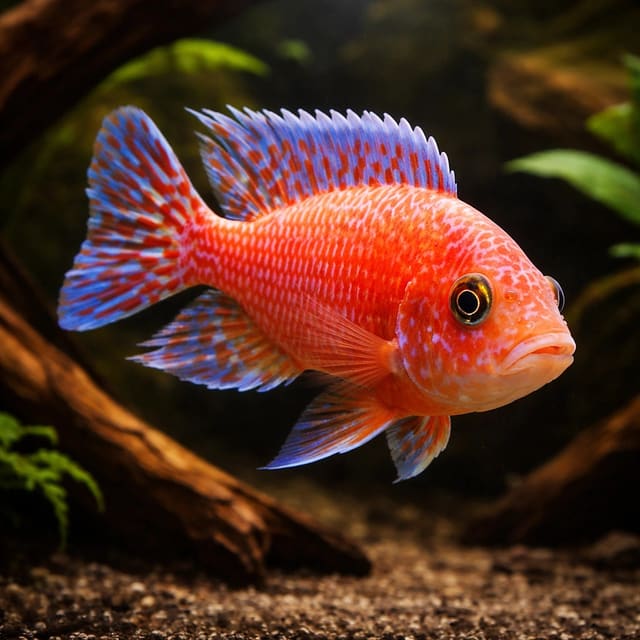
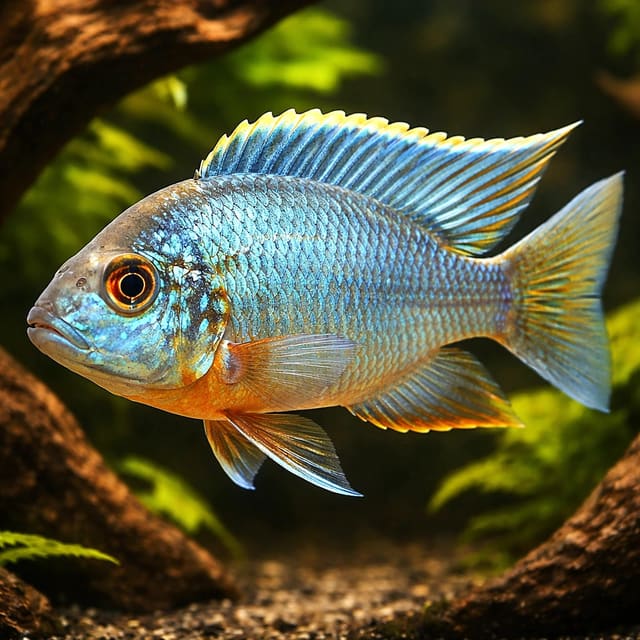
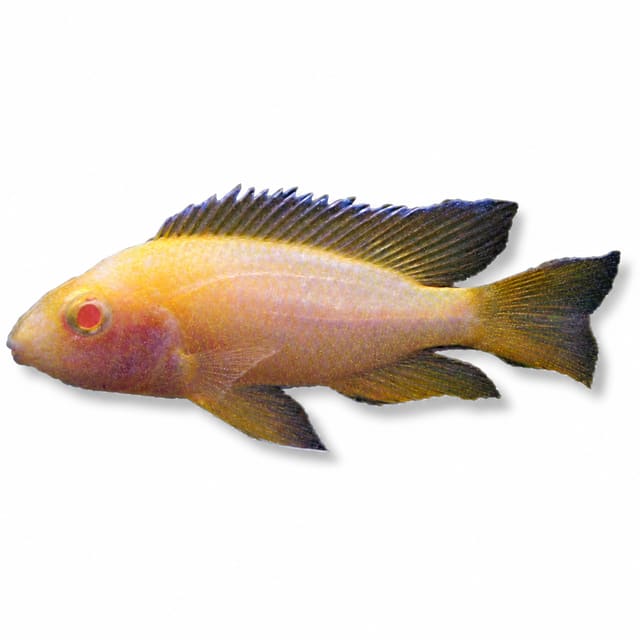
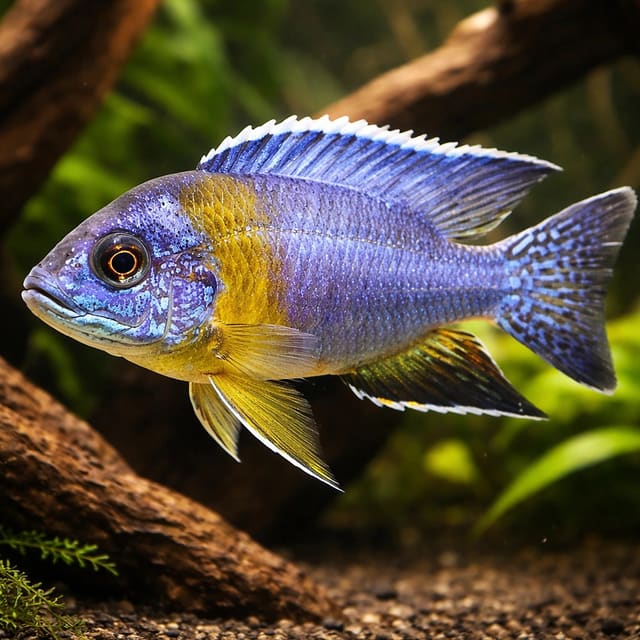
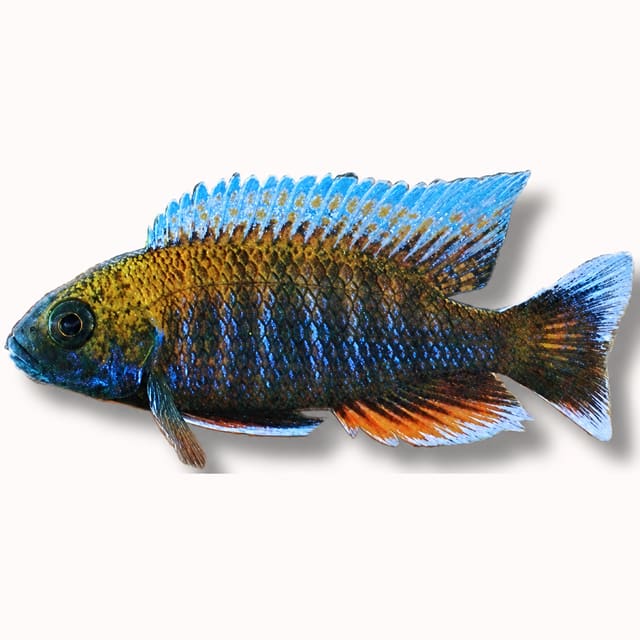
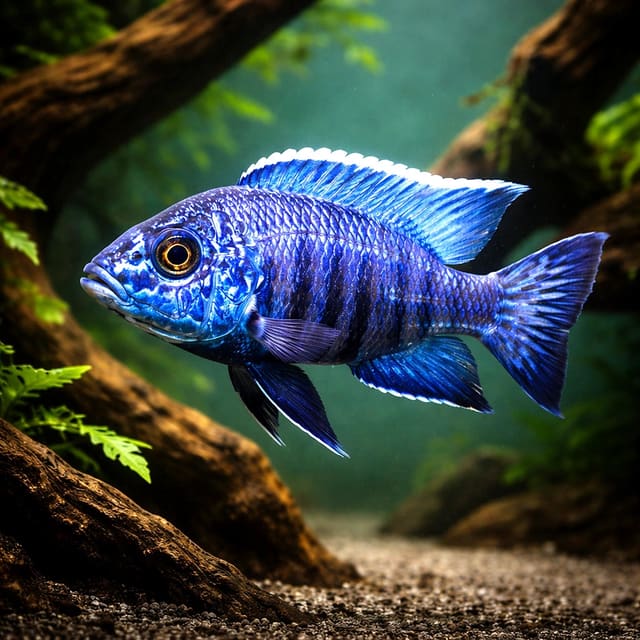
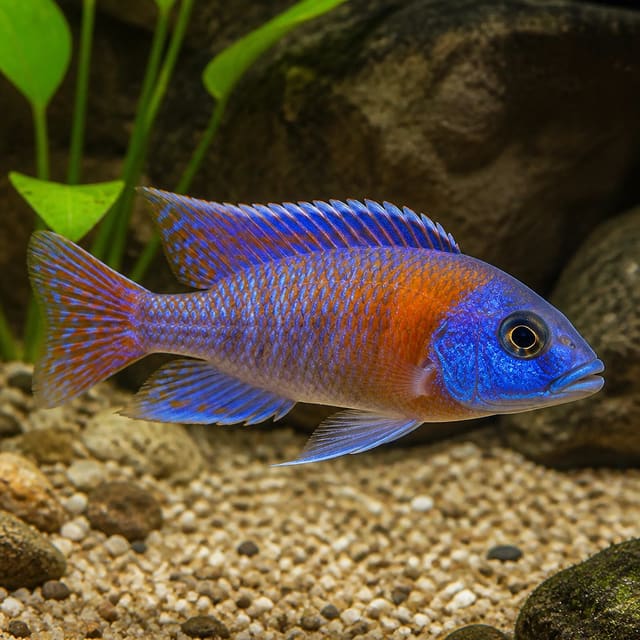
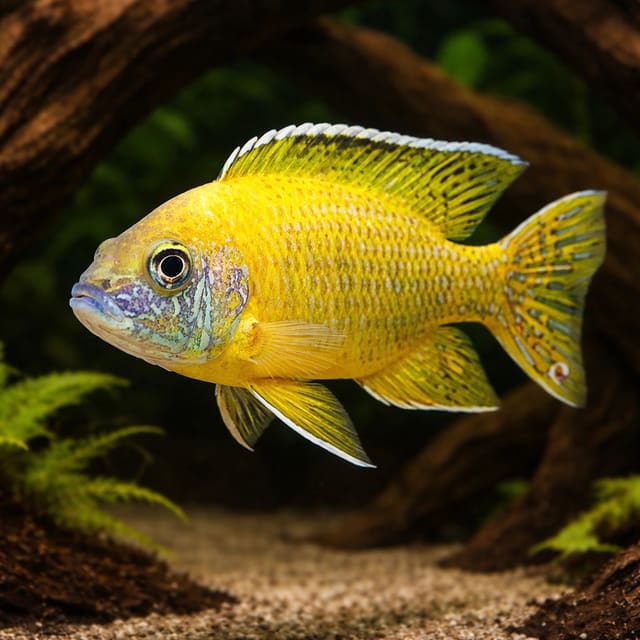
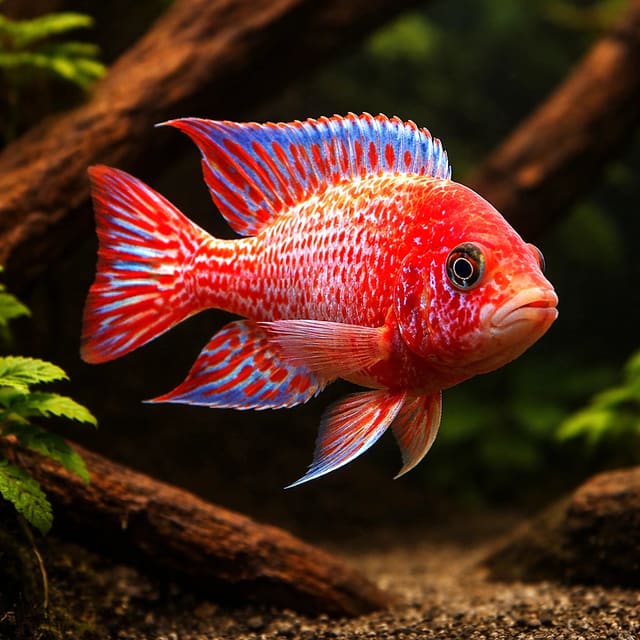
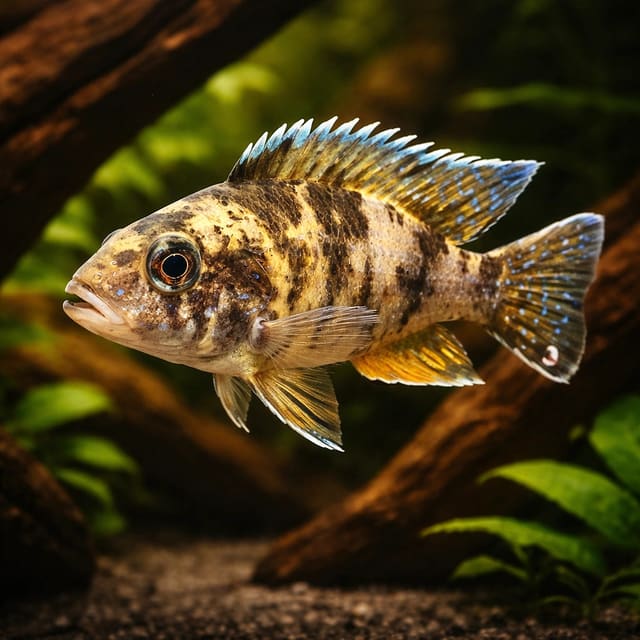
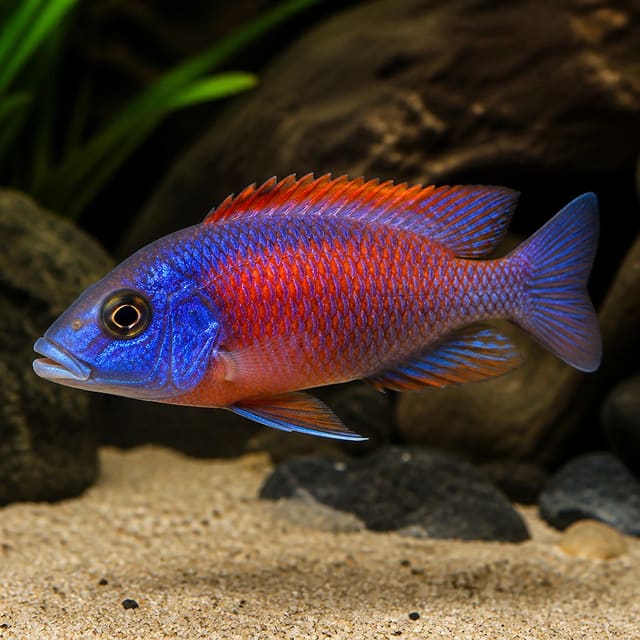
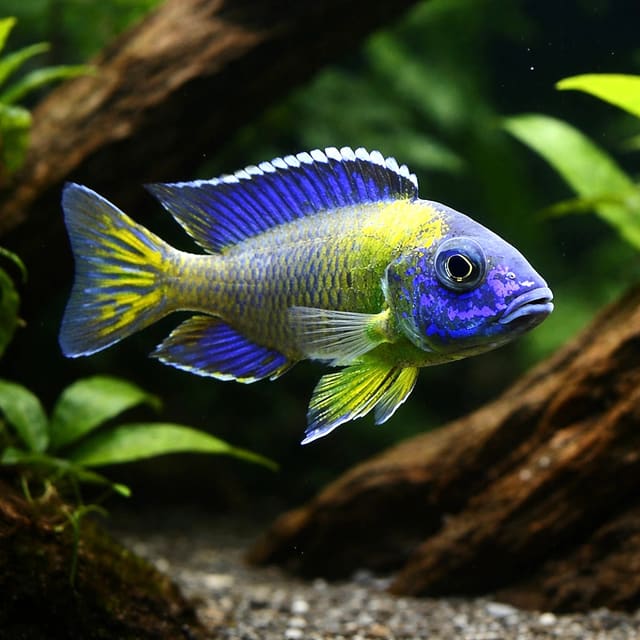
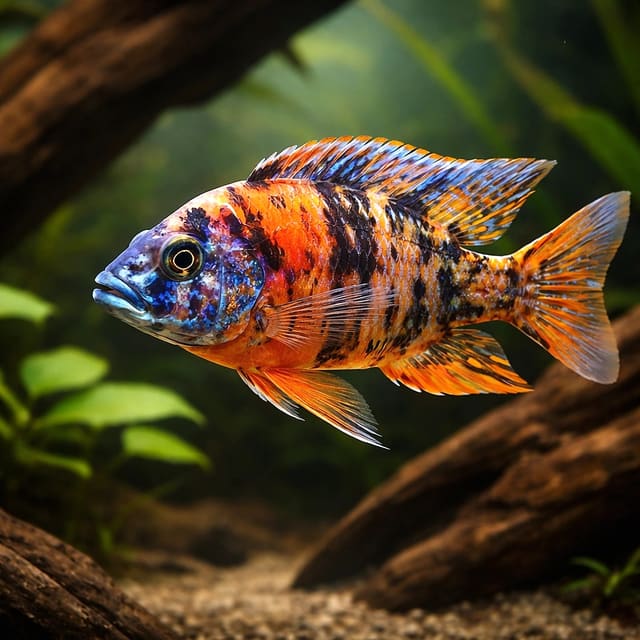
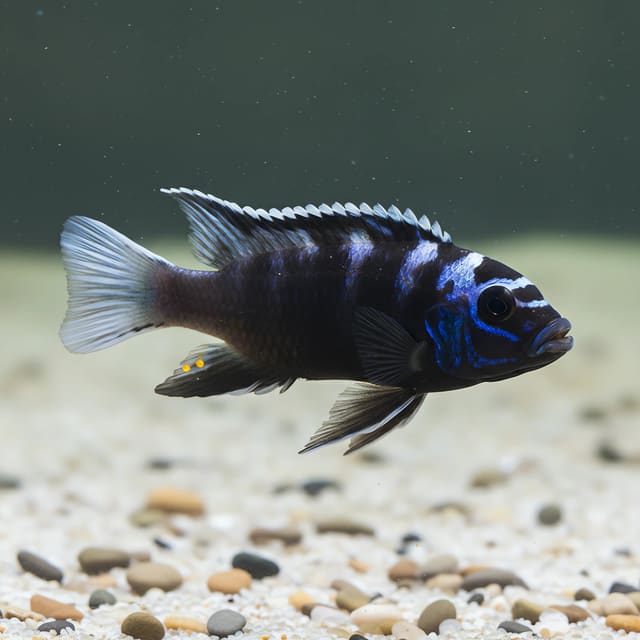
The gallery scenes depict red or red-orange peacock-shaped fish with blue faces and blue markings on the fins. Some gallery images have been digitally enhanced to improve image quality. They show the listed type of animal rather than guaranteeing the exact markings of the individual supplied, so natural colour and pattern can vary.
Use those scenes to recognise the intended Rubin Red appearance, then judge the live animal by clear eyes, intact scales and fins, normal swimming, breathing, feeding and temperament after it settles. Colour alone is not a reliable health or sex test because appearance can vary between individuals and change during transport or social adjustment.
One purchase supplies one animal of the selected option. The selector uses the labels 2 - 3 cm, 4 - 5 cm, 6-7 cm, 7-9 cm and XL. Check the live size selector when choosing; it is the place to see the choices that can be ordered.
The size you select is the size supplied, not the adult size. A centimetre label describes the dispatch grade, while XL is a non-numeric grade and should not be converted into a length. Match the selected grade to the size and confidence of established residents, but design the aquarium around long-term Malawi-cichlid needs rather than the fish’s arrival measurement.
Sex is guaranteed only when the selected option explicitly states male or female. This Rubin Red Peacock Cichlid listing has no sex-guaranteed option.
OATA reports that most Malawi cichlids grow to around 10 cm, while some grow up to 25 cm. Because Rubin Red does not name a species, treat the upper figure as a conservative space-planning reference rather than a promised adult length. Leave enough swimming room and keep the layout adjustable as the fish grows and its place in the community becomes clearer.
For a reasonable Malawi community, OATA recommends an aquarium of at least 200 litres. That is a community planning figure, not permission to place any number or combination of fish into every 200-litre aquarium. Footprint, décor, filtration capacity, oxygenation, resident size and aggression all affect whether a proposed community is workable.
| Decision | Planning rule |
|---|---|
| Dispatch grade | Choose from the live selector and compare it with established residents. |
| Long-term space | Start with at least 200 litres for a reasonable Malawi community. |
| Growth allowance | Keep swimming space open and allow for a group member potentially reaching well beyond its dispatch size. |
| Water | Prepare hard, alkaline water at 23–27°C before arrival. |
| Social plan | Build a complete Malawi community plan rather than adding individuals without an aggression assessment. |
This fish suits a keeper prepared to mature the filter, test water every week and manage a cichlid community actively. It is not a substitute for a peaceful general community fish: Malawi cichlids can be aggressive, and success depends on deliberate stocking, robust filtration and prompt action when one fish is persistently targeted.
| Suits | Not suited to |
|---|---|
| Stable aquarium water maintained at 23–27°C and pH 8.0–8.6 | Water outside 23–27°C and pH 8.0–8.6 |
| Other Malawi cichlids after an individual aggression, size and space assessment | General non-Malawi community stocking |
Start with an aquarium of at least 200 litres when planning a reasonable Malawi-cichlid community. Choose as large an aquarium as practical within the room, floor-loading and maintenance limits: greater water volume normally gives more stable temperature and water quality, while a larger footprint creates more room for territories and escape routes.
Use rocks and other stable décor to interrupt long sight lines, then preserve a clear area for swimming. A fish should be able to move away from another animal without immediately entering a second defended space. View the layout from both ends as well as from the front; an apparently solid screen can leave a direct chasing lane when seen from another angle.
Malawi cichlids often dig and rearrange the substrate, which will uproot any plants present. Use coral sand or a similar substrate that helps buffer the water, and place heavy décor so digging cannot undermine it. Build stable structures before adding loose substrate around them rather than resting a precarious pile on top of sand that can be excavated.
Digging will uproot plants, so do not make delicate planting central to the aquarium’s function. Any plant included must tolerate the hard-water setting and the physical disturbance expected from cichlids. Keep water movement, swimming room and safe territory boundaries ahead of decorative planting when those aims compete.
After arranging the aquarium, check that the filter intake and outlet remain clear, water can circulate behind the rocks and no sharp or unstable surface threatens a fish during a chase. Recheck the structure after digging begins. If a route narrows, a rock shifts or waste collects in a sheltered pocket, correct the layout during maintenance rather than waiting for the problem to grow.
A useful final test is to imagine one fish pursuing another for several seconds. The weaker animal should have more than one route away, while the stronger fish should repeatedly lose direct sight of it. That arrangement cannot remove cichlid aggression, but it gives the community room to interrupt confrontations.
OATA’s African Malawi cichlid guidance gives 23–27°C, pH 8.0–8.6, general hardness of 12–18°dH and carbonate hardness of 10–15°dKH for the group; use these as group guidance rather than a species-specific optimum for Rubin Red.
Measure the aquarium rather than assuming its chemistry from the local area or the substrate label. Our water chemistry guide explains what the readings mean, while the water matcher helps compare measured aquarium values with the intended range.
| Measurement | Routine target |
|---|---|
| Temperature | 23–27°C |
| pH | 8.0–8.6 |
| General hardness | 12–18°dH |
| Carbonate hardness | 10–15°dKH |
| Ammonia | 0 mg/l |
| Nitrite | 0 mg/l |
| Nitrate | Up to 20 mg/l above the normal tap-water level |
Treat tap water with a conditioner that removes chlorine or chloramine before it enters the aquarium. Match replacement water closely enough to prevent an abrupt temperature or chemistry change during a partial water change. Test both the aquarium and source water when a reading shifts; that comparison shows whether the change begins at the tap or inside the tank.
If pH, hardness or temperature sits outside the target, adjust the preparation method deliberately and remeasure before adding the fish. Avoid a large, sudden correction made directly in an occupied aquarium. A repeatable routine is more useful than alternating between different products or quantities in pursuit of a single reading.
Any detectable ammonia or nitrite requires prompt attention because the targets are zero. Pause further livestock additions, test again to check the result, inspect filtration and feeding, and make an appropriately prepared partial water change. Nitrate trends help reveal whether water changes and feeding remain in balance with the community’s waste output.
Record the weekly results. A short sequence of temperature, pH, hardness, ammonia, nitrite and nitrate readings reveals gradual movement that one isolated result can hide. Test again after changes to stocking, feeding or filter maintenance because each can alter the load placed on the biological filter.
Every aquarium for this fish needs a well-established, maintained filter. The RSPCA’s aquarium welfare guidance explains that fish release toxic ammonia and that biological filtration supports bacteria which convert ammonia to nitrite and then to the safer nitrate. A filter therefore manages waste through living bacterial activity; clear-looking water by itself does not show that the aquarium is ready.
Prepare and mature the aquarium before livestock arrives. If this is a new installation, follow the steps in our first tropical aquarium guide and confirm that ammonia and nitrite read 0 mg/l. Do not use the arrival date as the point at which cycling begins.
OATA recommends an oversized filter for the crowded conditions often used in Malawi communities, together with aggressive aeration to maintain dissolved oxygen. Select equipment for the aquarium volume and intended fish load, then arrange the outlet or separate aeration so the water surface moves vigorously without leaving stagnant pockets behind the décor.
Do not run biological filter media under the tap because any chlorine or chloramine present may kill beneficial bacteria. When cleaning is necessary, rinse the media lightly in aquarium water removed during a partial water change. Clean only enough to restore flow rather than stripping every surface at once.
Never combine a heavy filter clean, a large stocking increase and a major feeding increase without monitoring the result. Each change can affect waste processing. Stage additions slowly so the bacterial population can increase as feeding and fish waste rise.
If flow weakens, inspect for a blockage rather than assuming the motor has failed. If fish gather near the surface or breathe unusually fast, test water immediately and check circulation and aeration. Restore oxygenation and address any ammonia or nitrite reading instead of treating the behaviour as a normal feature of an active cichlid aquarium.
Malawi cichlids do not all share one diet. The group includes more herbivorous fish and more predatory fish, so choose a prepared Malawi-cichlid food formulated for the dietary needs of peacock cichlids rather than automatically copying a vegetable-heavy mbuna routine or a rich predatory routine.
Feed only what the fish can consume within a few minutes, twice a day. Start with a deliberately small amount, watch the whole feeding response and stop before food begins settling into the substrate or disappearing behind rocks. The portion is defined by consumption within that short window, not by a fixed spoonful that ignores fish size and community composition.
Distribute food across more than one point when a dominant fish controls the first feeding area. Watch whether the Rubin Red leaves cover, takes food and swallows normally. A fish that approaches but repeatedly loses every item may need the feeding pattern or social arrangement changed even when the total amount looks adequate.
| What you see | What to do |
|---|---|
| Food remains after a few minutes | Remove what you can and reduce the next portion. |
| One fish controls the feed | Spread the portion across separated feeding points. |
| Interest in food drops | Test water and compare breathing, swimming and social behaviour with normal. |
| Waste readings rise | Reduce excess feeding, inspect filtration and carry out the planned water-quality response. |
Overfeeding leaves organic waste that breaks down and increases the load on the filter. More food is not a shortcut to stronger colour or faster growth. Consistent portions, zero ammonia and nitrite, appropriate social access and stable water give the fish a better foundation than rich additions that remain uneaten.
Review portions whenever fish are added, grow substantially or change their feeding response. The right amount for a smaller community can become inadequate after growth, while the previous amount may be excessive if a fish is removed or stops feeding. Use the few-minute rule at every meal rather than treating an old portion as permanent.
Keep the diet decision tied to the Rubin Red’s peacock-cichlid identity and the product directions on the chosen food. Do not infer an individual’s nutritional needs from red intensity, sex assumptions or a dispatch-size label.
Carry out a 25% partial water change at least once every week. Use a siphon to remove solid waste from the substrate and from accessible pockets around the décor. Prepare the replacement water with conditioner before it enters the aquarium, and keep its temperature and chemistry consistent with the established system.
Test ammonia, nitrite and the other planned water values at least weekly. Record results before the water change so the trend reflects what accumulated during the week, then retest when a result is unexpected or after corrective work. The targets remain 0 mg/l ammonia, 0 mg/l nitrite and nitrate up to 20 mg/l above the normal tap-water level.
A weekly change is the baseline, not a reason to wait when ammonia or nitrite appears. If either is detected, test again, prepare replacement water, inspect the filter and feeding history, and take corrective action promptly. Delay additional stocking while the biological filter and waste readings recover.
If nitrate rises faster than usual, compare the result with tap water and review feeding, trapped debris, stocking changes and the actual volume replaced. Removing clean-looking water without siphoning accumulated solids may leave the underlying waste source in place.
Check rocks and substrate after siphoning. Cichlid digging can redirect water flow, bury debris or undermine structures. Restore safe routes and stable supports without removing every territorial marker at once unless aggression management requires a deliberate rearrangement.
Keep filter cleaning proportionate. A reduced flow needs attention, but washing all media aggressively can remove too much bacterial capacity. Light cleaning in removed aquarium water protects the biological function while clearing physical blockage.
A written maintenance log makes changes easier to interpret. Note water values, approximate volume changed, unusual behaviour, filter work and stocking changes. When a result moves, the preceding entries provide a practical starting point for deciding whether feeding, filtration, source water or community load changed first.
Arrange for someone to receive the fish so the parcel is not left unattended. Before it arrives, confirm that the heater, filter and aeration are working and make sure the intended release area is not blocked by nets or maintenance equipment.
Follow our delivery and acclimatisation policy: film every delivery from the sealed parcel onward, float the bag for 20–30 minutes before releasing the fish and do not pour the bag water into the aquarium.
Keep the first observation focused on function. A newly transported fish may not immediately display the colour or confidence shown in a settled aquarium scene. Check that it can maintain position, move away from residents, breathe without a marked change and find a place where it is not trapped.
OATA recommends adding Malawi cichlids in groups so one newcomer does not receive all the attention. It also advises introducing more peaceful fish before more aggressive fish and notes that rearranging décor can disrupt established territories. Apply those principles to a pre-planned stocking change rather than adding animals merely to solve aggression after it begins.
If the aquarium already contains cichlids, compare the new dispatch size with resident size before ordering. On arrival, watch whether residents allow the newcomer to leave cover and approach feeding areas. Persistent cornering, repeated physical damage or complete exclusion from food requires intervention; it should not be dismissed as an inevitable settling phase.
Do not add further fish while water readings or behaviour remain unsettled. Beneficial bacteria need time to adjust when fish numbers and feeding increase, and adding too quickly can lead to new tank syndrome with harmful ammonia or nitrite.
Retest ammonia and nitrite after the introduction and continue close observation through the first week. The aim is a fish that can swim, shelter and feed without being continually pursued, inside water that remains at the planned values.
Learn the fish’s normal swimming, breathing, colour, feeding response, use of cover and interaction with other residents. Daily familiarity makes a change easier to notice than comparing the animal with a generic picture. Observe before feeding as well as during meals so food competition does not hide resting behaviour.
| Change noticed | First response |
|---|---|
| Hanging at the surface | Test water immediately and check aeration and filter flow. |
| Sitting on the bottom or erratic swimming | Check temperature, ammonia, nitrite and social pressure. |
| Faster or slower gill movement | Test water and confirm strong circulation and oxygenation. |
| Hiding more than normal | Look for persistent pursuit, blocked routes and denied feeding access. |
| Reduced food intake | Test water, observe swallowing and check whether another fish controls the feeding area. |
| White spots, fluffy growths, lost scales or damaged fins | Check water and aggression, then seek a diagnosis before using treatment. |
Do not select a medicine from one symptom alone. Similar outward changes can follow water-quality failure, aggression or different health problems. Correct measurable husbandry problems first and avoid adding an unselected treatment that could complicate diagnosis or affect the biological filter.
During the first day, confirm that the fish can maintain its position and escape direct pursuit. At the first feeds, check that it reaches food. Through the week, monitor ammonia and nitrite closely as the filter responds to the additional waste. Record injuries, appetite and hiding rather than relying on memory.
By the end of the first month, compare the weekly records. Stable zero ammonia and nitrite, consistent feeding and a social position that allows normal movement are more useful indicators than any promised colour timetable. Continue the same observation routine after décor changes, additions or major filter work.
If a fish is being damaged, separate the immediate aggressor and target safely where your aquarium plan allows, or rearrange territories as part of a considered response. Adding random companions can increase both aggression and biological load.
When a health change persists after water and social conditions are checked, contact us with the water readings, timeline, behaviour and clear images. Those details make the next step more precise than a colour description by itself.
OATA advises keeping Malawi cichlids only with other Malawi cichlids or with some species of Synodontis catfish that also naturally inhabit Lake Malawi. This is a screening boundary, not a universal promise that any two animals within those categories will coexist.
Avoid placing this fish in a general non-Malawi community. Shared temperature alone is not enough: the aquarium must also provide hard, alkaline water, appropriate space, robust filtration and a social structure designed for aggressive cichlids.
| Check | Question to answer |
|---|---|
| Water | Does the proposed animal suit 23–27°C, pH 8.0–8.6 and hard water? |
| Identity | Is it another Malawi cichlid or a checked Synodontis species that naturally inhabits Lake Malawi? |
| Social pressure | Can the layout and stocking plan distribute aggression without trapping one fish? |
| Size and space | Can each animal move, feed and retreat safely at its present and planned size? |
Passing one check does not cancel failure on another. A Malawi fish that needs the same chemistry may still be too aggressive for the planned mix. A suitably sized catfish still needs its identity and Lake Malawi association checked. A large aquarium can create more routes and water volume, but it does not make an incompatible social mix safe automatically.
Add more peaceful species before more aggressive ones where the full community plan allows. Introduce Malawi cichlids in planned groups rather than making one individual the sole focus of established territories. Rearranging décor can reduce territorial certainty, but the new structure must remain stable and preserve open swimming space.
Watch access to food and routes, not chasing alone. Brief pursuit can occur in a cichlid hierarchy, while repeated cornering, physical damage, constant hiding or exclusion from meals shows that the arrangement needs action. The correct response may involve changing territories or revising the stocking mix rather than simply waiting.
Compatibility remains conditional on the individual fish, aquarium dimensions, residents and layout. For a stocking and compatibility assessment, contact us with the aquarium volume and footprint, current species and sizes, water readings, décor plan and intended additions.
Malawi cichlids are not social fish in the schooling sense, but OATA explains that they can be maintained in groups of at least 15 and slightly overcrowded to distribute aggression. It also warns that small groups often fight. Treat these as community-management principles that must be balanced against aquarium capacity, filtration and the aggression of the chosen animals.
Do not turn “at least 15” into an automatic stocking count for every 200-litre aquarium. The 200-litre figure is a starting recommendation for a reasonable community, while actual capacity depends on footprint, adult planning sizes, décor displacement, filter performance and the behaviour of the mix. Slight overstocking for aggression control is only responsible when oxygenation and waste processing can support it.
Where the sexes of established adult fish have been determined independently, OATA recommends keeping more females than males of each species where possible so one female is not harassed continually. This offer should not be used to fill a sex-ratio requirement because its options do not guarantee sex.
A planned group can spread attention, but adding animals after aggression starts also increases feeding and waste immediately. Diagnose the existing problem first. Check whether the aquarium contains a dead end, whether one fish controls the only shelter, whether residents are mismatched in size, and whether ammonia or nitrite has altered behaviour.
If the layout is the main issue, rearrange stable décor to create new boundaries and routes. If the intended community exceeds the filter or aquarium capacity, adding toward a numerical group target is the wrong response. If one fish remains pinned, injured or unable to feed, protect it while revising the mix.
Browse the African cichlid collection to compare identities, but assess each proposed animal individually rather than treating the collection as a compatibility list. A sound plan joins water chemistry, adult space, present sizes, filtration and temperament in one decision.
The Rubin Red Peacock Cichlid is an unidentified colour form within the Lake Malawi genus Aulonocara. Its scientific label is Aulonocara sp. 'Rubin Red'; plan its aquarium around Aulonocara and Malawi-cichlid guidance.
One purchase supplies one animal in the option selected. The gallery may show one or two fish for visual context, but it does not change the purchase unit. Use the live selector to choose the dispatch grade.
The selector uses the labels 2 - 3 cm, 4 - 5 cm, 6-7 cm, 7-9 cm and XL. These are dispatch grades rather than adult measurements, and XL is a non-numeric label. Check the live selector when ordering.
OATA’s Malawi group guidance recommends at least 200 litres for a reasonable community, with coral sand or a similar buffering substrate, stable rockwork, broken sight lines, open swimming space, oversized filtration and strong aeration. Mature the biological filter before introducing fish.
Malawi cichlids are not schooling fish, but OATA’s group guidance says they can be kept in groups of at least 15 and warns that small groups often fight. The actual plan must fit the aquarium footprint, filtration and aggression levels; do not apply the number automatically to every 200-litre tank.
OATA’s Malawi group guidance gives 23–27°C, pH 8.0–8.6, general hardness of 12–18°dH and carbonate hardness of 10–15°dKH. Keep ammonia and nitrite at 0 mg/l, with nitrate up to 20 mg/l above the normal tap-water level.
Choose a prepared Malawi-cichlid food formulated for peacock-cichlid dietary needs. OATA’s group guidance says to feed only what it can finish within a few minutes, twice a day. Spread the portion when one resident controls the feeding area, and reduce it if food remains.
Start filming before the parcel is opened, showing the sealed parcel and outer box, then open it in one continuous take and show the fish inside the sealed bag. Tropical Fish Co’s delivery policy says to float the bag for 20–30 minutes before releasing the fish and not to pour bag water into the aquarium.
Screen companions among other Malawi cichlids or some checked Synodontis species that naturally inhabit Lake Malawi. OATA’s Malawi group guidance gives 23–27°C and hard, alkaline water; every candidate must also pass checks for aggression, present size, planned growth, aquarium space and feeding access.
No reviews for this item yet. Bought one? Honest reviews only, good or bad.
What customers say about ordering from us
I have a small group of long finned mountain minnows. So was delighted to be able to order ten of this variety to increase the genetics in my tank . The ones I recieved are healthy but it’s to early to give a verdict on wether they are of a long finned type since they are small currently.
Gordon Walker · 23 Sept 2026
100% success travel and "installation". Pleased with quality of purchase. The Siamese fighter a bit "shy" so have not yet seen him at his best yet but looking good. Happy customer. GG
George E Garratt · 21 Sept 2026
Reviews of our shop, collected by Judge.me, an independent third-party review collector. Newest first.