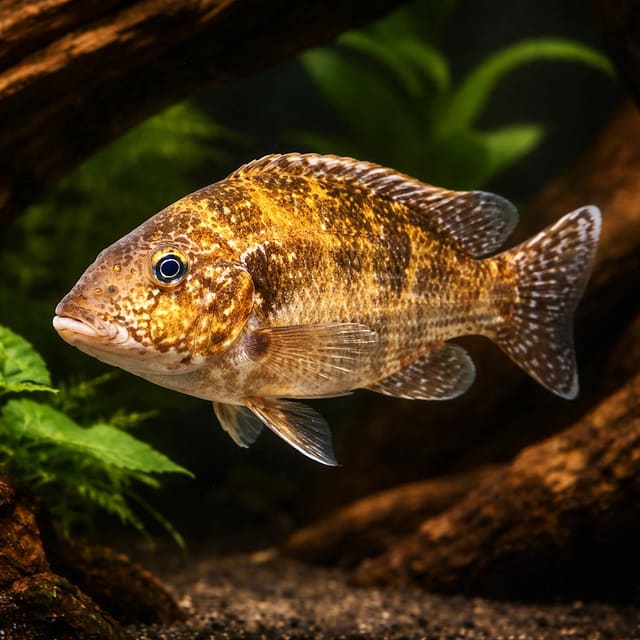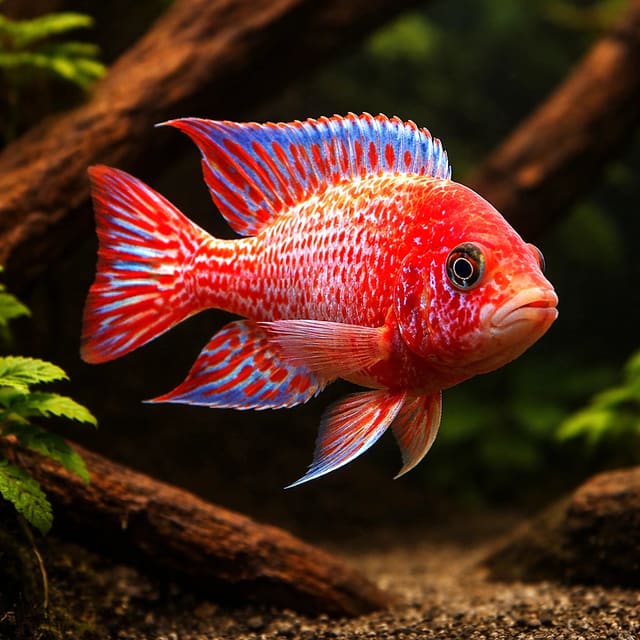
Red Dragon Peacock Cichlid (Aulonocara Hybrid)
23–27°C · pH 8–8.6
From £12.09Some sizes on sale

One unsexed 4-5 cm or 5-6 cm Blue Otter Cichlid juvenile. Plan around the supplier's 18 cm maximum, 24-26 C water and an adult 400-500 L, 150 cm+ Malawi aquarium.
Adult size is the maximum length this species reaches at full maturity (scientific sources). The livestock you receive will be younger and smaller — pick a size above for the actual shipping size. Product-photo provenance and any image-specific limitations are stated on the listing.
Placidochromis sp. 'Blue Otter'
Save when buying multiple fish. Each quantity is one fish; sex and pair formation are not guaranteed unless the selected variant explicitly states them.
One unsexed 4-5 cm or 5-6 cm Blue Otter Cichlid juvenile. Plan around the supplier's 18 cm maximum, 24-26 C water and an adult 400-500 L, 150 cm+ Malawi aquarium.
Adult size is the maximum length this species reaches at full maturity (scientific sources). The livestock you receive will be younger and smaller — pick a size above for the actual shipping size. Product-photo provenance and any image-specific limitations are stated on the listing.
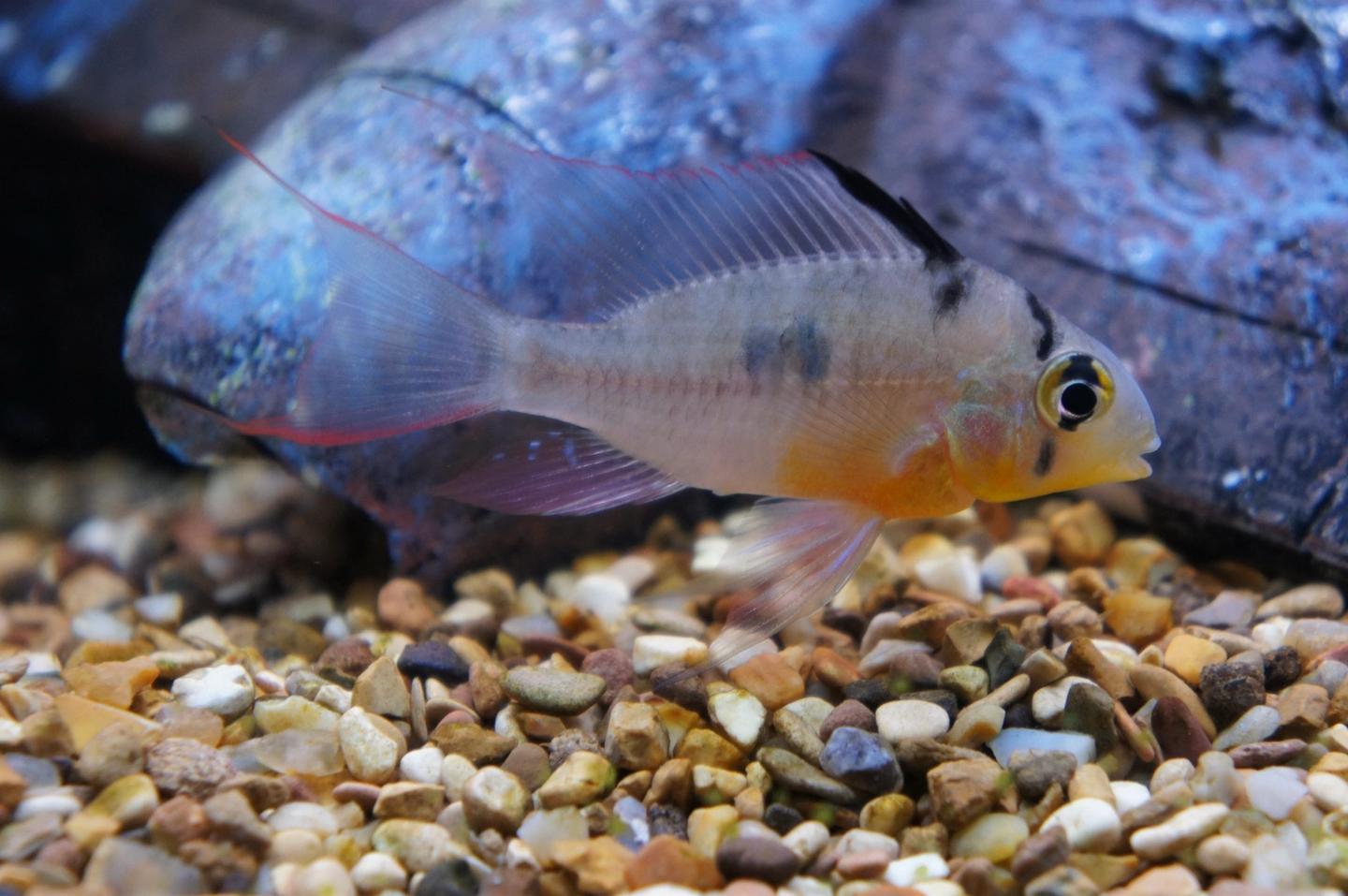
Cichlids are a family of roughly 1,800 accepted species, not one care type. Before buying, identify the exact species and source, then compare adult measurement, usable tank dimensions, social system, territory, tested water, diet and an exit plan. No family-wide minimum tank, water range or tank-mate list is safe.
Maintain these water conditions for optimal health and vibrant colors
Blue Otter Cichlid (Placidochromis sp. 'Blue Otter') is a Lake Malawi haplochromine sold here in two juvenile size options: approximately 4-5 cm or 5-6 cm. One retail unit is one unsexed juvenile in the selected size grade. It is not a male, female, proven pair or guaranteed blue adult. Juveniles and females can remain silver-grey or subdued, while mature males usually develop the stronger metallic-blue display colour associated with the trade name.
There is an important identity boundary. The supplier calls this line Placidochromis sp. blue and does not provide a collection locality. Blue Otter is an established provisional aquarium name, with documented populations at several Lake Malawi locations, but this listing does not claim Tsano Rock, wild origin or a particular generation. The supplier's own care row gives 24-26°C, pH 7.5-8.5, 10-25 dGH and an 18 cm maximum. For adult housing, plan conservatively around 400-500 litres with at least a 150 cm footprint, then scale upward for a group or mixed Malawi community.
| Planning point | Reviewed guidance | Evidence boundary |
|---|---|---|
| Sale animal | One unsexed 4-5 cm or 5-6 cm juvenile | No chosen sex, pair or adult colour |
| Identity | Placidochromis sp. 'Blue Otter'; our stock records say Placidochromis sp. blue | Provisional trade name, not a formally described species |
| Locality | Lake Malawi trade identity | Supplier does not provide locality or generation |
| Adult size | Plan around the supplier's 18 cm maximum | Specialist Blue Otter records vary by population and source |
| Aquarium | Approximately 400-500 L and at least 150 cm long | Use more space for groups and mixed communities |
| Water | 24-26°C; pH 7.5-8.5; 10-25 dGH | Supplier care range, with stability prioritised |
| Diet | Small-animal feeder/carnivore; prepared protein-rich staple plus measured aquatic-invertebrate variety | Not a generic omnivore or algae-control fish |
| Temperament | Relatively calm for a Malawi hap, but males can be territorial | No universal community guarantee |
The abbreviation "sp." means the fish has not been assigned a formally described species name in this trade context. Blue Otter is a provisional hobby label used to distinguish a recognisable Placidochromis form. It should be written in quotation marks and not italicised as though it were a valid Latin species epithet.
That distinction matters because common and provisional names can be used loosely in supply chains. The historic product identity is Blue Otter, while the current supplier line is labelled only Placidochromis sp. blue. The reference photo and established catalogue history support retaining the trade name, but they do not support adding a locality, wild-caught status or lineage claim.
The Placidochromis sp. 'Blue Otter' record at Cichlid Room Companion places the fish in Cichlidae, Pseudocrenilabrinae, Haplochromini and the genus Placidochromis. Its photo records include males and females at multiple Lake Malawi locations. This supports the provisional identity as a genuine Malawi haplochromine, but not the locality of the juvenile sold here.
A 2025 Blue Otter breeding article focuses specifically on Tsano Rock fish and describes a difficult captive breeding history. It is useful evidence that breeding should not be marketed as automatic, but it cannot turn a locality-unspecified supplier juvenile into a Tsano Rock fish.
Quantity one means one unsexed juvenile in the chosen size grade. The two size choices belong to the same parent product so you can choose the available dispatch grade. A quantity-pricing interface may offer a threshold for buying more than one fish, but that does not change the retail unit into a pair or guarantee a sex ratio.
The supplier's packing figures are wholesale logistics and are not customer quantities. If you order two, you receive two unsexed fish. You must not assume they will be one male and one female, remain compatible or form a breeding pair.
| Option | What it means | What it does not promise |
|---|---|---|
| 4-5 cm | One juvenile in the smaller dispatch grade | Sex, blue adult colour, exact final size or immediate social status |
| 5-6 cm | One juvenile in the larger dispatch grade when available | Male selection, proven female, pair status or mature finnage |
Grades are approximate because live fish move and natural body size varies. Select the grade that suits your established stock and quarantine plan, not the one you expect to colour most quickly. A larger unsexed juvenile is still unsexed.
Our stock records give an 18 cm maximum for this supplied line. Specialist Blue Otter sources vary, with some population profiles around 12-15 cm and more conservative references reaching 22 cm. The responsible retail approach is to use the supplier's 18 cm figure for the product record while providing enough aquarium length and volume for a substantial adult Malawi hap.
Growth is influenced by sex, lineage, age, food and conditions, so 18 cm is not a guaranteed final measurement. Do not keep the juvenile in a temporary small tank on the assumption that an upgrade can wait until colour develops. The adult aquarium should be prepared before ordering.
Not necessarily. Mature males usually develop the most intense metallic blue, while females, subordinate males and juveniles are commonly silver-grey, brownish or less saturated. A 4-6 cm fish may look very different from an adult male reference. Stress, transport, social rank, lighting and background can also change visible colour from hour to hour.
Colour cannot be used as a sex promise at this dispatch size. Buying several juveniles may improve the chance of obtaining both sexes, but it does not guarantee a ratio and creates a larger adult space requirement. Choose the fish because you can meet the species' care needs, not because every juvenile is expected to become an electric-blue male.
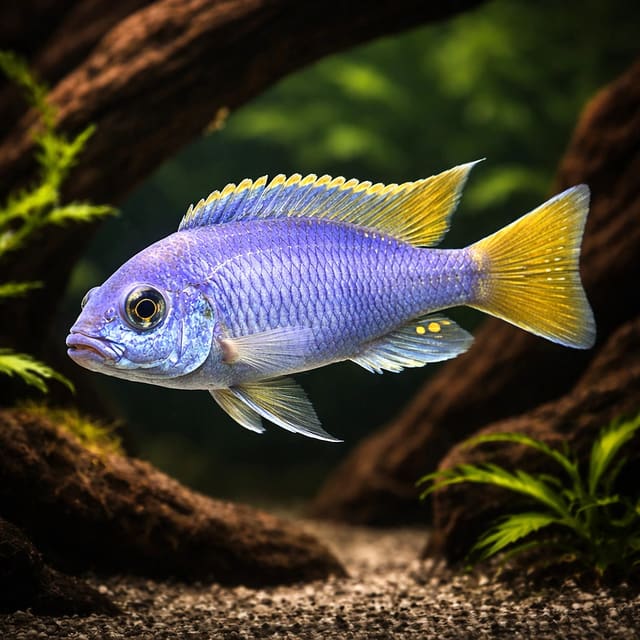
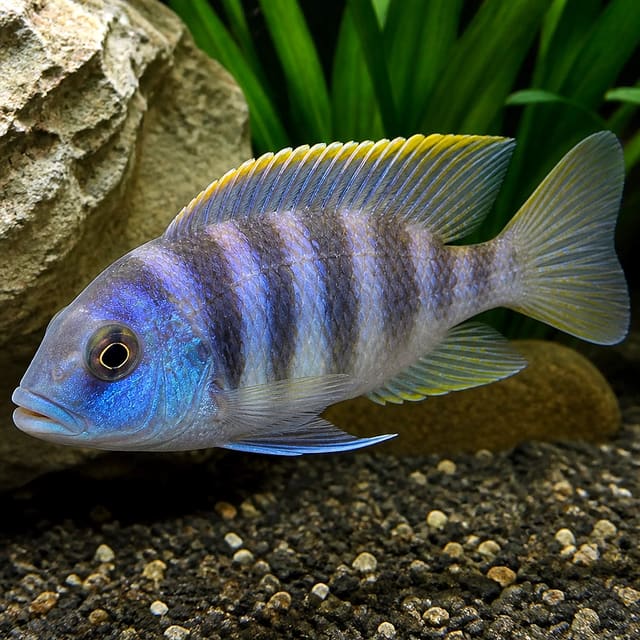
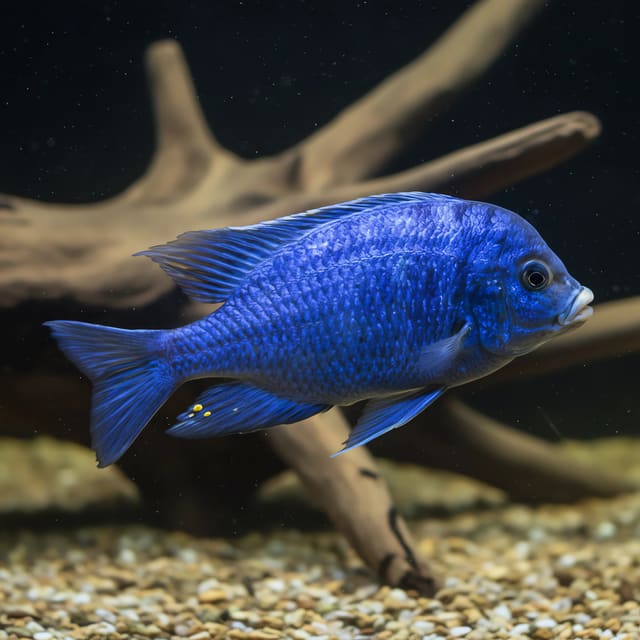
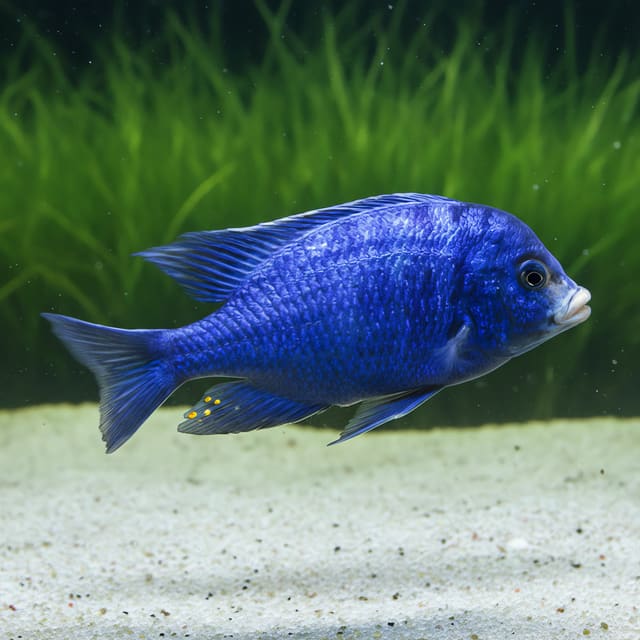
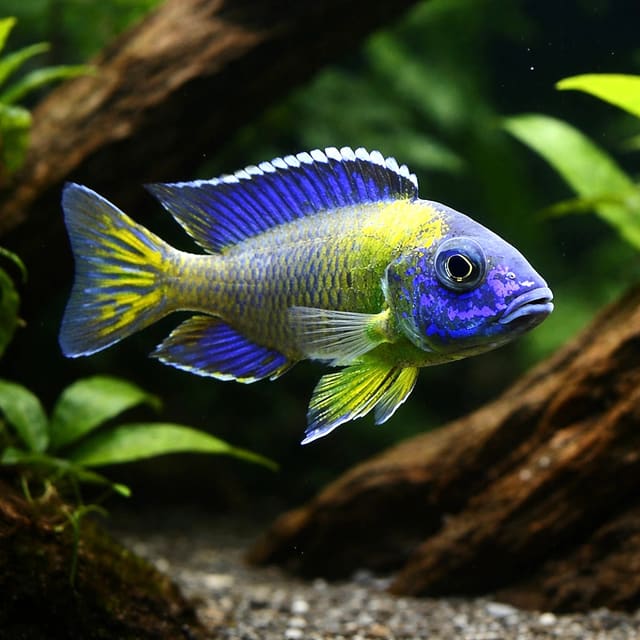
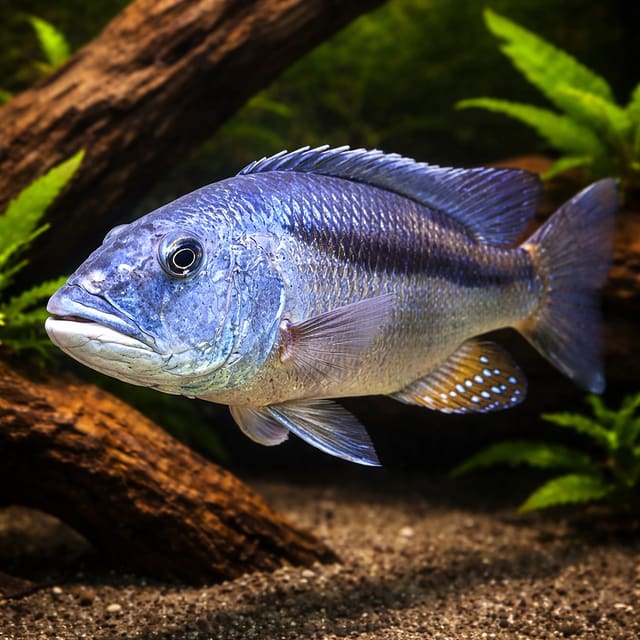
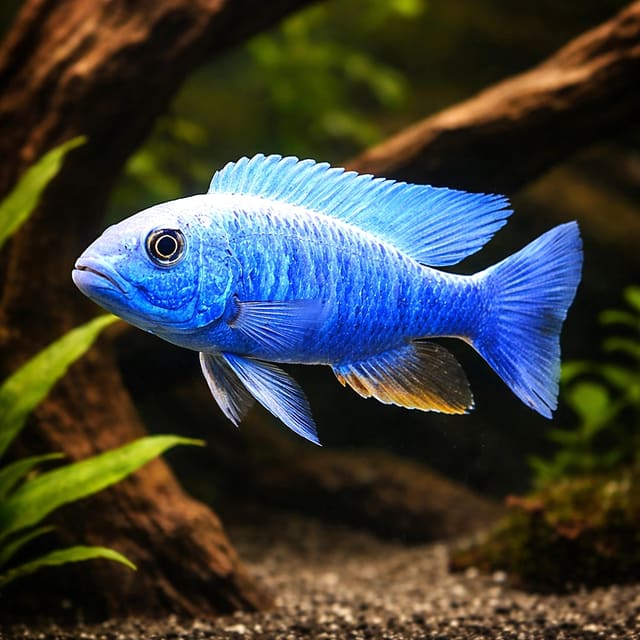
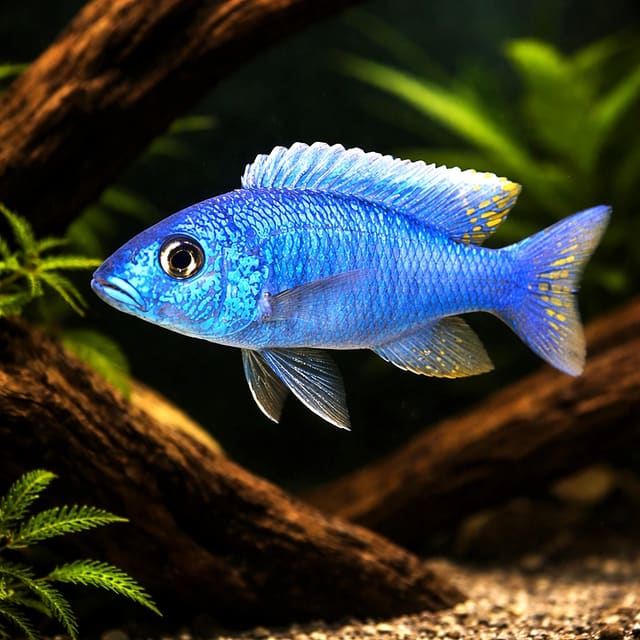
| Position | Image role | Limitation |
|---|---|---|
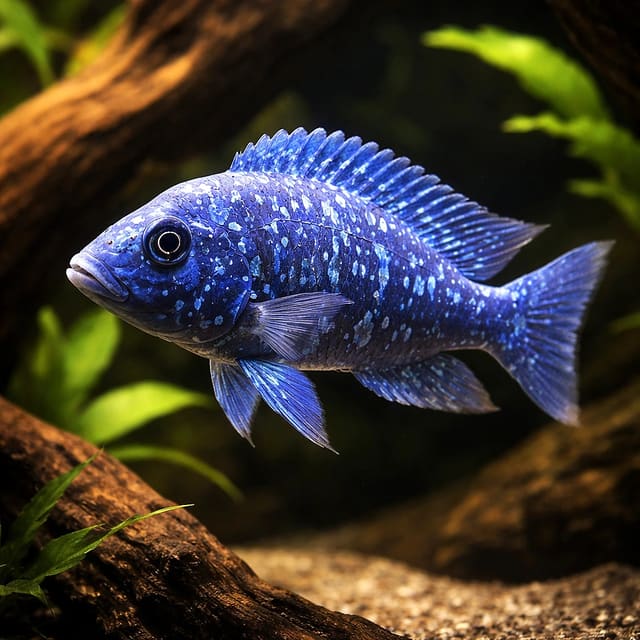
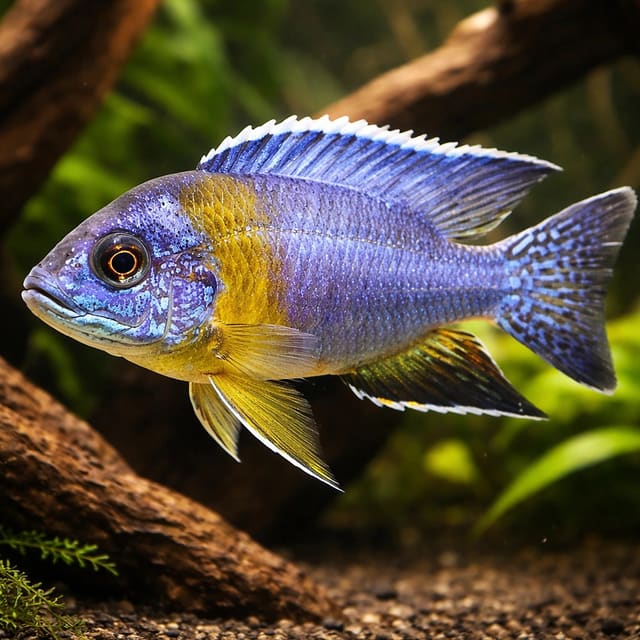
| 1 | Illustration of an adult blue display fish, loosely based on the reference photo | Not the dispatch fish or a locality/sex guarantee |
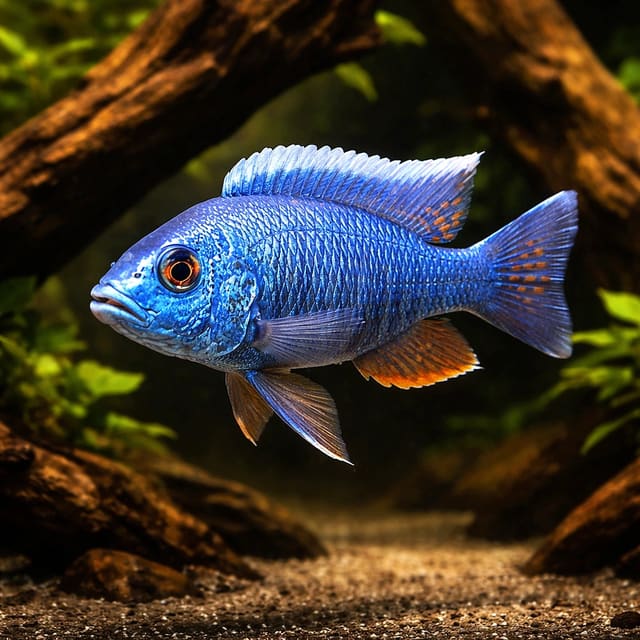
| 2 | Illustration showing two adult blue fish | Not a sexed pair and not evidence that two juveniles will coexist |
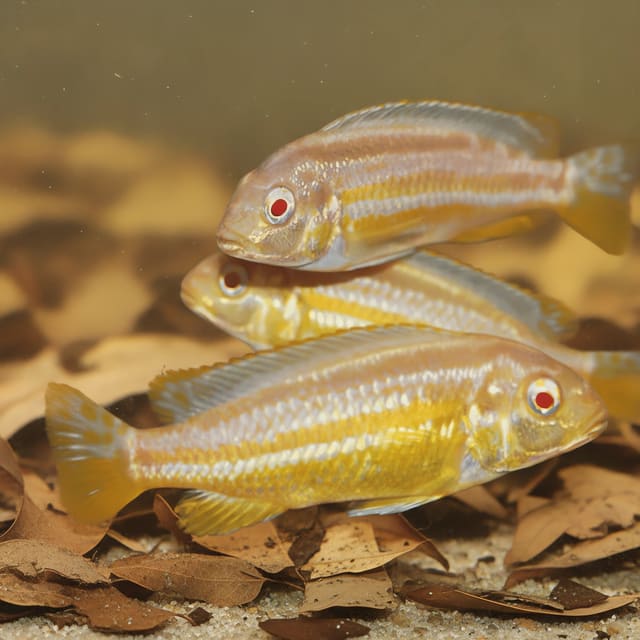
| 3 | Clean illustrative side view | Colour, anatomy and proportions are non-diagnostic |
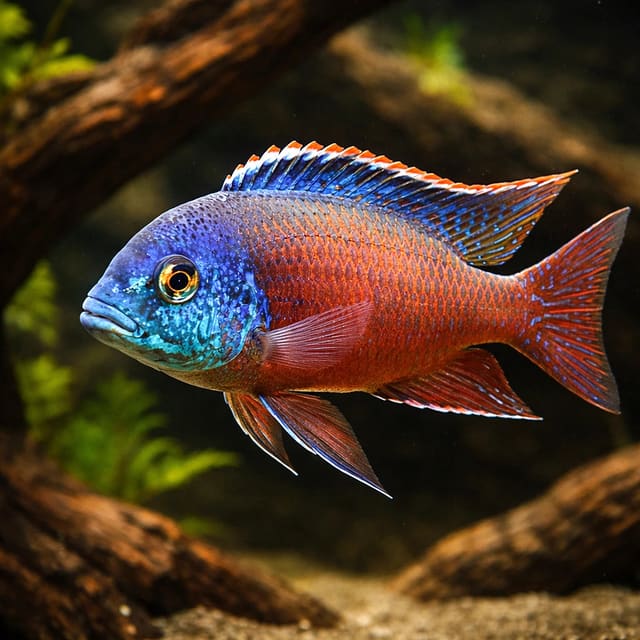
| 4 | Illustrative aquarium scale scene | Does not replace the written 4-5 cm or 5-6 cm dispatch contract |
None is presented as an exact supplier photograph.
Documented Blue Otter populations occur in Lake Malawi's rocky transition and adjacent sandy habitat. Specialist records describe fish working near rock structures while using open sand to search for small invertebrates. That supports a layout with both cover and broad swimming/feeding areas rather than a solid wall of rock.
The supplied fish is not locality-confirmed, so this page does not say it comes from Tsano Rock, Mitande Reef or any other named site. Those locations explain the provisional form's known natural history; they are not a certificate of origin for this retail line.
Use an aquarium around 400-500 litres with at least a 150 cm footprint as the long-term baseline. This replaces the old 250 L and 100 cm advice, which is too cramped for an 18 cm adult, social management and open swimming space. A 150 cm aquarium offers more useful territory than a shorter, taller aquarium of similar volume.
For a group or mixed Malawi community, move toward the upper end or beyond it. One male with several confirmed females is a common specialist structure, but the unsexed juveniles sold here cannot be assembled into that ratio at checkout. More males, assertive tank mates or complex stocking may require considerably more than 500 L.
A grow-out tank is not the final home. Do not order a juvenile for a 100 cm aquarium with an undefined future upgrade. Adult volume, footprint, filtration and separation options should already be realistic.
Use fine aquarium-safe sand with stable rock structures that create visual barriers, shaded retreats and several routes around the tank. Leave a broad open area for swimming and natural substrate investigation. Place rocks directly and securely so digging cannot undermine them; do not balance heavy stone on loose sand.
The layout should let a subordinate fish leave a dominant fish's view. One central cave does not provide that choice. The cichlid care guide covers general planning, while the African cichlids hub helps compare other Malawi fish that may have different space and aggression requirements.
Use 24-26°C, pH 7.5-8.5 and 10-25 dGH as the supplier-backed planning range. These values describe warm, alkaline, mineralised Lake Malawi-style conditions. They do not mean the fish tolerates sudden movement from one end of each range to the other.
| Measure | Reviewed range | Practical use |
|---|---|---|
| Temperature | 24-26°C | Choose a stable point and verify the heater with a separate thermometer |
| pH | 7.5-8.5 | Maintain stable alkaline water; do not chase pH with daily chemical swings |
| Hardness | 10-25 dGH | Confirm the source water and mineral strategy before ordering |
| Ammonia | 0 | Any reading requires immediate investigation |
| Nitrite | 0 | A mature biological filter must process the normal load |
| Oxygen | High and stable | Use strong surface exchange and avoid stagnant warm zones |
Read the aquarium water chemistry guide before adjusting naturally soft or acidic source water. Buffering and mineral products must be measured against actual water volume and used consistently, not added by guesswork after the fish arrives.
A large Malawi aquarium needs mature biological capacity, effective mechanical capture and strong oxygen exchange. Choose filtration for real stocking and waste production rather than relying on a box's maximum-volume claim. Use multiple circulation paths so debris does not accumulate behind rocks, but avoid directing a harsh jet at one resting area.
Maintain the filter without destroying its bacterial community. Rinse reusable biological media only as appropriate for the system, normally in removed aquarium water, and do not replace all mature media at once. A power or pump failure needs prompt attention because warm, heavily stocked cichlid aquariums can lose oxygen quickly.
Do not use a fixed four-week calendar as proof of cycling. Test results and demonstrated waste processing matter. If the aquarium cannot hold stable conditions before the order, delay the fish.
Blue Otter references describe a carnivorous small-animal feeder that searches sediment for small crustaceans and other invertebrates. That is more precise than the old generic omnivore label. In the aquarium, use a complete prepared food formulated for carnivorous or micro-predatory Malawi cichlids as the staple, with measured aquatic-invertebrate variety.
A fish accepting a food does not prove the food should dominate its diet. Avoid mammal or bird meat, heavy fatty meals and repeated overfeeding. Spirulina can appear in balanced prepared foods, but this is not a spirulina-led mbuna grazer and should not be fed as though it were one.
| Role | Suitable approach | Control point |
|---|---|---|
| Staple | Complete high-quality Malawi carnivore/micro-predator pellet or granule | Match pellet size to the juvenile and confirm all fish feed |
| Variety | Appropriate prepared or frozen aquatic-invertebrate foods | Use measured portions and avoid making rich foods the whole diet |
| Enrichment | Food that encourages controlled midwater or sand-searching behaviour | Do not bury food where it can decay unseen |
| Not suitable | Mammal meat, feeder fish and uncontrolled leftovers | These add nutritional, ethical or disease risks |
There is no honest universal seconds rule, pellet count or mandatory fasting schedule. Fish size, food density, temperature, group competition and filtration all change the correct portion. Start small, watch each juvenile feed and reduce the next portion when food persists. Browse the fish-food category by formulation, then verify the actual label suits a carnivorous Malawi cichlid.
Blue Otter is generally described as relatively calm for a Malawi hap, but that does not mean peaceful in a generic community. Mature males can defend courtship space and challenge similar males. Subordinate fish can be stressed without obvious injury if they cannot escape visual contact or reach food.
Assess behaviour across feeding, lights-on, lights-off and water-change periods. A combination that appears calm while all fish are juvenile can change at sexual maturity. Keep dividers, nets and a cycled alternative available before a conflict develops.
The safest community is a large, carefully selected Lake Malawi aquarium with similarly sized, relatively calm fish that share the same water and diet strategy. Even then, compatibility depends on sex, body shape, colour, maturity, territory and the individual. No list can guarantee a result.
| Potential companion | Assessment | Reason |
|---|---|---|
| Calm, similarly sized Malawi haps | Possible with planning | Shared chemistry, but compare adult size, colour and territorial style |
| Suitable Aulonocara | Possible in a large setup | Avoid lookalike males and feeding/territory imbalance |
| Highly aggressive mbuna | Usually avoid | May outcompete or harass this relatively calm hap |
| Small community fish | Avoid | Wrong scale, social pressure and often unsuitable chemistry |
| Shrimp and small invertebrates | Avoid | Likely food rather than tank mates |
| Similar Placidochromis forms | Caution | Competition and hybridisation/identity risks require specialist planning |
Specialists often maintain a mature male with several females, but this listing sells unsexed juveniles. Two fish are not a guaranteed pair, and buying four does not guarantee one male and three females. Juvenile social tolerance is also not proof of adult compatibility.
If you plan a group, provide adult-scale space from the beginning, allow for an unfavourable sex ratio and have somewhere to move surplus males. Do not keep a single female under constant attention from one male. A species-focused group and a mixed Malawi community may need different final volumes.
Specialist Blue Otter records identify maternal mouthbrooding: the female carries developing eggs and young in her mouth. Cichlid Room Companion records the provisional form as polygynandrous, and a recent Tsano Rock account describes breeding as challenging. Those points support the reproductive mode, but not an easy-breeding promise for this supplier line.
The sale fish is too young and unsexed for pair selection. Do not promise a fixed brood count, incubation period or fertility. If breeding becomes a goal, confirm mature sex, maintain a documented line, avoid mixing confusingly similar forms and prepare a separate recovery/rearing plan that protects the holding female from harassment.
A settled juvenile should maintain balance, breathe without persistent distress, respond to an appropriate food and use the available swimming space. Colour intensity is not a reliable health measure by itself. A healthy female or subordinate juvenile may remain subdued.
Watch for clamped fins, repeated hiding, loss of balance, persistent surface breathing, white stringy waste, refusal of food, visible injury or one fish being excluded. These signs are not diagnoses. Test water, inspect equipment, review aggression and seek informed aquatic-veterinary or experienced specialist advice before using medication.
Base water changes on tested waste accumulation, stocking and source-water consistency. Match replacement water for temperature and mineral conditions, and avoid sudden large chemistry shifts. Vacuum accessible debris without stripping the whole substrate or dismantling every territory at once.
Record pH, hardness, nitrate and maintenance results so slow drift is visible. Never add salts, buffers or medication without calculating actual water volume. Keep aerosols, cleaning chemicals, insect treatments and metal contamination away from aquarium tools.
Read the current livestock instructions supplied with the order before opening the bag. Confirm the selected size option and inspect the fish promptly. Follow the provided temperature and water-transition process without leaving the juvenile indefinitely in transport water.
Use low light, release near cover and minimise chasing. Quarantine is strongly preferred because it lets you observe feeding and health without immediate competition. Do not judge final colour or sex on arrival.
| Stage | Useful action | Avoid |
|---|---|---|
| Arrival | Follow the current instructions and document any concern immediately | Discarding packaging before the fish is checked |
| Release day | Keep lighting low and monitor breathing and balance | Repeated netting or forced photography |
| First food | Offer a small suitable juvenile portion once settled | Adding several rich foods because colour is pale |
| Days 2-7 | Check water, food access, waste and social pressure | Assuming juvenile calm proves permanent compatibility |
Delivery availability depends on postcode, schedule, weather and the current checkout rules. Review the delivery information before ordering and arrange for prompt receipt. Live-arrival support depends on following the current instructions and reporting process, so read the returns and problem-reporting policy rather than relying on old promotional wording.
If there is a concern, photograph or film the fish, unopened bag where applicable, parcel and labels before disposal, then contact support promptly. Do not introduce a visibly compromised fish to a community aquarium before documenting the issue.
Do not treat every blue Placidochromis as the same fish. Placidochromis electra, P. phenochilus forms and provisional Blue Otter populations differ in markings, adult presentation and locality. Retail photographs and juvenile colour can make them look deceptively similar.
The Placidochromis category lets you compare current listings. The Star Sapphire Hap Cichlid is an alternative species, not a companion recommendation. Keep separate locality and species records if breeding, and avoid creating unidentified hybrids.
Our stock records provide an 18 cm maximum for the supplied line, while established Blue Otter references commonly recommend 400-500 L and around 150 cm or more. The old numbers did not leave enough room for adult swimming, sand/rock zoning, social avoidance or the extra fish implied by its own one-male-to-several-females advice.
A minimum should describe a defensible complete setup, not the smallest container in which a juvenile can be maintained temporarily. The revised 400-500 L and 150 cm+ baseline still requires judgment: a wide, mature 450 L species aquarium may be easier to manage than a narrow tank with the same volume, while an assertive mixed community may need substantially more. Filtration capacity cannot compensate for insufficient territory.
Each additional fish increases adult biomass, feeding competition and the chance of more than one male. It also increases the number of independent shelters and escape routes required. The quantity control should therefore be treated as a stocking decision, not just a way to reach a pricing threshold.
Before ordering several, calculate the adult plan for every fish and decide what you will do if the sex ratio is unsuitable. Do not rely on returning or rehoming a mature male later. A spare cycled aquarium, divider strategy and relationship with an experienced Malawi keeper are more responsible than hoping juvenile harmony continues.
Provisional Malawi names are especially vulnerable to confusion. Keep the supplier invoice, size, purchase date and this page's identity note with your aquarium records. If the fish is later bred, do not add a locality that was never supplied and do not distribute fry as Tsano Rock. Label descendants from the information you actually possess.
Avoid breeding alongside similar Placidochromis forms where courtship can be confused or hybridisation cannot be excluded. Hybrid offspring may look attractive but weaken the reliability of already provisional trade lines. A display aquarium and a breeding project have different standards: breeding requires stricter identity, sex and provenance control.
| Source | What it controls | What it cannot prove |
|---|---|---|
| Live Shopify | Variants, option, prices, inventory, status and existing media | Biological accuracy of old copy |
| Our stock records | Retail size grades, supplier identity and supplied water/size facts | Blue Otter locality, sex, generation, diet or breeding ease |
| Cichlid Room Companion | Provisional classification, photographed populations and mating context | The provenance of this supplier juvenile |
| Specialist Malawi profiles | Conservative habitat, tank, feeding, colour and mouthbrooding context | A guaranteed individual outcome |
| Gallery illustrations | Visual orientation only | Exact colour, sex, locality, size or dispatch appearance |
Where sources disagree, the listing uses the supplier for the retail contract and the more cautious specialist guidance for long-term welfare. It states the disagreement instead of selecting the smallest tank, brightest colour or easiest breeding claim.
List every proposed fish with adult length, adult diet, preferred zone, likely sex ratio and aggression pattern. Then mark which fish compete for the same cave, sand patch or courtship area. Two species described separately as "relatively peaceful" can still be a poor match when males share colour and territory.
Introduce fish according to a considered quarantine and stocking sequence, not simply in the order they become available. Observe the aquarium after dark and during feeding, because those periods reveal pressure that a bright daytime inspection can miss. Rearranging decor can interrupt established territories, but it is not a permanent cure for an undersized or incompatible community.
One retail unit is one unsexed juvenile in the selected 4-5 cm or 5-6 cm grade. It is not a pair or group.
No. These juveniles are sold unsexed, and colour at this size is not used as a dependable sex guarantee.
Not necessarily. Mature males generally show the strongest blue, while juveniles, females and subordinate males can remain silver-grey or subdued.
No locality is promised. The supplier identifies the line as Placidochromis sp. blue and does not provide collection site or generation.
No. Placidochromis sp. 'Blue Otter' is a provisional aquarium name used for a recognised Malawi form.
The supplier gives an 18 cm maximum for this line. Natural variation and source differences mean final size is not guaranteed.
Plan around 400-500 litres with at least a 150 cm footprint. Use more space for a group or mixed Malawi community.
It is not our revised long-term recommendation. It gives too little margin for an 18 cm adult, open swimming space and social management.
The supplier gives 24-26 C, pH 7.5-8.5 and 10-25 dGH. Keep conditions stable and maintain zero ammonia and nitrite.
Use a complete prepared Malawi carnivore or micro-predator staple with measured aquatic-invertebrate variety. Avoid mammal meat and overfeeding.
Specialist evidence describes Blue Otter as a carnivorous small-animal feeder. It may accept varied prepared foods, but that does not make a generic omnivore diet ideal.
Similarly sized, relatively calm Malawi haps may work in a large setup, but sex, colour, maturity and individual behaviour prevent a universal guarantee.
Highly aggressive mbuna are usually a poor match because they can outcompete or harass this relatively calm hap.
No. Two unsexed juveniles are not a sexed or compatible pair. A future harem structure requires confirmed mature sexes and much more space.
Easy breeding is not promised. Blue Otter is reported as a maternal mouthbrooder, but specialist Tsano Rock breeding accounts describe real difficulty.
No. All four are preserved illustrations and are non-diagnostic. The written size option and unsexed retail contract control what is supplied.
Choose the Blue Otter Cichlid only with an adult-scale Lake Malawi plan. Each unit is one unsexed 4-5 cm or 5-6 cm juvenile. The supplier provides no locality or sex and calls the line Placidochromis sp. blue, so Tsano Rock origin and mature male colour are not guaranteed. Use the supplier's 18 cm maximum, 24-26°C, pH 7.5-8.5 and 10-25 dGH, plus a conservative aquarium around 400-500 L and at least 150 cm long. Feed as a carnivorous small-animal feeder, provide sand, rock structure and open water, and plan all companions at adult size.
No reviews for this item yet. Bought one? Honest reviews only, good or bad.
What customers say about ordering from us
I have a small group of long finned mountain minnows. So was delighted to be able to order ten of this variety to increase the genetics in my tank . The ones I recieved are healthy but it’s to early to give a verdict on wether they are of a long finned type since they are small currently.
Gordon Walker · 23 Sept 2026
100% success travel and "installation". Pleased with quality of purchase. The Siamese fighter a bit "shy" so have not yet seen him at his best yet but looking good. Happy customer. GG
George E Garratt · 21 Sept 2026
Reviews of our shop, collected by Judge.me, an independent third-party review collector. Newest first.