Moderate
Jalo Reef Afra (Cynotilapia zebroides)
24–28°C · pH 7.5–8.5
£14.89

Lake Malawi zooplankton-feeding hap for a 400L+, 130cm+ aquarium. Adult males may reach 17cm; current sizes are sold per fish and unsexed unless stated.
Adult size is the maximum length this species reaches at full maturity (scientific sources). The livestock you receive will be younger and smaller — pick a size above for the actual shipping size. Product-photo provenance and any image-specific limitations are stated on the listing.
Nyassachromis boadzulu
Save when buying multiple fish. Each quantity is one fish; sex and pair formation are not guaranteed unless the selected variant explicitly states them.
Lake Malawi zooplankton-feeding hap for a 400L+, 130cm+ aquarium. Adult males may reach 17cm; current sizes are sold per fish and unsexed unless stated.
Adult size is the maximum length this species reaches at full maturity (scientific sources). The livestock you receive will be younger and smaller — pick a size above for the actual shipping size. Product-photo provenance and any image-specific limitations are stated on the listing.
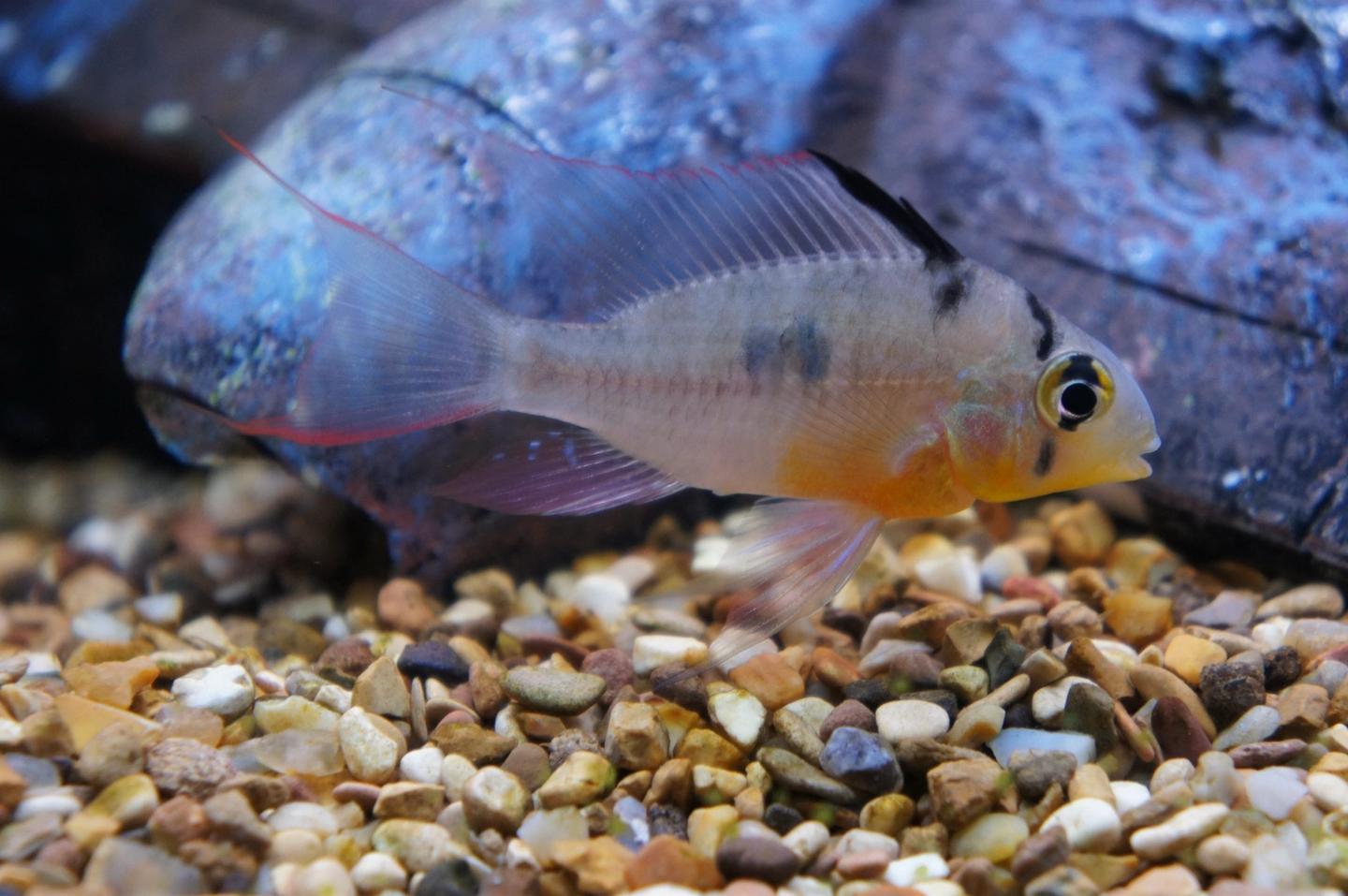
Cichlids are a family of roughly 1,800 accepted species, not one care type. Before buying, identify the exact species and source, then compare adult measurement, usable tank dimensions, social system, territory, tested water, diet and an exit plan. No family-wide minimum tank, water range or tank-mate list is safe.
Maintain these water conditions for optimal health and vibrant colors
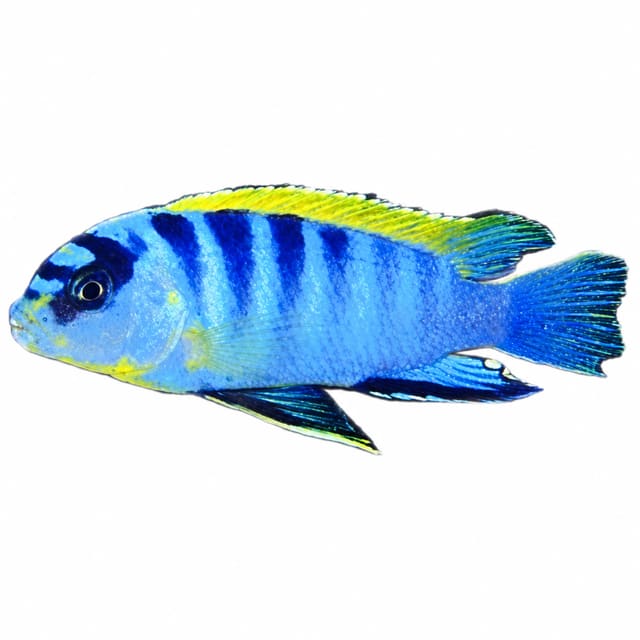
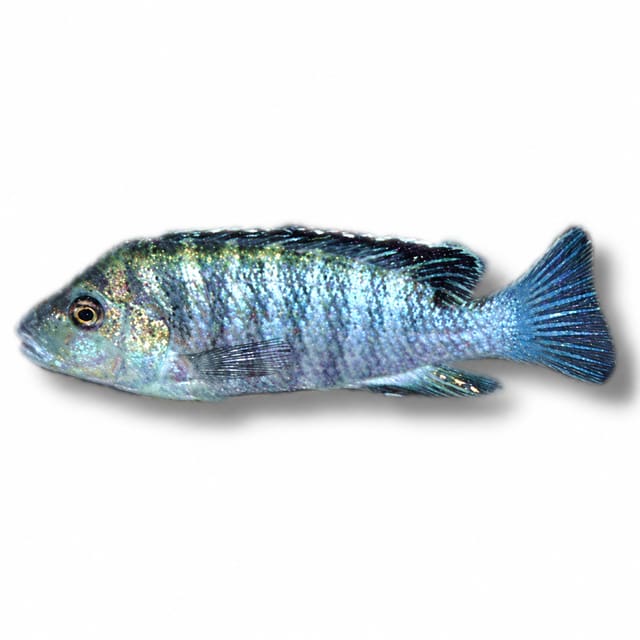
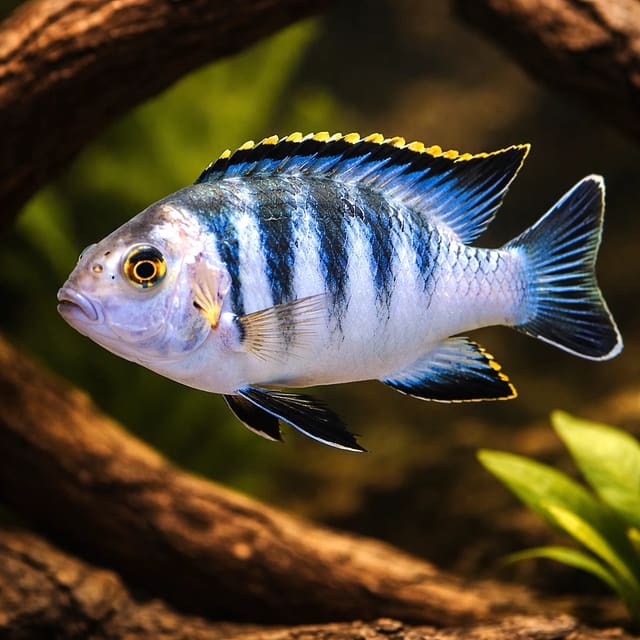
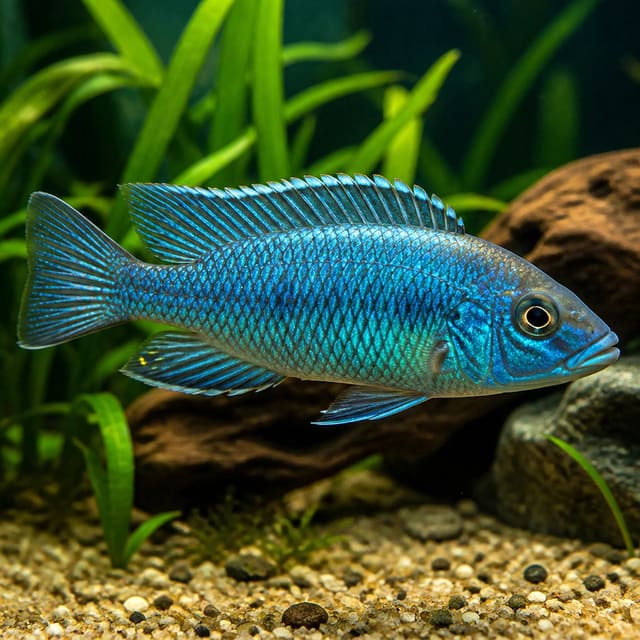
Nyassachromis boadzulu, the Boadzulu Cichlid, is a specialised Lake Malawi utaka for experienced African-cichlid keepers. It is an open-water zooplankton feeder rather than a rock-grazing mbuna: a settled adult male may develop a blue base, darker bars, a pale blaze over the head and dorsal margin, and subtle reddish or purplish colour through the body. Females and juveniles are predominantly silver. The fish needs a long, mature aquarium with open sand, restrained rockwork, hard alkaline water and calm, compatible companions.
This listing was formerly headed Cyrtocara boadzulu. That name remains useful as an older trade synonym, but the accepted name used by FishBase and current cichlid references is Nyassachromis boadzulu. FishBase records the species only from Lake Malawi, particularly Boadzulu Island and White Rock, and gives a 2018 IUCN assessment of Endangered. It is therefore a fish to buy deliberately, with enough space for its full adult life and with provenance questions asked before purchase.
| Accepted name | Nyassachromis boadzulu (Iles, 1960) |
|---|---|
| Common name | Boadzulu Cichlid |
| Older synonyms | Haplochromis boadzulu, Copadichromis boadzulu and Cyrtocara boadzulu |
| Family | Cichlidae; haplochromine Lake Malawi cichlid |
| Natural range | Endemic to Lake Malawi; published records include Boadzulu Island and White Rock |
| Adult planning size | Plan for males to about 17 cm and females to about 13 cm; FishBase lists 14 cm total length as its published maximum |
| Minimum aquarium | About 400 litres with at least 130 cm of swimming length; larger for mixed groups or more than one male |
| Temperature | 24-26°C as a conservative routine target |
| Water | Hard and alkaline; approximately pH 7.8-8.6 and 10-20 dGH, kept stable |
| Natural diet | Zooplankton captured in open water |
| Temperament | Generally calmer than forceful mbuna, but breeding males defend sand territories |
| Care level | Moderate: large-tank planning, water stability and social judgement are essential |
| Breeding | Maternal mouthbrooder; not a bonded-pair species |
| Conservation | Endangered in the IUCN assessment dated 23 May 2018 |
Each unit in the size selector is one fish of the chosen size. Selecting a quantity of two or four is a multi-buy; it does not create a guaranteed male/female pair, a bonded pair or two sexed pairs. None of the current size options is labelled male, female or sexed. Unless a future variant explicitly says otherwise, treat every size as unsexed stock. This is especially important with the smaller sizes, where dependable visual sexing is often impossible.
The available size options let you match the fish to an established group, but the listed length is shipping size, not adult size. A 3-4 cm juvenile still needs accommodation planned around an adult male that may approach 17 cm. Larger specimens can show more colour or sex-related features, yet size alone is not a sex guarantee. Ask before ordering if sex, collection locality, captive-bred status or a particular colour stage is essential to your project.
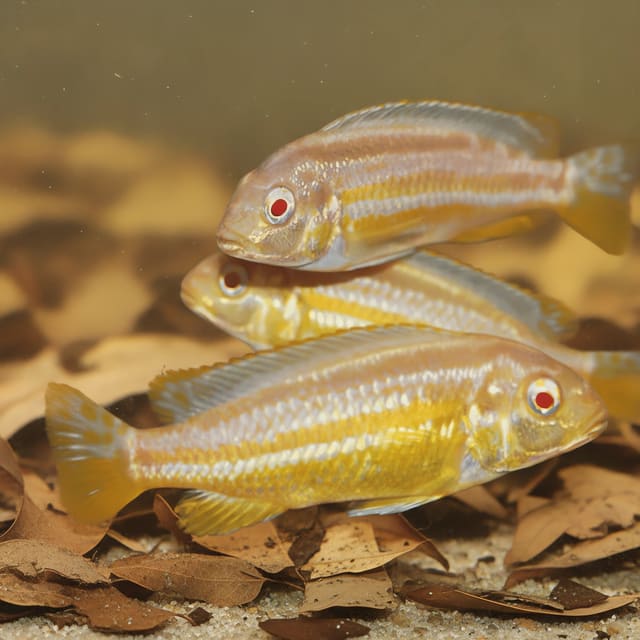
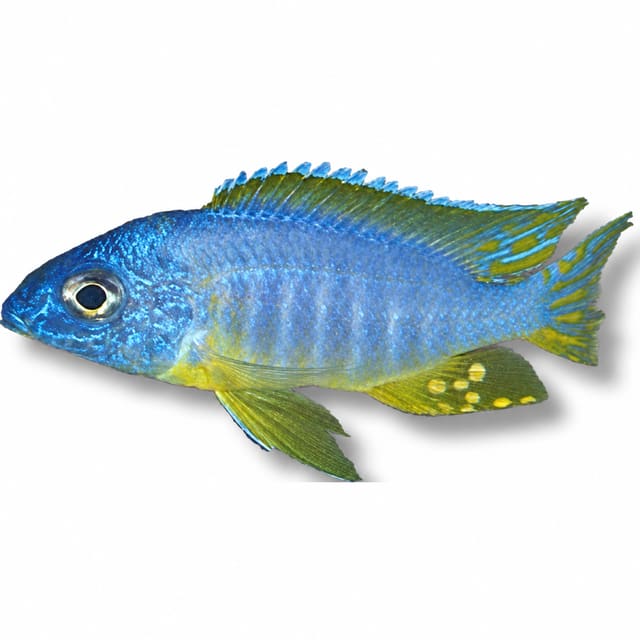
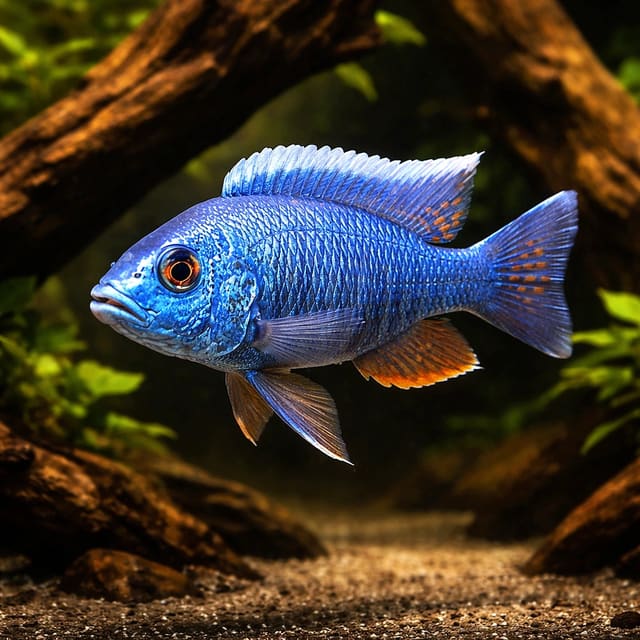
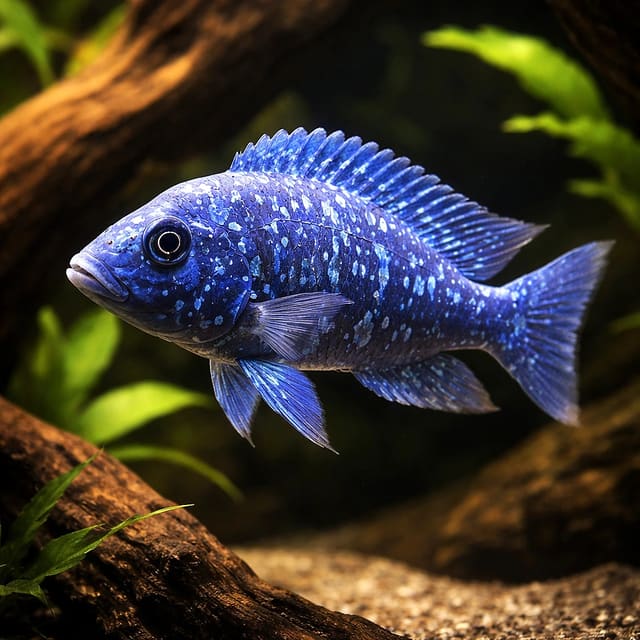
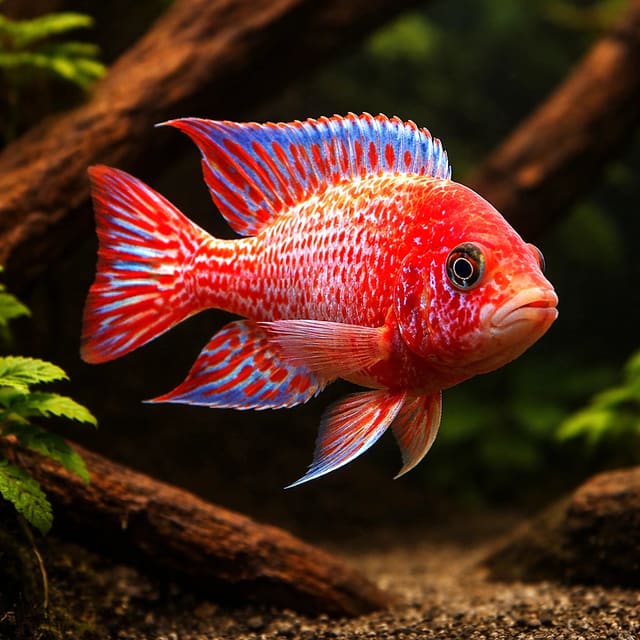
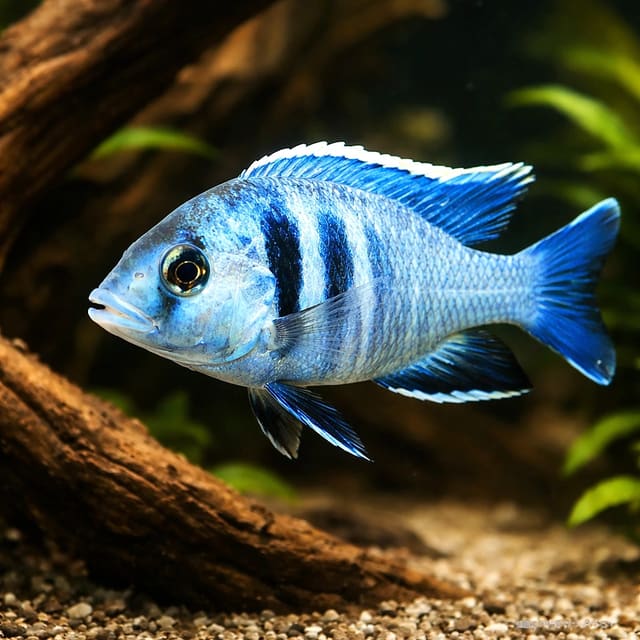
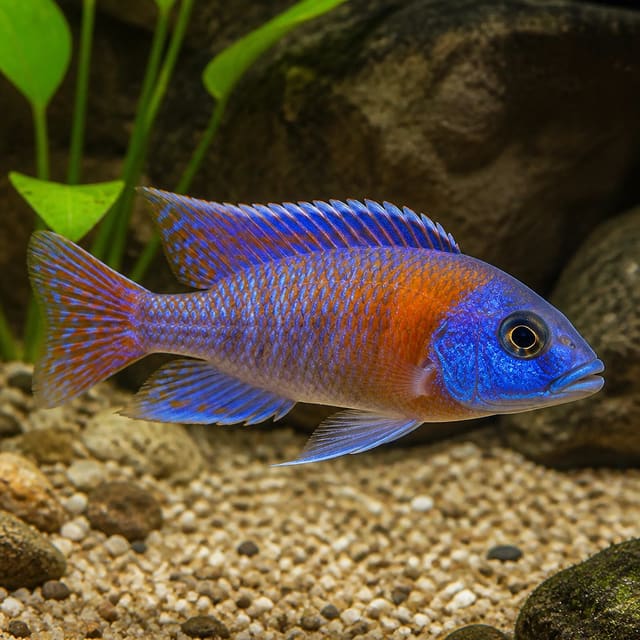
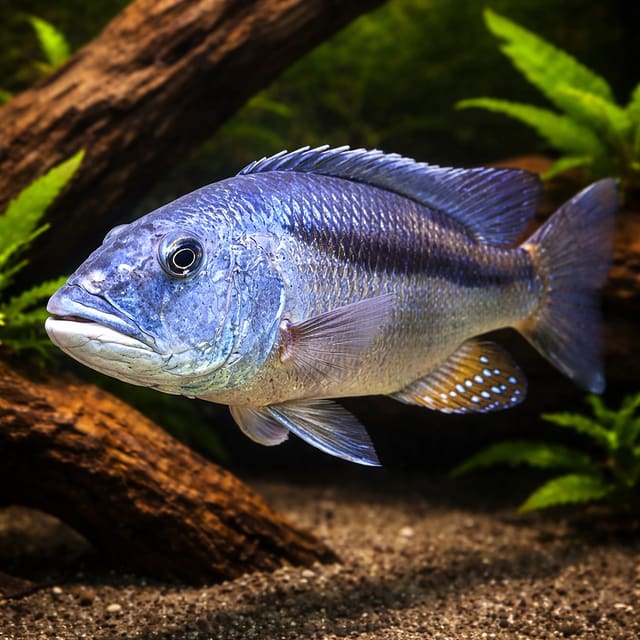
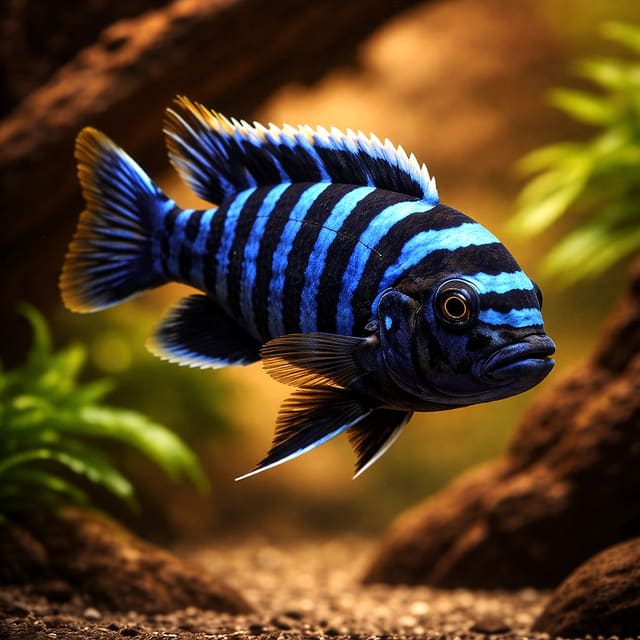
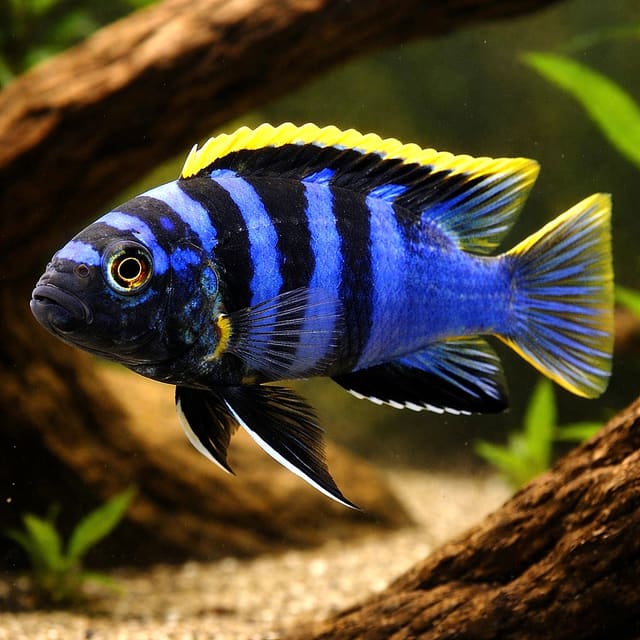
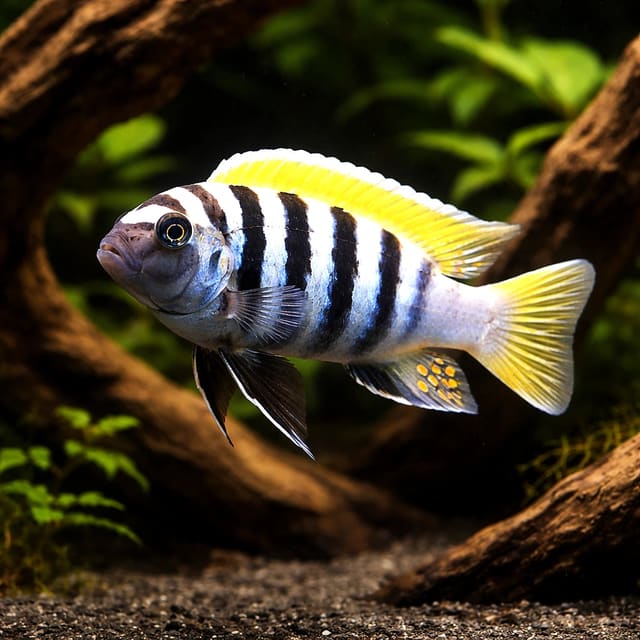
The gallery is representative, not a guarantee of the individual fish supplied. Sex, maturity, condition, lighting and individual colour can differ. The two-fish image does not establish a breeding pair, and its aquarium scenery is not a natural-habitat recommendation. Use the size selector and written care profile for ordering and planning; exact capture provenance is not certified here.
Thomas Derrick Iles described this fish in his work on Lake Nyasa zooplankton feeders under the original combination Haplochromis boadzulu. It subsequently appeared in the aquarium and scientific literature as Copadichromis boadzulu and Cyrtocara boadzulu. Current FishBase and specialist cichlid catalogues place it in Nyassachromis, so Nyassachromis boadzulu is the primary name on this listing. The older combinations are retained in this section to help keepers reconcile labels, books and supplier lists, not to suggest several different fish are being sold.
The genus name also tells part of the story: these are Lake Malawi haplochromines adapted to feeding in and above the water column. Hobbyists commonly group them with the utaka rather than with mbuna. That distinction matters. Mbuna are generally associated with rocky habitat and grazing or picking food from surfaces; this fish is associated with open sand, scattered rubble and plankton feeding. A generic "African cichlid" care sheet can therefore be actively misleading.
Do not confuse this species with Protomelas taeniolatus sold under locality or trade names containing "Boadzulu", such as Boadzulu Red Empress forms. The specialist Malawi reference used for this review explicitly warns that the name "boadzulu" has often been applied incorrectly to Protomelas taeniolatus from another locality. Protomelas boadzulu also appears in UK search data, but it is not the accepted identity of the fish on this page. Check the binomial, not only the locality word or colour.
| Name seen in trade or literature | How to interpret it here |
|---|---|
| Nyassachromis boadzulu | Accepted name used for this listing |
| Haplochromis boadzulu | Original combination from the species description |
| Copadichromis boadzulu | Older combination still common in aquarium references |
| Cyrtocara boadzulu | Older synonym and former title of this product |
| Protomelas taeniolatus "Boadzulu" | A different Lake Malawi cichlid; do not merge the care or identity |
Nyassachromis boadzulu is endemic to Lake Malawi. FishBase names Boadzulu Island and White Rock in the south-eastern arm of the lake. Specialist locality records also discuss fish around Crocodile Rocks and Kanchedza Island. Locality-labelled stock should never be assumed from the species name alone, however: this listing does not promise a particular collection location. Ask for documented provenance if maintaining a locality-pure breeding line is your aim.
FishBase describes the species over shallow open sand, also close to small rocks and bottom rubble. Specialist observations place it around 5-15 metres and describe mature males defending large sand craters in transition habitat. The fish feeds above this open substrate rather than scraping algae from a rock face. Its protrusible mouth is adapted to draw in zooplankton from the water column.
This habitat points directly to good aquarium design. The fish needs horizontal room to cruise, a broad area of fine sand and only enough secure rockwork to mark boundaries and provide retreat. A dense wall of caves may suit some mbuna, but it removes the open floor and water column this species uses. Equally, a bare tank gives subordinate fish nowhere to leave a dominant male's line of sight. The useful compromise is open centre and foreground space with a few stable rock groups towards the back and ends.
FishBase links the species to an IUCN Red List assessment of Endangered, completed on 23 May 2018 under criteria A2d and B1ab(v)+2ab(v). The official IUCN change table records its move from Vulnerable to Endangered in the 2018-2 release. This page does not infer a collection method or conservation benefit from that status. It does mean that accurate naming, traceable stock and avoiding accidental hybrids are more important than they would be for a generic colour strain.
This listing does not certify wild-caught or captive-bred origin, or a particular collection locality. Ask for documented provenance before building a locality-focused breeding project. Keep locality stock separate and do not sell hybrids under the species name.
Adult males are the conspicuous fish usually illustrated in the trade. Specialist descriptions give a blue ground colour with vertical barring, a horizontal mid-lateral stripe and a whitish to light-blue blaze that continues towards the dorsal fin. Depending on maturity, dominance, lighting and locality, the body may show subdued red, purple or bronze tones. A settled male in breeding condition can look dramatically different from the same fish when subordinate, newly transported or displayed under bright shop lighting.
Females and juveniles are primarily silvery. That difference is normal, not evidence that a pale fish is unhealthy or the wrong species. Small juveniles may show little of the adult male pattern, and a dominant tank mate can suppress another male's colour. Colour alone is therefore not a safe way to diagnose identity, health or sex. Look at body form, finnage, posture, breathing, feeding response and provenance together.
Published size figures differ. FishBase lists a maximum of 14 cm total length for male or unsexed fish, while two specialist Malawi references plan for males near 16-17 cm and females around 13 cm. Aquarium welfare should use the larger credible figure. This profile therefore treats 17 cm as the adult planning size while retaining the FishBase measurement for transparency. A long aquarium footprint matters more than trying to resolve the difference to a single centimetre.
| Feature | Adult male | Female or juvenile |
|---|---|---|
| Base colour | Blue in display condition, sometimes with subdued red or purple tones | Predominantly silver |
| Pattern | Vertical bars, mid-lateral stripe and a pale blaze may be visible | Lower-contrast patterning |
| Planning length | Allow up to about 17 cm | Females are reported around 13 cm; juveniles are sold much smaller |
| Sex certainty | More reliable only after maturity and expert assessment | Small sale sizes should be treated as unsexed |
Nordiska Ciklidsällskapet recommends a tank around 120 cm and 350 litres; the detailed Malawi locality reference recommends at least 130 cm and 400 litres. For adult planning, use the more conservative 400-litre, 130-cm minimum. A longer aquarium is preferable, especially in a mixed hap display or where more than one male is present.
Volume alone is not enough. A tall 400-litre aquarium with a short base is less useful than a long tank that provides uninterrupted swimming lanes and room for separate sand territories. Aim for generous front-to-back width as well as length, because a 17 cm male needs turning room around decor. The footprint must also leave enough open substrate for normal courtship behaviour rather than filling every surface with rock piles.
Plan around the adult group before buying juveniles. Four small fish can look lost in a large aquarium, but they will not remain small. If the long-term tank is unavailable, do not rely on upgrading later. Moving territorial cichlids between temporary tanks changes hierarchy, increases handling stress and can leave the final upgrade overdue just when males begin to mature.
For one specimen in a carefully chosen, calm Malawi community, the same 130 cm and 400-litre planning point remains sensible. For a male with several females, or a community containing several medium haps, go larger. Multiple adult males require substantial extra length, visual barriers and an exit plan if one fish becomes relentlessly dominant. Stocking formulas cannot guarantee compatibility.
Use fine, smooth sand as the main substrate. It reflects the natural open floor, allows mature males to shape display craters and is safer than sharp gravel around the mouth and fins. Rinse inert aquarium sand thoroughly before use. If the source water is too soft, adjust chemistry with a controlled remineralisation method rather than assuming any decorative substrate will create stable Lake Malawi conditions.
Place stable rock groups on the tank base before adding deep sand so digging cannot undermine them. Use a few broad structures to interrupt sight lines without turning the entire aquarium into a cave wall. Leave the centre and much of the foreground open. Every rock should be secure enough that a full-grown cichlid cannot shift it into the glass or trap another fish.
Plants are optional and are not a defining part of the natural habitat. Hardy attached plants may survive in a display tank, but they should not replace swimming space. Driftwood is also unnecessary, and the driftwood shown in the hero image is decorative rather than a habitat recommendation. Avoid large amounts of material that may lower pH or stain the water if your aim is a stable hard-water Malawi system.
Moderate lighting is sufficient. Intense light is not required to produce healthy colour; genetics, maturity, social status, diet and low stress matter more. Provide a regular day-night cycle and some shaded retreat around the rock groups. If a male is constantly dark, clamped or hidden, investigate water quality and social pressure rather than simply changing the lamp.
FishBase gives 24-26°C for the species. Some aquarium references use a wider 23-28°C or 24-28°C range, but a stable 24-26°C is a sensible routine target that stays within the published species range. Avoid running continuously at the warmest edge without a reason: warmer water holds less oxygen and can increase metabolic demand.
Maintain hard, alkaline water around pH 7.8-8.6 and roughly 10-20 dGH. The precise number is less important than keeping it appropriate and stable. Do not chase pH with repeated doses of short-lived chemicals. Measure the tap water's pH, KH and GH, choose a repeatable remineralisation method where necessary, and prepare replacement water consistently.
Ammonia and nitrite must remain at zero. Track nitrate and use water changes before it accumulates to a chronic high level. No universal weekly percentage suits every aquarium: stocking, feeding, source-water nitrate and filter capacity differ. Begin with a regular weekly schedule, test before and after changes, and adjust the volume from measured results. Large cichlids and protein-rich foods make visual clarity a poor substitute for testing.
| Parameter | Working target | Why it matters |
|---|---|---|
| Temperature | 24-26°C | Matches the FishBase species range while supporting oxygenation |
| pH | About 7.8-8.6 | Reflects a hard, alkaline Malawi-style system |
| General hardness | About 10-20 dGH | Provides the mineral-rich conditions used in specialist care |
| Ammonia | 0 mg/L | Any detectable result requires immediate investigation |
| Nitrite | 0 mg/L | Also toxic; confirms whether biological filtration is coping |
| Nitrate | Keep low and stable through measured maintenance | Trend is more useful than waiting for visible distress |
Use strong biological and mechanical filtration with good surface movement. The fish occupies open water and benefits from high dissolved oxygen, but flow should not pin it at one end of the tank. Direct returns across the surface and through open lanes, then check that calmer retreat areas remain behind rock groups. Clean mechanical media before flow collapses and protect biological media from untreated chlorinated water.
For wider preparation, read the water chemistry guide and confirm that the aquarium is fully cycled with the nitrogen-cycle guide. These are prerequisites, not problems to solve after livestock arrives.
FishBase is much more specific: wild Nyassachromis boadzulu feeds exclusively on zooplankton. Specialist accounts describe the protrusible mouth used to capture plankton in open water. Aquarium feeding should therefore be built around small animal-based items presented in the water column, not around algae wafers, large chunks of meat or a generic mixed-community flake.
Choose a high-quality small or medium slow-sinking pellet formulated for carnivorous or plankton-feeding Malawi haps. The food should stay available in midwater long enough for natural feeding rather than dropping immediately into crevices. Frozen cyclops, daphnia, mysis and appropriately sized brine shrimp can add variety. Match particle size to the fish and thaw frozen food before feeding.
Feed small portions once or twice daily, with one lighter day if body condition and the community allow. Spread food over more than one area so subordinate fish can eat without entering a dominant male's space. Watch every fish rather than judging the group by the fastest eater. A female that is mouthbrooding may stop feeding; a non-brooding fish that suddenly refuses food, spits repeatedly or isolates needs investigation.
Avoid routine heavy meals of rich mammal tissue or oversized foods. Do not use feeder fish. Bloodworm is not necessary and can be omitted where its source, storage or suitability is uncertain. Spirulina-containing food can appear as a minor ingredient in a balanced cichlid diet, but this species should not be managed as a specialised algae grazer simply because it comes from Lake Malawi.
| Food | Role | Practical use |
|---|---|---|
| Quality hap or planktivore pellet | Staple | Small, slow-sinking particles offered in controlled portions |
| Frozen cyclops or daphnia | Close to natural prey size | Useful variety, distributed through the water column |
| Mysis or brine shrimp | Supplement | Choose a particle size the fish can swallow cleanly |
| Large meaty chunks or feeder fish | Not appropriate | Do not use as a shortcut for colour or growth |
| Algae wafers as the main food | Wrong feeding model | This is a zooplankton feeder, not a rock-grazing mbuna |
This species is often described as peaceful relative to more forceful Lake Malawi cichlids. That does not mean passive or suitable for a general community aquarium. Adult males become territorial around breeding sites, display vigorously and can chase females or rival males across open water. Tank length, broken sight lines and compatible companions determine whether those displays remain manageable.
Specialist sources report that the fish can be maintained as a pair or as one male with several females. In a home display, a group with one male and multiple females can spread courtship attention, but only when the tank is large enough and the fish are actually sexed. Buying two unsexed juveniles does not create a breeding pair. They may become two males, two females or a mixed-sex combination, and cichlids do not arrive as guaranteed bonded partners unless a listing explicitly says so.
The quantity discount attached to this product must therefore be read only as a multi-buy price. The labels "pair" or "two pairs" in the current storefront control do not guarantee sex and should not be used as husbandry evidence.
If keeping one male with several females, provide enough refuge for every female and monitor whether one individual is being singled out. If keeping more than one male, use a substantially larger aquarium and be prepared to separate them. Overcrowding should not be presented as the default cure for aggression. It may suppress some territorial behaviour, but it also raises waste, oxygen demand and the consequences of a filter failure.
Choose medium, comparatively calm Lake Malawi haps or peacocks that share hard alkaline water and are not close lookalikes. Avoid tiny community fish, slow long-finned species, soft-water specialists and highly combative mbuna. A species name on a compatibility chart is never a guarantee: individual sex, size, tank footprint, introduction order and existing hierarchy can change the result.
Potential comparison fish on this site include the Star Sapphire Hap, Blue-Gold Peacock, Jackson’s Nkata (Haplochromis jacksoni ahli) and Red Dragon Peacock. These links are for comparing adult size, diet, water and temperament. They are not automatic recommendations to place every listed species together.
| Companion type | Assessment | Reason |
|---|---|---|
| Calmer medium Lake Malawi haps | Often workable with planning | Similar chemistry and swimming style; compare adult size and male colour |
| Suitable Aulonocara | Possible in a large tank | Can share alkaline conditions, but timid fish may be suppressed |
| Very aggressive mbuna | Avoid | Different territorial intensity and habitat use can overwhelm this open-water fish |
| Small tetras, guppies or rasboras | Avoid | Wrong social context and often incompatible chemistry or size |
| Lake Tanganyika cichlids | Do not mix by continent alone | They have species-specific diet, territory and social requirements |
| Similar-looking males | Use caution | Colour and body-shape resemblance can trigger persistent rivalry |
Browse the Lake Malawi and Victoria cichlid category or the curated African cichlid collection to compare alternatives. The broader cichlid care guide explains why family-level rules still need to be narrowed to the species in front of you.
Nyassachromis boadzulu is a maternal mouthbrooder. A mature male constructs and defends a large crater in open sand, intensifies his display and courts females over the site. After spawning, the female carries the developing brood in her mouth. Specialist observations give an incubation period of about 21 days and broods of roughly 30-50 fry, but temperature, female size and disturbance can alter the outcome.
This reproductive strategy is the opposite of a bonded cichlid pair guarding eggs together. The male does not share mouthbrooding care, and a quantity of two unsexed fish should never be marketed as a guaranteed breeding pair. A breeding project begins with correctly identified, mature, sexed and preferably documented stock, plus enough females and space to prevent courtship pressure concentrating on one fish.
Do not repeatedly net or strip a holding female as a casual experiment. Disturbance can cause premature release or brood loss. If a separate brooding or fry tank is used, match temperature and chemistry precisely and move the fish with as little handling as possible. Newly released fry can take appropriately small foods such as newly hatched brine shrimp and fine specialist fry feed. Maintain excellent water quality without creating strong flow that exhausts them.
Avoid crossing locality forms or similar species merely to produce saleable colour. Record parent identity, source and spawning dates. Because the wild species is Endangered and the trade name has been confused with other Boadzulu cichlids, truthful lineage records are especially valuable.
Prepare the aquarium before dispatch. Temperature, pH, GH and KH should already be stable, ammonia and nitrite must be zero, and established tank mates should have enough room after the newcomer is added. Rearranging one or two boundary rocks immediately before introduction can reduce ownership of a single established territory, but do not dismantle the tank or destabilise secure structures.
Follow the receiving instructions supplied with the order because bag condition and journey time affect the safest method. Temperature matching is important, but a long open-bag acclimation can allow bag-water chemistry to change after carbon dioxide escapes. Keep lights low, minimise delay, avoid pouring shipping water into the display and never leave the fish unattended in an open container. If the bag is damaged, the fish is distressed or the water is unusually cold, contact support and prioritise oxygenated, temperature-matched water.
Quarantine is strongly recommended. Use a cycled, covered tank large enough for the arrival size, with inert shelter, mature filtration and separate nets and siphons. Observe breathing, appetite, waste, skin, eyes and fins for several weeks. Quarantine should not be a tiny uncycled box; poor temporary housing can create the very symptoms it is meant to detect.
During the first week, offer small familiar foods and remove leftovers. A newly moved fish may show reduced colour while it settles. Heavy breathing, rolling, prolonged surface gasping, repeated collision, clamped fins or complete loss of balance are not normal settling behaviour. Test water and oxygenation immediately, then seek an aquatic veterinarian or experienced fish-health professional when signs persist.
No precise species-specific lifespan is promised here. Treat the fish as a long-term cichlid commitment and plan equipment, floor loading, maintenance access and backup aeration accordingly. Adult housing should not depend on an optimistic lifespan estimate.
Common warning signs are non-specific: loss of appetite, spitting food, abdominal swelling, hollowing, abnormal faeces, rapid breathing, flashing, clamped fins, skin marks or social isolation. Start with water tests, temperature, oxygen and a review of aggression. Similar symptoms can have very different causes; blind medication can delay the right response and damage biological filtration.
Malawi cichlids are often discussed under the loose label "Malawi bloat", but abdominal swelling is a sign rather than a single diagnosis. Diet errors, internal parasites, bacterial disease, organ dysfunction and chronic stress can overlap. Isolate when necessary, document symptoms and timing, and seek a diagnosis instead of applying several medications at once.
| Routine | Checks |
|---|---|
| Daily | Breathing, posture, appetite, social pressure, temperature and equipment flow |
| Weekly | Ammonia, nitrite, nitrate trend, pH stability, water change and mechanical-media condition |
| Monthly | GH/KH trend, impeller and hose flow, rock stability, heater comparison and backup equipment |
| After any new fish | Extended observation for disease and changes in hierarchy |
| A good choice when | Choose another fish when |
|---|---|
| You have a mature 400-litre-plus, 130-cm-plus Malawi aquarium | Your tank is 200-250 litres or shorter than the specialist footprint recommendation |
| You can maintain stable hard alkaline water | Your established aquarium is soft and acidic |
| You want a comparatively calm open-water hap and understand male territories | You need a peaceful general-community fish |
| You can provide a planktivore diet and observe each fish feeding | You want one generic food for every tank inhabitant |
| You accept that small variants are unsexed and adult colour varies | You require a guaranteed male, female or breeding pair without an explicitly sexed variant |
| You value accurate taxonomy and can keep similar species or localities separate | You plan to mix unidentified Malawi cichlids for colour alone |
The accepted name used by FishBase is Nyassachromis boadzulu (Iles, 1960). The species was originally described as Haplochromis boadzulu and has also been sold as Copadichromis boadzulu and Cyrtocara boadzulu.
No. Forms of Protomelas taeniolatus may use Boadzulu in a trade or locality name, but they are different fish. This listing is for Nyassachromis boadzulu. Compare the complete scientific name, not the word Boadzulu alone.
FishBase lists 14 cm total length as its published maximum, while specialist aquarium references report males around 16-17 cm and females around 13 cm. Plan the aquarium around a 17 cm adult male.
Use about 400 litres with at least 130 cm of length as the minimum planning point for adult swimming and social behaviour. A longer aquarium is preferable for a mixed hap display or additional males.
No. Each unit is one fish of the selected size, and current variants are not labelled by sex. A quantity of two is a multi-buy, not a guaranteed male/female pair or bonded pair.
Small juveniles are usually predominantly silver and may not show dependable adult sex differences. Unless a variant explicitly states male or female, treat it as unsexed. A larger size can make assessment easier but is still not a guarantee.
Keep it in stable hard alkaline water, approximately pH 7.8-8.6 and 10-20 dGH. A routine temperature of 24-26°C stays within the FishBase range. Ammonia and nitrite must remain at zero.
Its documented wild diet is zooplankton. Use a quality slow-sinking hap or planktivore pellet, supported by suitably sized frozen cyclops, daphnia, mysis or brine shrimp. Feed controlled portions in the water column.
No. It is an open-water haplochromine commonly discussed with utaka. It uses open sand and feeds on zooplankton, so its layout and diet should not be copied from a rock-grazing mbuna profile.
Comparatively calm, similarly sized Lake Malawi haps or selected Aulonocara can be considered in a large aquarium. Avoid highly aggressive mbuna, tiny community fish and close male lookalikes. Monitor individuals and keep a separation plan.
A male prepares and defends a sand crater, then courts females over the site. The female is a maternal mouthbrooder and carries the brood for about 21 days in specialist observations. The species does not form a shared-care bonded pair.
No individual fish is guaranteed to match a gallery image. Sex, maturity, pattern and colour can differ, and the two-fish image is not evidence of a sexed pair. The images’ exact capture or creation provenance is not certified here.
Yes. FishBase reports an IUCN Endangered assessment dated 23 May 2018. That is a dated species assessment, not proof of this stock’s collection method or origin; ask for documented provenance where it matters.
Read the current delivery and live-arrival terms before ordering, including eligibility, receiving steps and any guarantee conditions. Check current offers at checkout rather than relying on an old discount code.
Before ordering, select the correct shipping size, confirm that the adult aquarium is already suitable, and remember that quantity does not guarantee sex. Check the delivery date and make sure someone can receive the parcel promptly. The Live Arrival Guarantee applies to eligible livestock orders under the published receiving and evidence conditions; it is not a promise of a particular delivery speed, sex, colour stage or future compatibility.
Choose an appropriate adult setup before checkout. Read the delivery and live-arrival page for current delivery areas, receiving steps and guarantee conditions, and arrange to receive the fish promptly.
No reviews for this item yet. Bought one? Honest reviews only, good or bad.
What customers say about ordering from us
I have a small group of long finned mountain minnows. So was delighted to be able to order ten of this variety to increase the genetics in my tank . The ones I recieved are healthy but it’s to early to give a verdict on wether they are of a long finned type since they are small currently.
Gordon Walker · 23 Sept 2026
100% success travel and "installation". Pleased with quality of purchase. The Siamese fighter a bit "shy" so have not yet seen him at his best yet but looking good. Happy customer. GG
George E Garratt · 21 Sept 2026
Reviews of our shop, collected by Judge.me, an independent third-party review collector. Newest first.