Advanced
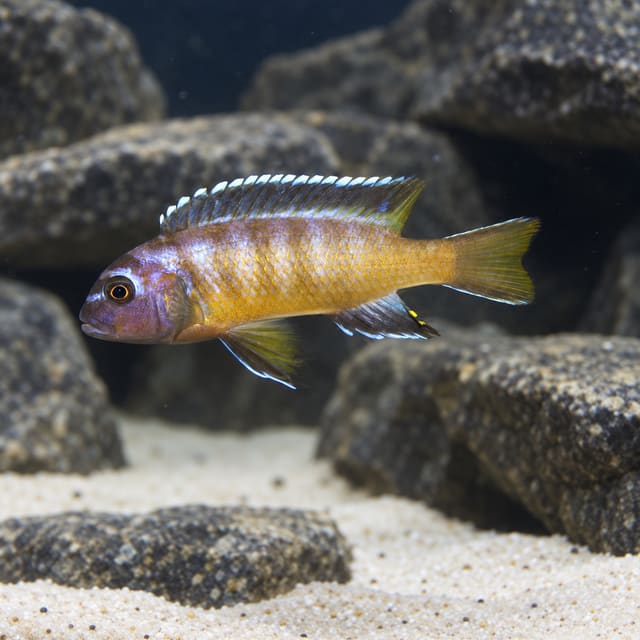
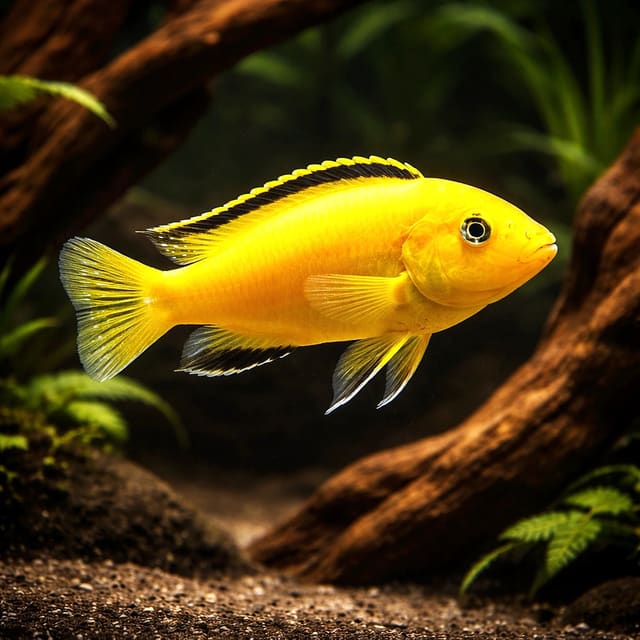
Albino Golden Mbuna (Melanochromis auratus albino)
24–28°C · pH 7.6–8.8 · 205L
£9.99

Trade-listed Jalo Reef Afra, treated here as Cynotilapia zebroides, for a mature rock-led Lake Malawi aquarium. One unsexed fish per selected 3-4 cm, 4-5 cm or 6-7 cm grade; not a pair.
Cynotilapia zebroides
Save when buying multiple fish. Each quantity is one fish; sex and pair formation are not guaranteed unless the selected variant explicitly states them.
Trade-listed Jalo Reef Afra, treated here as Cynotilapia zebroides, for a mature rock-led Lake Malawi aquarium. One unsexed fish per selected 3-4 cm, 4-5 cm or 6-7 cm grade; not a pair.
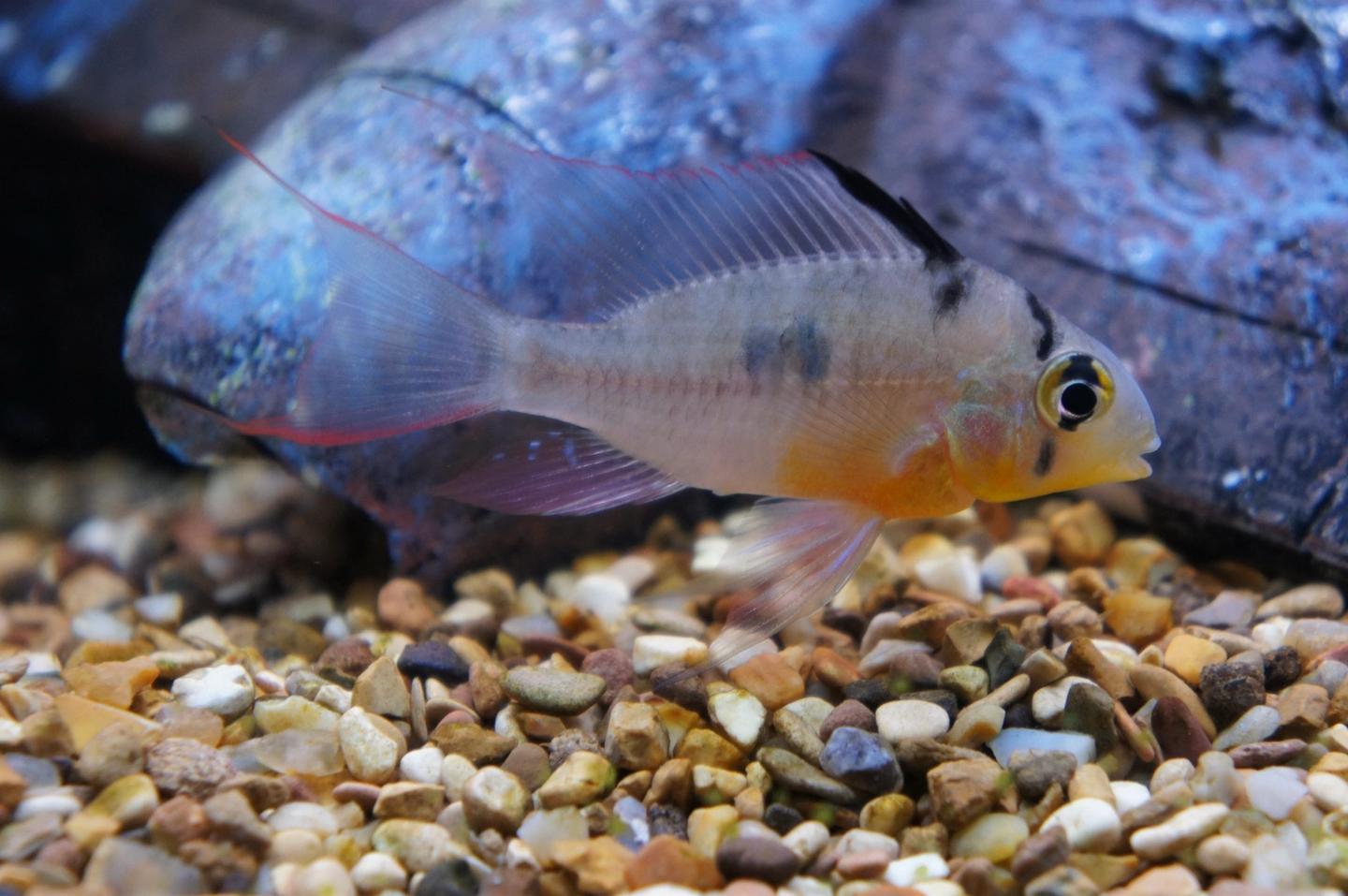
Cichlids are a family of roughly 1,800 accepted species, not one care type. Before buying, identify the exact species and source, then compare adult measurement, usable tank dimensions, social system, territory, tested water, diet and an exit plan. No family-wide minimum tank, water range or tank-mate list is safe.
Maintain these water conditions for optimal health and vibrant colors
Jalo Reef Afra is the long-established aquarium-trade name for a small, rock-associated Lake Malawi mbuna now treated as Cynotilapia zebroides. Older stock lists, including our stock records behind this listing, call it Cynotilapia afra Jalo Reef. Both names matter when researching the fish, but they are not equally current: this page uses C. zebroides as the primary scientific identity and keeps C. afra as a clearly labelled historic trade bridge.
Each selected quantity is one unsexed live fish in the chosen approximate 3-4 cm, 4-5 cm or 6-7 cm grade. It is not a male, female, sexed pair, bonded pair or fixed-ratio group. Pair Pricing is a quantity discount only. Choosing two fish does not establish their sexes, compatibility or breeding potential.
FishBase records 9.3 cm maximum standard length for Cynotilapia zebroides. Standard length stops at the base of the tail, so adult planning should allow for roughly 10-12 cm total length and for the territory of a mature mbuna rather than only the dimensions of the juvenile dispatched. This is an active, socially complex cichlid for a mature hard-water aquarium, not a peaceful general community fish or a first addition to a newly cycled tank.
This listing retains the Jalo Reef trade label and the three approximate commercial size grades. The label is not a wild collection or breeding-line certificate, and reference images are not the individual fish received.
| Listing point | What is supplied | What is not promised |
|---|---|---|
| Sale unit | One live fish per selected quantity | A pair, trio, harem or school |
| Sex | Unsexed | Male, female or a requested ratio |
| Size choice | Approximate 3-4 cm, 4-5 cm or 6-7 cm supplier grade | Exact millimetres, age or maturity |
| Identity | Trade-listed Jalo Reef form; current entity Cynotilapia zebroides | Genetic testing or certified wild locality |
| Appearance | A living fish whose colour varies with sex, rank, age and condition | The exact colour shown in an image |
A size grade is a practical dispatch band, not an adult-size category. The smallest fish needs the same adult aquarium plan as the largest option. Do not choose a juvenile because it fits a temporary tank or assume that selecting two different grades creates a male and female.
Stock, price and selectable grades can change. The live selector remains the source for current availability and cost; care copy should not freeze inventory figures into a page that may be indexed for months.
The name problem is real rather than cosmetic. Cynotilapia afra is a valid species, but a 2011 re-examination of the type material found that much aquarium stock historically called C. afra belonged with Microchromis zebroides. The current combination used by FishBase is Cynotilapia zebroides. Jalo Reef aquarium fish are widely placed in that zebroides complex, while supplier and retail stock lists often continue to use the older afra label.
| Name | Use on this page | Interpretation |
|---|---|---|
| Cynotilapia zebroides | Primary scientific entity | Current name used by FishBase for the familiar zebroides complex |
| Jalo Reef Afra | Primary trade name | Useful, recognisable aquarium label; not a formal species name |
| Cynotilapia afra Jalo Reef | Historic supplier and search bridge | Explains older stock lists without presenting the identification as current consensus |
| Dogtooth cichlid | Common-name bridge | Refers to the conical outer teeth associated with the genus; not a claim that the fish is predatory |
| Jalo Reef locality | Supplier trade label | Not independently certified for this commercial batch |
This distinction protects both search clarity and livestock records. A customer using the older name can still find the fish, while a keeper maintaining locality or breeding records receives the updated entity. If offspring are produced, retain the supplier wording and the uncertainty rather than silently relabelling them as certified wild-locality stock.
Colour alone cannot resolve the taxonomy. Several Lake Malawi mbuna develop blue ground colour and dark vertical bars. Reliable identification depends on provenance and diagnostic morphology, not a bright photograph or a search result.
| Feature | Evidence-led planning value | Boundary |
|---|---|---|
| Accepted entity | Cynotilapia zebroides | Supplier retains historic C. afra Jalo Reef wording |
| Adult size | 9.3 cm maximum standard length; plan around 10-12 cm total length | Not every individual reaches the maximum |
| Habitat | Rocky Lake Malawi habitat with access to open water | An aquarium is a welfare model, not a replica of collection coordinates |
| Temperature | Retailer planning guide 24-28°C; practical overlap often 24-26°C | Stability and oxygen matter more than chasing one number |
| pH | Retailer planning guide 7.5-8.5; hard alkaline water | Measure source water, GH and KH before changing chemistry |
| Hardness | Retailer planning guide 10-20 dGH | A repeatable mineral recipe is safer than intermittent correction |
| Diet | Planktivore and rock-biocoating grazer; balanced mbuna feeding | Neither algae-only nor repeated rich animal food |
| Temperament | Territorial mbuna with variable individual and sex effects | No universal community or group-size guarantee |
| Breeding context | Maternal mouthbrooder | Supplied fish are not sexed, paired or breeding-ready |
Published species data, retailer care guidance and supplier size grades answer different questions. Species records describe known biology; supplier information describes the commercial line and grading system. Retailer recommendations translate both into a cautious aquarium plan. Where evidence is incomplete, this page says so rather than filling the gap with a precise-looking lifespan or ratio.
| Selected grade | Practical meaning | Planning point |
|---|---|---|
| 3-4 cm | Small juvenile commercial band | Needs protected intakes, suitable food particles and careful competition monitoring |
| 4-5 cm | Intermediate juvenile band | Still unsexed; colour and social rank can change substantially |
| 6-7 cm | Larger immature or developing fish | May assert territory sooner; not proof of sex or adulthood |
Approximate grades can overlap because living fish are not manufactured objects. Fasting before dispatch, posture and measurement method can affect the apparent figure. The grade does not certify age, sex, maturity or final colour.
When adding a smaller fish to an established Malawi aquarium, assess the size and behaviour of every resident. A technically compatible water range does not protect a juvenile from intimidation, exclusion from food or predation. A larger grade may reduce some size disparity, but it does not remove territorial risk.
For one adult-planned fish, use at least a 120 x 45 cm footprint and roughly 250 litres as conservative retailer guidance. Multiple fish or a mixed mbuna community need substantially more usable horizontal territory, filtration capacity and a credible way to remove an aggressor or injured fish.
| Planning question | Why it matters | Ready when |
|---|---|---|
| Is the tank at least 120 cm long? | Territories and escape routes use length, not only litres | Rock zones can be separated by broken sight lines |
| Is the front-to-back depth at least 45 cm? | Shallow layouts force fish into the same lanes | Rocks, open feeding water and retreat routes all fit |
| Can filtration support adult biomass? | Mbuna are active and food reaches rock gaps | Ammonia and nitrite remain zero under the intended load |
| Is spare accommodation mature? | Compatibility can fail after hierarchy or maturity changes | A fish can be separated immediately without an emergency cycle |
The tank-volume tool can calculate nominal litres, but it cannot judge territory quality. Two tanks with the same volume can offer very different usable space. A long, deep layout with stable rock zones is more relevant than a tall display with little horizontal separation.
Do not buy for a future upgrade that is not already available. Juveniles grow while hierarchy develops, and delays can turn a temporary arrangement into chronic conflict.
Use stable piles or modules that create several visual zones, shaded retreats and open water for plankton-like feeding behaviour. Place heavy rocks on a secure base rather than loose sand, then add substrate around them. A digging fish must not be able to undermine a tower.
Break direct lines of sight from one end of the aquarium to the other. A cave with only one entrance can become a trap if another fish controls the exit. Prefer connected routes and openings large enough for the intended fish but not shaped so tightly that a growing cichlid can wedge itself.
Leave open swimming and feeding space. Published work describes Jalo Reef material as a planktivore and biocover grazer, so a wall of sealed caves is not a complete habitat plan. The fish should be able to move between rock faces and adjacent water without crossing one dominant individual's single uninterrupted territory.
Plants are optional and the gallery backgrounds are not a care instruction. If plants are used, choose species that tolerate hard alkaline water and protect their roots. Do not sacrifice rock stability or swimming space simply to reproduce a scene.
| Measurement | Planning range | Management point |
|---|---|---|
| Temperature | 24-28°C retailer planning range | 24-26°C is a practical overlap; avoid rapid swings |
| pH | 7.5-8.5 retailer planning range | Interpret with KH; do not chase pH using repeated unmeasured doses |
| GH | 10-20 dGH retailer planning range | Use a consistent source-water or remineralisation recipe |
| Ammonia | 0 mg/l | Any detectable result requires immediate investigation |
| Nitrite | 0 mg/l | Never use a new fish to test an unfinished cycle |
| Nitrate | Low and controlled | Track the trend and respond with stocking, feeding and water changes |
Test the source water before selecting buffers or mineral salts. Crushed coral, limestone and commercial Malawi salts behave differently and may continue changing chemistry after the first measurement. If reverse-osmosis water is used, remineralise it to a measured recipe; pure RO is not a suitable default for this mineral-rich system.
Record temperature, pH, GH, KH or conductivity, ammonia, nitrite and nitrate. The water-matcher can help compare broad requirements, but measured aquarium values remain the evidence. Do not make a major chemistry correction immediately before delivery.
Warm water carries less dissolved oxygen, while rockwork can create poorly circulated pockets. Use mature biological filtration, visible surface movement and enough mechanical capture to prevent food and waste collecting behind structures. The aim is oxygen-rich clean water, not a single harsh jet across the whole tank.
Choose filter capacity for adult biomass and feeding, not merely the volume printed on the aquarium. Guard intakes for the smallest grade. Position outlets so that water moves around and behind rocks, while still leaving calmer areas where a fish can rest without continuous exertion.
Check flow every day. A canister or internal filter may continue making noise while its actual output falls because media or an intake is blocked. Never switch mature filtration off for long maintenance sessions, and preserve biological media by cleaning it gently in removed aquarium water or another suitable dechlorinated source.
A battery air pump is useful contingency equipment during a power interruption or hot weather. Rapid breathing, surface gathering or holding directly in filter flow requires immediate checks of temperature, oxygen, ammonia and nitrite before assuming an infectious disease.
Published work is more informative: Jalo Reef fish in the historic C. afra usage are described as small planktivores and biocover grazers. A suitable captive plan therefore combines a complete plant-rich mbuna staple with controlled aquatic invertebrate or plankton-like variety.
| Food type | Role | Caution |
|---|---|---|
| Complete plant-rich mbuna granule or flake | Measured staple with vitamins, minerals and fibre | Choose particles the selected grade can swallow whole |
| Quality Malawi chips | Alternative staple texture and surface-feeding opportunity | Use as part of the ration, not unlimited grazing |
| Artemia, cyclops or daphnia | Controlled plankton-like animal variety | Portion carefully and protect water quality |
| Clean cultured live foods | Foraging enrichment | Use reliable cultures that do not introduce pests or pollution |
| Repeated rich bloodworm or fatty animal food | Not a staple plan | Can distort nutrition and add unnecessary waste |
| Mammalian or poultry meat | Not recommended | Poor nutritional fit for this feeding ecology |
Tropical Malawi Chips can form part of a varied plan when the particle size suits the fish. No single food replaces portion control, observation and stable water.
Feed modest amounts that are eaten promptly. Watch each fish swallow food rather than assuming that a portion added to the aquarium reached every individual. Remove persistent waste from rock gaps and reduce the ration if body condition becomes heavy or nitrate rises faster than expected.
Smaller juveniles often benefit from more than one modest meal rather than one large portion. Larger, settled fish may need fewer feeds depending on body condition and tank temperature. There is no universal spoonful or minute rule because pellet density, stocking and filtration differ.
Distribute food across more than one position in a group aquarium. A dominant fish may intercept the obvious feeding point while a subordinate animal appears to participate but swallows nothing. Persistent hiding, spitting, weight loss or a hollow abdomen needs investigation.
Do not use colour-enhancing food as a substitute for correct identity or husbandry. Sex, rank, maturity, lighting and lineage all influence colour. Excess feeding cannot force a juvenile or female to match an idealised male-form image.
Jalo Reef Afra is a territorial mbuna. Intensity varies with individual, sex, maturity, aquarium footprint, rock layout, resident hierarchy and access to food. It should not be described as universally peaceful or perfectly social, but neither should every individual be assumed to attack every compatible fish.
| Purchase choice | What it means | What it does not mean |
|---|---|---|
| Quantity one | One unsexed fish | A guaranteed display male |
| Quantity two | Two unsexed fish and any eligible quantity price | A male-female pair or compatible bond |
| Quantity three or more | Several unsexed fish requiring a complete adult territory plan | A safe harem, school or fixed ratio |
| Different size grades | Different approximate dispatch bands | Different sexes or social roles |
Ratio-based plans can be useful in deliberately sexed breeding groups, but this listing cannot guarantee the animals needed to create one. Buying extra fish to discover their sex later transfers the welfare problem to the keeper, who must already have separation and rehoming capacity.
Warning signs include repeated full-length chases, exclusion from food, torn fins, a fish trapped behind equipment, rapid breathing without a water-quality cause, or one individual never leaving a top corner. Waiting for a hierarchy to "sort itself out" is not a plan when injury or starvation is developing.
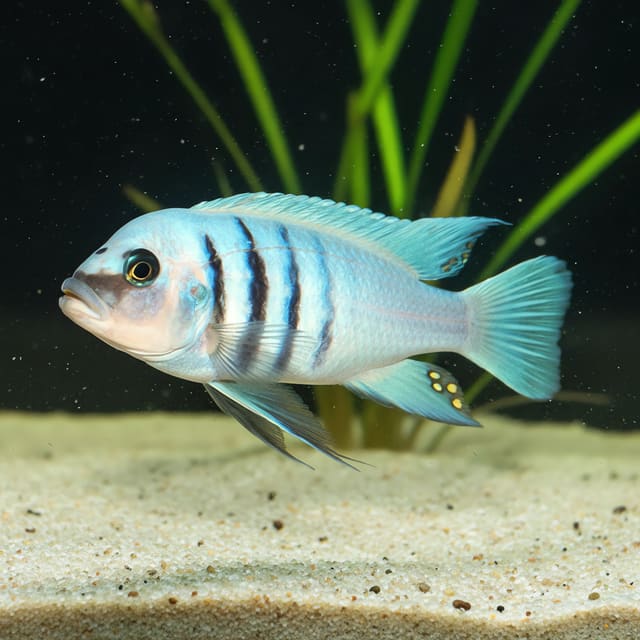
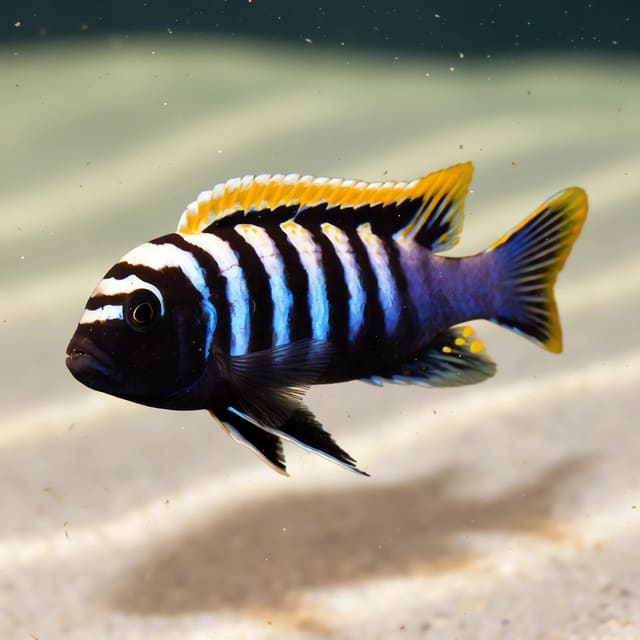
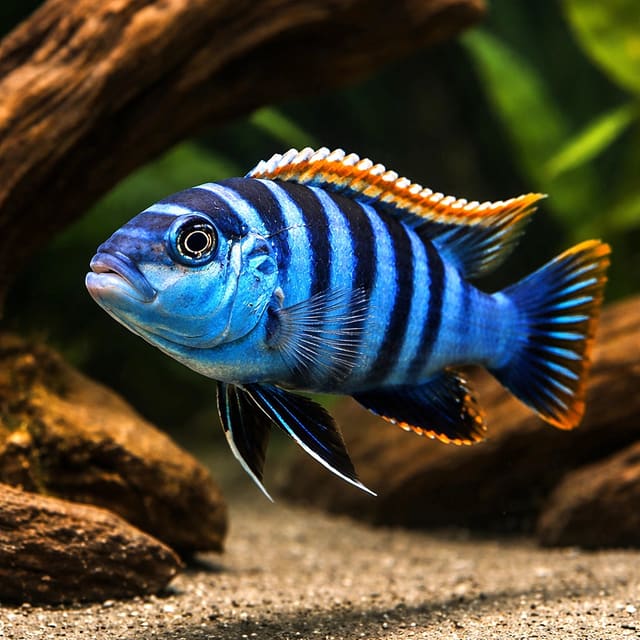
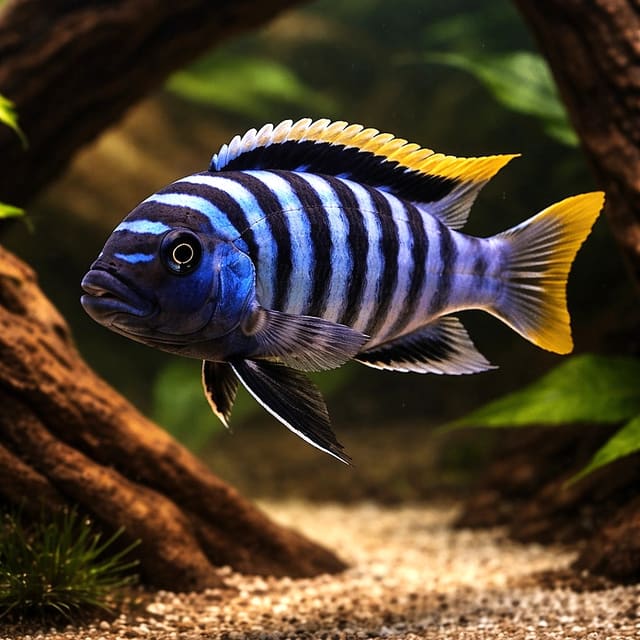
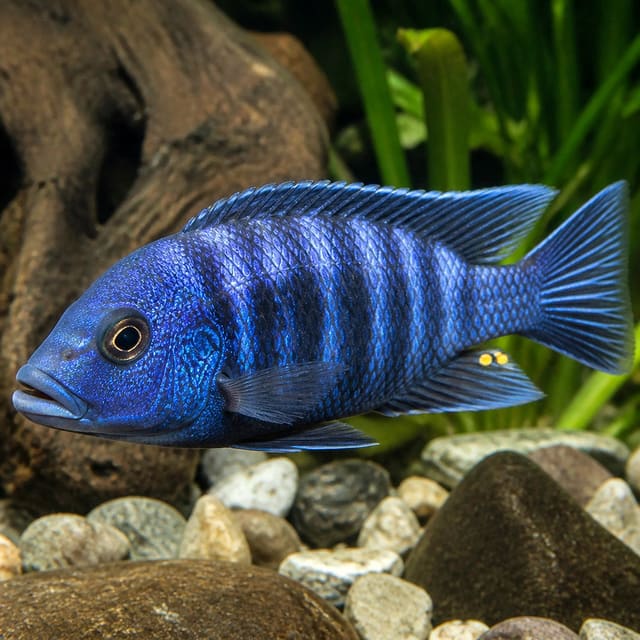
Dominant males in the zebroides complex can show a blue ground colour with dark vertical bars and yellow or orange in the dorsal region. Females, juveniles and subordinate males may be much less vivid. Mood, lighting, transport and background also alter appearance.
The supplier does not sex the fish. Neither size nor one photograph can guarantee sex, and a larger grade is not automatically male. Anal-fin spots, dorsal colour or barring may contribute to an experienced assessment but are not a retail promise.
Jalo Reef is retained as the supplier's trade locality wording. Without documented collection, breeder and generation records, it should not be converted into a wild, F1 or pure-line claim. Keep that distinction in any future breeding or transfer records.
| Candidate | Assessment | Main question |
|---|---|---|
| Species-focused zebroides setup | Most controlled, but still requires sex and territory management | Can incompatible fish be separated immediately? |
| Robust Malawi mbuna of different appearance | Conditional in a substantially larger aquarium | Do adult size, diet, rank and territory overlap safely? |
| Peacocks or haps | Comparison only, not automatic companions | Will feeding style and aggression allow every fish to thrive? |
| Similar blue barred Cynotilapia or zebra forms | High caution | Could rivalry, mistaken mate choice or hybridisation compromise welfare and records? |
| Peaceful soft-water community fish | Avoid | Water chemistry and behaviour are both mismatched |
| Shrimp and small invertebrates | Avoid as intended companions | They may be harassed or eaten and cannot manage the cichlid's waste |
The Lake Malawi cichlid guide provides broader planning context, while the Cynotilapia supplier category is for browsing, not a compatibility list. Shared genus or lake does not prove that two fish belong together.
Observe feeding and routes after every addition. A fish can tolerate a neighbour as a juvenile and become incompatible after growth, sex expression or spawning behaviour changes. The adult plan must be able to change with the animals.
Hybridisation is not a theoretical footnote. Gerlai's controlled work with Jalo Reef fish under the historic C. afra name showed that status and territory could affect mate choice and that spawning with Sciaenochromis fryeri produced fertile offspring. Other work has documented hybridisation involving translocated Cynotilapia and zebra-type mbuna.
Do not mix similar forms casually if offspring may be retained or distributed. Record the supplier name, current taxonomic interpretation, purchase date and any known lineage. If parentage is uncertain, label offspring as uncertain or hybrid rather than assigning the more valuable or fashionable name.
Colour matching is not lineage verification. A blue barred juvenile from a mixed Malawi aquarium cannot be identified reliably from appearance alone. Responsible records protect future keepers and reduce the spread of falsely labelled stock.
Cynotilapia are maternal mouthbrooders: after spawning, the female carries developing eggs and early fry in her mouth. That species-level context does not mean the supplied fish are mature, sexed, compatible or ready to breed.
A fish holding eggs may stop feeding and become vulnerable to harassment. Breeding plans therefore need calm retreat space, excellent water, suitable food before spawning and a decision about whether separation can be achieved without causing more stress. The display aquarium must not depend on repeated pursuit and netting through unstable rockwork.
Do not buy two fish and describe them as a breeding pair. Any two unsexed juveniles can mature as two males, two females or an incompatible male and female.
| Observation | Check first | Reason |
|---|---|---|
| Rapid breathing | Temperature, oxygen, ammonia, nitrite and aggression | Environmental stress can resemble infection |
| Refusal of food | Hierarchy, mouthbrooding possibility, water and mouth condition | One symptom has several very different causes |
| Swollen abdomen or abnormal faeces | Diet, portion, water and veterinary assessment | Do not label every swelling "Malawi bloat" without diagnosis |
| Torn fins or missing scales | Chasing routes, rock edges and tank mates | Medication cannot correct an unsafe social layout |
| Hiding continuously | Feeding access, light, cover, hierarchy and water | Chronic exclusion may occur without dramatic fighting |
| White spots, ulcers or persistent lesions | Quarantine and aquatic-veterinary advice | Treatment depends on the actual cause |
Never medicate blindly. Confirm water quality and isolate when appropriate, then use a diagnosis-led treatment safe for the species and system. Copper and other medications can harm invertebrates and biological filtration; dosage depends on water volume and product, not guesswork.
Body condition is more useful than chasing maximum colour. Photograph the fish after settling under consistent light if a baseline is needed. Watch posture, breathing, appetite, fin position and recovery after disturbance.
A separate mature quarantine aquarium is strongly preferred. Match hard alkaline chemistry and temperature, provide inert cover and use equipment that can be disinfected between groups. Quarantine is for observation as well as disease control: it reveals feeding ability, breathing, body condition and waste without competition from established fish.
Do not share wet nets, siphons or filter media between quarantine and display unless they have been managed deliberately. Observe for a meaningful period rather than treating a few symptom-free days as proof. Seek qualified advice when disease is suspected.
Before release into the display, reassess social space. Rearranging selected rock boundaries can interrupt an established territory, but do not destabilise the entire structure or combine a major rescape with a large chemistry change.
Prepare the aquarium, tests, dim lighting and transfer equipment before the parcel arrives. Inspect the fish promptly. If there is a genuine arrival concern, follow the current guarantee instructions and take clear photographs while the bag remains sealed before discarding packaging or moving the fish through several containers.
Temperature equalisation is only one part of acclimation. Compare water chemistry and follow the new-fish acclimation guide. The acclimation timer can support the process, but it cannot measure pH, hardness or the condition of the fish.
Once a transport bag is opened, gas exchange changes the chemistry of the water. Do not leave the fish in warming opened transport water for an unnecessarily long ritual. Transfer without adding transport water to the aquarium where practical, keep lighting low and avoid immediate crowding at the glass.
| Period | Useful observation | Warning sign |
|---|---|---|
| First hours | Steady breathing, upright posture and access to a retreat | Gasping, rolling, inability to settle or direct attack |
| First meal | A small suitable particle swallowed after recovery | Repeated spitting, choking or complete exclusion |
| Days 2-3 | Predictable use of rock and open water | Continuous top-corner hiding or filter-clinging |
| Days 4-7 | Stable appetite, body condition and normal waste | Weight loss, lesions, swelling or escalating chasing |
| After any concern | Measured water results and written observations | Multiple unmeasured treatments applied together |
Offer a modest first meal only after breathing and posture settle. Remove uneaten food. A newly transported fish may not display full colour or feed immediately, but persistent refusal or deterioration requires action rather than repeated feeding attempts.
Keep a brief record of temperature, water tests, food taken and social position. Trends are easier to recognise when they are written down.
| Frequency | Checks | Useful action |
|---|---|---|
| Daily | Temperature, breathing, posture, appetite, wounds and filter flow | Record any departure from the settled baseline |
| At each feed | Whether every fish actually swallows food | Adjust particle size, amount or delivery points |
| Weekly | Nitrite, nitrate, pH, equipment and visible waste; ammonia when indicated | Complete a measured matched water change |
| Monthly | Rock stability, intake guards, hose condition, lid gaps and body condition | Correct slow trends before they become emergencies |
| After any stocking or layout change | Routes, breathing, feeding and hierarchy | Use the prepared separation plan when needed |
The exact water-change percentage depends on stocking, feeding, nitrate trend and source water. Match temperature and chemistry, dechlorinate correctly and avoid exposing mature biological media to untreated tap water. Stagger major work so a filter clean, rockscape rebuild, chemistry change and new fish do not all happen on the same day.
Vacuum accessible waste without dismantling every territory. Check behind rock modules with a torch and maintain circulation routes. A clear front pane does not prove that hidden areas are clean.
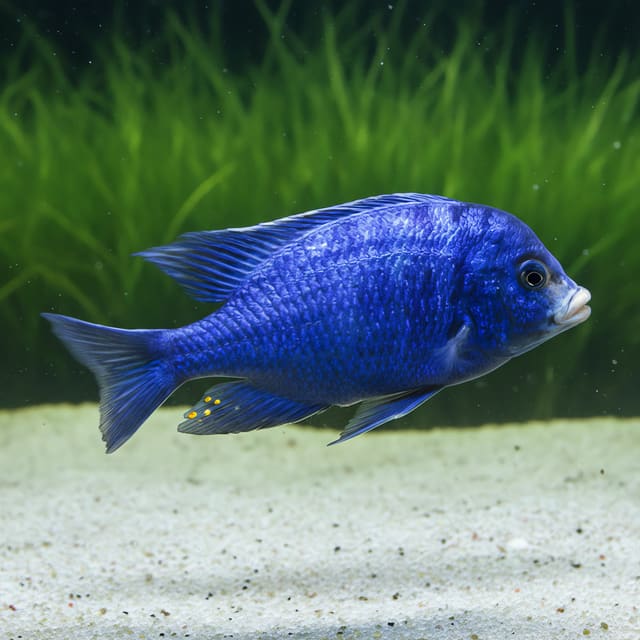
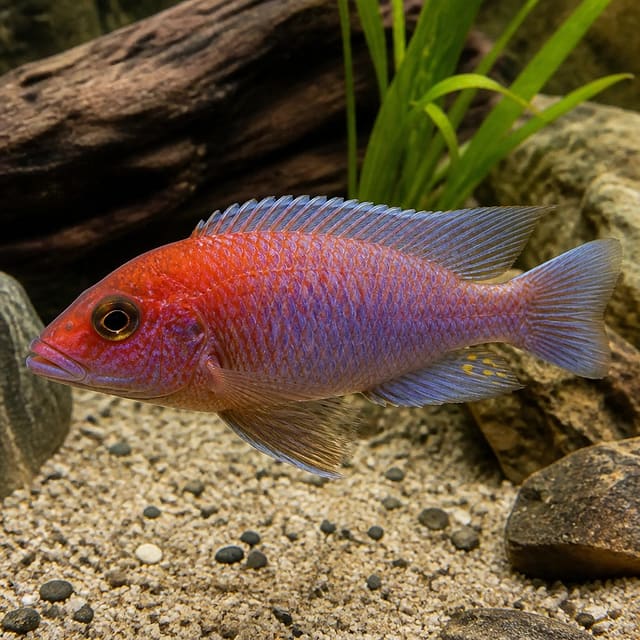
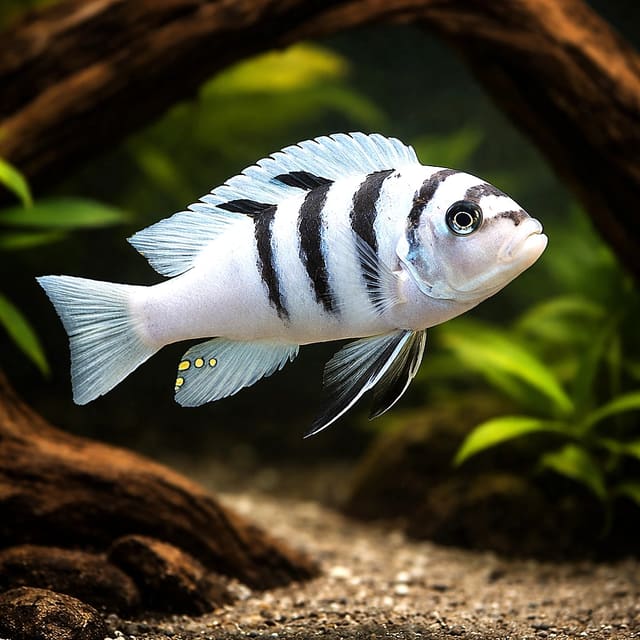
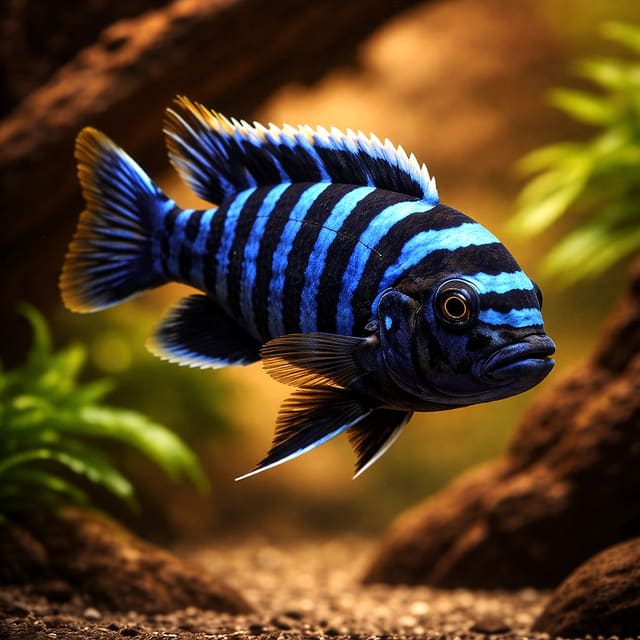
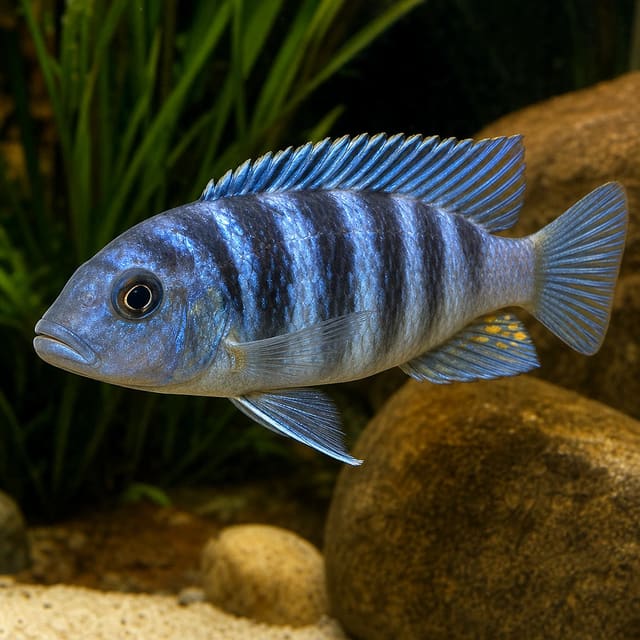
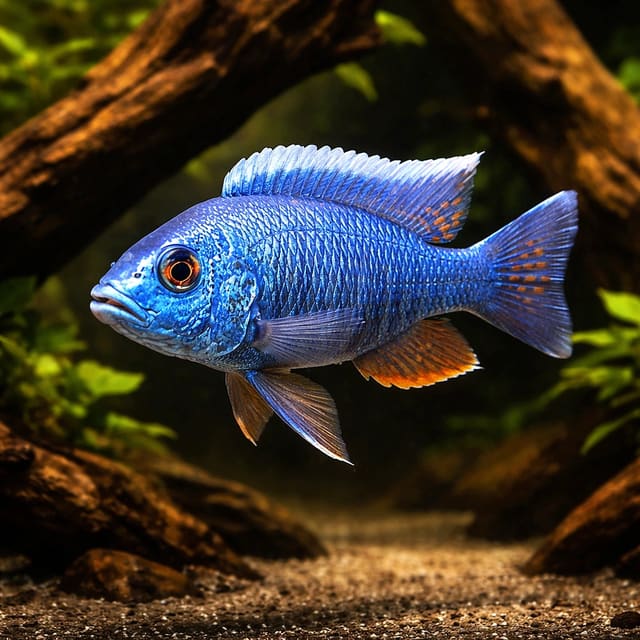
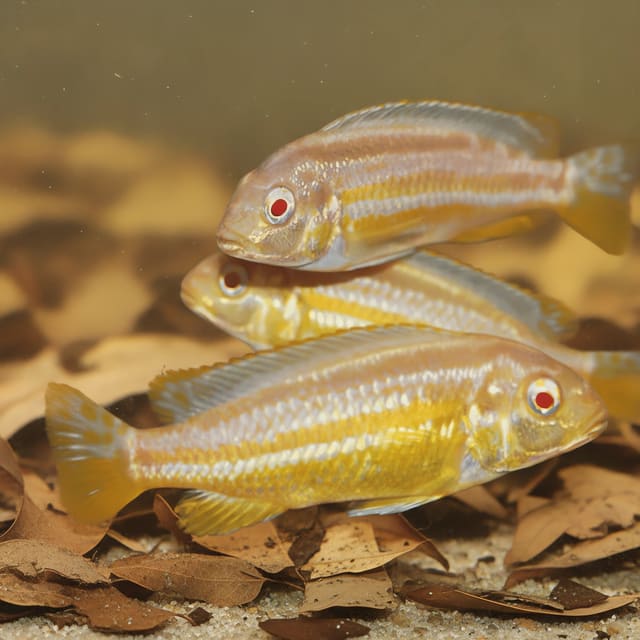
Reference images are not the individual fish received. Colour changes with maturity, condition and social rank; photographs do not guarantee sex, grade or exact adult appearance.
A scene showing two fish does not mean a pair is included. Plan around secure rockwork, territories and hard alkaline water rather than recreating a planted gallery background.
Use the gallery to understand a broad visual theme only. Base the purchase on the written sale unit, adult plan, water, diet and social requirements.
| Listing | Useful comparison | Do not assume |
|---|---|---|
| Gallireya Reef Hara Dogtooth Cichlid | Another trade-listed Cynotilapia-type form | Shared genus wording makes it a safe companion or the same locality |
| Albino Golden Mbuna | Contrasting mbuna colour and identity | Different colour prevents all territorial conflict |
| Usisya Mara Rock Mbuna | Another rock-associated Malawi trade form | Similar habitat automatically gives safe cohabitation |
| Spindle Hap Cichlid | A non-mbuna Malawi comparison | Shared lake means identical diet and social behaviour |
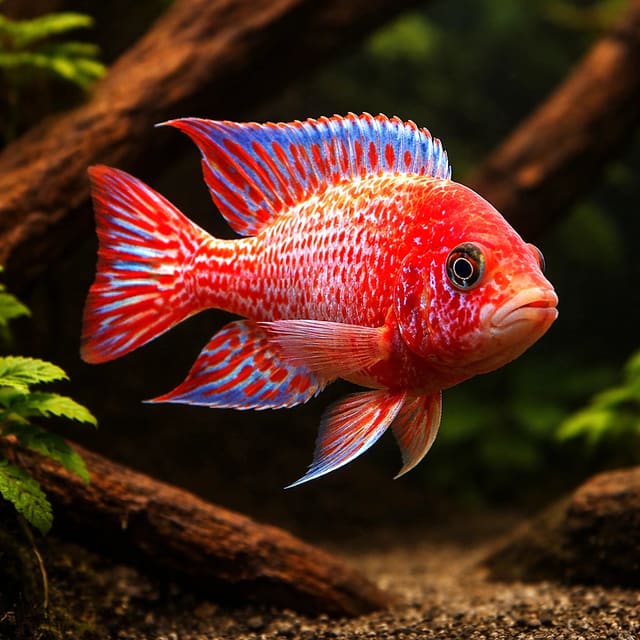
| Red Dragon Peacock Cichlid | A peacock comparison with different body and display context | Every colourful Malawi cichlid belongs in one stocking plan |
These links support comparison, not a ready-made community. Read the adult size, diet, water, social and provenance information for each fish, then plan the complete aquarium before combining them.
| Question | Ready answer |
|---|---|
| Is the aquarium mature? | Ammonia and nitrite remain zero under the intended feeding load. |
| Does the adult footprint fit now? | At least 120 x 45 cm and roughly 250 litres are available for the one-fish starting plan. |
| Is hard alkaline water repeatable? | Temperature, pH, GH and KH are measured through routine maintenance cycles. |
| Is rockwork secure? | Structures cannot be undermined and routes cannot become traps. |
| Is sex uncertainty acceptable? | The purchase does not depend on receiving a male, female or pair. |
| Can conflict be managed? | Mature heated and filtered separation accommodation is ready. |
| Is suitable food available? | Plant-rich mbuna staple and controlled plankton-like variety fit the selected grade. |
| Are the images understood? | They are representatives, not the exact fish or identification evidence. |
| Can delivery be received promptly? | Someone can inspect, document and acclimate the fish under current terms. |
If any answer is no, finish the system before ordering. Readiness is cheaper and kinder than emergency equipment, rushed rehoming or treatment after an avoidable failure.
Taxonomy and our stock records can change. New documented provenance should be added to the record rather than used to erase the earlier supplier wording.
Select the required approximate size grade and quantity from the live options. Each quantity remains one unsexed fish. Review the current Live Arrival Guarantee and delivery terms before checkout, arrange prompt receipt and follow the evidence instructions if there is an arrival concern.
No reviews for this item yet. Bought one? Honest reviews only, good or bad.
What customers say about ordering from us
I have a small group of long finned mountain minnows. So was delighted to be able to order ten of this variety to increase the genetics in my tank . The ones I recieved are healthy but it’s to early to give a verdict on wether they are of a long finned type since they are small currently.
Gordon Walker · 23 Sept 2026
100% success travel and "installation". Pleased with quality of purchase. The Siamese fighter a bit "shy" so have not yet seen him at his best yet but looking good. Happy customer. GG
George E Garratt · 21 Sept 2026
Reviews of our shop, collected by Judge.me, an independent third-party review collector. Newest first.