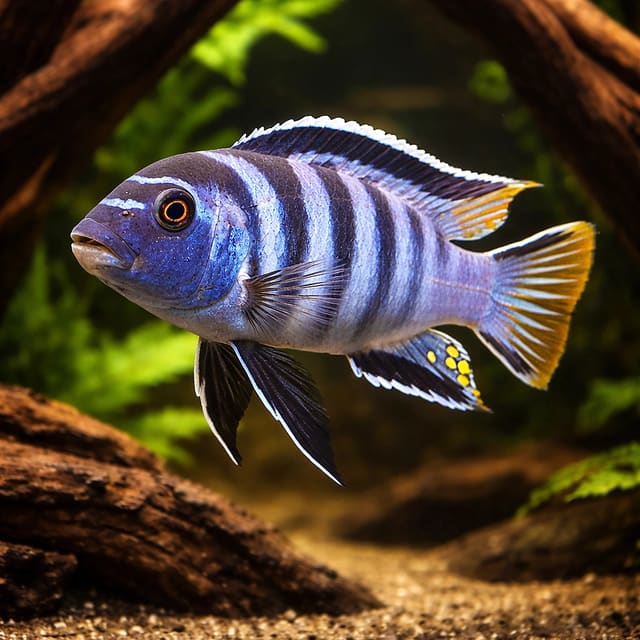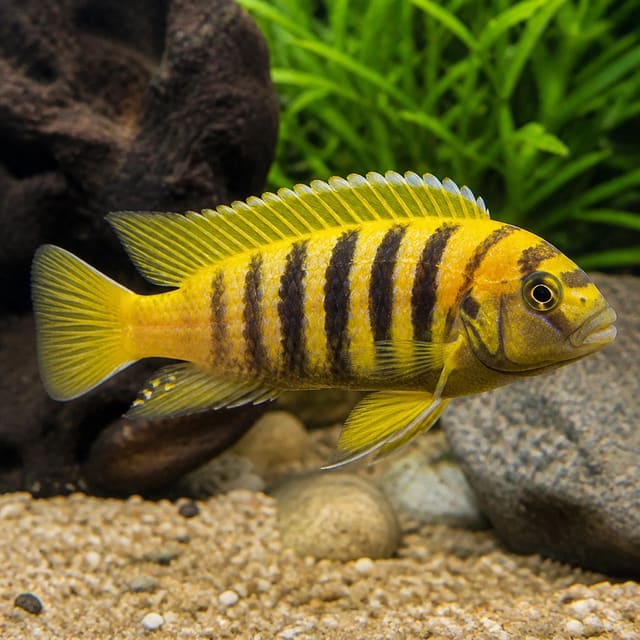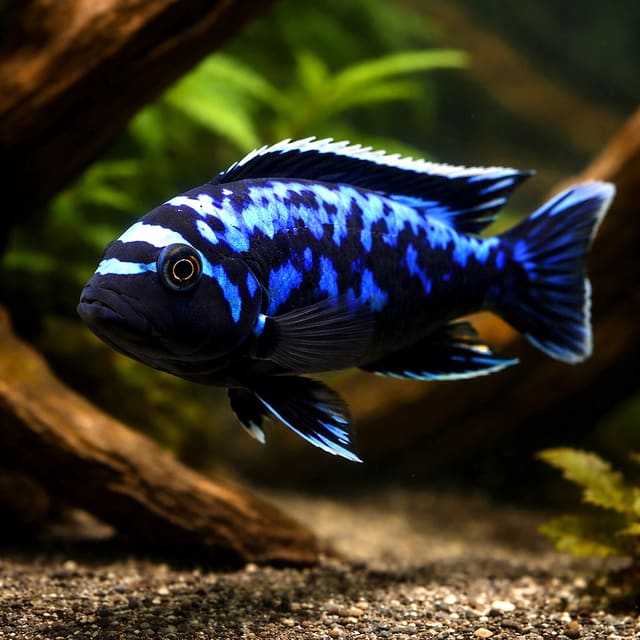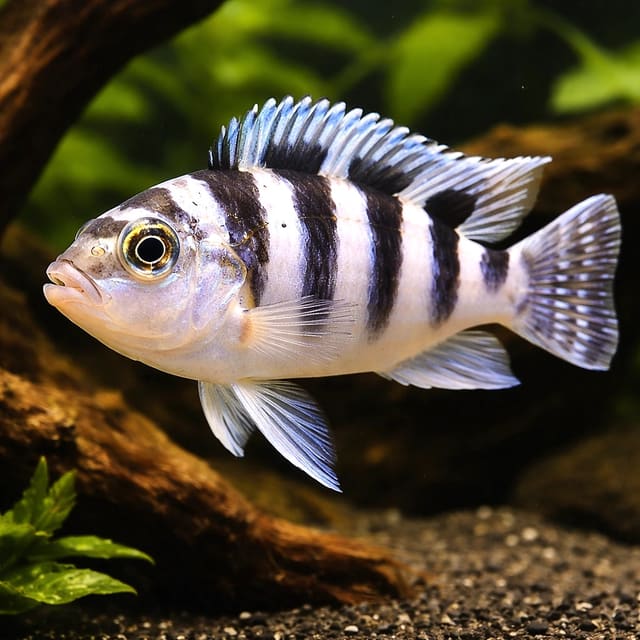
Jalo Reef Afra (Cynotilapia zebroides)
24–28°C · pH 7.5–8.5

Usisya Mara Rock Mbuna (Metriaclima usisyae) is a locality-linked Lake Malawi rock cichlid for a mature 300L+ hard-water aquarium. Each quantity is one unsexed fish in the size selected, not a guaranteed pair.
Metriaclima usisyae
Usisya Mara Rock Mbuna (Metriaclima usisyae) is a locality-linked Lake Malawi rock cichlid for a mature 300L+ hard-water aquarium. Each quantity is one unsexed fish in the size selected, not a guaranteed pair.

Cichlids are one of the most diverse fish families in the hobby. From tiny apistogrammas to massive oscars, this guide covers the basics of keeping them well.
Maintain these water conditions for optimal health and vibrant colors
Usisya Mara Rock Mbuna is the locality-linked Lake Malawi cichlid now formally described as Metriaclima usisyae. Older aquarium and supplier records may call it Pseudotropheus elongatus "Usisya", "Mara Rock" or Metriaclima sp. "elongatus usisya". Those older names are useful for recognising the trade form, but they are not the current species identity.
This is an active rock-dwelling mbuna for a mature, hard-water African cichlid aquarium. It is sold as an individual fish in the selected size, not as a sexed pair, breeding pair or guaranteed male/female group. Young fish may not show adult colour, and sex cannot be promised unless a variant explicitly says so.
| Accepted name used here | Metriaclima usisyae Li, Konings & Stauffer, 2016 |
|---|---|
| Also published as | Maylandia usisyae in sources that prefer Maylandia for the genus |
| Older trade names | Pseudotropheus elongatus "Usisya/Mara Rock" and Metriaclima sp. "elongatus usisya" |
| Family | Cichlidae |
| Natural range | Lake Malawi; the formal description records Usisya and Mara Rocks, with specialist locality records also noting nearby populations |
| Habitat | Intermediate rock-and-sand areas, including submerged rocky reef habitat |
| Adult planning size | Allow for about 13-14 cm; individual size varies with sex, age and source line |
| Long-term aquarium | About 300 litres or larger with a footprint around 120 cm or more for a managed group or mixed mbuna community |
| Temperature | 23-28°C; stable mid-range conditions are usually easier to manage than either extreme |
| Water | Hard, alkaline and well oxygenated; a practical pH planning range is 7.5-8.5 |
| Feeding ecology | Aufwuchs and loose material combed from rock surfaces, with plankton also reported; not accurately described as a strict herbivore |
| Temperament | Territorial mbuna; generally described as less combative than some elongatus-type fish, but breeding males can still be forceful |
| Breeding | Maternal mouthbrooder; spawning is possible in suitable conditions but is never guaranteed |
| Sale unit | One unsexed fish per product quantity in the size variant selected |
Choose the available size on the product page before adding the fish to your basket. The listed options are approximate dispatch sizes, not separate species and not final adult sizes. A quantity of one means one fish. Ordering two does not create a guaranteed pair because juvenile mbuna cannot reliably be sold as one male and one female without explicit sexing.
Length bands are practical trade measurements. Fish are living animals, so a specimen may sit close to either edge of the selected band, and posture or tail position can alter a quick visual measurement. Colour also changes during transport, acclimation, social adjustment and maturity. Select a size that is safe with the fish already in your aquarium rather than choosing only by the brightest catalogue appearance.
| Displayed size option | What it means | Planning point |
|---|---|---|
| 3-4 cm | Small juvenile dispatch size | Expect subdued colour and allow for substantial growth |
| 4-5 cm | Juvenile dispatch size | Still normally too young for dependable visual sexing |
| 5-6 cm | Larger juvenile/subadult dispatch size | Match carefully with the size and confidence of existing fish |
| 6-7 cm | Subadult dispatch size | Territorial behaviour and developing male colour may become more apparent |
| 7-9 cm | Larger subadult/adult-range dispatch size | Do not introduce to much smaller, newly settled mbuna without a management plan |
This listing does not promise a breeding pair, a particular sex, a fixed male-to-female ratio, mature colour, fertility or successful breeding. Ask before ordering if sex is essential to your project; do not infer sex from a stock image or size band.
The scientific identity is not a cosmetic wording change. In 2016, Li, Konings and Stauffer formally described Metriaclima usisyae from Lake Malawi. Their synonymy connects the species with aquarium names including Pseudotropheus elongatus "mara" in part and Metriaclima sp. "elongatus usisya". The description places the fish in Metriaclima using diagnostic jaw and tooth characters rather than in Chindongo.
That makes Chindongo elongatus an unsuitable care anchor for this exact Usisya/Mara Rock trade form. Some retailers still repeat it because historic elongatus names remain common in stock lists.
You may also see Maylandia usisyae. Maylandia and Metriaclima are alternative genus usages in cichlid literature and databases. We use Metriaclima because that is the genus in the formal 2016 species description. The practical husbandry does not change when a reliable source uses Maylandia, but the locality and species epithet usisyae should remain clear.
The supplier trade label is a strong match to the historical names and localities in the formal description. It does not provide DNA, collection coordinates or a pedigree certificate for each retail fish. The scientifically responsible wording is therefore "sold under the Usisya/Mara Rock trade identity, treated here as Metriaclima usisyae", not a claim that every individual has been genetically verified.
Metriaclima usisyae is endemic to Lake Malawi. The type material in the formal description came from a submerged reef near Usisya, and the paper also records Mara Rocks. The species name honours Usisya village. This is meaningful locality information, not decorative branding: locality-linked mbuna can differ in colour and should not be casually mixed if preserving a line matters.
Specialist observations place the fish in an intermediate habitat where rock and sand meet, at greater depth than a wave-battered shallow shoreline. Rock still matters for shelter, territories and feeding, but the natural picture is more nuanced than a solid wall of caves. A useful aquarium translation is secure rock structure with crevices and broken sight lines, plus open sand or clear swimming lanes.
Wild feeding observations describe fish combing loose material from rock surfaces and also taking plankton. Aufwuchs is a living mixture of algae, microbes and small organisms, not simply vegetable matter. This is why a varied, digestible mbuna diet makes more sense than calling the species strictly herbivorous or feeding only spirulina.
Lake Malawi water is mineral-rich, alkaline and oxygenated. The fish is adapted to stability. Sudden changes in pH, temperature or dissolved minerals are usually more dangerous than being a small distance from an arbitrary perfect number. Build and test the system before ordering rather than trying to convert a soft-water community aquarium on delivery day.
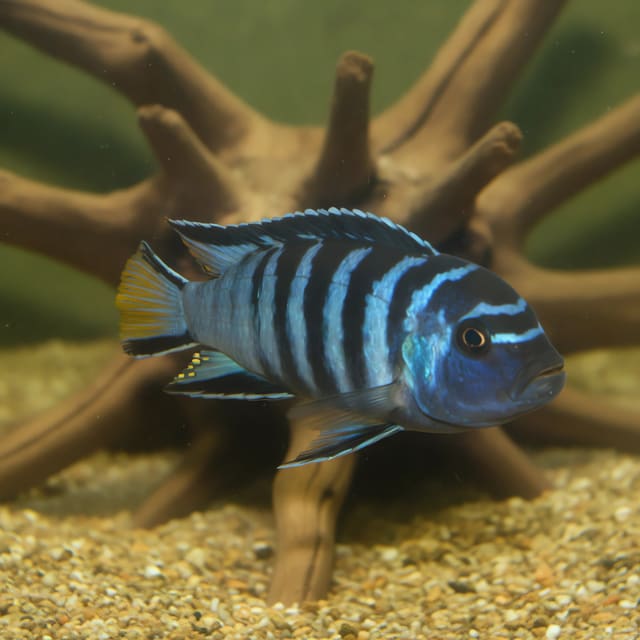
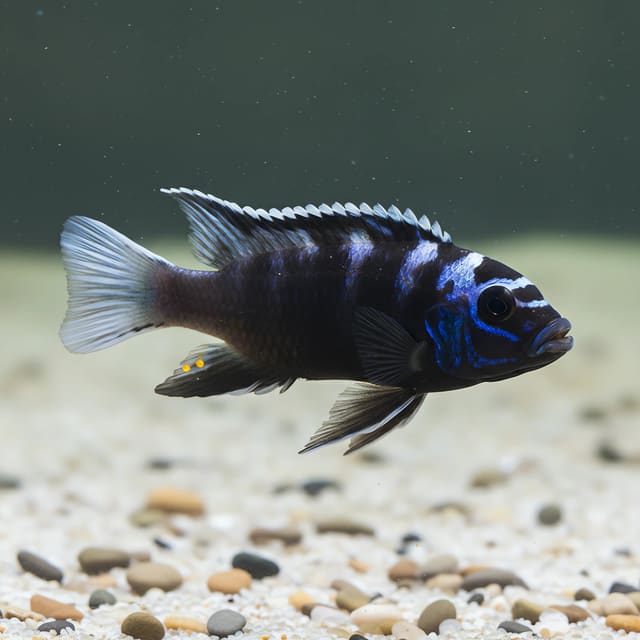
The formal description and locality photographs show a more complex fish than the generic blue-barred "elongatus" copy often repeated online. Territorial males may develop a brown to yellow-brown body with darker vertical markings, while non-territorial males, females and juveniles can be browner and less vivid. Colour depends on maturity, sex, mood, hierarchy, lighting and locality.
Small fish should not be rejected because they do not resemble a dominant adult male image. Juveniles can remain neutral while they settle and mature. A subordinate male may suppress colour in the presence of a dominant fish. Females are naturally more restrained. None of these states means the fish is defective.
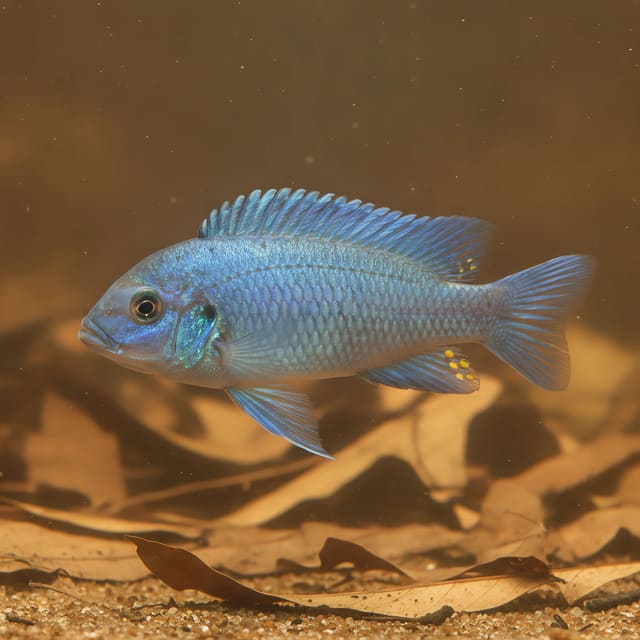
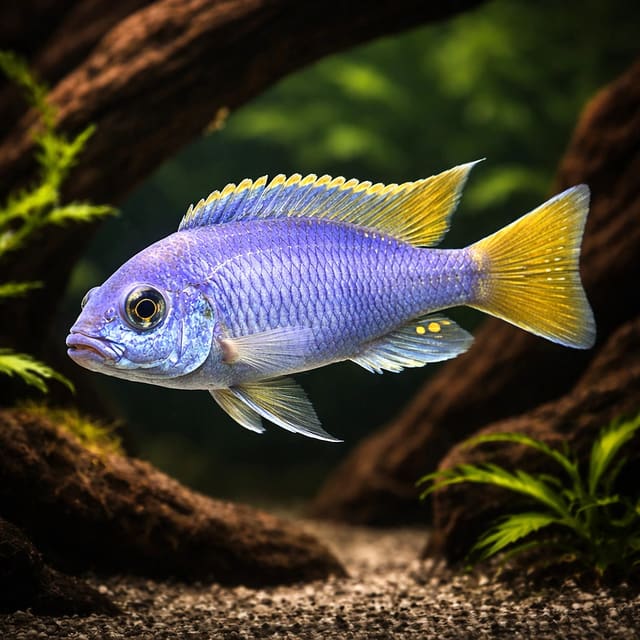
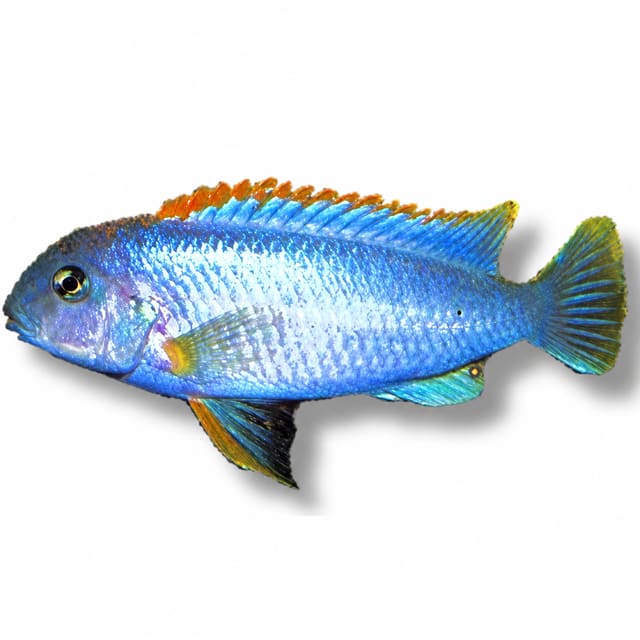
The existing gallery visual is illustrative rather than a photograph of the exact fish dispatched. It helps show the intended locality form and a rocky aquarium context, but it cannot guarantee sex, colour, stripe count, fin shape, size or social state.
| Factor | Likely effect on appearance | How to respond |
|---|---|---|
| Juvenile age | Muted colour and incomplete pattern | Plan for adult care and allow time |
| Transport | Temporary paling or darkening | Dim lights and acclimatise calmly |
| Subordinate status | Suppressed male display | Improve space and sight breaks; do not provoke fighting for colour |
| Breeding territory | Stronger male colour and increased defence | Monitor weaker fish and maintain escape routes |
| Different locality/source line | Natural pattern variation | Keep records and avoid unsupported visual guarantees |
Plan around an adult fish of roughly 13-14 cm rather than the smallest dispatch option. The aquarium needs room for territories, retreat paths and social movement, not merely enough water to contain the body length. A long footprint is more valuable than a narrow tall tank because territories form across the substrate and rockwork.
Around 300 litres and a 120 cm footprint is a sensible long-term starting point for a managed group or mixed mbuna community. More space is preferable when keeping several males, combining robust species or introducing a larger established fish. A smaller aquarium can turn normal displays into relentless pursuit because the chased fish cannot leave the dominant animal's visual field.
Do not use the juvenile sale size to justify a temporary undersized setup without a firm upgrade date. Mbuna mature socially as well as physically. Aggression can increase before the keeper thinks the fish has "outgrown" the glass. The permanent system should be cycled and structurally ready before the fish arrives.
Compare length and front-to-back depth as well as nominal volume. Two aquariums can hold similar litres while offering very different territory space. A long, deep footprint with several separate rock zones is the stronger choice.
Build the heaviest rockwork on a stable base before adding deep sand. Mbuna dig and can undermine stones resting loosely on substrate. Use aquarium-safe rock, stable contact points and structures that cannot shift when a fish excavates beneath an edge. Adhesive or supports may be appropriate for complex structures, but every material must be aquarium safe.
Create several caves and overhangs with more than one entrance. A single attractive central cave becomes one defendable resource; multiple separated shelters give subordinate fish choices. Angle rocks so a fish crossing the aquarium can leave another fish's line of sight. Keep enough open sand for movement and cleaning.
Plants are optional. Tough epiphytes attached to rock may survive, but this is not a plant-led community species. Digging, hard water and grazing can damage delicate stems. If plants are important to the design, choose species that tolerate alkaline water and protect their roots without reducing the territory space the fish needs.
Moderate daylight is sufficient. Lighting should let you inspect skin, fins and behaviour without producing excessive heat or a harsh all-day glare. Algae growth on selected rock surfaces is not automatically a problem, but it does not replace balanced food or maintenance.
| Layout element | Purpose | Common mistake |
|---|---|---|
| Secure base rocks | Prevent collapse during digging | Balancing heavy stone on loose sand |
| Several rock zones | Distribute territories | One central pile controlled by one fish |
| Broken sight lines | Let chased fish disengage | Open glass-to-glass view across the tank |
| Open sand lanes | Movement, observation and cleaning | Packing every centimetre with unstable caves |
| Accessible equipment | Reliable maintenance | Trapping detritus where it cannot be siphoned |
Use hard, alkaline water with a practical pH target around 7.5-8.5 and a stable temperature between 23 and 28°C. For routine home care, a steady mid-range temperature is generally easier than running close to the maximum. Warm water holds less oxygen, so temperature, circulation and stocking density must be considered together.
A practical hardness plan is roughly 10-25 dGH where the source water and mineral strategy support it, but hardness should be measured rather than guessed. Do not add buffers simply because the label says "Malawi". Test tap water first, then use an appropriate remineralising method only if needed. Large pH jumps caused by irregular dosing are dangerous.
Ammonia and nitrite should remain at zero in a mature system. Keep nitrate controlled through sensible stocking, feeding and water changes. There is no universal nitrate number that excuses poor behaviour or appetite; monitor the trend in your own aquarium and intervene before waste accumulates.
Use the water matcher as a starting comparison, then confirm readings with your own reliable test kit. A digital thermometer and regular pH/hardness checks are more useful than copying a generic tropical-fish chart that was written for soft-water tetras.
| Parameter | Planning range | Priority |
|---|---|---|
| Temperature | 23-28°C | Stable, with strong oxygenation |
| pH | 7.5-8.5 | Hard and alkaline without sudden correction |
| General hardness | About 10-25 dGH as an aquarium planning range | Measure source water and adjust consistently only when required |
| Ammonia | 0 | Stop feeding and investigate immediately if detected |
| Nitrite | 0 | Any reading indicates a filtration problem |
| Nitrate | Controlled and stable | Track trend; use water changes and stocking discipline |
Mbuna aquariums carry a substantial biological load. Use mature biological filtration sized for the real stock, not only the empty tank volume printed on a box. Good surface movement and circulation help oxygen reach fish and nitrifying bacteria. Position outlets so there are no stagnant detritus pockets behind the rockwork, while leaving calmer refuge areas.
Cycle the aquarium fully before purchase. Adding bottled bacteria does not by itself prove the system can process the intended waste load. Test ammonia and nitrite after establishing the cycle, add fish gradually where the social plan permits, and continue testing after meaningful stocking changes.
Carry out regular partial water changes using temperature-matched, dechlorinated water. Clean mechanical media as needed without sterilising all biological media at once. Siphon accessible debris from open sand and inspect hidden rock edges. A cloudy or smelly tank is a system warning, not a cue to add a so-called cleaner fish.
Heaters should be protected from rock impact and placed in moving water. Large aquariums may benefit from two appropriately controlled heaters rather than one extreme hot spot. Always verify with an independent thermometer. Unplug heaters before exposing them during a water change.
Field-oriented specialist information is more precise: the fish combs loose material and aufwuchs from rocks and also takes plankton. Aufwuchs includes plant matter, microbes and small animal material. A high-quality mbuna food with useful plant content is a sensible staple, but an algae-only menu does not reproduce that feeding ecology.
Use a digestible Malawi/mbuna pellet or flake as the base. Products containing spirulina and varied aquatic ingredients can form part of the rotation. Small portions of suitable frozen foods such as cyclops or brine shrimp may be used if the complete diet and the fish's condition support them. Rich mammalian meat, oversized meals and frequent heavy feeds are poor choices.
Feed little enough that the group finishes promptly. Scatter food across more than one point so a dominant fish cannot monopolise every mouthful. Observe body shape and waste. A swollen abdomen, stringy faeces, loss of appetite or isolation needs investigation; it should not automatically be labelled "Malawi bloat" or treated without checking water quality, social stress and the full clinical picture.
Do not use peas, fasting or medication as automatic internet remedies. A qualified aquatic vet or experienced fish-health professional is the right route when signs are severe, persistent or spreading. Correct husbandry reduces risk but does not diagnose disease.
| Food role | Examples | Use |
|---|---|---|
| Staple | Quality mbuna/Malawi pellet or flake with meaningful plant and aquatic ingredients | Small measured feeds, one or two times daily according to stock and body condition |
| Variety | Spirulina-containing food, cyclops or modest brine shrimp where appropriate | Rotate rather than creating one rich daily treat |
| Natural behaviour | Safe mature rock surfaces with some biofilm/aufwuchs | Enrichment, not a replacement for complete prepared food |
| Avoid as routine | Beefheart, mammalian meat, very rich oversized foods and uncontrolled leftovers | These add digestive and water-quality risk without a husbandry benefit |
This is a territorial mbuna, not a peaceful community fish and not a true schooling species. Males defend space, especially when mature or breeding. Females and subordinate fish need routes around territories. Specialist observations describe M. usisyae as relatively peaceful toward other species compared with more combative mbuna, but that does not mean harmless.
Do not rely on the old advice to keep a "breeding pair". Pairing one male with one female can concentrate all courtship and aggression on a single fish. Where sex is reliably known and the aquarium is suitable, one male with several females is the more conventional structure. With unsexed juveniles, the eventual ratio cannot be known in advance, so the keeper needs space, monitoring and a humane rehoming plan.
Overstocking is sometimes promoted as a universal aggression cure. It is not. Higher density can interrupt territories, but it also raises waste, oxygen demand and disease transmission while making an individual victim harder to spot. Stocking must be matched to the aquarium footprint, filtration, species mix and keeper's ability to intervene.
Rearranging rock can temporarily reset territories, but repeated full rescapes also stress the whole group. Use it as a considered intervention, not a weekly routine. If one fish is being injured, separate it safely and reassess the stock rather than waiting for hierarchy to "sort itself out".
Continuous hiding, rapid breathing, refusal to feed, repeated surface or corner confinement, torn fins and jaw damage are not acceptable background behaviour. Add effective separation, change the social plan or remove the aggressor/victim before secondary infection develops.
Potential companions are robust Lake Malawi fish that share hard alkaline water and are not so similar that they trigger constant rivalry. Even then, compatibility is an assessment, not a guarantee. Individual temperament, sex, size, tank footprint, introduction order and rock layout can overturn a simple species list.
Small tetras, guppies, shrimp, delicate long-finned fish and soft-water community species are unsuitable. Calmer peacocks may be intimidated in a rock-heavy mbuna setup, especially if space is limited. Synodontis catfish are sometimes kept in Malawi systems, but species size, diet, night-time behaviour and cave access must be checked first.
Avoid mixing closely related or similar-looking locality forms if you intend to breed or distribute fry. Female mbuna can be difficult to distinguish, and hybrid fry may be sold under incorrect names. Keep source records, separate breeding projects and never present uncertain offspring as pure Metriaclima usisyae.
For a broad overview before building the stock list, read the Lake Malawi cichlid guide and browse the live African cichlid collection. Those links are for planning and comparison; they do not mean every fish shown is a safe tank mate.
| Candidate | Assessment | Reason |
|---|---|---|
| Robust, differently patterned mbuna | Possible with planning | Water needs can align, but territory, adult size and sex ratio still matter |
| Similar Metriaclima/locality forms | Use caution | Rivalry and hybridisation risk can be high |
| Lake Malawi peacocks | Often avoid in cramped systems | Many are calmer and may lose access to food or shelter |
| Appropriate Synodontis species | Sometimes possible | Check adult size, cave needs and feeding rather than using them as cleaners |
| Tetras, guppies, shrimp, nano fish | Avoid | Mismatch in water, size, temperament or predation risk |
The name "elongatus" appears across unrelated or incompletely resolved trade forms, so a similar word in two titles does not make the fish the same species. The Yellow Elongatus Cichlid is sold as a Chindongo cf. elongatus trade form. It can be compared for mbuna layout and buying decisions, but it should not be used to overwrite the identity of M. usisyae.
The Jalo Reef Dogtooth Cichlid is another locality-linked Lake Malawi mbuna, placed in Cynotilapia. It offers a useful contrast in colour and genus while sharing the need for hard alkaline water, secure rockwork and managed aggression. The link is an alternative to research, not an automatic companion recommendation.
| Listing | Identity anchor | Useful comparison | Do not assume |
|---|---|---|---|
| Usisya Mara Rock Mbuna | Metriaclima usisyae | Intermediate habitat, locality history, aufwuchs/plankton feeding | That old elongatus names make it Chindongo elongatus |
| Yellow Elongatus | Chindongo cf. elongatus trade form | Different elongatus-style mbuna choice | Identical taxonomy, locality or adult colour |
| Jalo Reef Dogtooth | Cynotilapia afra locality form | Another rock-dwelling Malawi comparison | Automatic compatibility merely because both are mbuna |
Metriaclima usisyae is a maternal mouthbrooder. A mature male may intensify colour and defend a spawning site. The female collects eggs and carries developing young in her mouth. She may eat less, hold her throat differently and seek quieter cover while brooding.
Breeding should not be described as "easy" in a way that ignores welfare. A female can be exhausted by persistent male attention, and young can be eaten in a mixed display. If breeding is intentional, provide appropriate space, several females only when sex is known, refuge, excellent water quality and a plan for fry. Do not repeatedly net or strip a holding female without the skill and a genuine welfare reason.
Keep the locality/source identity with any fry. Do not mix similar forms and then sell offspring under a pure locality name. If parentage is uncertain, describe it honestly as uncertain or hybrid and do not use it to replenish a species-labelled retail line.
Breeding is never guaranteed by purchasing two fish, several juveniles or a larger size. Fertility, sex, maturity, hierarchy and compatibility are all individual. The corrected buy box therefore offers normal single-fish quantities rather than claiming that two unsexed fish form a breeding pair.
A healthy settled mbuna is alert, balanced in the water, responsive to food and able to move without continuous harassment. Check both sides of the body, eyes, mouth, gill movement, fin edges and waste. A fish can temporarily hide or pale after transport, but worsening respiration, loss of balance, severe swelling, ulcers or persistent refusal to feed needs prompt action.
Quarantine new fish when you have a mature, appropriately sized quarantine system. The quarantine tank must itself have stable heat, biological filtration and cover. A bare, uncycled small box can cause more harm than a carefully managed introduction. Use separate nets and siphons, observe feeding and waste, and avoid preventive medication without a reason.
Many apparent disease problems begin with aggression, poor water quality or an abrupt chemistry change. Test first. Separate a badly bullied fish. Photograph signs in good light and record water results, recent additions and foods. That evidence gives a vet or specialist far more to work with than a generic label.
Never add salt, antibiotics, dewormers or broad "bloat" treatments automatically. Medicines can damage filtration, mask the cause or be unsuitable for the actual condition. In the UK, consult an aquatic vet for serious or persistent signs.
| Observation | Immediate check | Escalation |
|---|---|---|
| Rapid breathing | Temperature, oxygen, ammonia, nitrite and gill condition | Increase safe aeration and seek help if it persists |
| One fish always hidden | Aggression, blocked exits and food access | Separate or redesign before injury occurs |
| Swelling or stringy waste | Diet, water quality, recent stress and other affected fish | Do not guess; obtain qualified diagnosis |
| Torn fins or jaw marks | Territorial conflict and sex ratio | Use a divider/separate tank and revise the stock |
| Female not eating with enlarged throat | Possible mouthbrooding, breathing and body condition | Reduce disturbance; intervene only for welfare |
Read the current delivery information before checkout and make sure an adult can receive the parcel. Prepare the aquarium, test the water and have a dim, quiet area ready. Do not schedule major maintenance or a full rescape for the same day unless the social introduction plan requires it.
On arrival, inspect the sealed bag and fish before opening. Follow the acclimation instructions supplied with the order because the safest method depends on transport duration and bag chemistry. Long uncontrolled drip acclimation can be harmful after shipping if ammonia becomes more toxic as the bag opens and pH rises.
Keep aquarium lights low, avoid feeding heavily at once and watch respiration and balance. Give the new fish refuge without allowing an established dominant male to trap it. An acclimation box or divider can be useful in some setups, but it must provide adequate circulation and cannot permanently solve an incompatible stock plan.
Every live-fish order is subject to the current Live Arrival Guarantee terms. Follow the evidence and contact-time instructions on that page rather than relying on an old promise embedded in a product description.
This fish suits an aquarist prepared for a mature Lake Malawi system, hard alkaline water, substantial filtration and active social management. It rewards observation: grazing, territory displays, colour changes and mouthbrooding can all be fascinating when the fish has enough space and the keeper intervenes before conflict becomes injury.
It is not suitable for a new uncycled aquarium, a soft-water planted community, a nano tank, a peaceful tetra group or a buyer seeking an automatically sexed pair. It is also a poor impulse purchase for a keeper who cannot separate or rehome incompatible individuals.
| You are ready when... | Wait before ordering when... |
|---|---|
| The permanent aquarium is cycled, about 300 litres or larger and has a long footprint | The plan depends on a temporary small tank or an upgrade without a date |
| Your water is hard and alkaline or you have a tested, repeatable mineral strategy | You have not tested tap or aquarium water |
| Rockwork is secure with several territories and retreat paths | One cave or open glass leaves no escape from a dominant fish |
| Existing fish are compatible in adult size, water and temperament | The tank contains small peaceful fish, shrimp or delicate peacocks |
| You can quarantine, separate or rehome if the social balance fails | You need every unsexed juvenile to remain together permanently |
Prices, availability and size options on the live product controls are the current source of truth. This description deliberately avoids a fixed "from" price because the cheapest size can change. No variant price, SKU or inventory quantity has been altered as part of this scientific and content correction.
Eligible new customers can use WELCOME10 for 10% off a first order while the promotion remains active. Check the current offers page for terms. Delivery dates, postcode coverage, weather decisions and guarantee requirements remain on the dedicated service pages so they stay accurate.
Choose the size for compatibility, not just price. A small juvenile can be vulnerable among established adults, while a larger fish may immediately challenge an existing hierarchy. Contact the team before ordering if the current stock mix leaves that decision unclear.
This listing uses Metriaclima usisyae, formally described in 2016. Maylandia usisyae is an alternative genus combination used by some sources. Older trade records include Pseudotropheus elongatus "Usisya/Mara Rock" and Metriaclima sp. "elongatus usisya".
No. The historic Usisya/Mara Rock trade name was sometimes grouped with elongatus forms, but the formal description places this species in Metriaclima. The old Chindongo elongatus wording has been removed as the care identity.
Each product quantity is one fish in the selected size variant. Two fish are not guaranteed to be one male and one female.
No, not from these unsexed size variants. Juvenile sex and future breeding cannot be guaranteed. Ask before ordering if a specifically sexed fish is essential.
Plan for roughly 13-14 cm. The size selected on this page is an approximate dispatch size, not the final adult length.
Around 300 litres or larger with a footprint near 120 cm or more is a sensible long-term starting point for a managed group or mixed mbuna setup. More space may be required for several males or a demanding species mix.
Keep the aquarium stable within about 23-28°C and pH 7.5-8.5, with hard, alkaline water and strong oxygenation. Test source water and avoid sudden chemical corrections.
No. Wild observations describe aufwuchs/loose material feeding and plankton use. A digestible mbuna food with plant content is a good staple, supported by sensible variety rather than an algae-only or heavy meat diet.
It is a territorial mbuna. It may be less combative than some similarly named forms, but mature males can still defend space strongly. It is not a peaceful community fish.
No pair is supplied or guaranteed. A single female can receive excessive male attention. Where adults are reliably sexed, one male with several females is a more conventional plan, subject to tank size and individual behaviour.
Sometimes water chemistry overlaps, but many peacocks are calmer and can be bullied by mbuna. Do not treat shared Lake Malawi origin as automatic compatibility.
No. Their size, temperament and/or water requirements make them unsuitable companions for this territorial hard-water cichlid.
No. The retained gallery visual is illustrative. Sex, age, mood, hierarchy, locality variation and transport affect colour, and the image is not the individual fish dispatched.
It can breed as a maternal mouthbrooder in suitable conditions, but spawning, sex ratio, fertility and fry survival are not guaranteed by an order.
Match sizes carefully, provide secure broken sight lines, dim the lights, observe continuously and have a divider or separate mature tank ready. No introduction method can make an incompatible stock plan safe.
Use the live delivery page and Live Arrival Guarantee page. Those pages contain the current timing, evidence and postcode conditions.
Eligible new customers can use WELCOME10 for 10% off a first order while active. Review the current offer terms before checkout.
The identity correction is anchored to Li, Konings and Stauffer's 2016 peer-reviewed description of Metriaclima usisyae in Zootaxa (DOI 10.11646/zootaxa.4168.2.9). That paper supports the accepted name, old trade-name bridge, type locality and diagnostic placement in Metriaclima. A later peer-reviewed geographical study of elongatus-type mbuna provides additional context for why old trade groupings should not replace formal species identities.
Habitat, feeding, aquarium size and social notes were cross-checked against the specialist Malawi.si locality profile for Maylandia/Metriaclima usisyae at Mara Rocks and the Cichlid Room Companion species account. These aquarium observations are used conservatively; they are not converted into guarantees for the supplier's exact retail batch.
Supplier evidence supports the old trade label, available size variants and stock relationship. It does not supply collection coordinates, sex, pedigree, adult colour, DNA verification, exact lifespan or a guaranteed breeding group. Where sources differ or remain incomplete, this page uses cautious long-term planning and says what is not known.

24–28°C · pH 7.5–8.5

23–27°C · pH 7.5–8.6 · 200L

24–28°C · pH 7.5–8.5 · 200L

23–26°C · pH 7.5–8.5 · 200L

24–26°C · pH 7.5–8.5 · 400L

24–26°C

18–26°C · pH 6.5–8 · 30L

23–27°C · pH 7.4–8.4 · 1000L

20–24°C · pH 7–8 · 45L

24–28°C · pH 5.5–7 · 60L

18–25°C · pH 6–8 · 100L

24–28°C · pH 7–8 · 120L

18–28°C · pH 6.5–8 · 20L

22–26°C · pH 6–7.5 · 60L

24–28°C

24–28°C · pH 7.5–8.5 · 500L

22–28°C · pH 7–8.5 · 10L

24–27°C · pH 7.5–9 · 250L

24–28°C · pH 8–9 · 300L

20–25°C · pH 6–7.5 · 80L

24–28°C · pH 5.5–7 · 60L

26–30°C · pH 5.5–7 · 60L