Moderate
Acei Cichlid (Pseudotropheus sp. “acei”)
24–26°C · pH 7.5–8.5 · 300L
£7.99

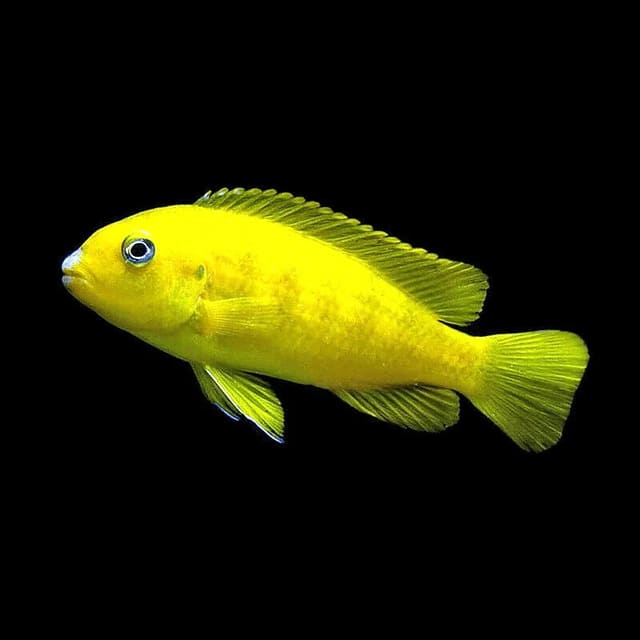
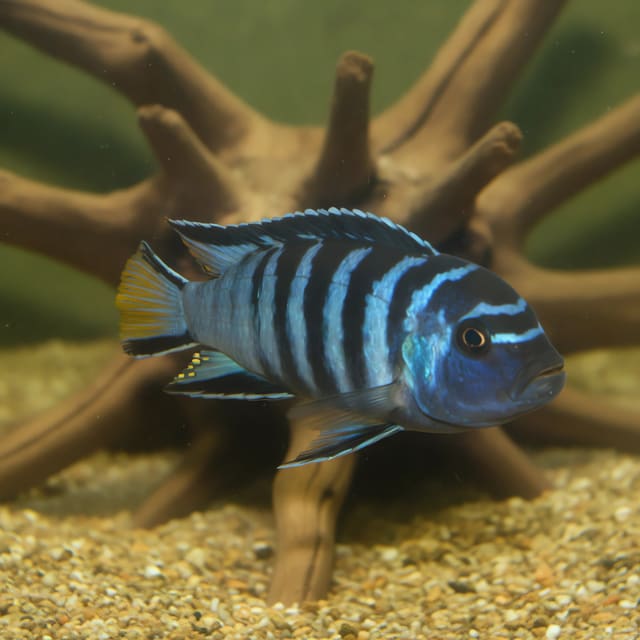
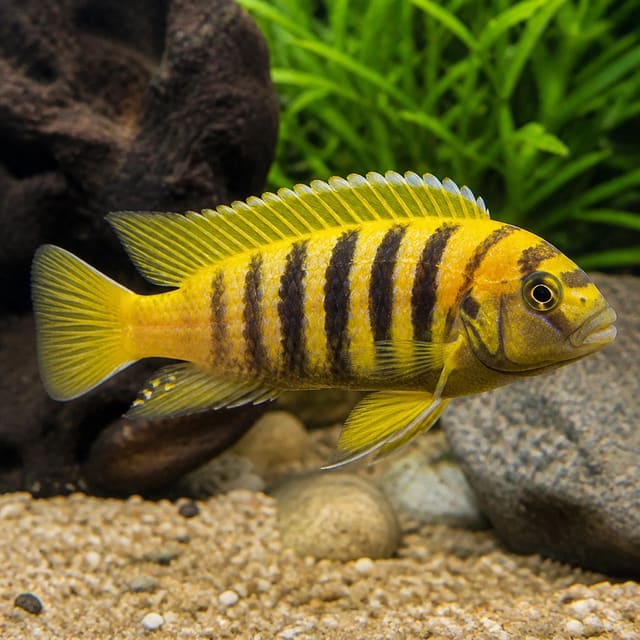
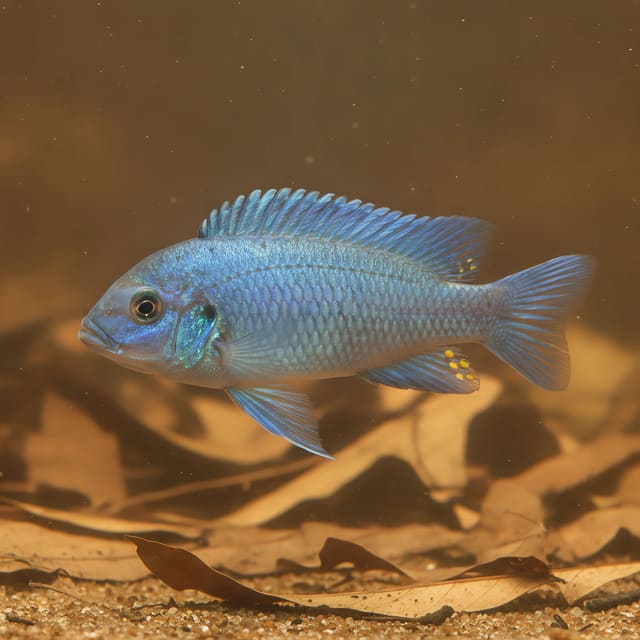
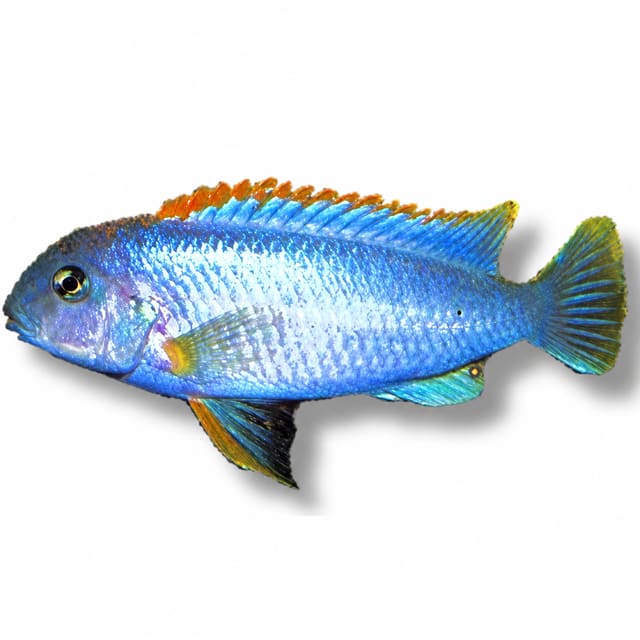
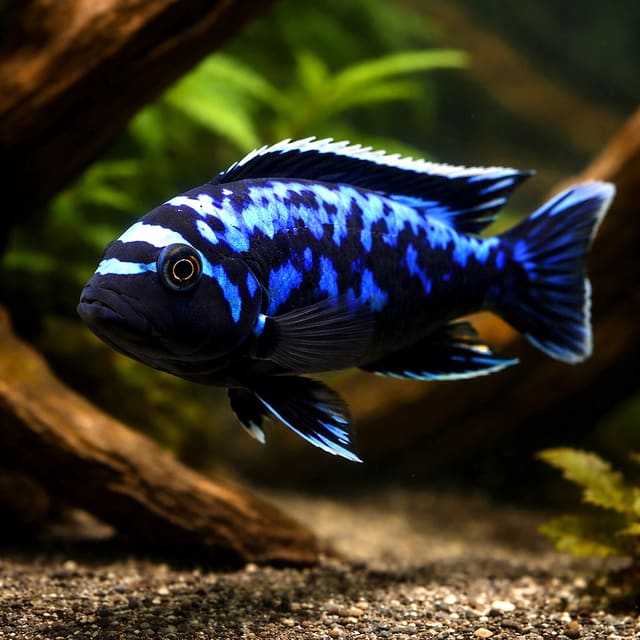
The Blue Gold Mbuna Cichlid (Pseudotropheus sp. 'kingsizei') is a rock-dwelling cichlid from Lake Malawi in Eastern Africa. It suits an intermediate keeper planning a managed Malawi community; OATA's group guidance uses communities of at least 15 Malawi cichlids at 23–27°C and pH 8.0–8.6. Sold individually in sizes from 2 - 3 cm to XL.
Pseudotropheus sp. 'kingsizei'
Save when buying multiple fish. Each quantity is one fish; sex and pair formation are not guaranteed unless the selected variant explicitly states them.
The Blue Gold Mbuna Cichlid (Pseudotropheus sp. 'kingsizei') is a rock-dwelling cichlid from Lake Malawi in Eastern Africa. It suits an intermediate keeper planning a managed Malawi community; OATA's group guidance uses communities of at least 15 Malawi cichlids at 23–27°C and pH 8.0–8.6. Sold individually in sizes from 2 - 3 cm to XL.

Cichlids are a family of roughly 1,800 accepted species, not one care type. Before buying, identify the exact species and source, then compare adult measurement, usable tank dimensions, social system, territory, tested water, diet and an exit plan. No family-wide minimum tank, water range or tank-mate list is safe.
Maintain these water conditions for optimal health and vibrant colors
Blue Gold Mbuna Cichlid is the aquarium trade name for this blue-barred Pseudotropheus form. WoRMS lists Pseudotropheus as an accepted genus in the cichlid family Cichlidae. The careful scientific label for this animal is Pseudotropheus sp. ‘kingsizei’, with “sp.” showing that it is identified to genus rather than as a formally named species.
The exact species has not been identified, so the care advice here follows the genus Pseudotropheus and its care group.
Wikipedia describes the genus as Lake Malawi mbuna endemic to Eastern Africa. Mbuna are the rock-dwelling side of the Malawi cichlid community, so the aquarium should be designed around rock-associated behaviour rather than as a peaceful planted community.
| Identity point | How to plan |
|---|---|
| Trade name | Blue Gold Mbuna Cichlid |
| Scientific label | Pseudotropheus sp. ‘kingsizei’ |
| Family | Cichlidae |
| Natural context | Rock-dwelling Lake Malawi mbuna |
One purchase quantity supplies one animal of the selected option. Use the live size selector to choose between the labels 2 - 3 cm, 4 - 5 cm, 6 - 7 cm and XL, then choose the quantity required for your aquarium plan. Selector labels describe the animal at dispatch rather than its future dimensions.
The size you select is the size supplied, not the adult size. The centimetre labels are bounded dispatch grades. XL is a named grade without a fixed centimetre range, so it should not be interpreted as a promised measurement, age, life stage or final size.
| Size choice | What the label means |
|---|---|
| 2 - 3 cm | An animal selected within that dispatch-size band |
| 4 - 5 cm | An animal selected within that dispatch-size band |
| 6 - 7 cm | An animal selected within that dispatch-size band |
| XL | A larger named dispatch grade without a fixed length |
Sex is guaranteed only when the selected option explicitly states male or female. This Blue Gold Mbuna Cichlid listing has no sex-guaranteed option.
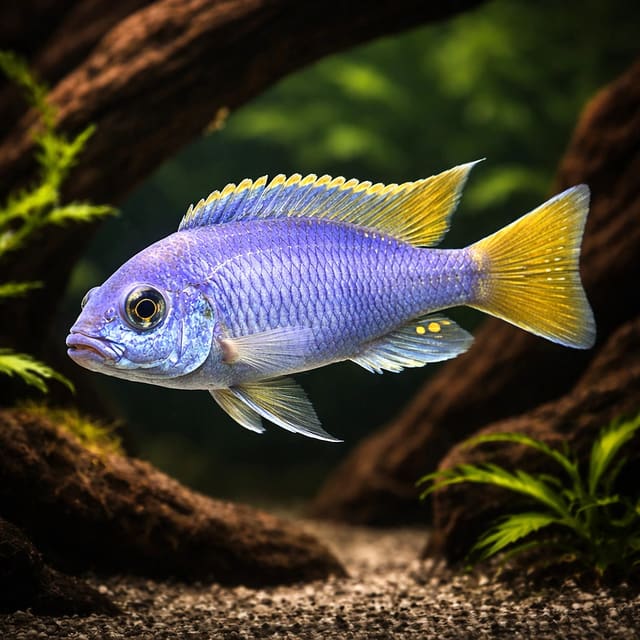
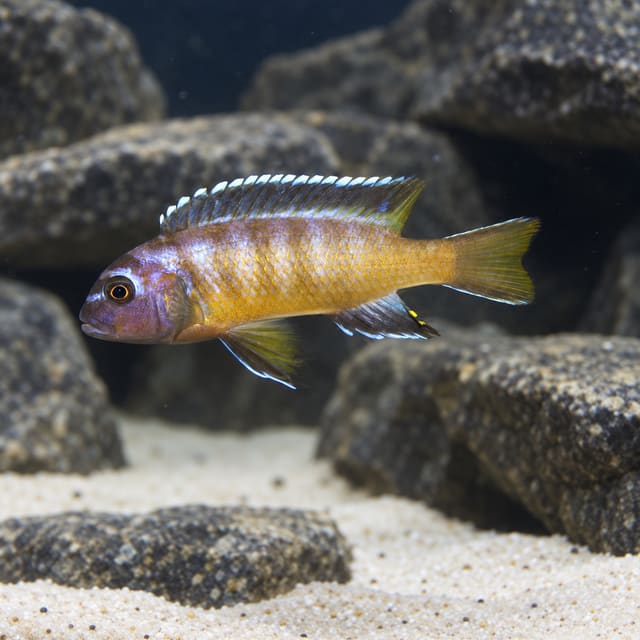
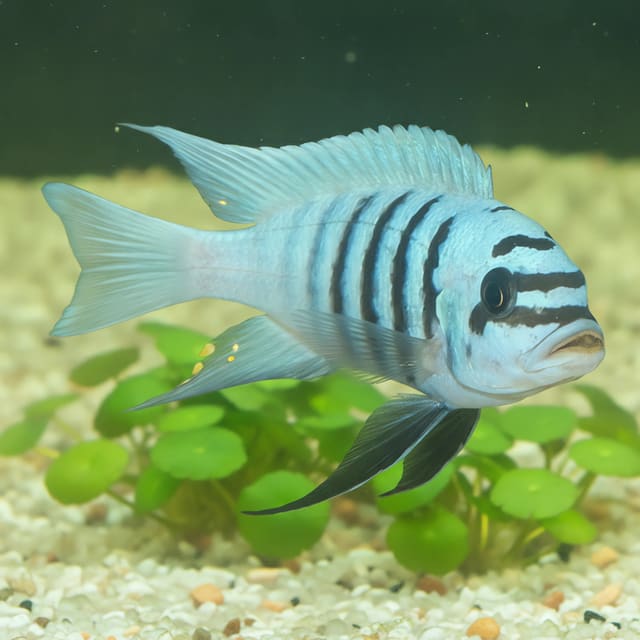
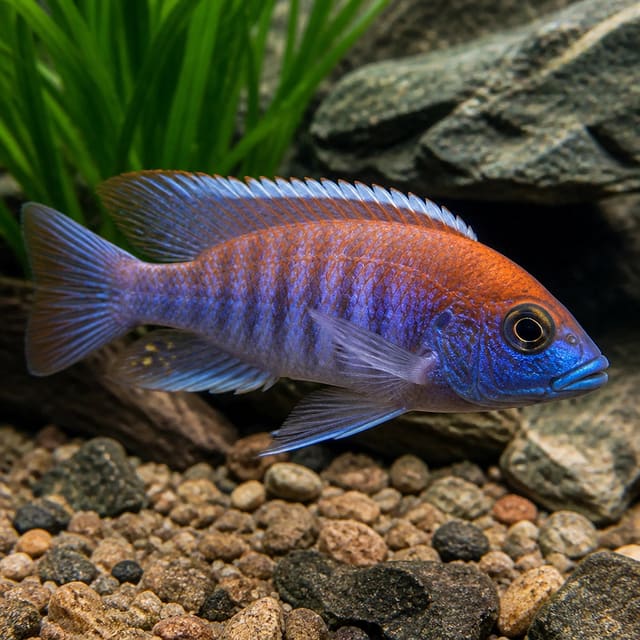
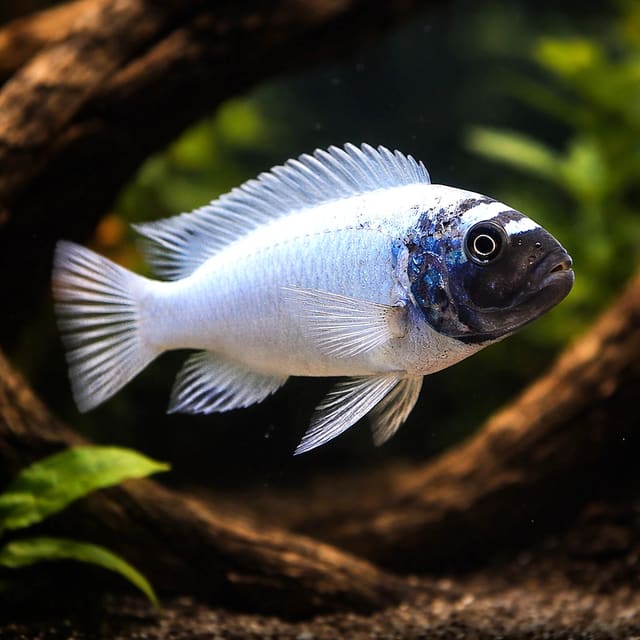
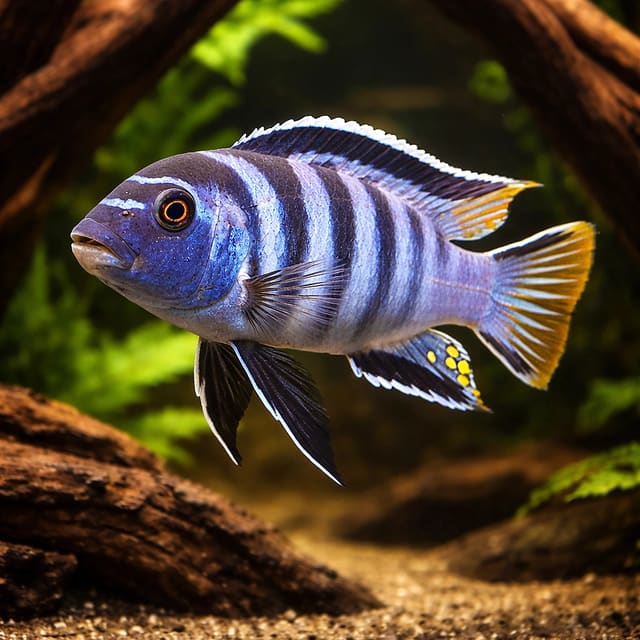
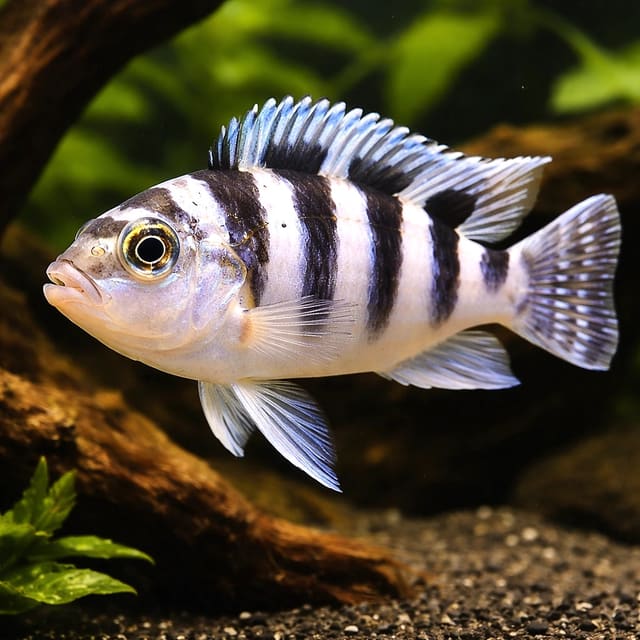
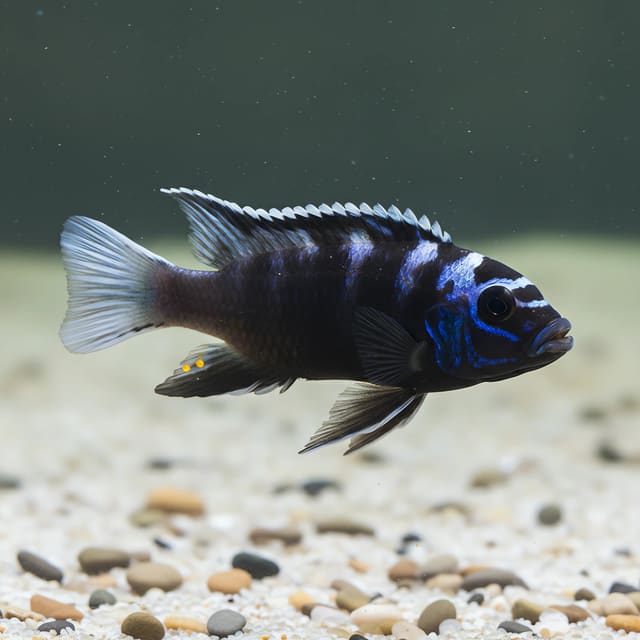
Some gallery images have been digitally enhanced to improve image quality. They show the listed type of animal rather than guaranteeing the exact markings of the individual supplied, so natural colour and pattern can vary.
A gallery scene containing two fish shows two animals in that scene only. Calculate the order using one animal for each purchase quantity.
If the aquarium plan calls for three animals, select the preferred size label and set the purchase quantity to three; that supplies three animals from that selected option. Recheck the live selector if changing size, because the quantity and size decisions work together. Base the number on the completed Malawi community plan, usable aquarium volume and filtration capacity rather than on how many fish appear in a gallery scene.
OATA’s African Malawi cichlid guidance gives 23–27°C, pH 8.0–8.6, general hardness of 12–18°dH and carbonate hardness of 10–15°dKH for the group. Use these as broad planning targets rather than a species-specific optimum.
Ammonia and nitrite must remain at zero mg per litre. Nitrate should not rise more than 20 mg per litre above the normal tap-water level. A filter is essential, and OATA recommends an oversized filter plus strong aeration for the crowded conditions used in managed Malawi communities.
For a reasonable community, start with an aquarium of at least 200 litres. This is a community benchmark rather than permission to add fish without checking usable space, rock displacement, filtration and aggression. OATA says most Malawi cichlids grow to around 10 cm, while some grow up to 25 cm, so treat 10 cm as a broad group norm rather than a promised final length for this trade form.
| Decisive check | Planning value |
|---|---|
| Community aquarium | At least 200 litres |
| Temperature | 23–27°C |
| pH | 8.0–8.6 |
| General hardness | 12–18°dH |
We rate this fish intermediate because specialised alkaline water, territorial behaviour and community management require more planning than a peaceful general aquarium. Compare those requirements across our African cichlid collection before deciding.
| Suits | Not suited to |
|---|---|
| Stable aquarium water maintained at 23–27°C and pH 8.0–8.6 | Water outside 23–27°C and pH 8.0–8.6 |
| Carefully screened Malawi cichlids in a suitably planned community | Fish outside a planned Lake Malawi cichlid community, except an individually assessed Synodontis species |
Prepare and mature the aquarium before the fish arrives. A new biological filter needs time to establish the bacteria that process fish waste, so adding livestock while the aquarium is still cycling risks toxic ammonia and nitrite. Our first tropical aquarium guide explains how to prepare the system before livestock is introduced.
Use substantial rockwork to reflect the mbuna’s rock-dwelling behaviour and create several usable areas rather than one dominant feature. Every structure must remain stable when the fish digs and rearranges substrate. Check that rocks cannot shift, trap an animal or place unsafe pressure against the glass.
Malawi cichlids often dig, so expect the substrate to move. Coral sand or a similar substrate can help buffer the water, but the finished aquarium still needs regular testing. Digging will uproot any plants present; treat planting as secondary to safe rockwork, clear routes and reliable water circulation.
Rock occupies space that would otherwise hold water. Begin with the aquarium’s stated volume, then consider how much is displaced by substrate and stone. A heavily decorated aquarium can therefore have substantially less working water than its label suggests, while still carrying the waste and territorial pressure of the full fish population.
Choose the largest practical aquarium within the household plan. Larger water volume changes temperature and water quality more slowly, while a broader layout gives more scope to distribute decor and territories. The at-least-200-litre figure belongs to a reasonable Malawi community; it is not a shortcut around checking the number, eventual dimensions and behaviour of every resident.
After the first full layout is built, disturb a small area of substrate beside each major rock and check the structure again. This simple test imitates the effect of digging without placing a fish at risk. Then confirm that water can circulate around the rockwork and that a siphon can reach the main debris-collecting areas.
Maintain the aquarium at 23–27°C, pH 8.0–8.6, 12–18°dH general hardness and 10–15°dKH carbonate hardness. These values describe hard, alkaline water. Test the actual aquarium rather than judging chemistry by clarity, because clear water can still contain toxic dissolved waste.
Measure both tap water and aquarium water. The tap-water nitrate result provides the baseline for the instruction that aquarium nitrate should not exceed it by more than 20 mg per litre. Recording the readings each week makes a gradual rise easier to recognise than isolated tests.
Use our water chemistry guide to understand temperature, pH, general hardness, carbonate hardness, ammonia, nitrite and nitrate. The water matcher can then compare measured aquarium values with the care range.
| Test | Required result |
|---|---|
| Temperature | 23–27°C |
| pH | 8.0–8.6 |
| General hardness | 12–18°dH |
| Carbonate hardness | 10–15°dKH |
| Ammonia | Zero mg per litre |
| Nitrite | Zero mg per litre |
| Nitrate | Up to 20 mg per litre above tap water |
If ammonia or nitrite appears, treat the reading as an immediate water-quality problem. Check stocking pace, feeding, filter operation and maintenance rather than adding more fish. If nitrate repeatedly approaches its limit before the next weekly service, review waste removal, feeding quantity and the aquarium’s biological load.
Treat replacement tap water with a conditioner that removes harmful chlorine or chloramine before it enters the aquarium. Keep the maintenance method repeatable: test, record, change water, recheck when necessary and investigate any trend that moves away from the target range.
For example, if tap water measures 10 mg per litre nitrate, keep the aquarium from rising above 30 mg per litre under OATA’s limit. If the tap-water result is 20 mg per litre, the corresponding ceiling is 40 mg per litre. Use the newly measured tap-water value rather than assuming the baseline never changes.
RSPCA aquarium welfare guidance explains why every fish aquarium needs a well-established and maintained filter. Fish release toxic ammonia; bacteria in the biological filter convert it first to toxic nitrite and then to the safer nitrate measured during routine testing.
Malawi communities place heavy demands on filtration because the aggression-management approach can involve a comparatively dense population. Use an oversized filter and strong aeration, as OATA recommends, while keeping enough open circulation for oxygenated water to reach the occupied areas of the aquarium.
| Check | Action |
|---|---|
| Ammonia and nitrite | Test at least weekly and keep both at zero |
| Nitrate | Compare with the tap-water baseline |
| Water change | Make a 25% partial change at least once a week |
| Tap water | Treat chlorine and chloramine before use |
| Filter flow | Check for blockages |
| Solid waste | Siphon it from accessible substrate |
At least once a week, make a 25% partial water change as OATA recommends. Use a siphon to remove solid waste from the substrate instead of replacing water alone. Rock gaps can collect debris, so maintain access to practical cleaning points when arranging the aquarium.
If the filter needs cleaning, do not run it under the tap. Chlorine or chloramine may kill the bacterial population that processes ammonia and nitrite. When cleaning is needed, lightly rinse reusable media in aquarium water removed during the partial water change. This reduces bacterial loss while allowing obstructing debris to be removed.
Check flow and aeration every day. A blocked filter or reduced surface movement changes the system’s oxygen and waste-processing capacity even when the aquarium still appears clear. If flow falls, investigate the blockage and service the affected part without replacing all established biological media at once.
Daily checks should confirm steady filter flow, visible surface movement and normal breathing. The weekly service then combines testing, a 25% partial water change at least once a week, waste removal and a blockage check. Keeping those jobs distinct makes a sudden equipment problem easier to notice instead of waiting for the next planned water change.
Dietary needs vary across Malawi cichlids. OATA distinguishes smaller, more herbivorous mbuna from larger utaka that may require food with more animal content. For this mbuna trade form, use a specialised Malawi cichlid food with a high algae content and include fresh vegetables in the routine.
Feed twice a day and offer only what the fish can consume within a few minutes. The time limit matters because uneaten food breaks down and releases waste into the water. It also provides a repeatable way to adjust portions without relying on guesswork.
| What you observe | What to do next |
|---|---|
| Food remains after a few minutes | Remove it and reduce the next portion |
| Every portion disappears promptly | Keep the measured amount and continue observing condition |
| One fish loses interest | Test water and check behaviour before changing the diet |
| Waste rises between weekly services | Review portion size and remove trapped leftovers |
A rich feeding response is not a reason to keep adding food. Overfeeding increases uneaten material and fish waste, raising the load placed on the biological filter. Keep the food appropriate to the animal’s mouth size, but do not interpret a dispatch-size label as proof of age or life stage.
Keep this mbuna’s feeding plan centred on high-algae Malawi cichlid food and fresh vegetables. The higher-animal-content foods described for larger utaka serve different dietary requirements within the wider Malawi cichlid group.
Appetite is also a useful daily welfare signal. A sudden reduction in feeding, especially when paired with changed breathing, colour, swimming or aggression, should trigger water testing and a close check of the social situation rather than an automatic increase in food.
Begin with a deliberately measured amount at each of the two daily feeds. If food remains after a few minutes, remove the remainder and make the next portion smaller. If one fish misses food while others finish it, observe whether aggression is blocking access before increasing the total amount, because extra leftovers raise waste without necessarily feeding the excluded animal.
Confirm zero ammonia and zero nitrite before introducing fish. Additions increase waste and feeding, so the filter’s bacterial population must expand to process the greater load. Stocking too quickly can create new tank syndrome, where ammonia or nitrite rises because there are too few nitrifying bacteria for the new waste level.
Arrange for someone to receive the parcel because live fish cannot be left unattended. The live delivery and Live Arrival Guarantee page gives the checkout window, tracking process, licensed live-animal courier details and the conditions that apply to a claim.
Start filming before the parcel is opened, with the sealed parcel and outer box visible. Continue in one take while opening it and showing the fish inside the sealed bag. Float the bag for 20–30 minutes before releasing the fish. Do not pour transport water into the aquarium.
OATA recommends adding Malawi cichlids in groups so that one newcomer does not receive all the aggression while settling. It also recommends introducing more peaceful species before more aggressive ones. Apply that sequence only after checking that the aquarium has the capacity for the planned group.
Increase the total population slowly across the wider stocking plan. “Add in groups” and “stock slowly” work together: introduce a planned batch where social behaviour calls for it, then pause further additions while testing ammonia, nitrite and nitrate and watching the existing fish.
Established Malawi cichlids may already control preferred areas. Rearranging aquarium decor before an introduction can reduce that territorial advantage, but keep every rock stable after the change. Observe the new social pattern closely and be prepared to separate a fish if repeated targeting prevents normal swimming or feeding.
Check the fish immediately after release, again after it has had time to move through the rockwork and once more before the end of the day. Look for steady breathing, controlled swimming and access to shelter. If behaviour changes sharply, test the water and check whether an established resident is repeatedly controlling the same route or refuge.
Healthy fish should have clear, bright eyes, undamaged fins, intact scales, no ulcers or bumps and swimming behaviour appropriate to their aquarium. Use those observations alongside test results; appearance alone cannot show whether ammonia or nitrite is present.
| Change you see | First response |
|---|---|
| Hanging at the surface | Check aeration, filter operation and water quality |
| Sitting on the bottom | Test water and compare with the fish’s usual behaviour |
| Erratic swimming | Check water and look for concentrated aggression |
| Darker or paler colour | Review water, hiding and social pressure |
| Faster or slower gill movement | Test ammonia and nitrite and check oxygenation |
| Reduced feeding | Test water and observe whether another fish blocks access |
| White spots or fluffy growths | Record the change and seek health guidance |
Aggression deserves the same disciplined observation. Short interactions can occur among territorial Malawi cichlids, but repeated cornering, damaged fins, persistent hiding or exclusion from food means pressure is concentrated on one animal. Review the rock layout and group composition, and separate the targeted fish when necessary.
Test ammonia, nitrite, nitrate, pH and temperature whenever normal behaviour changes. Ammonia or nitrite above zero requires prompt water-quality action. Also check the filter for blockage and confirm that aeration remains strong.
During the first week, compare appetite, breathing, colour, swimming and aggression at the same daily checks. Continue the 25% partial water change at least once a week and the test schedule through the first month rather than relaxing the routine after the fish begins feeding.
If an animal develops white spots, fluffy growths, ulcers, loss of fins or scales, marked weight change, persistent abnormal breathing or refusal to feed, test the water and contact us for health guidance. Describe the visible change, the test results and when it began so the next decision addresses the actual pattern.
Record the weekly water results beside brief notes on appetite, breathing and aggression. A repeated change is easier to recognise when the observations are dated. If one fish becomes progressively more withdrawn or misses several feeds, act on the pattern by checking water, access to shelter and social pressure rather than waiting for obvious injury.
Malawi cichlids are not social fish in the peaceful shoaling sense. OATA describes them as aggressive and advises mixing them with caution. Its community method uses groups of at least 15 and slight overcrowding to spread aggression, because small Malawi cichlid groups often fight.
Apply that method only in an aquarium with the necessary capacity. A group of at least 15 belongs with the at-least-200-litre community benchmark, oversized filtration, strong aeration, weekly maintenance and enough decor to distribute territories. Slight crowding is an aggression-management technique, not permission to exceed the aquarium’s waste-processing or oxygen capacity.
Where sexes can later be distinguished, OATA recommends keeping more females than males of each species so one female does not receive all of a male’s attention. Build no promised ratio into the purchase plan because the size choices do not select sex.
| Outcome | Decision |
|---|---|
| Brief chases with normal feeding | Continue close observation |
| One fish repeatedly cornered | Rearrange decor or separate the fish |
| Fin damage or missed meals | Intervene rather than waiting for the hierarchy to settle |
| Sudden aggression across the aquarium | Test water, then reassess the social layout |
The correct quantity therefore comes from a complete Malawi community plan, not from choosing an even number or trying to form a pair. Consider final group capacity before using the selector, and leave room in the plan for behaviour to change as the fish develop.
Before choosing the quantity, decide where one persistently targeted fish could be separated safely. Then check whether the remaining aquarium still has adequate filtration, aeration and territory distribution. If the plan works only while every individual behaves predictably, revise the group or aquarium plan before adding animals.
OATA advises keeping Malawi cichlids only with other Malawi cichlids or with some species of Synodontis catfish that also inhabit Lake Malawi. Use that boundary as the first compatibility screen: avoid fish outside a planned Malawi community, apart from a carefully assessed Synodontis species.
Sharing Lake Malawi does not make every combination safe. All Malawi cichlid mixes still require caution because these fish are aggressive, while the aquarium must accommodate the behaviour and total waste load of every resident. Some Synodontis may be considered, but the genus name alone is not an approval for a particular species.
| Candidate | Screening decision |
|---|---|
| Another Malawi cichlid | Conditional: assess aggression, group plan and aquarium capacity |
| A Synodontis species | Conditional: assess the exact species, adult needs and usable space |
| Fish outside those categories | Avoid under OATA’s Malawi compatibility boundary |
A companion must fit the 23–27°C temperature range, pH 8.0–8.6, hard water and the physical space left after rockwork. It must also cope with a territorial Malawi community without being used merely to fill a visual gap. Feeding requirements must remain workable without compromising the high-algae Malawi routine used for this mbuna trade form.
Add more peaceful Malawi species before more aggressive species, and rearrange decor when an established hierarchy would place newcomers at a disadvantage. Introduce Malawi cichlids in a planned group where capacity allows, then monitor feeding access, fin condition, hiding and repeated chases.
No named companion is guaranteed to work in every aquarium because individual behaviour and the existing population affect the outcome. Browse the African cichlid collection linked in the overview for comparison, then send us the aquarium volume, water results, existing fish and proposed additions for a stocking assessment.
Blue Gold Mbuna Cichlid is an aquarium trade form labelled Pseudotropheus sp. ‘kingsizei’. Pseudotropheus is an accepted cichlid genus, while “sp.” means the animal is identified to genus rather than as a named species.
One purchase quantity supplies one animal in the size chosen from the live selector. Quantity two means two animals, while a gallery scene showing two fish does not change the purchase unit.
The selector uses 2 - 3 cm, 4 - 5 cm, 6 - 7 cm and XL dispatch grades. The centimetre bands describe dispatch size; XL has no fixed length, and none of these labels promises the adult size.
OATA’s Malawi guidance recommends an aquarium of at least 200 litres for a reasonable community, with stable rockwork, hard alkaline water, an oversized filter and strong aeration. Account for water displaced by rocks and substrate.
OATA’s Malawi community method uses groups of at least 15 and slight crowding to spread aggression because small groups often fight. Use that method only with sufficient aquarium capacity, filtration, aeration and a separation plan.
OATA’s Malawi guidance gives 23–27°C, pH 8.0–8.6, 12–18°dH general hardness and 10–15°dKH carbonate hardness for the group. Keep ammonia and nitrite at zero mg per litre and nitrate no more than 20 mg per litre above tap water.
OATA’s Malawi guidance recommends a specialised Malawi cichlid food with a high algae content and fresh vegetables for smaller mbuna. Feed only what the fish consume within a few minutes, twice a day, and remove leftovers that would add waste.
Start filming with the parcel still sealed before opening it or floating the bag. Be present to receive it, continue filming as it is opened and the fish is shown inside the sealed bag, then float the bag for 20–30 minutes before release and do not pour transport water into the aquarium.
Consider carefully screened Malawi cichlids or some suitable Synodontis species. Avoid fish outside that boundary, and assess hard-water needs, aggression, adult requirements, usable space and the existing population before combining animals.
| Reference | Coverage |
|---|---|
| World Register of Marine Species | Accepted genus and family identity |
| Wikipedia genus summary | Lake Malawi natural history of Pseudotropheus |
| Ornamental Aquatic Trade Association | African Malawi cichlid husbandry and compatibility |
| RSPCA | General aquarium filtration and biological waste processing |
| Tropical Fish Co delivery policy | Delivery, acclimatisation and Live Arrival Guarantee process |
No reviews for this item yet. Bought one? Honest reviews only, good or bad.
What customers say about ordering from us
I have a small group of long finned mountain minnows. So was delighted to be able to order ten of this variety to increase the genetics in my tank . The ones I recieved are healthy but it’s to early to give a verdict on wether they are of a long finned type since they are small currently.
Gordon Walker · 23 Sept 2026
100% success travel and "installation". Pleased with quality of purchase. The Siamese fighter a bit "shy" so have not yet seen him at his best yet but looking good. Happy customer. GG
George E Garratt · 21 Sept 2026
Reviews of our shop, collected by Judge.me, an independent third-party review collector. Newest first.